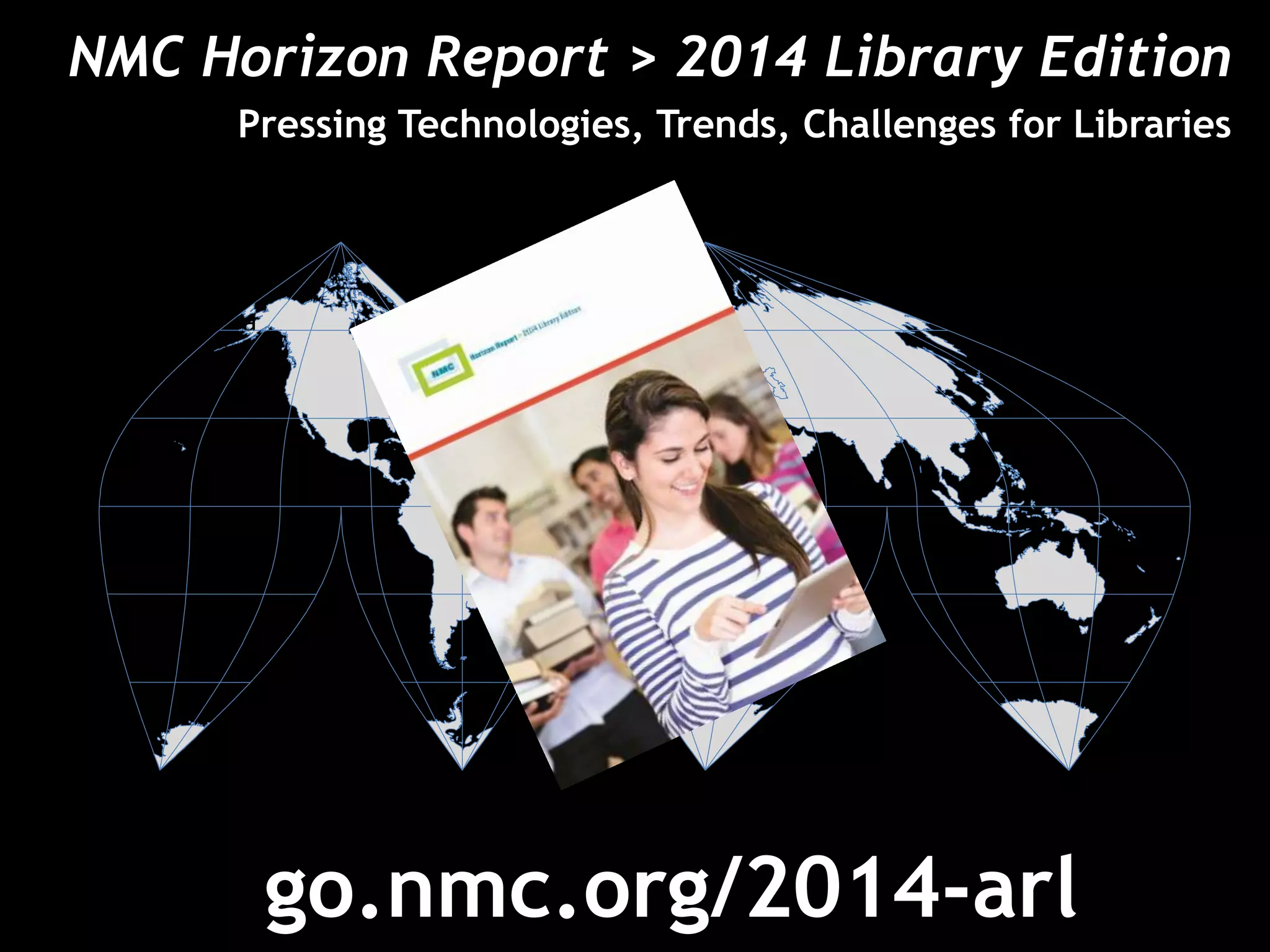
NMC Horizon Report > 2014 Library Edition 
Pressing Technologies, Trends, Challenges for Libraries 
å 
go.nmc.org/2014-arl
@NMCorg 
#NMCHz
. 
Where I’m coming from.
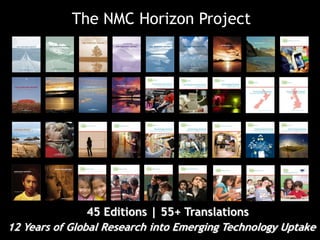
The NMC Horizon Project 
45 Editions | 55+ Translations 
12 Years of Global Research into Emerging Technology Uptake
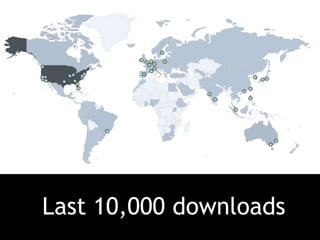
Last 10,000 downloads
Acknowledgements 
The research behind the NMC Horizon Report: 2014 Library Edition is jointly 
conducted by the New Media Consortium (NMC) and University of Applied 
Sciences (HTW) Chur, Technische Informationsbibliothek (TIB) Hannover, and 
ETH-Bibliothek Zurich. Our partners’ critical participation in the production 
of this report and their strong support for the NMC Horizon Project is 
gratefully acknowledged. 
The NMC Horizon Report: 2014 Library Edition is a publication of the New 
Media Consortium
library.wiki.nmc.org
. 
Where I’m coming from.
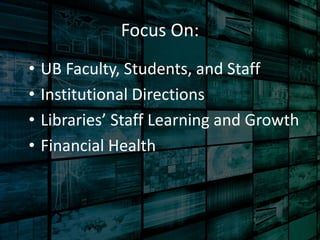
Focus On: 
• UB Faculty, Students, and Staff 
• Institutional Directions 
• Libraries’ Staff Learning and Growth 
• Financial Health
Discussion Questions
Dreaming and Doing!
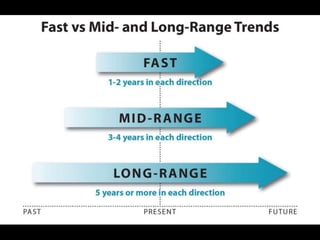
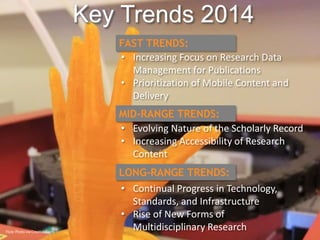
Key Trends 2014 
FAST TRENDS: 
• Increasing Focus on Research Data 
Management for Publications 
• Prioritization of Mobile Content and 
Delivery 
MID-RANGE TRENDS: 
• Evolving Nature of the Scholarly Record 
• Increasing Accessibility of Research 
Content 
LONG-RANGE TRENDS: 
• Continual Progress in Technology, 
Standards, and Infrastructure 
• Rise of New Forms of 
Multidisciplinary Research Flickr Photo via Creative Tools
Increasing Focus on 
Research Data 
Management
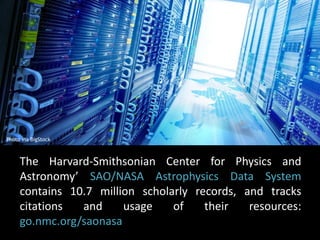
Photo via BigStock 
The Harvard-Smithsonian Center for Physics and 
Astronomy’ SAO/NASA Astrophysics Data System 
contains 10.7 million scholarly records, and tracks 
citations and usage of their resources: 
go.nmc.org/saonasa
Prioritization of Mobile 
Content and Delivery
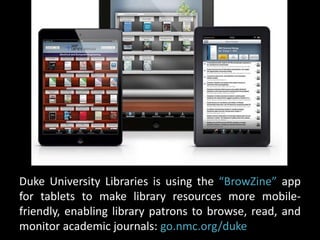
Duke University Libraries is using the “BrowZine” app 
for tablets to make library resources more mobile-friendly, 
enabling library patrons to browse, read, and 
monitor academic journals: go.nmc.org/duke
Evolving Nature of the 
Scholarly Record
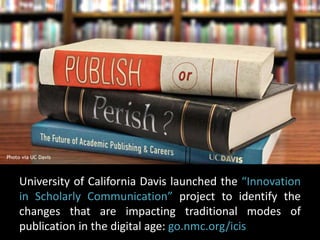
Photo via UC Davis 
University of California Davis launched the “Innovation 
in Scholarly Communication” project to identify the 
changes that are impacting traditional modes of 
publication in the digital age: go.nmc.org/icis
Increasing Accessibility 
of Research Content
Initiated by the Association of Research Libraries, 
SPARC is an international alliance of 800+ institutions 
that helps its global members establish sustainable 
systems of open scholarship: go.nmc.org/sparc
Rise of New Forms of 
Multi-Disciplinary 
Research
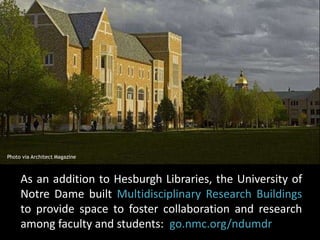
Photo via Architect Magazine 
As an addition to Hesburgh Libraries, the University of 
Notre Dame built Multidisciplinary Research Buildings 
to provide space to foster collaboration and research 
among faculty and students: go.nmc.org/ndumdr
Dreaming and Doing!
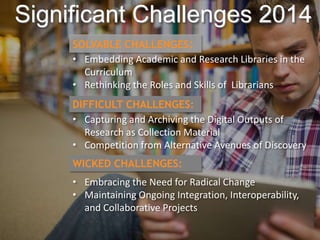
Significant Challenges 2014 
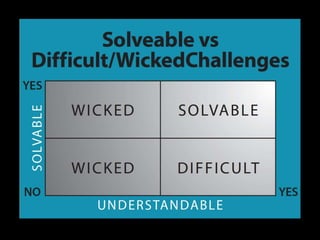
SOLVABLE CHALLENGES: 
• Embedding Academic and Research Libraries in the 
Curriculum 
• Rethinking the Roles and Skills of Librarians 
DIFFICULT CHALLENGES: 
• Capturing and Archiving the Digital Outputs of 
Research as Collection Material 
• Competition from Alternative Avenues of Discovery 
WICKED CHALLENGES: 
• Embracing the Need for Radical Change 
• Maintaining Ongoing Integration, Interoperability, 
and Collaborative Projects
Embedding Academic 
and Research Libraries 
in the Curriculum
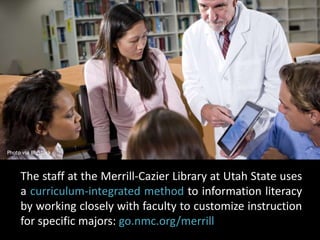
Photo via BigStock 
The staff at the Merrill-Cazier Library at Utah State uses 
a curriculum-integrated method to information literacy 
by working closely with faculty to customize instruction 
for specific majors: go.nmc.org/merrill
Rethinking the Roles 
and Skills of Librarians
Photo via BigStock 
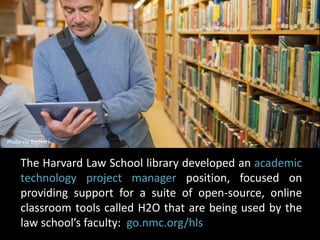
The Harvard Law School library developed an academic 
technology project manager position, focused on 
providing support for a suite of open-source, online 
classroom tools called H2O that are being used by the 
law school’s faculty: go.nmc.org/hls
Capturing and 
Archiving the Digital 
Outputs of Research as 
Collection Material
Photo via British Library 
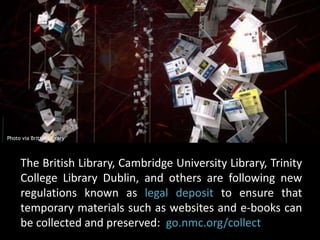
The British Library, Cambridge University Library, Trinity 
College Library Dublin, and others are following new 
regulations known as legal deposit to ensure that 
temporary materials such as websites and e-books can 
be collected and preserved: go.nmc.org/collect
Competition from 
Alternative Avenues of 
Discovery
Photo via BigStock 
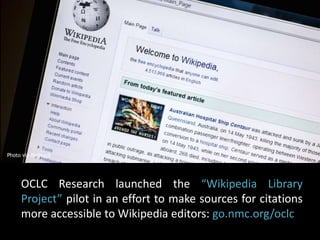
OCLC Research launched the “Wikipedia Library 
Project” pilot in an effort to make sources for citations 
more accessible to Wikipedia editors: go.nmc.org/oclc
Embracing the Need 
for Radical Change
Photo via University of British Colombia 
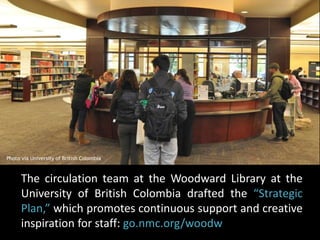
The circulation team at the Woodward Library at the 
University of British Colombia drafted the “Strategic 
Plan,” which promotes continuous support and creative 
inspiration for staff: go.nmc.org/woodw
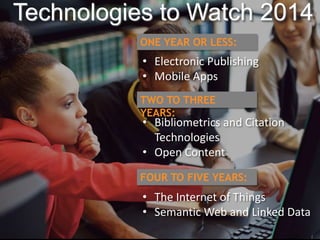
Technologies to Watch 2014 
ONE YEAR OR LESS: 
• Electronic Publishing 
• Mobile Apps 
TWO TO THREE 
YEARS: 
• Bibliometrics and Citation 
Technologies 
• Open Content 
FOUR TO FIVE YEARS: 
• The Internet of Things 
• Semantic Web and Linked Data
Electronic Publishing
Photo via BigStock 
Vectors is a USC scholarly journal that focuses on how 
technology transforms, and/or impedes social relations. 
It uses a peer-reviewed format and publishes only 
multimedia works: go.nmc.org/vect
Mobile Apps
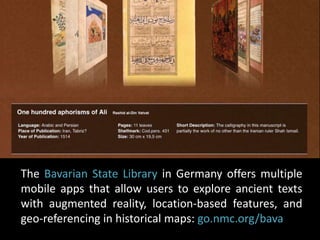
The Bavarian State Library in Germany offers multiple 
mobile apps that allow users to explore ancient texts 
with augmented reality, location-based features, and 
geo-referencing in historical maps: go.nmc.org/bava
Bibliometric and 
Citation Technologies
Photo via BigStock 
ORCiD provides a persistent digital identifier that 
distinguishes one researcher from another, and 
supports automated linkages between a person and 
their professional activities ensuring that each person’s 
work is recognized: go.nmc.org/orcid
Open Content
Photo via BigStock 
The Staffordshire University Online Repository is an 
open access institutional research repository designed 
to house the research and scholarly output of the 
University’s staff and researchers: go.nmc.org/staf
Semantic Web and 
Linked Data
Photo via BigStock 
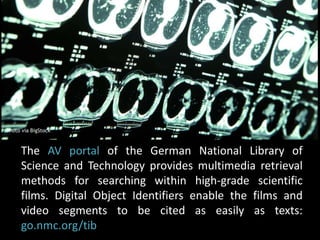
The AV portal of the German National Library of 
Science and Technology provides multimedia retrieval 
methods for searching within high-grade scientific 
films. Digital Object Identifiers enable the films and 
video segments to be cited as easily as texts: 
go.nmc.org/tib
Tag Articles or Reports 
Twitter: #NMCHz 
Comment on the Report 
Twitter: #NMCHz 
Facebook: www.facebook.com/TheNMCHorizonProject 
Sign up for the Expert Panel 
go.nmc.org/horizon-nominate 
Submit Your Projects 
go.nmc.org/projects 
samantha@nmc.org 
Jump In! 
cc licensed flickr photo by Marina Cast.: http://flickr.com/photos/marinacast/3878053449/

2014 Library Presentation

  • 1.
    NMC Horizon Report> 2014 Library Edition Pressing Technologies, Trends, Challenges for Libraries å go.nmc.org/2014-arl
  • 2.
  • 3.
    . Where I’mcoming from.
  • 4.
    The NMC HorizonProject 45 Editions | 55+ Translations 12 Years of Global Research into Emerging Technology Uptake
  • 5.
  • 6.
    Acknowledgements The researchbehind the NMC Horizon Report: 2014 Library Edition is jointly conducted by the New Media Consortium (NMC) and University of Applied Sciences (HTW) Chur, Technische Informationsbibliothek (TIB) Hannover, and ETH-Bibliothek Zurich. Our partners’ critical participation in the production of this report and their strong support for the NMC Horizon Project is gratefully acknowledged. The NMC Horizon Report: 2014 Library Edition is a publication of the New Media Consortium
  • 7.
  • 8.
    . Where I’mcoming from.
  • 9.
    Focus On: •UB Faculty, Students, and Staff • Institutional Directions • Libraries’ Staff Learning and Growth • Financial Health
  • 10.
  • 12.
  • 13.
    Key Trends 2014 FAST TRENDS: • Increasing Focus on Research Data Management for Publications • Prioritization of Mobile Content and Delivery MID-RANGE TRENDS: • Evolving Nature of the Scholarly Record • Increasing Accessibility of Research Content LONG-RANGE TRENDS: • Continual Progress in Technology, Standards, and Infrastructure • Rise of New Forms of Multidisciplinary Research Flickr Photo via Creative Tools
  • 14.
    Increasing Focus on Research Data Management
  • 15.
    Photo via BigStock The Harvard-Smithsonian Center for Physics and Astronomy’ SAO/NASA Astrophysics Data System contains 10.7 million scholarly records, and tracks citations and usage of their resources: go.nmc.org/saonasa
  • 16.
    Prioritization of Mobile Content and Delivery
  • 17.
    Duke University Librariesis using the “BrowZine” app for tablets to make library resources more mobile-friendly, enabling library patrons to browse, read, and monitor academic journals: go.nmc.org/duke
  • 18.
    Evolving Nature ofthe Scholarly Record
  • 19.
    Photo via UCDavis University of California Davis launched the “Innovation in Scholarly Communication” project to identify the changes that are impacting traditional modes of publication in the digital age: go.nmc.org/icis
  • 20.
  • 21.
    Initiated by theAssociation of Research Libraries, SPARC is an international alliance of 800+ institutions that helps its global members establish sustainable systems of open scholarship: go.nmc.org/sparc
  • 22.
    Rise of NewForms of Multi-Disciplinary Research
  • 23.
    Photo via ArchitectMagazine As an addition to Hesburgh Libraries, the University of Notre Dame built Multidisciplinary Research Buildings to provide space to foster collaboration and research among faculty and students: go.nmc.org/ndumdr
  • 25.
  • 26.
    Significant Challenges 2014 SOLVABLE CHALLENGES: • Embedding Academic and Research Libraries in the Curriculum • Rethinking the Roles and Skills of Librarians DIFFICULT CHALLENGES: • Capturing and Archiving the Digital Outputs of Research as Collection Material • Competition from Alternative Avenues of Discovery WICKED CHALLENGES: • Embracing the Need for Radical Change • Maintaining Ongoing Integration, Interoperability, and Collaborative Projects
  • 27.
    Embedding Academic andResearch Libraries in the Curriculum
  • 28.
    Photo via BigStock The staff at the Merrill-Cazier Library at Utah State uses a curriculum-integrated method to information literacy by working closely with faculty to customize instruction for specific majors: go.nmc.org/merrill
  • 29.
    Rethinking the Roles and Skills of Librarians
  • 30.
    Photo via BigStock The Harvard Law School library developed an academic technology project manager position, focused on providing support for a suite of open-source, online classroom tools called H2O that are being used by the law school’s faculty: go.nmc.org/hls
  • 31.
    Capturing and Archivingthe Digital Outputs of Research as Collection Material
  • 32.
    Photo via BritishLibrary The British Library, Cambridge University Library, Trinity College Library Dublin, and others are following new regulations known as legal deposit to ensure that temporary materials such as websites and e-books can be collected and preserved: go.nmc.org/collect
  • 33.
    Competition from AlternativeAvenues of Discovery
  • 34.
    Photo via BigStock OCLC Research launched the “Wikipedia Library Project” pilot in an effort to make sources for citations more accessible to Wikipedia editors: go.nmc.org/oclc
  • 35.
    Embracing the Need for Radical Change
  • 36.
    Photo via Universityof British Colombia The circulation team at the Woodward Library at the University of British Colombia drafted the “Strategic Plan,” which promotes continuous support and creative inspiration for staff: go.nmc.org/woodw
  • 37.
    Technologies to Watch2014 ONE YEAR OR LESS: • Electronic Publishing • Mobile Apps TWO TO THREE YEARS: • Bibliometrics and Citation Technologies • Open Content FOUR TO FIVE YEARS: • The Internet of Things • Semantic Web and Linked Data
  • 38.
  • 39.
    Photo via BigStock Vectors is a USC scholarly journal that focuses on how technology transforms, and/or impedes social relations. It uses a peer-reviewed format and publishes only multimedia works: go.nmc.org/vect
  • 40.
  • 41.
    The Bavarian StateLibrary in Germany offers multiple mobile apps that allow users to explore ancient texts with augmented reality, location-based features, and geo-referencing in historical maps: go.nmc.org/bava
  • 42.
  • 43.
    Photo via BigStock ORCiD provides a persistent digital identifier that distinguishes one researcher from another, and supports automated linkages between a person and their professional activities ensuring that each person’s work is recognized: go.nmc.org/orcid
  • 44.
  • 45.
    Photo via BigStock The Staffordshire University Online Repository is an open access institutional research repository designed to house the research and scholarly output of the University’s staff and researchers: go.nmc.org/staf
  • 46.
    Semantic Web and Linked Data
  • 47.
    Photo via BigStock The AV portal of the German National Library of Science and Technology provides multimedia retrieval methods for searching within high-grade scientific films. Digital Object Identifiers enable the films and video segments to be cited as easily as texts: go.nmc.org/tib
  • 48.
    Tag Articles orReports Twitter: #NMCHz Comment on the Report Twitter: #NMCHz Facebook: www.facebook.com/TheNMCHorizonProject Sign up for the Expert Panel go.nmc.org/horizon-nominate Submit Your Projects go.nmc.org/projects samantha@nmc.org Jump In! cc licensed flickr photo by Marina Cast.: http://flickr.com/photos/marinacast/3878053449/