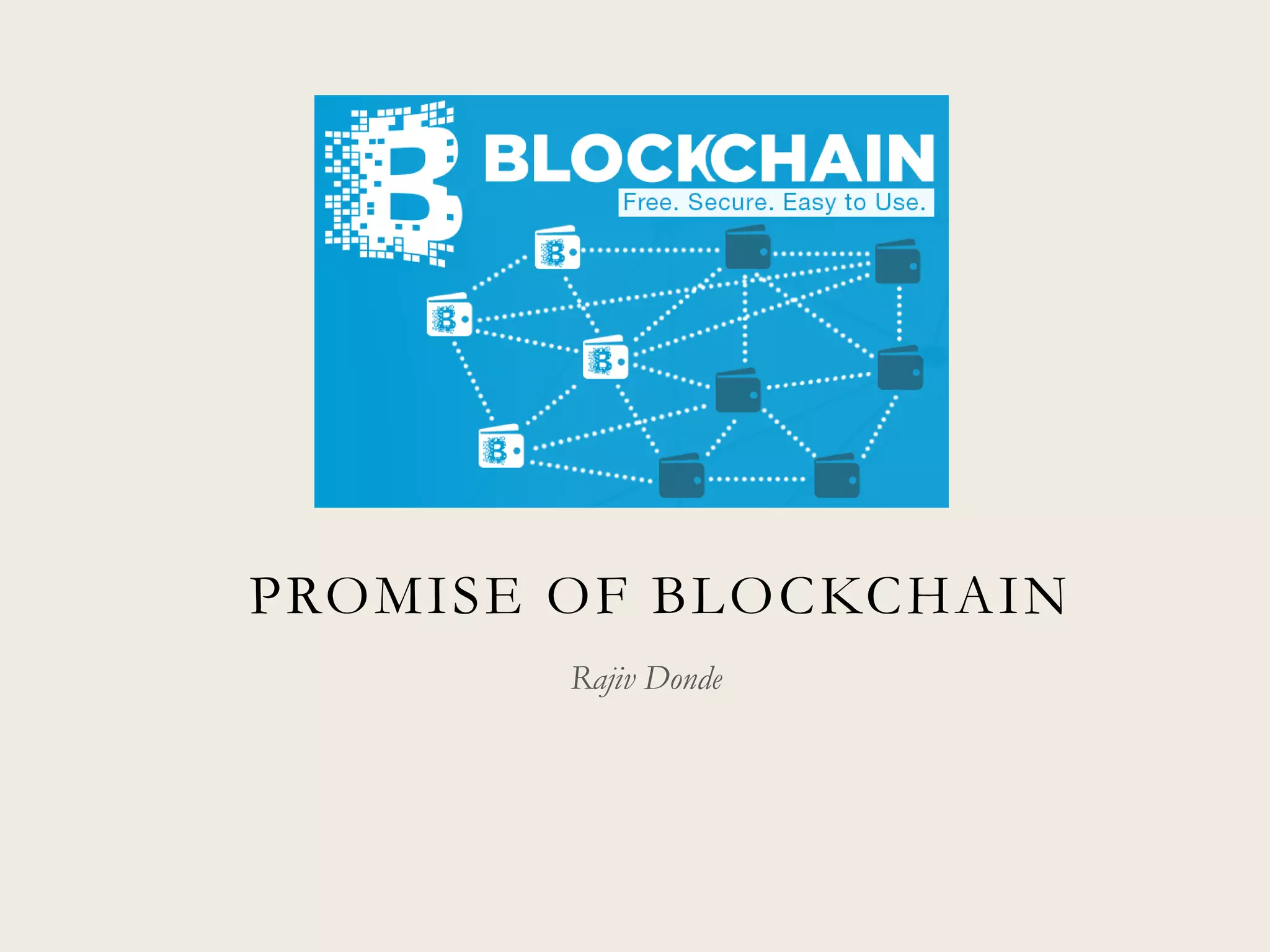
PROMISE OF BLOCKCHAIN
Rajiv Donde
AGENDA
 Background for Blockchain discussion
 Technical components
 Traits / Limitations
 The Promise
 Innovation
 A parallel - TCP/IP story
 Trajectory, examples & next steps
ROLE OF INSTITUTIONS TODAY ?
 Douglass C. North awarded Nobel Prize in Economics 1993 …… among other things ….. “
Institutions, Institutional change and Economic Performance ”
 Ascent of money – Niall Ferguson
 Contracts ………….. Legal organizations
 Transactions ……… Accounting discipline
 Records …………….. Business Operations
• Asset protection, organizational boundaries, verify identities, chronicle events
• Govern interactions b/w nations, communities, organizations and individuals
BUSINESS EVOLUTION ON
THE INTERNET
 Moving from Internet of information to internet of value (money
of things)
• Web 1.0 – Read only of static web pages
• Web 2.0 – Dynamic user-generated content and rise of social media
• Web 3.0 – most popular definition – connective intelligence where
people, data, applications and content are connected by an
unmediated fabric not needing trust brokers (like banks) to ensure privacy
and security
INSTITUTIONAL EVOLUTION
 Person to Person transactions (Barter)
 Centralized institutions (Banks)
 Decentralized transactions (Bitcoins) –
• Our interest is in Blockchain – the mechanism driving Bitcoins
• Central banks manipulate interest rates and money supply!
BLOCKCHAIN COMPONENTS
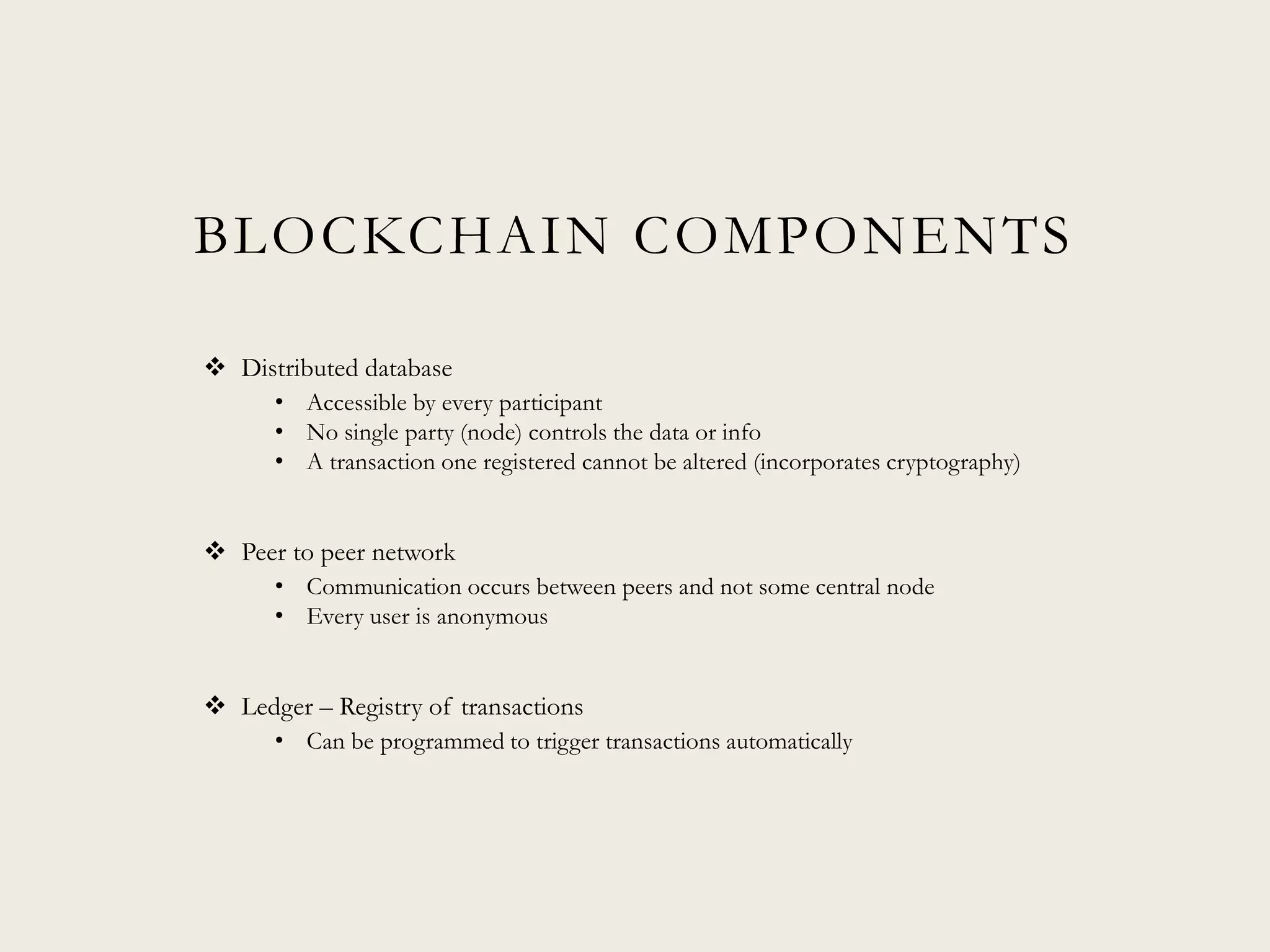
 Distributed database
• Accessible by every participant
• No single party (node) controls the data or info
• A transaction one registered cannot be altered (incorporates cryptography)
 Peer to peer network
• Communication occurs between peers and not some central node
• Every user is anonymous
 Ledger – Registry of transactions
• Can be programmed to trigger transactions automatically
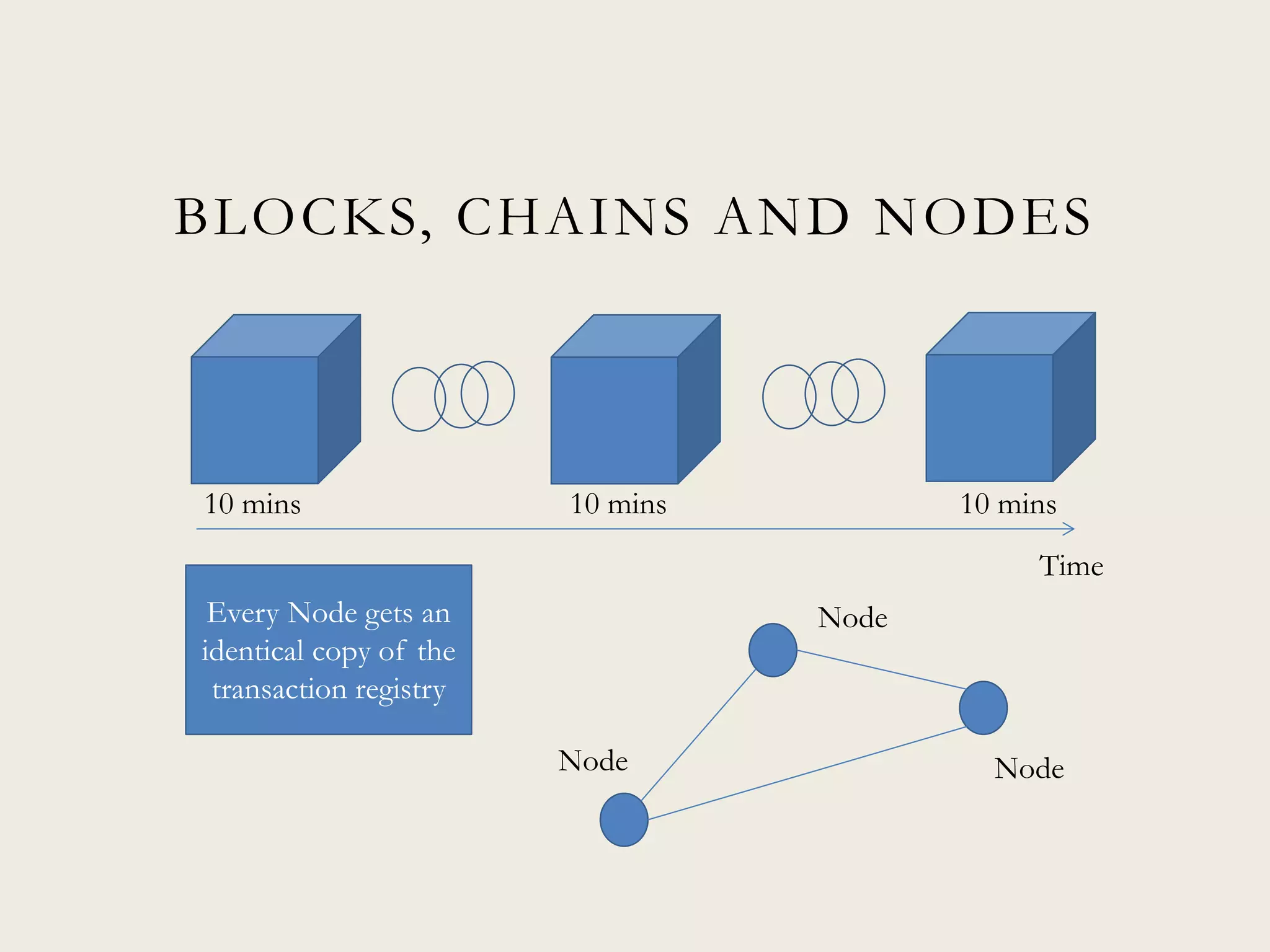
BLOCKS, CHAINS AND NODES
10 mins 10 mins 10 mins
Time
Node Node
NodeEvery Node gets an
identical copy of the
transaction registry
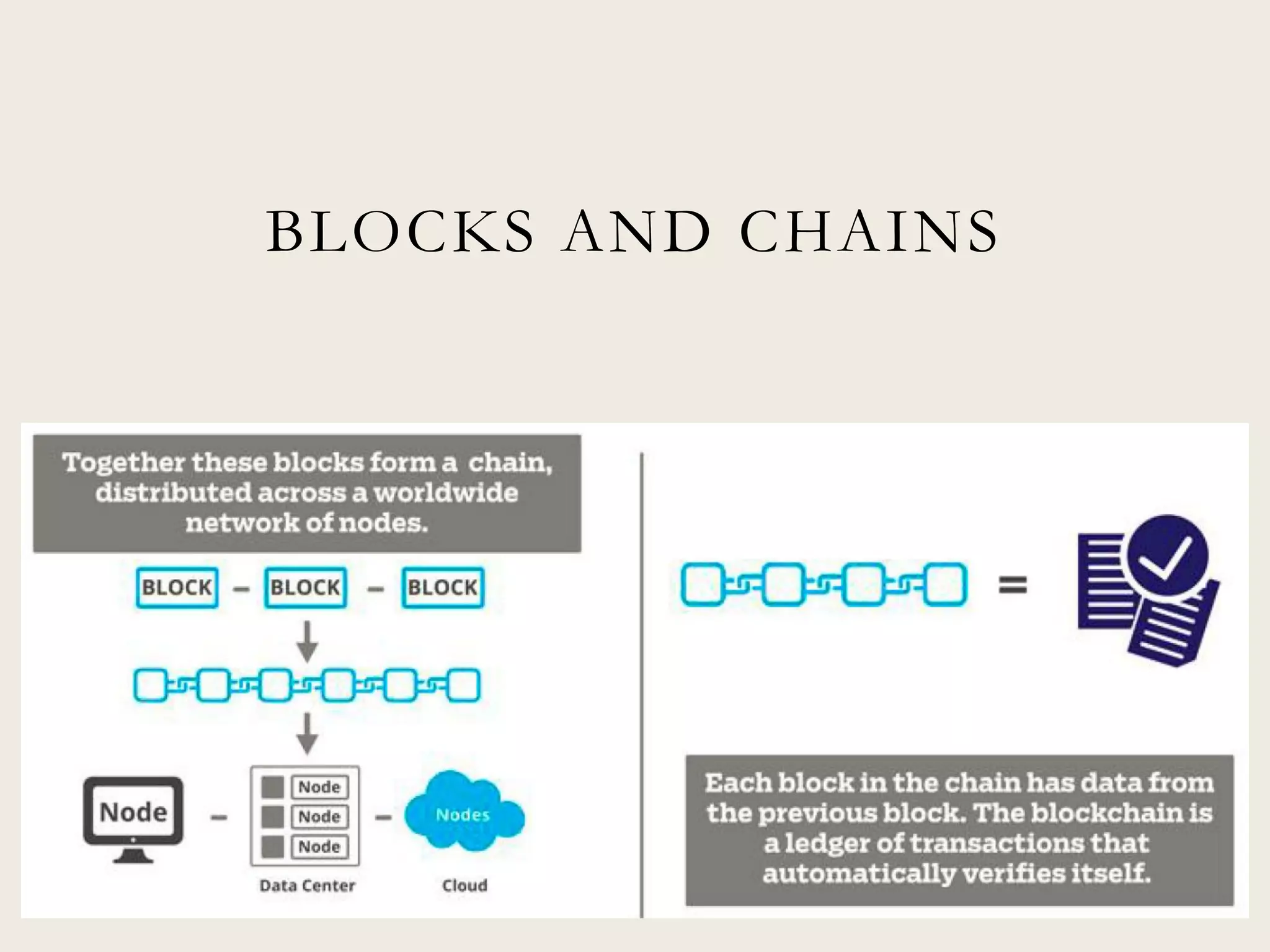
BLOCKS AND CHAINS
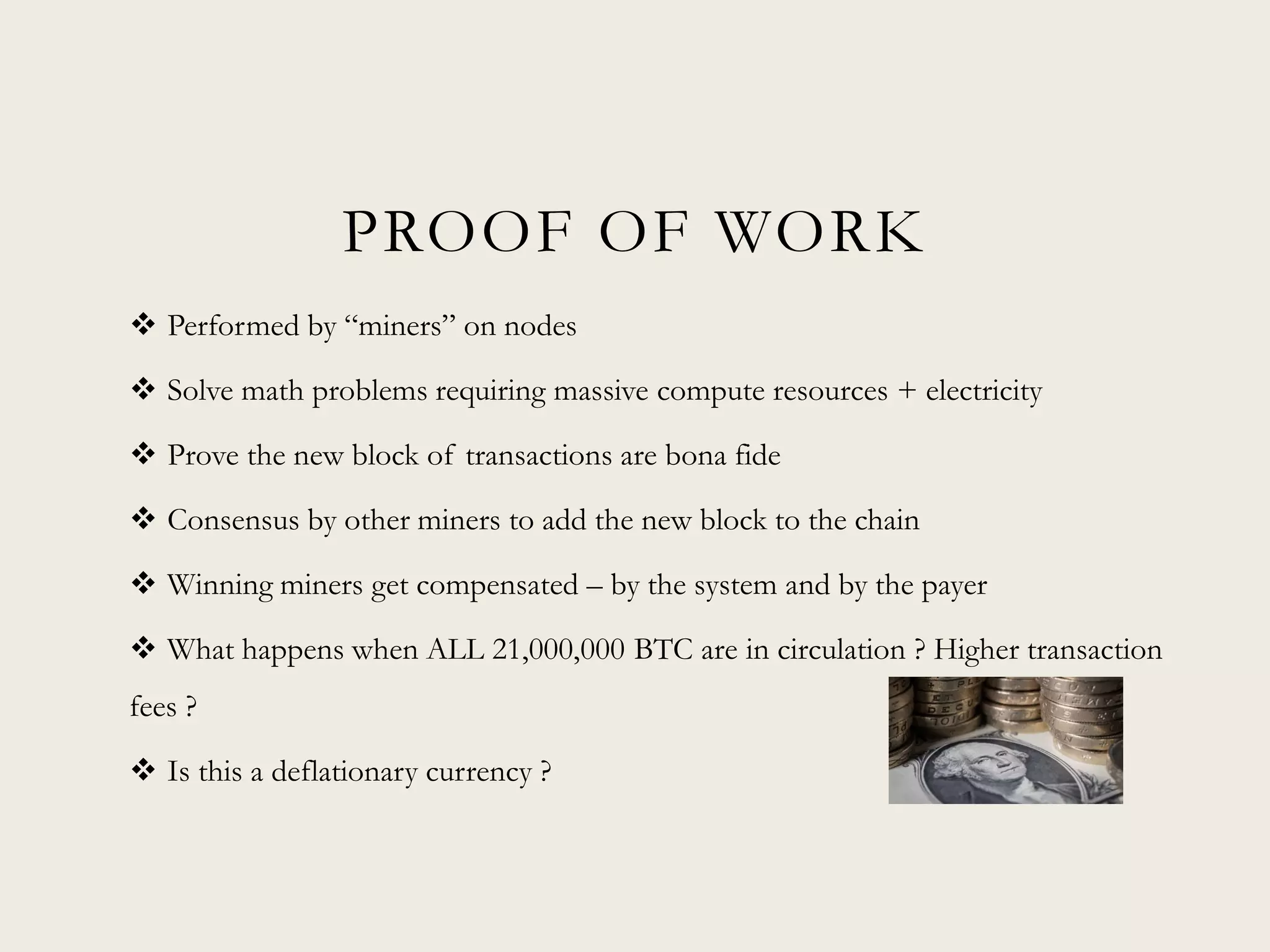
PROOF OF WORK
 Performed by “miners” on nodes
 Solve math problems requiring massive compute resources + electricity
 Prove the new block of transactions are bona fide
 Consensus by other miners to add the new block to the chain
 Winning miners get compensated – by the system and by the payer
 What happens when ALL 21,000,000 BTC are in circulation ? Higher transaction
fees ?
 Is this a deflationary currency ?
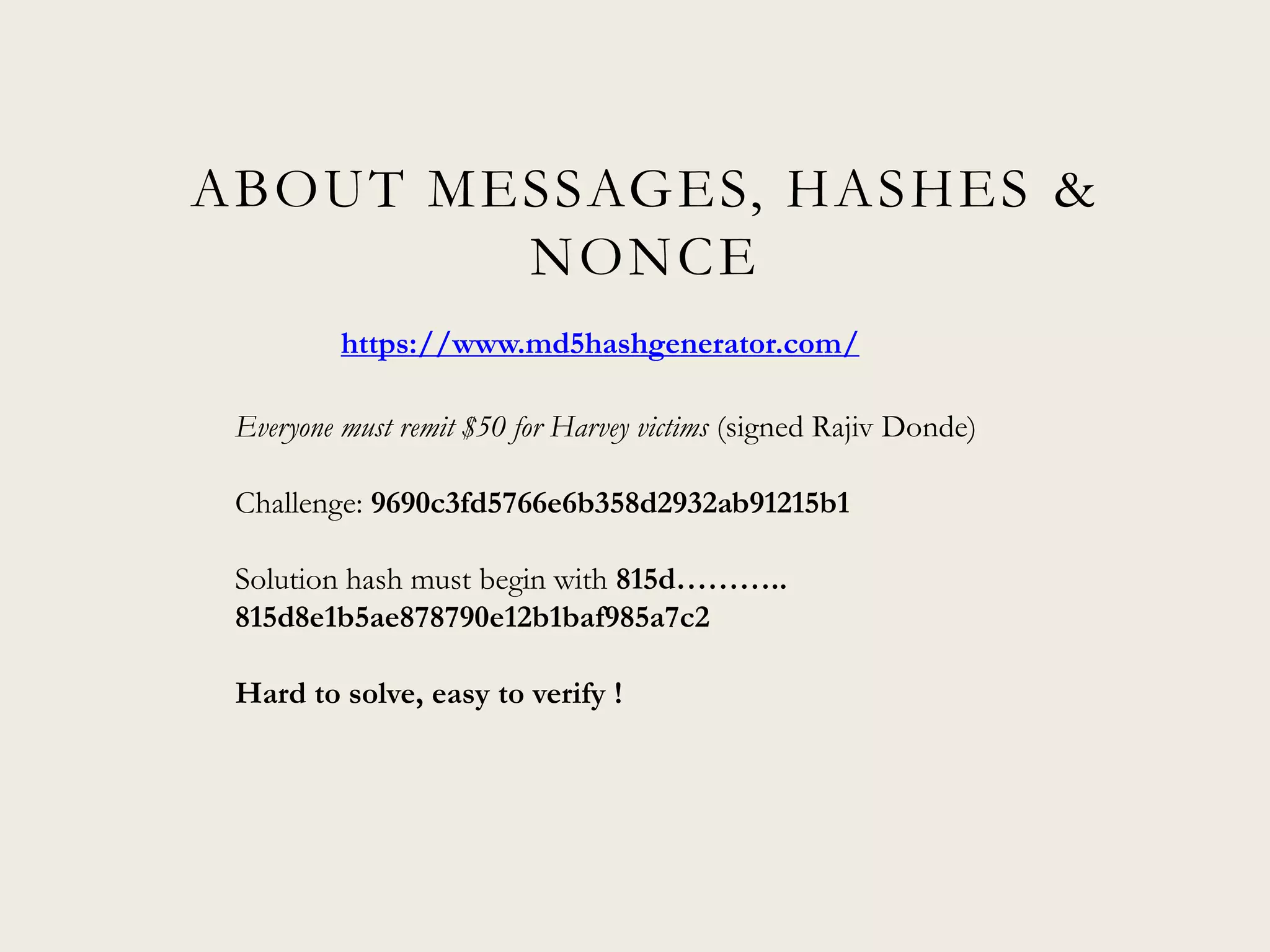
ABOUT MESSAGES, HASHES &
NONCE
https://www.md5hashgenerator.com/
Everyone must remit $50 for Harvey victims (signed Rajiv Donde)
Challenge: 9690c3fd5766e6b358d2932ab91215b1
Solution hash must begin with 815d………..
815d8e1b5ae878790e12b1baf985a7c2
Hard to solve, easy to verify !
RULES OF CRYPTOGRAPHY
 Computationally efficient
 Same string input must produce the same hash
 Must hide information about the inputs
 Output must appear random and unrelated to the input
 Two separate strings cannot produce the same hash (very low
probability)
SMART CONTRACTS
 Smart Contracts Are programs that run on the blockchain
 IFTTT (If this then that logic) – triggers when a condition is met e.g.
release funds to a vendor
 Often called self extracting contracts – they guarantee the business
logic – since the code runs automatically
 Concepts to be aware of (connected smart contracts):
• DAO : Decentralized autonomous Organizations
• DAC : Decentralized autonomous corporations
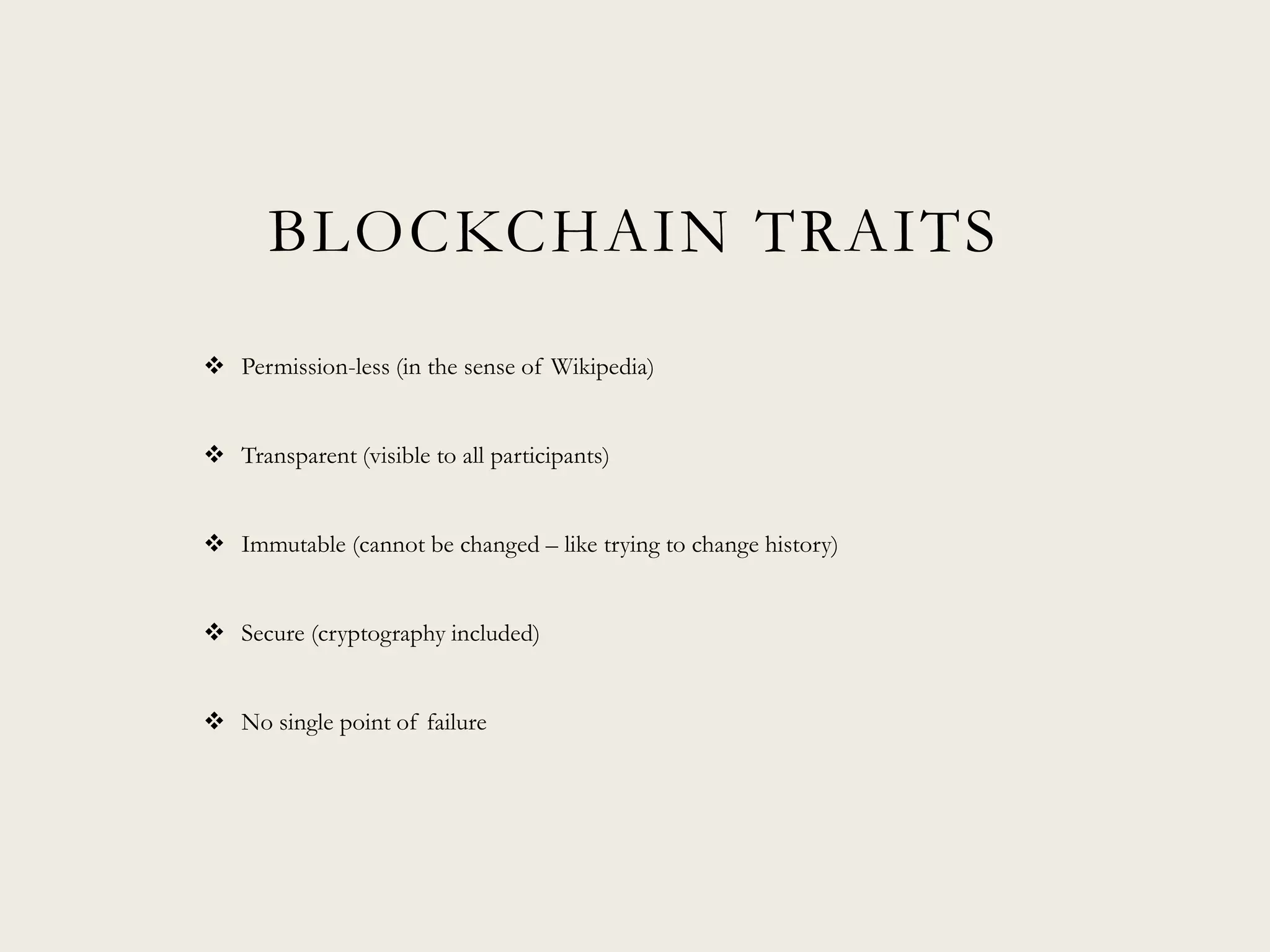
BLOCKCHAIN TRAITS
 Permission-less (in the sense of Wikipedia)
 Transparent (visible to all participants)
 Immutable (cannot be changed – like trying to change history)
 Secure (cryptography included)
 No single point of failure
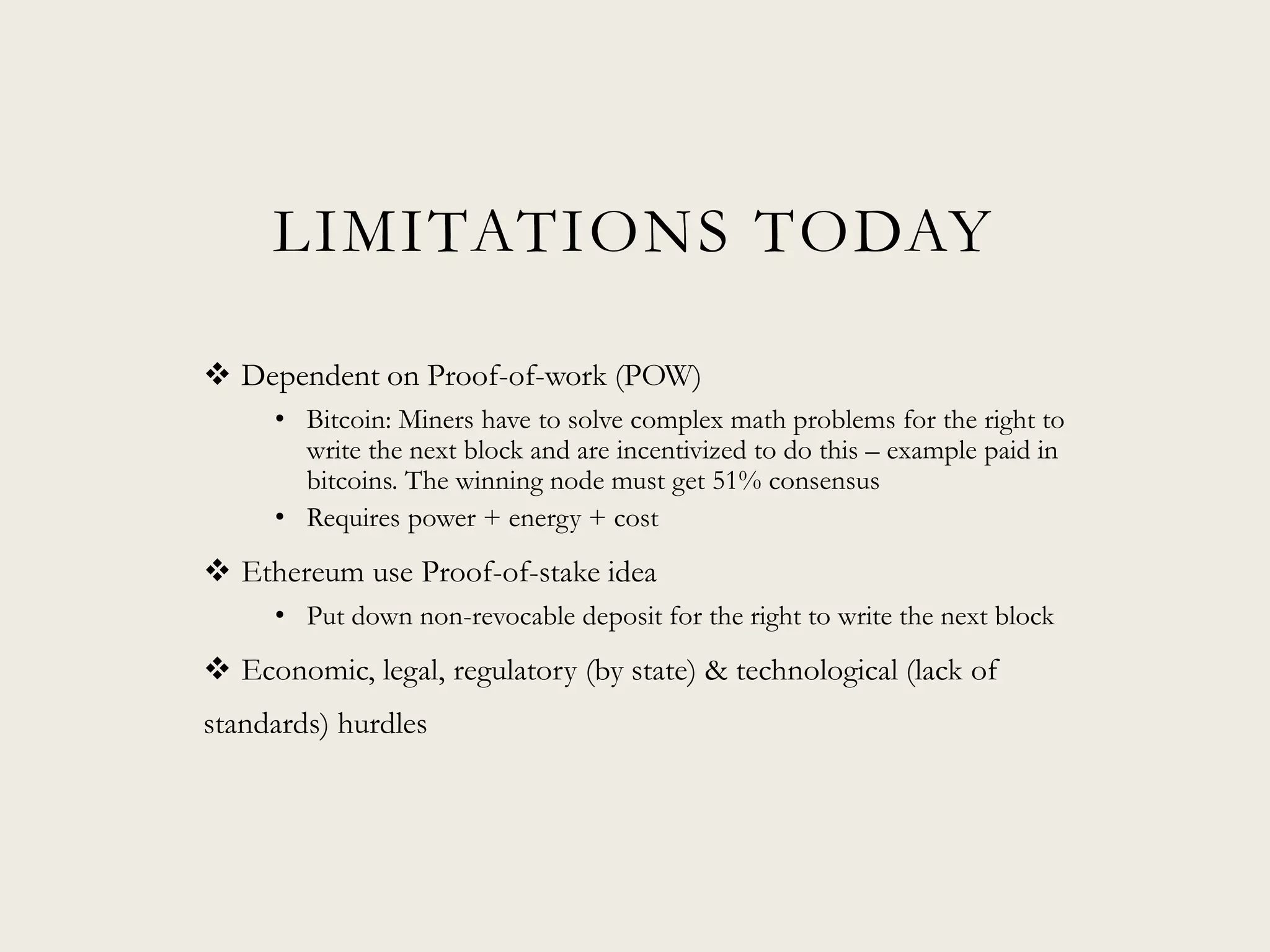
LIMITATIONS TODAY
 Dependent on Proof-of-work (POW)
• Bitcoin: Miners have to solve complex math problems for the right to
write the next block and are incentivized to do this – example paid in
bitcoins. The winning node must get 51% consensus
• Requires power + energy + cost
 Ethereum use Proof-of-stake idea
• Put down non-revocable deposit for the right to write the next block
 Economic, legal, regulatory (by state) & technological (lack of
standards) hurdles
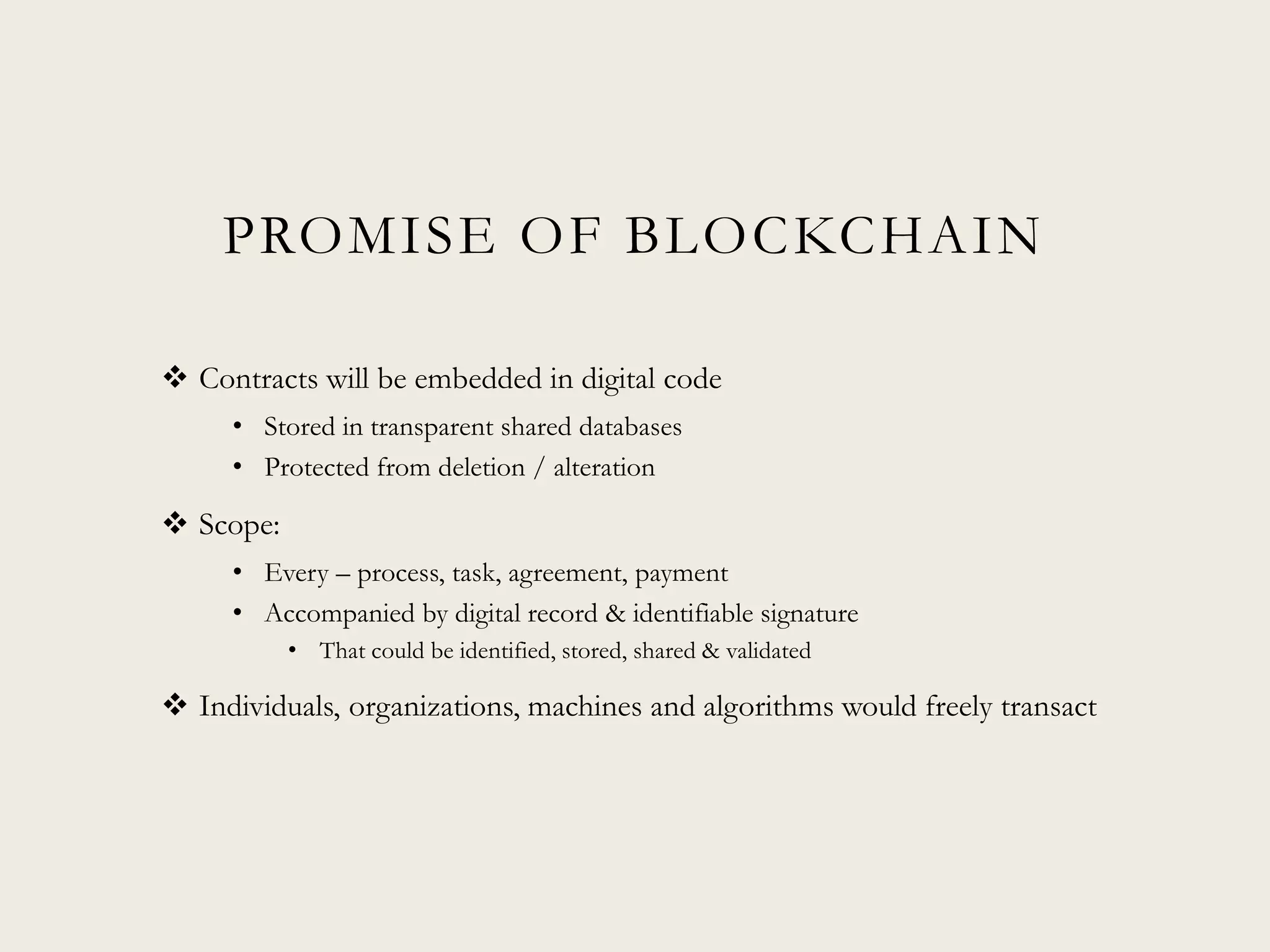
PROMISE OF BLOCKCHAIN
 Contracts will be embedded in digital code
• Stored in transparent shared databases
• Protected from deletion / alteration
 Scope:
• Every – process, task, agreement, payment
• Accompanied by digital record & identifiable signature
• That could be identified, stored, shared & validated
 Individuals, organizations, machines and algorithms would freely transact
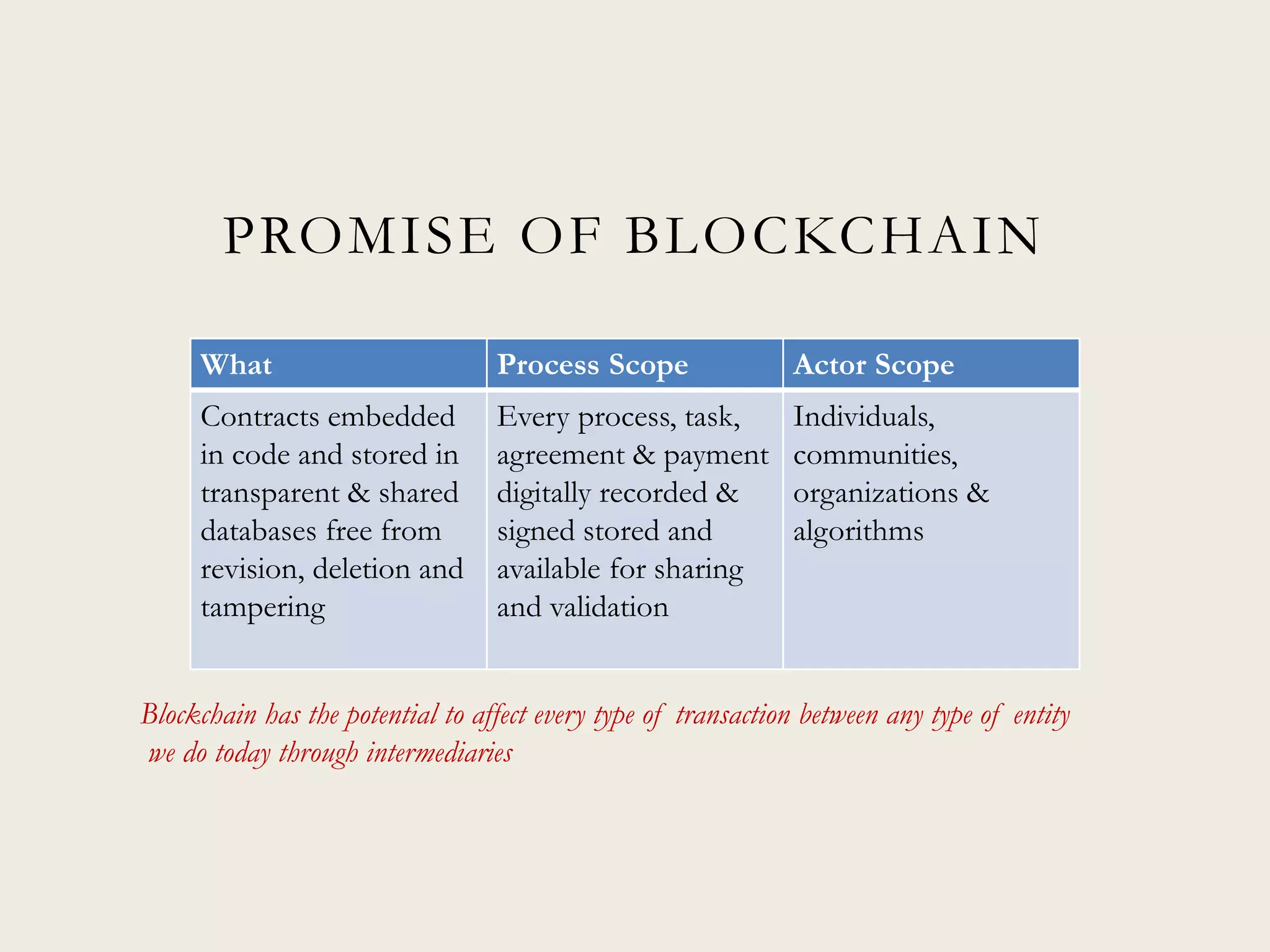
PROMISE OF BLOCKCHAIN
What Process Scope Actor Scope
Contracts embedded
in code and stored in
transparent & shared
databases free from
revision, deletion and
tampering
Every process, task,
agreement & payment
digitally recorded &
signed stored and
available for sharing
and validation
Individuals,
communities,
organizations &
algorithms
Blockchain has the potential to affect every type of transaction between any type of entity
we do today through intermediaries
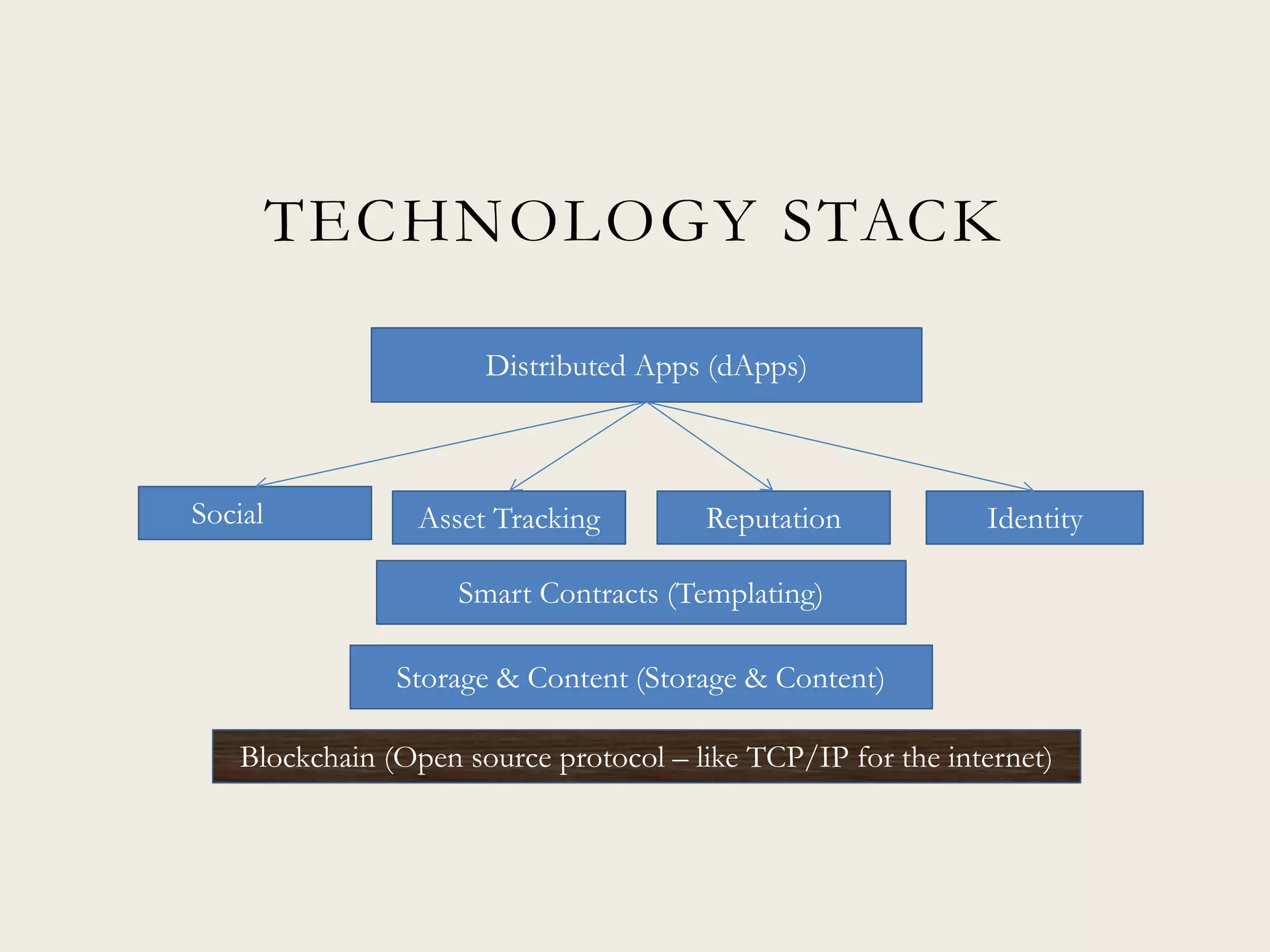
TECHNOLOGY STACK
Distributed Apps (dApps)
Social Asset Tracking Reputation Identity
Smart Contracts (Templating)
Storage & Content (Storage & Content)
Blockchain (Open source protocol – like TCP/IP for the internet)
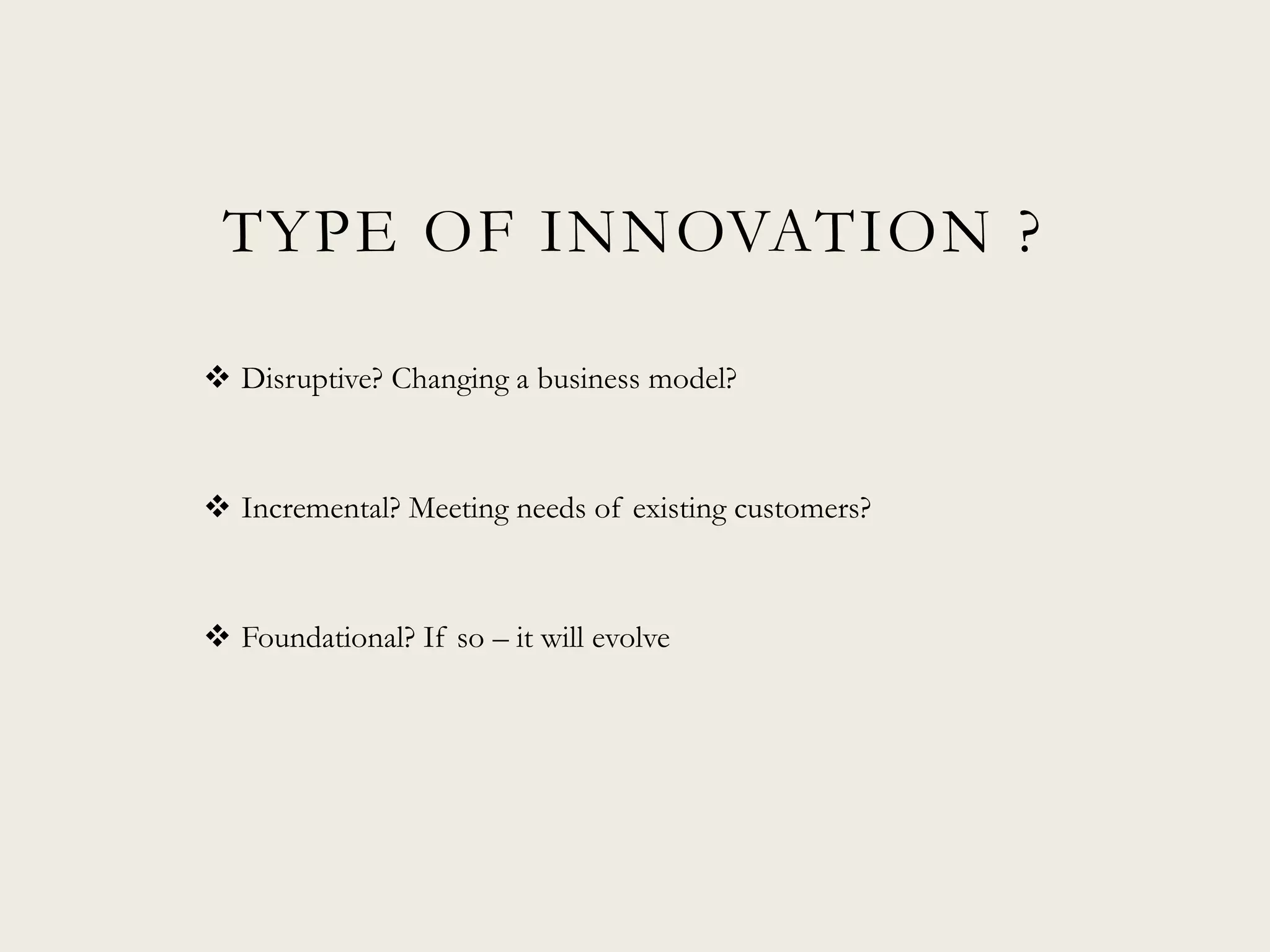
TYPE OF INNOVATION ?
 Disruptive? Changing a business model?
 Incremental? Meeting needs of existing customers?
 Foundational? If so – it will evolve
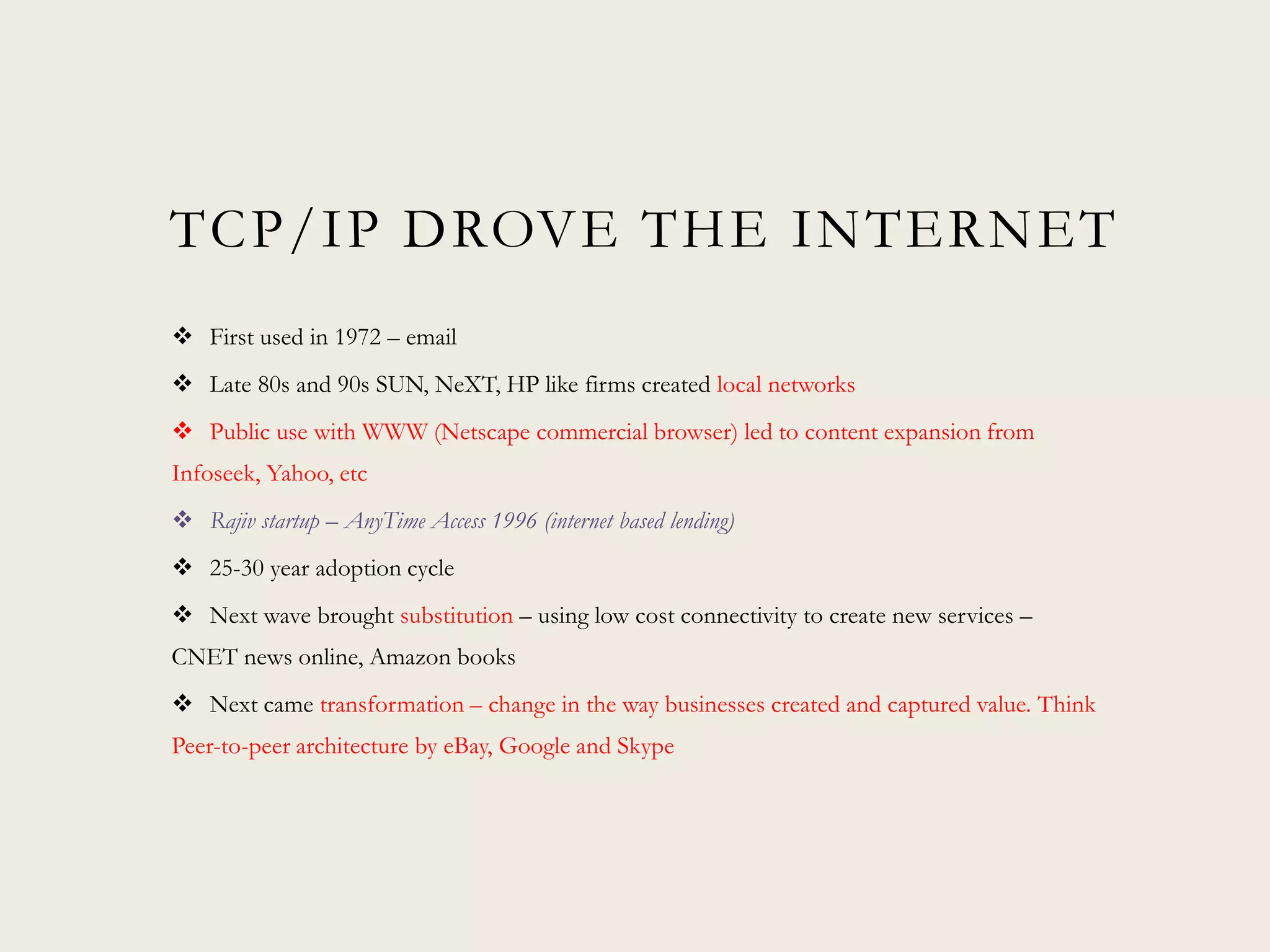
TCP/IP DROVE THE INTERNET
 First used in 1972 – email
 Late 80s and 90s SUN, NeXT, HP like firms created local networks
 Public use with WWW (Netscape commercial browser) led to content expansion from
Infoseek, Yahoo, etc
 Rajiv startup – AnyTime Access 1996 (internet based lending)
 25-30 year adoption cycle
 Next wave brought substitution – using low cost connectivity to create new services –
CNET news online, Amazon books
 Next came transformation – change in the way businesses created and captured value. Think
Peer-to-peer architecture by eBay, Google and Skype
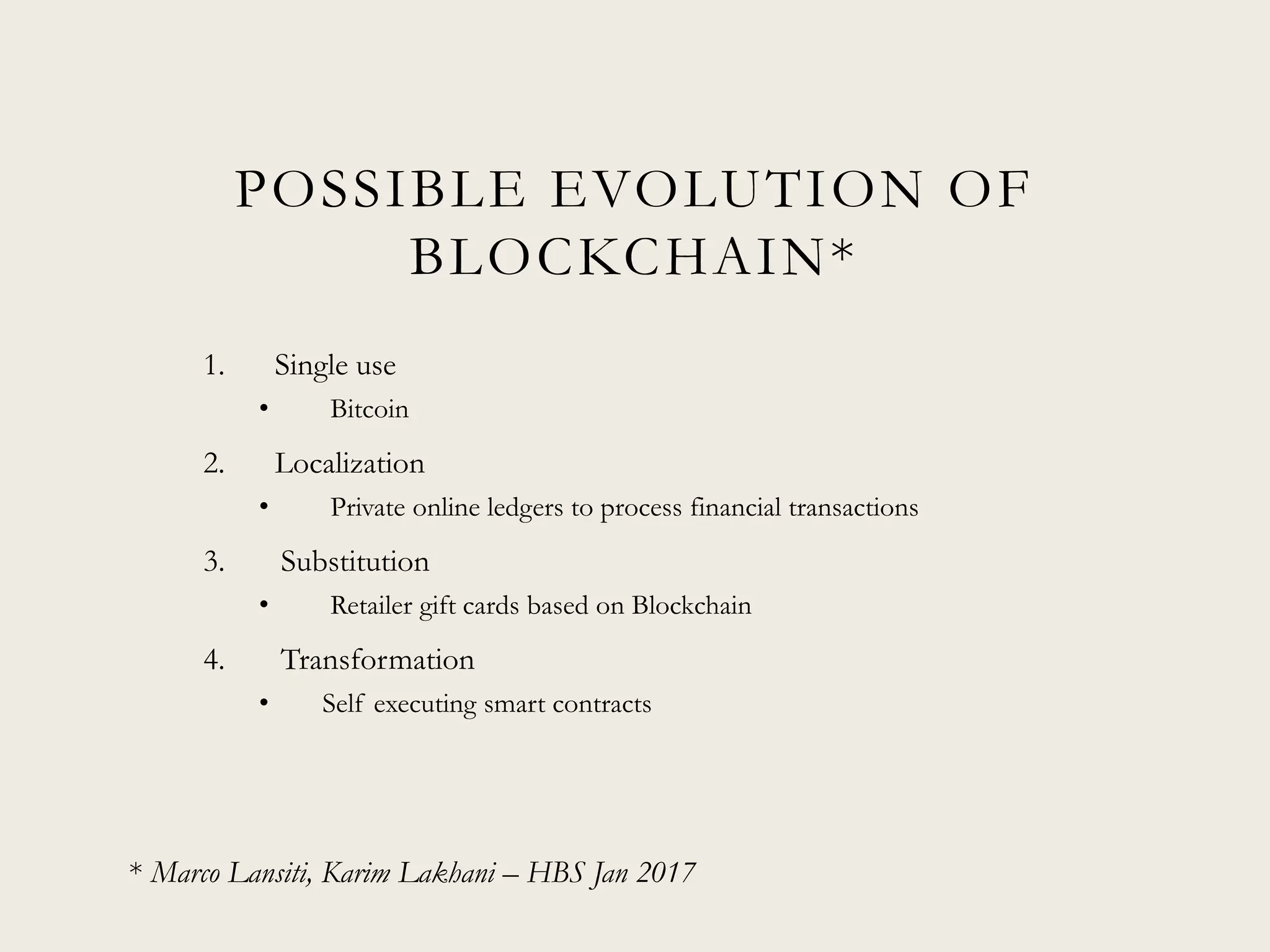
POSSIBLE EVOLUTION OF
BLOCKCHAIN*
1. Single use
• Bitcoin
2. Localization
• Private online ledgers to process financial transactions
3. Substitution
• Retailer gift cards based on Blockchain
4. Transformation
• Self executing smart contracts
* Marco Lansiti, Karim Lakhani – HBS Jan 2017
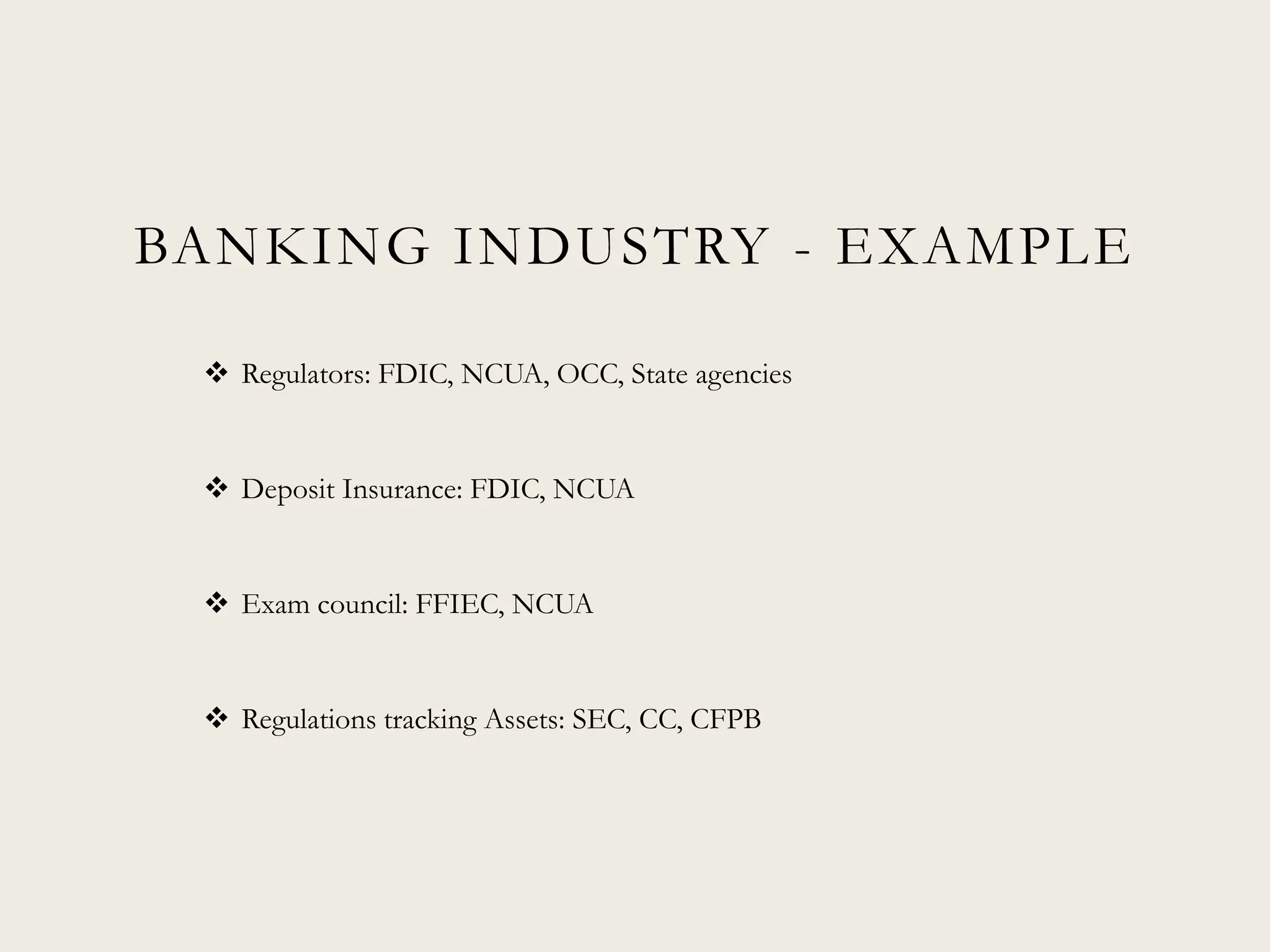
BANKING INDUSTRY - EXAMPLE
 Regulators: FDIC, NCUA, OCC, State agencies
 Deposit Insurance: FDIC, NCUA
 Exam council: FFIEC, NCUA
 Regulations tracking Assets: SEC, CC, CFPB
WHAT SHOULD YOU DO NOW?
 Experimentation !
 Products from Microsoft : Coco framework
 Amazon
 Blockchain as a service!
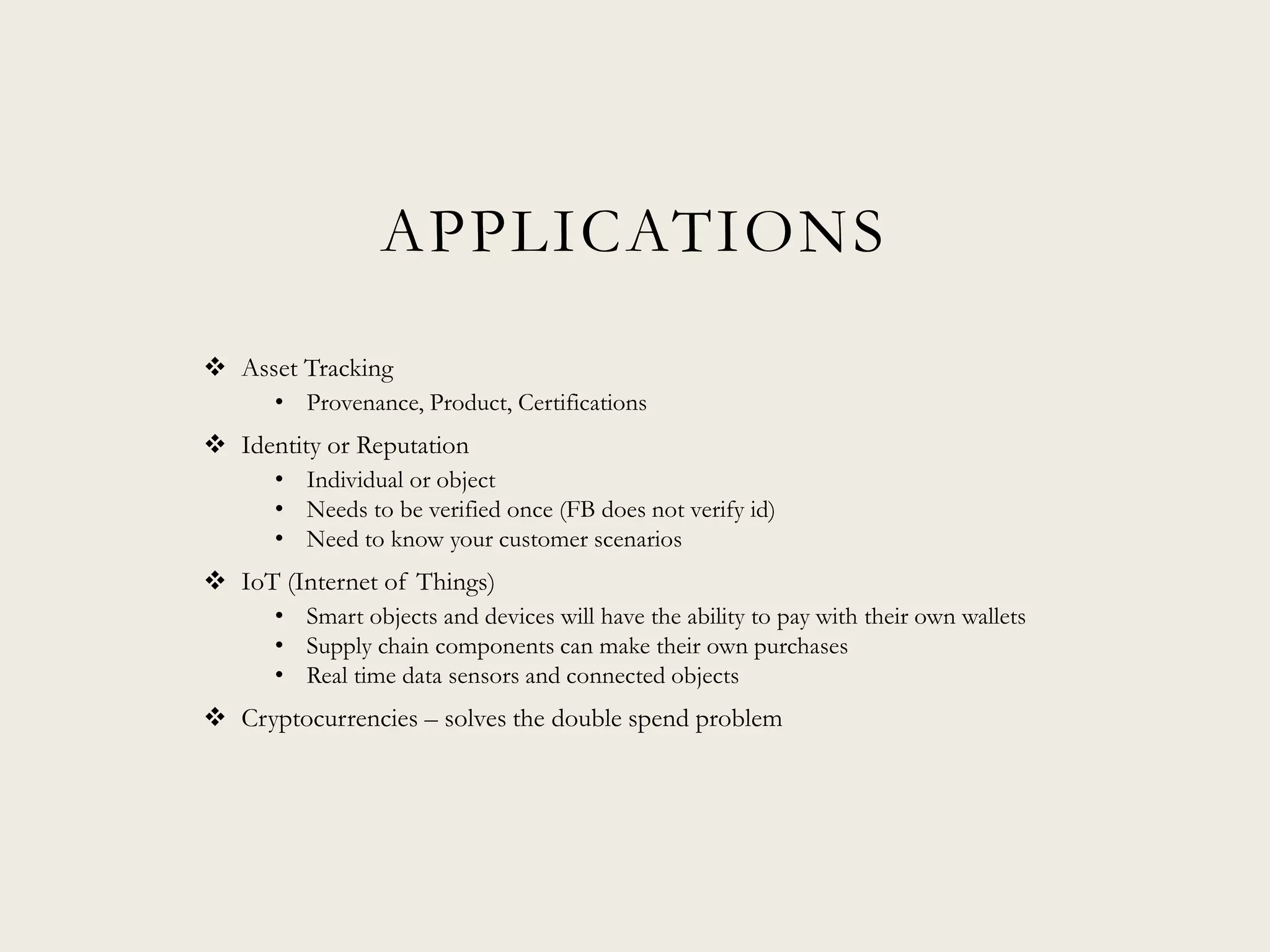
APPLICATIONS
 Asset Tracking
• Provenance, Product, Certifications
 Identity or Reputation
• Individual or object
• Needs to be verified once (FB does not verify id)
• Need to know your customer scenarios
 IoT (Internet of Things)
• Smart objects and devices will have the ability to pay with their own wallets
• Supply chain components can make their own purchases
• Real time data sensors and connected objects
 Cryptocurrencies – solves the double spend problem
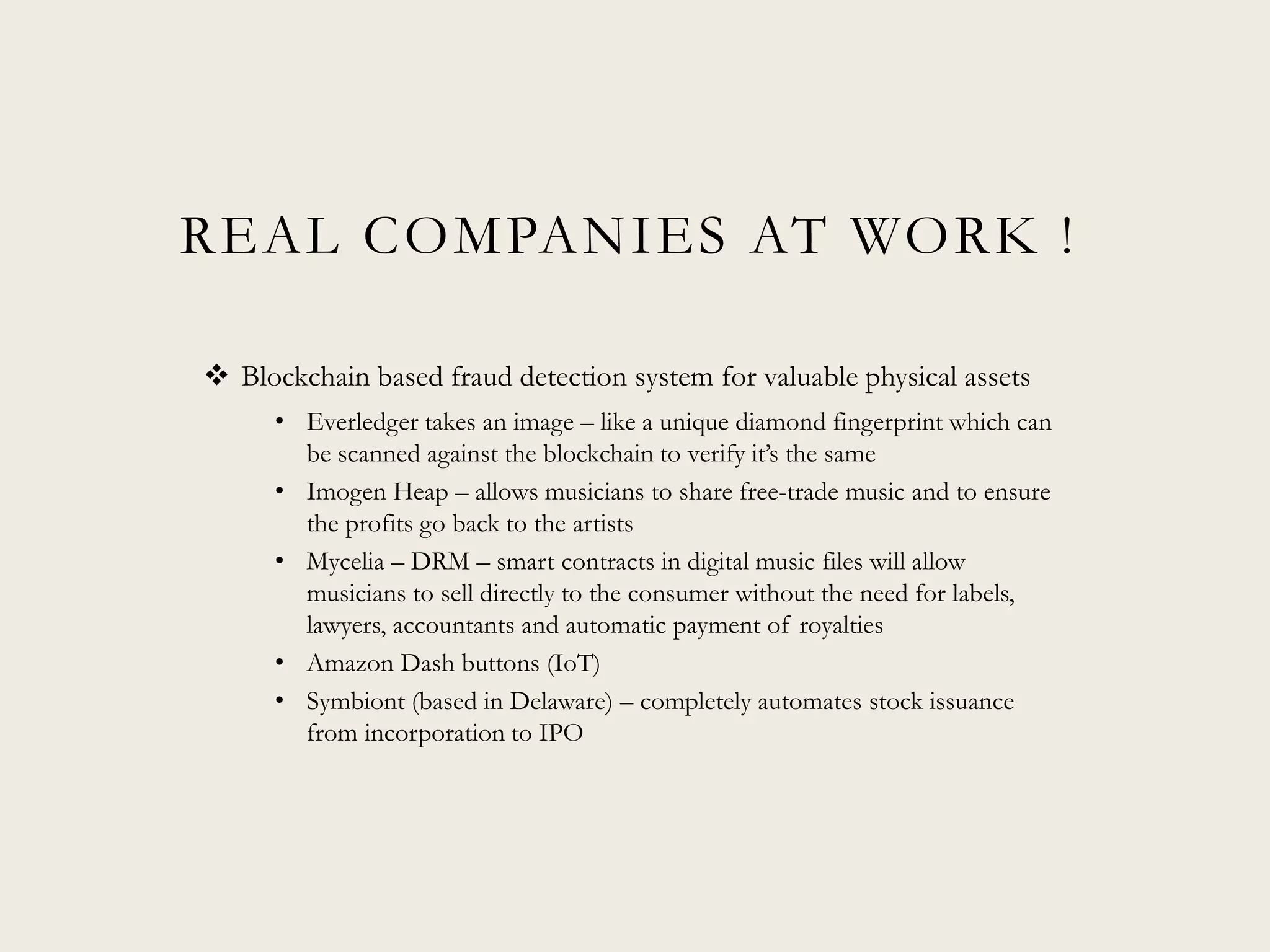
REAL COMPANIES AT WORK !
 Blockchain based fraud detection system for valuable physical assets
• Everledger takes an image – like a unique diamond fingerprint which can
be scanned against the blockchain to verify it’s the same
• Imogen Heap – allows musicians to share free-trade music and to ensure
the profits go back to the artists
• Mycelia – DRM – smart contracts in digital music files will allow
musicians to sell directly to the consumer without the need for labels,
lawyers, accountants and automatic payment of royalties
• Amazon Dash buttons (IoT)
• Symbiont (based in Delaware) – completely automates stock issuance
from incorporation to IPO
PROJECTS IN THE WORKS
 Hyperledger
• Open source initiative – enterprise grade distributed ledger and code
base to be used across industries
• Overseen by Linux Foundation
• Members include : Cisco, IBM, Intel,, Red Hat, Samsung, VMWare,
big banks (JP Morgan Chase, Wells Fargo …
QUESTIONS ?
Thank you !
Rajiv Donde
rajivdonde@yahoo.com

The Promise of BlockChain

  • 1.
  • 2.
    AGENDA  Background forBlockchain discussion  Technical components  Traits / Limitations  The Promise  Innovation  A parallel - TCP/IP story  Trajectory, examples & next steps
  • 3.
    ROLE OF INSTITUTIONSTODAY ?  Douglass C. North awarded Nobel Prize in Economics 1993 …… among other things ….. “ Institutions, Institutional change and Economic Performance ”  Ascent of money – Niall Ferguson  Contracts ………….. Legal organizations  Transactions ……… Accounting discipline  Records …………….. Business Operations • Asset protection, organizational boundaries, verify identities, chronicle events • Govern interactions b/w nations, communities, organizations and individuals
  • 4.
    BUSINESS EVOLUTION ON THEINTERNET  Moving from Internet of information to internet of value (money of things) • Web 1.0 – Read only of static web pages • Web 2.0 – Dynamic user-generated content and rise of social media • Web 3.0 – most popular definition – connective intelligence where people, data, applications and content are connected by an unmediated fabric not needing trust brokers (like banks) to ensure privacy and security
  • 5.
    INSTITUTIONAL EVOLUTION  Personto Person transactions (Barter)  Centralized institutions (Banks)  Decentralized transactions (Bitcoins) – • Our interest is in Blockchain – the mechanism driving Bitcoins • Central banks manipulate interest rates and money supply!
  • 6.
    BLOCKCHAIN COMPONENTS  Distributeddatabase • Accessible by every participant • No single party (node) controls the data or info • A transaction one registered cannot be altered (incorporates cryptography)  Peer to peer network • Communication occurs between peers and not some central node • Every user is anonymous  Ledger – Registry of transactions • Can be programmed to trigger transactions automatically
  • 7.
    BLOCKS, CHAINS ANDNODES 10 mins 10 mins 10 mins Time Node Node NodeEvery Node gets an identical copy of the transaction registry
  • 8.
  • 9.
    PROOF OF WORK Performed by “miners” on nodes  Solve math problems requiring massive compute resources + electricity  Prove the new block of transactions are bona fide  Consensus by other miners to add the new block to the chain  Winning miners get compensated – by the system and by the payer  What happens when ALL 21,000,000 BTC are in circulation ? Higher transaction fees ?  Is this a deflationary currency ?
  • 10.
    ABOUT MESSAGES, HASHES& NONCE https://www.md5hashgenerator.com/ Everyone must remit $50 for Harvey victims (signed Rajiv Donde) Challenge: 9690c3fd5766e6b358d2932ab91215b1 Solution hash must begin with 815d……….. 815d8e1b5ae878790e12b1baf985a7c2 Hard to solve, easy to verify !
  • 11.
    RULES OF CRYPTOGRAPHY Computationally efficient  Same string input must produce the same hash  Must hide information about the inputs  Output must appear random and unrelated to the input  Two separate strings cannot produce the same hash (very low probability)
  • 12.
    SMART CONTRACTS  SmartContracts Are programs that run on the blockchain  IFTTT (If this then that logic) – triggers when a condition is met e.g. release funds to a vendor  Often called self extracting contracts – they guarantee the business logic – since the code runs automatically  Concepts to be aware of (connected smart contracts): • DAO : Decentralized autonomous Organizations • DAC : Decentralized autonomous corporations
  • 13.
    BLOCKCHAIN TRAITS  Permission-less(in the sense of Wikipedia)  Transparent (visible to all participants)  Immutable (cannot be changed – like trying to change history)  Secure (cryptography included)  No single point of failure
  • 14.
    LIMITATIONS TODAY  Dependenton Proof-of-work (POW) • Bitcoin: Miners have to solve complex math problems for the right to write the next block and are incentivized to do this – example paid in bitcoins. The winning node must get 51% consensus • Requires power + energy + cost  Ethereum use Proof-of-stake idea • Put down non-revocable deposit for the right to write the next block  Economic, legal, regulatory (by state) & technological (lack of standards) hurdles
  • 15.
    PROMISE OF BLOCKCHAIN Contracts will be embedded in digital code • Stored in transparent shared databases • Protected from deletion / alteration  Scope: • Every – process, task, agreement, payment • Accompanied by digital record & identifiable signature • That could be identified, stored, shared & validated  Individuals, organizations, machines and algorithms would freely transact
  • 16.
    PROMISE OF BLOCKCHAIN WhatProcess Scope Actor Scope Contracts embedded in code and stored in transparent & shared databases free from revision, deletion and tampering Every process, task, agreement & payment digitally recorded & signed stored and available for sharing and validation Individuals, communities, organizations & algorithms Blockchain has the potential to affect every type of transaction between any type of entity we do today through intermediaries
  • 17.
    TECHNOLOGY STACK Distributed Apps(dApps) Social Asset Tracking Reputation Identity Smart Contracts (Templating) Storage & Content (Storage & Content) Blockchain (Open source protocol – like TCP/IP for the internet)
  • 18.
    TYPE OF INNOVATION?  Disruptive? Changing a business model?  Incremental? Meeting needs of existing customers?  Foundational? If so – it will evolve
  • 19.
    TCP/IP DROVE THEINTERNET  First used in 1972 – email  Late 80s and 90s SUN, NeXT, HP like firms created local networks  Public use with WWW (Netscape commercial browser) led to content expansion from Infoseek, Yahoo, etc  Rajiv startup – AnyTime Access 1996 (internet based lending)  25-30 year adoption cycle  Next wave brought substitution – using low cost connectivity to create new services – CNET news online, Amazon books  Next came transformation – change in the way businesses created and captured value. Think Peer-to-peer architecture by eBay, Google and Skype
  • 20.
    POSSIBLE EVOLUTION OF BLOCKCHAIN* 1.Single use • Bitcoin 2. Localization • Private online ledgers to process financial transactions 3. Substitution • Retailer gift cards based on Blockchain 4. Transformation • Self executing smart contracts * Marco Lansiti, Karim Lakhani – HBS Jan 2017
  • 21.
    BANKING INDUSTRY -EXAMPLE  Regulators: FDIC, NCUA, OCC, State agencies  Deposit Insurance: FDIC, NCUA  Exam council: FFIEC, NCUA  Regulations tracking Assets: SEC, CC, CFPB
  • 22.
    WHAT SHOULD YOUDO NOW?  Experimentation !  Products from Microsoft : Coco framework  Amazon  Blockchain as a service!
  • 23.
    APPLICATIONS  Asset Tracking •Provenance, Product, Certifications  Identity or Reputation • Individual or object • Needs to be verified once (FB does not verify id) • Need to know your customer scenarios  IoT (Internet of Things) • Smart objects and devices will have the ability to pay with their own wallets • Supply chain components can make their own purchases • Real time data sensors and connected objects  Cryptocurrencies – solves the double spend problem
  • 24.
    REAL COMPANIES ATWORK !  Blockchain based fraud detection system for valuable physical assets • Everledger takes an image – like a unique diamond fingerprint which can be scanned against the blockchain to verify it’s the same • Imogen Heap – allows musicians to share free-trade music and to ensure the profits go back to the artists • Mycelia – DRM – smart contracts in digital music files will allow musicians to sell directly to the consumer without the need for labels, lawyers, accountants and automatic payment of royalties • Amazon Dash buttons (IoT) • Symbiont (based in Delaware) – completely automates stock issuance from incorporation to IPO
  • 25.
    PROJECTS IN THEWORKS  Hyperledger • Open source initiative – enterprise grade distributed ledger and code base to be used across industries • Overseen by Linux Foundation • Members include : Cisco, IBM, Intel,, Red Hat, Samsung, VMWare, big banks (JP Morgan Chase, Wells Fargo …
  • 26.
    QUESTIONS ? Thank you! Rajiv Donde rajivdonde@yahoo.com