
Second Life Dr. Laura Nicosia Assistant Professor English Department AJ Kelton Director CHSS Technology Services Unit College of Humanities and Social Sciences at Montclair State University Teaching, Learning and Technology Center at Seton Hall University Heidi Trotta Instructional Designer Riad Twal Instructional Designer
What do you already know about Second Life? Why talk about Second Life?
What is Second Life? Started in 2003 “ Second Life is a 3-D virtual world entirely built and owned by its residents.” A flexible space for learning and exploration An opportunity for people to interact in a way that conveys a sense of presence lacking in other media. Generalized rather than contextual, applicable to almost any discipline.
What is Second Life? Second life is NOT a game - there are no rules or a fixed goal-oriented purpose. 15-20K sign ups daily - over 10.5 million total 25 - 50K residents on at one time  over $1 million spent daily (real US dollars) Well over 200 educational institutions Over 250 “sims” dedicated to education
What is Behind Second Life a scaleable co-located grid of servers running Linux  Real-time 3D streaming with rigid body physics simulation, streaming positional audio (distance and direction) Persistent desktop access - everything resides on the grid Cross-platform portability Infinite avatar customization - no two avatars alike Uploadable textures, audio, Quicktime video can play in-world. International Language Support - chat and communicate in local languages, inc. Asian character sets. European keyboards supported.
Technical Requirements Highest speed connection (no dial up) Best Graphics Card (specific) Windows 2000 / Mac OS X 10.3.9 800MHz Pentium III / 1 GHz G4 512 MB RAM
A Universe of Virtual Worlds 22 virtual world platforms listing over 11.8 million users, and that only includes numbers from 7 of the 22 18 virtual worlds for Teens and Tweens listing over 52.3 million users from 12 of the 18 15 virtual worlds for kids listing over 16.7 million users from 9 of the 15 Do the math:  55 virtual platforms w/ 80.8 million users
Show me the money “ We don't see any slowing in the market adoption of virtual worlds technologies and expect investment in the space to continue. In fact the market is growing significantly, with the rate of adoption of virtual worlds increasing as the technology matures and has more to offer both consumers and enterprise customers.” Christopher Sherman Executive Director of Virtual Worlds Management
Pedagogical Validity for Teaching with Second Life
First, we recognize… There is significant media hype focused on the “darker sides” of the in-world experience - violence, sex, drugs and rock & roll The label of “gaming” poses an image problem for SL insofar as its potential uses in secondary and/or higher education Without proper directions, goals and objectives, SL is as aimless and as pedagogically bereft of meaning as any other poorly designed or poorly deployed classroom lesson
However, with constructivist pedagogies Comprehension  soars when millennials engage with their avatars and co-journey through the learning environment’s unfolding episodes and processes (Dede) Learning communities  are fostered Collaborative knowledge-building  develops and cognitive capital is distributed among groups and individuals
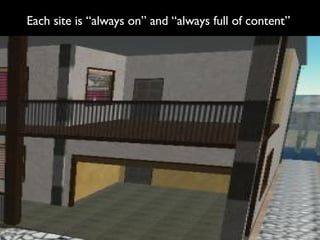
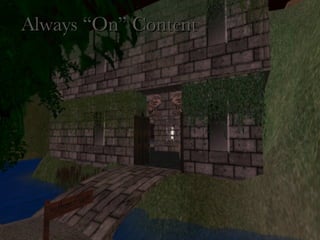
Each site is “always on” and “always full of content”
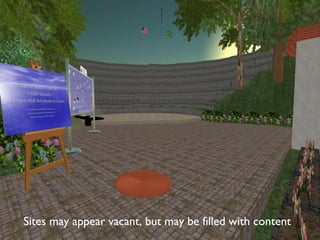
Sites may appear vacant, but may be filled with content
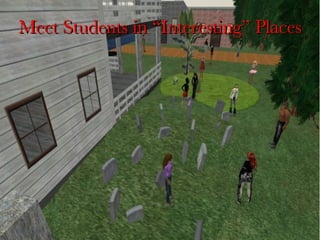
Meet Students in “Interesting” Places
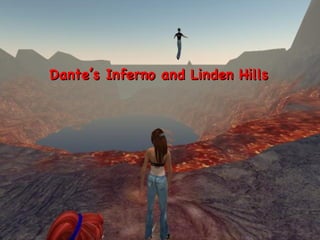
Second Life permits the use of unconventional educational settings and hands-on experiences that would be difficult/impossible in Real Life.  Such as…
Dante’s Inferno and Linden Hills
Second Life provides Guided Inquiry,  where experience is central to learning  Scaffolding  of in-world prior experiences through seeking, sieving and synthesizing experiences Decentralization  of the class, where knowledge is created across a community rather than delivered from an individual
In the process, we… Share and exchange  resources, cultural knowledge, stories and experiences Engage in  social exploration  using a multiplicity of  perspectives and points of view Apply  critical thinking  and problem-solving in context and in process Unlearn assumptions  about communities and the “Other”
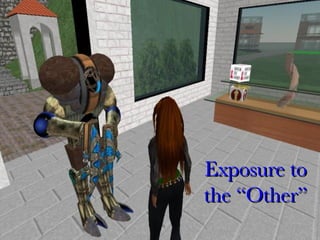
Exposure to the “Other”
But, how do we teach  content  and  skill sets  using Second Life
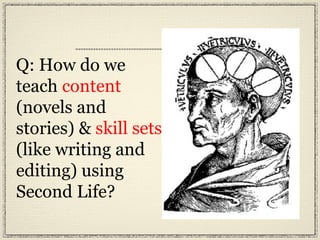
Q: How do we teach  content  (novels and stories) &  skill   sets  (like writing and editing) using Second Life?
Pedagogical considerations: Asynchronous  participation and deep reflection at each user’s pace Synchronous  virtual exchanges to heighten immersion and foster interactions A combination of  mediated ,  situated learning-environments (teacher established challenges) and  free,   evolving  situated learning environments (to experience virtual exploration)
If you build it, they will come
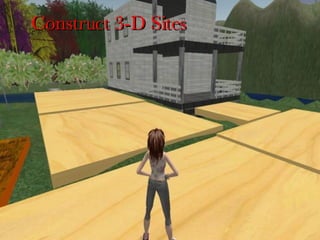
Construct 3-D Sites
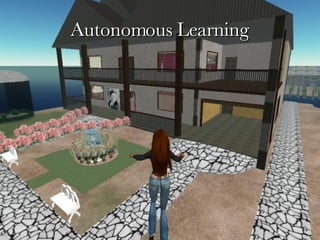
Autonomous Learning
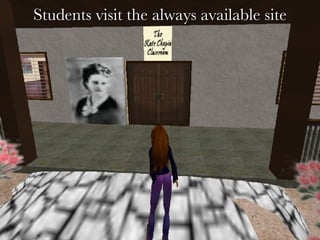
Students visit the always available site
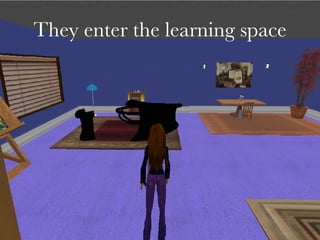
They enter the learning space
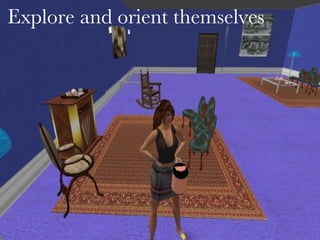
Explore and orient themselves
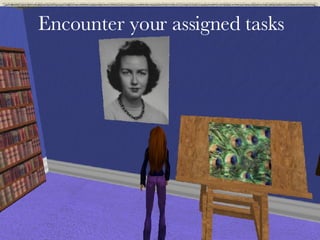
Encounter your assigned tasks
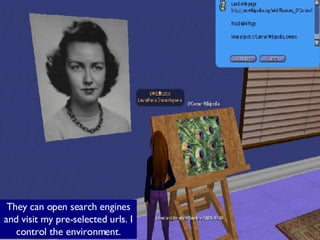
They can open search engines and visit my pre-selected urls. I control the environment.
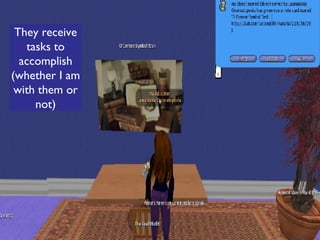
They receive tasks to accomplish (whether I am with them or not)
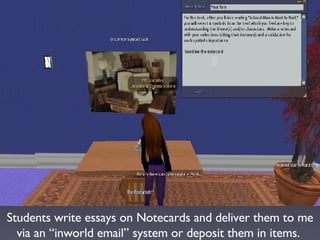
Students write essays on Notecards and deliver them to me via an “inworld email” system or deposit them in items.
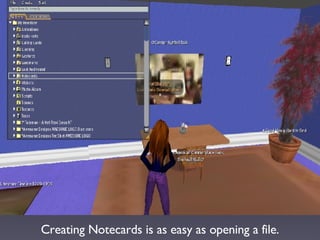
Creating Notecards is as easy as opening a file.
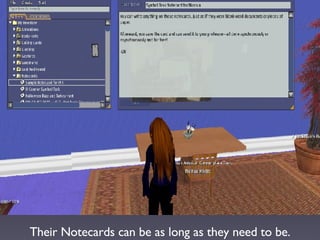
Their Notecards can be as long as they need to be.
An effective virtual learning environment (VLE) may: Supplement  face-to-face interaction  Be used  in combination  with other multi-media (e.g. videoconferences embedded within the SL platform or concomitant with SL) Be an adjunct to  Blackboard  or another more linear, asynchronous interactions with discussion groups and blogs
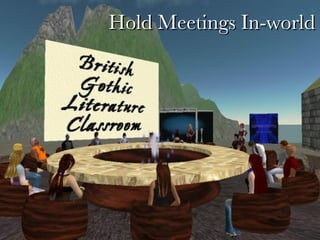
Hold Meetings In-world
Ultimately, We Must Make the environment part of the learning experience—not an end unto itself Enable metacognitive reflection on the SL experience Construct feedback loops and self-renewing frameworks to inform our praxis Investigate the pedagogical successes and failures of using Second life for our classes and disciplines
For discipline-specific  uses of SL in the class: “ 101 Uses for Second Life  in the College Classroom”  Dr. Megan S. Conklin—Elon University http://trumpy.cs.elon.edu/metaverse
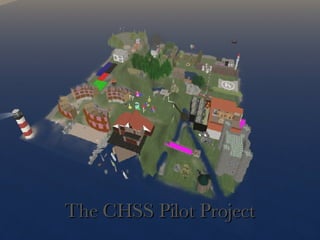
The CHSS Pilot Project
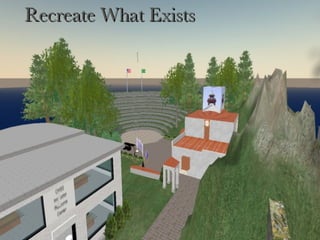
Recreate What Exists
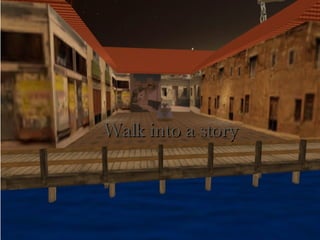
Walk into a story
Always “On” Content
 
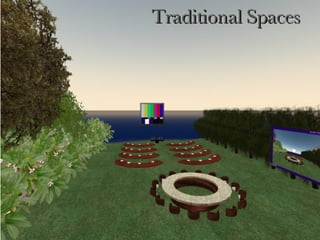
Traditional Spaces
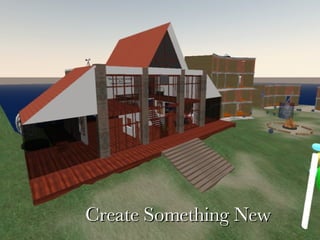
Create Something New
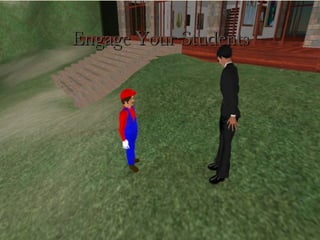
Engage Your Students
Challenges
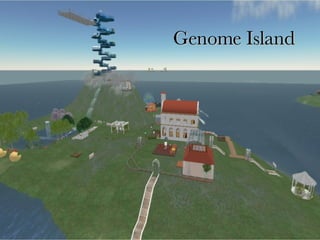
Genome Island
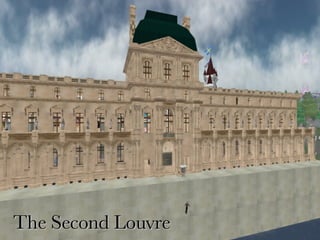
The Second Louvre
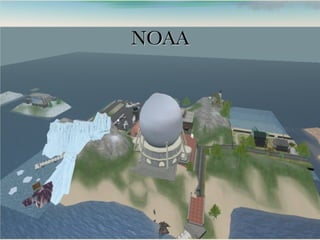
NOAA
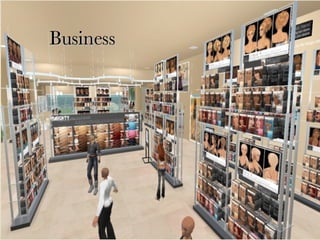
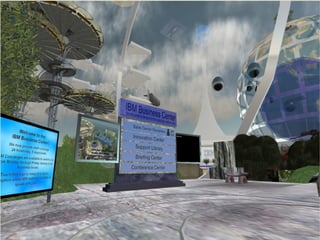
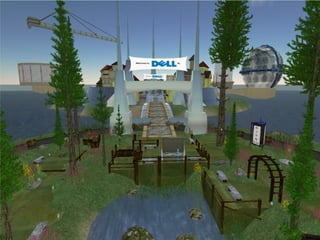
Business
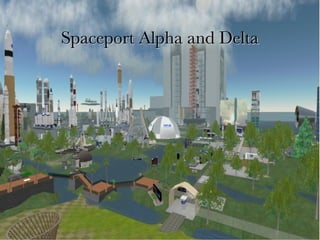
Spaceport Alpha and Delta
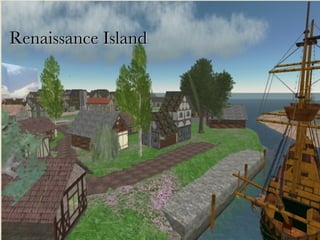
Renaissance Island
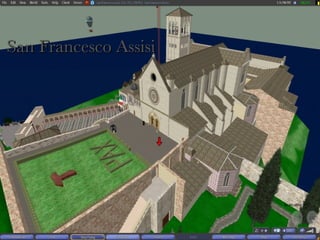
San Francesco Assisi
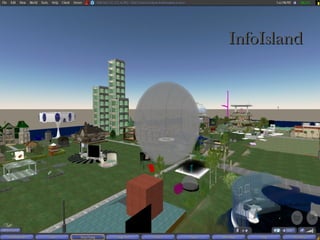
InfoIsland
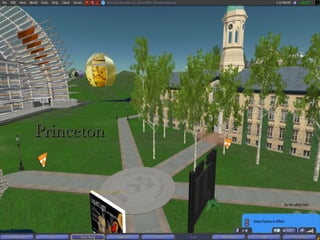
Princeton
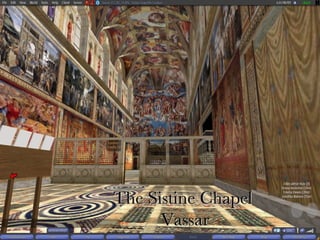
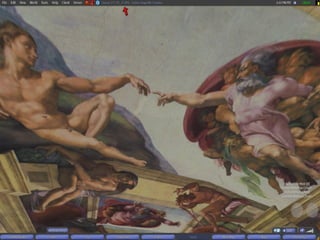
The Sistine Chapel  Vassar
 
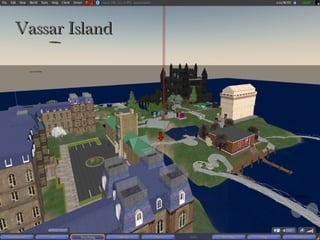
Vassar Island
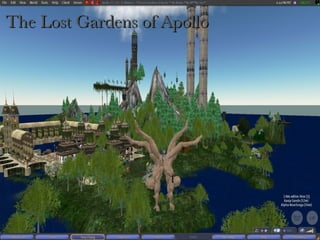
The Lost Gardens of Apollo
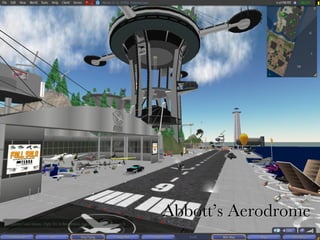
Abbott’s Aerodrome
 
 
?
So many thanks to the numerous educators in Second Life who have shared their Second Life experiences, photographs and thoughts for this presentation! AJ Kelton (SL: AJ Brooks) keltona at mail.montclair.edu http://www.sorry-afk.com Slid eShare: sorry.afk Laura Nicosia (SL: LauraMaria Onomatopoeia) nicosiala at mail.montclair.edu SlideShare: lauranicosia Heidi Trotta (SL: Heidi TeeCee) trottahe at shi.edu http://heiditrotta.com SlideShare: trottahe Riad Twal Twaltiad at shu.edu http://pirate.shu.edu/~twalriad

071116 Ne Connect

  • 1.
    Second Life Dr.Laura Nicosia Assistant Professor English Department AJ Kelton Director CHSS Technology Services Unit College of Humanities and Social Sciences at Montclair State University Teaching, Learning and Technology Center at Seton Hall University Heidi Trotta Instructional Designer Riad Twal Instructional Designer
  • 2.
    What do youalready know about Second Life? Why talk about Second Life?
  • 3.
    What is SecondLife? Started in 2003 “ Second Life is a 3-D virtual world entirely built and owned by its residents.” A flexible space for learning and exploration An opportunity for people to interact in a way that conveys a sense of presence lacking in other media. Generalized rather than contextual, applicable to almost any discipline.
  • 4.
    What is SecondLife? Second life is NOT a game - there are no rules or a fixed goal-oriented purpose. 15-20K sign ups daily - over 10.5 million total 25 - 50K residents on at one time over $1 million spent daily (real US dollars) Well over 200 educational institutions Over 250 “sims” dedicated to education
  • 5.
    What is BehindSecond Life a scaleable co-located grid of servers running Linux Real-time 3D streaming with rigid body physics simulation, streaming positional audio (distance and direction) Persistent desktop access - everything resides on the grid Cross-platform portability Infinite avatar customization - no two avatars alike Uploadable textures, audio, Quicktime video can play in-world. International Language Support - chat and communicate in local languages, inc. Asian character sets. European keyboards supported.
  • 6.
    Technical Requirements Highestspeed connection (no dial up) Best Graphics Card (specific) Windows 2000 / Mac OS X 10.3.9 800MHz Pentium III / 1 GHz G4 512 MB RAM
  • 7.
    A Universe ofVirtual Worlds 22 virtual world platforms listing over 11.8 million users, and that only includes numbers from 7 of the 22 18 virtual worlds for Teens and Tweens listing over 52.3 million users from 12 of the 18 15 virtual worlds for kids listing over 16.7 million users from 9 of the 15 Do the math: 55 virtual platforms w/ 80.8 million users
  • 8.
    Show me themoney “ We don't see any slowing in the market adoption of virtual worlds technologies and expect investment in the space to continue. In fact the market is growing significantly, with the rate of adoption of virtual worlds increasing as the technology matures and has more to offer both consumers and enterprise customers.” Christopher Sherman Executive Director of Virtual Worlds Management
  • 9.
    Pedagogical Validity forTeaching with Second Life
  • 10.
    First, we recognize…There is significant media hype focused on the “darker sides” of the in-world experience - violence, sex, drugs and rock & roll The label of “gaming” poses an image problem for SL insofar as its potential uses in secondary and/or higher education Without proper directions, goals and objectives, SL is as aimless and as pedagogically bereft of meaning as any other poorly designed or poorly deployed classroom lesson
  • 11.
    However, with constructivistpedagogies Comprehension soars when millennials engage with their avatars and co-journey through the learning environment’s unfolding episodes and processes (Dede) Learning communities are fostered Collaborative knowledge-building develops and cognitive capital is distributed among groups and individuals
  • 12.
    Each site is“always on” and “always full of content”
  • 13.
    Sites may appearvacant, but may be filled with content
  • 14.
    Meet Students in“Interesting” Places
  • 15.
    Second Life permitsthe use of unconventional educational settings and hands-on experiences that would be difficult/impossible in Real Life. Such as…
  • 16.
  • 17.
    Second Life providesGuided Inquiry, where experience is central to learning Scaffolding of in-world prior experiences through seeking, sieving and synthesizing experiences Decentralization of the class, where knowledge is created across a community rather than delivered from an individual
  • 18.
    In the process,we… Share and exchange resources, cultural knowledge, stories and experiences Engage in social exploration using a multiplicity of perspectives and points of view Apply critical thinking and problem-solving in context and in process Unlearn assumptions about communities and the “Other”
  • 19.
    Exposure to the“Other”
  • 20.
    But, how dowe teach content and skill sets using Second Life
  • 21.
    Q: How dowe teach content (novels and stories) & skill sets (like writing and editing) using Second Life?
  • 22.
    Pedagogical considerations: Asynchronous participation and deep reflection at each user’s pace Synchronous virtual exchanges to heighten immersion and foster interactions A combination of mediated , situated learning-environments (teacher established challenges) and free, evolving situated learning environments (to experience virtual exploration)
  • 23.
    If you buildit, they will come
  • 24.
  • 25.
  • 26.
    Students visit thealways available site
  • 27.
    They enter thelearning space
  • 28.
  • 29.
  • 30.
    They can opensearch engines and visit my pre-selected urls. I control the environment.
  • 31.
    They receive tasksto accomplish (whether I am with them or not)
  • 32.
    Students write essayson Notecards and deliver them to me via an “inworld email” system or deposit them in items.
  • 33.
    Creating Notecards isas easy as opening a file.
  • 34.
    Their Notecards canbe as long as they need to be.
  • 35.
    An effective virtuallearning environment (VLE) may: Supplement face-to-face interaction Be used in combination with other multi-media (e.g. videoconferences embedded within the SL platform or concomitant with SL) Be an adjunct to Blackboard or another more linear, asynchronous interactions with discussion groups and blogs
  • 36.
  • 37.
    Ultimately, We MustMake the environment part of the learning experience—not an end unto itself Enable metacognitive reflection on the SL experience Construct feedback loops and self-renewing frameworks to inform our praxis Investigate the pedagogical successes and failures of using Second life for our classes and disciplines
  • 38.
    For discipline-specific uses of SL in the class: “ 101 Uses for Second Life in the College Classroom” Dr. Megan S. Conklin—Elon University http://trumpy.cs.elon.edu/metaverse
  • 39.
  • 40.
  • 41.
  • 42.
  • 43.
  • 44.
  • 45.
  • 46.
  • 47.
  • 48.
  • 49.
  • 50.
  • 51.
  • 52.
  • 53.
  • 54.
  • 55.
  • 56.
  • 57.
  • 58.
  • 59.
  • 60.
  • 61.
  • 62.
  • 63.
  • 64.
  • 65.
    So many thanksto the numerous educators in Second Life who have shared their Second Life experiences, photographs and thoughts for this presentation! AJ Kelton (SL: AJ Brooks) keltona at mail.montclair.edu http://www.sorry-afk.com Slid eShare: sorry.afk Laura Nicosia (SL: LauraMaria Onomatopoeia) nicosiala at mail.montclair.edu SlideShare: lauranicosia Heidi Trotta (SL: Heidi TeeCee) trottahe at shi.edu http://heiditrotta.com SlideShare: trottahe Riad Twal Twaltiad at shu.edu http://pirate.shu.edu/~twalriad

Editor's Notes