Secondary 1  Normal Academic Meet The Parents Session
Meet-The-Parents Session 2011  Programme Outline Impact of latest MOE Direction Review of Sec 1 Programmes Secondary 1 Academic Performance Subject Syllabus Update:  1) English Language;  2) Mother Tongue; and  3) Food & Nutrition Use of ICT for Teaching & Learning Programmes for 2012
Impact of latest MOE Direction
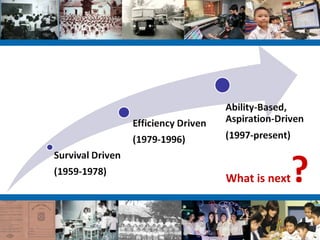
What is next ?
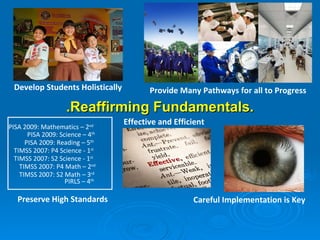
.Reaffirming Fundamentals. Develop Students Holistically Provide Many Pathways for all to Progress PISA 2009: Science – 4 th   PISA 2009: Reading – 5 th   TIMSS 2007: P4 Science - 1 st   PIRLS – 4 th   Preserve High Standards Careful Implementation is Key Effective and Efficient PISA 2009: Mathematics – 2 nd   TIMSS 2007: S2 Science - 1 st   TIMSS 2007: P4 Math – 2 nd   TIMSS 2007: S2 Math – 3 rd
Greater emphasis: Student-Centricity Developing whole person and citizen
 
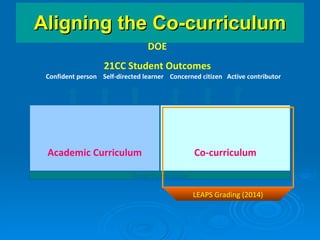
Aligning the Co-curriculum Academic Curriculum Co-curriculum Total Curriculum DOE 21CC Student Outcomes LEAPS Grading (2014) Confident person  Self-directed learner  Concerned citizen  Active contributor
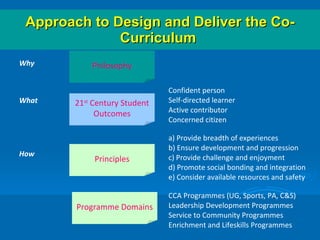
Approach to Design and Deliver the Co-Curriculum   How Why Philosophy What 21 st  Century Student Outcomes Confident person Self-directed learner Active contributor  Concerned citizen Principles Programme   Domains a) Provide breadth of experiences b) Ensure development and progression c) Provide challenge and enjoyment d) Promote social bonding and integration e) Consider available resources and safety CCA Programmes (UG, Sports, PA, C&S) Leadership Development Programmes Service to Community Programmes Enrichment and Lifeskills Programmes
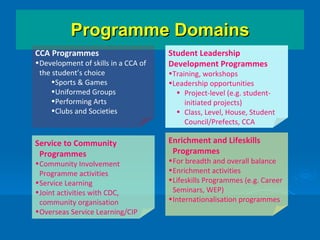
Programme Domains CCA Programmes Development of skills in a CCA of the student’s choice Sports & Games Uniformed Groups Performing Arts Clubs and Societies Student Leadership Development Programmes Training, workshops Leadership opportunities Project-level (e.g. student-initiated projects) Class, Level, House, Student Council/Prefects, CCA Service to Community Programmes Community Involvement Programme activities Service Learning Joint activities with CDC, community organisation Overseas Service Learning/CIP Enrichment and Lifeskills Programmes For breadth and overall balance  Enrichment activities Lifeskills Programmes (e.g. Career Seminars, WEP) Internationalisation programmes
Review of Sec 1 Programmes Orientation Camp Investiture Student Leadership Training E-Learning Week iPW
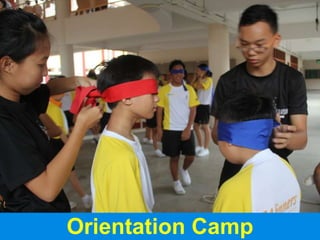
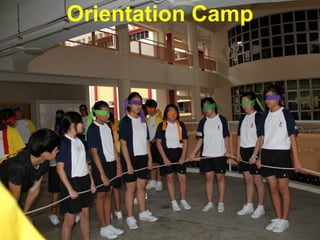
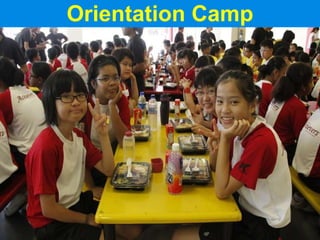
Orientation Camp
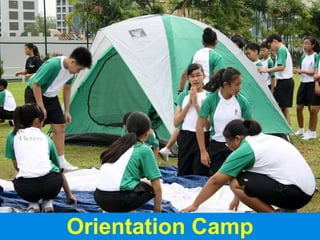
Orientation Camp
Orientation Camp
Orientation Camp
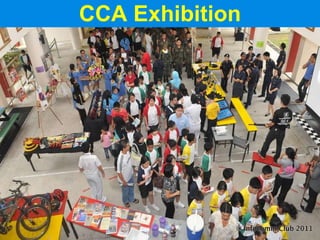
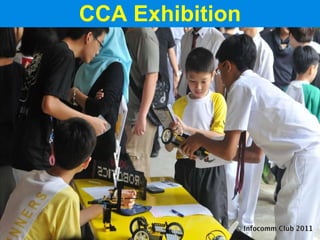
CCA Exhibition
CCA Exhibition
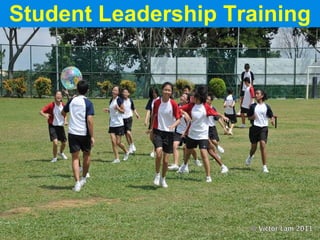
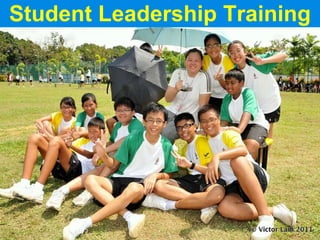
Student Leadership Training
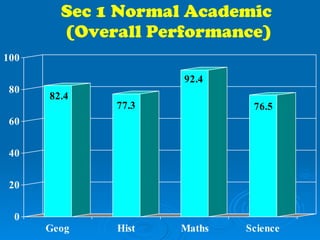
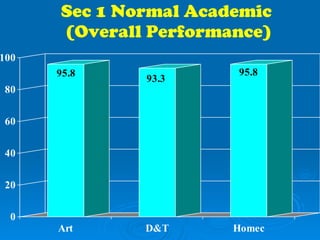
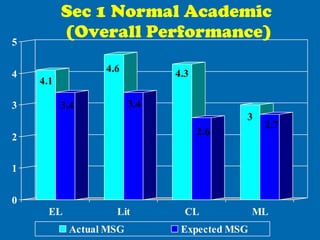
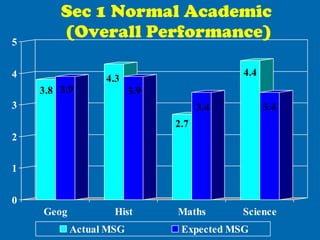
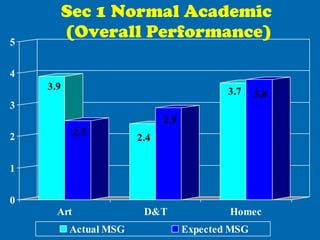
Sec 1N(A) Academic Performance % passes of Subjects Mean Subject Grade (MSG)
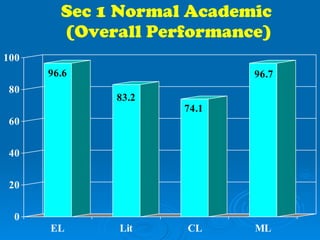
Sec 1 Normal Academic  (Overall Performance)
Syllabus Updates English Language Mother Tongue Food & Nutrition (F&N)
English Language Review
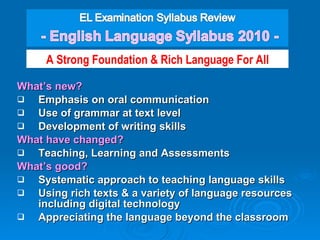
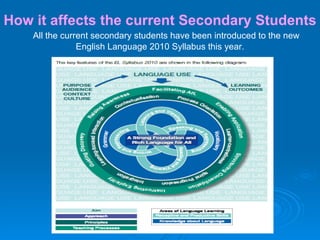
What’s new? Emphasis on oral communication Use of grammar at text level Development of writing skills What have changed? Teaching, Learning and Assessments What’s good? Systematic approach to teaching language skills Using rich texts & a variety of language resources including digital technology  Appreciating the language beyond the classroom A Strong Foundation & Rich Language For All
How it affects the current Secondary Students All the current secondary students have been introduced to the new  English Language 2010 Syllabus this year.
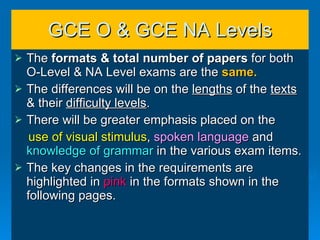
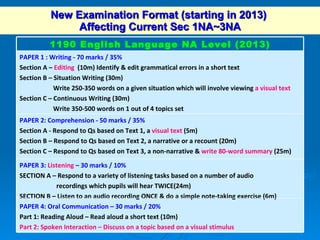
GCE O & GCE NA Levels The  formats & total number of papers  for both O-Level & NA Level exams   are the  same. The differences will be on the  lengths  of the  texts  & their  difficulty levels . There will be greater emphasis placed on the  use of visual stimulus ,  spoken language  and  knowledge of grammar  in the various exam items. The key changes in the requirements are highlighted in  pink  in the formats shown in the following pages.
 
 
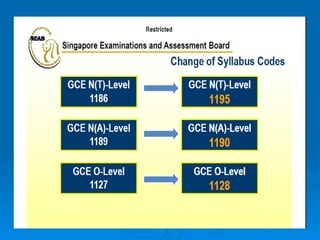
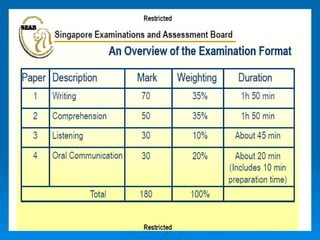
New Examination Format (starting in 2013)  Affecting Current Sec 1NA~3NA 1190 English Language NA Level (2013) PAPER 1 : Writing - 70 marks / 35% Section A –  Editing   (10m) Identify & edit grammatical errors in a short text Section B – Situation Writing (30m)  Write 250-350 words on a given situation which will involve viewing  a visual text Section C – Continuous Writing (30m)  Write 350-500 words on 1 out of 4 topics set PAPER 2: Comprehension - 50 marks / 35% Section A - Respond to Qs based on Text 1, a  visual text  (5m)  Section B – Respond to Qs based on Text 2, a narrative or a recount (20m) Section C – Respond to Qs based on Text 3, a non-narrative &  write 80-word   summary  (25m) PAPER 3:  Listening  – 30 marks / 10% SECTION A – Respond to a variety of listening tasks based on a number of audio  recordings which pupils will hear TWICE(24m) SECTION B – Listen to an audio recording ONCE & do a simple note-taking exercise (6m) PAPER 4: Oral Communication – 30 marks / 20% Part 1: Reading Aloud – Read aloud a short text (10m) Part 2: Spoken Interaction – Discuss on a topic based on a visual stimulus
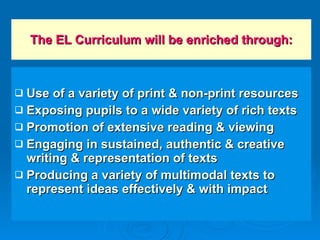
The EL Curriculum will be enriched through: Use of a variety of print & non-print resources Exposing pupils to a wide variety of rich texts Promotion of extensive reading & viewing Engaging in sustained, authentic & creative writing & representation of texts Producing a variety of multimodal texts to represent ideas effectively & with impact
Mother Tongue Language Review
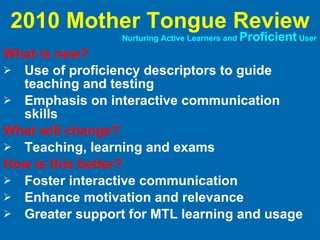
What is new? Use of proficiency descriptors to guide teaching and testing Emphasis on interactive communication skills What will change? Teaching, learning and exams How is this better? Foster interactive communication Enhance motivation and relevance Greater support for MTL learning and usage 2010 Mother Tongue Review Nurturing Active Learners and  Proficient  User
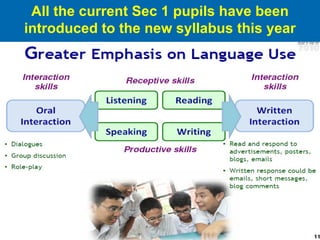
All the current Sec 1 pupils have been introduced to the new syllabus this year
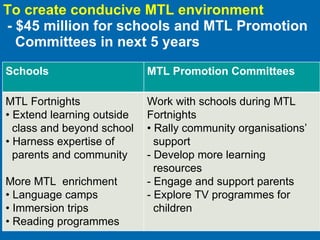
To create conducive MTL environment -  $45 million for schools and MTL Promotion Committees in next 5 years Schools MTL Promotion Committees MTL Fortnights •  Extend learning outside  class and beyond school •  Harness expertise of parents and community More MTL  enrichment •  Language camps •  Immersion trips •  Reading programmes Work with schools during MTL Fortnights •  Rally community organisations’ support - Develop more learning  resources - Engage and support parents - Explore TV programmes for children
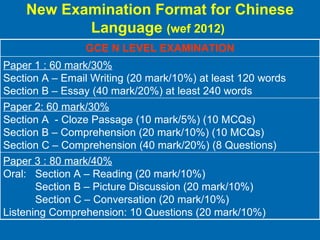
New Examination Format for Chinese Language  (wef 2012)   Paper 2: 60 mark/30% Section A  - Cloze Passage (10 mark/5%) (10 MCQs)  Section B – Comprehension (20 mark/10%) (10 MCQs)  Section C – Comprehension (40 mark/20%) (8 Questions) Paper 1 : 60 mark/30% Section A – Email Writing (20 mark/10%) at least 120 words Section B – Essay (40 mark/20%) at least 240 words Paper 3 : 80 mark/40% Oral: Section A – Reading (20 mark/10%) Section B – Picture Discussion (20 mark/10%) Section C – Conversation (20 mark/10%) Listening Comprehension: 10 Questions (20 mark/10%) GCE N LEVEL EXAMINATION
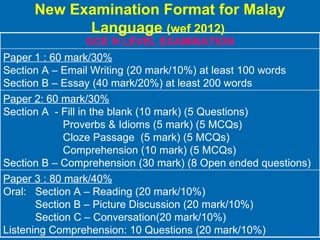
New Examination Format for Malay Language  (wef 2012)   Paper 2: 60 mark/30% Section A  - Fill in the blank (10 mark) (5 Questions) Proverbs & Idioms (5 mark) (5 MCQs) Cloze Passage  (5 mark) (5 MCQs) Comprehension (10 mark) (5 MCQs)  Section B – Comprehension (30 mark) (8 Open ended questions) Paper 1 : 60 mark/30% Section A – Email Writing (20 mark/10%) at least 100 words Section B – Essay (40 mark/20%) at least 200 words Paper 3 : 80 mark/40% Oral: Section A – Reading (20 mark/10%) Section B – Picture Discussion (20 mark/10%) Section C – Conversation(20 mark/10%) Listening Comprehension: 10 Questions (20 mark/10%) GCE N LEVEL EXAMINATION
Food & Nutrition (F&N)
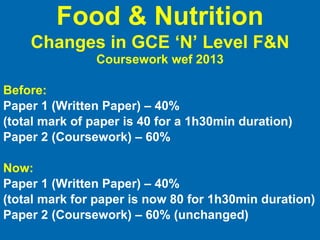
Before: Paper 1 (Written Paper) – 40%  (total mark of paper is 40 for a 1h30min duration) Paper 2 (Coursework) – 60% Now: Paper 1 (Written Paper) – 40%  (total mark for paper is now 80 for 1h30min duration) Paper 2 (Coursework) – 60% (unchanged) Food & Nutrition Changes in GCE ‘N’ Level F&N   Coursework wef 2013
Use of ICT for  Teaching & Learning
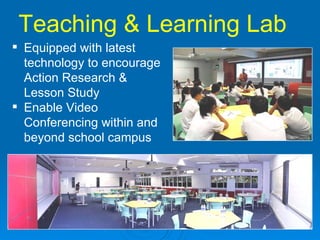
Teaching & Learning Lab Equipped with latest technology to encourage Action Research & Lesson Study Enable Video Conferencing within and beyond school campus
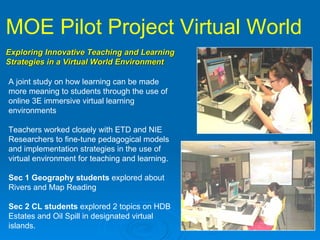
MOE Pilot Project Virtual World   Exploring Innovative Teaching and Learning  Strategies in a Virtual World Environment   A joint study on how learning can be made more meaning to students through the use of online 3E immersive virtual learning environments  Teachers worked closely with ETD and NIE Researchers to fine-tune pedagogical models and implementation strategies in the use of virtual environment for teaching and learning.  Sec 1 Geography students  explored about Rivers and Map Reading Sec 2 CL students  explored 2 topics on HDB Estates and Oil Spill in designated virtual islands.
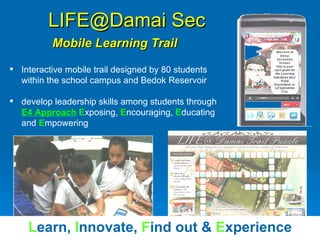
LIFE@Damai Sec   Mobile Learning Trail Interactive mobile trail designed by 80 students within the school campus and Bedok Reservoir develop leadership skills among students through  E4 Approach   E xposing,  E ncouraging,  E ducating and  E mpowering L earn,   I nnovate,   F ind out &  E xperience
Programmes for 2012
Programmes for 2012 Sec 2 Overseas Level Camp Student Leadership Training E-Learning Week iPW Sec 2 Streaming
Thank you Question & Answer

2011 Meet the Parents Session - 1NA (Year-End)

  • 1.
    Secondary 1 Normal Academic Meet The Parents Session
  • 2.
    Meet-The-Parents Session 2011 Programme Outline Impact of latest MOE Direction Review of Sec 1 Programmes Secondary 1 Academic Performance Subject Syllabus Update: 1) English Language; 2) Mother Tongue; and 3) Food & Nutrition Use of ICT for Teaching & Learning Programmes for 2012
  • 3.
    Impact of latestMOE Direction
  • 4.
  • 5.
    .Reaffirming Fundamentals. DevelopStudents Holistically Provide Many Pathways for all to Progress PISA 2009: Science – 4 th PISA 2009: Reading – 5 th TIMSS 2007: P4 Science - 1 st PIRLS – 4 th Preserve High Standards Careful Implementation is Key Effective and Efficient PISA 2009: Mathematics – 2 nd TIMSS 2007: S2 Science - 1 st TIMSS 2007: P4 Math – 2 nd TIMSS 2007: S2 Math – 3 rd
  • 6.
    Greater emphasis: Student-CentricityDeveloping whole person and citizen
  • 7.
  • 8.
    Aligning the Co-curriculumAcademic Curriculum Co-curriculum Total Curriculum DOE 21CC Student Outcomes LEAPS Grading (2014) Confident person Self-directed learner Concerned citizen Active contributor
  • 9.
    Approach to Designand Deliver the Co-Curriculum How Why Philosophy What 21 st Century Student Outcomes Confident person Self-directed learner Active contributor Concerned citizen Principles Programme Domains a) Provide breadth of experiences b) Ensure development and progression c) Provide challenge and enjoyment d) Promote social bonding and integration e) Consider available resources and safety CCA Programmes (UG, Sports, PA, C&S) Leadership Development Programmes Service to Community Programmes Enrichment and Lifeskills Programmes
  • 10.
    Programme Domains CCAProgrammes Development of skills in a CCA of the student’s choice Sports & Games Uniformed Groups Performing Arts Clubs and Societies Student Leadership Development Programmes Training, workshops Leadership opportunities Project-level (e.g. student-initiated projects) Class, Level, House, Student Council/Prefects, CCA Service to Community Programmes Community Involvement Programme activities Service Learning Joint activities with CDC, community organisation Overseas Service Learning/CIP Enrichment and Lifeskills Programmes For breadth and overall balance Enrichment activities Lifeskills Programmes (e.g. Career Seminars, WEP) Internationalisation programmes
  • 11.
    Review of Sec1 Programmes Orientation Camp Investiture Student Leadership Training E-Learning Week iPW
  • 12.
  • 13.
  • 14.
  • 15.
  • 16.
  • 17.
  • 18.
  • 19.
  • 20.
    Sec 1N(A) AcademicPerformance % passes of Subjects Mean Subject Grade (MSG)
  • 21.
    Sec 1 NormalAcademic (Overall Performance)
  • 22.
    Sec 1 NormalAcademic (Overall Performance)
  • 23.
    Sec 1 NormalAcademic (Overall Performance)
  • 24.
    Sec 1 NormalAcademic (Overall Performance)
  • 25.
    Sec 1 NormalAcademic (Overall Performance)
  • 26.
    Sec 1 NormalAcademic (Overall Performance)
  • 27.
    Syllabus Updates EnglishLanguage Mother Tongue Food & Nutrition (F&N)
  • 28.
  • 29.
    What’s new? Emphasison oral communication Use of grammar at text level Development of writing skills What have changed? Teaching, Learning and Assessments What’s good? Systematic approach to teaching language skills Using rich texts & a variety of language resources including digital technology Appreciating the language beyond the classroom A Strong Foundation & Rich Language For All
  • 30.
    How it affectsthe current Secondary Students All the current secondary students have been introduced to the new English Language 2010 Syllabus this year.
  • 31.
    GCE O &GCE NA Levels The formats & total number of papers for both O-Level & NA Level exams are the same. The differences will be on the lengths of the texts & their difficulty levels . There will be greater emphasis placed on the use of visual stimulus , spoken language and knowledge of grammar in the various exam items. The key changes in the requirements are highlighted in pink in the formats shown in the following pages.
  • 32.
  • 33.
  • 34.
    New Examination Format(starting in 2013) Affecting Current Sec 1NA~3NA 1190 English Language NA Level (2013) PAPER 1 : Writing - 70 marks / 35% Section A – Editing (10m) Identify & edit grammatical errors in a short text Section B – Situation Writing (30m) Write 250-350 words on a given situation which will involve viewing a visual text Section C – Continuous Writing (30m) Write 350-500 words on 1 out of 4 topics set PAPER 2: Comprehension - 50 marks / 35% Section A - Respond to Qs based on Text 1, a visual text (5m) Section B – Respond to Qs based on Text 2, a narrative or a recount (20m) Section C – Respond to Qs based on Text 3, a non-narrative & write 80-word summary (25m) PAPER 3: Listening – 30 marks / 10% SECTION A – Respond to a variety of listening tasks based on a number of audio recordings which pupils will hear TWICE(24m) SECTION B – Listen to an audio recording ONCE & do a simple note-taking exercise (6m) PAPER 4: Oral Communication – 30 marks / 20% Part 1: Reading Aloud – Read aloud a short text (10m) Part 2: Spoken Interaction – Discuss on a topic based on a visual stimulus
  • 35.
    The EL Curriculumwill be enriched through: Use of a variety of print & non-print resources Exposing pupils to a wide variety of rich texts Promotion of extensive reading & viewing Engaging in sustained, authentic & creative writing & representation of texts Producing a variety of multimodal texts to represent ideas effectively & with impact
  • 36.
  • 37.
    What is new?Use of proficiency descriptors to guide teaching and testing Emphasis on interactive communication skills What will change? Teaching, learning and exams How is this better? Foster interactive communication Enhance motivation and relevance Greater support for MTL learning and usage 2010 Mother Tongue Review Nurturing Active Learners and Proficient User
  • 38.
    All the currentSec 1 pupils have been introduced to the new syllabus this year
  • 39.
    To create conduciveMTL environment - $45 million for schools and MTL Promotion Committees in next 5 years Schools MTL Promotion Committees MTL Fortnights • Extend learning outside class and beyond school • Harness expertise of parents and community More MTL enrichment • Language camps • Immersion trips • Reading programmes Work with schools during MTL Fortnights • Rally community organisations’ support - Develop more learning resources - Engage and support parents - Explore TV programmes for children
  • 40.
    New Examination Formatfor Chinese Language (wef 2012) Paper 2: 60 mark/30% Section A - Cloze Passage (10 mark/5%) (10 MCQs) Section B – Comprehension (20 mark/10%) (10 MCQs) Section C – Comprehension (40 mark/20%) (8 Questions) Paper 1 : 60 mark/30% Section A – Email Writing (20 mark/10%) at least 120 words Section B – Essay (40 mark/20%) at least 240 words Paper 3 : 80 mark/40% Oral: Section A – Reading (20 mark/10%) Section B – Picture Discussion (20 mark/10%) Section C – Conversation (20 mark/10%) Listening Comprehension: 10 Questions (20 mark/10%) GCE N LEVEL EXAMINATION
  • 41.
    New Examination Formatfor Malay Language (wef 2012) Paper 2: 60 mark/30% Section A - Fill in the blank (10 mark) (5 Questions) Proverbs & Idioms (5 mark) (5 MCQs) Cloze Passage (5 mark) (5 MCQs) Comprehension (10 mark) (5 MCQs) Section B – Comprehension (30 mark) (8 Open ended questions) Paper 1 : 60 mark/30% Section A – Email Writing (20 mark/10%) at least 100 words Section B – Essay (40 mark/20%) at least 200 words Paper 3 : 80 mark/40% Oral: Section A – Reading (20 mark/10%) Section B – Picture Discussion (20 mark/10%) Section C – Conversation(20 mark/10%) Listening Comprehension: 10 Questions (20 mark/10%) GCE N LEVEL EXAMINATION
  • 42.
  • 43.
    Before: Paper 1(Written Paper) – 40% (total mark of paper is 40 for a 1h30min duration) Paper 2 (Coursework) – 60% Now: Paper 1 (Written Paper) – 40% (total mark for paper is now 80 for 1h30min duration) Paper 2 (Coursework) – 60% (unchanged) Food & Nutrition Changes in GCE ‘N’ Level F&N Coursework wef 2013
  • 44.
    Use of ICTfor Teaching & Learning
  • 45.
    Teaching & LearningLab Equipped with latest technology to encourage Action Research & Lesson Study Enable Video Conferencing within and beyond school campus
  • 46.
    MOE Pilot ProjectVirtual World Exploring Innovative Teaching and Learning Strategies in a Virtual World Environment A joint study on how learning can be made more meaning to students through the use of online 3E immersive virtual learning environments Teachers worked closely with ETD and NIE Researchers to fine-tune pedagogical models and implementation strategies in the use of virtual environment for teaching and learning. Sec 1 Geography students explored about Rivers and Map Reading Sec 2 CL students explored 2 topics on HDB Estates and Oil Spill in designated virtual islands.
  • 47.
    LIFE@Damai Sec Mobile Learning Trail Interactive mobile trail designed by 80 students within the school campus and Bedok Reservoir develop leadership skills among students through E4 Approach E xposing, E ncouraging, E ducating and E mpowering L earn, I nnovate, F ind out & E xperience
  • 48.
  • 49.
    Programmes for 2012Sec 2 Overseas Level Camp Student Leadership Training E-Learning Week iPW Sec 2 Streaming
  • 50.