Academic Moot 2017
CURRICULUM-- O-LEVEL ENGLISH 1123
GRADES 9,10 AND 11
PREPARED BY SARA NIAZI (CAPITAL CAMPUS ISLAMABAD)
Programme for Academic Moot 2017
O-Level English (CIE Code:1123)
1st Session: Introduction/Orientation with Curriculum: 9am till 10:30 am
Tea break: 10:30 am till 11:00 am
2nd Session: Paper analysis and group activities: 11:00 am till 1:00 pm
Lunch/Jummah Break: 1:00 pm till 2:00pm
3rd Session: Hands on Marking, Teaching Tips/Strategies, Wrap-up: 2:00 pm till 4:00 pm
 And He taught Adam the names of all things; then He placed them
before the angels, and said: "Tell me the names of these if ye are
right.“ (2:31)
 They said: "Glory to Thee, of knowledge We have none, save what
Thou Hast taught us: In truth it is Thou Who art perfect in knowledge
and wisdom.“ (2:32)
 He said: "O Adam! Tell them their names." When he had told them,
Allah said: "Did I not tell you that I know the secrets of heaven and
earth, and I know what ye reveal and what ye conceal?“ (2:33)
Wisdom…
(taken from ‘Symposium’ written by Plato)
Socrates sat down and said: “It would be very
nice, Agathon, if wisdom were like water, and
flowed by contact out of a person who has
more into one who has less, just as water can
be made to pass through a thread of wool out
of a fuller of two cups into emptier.”
Goal/Objective of Moot
 GOAL:- to develop comprehensive and integrated understanding of
CIE curriculum in correspondence with CIE syllabus, through
exercising interactive skills in a proactive session.
 Objectives: to be able to devise strategies and methodologies to
execute the lesson plans to develop skills in students to obtain
optimum results in CIE.
Session 1:
Introduction and Orientation with
Curriculum (90 mins)
TCS Curriculum– (salient features)
English Language 1123
 Is entirely based on CIE curriculum (www.cie.org.uk)
 Is to be covered in 3 academic sessions beginning from grade 9 and
finishing in Grade 11(which is the out-going year)
 Separate SOW (breakup of the syllabus) for each grade, which is totally
based on the content of CIE curriculum
 Teachers need to study the curriculum breakup very carefully and execute
their yearly, monthly, weekly and daily lesson plans according to the
contents provided; however teachers may tailor the sequence as per
requirement.
 Teachers may incorporate additional material or reference texts apart
from the endorsed text books
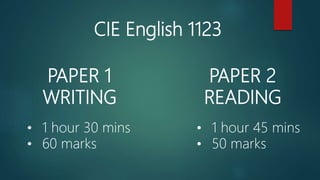
CIE English 1123
PAPER 1
WRITING
PAPER 2
READING
• 1 hour 30 mins
• 60 marks
• 1 hour 45 mins
• 50 marks
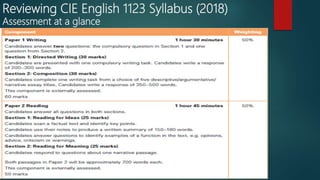
Reviewing CIE English 1123 Syllabus (2018)
Assessment at a glance
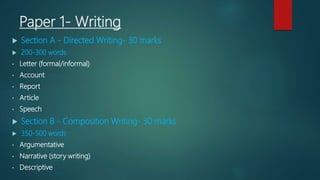
Paper 1- Writing
 Section A - Directed Writing- 30 marks
 200-300 words
• Letter (formal/informal)
• Account
• Report
• Article
• Speech
 Section B - Composition Writing- 30 marks
 350-500 words
• Argumentative
• Narrative (story writing)
• Descriptive
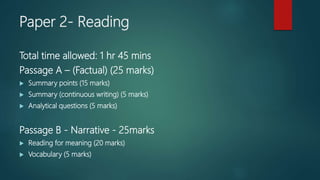
Paper 2- Reading
Total time allowed: 1 hr 45 mins
Passage A – (Factual) (25 marks)
 Summary points (15 marks)
 Summary (continuous writing) (5 marks)
 Analytical questions (5 marks)
Passage B - Narrative - 25marks
 Reading for meaning (20 marks)
 Vocabulary (5 marks)
Session 2:
Paper Analysis and Group Activities (120
mins)
Tasks as per
Assessment Objectives
AO1- Reading Objectives
 R1- Demonstrate understanding of explicit meanings
 R2- Demonstrate understanding of implicit meanings and
attitudes
 R3- Analyse, evaluate and develop facts, ideas and
opinions
 R4- Demonstrate understanding of how writers achieve
effects
 R5- Select for specific purposes
R1- Demonstrate understanding of explicit meanings
 Acquisition of variety of vocabulary- learning and practicing themed
based words, knowing their literal meanings
 Variety of worksheets based on precise, strong and authentic
vocabulary practice
 Comprehension practice including ‘explicit meanings’ i.e. direct
meanings of words, phrases and ideas- analyzing texts
 Creating sentences, paragraphs and larger content consisting
techniques of explicit meanings
R2- Demonstrate understanding of implicit (indirect)
meanings and attitudes
 Writing techniques for understanding and creating implicit texts
 Learning different types of figurative language/techniques and their
use to create implicit meanings
 Analyzing texts with implicit (indirect) meaning
 Inferential skills
 Creating sentences, paragraphs and larger content consisting
techniques of implicit meanings
R3- Analyze, evaluate and develop facts,
ideas and opinions
 Reading and analyzing different types of text materials
 Knowing the difference between opinion and facts
 Formation/developing ideas on the basis of facts and
opinion
 Reproducing and interpreting the analyzed text material
in ‘own words’ (OW)
R4- Demonstrate understanding of how
writers achieve effects
 Applied in creating short answers for passage 2 (narrative)
 Practicing narrative passages:- identifying nuances of
language, literary devices and techniques
 Analyzing critically and interpreting the different effects
created in narrative content
 Adequate and precise vocabulary required for
interpretation- practicing variety of vocabulary
AO2- Writing Objectives
 W1 Articulate experience and express what is thought,
felt and imagined
 W2 Sequence facts, ideas and opinions
 W3 Use a range of appropriate vocabulary
 W4 Use register appropriate to audience and context
 W5 Make accurate use of spelling, punctuation and
grammar
All writing objectives
W1, W2, W3, W4, W5
 All writing objectives need to be covered in all writing tasks
 Developing and creating ideas- Mind maps, drafting, discussions
 Creative writing- argumentative, narrative and descriptive writing
techniques and elements- sensory words, figurative language,
idiomatic phrases/words, precise and active vocabulary
 Different styles of directed and creative (composition) writing:
essay, story, account, article, letters, reports and speech
Core areas to focus in Paper 1-
Sec. A Directed Writing
 Basic concepts about grammar, punctuation, sentence structure, variety of sentences
 Use of appropriate, strong and precise vocabulary :- phrasal verbs, idiomatic
phrases, conjunctions, subordinating conjunction, interjections, transitional verbs.
 Comprehension and fulfillment of task :- understanding the question and answering
techniques
 Formats of different types of 'directed writings' :- letters, report, account, article,
speech
 CIE Exam Mark schemes and bands
 CIE examiners requirements :- reviewing past papers and examiners reports
Core areas to focus in Paper 1-
Sec B Creative Writing
Different genres of writing :- Argumentative,
narrative, descriptive, one-word
Variety of sentence structure
Precise and appropriate language :- strong verbs,
adjectives, phrasal verbs,
Types of questions and development of skills:
(for 2018 syllabus)
 Writing:
Directed
Composition
 Reading
Reading for Ideas
Reading for Meaning
SKILLS
• Inferential Skill
• Construction of compound, complex
and compound –complex sentences
• Effective use of figurative language
• Responding with reasons
• Evidence based judgments
• Accurate use of spelling, grammar,
and punctuation
Activity: analysis of Paper 1/Designing question
After a thorough analysis of section A of Paper 1
(writing) the participants will design directed writing
questions on their own.
Each group will design a different directed ‘type’ of
directed question e.g. one group will design a formal
letter question another may design a question on
account
Activity: analysis of Paper 1/Designing question
After analyzing Section B of Paper 1 (writing) the
participants will design composition questions on their
own.
Each group will design a different ‘type’ of composition
question e.g. one group will design a Narrative
question another may design a Descriptive one.
Activity: Designing questions after reading a factual
and narrative texts
 Participants will be two short passages one will be factual and the
other narrative
 They will create short 3 questions of different kinds on each of the
following texts
Session 3:
Hands on Marking, Teaching Tips/Strategies,
Wrap-up
Marking Paper 1- Writing
Marking scheme to be analyzed
Different responses to be identified according to
band scheme
Marking Paper 2- Reading
Marking scheme to be analyzed
Different responses to be identified according to
band scheme
Precision of response to be specially focused
How can teachers create active learners in the
classroom? Discuss
 Creating a positive learning environment
 Encouraging intellectual curiosity
 Encouraging learners to take risk
 Developing resilient learners
 When planning lessons thinking about skills as well as
content
Activity1:
Developing discursive through active learning
 Exploring questions on different levels: questions that open up
wider implications
 Learning to ask more abstract or philosophical questions
 Building a chain of enquiry through promoting independent
research
 Asking reflective questions to reinforce own understanding
See, think, wonder
See, think, wonder
What links the two pictures?
Developing descriptive writing through
collaborative writing tasks:
 In groups
 When the picture appears on the screen, observe, and
write a sentence describing an aspect of the picture on a
paper
 Remember to use your senses to describe what you see
 Use figurative language
To get started…
 Description A:
Below the bridge passes the
stream.
 Description B:
The silent stream secretly
passes beneath the still
bridge, that mischievously
connects the two sinister
ends.
Developing narrative writing skills
through slow writing:
What is slow writing?
Slow writing is an approach to teaching writing that
slows the writing process down and demands that
students give care and attention to each word,
sentence and paragraph. Students use double spacing
so that they can edit and refine their writing.
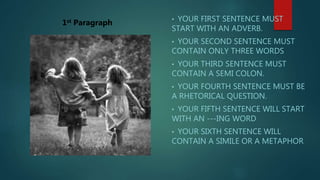
• YOUR FIRST SENTENCE MUST
START WITH AN ADVERB.
• YOUR SECOND SENTENCE MUST
CONTAIN ONLY THREE WORDS
• YOUR THIRD SENTENCE MUST
CONTAIN A SEMI COLON.
• YOUR FOURTH SENTENCE MUST BE
A RHETORICAL QUESTION.
• YOUR FIFTH SENTENCE WILL START
WITH AN ---ING WORD
• YOUR SIXTH SENTENCE WILL
CONTAIN A SIMILE OR A METAPHOR
1st Paragraph
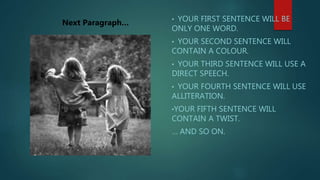
• YOUR FIRST SENTENCE WILL BE
ONLY ONE WORD.
• YOUR SECOND SENTENCE WILL
CONTAIN A COLOUR.
• YOUR THIRD SENTENCE WILL USE A
DIRECT SPEECH.
• YOUR FOURTH SENTENCE WILL USE
ALLITERATION.
•YOUR FIFTH SENTENCE WILL
CONTAIN A TWIST.
… AND SO ON.
Next Paragraph…
How does the design of activities help
learning?
 Interest
 Competence
 Autonomy
 Supportiveness
 Building ideas
 Reflection
Plenary/Reflect and share
 What we have done today will hopefully have identified for you
some starting points for future course development
CIE Support links:
infor@cie.org.uk
www.cie.org.uk
www.facebook.com/cie.org.uk
Twitter- @CIE_Education
#cambridgetraining
teach to make them “think”
Thank you

Academic moot 2017

  • 1.
    Academic Moot 2017 CURRICULUM--O-LEVEL ENGLISH 1123 GRADES 9,10 AND 11 PREPARED BY SARA NIAZI (CAPITAL CAMPUS ISLAMABAD)
  • 2.
    Programme for AcademicMoot 2017 O-Level English (CIE Code:1123) 1st Session: Introduction/Orientation with Curriculum: 9am till 10:30 am Tea break: 10:30 am till 11:00 am 2nd Session: Paper analysis and group activities: 11:00 am till 1:00 pm Lunch/Jummah Break: 1:00 pm till 2:00pm 3rd Session: Hands on Marking, Teaching Tips/Strategies, Wrap-up: 2:00 pm till 4:00 pm
  • 3.
     And Hetaught Adam the names of all things; then He placed them before the angels, and said: "Tell me the names of these if ye are right.“ (2:31)  They said: "Glory to Thee, of knowledge We have none, save what Thou Hast taught us: In truth it is Thou Who art perfect in knowledge and wisdom.“ (2:32)  He said: "O Adam! Tell them their names." When he had told them, Allah said: "Did I not tell you that I know the secrets of heaven and earth, and I know what ye reveal and what ye conceal?“ (2:33)
  • 4.
    Wisdom… (taken from ‘Symposium’written by Plato) Socrates sat down and said: “It would be very nice, Agathon, if wisdom were like water, and flowed by contact out of a person who has more into one who has less, just as water can be made to pass through a thread of wool out of a fuller of two cups into emptier.”
  • 5.
    Goal/Objective of Moot GOAL:- to develop comprehensive and integrated understanding of CIE curriculum in correspondence with CIE syllabus, through exercising interactive skills in a proactive session.  Objectives: to be able to devise strategies and methodologies to execute the lesson plans to develop skills in students to obtain optimum results in CIE.
  • 6.
    Session 1: Introduction andOrientation with Curriculum (90 mins)
  • 7.
    TCS Curriculum– (salientfeatures) English Language 1123  Is entirely based on CIE curriculum (www.cie.org.uk)  Is to be covered in 3 academic sessions beginning from grade 9 and finishing in Grade 11(which is the out-going year)  Separate SOW (breakup of the syllabus) for each grade, which is totally based on the content of CIE curriculum  Teachers need to study the curriculum breakup very carefully and execute their yearly, monthly, weekly and daily lesson plans according to the contents provided; however teachers may tailor the sequence as per requirement.  Teachers may incorporate additional material or reference texts apart from the endorsed text books
  • 8.
    CIE English 1123 PAPER1 WRITING PAPER 2 READING • 1 hour 30 mins • 60 marks • 1 hour 45 mins • 50 marks
  • 9.
    Reviewing CIE English1123 Syllabus (2018) Assessment at a glance
  • 10.
    Paper 1- Writing Section A - Directed Writing- 30 marks  200-300 words • Letter (formal/informal) • Account • Report • Article • Speech  Section B - Composition Writing- 30 marks  350-500 words • Argumentative • Narrative (story writing) • Descriptive
  • 11.
    Paper 2- Reading Totaltime allowed: 1 hr 45 mins Passage A – (Factual) (25 marks)  Summary points (15 marks)  Summary (continuous writing) (5 marks)  Analytical questions (5 marks) Passage B - Narrative - 25marks  Reading for meaning (20 marks)  Vocabulary (5 marks)
  • 12.
    Session 2: Paper Analysisand Group Activities (120 mins)
  • 13.
  • 14.
    AO1- Reading Objectives R1- Demonstrate understanding of explicit meanings  R2- Demonstrate understanding of implicit meanings and attitudes  R3- Analyse, evaluate and develop facts, ideas and opinions  R4- Demonstrate understanding of how writers achieve effects  R5- Select for specific purposes
  • 15.
    R1- Demonstrate understandingof explicit meanings  Acquisition of variety of vocabulary- learning and practicing themed based words, knowing their literal meanings  Variety of worksheets based on precise, strong and authentic vocabulary practice  Comprehension practice including ‘explicit meanings’ i.e. direct meanings of words, phrases and ideas- analyzing texts  Creating sentences, paragraphs and larger content consisting techniques of explicit meanings
  • 16.
    R2- Demonstrate understandingof implicit (indirect) meanings and attitudes  Writing techniques for understanding and creating implicit texts  Learning different types of figurative language/techniques and their use to create implicit meanings  Analyzing texts with implicit (indirect) meaning  Inferential skills  Creating sentences, paragraphs and larger content consisting techniques of implicit meanings
  • 17.
    R3- Analyze, evaluateand develop facts, ideas and opinions  Reading and analyzing different types of text materials  Knowing the difference between opinion and facts  Formation/developing ideas on the basis of facts and opinion  Reproducing and interpreting the analyzed text material in ‘own words’ (OW)
  • 18.
    R4- Demonstrate understandingof how writers achieve effects  Applied in creating short answers for passage 2 (narrative)  Practicing narrative passages:- identifying nuances of language, literary devices and techniques  Analyzing critically and interpreting the different effects created in narrative content  Adequate and precise vocabulary required for interpretation- practicing variety of vocabulary
  • 19.
    AO2- Writing Objectives W1 Articulate experience and express what is thought, felt and imagined  W2 Sequence facts, ideas and opinions  W3 Use a range of appropriate vocabulary  W4 Use register appropriate to audience and context  W5 Make accurate use of spelling, punctuation and grammar
  • 20.
    All writing objectives W1,W2, W3, W4, W5  All writing objectives need to be covered in all writing tasks  Developing and creating ideas- Mind maps, drafting, discussions  Creative writing- argumentative, narrative and descriptive writing techniques and elements- sensory words, figurative language, idiomatic phrases/words, precise and active vocabulary  Different styles of directed and creative (composition) writing: essay, story, account, article, letters, reports and speech
  • 21.
    Core areas tofocus in Paper 1- Sec. A Directed Writing  Basic concepts about grammar, punctuation, sentence structure, variety of sentences  Use of appropriate, strong and precise vocabulary :- phrasal verbs, idiomatic phrases, conjunctions, subordinating conjunction, interjections, transitional verbs.  Comprehension and fulfillment of task :- understanding the question and answering techniques  Formats of different types of 'directed writings' :- letters, report, account, article, speech  CIE Exam Mark schemes and bands  CIE examiners requirements :- reviewing past papers and examiners reports
  • 22.
    Core areas tofocus in Paper 1- Sec B Creative Writing Different genres of writing :- Argumentative, narrative, descriptive, one-word Variety of sentence structure Precise and appropriate language :- strong verbs, adjectives, phrasal verbs,
  • 23.
    Types of questionsand development of skills: (for 2018 syllabus)  Writing: Directed Composition  Reading Reading for Ideas Reading for Meaning SKILLS • Inferential Skill • Construction of compound, complex and compound –complex sentences • Effective use of figurative language • Responding with reasons • Evidence based judgments • Accurate use of spelling, grammar, and punctuation
  • 24.
    Activity: analysis ofPaper 1/Designing question After a thorough analysis of section A of Paper 1 (writing) the participants will design directed writing questions on their own. Each group will design a different directed ‘type’ of directed question e.g. one group will design a formal letter question another may design a question on account
  • 25.
    Activity: analysis ofPaper 1/Designing question After analyzing Section B of Paper 1 (writing) the participants will design composition questions on their own. Each group will design a different ‘type’ of composition question e.g. one group will design a Narrative question another may design a Descriptive one.
  • 26.
    Activity: Designing questionsafter reading a factual and narrative texts  Participants will be two short passages one will be factual and the other narrative  They will create short 3 questions of different kinds on each of the following texts
  • 27.
    Session 3: Hands onMarking, Teaching Tips/Strategies, Wrap-up
  • 28.
    Marking Paper 1-Writing Marking scheme to be analyzed Different responses to be identified according to band scheme
  • 29.
    Marking Paper 2-Reading Marking scheme to be analyzed Different responses to be identified according to band scheme Precision of response to be specially focused
  • 30.
    How can teacherscreate active learners in the classroom? Discuss  Creating a positive learning environment  Encouraging intellectual curiosity  Encouraging learners to take risk  Developing resilient learners  When planning lessons thinking about skills as well as content
  • 31.
    Activity1: Developing discursive throughactive learning  Exploring questions on different levels: questions that open up wider implications  Learning to ask more abstract or philosophical questions  Building a chain of enquiry through promoting independent research  Asking reflective questions to reinforce own understanding
  • 32.
  • 33.
  • 34.
    What links thetwo pictures?
  • 35.
    Developing descriptive writingthrough collaborative writing tasks:  In groups  When the picture appears on the screen, observe, and write a sentence describing an aspect of the picture on a paper  Remember to use your senses to describe what you see  Use figurative language
  • 37.
    To get started… Description A: Below the bridge passes the stream.  Description B: The silent stream secretly passes beneath the still bridge, that mischievously connects the two sinister ends.
  • 38.
    Developing narrative writingskills through slow writing: What is slow writing? Slow writing is an approach to teaching writing that slows the writing process down and demands that students give care and attention to each word, sentence and paragraph. Students use double spacing so that they can edit and refine their writing.
  • 39.
    • YOUR FIRSTSENTENCE MUST START WITH AN ADVERB. • YOUR SECOND SENTENCE MUST CONTAIN ONLY THREE WORDS • YOUR THIRD SENTENCE MUST CONTAIN A SEMI COLON. • YOUR FOURTH SENTENCE MUST BE A RHETORICAL QUESTION. • YOUR FIFTH SENTENCE WILL START WITH AN ---ING WORD • YOUR SIXTH SENTENCE WILL CONTAIN A SIMILE OR A METAPHOR 1st Paragraph
  • 40.
    • YOUR FIRSTSENTENCE WILL BE ONLY ONE WORD. • YOUR SECOND SENTENCE WILL CONTAIN A COLOUR. • YOUR THIRD SENTENCE WILL USE A DIRECT SPEECH. • YOUR FOURTH SENTENCE WILL USE ALLITERATION. •YOUR FIFTH SENTENCE WILL CONTAIN A TWIST. … AND SO ON. Next Paragraph…
  • 41.
    How does thedesign of activities help learning?  Interest  Competence  Autonomy  Supportiveness  Building ideas  Reflection
  • 42.
    Plenary/Reflect and share What we have done today will hopefully have identified for you some starting points for future course development
  • 43.
  • 44.
    teach to makethem “think” Thank you

Editor's Notes