Y5C10 ENTREPRENEURSHIP IN
MICROBIOLOGY
Unit – IV Macroalgae cultivation
Dr. S. Sivasankara Narayani
Assistant Professor
Department of Microbiology
Ayya Nadar Janaki Ammal College
Sivakasi
TamilNadu
India
25-08-2020Dr.SS
Intro
 Macroscopic marine algae form an important living resource of the oceans.
 Seaweeds are food important for humans and animals, as well as fertilizers for plants and a source of various chemicals.
 Seaweeds have been gaining momentum as a new experimental system for biological research and as an integral part of integrated
aquaculture systems.
 We all use seaweed products in our day-to-day life in some way or other.
 For example, some seaweed polysaccharides are used in toothpaste, soap, shampoo, cosmetics, milk, ice cream, meat, processed food, air
freshener, and many other items.
 In many oriental countries such as Japan, China, Korea, and others, seaweeds are diet staples.
25-08-2020Dr.SS
Farming Methods
 onestep farming through vegetative propagation
 two-step or multistep farming
25-08-2020Dr.SS
IN VEGETATIVE CULTIVATION
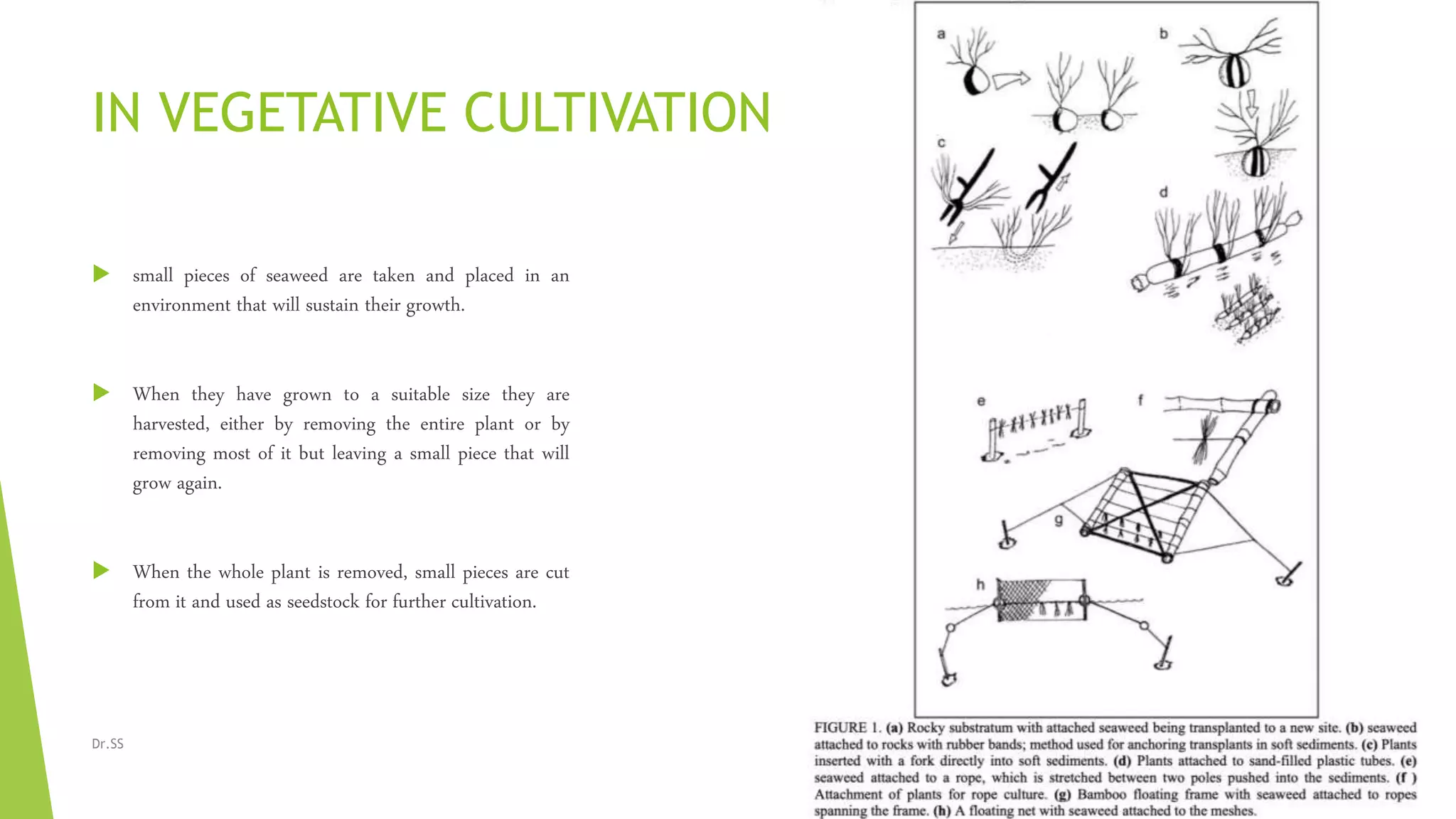
 small pieces of seaweed are taken and placed in an
environment that will sustain their growth.
 When they have grown to a suitable size they are
harvested, either by removing the entire plant or by
removing most of it but leaving a small piece that will
grow again.
 When the whole plant is removed, small pieces are cut
from it and used as seedstock for further cultivation.
25-08-2020Dr.SS
LAND-BASED CULTIVATION SYSTEMS
 TANKS
 PONDS
25-08-2020Dr.SS
TANKS
 a steady stream of aeration and seawater.
 The aeration provides vigorous water movement in the tanks, sending the algal thalli up and down in the water
column in a circular pattern.
 This vigorous aeration permits rapid uptake of dissolved carbon dioxide, and bringing the biomass to the
surface into the light.
 greatest productivity
 . Efficiency input of various types of energy (compressed air for bubbling, CO2, and pumping water) and
nutrients.
25-08-2020Dr.SS
TANKS
 Carbon supply can be improved by either pumping more seawater or by adding CO2.
 The temperature and salinity also can be manipulated by pumping more seawater.
 The pH of the tanks should be managed in the range of 7.9 to 8.3,
 the nutrient status of the medium must be monitored.
 Tanks should be cleaned regularly and epiphytes must be controlled.
 Tank systems also may hold promise for the processing of polluted water for specific products, the removal of extra nutrients from
wastewater, or for energy production.
25-08-2020Dr.SS
PONDS
 Macroalgae can also be grown in ponds.
 An advantage of this approach is the low-operating costs.
 Generally, water exchange in the ponds is accomplished by use of tide gates.
 Seaweed yields are low because of the lack of water movement in the ponds and the low exchanges of water.
 Tank systems are usually in smaller modules that allow a predictable maintenance schedule, several steps however, can be
precisely controlled and managed to reduce the labor input, although this type of system has high operational costs.
 Ponds are larger, and a significant outbreak of epiphytes or other weedy species may be much harder to bring under control.
25-08-2020Dr.SS
SEAWEED CULTIVATION IN THE SEA
 Long-Line Cultivation Systems
 Net-Style Farm Systems
 Line and Rope Farm Systems
 Offshore or Deep-Water Seaweed Cultivation
25-08-2020Dr.SS
Long-Line Cultivation Systems
 In the 1950s, China - Laminaria.
 sporelings (“seedlings”) are produced in cooled water in greenhouses and later planted out in the ocean
 For cultivation, Laminaria must go through its life cycle, and this involves an alternation of generations between a large
sporophyte
 sporophyte seaweed- and a microscopic gametophyte. T
 he mature sporophytes form sori -surface organs where sporangia are produced- motile zoospores are released.
 To stimulate zoospore release, a selected parent Laminaria plants are dried for a few hours and placed in the seeding
container which is filled with cool seawater.
25-08-2020Dr.SS
Cont…
 The seed string (a synthetic twine of 2 to 6 mm in diameter or palm line 6 mm in diameter) is placed on the bottom of the
same container.
 Released zoospores are attached to the strings and germinate into male and female gametophytes.
 As the gametophytes become fertile, they release sperm and eggs that join to form zygotes which attach themselves to the
collectors – i.e. the same substrate materials - and develop into seedlings or sporelings.
 The seedlings - young sporophyte plants.
25-08-2020Dr.SS
Cont…
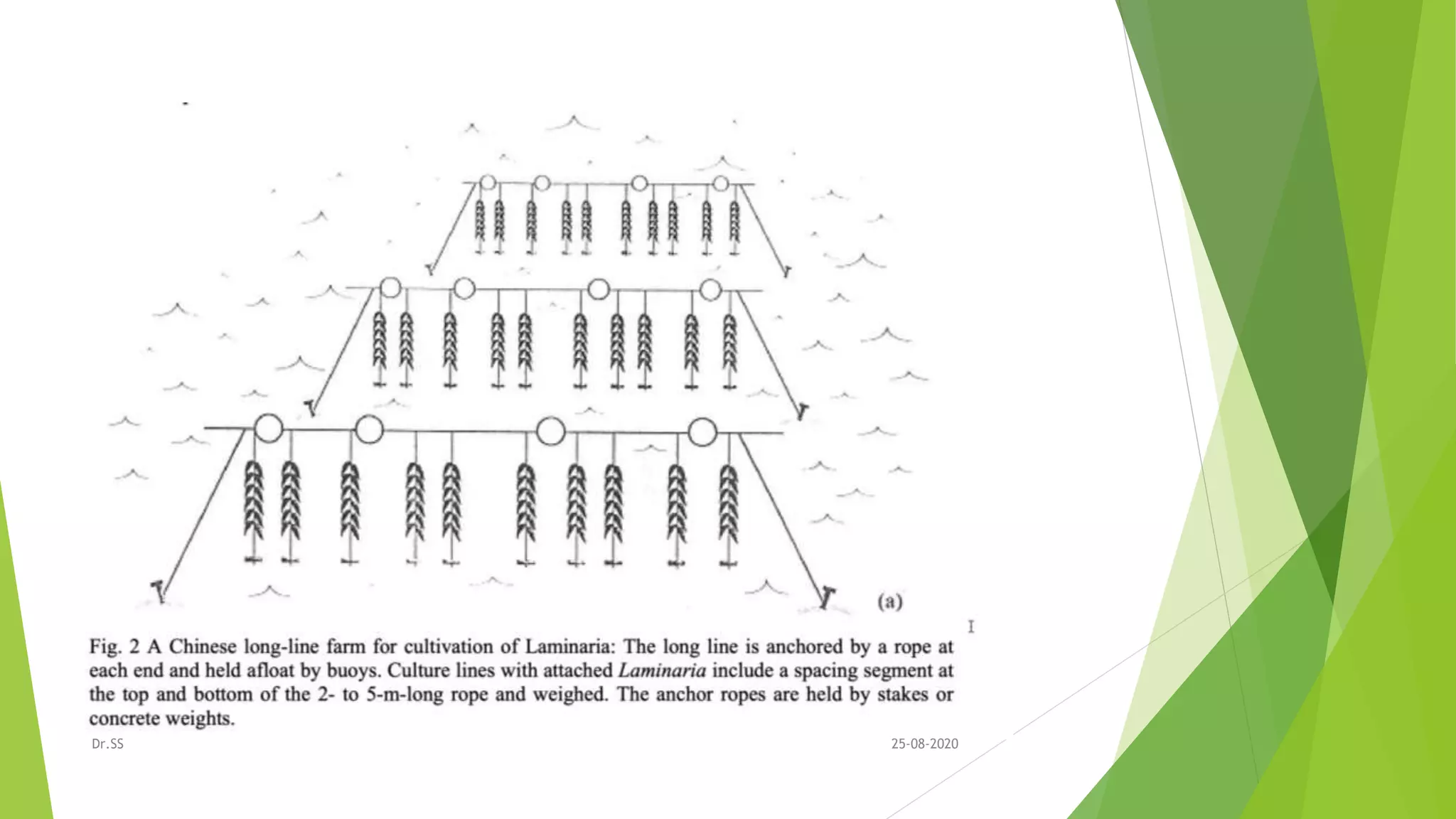
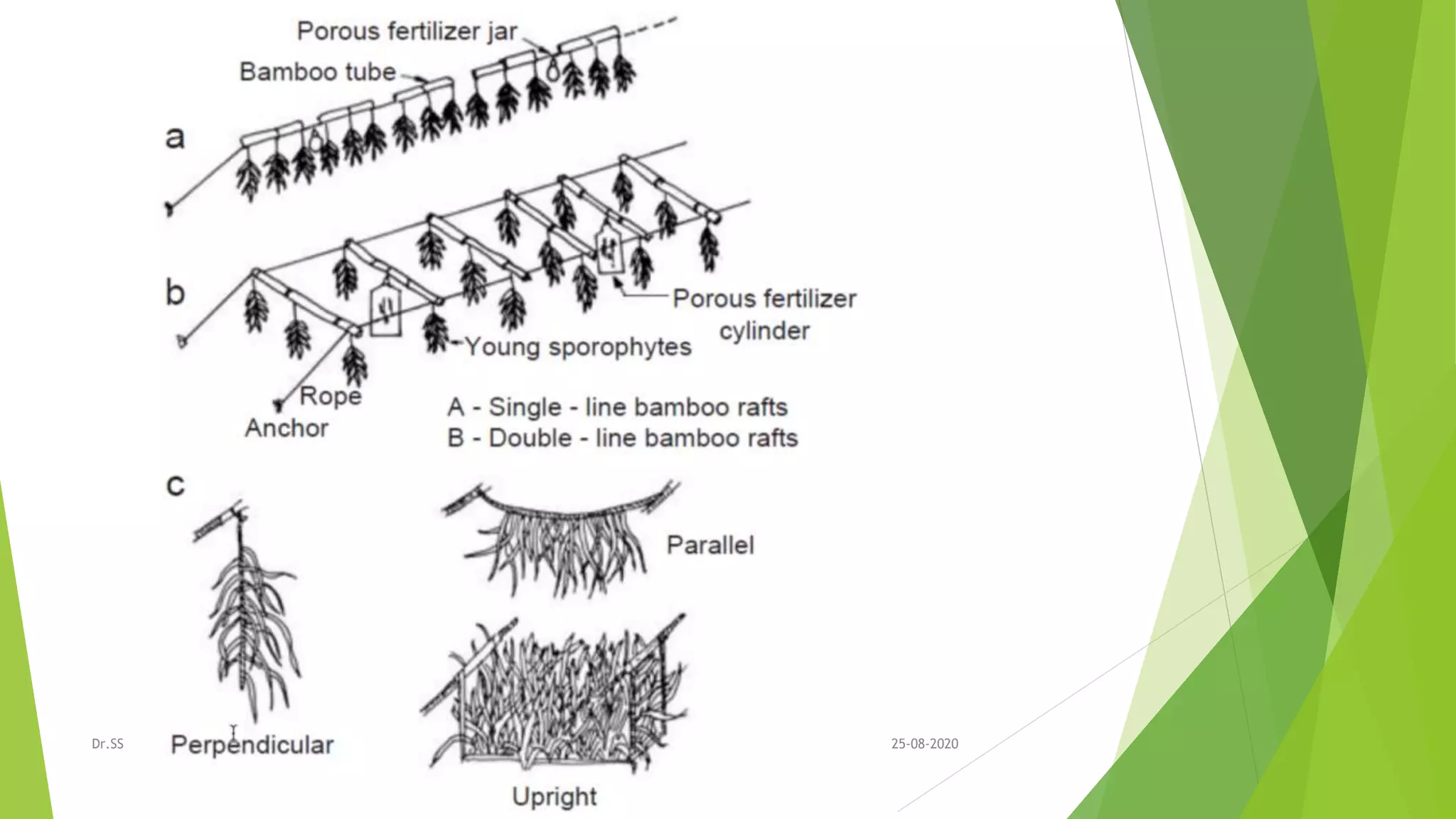
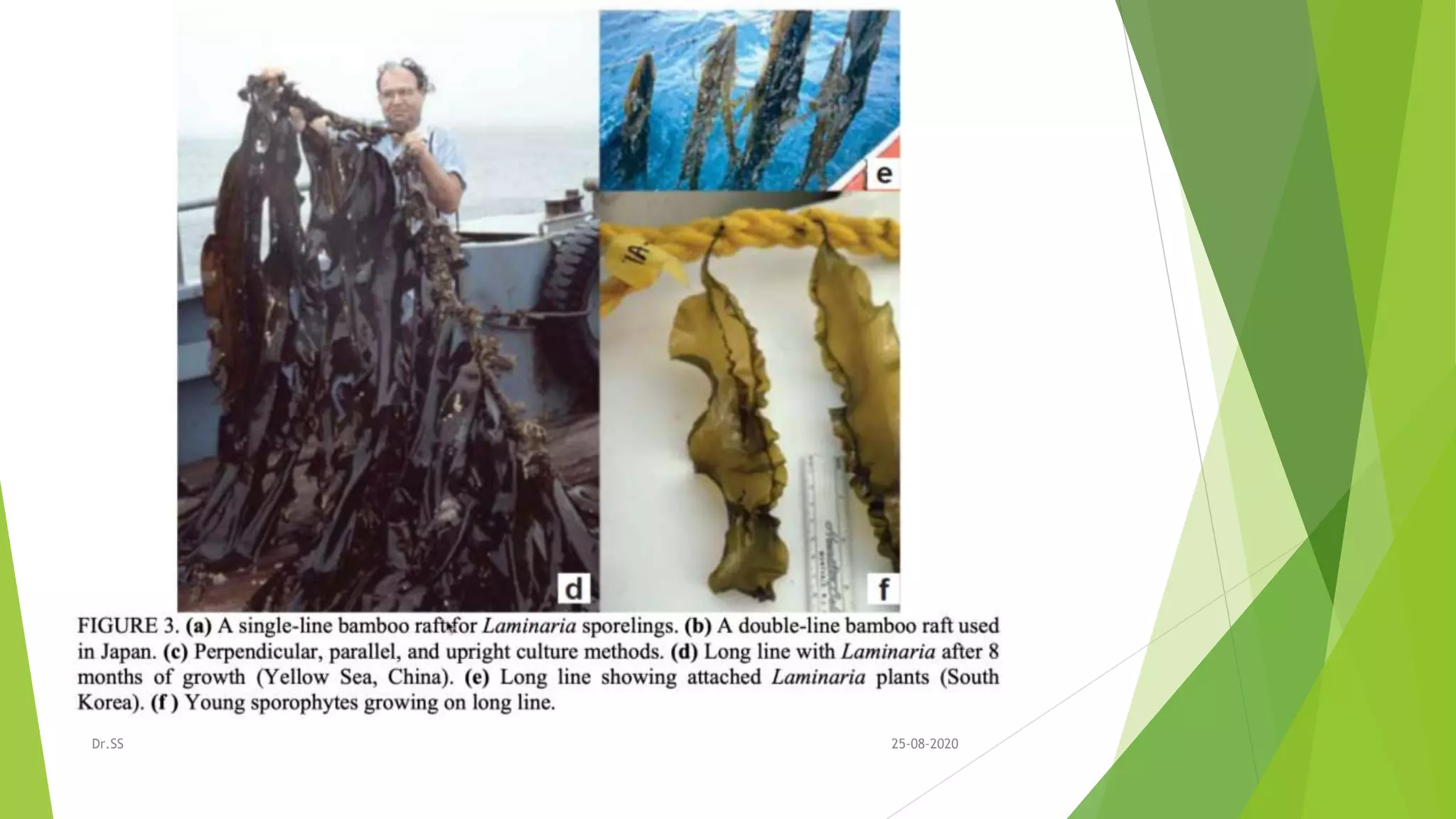
 The strings are then cut into small pieces
 transferred to the sea and inserted into the warp of large diameter, 60 m long culture rope.
 The ropes with the young sporophytes are kept floating by buoys fixed every 2–3 m.
 Each end of the rope is anchored to a wooden peg driven into the sea bottom.
 The ropes with the young sporophytes attached hang down from this rope at 50 cm intervals.
 These slowly develop into the large sporophytes that we harvest
25-08-2020Dr.SS
25-08-2020Dr.SS
Forced cultivation
 The Japanese use a forced cultivation technique to produce plants with 2-year-old characteristics in a single growing season
by controlling the water temperature and light.
 By the same method, the Japanese also farm a similar kelp, Undaria, which is sold as the food wakame.
25-08-2020Dr.SS
25-08-2020Dr.SS
25-08-2020Dr.SS
Net-Style Farm Systems
 Porphyra, or nori, is the world's most valuable marine crop.
 The crop is valued at more than 1 billion dollars worldwide and is used mainly for human food.
 These plants grow mainly in cooler waters.
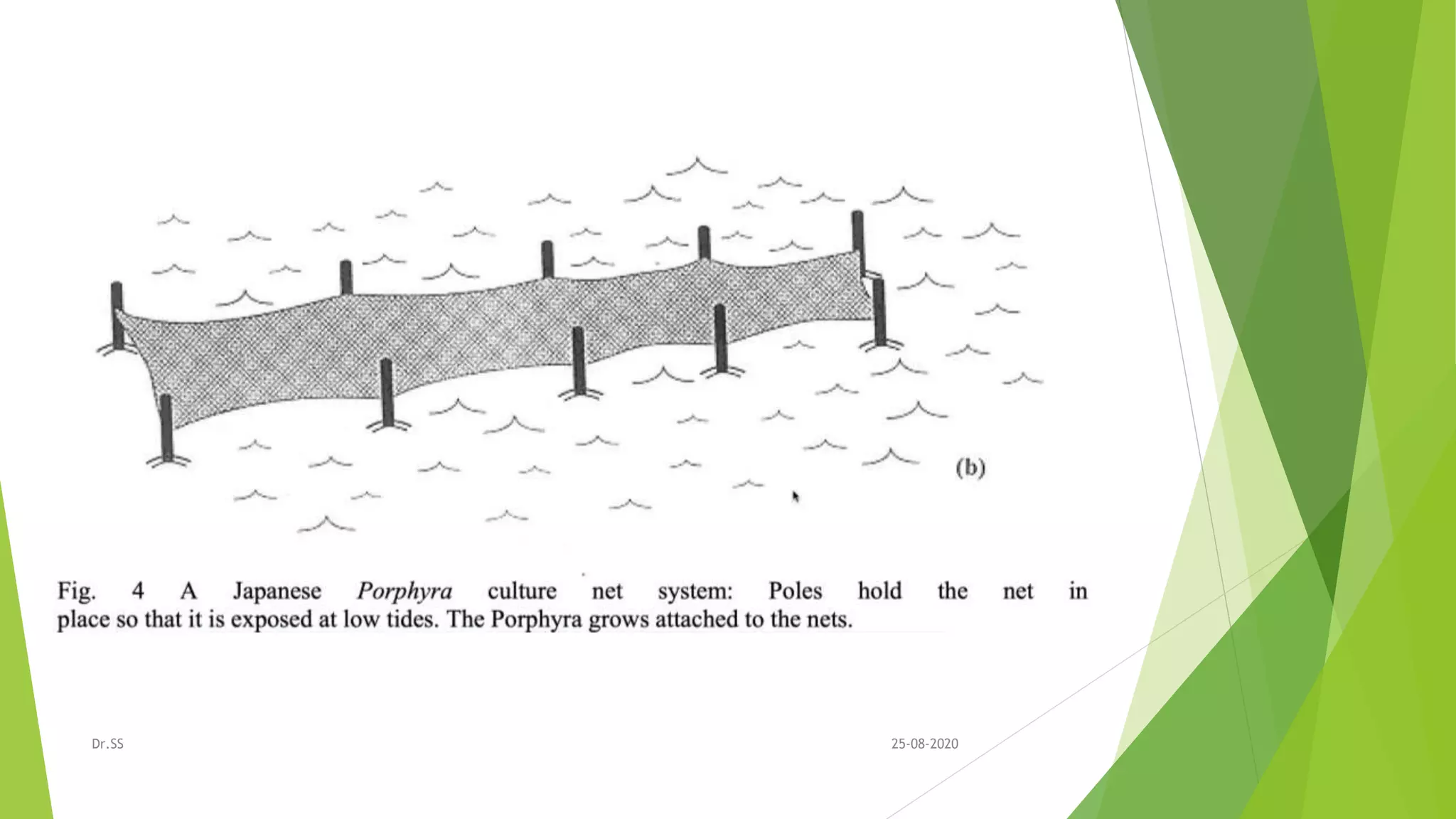
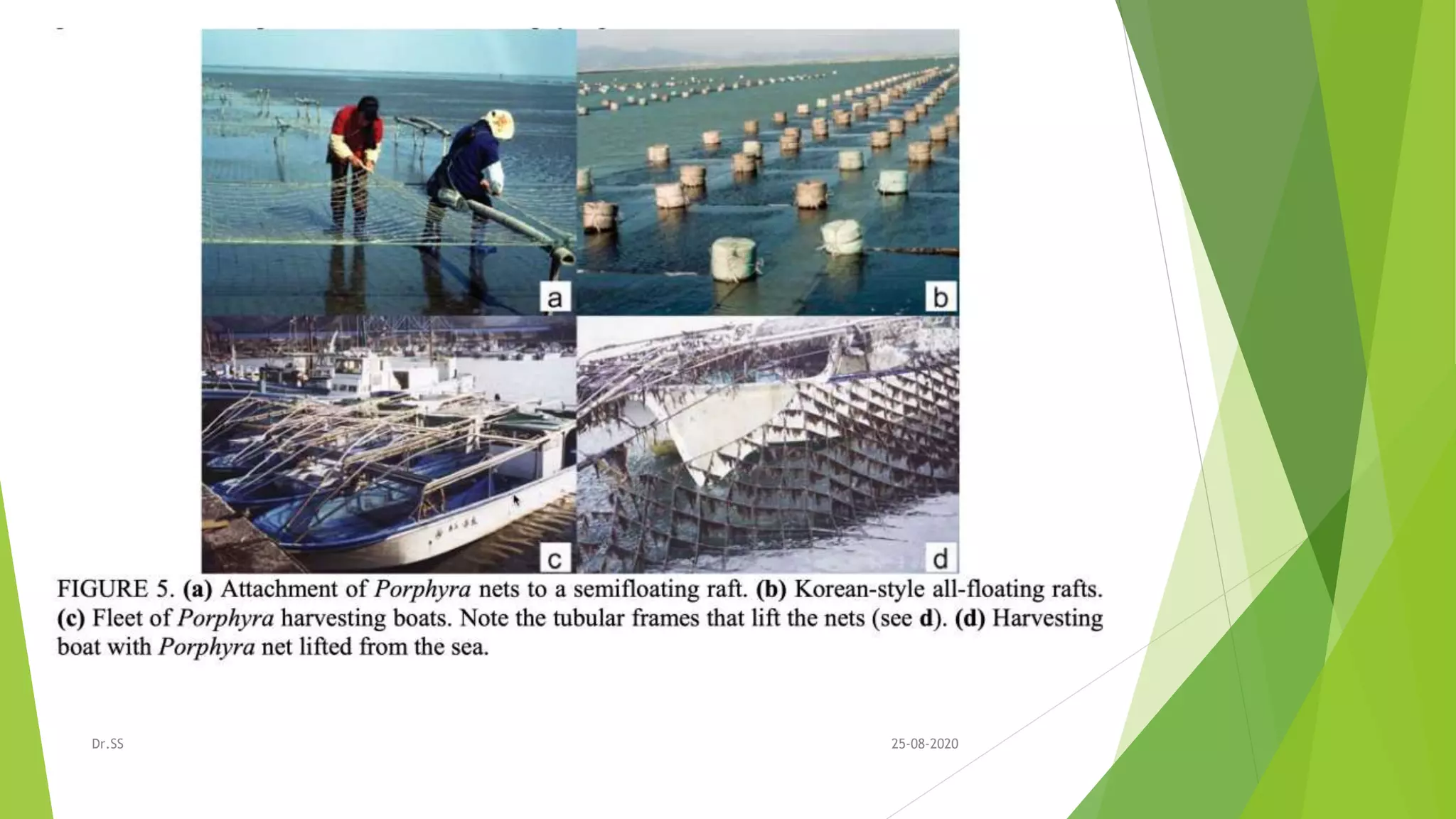
 The algal spores are seeded onto nets that are then put in place on fixed support systems.
 The fixed support system exposes the nets to the atmosphere at low tides.
 This periodic exposure and drying act to improve the growth of nori and to inhibit fouling organisms (e.g., other seaweed
species or diatoms).
25-08-2020Dr.SS
Net-Style Farm Systems
 Nori grows as a flat sheet and has a high surface area/volume ratio, a feature that aids nutrient uptake.
 Porphyra are allowed to grow to 15–30 cm in about 40–50 days before they are harvested .
 The remaining thalli are allowed to grow and may be ready for a second harvest after another 15 to 20 days.
 Several harvests may be made from the same nets in one growing season.
 The harvested crop is washed and transferred to an automatic nori-processing machine, which cuts the blades into small
pieces.
 The nori is then processed by the cultivator into dried rectangular sheets or processed by the manufacturer per market
requirements
25-08-2020Dr.SS
25-08-2020Dr.SS
25-08-2020Dr.SS
Line and Rope Farm Systems
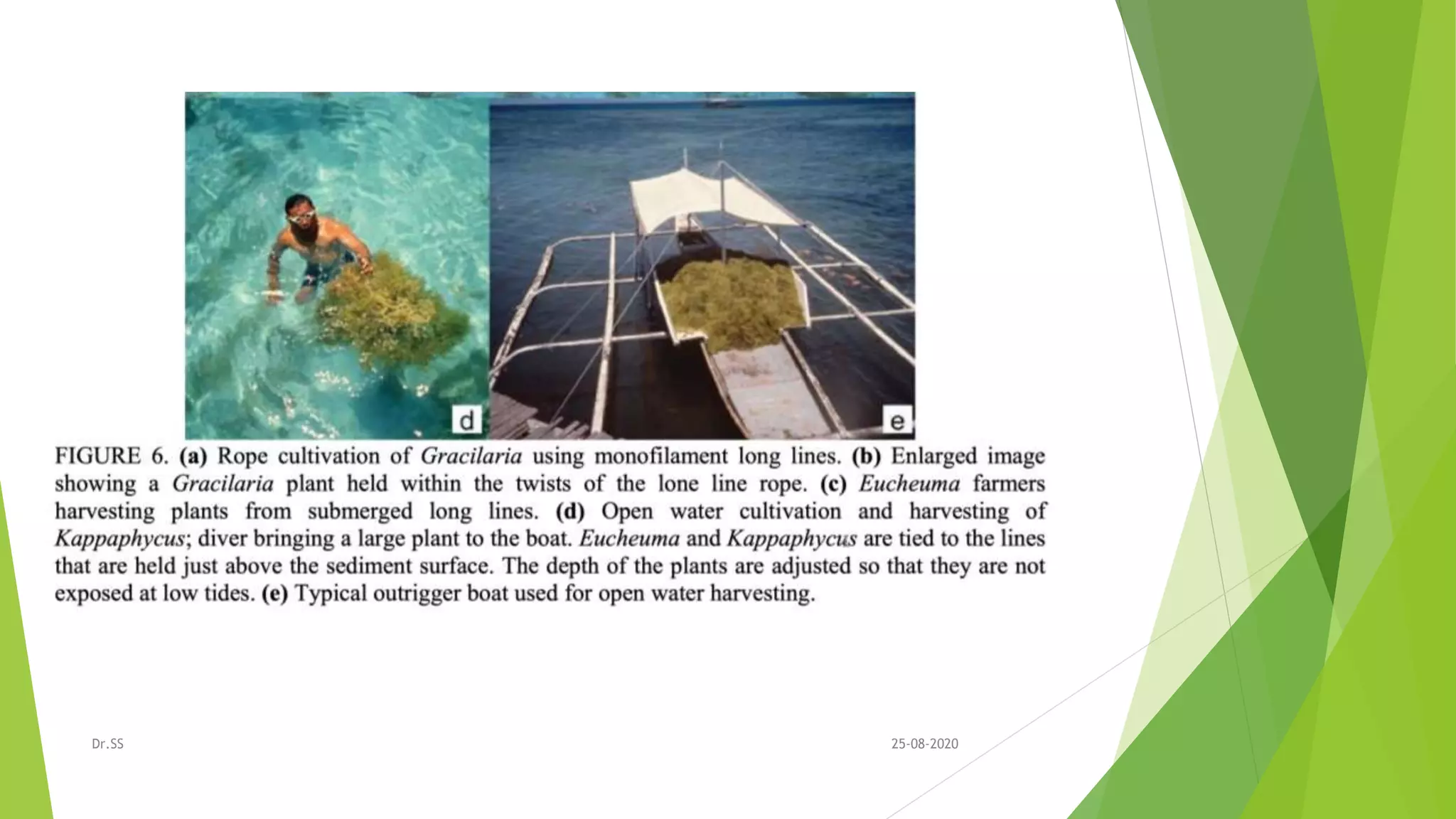
 Fishermen in the Philippines use rope and lines to grow tropical seaweeds.
 These seaweeds comprise species of genera Eucheuma and Kappaphycus.
 The seaweeds are tied to the lines, and the lines are then staked over the bottom.
 The water level should be 0.5 to 1.0 meter during low tide and not more than 2.0 to 3.0 m during high tide. The lines are
constructed to form plots or units of a standard size.
25-08-2020Dr.SS
Cont…
 Seedlings weighing between 50 and 100 g are tied to the monolines at 25- to 30-cm intervals using soft plastic tying
material called tie-tie.
 Usually the plants are harvested after 45 days when each seedling weighs up to 1 kg .
 The best looking healthy plants are selected to serve as seedlings for the next crop.
 The remaining plants are sun dried or sold fresh in the market.
 Eucheuma and Kappaphycus are important carrageenophytes (80% of world’s carrageenan production).
25-08-2020Dr.SS
25-08-2020Dr.SS
25-08-2020Dr.SS
Offshore or Deep-Water Seaweed
Cultivation
 Various attempts were made to cultivate the brown alga Macrocystis pyrifera on farm structures designed for use in deep
water.
 The nutrients for these seaweeds were to come from cold, deep waters that would be pumped up into the growing kelps.
 The benefits of this approach is that growth of macroalgae would not be constrained by available shallow nearshore regions.
25-08-2020Dr.SS
Offshore or Deep-Water Seaweed
Cultivation
 Despite several trials using different farm designs, operational problems prevented the production of actual kelp crops.
 However, the experiments did establish that M. pyrifera could grow in an open ocean environment, and that deep waters
supplied ample nutrients for sustained growth without toxic side effects.
 It is probable that these research results could be extended to other brown kelps, such as Laminaria spp. or Undaria spp.
 However, no reports are available that describe such offshorefarming approaches with green or red algae.
25-08-2020Dr.SS
Questions to think
 Macroalgae ?!! With examples?!!
 Methods to cultivate macroalgae?
 Conditions required to cultivate in tanks and why?
 Applications of macroalgae
 What is vegetative propagation?
25-08-2020Dr.SS
Clarifications
sivasan91@gmail.com
Sivasan_sf549@anjaconline.org
25-08-2020Dr.SS
25-08-2020Dr.SS

Macroalgae cultivation

  • 1.
    Y5C10 ENTREPRENEURSHIP IN MICROBIOLOGY Unit– IV Macroalgae cultivation Dr. S. Sivasankara Narayani Assistant Professor Department of Microbiology Ayya Nadar Janaki Ammal College Sivakasi TamilNadu India 25-08-2020Dr.SS
  • 2.
    Intro  Macroscopic marinealgae form an important living resource of the oceans.  Seaweeds are food important for humans and animals, as well as fertilizers for plants and a source of various chemicals.  Seaweeds have been gaining momentum as a new experimental system for biological research and as an integral part of integrated aquaculture systems.  We all use seaweed products in our day-to-day life in some way or other.  For example, some seaweed polysaccharides are used in toothpaste, soap, shampoo, cosmetics, milk, ice cream, meat, processed food, air freshener, and many other items.  In many oriental countries such as Japan, China, Korea, and others, seaweeds are diet staples. 25-08-2020Dr.SS
  • 3.
    Farming Methods  onestepfarming through vegetative propagation  two-step or multistep farming 25-08-2020Dr.SS
  • 4.
    IN VEGETATIVE CULTIVATION small pieces of seaweed are taken and placed in an environment that will sustain their growth.  When they have grown to a suitable size they are harvested, either by removing the entire plant or by removing most of it but leaving a small piece that will grow again.  When the whole plant is removed, small pieces are cut from it and used as seedstock for further cultivation. 25-08-2020Dr.SS
  • 5.
    LAND-BASED CULTIVATION SYSTEMS TANKS  PONDS 25-08-2020Dr.SS
  • 6.
    TANKS  a steadystream of aeration and seawater.  The aeration provides vigorous water movement in the tanks, sending the algal thalli up and down in the water column in a circular pattern.  This vigorous aeration permits rapid uptake of dissolved carbon dioxide, and bringing the biomass to the surface into the light.  greatest productivity  . Efficiency input of various types of energy (compressed air for bubbling, CO2, and pumping water) and nutrients. 25-08-2020Dr.SS
  • 7.
    TANKS  Carbon supplycan be improved by either pumping more seawater or by adding CO2.  The temperature and salinity also can be manipulated by pumping more seawater.  The pH of the tanks should be managed in the range of 7.9 to 8.3,  the nutrient status of the medium must be monitored.  Tanks should be cleaned regularly and epiphytes must be controlled.  Tank systems also may hold promise for the processing of polluted water for specific products, the removal of extra nutrients from wastewater, or for energy production. 25-08-2020Dr.SS
  • 8.
    PONDS  Macroalgae canalso be grown in ponds.  An advantage of this approach is the low-operating costs.  Generally, water exchange in the ponds is accomplished by use of tide gates.  Seaweed yields are low because of the lack of water movement in the ponds and the low exchanges of water.  Tank systems are usually in smaller modules that allow a predictable maintenance schedule, several steps however, can be precisely controlled and managed to reduce the labor input, although this type of system has high operational costs.  Ponds are larger, and a significant outbreak of epiphytes or other weedy species may be much harder to bring under control. 25-08-2020Dr.SS
  • 9.
    SEAWEED CULTIVATION INTHE SEA  Long-Line Cultivation Systems  Net-Style Farm Systems  Line and Rope Farm Systems  Offshore or Deep-Water Seaweed Cultivation 25-08-2020Dr.SS
  • 10.
    Long-Line Cultivation Systems In the 1950s, China - Laminaria.  sporelings (“seedlings”) are produced in cooled water in greenhouses and later planted out in the ocean  For cultivation, Laminaria must go through its life cycle, and this involves an alternation of generations between a large sporophyte  sporophyte seaweed- and a microscopic gametophyte. T  he mature sporophytes form sori -surface organs where sporangia are produced- motile zoospores are released.  To stimulate zoospore release, a selected parent Laminaria plants are dried for a few hours and placed in the seeding container which is filled with cool seawater. 25-08-2020Dr.SS
  • 11.
    Cont…  The seedstring (a synthetic twine of 2 to 6 mm in diameter or palm line 6 mm in diameter) is placed on the bottom of the same container.  Released zoospores are attached to the strings and germinate into male and female gametophytes.  As the gametophytes become fertile, they release sperm and eggs that join to form zygotes which attach themselves to the collectors – i.e. the same substrate materials - and develop into seedlings or sporelings.  The seedlings - young sporophyte plants. 25-08-2020Dr.SS
  • 12.
    Cont…  The stringsare then cut into small pieces  transferred to the sea and inserted into the warp of large diameter, 60 m long culture rope.  The ropes with the young sporophytes are kept floating by buoys fixed every 2–3 m.  Each end of the rope is anchored to a wooden peg driven into the sea bottom.  The ropes with the young sporophytes attached hang down from this rope at 50 cm intervals.  These slowly develop into the large sporophytes that we harvest 25-08-2020Dr.SS
  • 13.
  • 14.
    Forced cultivation  TheJapanese use a forced cultivation technique to produce plants with 2-year-old characteristics in a single growing season by controlling the water temperature and light.  By the same method, the Japanese also farm a similar kelp, Undaria, which is sold as the food wakame. 25-08-2020Dr.SS
  • 15.
  • 16.
  • 17.
    Net-Style Farm Systems Porphyra, or nori, is the world's most valuable marine crop.  The crop is valued at more than 1 billion dollars worldwide and is used mainly for human food.  These plants grow mainly in cooler waters.  The algal spores are seeded onto nets that are then put in place on fixed support systems.  The fixed support system exposes the nets to the atmosphere at low tides.  This periodic exposure and drying act to improve the growth of nori and to inhibit fouling organisms (e.g., other seaweed species or diatoms). 25-08-2020Dr.SS
  • 18.
    Net-Style Farm Systems Nori grows as a flat sheet and has a high surface area/volume ratio, a feature that aids nutrient uptake.  Porphyra are allowed to grow to 15–30 cm in about 40–50 days before they are harvested .  The remaining thalli are allowed to grow and may be ready for a second harvest after another 15 to 20 days.  Several harvests may be made from the same nets in one growing season.  The harvested crop is washed and transferred to an automatic nori-processing machine, which cuts the blades into small pieces.  The nori is then processed by the cultivator into dried rectangular sheets or processed by the manufacturer per market requirements 25-08-2020Dr.SS
  • 19.
  • 20.
  • 21.
    Line and RopeFarm Systems  Fishermen in the Philippines use rope and lines to grow tropical seaweeds.  These seaweeds comprise species of genera Eucheuma and Kappaphycus.  The seaweeds are tied to the lines, and the lines are then staked over the bottom.  The water level should be 0.5 to 1.0 meter during low tide and not more than 2.0 to 3.0 m during high tide. The lines are constructed to form plots or units of a standard size. 25-08-2020Dr.SS
  • 22.
    Cont…  Seedlings weighingbetween 50 and 100 g are tied to the monolines at 25- to 30-cm intervals using soft plastic tying material called tie-tie.  Usually the plants are harvested after 45 days when each seedling weighs up to 1 kg .  The best looking healthy plants are selected to serve as seedlings for the next crop.  The remaining plants are sun dried or sold fresh in the market.  Eucheuma and Kappaphycus are important carrageenophytes (80% of world’s carrageenan production). 25-08-2020Dr.SS
  • 23.
  • 24.
  • 25.
    Offshore or Deep-WaterSeaweed Cultivation  Various attempts were made to cultivate the brown alga Macrocystis pyrifera on farm structures designed for use in deep water.  The nutrients for these seaweeds were to come from cold, deep waters that would be pumped up into the growing kelps.  The benefits of this approach is that growth of macroalgae would not be constrained by available shallow nearshore regions. 25-08-2020Dr.SS
  • 26.
    Offshore or Deep-WaterSeaweed Cultivation  Despite several trials using different farm designs, operational problems prevented the production of actual kelp crops.  However, the experiments did establish that M. pyrifera could grow in an open ocean environment, and that deep waters supplied ample nutrients for sustained growth without toxic side effects.  It is probable that these research results could be extended to other brown kelps, such as Laminaria spp. or Undaria spp.  However, no reports are available that describe such offshorefarming approaches with green or red algae. 25-08-2020Dr.SS
  • 27.
    Questions to think Macroalgae ?!! With examples?!!  Methods to cultivate macroalgae?  Conditions required to cultivate in tanks and why?  Applications of macroalgae  What is vegetative propagation? 25-08-2020Dr.SS
  • 28.
  • 29.