Deformation of the Crust
and Plate Tectonics
REORTERS
Jolina Egas, Aireen Guabong, Kyle
Danniela Baña
Subject
Natural Science
Catastrophism and Uniformitarianism
The theory of continental drift
Seafloor Spreading and Subduction
The theory of plate tectonics
Growth of continents
I
II
III
IV
V
3
4
7
12
18
Page
Table of
Contents
Catastrophism and Uniformitarianism
I
Earth scientist believe that the present landscape were created by a
previous period of great cataclysm.
Catastrophism
the certain vast geological changes in the earth's history were
caused by catastrophes rather than gradual evolutionary
processes.
It was rejected in 1830.
Uniformitarianism
the idea that internal and external Earth process operated in the
geologic past as they do today, that is, slowly and not by past
monumental cataclysms
3
The theory of continental drift
II
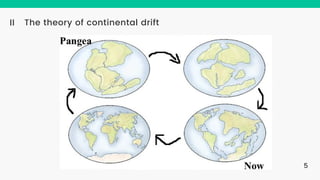
Continental Drift
Proposed by Alfred Wegener, a German climatologist
The idea that continents and other large masses have shifted their
position during Earth’s history
Wegener hypothesized that all the continents had once been part
of a single supercontinent, which he called Pangaea
4
The theory of continental drift
II
5
The theory of continental drift
II
Evidence Supporting Continental Drift
Magnetic-Field orientations in rocks
Iron-bearing minerals in rock record the magnetic field of Earth as it
existed when the rock solidified, which is a phenomenon known as
paleomagnetism
Using rock different age, scientist reconstructed locations of the
continents during past periods in geologic history.
The paleomagnetic data revealed the continents were grouped
together about 200 million years ago
The paleomagnetic data also revealed that the polarity’s of earth
magnet has been reversed many times in the past
The process responsible for the moving of the continents are still
unexplained
6
Seafloor Spreading and Subduction
III
Result in Studying and Mapping the seafloor
Detailed undersea mapping was conducted on a system of mid-
oceanic ridges (also called oceanic ridges or rises)
It was discovered that basaltic seafloor displays matching
patterns of magnetic properties in rocks of the same age but on
the opposite sides of mid-oceanic ridges.
Scientist made the surprising discovery that although some
continental rocks are 3.6 billion years old, rocks on the ocean floor
are all geologically young, having been less than 250 million years.
7
Seafloor Spreading and Subduction
III
Result in Studying and Mapping the seafloor
researchers found that the oldest rocks of the seafloor lie in
trenches beneath the deepest ocean waters or close to the
continents and that rocks become progressively younger toward
the mid-oceanic ridges where the youngest basaltic rocks exist.
it was determined that temperatures of rocks on the ocean floor
vary significantly, being hottest near the mid-oceanic ridges and
becoming progressively cooler farther away.
8
Seafloor Spreading and Subduction
III
Result in Studying and Mapping the seafloor
researchers found that the oldest rocks of the seafloor lie in
trenches beneath the deepest ocean waters or close to the
continents and that rocks become progressively younger toward
the mid-oceanic ridges where the youngest basaltic rocks exist.
it was determined that temperatures of rocks on the ocean floor
vary significantly, being hottest near the mid-oceanic ridges and
becoming progressively cooler farther away.
9
Seafloor Spreading and Subduction
III
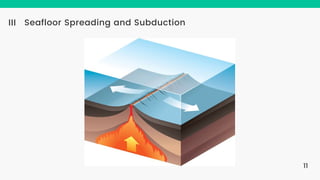
Seafloor spreading
The new oceanic crust froms along the mid-oceanic ridges, where
basaltic rocks are youngest, and that the oceanic crust moves
slowly in opposite directions away from the axis of a ridges.
The iron-rich basalt of the seafloor have preserved a historical
record of changes in the Earth’s magnetic field, including the
polarity reversal, where the north and south magnetic poles switch
locations.
Subduction
It is the process by which Earth materials move down to the
subsurface in these zones
10
Seafloor Spreading and Subduction
III
11
The theory of plate tectonics
IV.
Plate tectonics
modern theory that explains seafloor spreading, subduction, and
the movement of lithospheric plates
Lithosperic plates- are the large part of Earth’s lithosphere that
include continental crust, oceanic crust, and the uppermost
rigid part of the mantle.
Tectonics involve large-scale forces originating within Earth
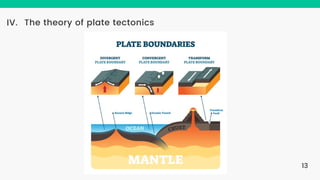
In some places, plates pull away from each other (divergent)
In some places, plates push away each other (converge)
In some places, they slide along side each other (move laterally)
12
The theory of plate tectonics
IV.
13
Tectonic plates movement
IV.
Plate Divergent
The pulling apart of plates, as occurs in the seafloor spreading, is
tectonic plate divergent.
Tectonic forces that act to pull rock masses apart cause the crust
to thin and weaken
The diverging plates separate an average rate og 2 to 5 cm per
year
Most plate divergent occurs in pacific ridge.
14
Tectonic plates movement
IV.
Plate Convergence
The pushing of plates to each other is convergent
Despite the relatively slow rate of plate movement to human
perspective, the energy involved in convergence causes the crust
to crumple as one plate overrides the other.
Continental crust colliding with continental crust is called
continental collision.
This process close and ocean basin that once separated the
colliding landmasses and therefore has also been called
continetal suturing.
15
Tectonic plates movement
IV.
Transform Movement
Lateral sliding along plate boundaries is called transform
movement.
Occurs where plates neither pull apart or converge, but instead,
slide pass each other.
As plates pull apart, they usually do so along a series of fracture
zones that tend to form at right angles to the major zone of plate
tectonics contacts.
The crosshatched plate boundaries along which lateral
movement takes place are called transform faults.
16
Tectonic plates movement
IV.
Transform Movement
Lateral sliding along plate boundaries is called transform
movement.
Occurs where plates neither pull apart or converge, but instead,
slide pass each other.
As plates pull apart, they usually do so along a series of fracture
zones that tend to form at right angles to the major zone of plate
tectonics contacts.
The crosshatched plate boundaries along which lateral
movement takes place are called transform faults.
17
Tectonic plates movement
IV.
Hot spots in the Mantle
hot spots - A hot spot is a large plume of hot mantle material
rising from deep within the Earth
These hotspots appear both in continental and oceanic locations.
Melting of the upper mantle and oceanic crust causes undersea
eruptions and the outpouring of basaltic lava on the seafloor,
eventually constructing a volcanic islands.
18
Growth of continents
IV.
The origins of continent is being debated.
It is clear that the continents tend to have a core area of very old
igneous and metamorphic rocks that are interpreted as representing
the deeply eroded roots of ancient mountains
The ancient crystalline rock areas are known as continental shields.
Most Earth scientist consider continents to grow by accretion.
it is by adding numerous chunks of crust to the main continent by
collision
Western North America grew in this manner over the past 200
million years by adding segment of crust, known as microplates
terranes.
19
Growth of continents
IV.
Geologic Time and Paleogeography
The study of past geographic environment is known as
paleogeography
It’s goal is to reconstruct past environment of a geographic
region based on geologic and climatic evidence
The geologic time scale is a calendar of Earth’s history is divided
into eras (Mesozoic Era “meso:middle-zoic:life”) Eras are divided
into periods (Cretaceous Period) Epoch, which is a shorter time
units to subdivide the periods of Cenozioc Period (Pleistocene
Epoch)
20
Growth of continents
IV.
Mesozoic Era
Age of the dinosaur (a class of large
animals that ruled the land and sea)
It is an episode of great extinction,
including the end of the dinosaurs
Geologists, paleontologist, and
paleogeographers are not in agreement
as to what cause this extinction.
21
Thank you
for listening!

Deformation-of-the-Crust-and-Plate-Tectonics.pdf

  • 1.
    Deformation of theCrust and Plate Tectonics REORTERS Jolina Egas, Aireen Guabong, Kyle Danniela Baña Subject Natural Science
  • 2.
    Catastrophism and Uniformitarianism Thetheory of continental drift Seafloor Spreading and Subduction The theory of plate tectonics Growth of continents I II III IV V 3 4 7 12 18 Page Table of Contents
  • 3.
    Catastrophism and Uniformitarianism I Earthscientist believe that the present landscape were created by a previous period of great cataclysm. Catastrophism the certain vast geological changes in the earth's history were caused by catastrophes rather than gradual evolutionary processes. It was rejected in 1830. Uniformitarianism the idea that internal and external Earth process operated in the geologic past as they do today, that is, slowly and not by past monumental cataclysms 3
  • 4.
    The theory ofcontinental drift II Continental Drift Proposed by Alfred Wegener, a German climatologist The idea that continents and other large masses have shifted their position during Earth’s history Wegener hypothesized that all the continents had once been part of a single supercontinent, which he called Pangaea 4
  • 5.
    The theory ofcontinental drift II 5
  • 6.
    The theory ofcontinental drift II Evidence Supporting Continental Drift Magnetic-Field orientations in rocks Iron-bearing minerals in rock record the magnetic field of Earth as it existed when the rock solidified, which is a phenomenon known as paleomagnetism Using rock different age, scientist reconstructed locations of the continents during past periods in geologic history. The paleomagnetic data revealed the continents were grouped together about 200 million years ago The paleomagnetic data also revealed that the polarity’s of earth magnet has been reversed many times in the past The process responsible for the moving of the continents are still unexplained 6
  • 7.
    Seafloor Spreading andSubduction III Result in Studying and Mapping the seafloor Detailed undersea mapping was conducted on a system of mid- oceanic ridges (also called oceanic ridges or rises) It was discovered that basaltic seafloor displays matching patterns of magnetic properties in rocks of the same age but on the opposite sides of mid-oceanic ridges. Scientist made the surprising discovery that although some continental rocks are 3.6 billion years old, rocks on the ocean floor are all geologically young, having been less than 250 million years. 7
  • 8.
    Seafloor Spreading andSubduction III Result in Studying and Mapping the seafloor researchers found that the oldest rocks of the seafloor lie in trenches beneath the deepest ocean waters or close to the continents and that rocks become progressively younger toward the mid-oceanic ridges where the youngest basaltic rocks exist. it was determined that temperatures of rocks on the ocean floor vary significantly, being hottest near the mid-oceanic ridges and becoming progressively cooler farther away. 8
  • 9.
    Seafloor Spreading andSubduction III Result in Studying and Mapping the seafloor researchers found that the oldest rocks of the seafloor lie in trenches beneath the deepest ocean waters or close to the continents and that rocks become progressively younger toward the mid-oceanic ridges where the youngest basaltic rocks exist. it was determined that temperatures of rocks on the ocean floor vary significantly, being hottest near the mid-oceanic ridges and becoming progressively cooler farther away. 9
  • 10.
    Seafloor Spreading andSubduction III Seafloor spreading The new oceanic crust froms along the mid-oceanic ridges, where basaltic rocks are youngest, and that the oceanic crust moves slowly in opposite directions away from the axis of a ridges. The iron-rich basalt of the seafloor have preserved a historical record of changes in the Earth’s magnetic field, including the polarity reversal, where the north and south magnetic poles switch locations. Subduction It is the process by which Earth materials move down to the subsurface in these zones 10
  • 11.
    Seafloor Spreading andSubduction III 11
  • 12.
    The theory ofplate tectonics IV. Plate tectonics modern theory that explains seafloor spreading, subduction, and the movement of lithospheric plates Lithosperic plates- are the large part of Earth’s lithosphere that include continental crust, oceanic crust, and the uppermost rigid part of the mantle. Tectonics involve large-scale forces originating within Earth In some places, plates pull away from each other (divergent) In some places, plates push away each other (converge) In some places, they slide along side each other (move laterally) 12
  • 13.
    The theory ofplate tectonics IV. 13
  • 14.
    Tectonic plates movement IV. PlateDivergent The pulling apart of plates, as occurs in the seafloor spreading, is tectonic plate divergent. Tectonic forces that act to pull rock masses apart cause the crust to thin and weaken The diverging plates separate an average rate og 2 to 5 cm per year Most plate divergent occurs in pacific ridge. 14
  • 15.
    Tectonic plates movement IV. PlateConvergence The pushing of plates to each other is convergent Despite the relatively slow rate of plate movement to human perspective, the energy involved in convergence causes the crust to crumple as one plate overrides the other. Continental crust colliding with continental crust is called continental collision. This process close and ocean basin that once separated the colliding landmasses and therefore has also been called continetal suturing. 15
  • 16.
    Tectonic plates movement IV. TransformMovement Lateral sliding along plate boundaries is called transform movement. Occurs where plates neither pull apart or converge, but instead, slide pass each other. As plates pull apart, they usually do so along a series of fracture zones that tend to form at right angles to the major zone of plate tectonics contacts. The crosshatched plate boundaries along which lateral movement takes place are called transform faults. 16
  • 17.
    Tectonic plates movement IV. TransformMovement Lateral sliding along plate boundaries is called transform movement. Occurs where plates neither pull apart or converge, but instead, slide pass each other. As plates pull apart, they usually do so along a series of fracture zones that tend to form at right angles to the major zone of plate tectonics contacts. The crosshatched plate boundaries along which lateral movement takes place are called transform faults. 17
  • 18.
    Tectonic plates movement IV. Hotspots in the Mantle hot spots - A hot spot is a large plume of hot mantle material rising from deep within the Earth These hotspots appear both in continental and oceanic locations. Melting of the upper mantle and oceanic crust causes undersea eruptions and the outpouring of basaltic lava on the seafloor, eventually constructing a volcanic islands. 18
  • 19.
    Growth of continents IV. Theorigins of continent is being debated. It is clear that the continents tend to have a core area of very old igneous and metamorphic rocks that are interpreted as representing the deeply eroded roots of ancient mountains The ancient crystalline rock areas are known as continental shields. Most Earth scientist consider continents to grow by accretion. it is by adding numerous chunks of crust to the main continent by collision Western North America grew in this manner over the past 200 million years by adding segment of crust, known as microplates terranes. 19
  • 20.
    Growth of continents IV. GeologicTime and Paleogeography The study of past geographic environment is known as paleogeography It’s goal is to reconstruct past environment of a geographic region based on geologic and climatic evidence The geologic time scale is a calendar of Earth’s history is divided into eras (Mesozoic Era “meso:middle-zoic:life”) Eras are divided into periods (Cretaceous Period) Epoch, which is a shorter time units to subdivide the periods of Cenozioc Period (Pleistocene Epoch) 20
  • 21.
    Growth of continents IV. MesozoicEra Age of the dinosaur (a class of large animals that ruled the land and sea) It is an episode of great extinction, including the end of the dinosaurs Geologists, paleontologist, and paleogeographers are not in agreement as to what cause this extinction. 21
  • 22.