Material Safety Data Sheets
Intended to provide workers and
emergency personnel with procedures for
handling or working with products in a safe
manner.
The sheets are in the MSDS binder located
in the lab.
Safety Data Sheets
In the past, there was no standard format for MSDS
Different manufacturers would create their sheets in
their own format. A person in need of information
on the hazards of a product might have to look in
different places on different MSDS to find the
information they need.
Safety Data Sheets
In 2012, The Hazard Communication
Standard (HCS)
was created to bring the United States
into alignment with the Globally
Harmonized Communication System of
Classification and Labeling of Chemicals.
Safety Data Sheets
• The Material Safety Data Sheets will be replaced
by Safety Data Sheets before June 1, 2015.
• The Safety Data Sheets sheets will have a
standardized and internationally recognized 16
section format.
• Each chemical manufacturer must transition to the
new format and supply their customers with the
SDS for each product.
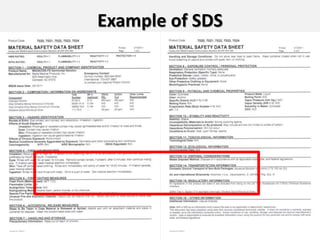
Example of SDS
SDS
• Section 1: Identification – Chemical identification,
recommended uses, restrictions, manufacturer or
distributor name, address, phone number and
emergency phone number.
• Section 2: Hazard identification –
Includes all hazards regarding the
chemical, such as affects of
exposure on skin, inhalation &
eye contact.
SDS
• Section 3: Composition/information on ingredients–
Name and CAS (Chemical Abstracts Service) Registry
number of the chemicals contained in the product.
• Section 4: First-aid measures – Includes symptoms and
effects and recommended treatment.
• Section 5: Fire-fighting measures –
Extinguishing techniques and proper
equipment to use. Chemical hazards
resulting from a fire.
SDS
• Section 6: Accidental release measures – Emergency
procedures, protective equipment and proper
methods of containment and cleanup should a leak or
spill occur.
• Section 7: Handling and storage –
Specific precautions for safe handling
and storage, including incompatibilities.
• Section 8: Exposure controls/personal protection –
OSHA’s Permissible Exposure Limits (PEL), Threshold
Limit Values (TLV), engineering controls and Personal
Protective Equipment (PPE) required.
SDS
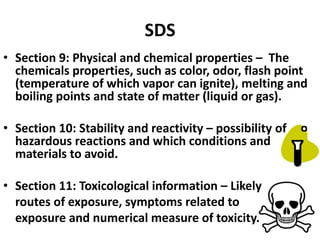
• Section 9: Physical and chemical properties – The
chemicals properties, such as color, odor, flash point
(temperature of which vapor can ignite), melting and
boiling points and state of matter (liquid or gas).
• Section 10: Stability and reactivity – possibility of
hazardous reactions and which conditions and
materials to avoid.
• Section 11: Toxicological information – Likely
routes of exposure, symptoms related to
exposure and numerical measure of toxicity.
SDS
• Section 12: Ecological information – Impact a spill
would have on the environment.
• Section 13: Disposal considerations – Methods for
proper disposal. Special precautions for landfills or
incineration.
• Section 14: Transportation information – Safe
modes of transporting the product.
SDS
• Section 15: Regulatory information – Specific
regulations for the product not listed elsewhere on
the SDS.
• Section 16: Other information –
Date the SDS was prepared or
date of last revision.
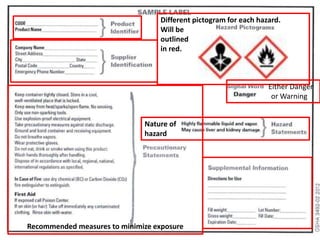
Chemical Labels
• Manufacturers will also follow a new format for
the labeling of hazardous chemicals by June 1,
2015.
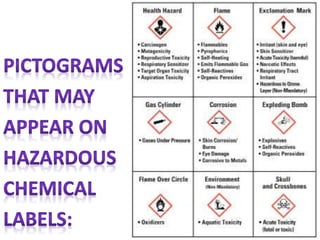
• All labels will have pictograms, a signal word (if
hazard is severe enough) hazard and precautionary
statements, the product identifier and supplier
identification information.
• Label information must match the
information on the SDS.
Recommended measures to minimize exposure
Nature of
hazard
Different pictogram for each hazard.
Will be
outlined
in red.
Either Danger
or Warning
For further information, log on to:
www.osha.gov/

Sds

  • 1.
    Material Safety DataSheets Intended to provide workers and emergency personnel with procedures for handling or working with products in a safe manner. The sheets are in the MSDS binder located in the lab.
  • 2.
    Safety Data Sheets Inthe past, there was no standard format for MSDS Different manufacturers would create their sheets in their own format. A person in need of information on the hazards of a product might have to look in different places on different MSDS to find the information they need.
  • 3.
    Safety Data Sheets In2012, The Hazard Communication Standard (HCS) was created to bring the United States into alignment with the Globally Harmonized Communication System of Classification and Labeling of Chemicals.
  • 4.
    Safety Data Sheets •The Material Safety Data Sheets will be replaced by Safety Data Sheets before June 1, 2015. • The Safety Data Sheets sheets will have a standardized and internationally recognized 16 section format. • Each chemical manufacturer must transition to the new format and supply their customers with the SDS for each product.
  • 5.
  • 6.
    SDS • Section 1:Identification – Chemical identification, recommended uses, restrictions, manufacturer or distributor name, address, phone number and emergency phone number. • Section 2: Hazard identification – Includes all hazards regarding the chemical, such as affects of exposure on skin, inhalation & eye contact.
  • 7.
    SDS • Section 3:Composition/information on ingredients– Name and CAS (Chemical Abstracts Service) Registry number of the chemicals contained in the product. • Section 4: First-aid measures – Includes symptoms and effects and recommended treatment. • Section 5: Fire-fighting measures – Extinguishing techniques and proper equipment to use. Chemical hazards resulting from a fire.
  • 8.
    SDS • Section 6:Accidental release measures – Emergency procedures, protective equipment and proper methods of containment and cleanup should a leak or spill occur. • Section 7: Handling and storage – Specific precautions for safe handling and storage, including incompatibilities. • Section 8: Exposure controls/personal protection – OSHA’s Permissible Exposure Limits (PEL), Threshold Limit Values (TLV), engineering controls and Personal Protective Equipment (PPE) required.
  • 9.
    SDS • Section 9:Physical and chemical properties – The chemicals properties, such as color, odor, flash point (temperature of which vapor can ignite), melting and boiling points and state of matter (liquid or gas). • Section 10: Stability and reactivity – possibility of hazardous reactions and which conditions and materials to avoid. • Section 11: Toxicological information – Likely routes of exposure, symptoms related to exposure and numerical measure of toxicity.
  • 10.
    SDS • Section 12:Ecological information – Impact a spill would have on the environment. • Section 13: Disposal considerations – Methods for proper disposal. Special precautions for landfills or incineration. • Section 14: Transportation information – Safe modes of transporting the product.
  • 11.
    SDS • Section 15:Regulatory information – Specific regulations for the product not listed elsewhere on the SDS. • Section 16: Other information – Date the SDS was prepared or date of last revision.
  • 12.
    Chemical Labels • Manufacturerswill also follow a new format for the labeling of hazardous chemicals by June 1, 2015. • All labels will have pictograms, a signal word (if hazard is severe enough) hazard and precautionary statements, the product identifier and supplier identification information. • Label information must match the information on the SDS.
  • 13.
    Recommended measures tominimize exposure Nature of hazard Different pictogram for each hazard. Will be outlined in red. Either Danger or Warning
  • 15.
    For further information,log on to: www.osha.gov/