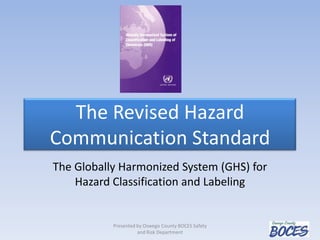
The Revised Hazard
Communication Standard
The Globally Harmonized System (GHS) for
Hazard Classification and Labeling
Presented by Oswego County BOCES Safety
and Risk Department
Course Objectives
• Inform employees of changes to the Hazard
Communication Standard (HCS).
• Discuss how the Global System of
Classification affects this change.
• Provide employees with transitional training
required by the revised HCS.
• Alert employees to new hazard
classifications, labeling elements and Safety
Data sheet requirements.
The New HazCom Standard
• The Hazard Communication Standard, which
gives us the ‘Right to Know’ about chemicals
we use in the workplace has been revised.
• Changes have brought the HCS into alignment
with the Globally Harmonized System (GHS) of
Classification and Labeling of Chemicals.
About the GHS
• The Global Harmonized System of Classification is
a system for standardizing the classification and
labeling of chemicals around the world.
• It is a logical and comprehensive approach for:
– Defining health, physical and environmental hazards
of chemicals;
– Creating classification processes that use available
data on chemicals for comparison with the defined
hazard criteria; and
– Communicating hazard information, as well as
protective measures, on labels and Safety Data Sheets
(SDS)
Why the GHS Affects Us!
• Every year, the U.S. imports tens of thousands of
chemicals from around the globe.
• In the past, chemical standards, classifications and
labels have varied from country to country.
• Material safety data sheets (MSDS) lacked a standard
format.
• Multiple types of labeling and classifying systems
were confusing to end-users.
• These deficiencies put workers handling imported
chemicals at greater risk.
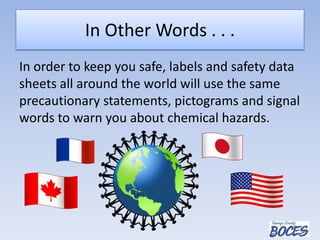
In Other Words . . .
In order to keep you safe, labels and safety data
sheets all around the world will use the same
precautionary statements, pictograms and signal
words to warn you about chemical hazards.
RTK vs. Right to Understand
• The original the Hazard Communication
Standard gave us the ‘Right to Know’ about
the chemicals we work with.
• The new Globally Harmonized System gives
workers the ‘Right to Understand’ that
information better.
So what has Changed?
• Labeling requirements:
– The revised standard requires information to be
conveyed with quick visual notations to alert the
user, providing immediate hazard recognition.
– Labels must also provide handling instructions so
that users are informed on how to protect
themselves.
• Safety Data Sheet format
– Information is largely the same, but presented in a
consistent user-friendly 16 section format.
GHS Label Features
• Labels now must have:
1. Product identifiers
2. Signal words
3. Pictograms
4. Hazard statements
5. Precautionary statements
6. Name, address and phone number of the
manufacturer, distributor or importer
Product Identifiers
• How the hazardous chemical is identified.
– Chemical name
– Chemical code number
– Batch number.
• The manufacturer, importer or distributer
must decide on appropriate identifier AND
assure that it is on both the label and Section
1 of the Safety Data Sheet.
1
Signal Word
• Used to indicate the relative level of severity
of hazard and alert the reader to a potential
hazard on the label.
• There are only two (2) signal words:
– DANGER is used for the more severe hazards.
– WARNING is used for less severe hazards.
2
Pictograms
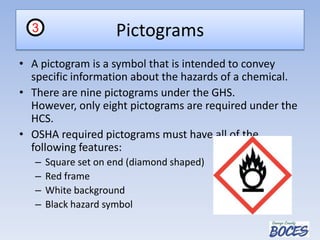
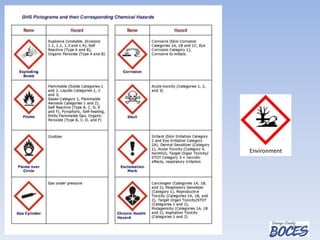
• A pictogram is a symbol that is intended to convey
specific information about the hazards of a chemical.
• There are nine pictograms under the GHS.
However, only eight pictograms are required under the
HCS.
• OSHA required pictograms must have all of the
following features:
– Square set on end (diamond shaped)
– Red frame
– White background
– Black hazard symbol
3
Environment
Hazard Statements
• Must describe the nature of a chemical’s
hazards, including the degree of hazard.
• All applicable hazard statements must appear
on the label.
• Chemical users should always see the same
statement for the same hazards:
– No matter what the chemical is.
– Or, who produces it.
4
Precautionary Statement
• A phrase that describes recommended
precautionary measures that should be taken for:
– General precautions
– Preventive precautions
– Response precautions
– Storage precautions
– Disposal precautions
• Each precautionary statement has an
alphanumeric code. (Click link below)
• Explore Precautionary Statement and Hazard
Codes
5
Contact Info
• Name, address and phone number of the
chemical manufacturer, distributor or
importer.
6
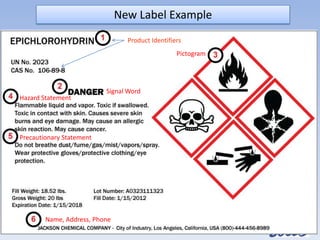
Product Identifiers
Signal Word
Pictogram
Hazard Statement
Precautionary Statement
Name, Address, Phone
New Label Example
Safety Data Sheets
• The word ‘Material’ has been eliminated as a
Hazard Communication descriptor.
• Safety Data Sheets (SDS) contain much of the
same info as MSDSs, but are now presented in
a consistent user-friendly, 16 section format.
Material
Section 1: Identification
• An SDS must have the same product identifier
used on the label and any other common
names by which the substance is known.
• Name, address and phone number of the
manufacturer or importer, AND emergency
phone number.
• Recommended use of the chemical with any
restrictions on use.
Section 2: Hazard Identification
• This section identifies the chemical hazards
and the associated warning information.
– Hazard classification (e.g., flammable).
– Signal word (DANGER or WARNING).
– Pictograms.
– Precautionary statements.
– Description of any unclassified hazards.
– Percentages of hazardous mixture ingredients.
Section 3: Ingredients
• Chemical name, common name and
synonyms.
• CAS (Chemical Abstract Service) number and
other unique identifiers.
• Impurities and stabilizing additives.
• For mixtures, chemical names and
concentrations.
• Trade secret disclaimers.
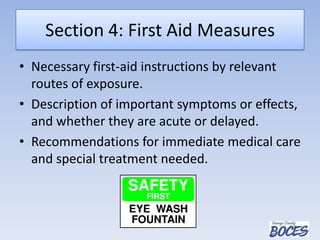
Section 4: First Aid Measures
• Necessary first-aid instructions by relevant
routes of exposure.
• Description of important symptoms or effects,
and whether they are acute or delayed.
• Recommendations for immediate medical care
and special treatment needed.
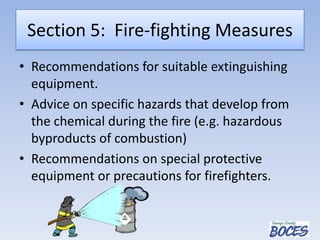
Section 5: Fire-fighting Measures
• Recommendations for suitable extinguishing
equipment.
• Advice on specific hazards that develop from
the chemical during the fire (e.g. hazardous
byproducts of combustion)
• Recommendations on special protective
equipment or precautions for firefighters.
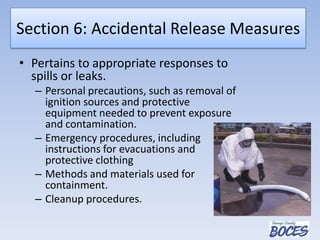
Section 6: Accidental Release Measures
• Pertains to appropriate responses to
spills or leaks.
– Personal precautions, such as removal of
ignition sources and protective
equipment needed to prevent exposure
and contamination.
– Emergency procedures, including
instructions for evacuations and
protective clothing
– Methods and materials used for
containment.
– Cleanup procedures.
Section 7: Handling and Storage
• Precautions for safe handling, including:
– Conditions for safe storage, including any
incompatibilities.
– Advice on specific storage requirements (e.g.
ventilation).
– Minimizing releases into the environment.
– Advice on general hygiene practices (e.g., work
area prohibitions on eating, drinking, etc.)
Section 8: Exposure Controls/PPE
• Info on Permissible Exposure Limits
(PELs), Threshold Limit Values (TLVs), etc.
• Appropriate engineering controls .
• Recommendations for personal protective
equipment (PPE).
• Special requirements for PPE (e.g., type of
glove material and breakthrough time of glove
material).
Section 9: Physical and Chemical
Properties
• Appearance
• Odor
• pH
• Melting/freezing point
• Boiling point and range
• Flash point
• Evaporation rate
• Flammability
• Flammable limits
• Vapor pressure
• Relative density
• Solubility
• Auto-ignition
temperature
• Decomposition
temperature
• Viscosity
Section 10: Stability and Reactivity
• Description of specific test data relative to
reactivity with other materials.
• Indication of whether the chemical is stable
under normal ambient temperature.
• Indication of potential safety issues should the
product change in physical appearance.
• Other possible hazardous reactions,
conditions that should be avoided, etc.
Section 11: Toxicological Information
• Routes of exposure
(e.g., inhalations, ingestion, skin and eye
contact).
• Delayed, immediate or chronic effects.
• Numerical measures of toxicity (e.g., LD50-
medial lethal dose).
• Description of symptoms.
• Whether the chemical is a known carcinogen.
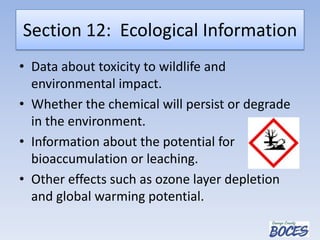
Section 12: Ecological Information
• Data about toxicity to wildlife and
environmental impact.
• Whether the chemical will persist or degrade
in the environment.
• Information about the potential for
bioaccumulation or leaching.
• Other effects such as ozone layer depletion
and global warming potential.
Section 13: Disposal Considerations
• Guidance on proper disposal, recycling or
reclamation of the chemical.
• Appropriate disposal containers to use.
• Recommendation for appropriate disposal
methods.
• Language discouraging sewage disposal.
• Special precautions for landfills or
incineration.
Sections 14: Transportation
• Guidance on classification information for
shipping by road, sea or air.
– UN number and shipping name.
– Transport hazard class
– Environmental hazards
– Bulk transport.
– Special precautions.
Section 15: Regulatory Information
• This section identifies safety, health and
environmental regulations not indicated
anywhere else on the SDS.
Section 16: Regulatory Information
• This section indicates when the SDS was
prepared or revised.
Summary
• The revised Hazard Communication Standard
makes it easier for employees to understand
chemical hazards in the workplace.
• Labels have been simplified and Safety Data
Sheets now have universally consistent
information.
Resources
• This presentation was based on information
published by OSHA and available through
these links:
– http://www.osha.gov/Publications/OSHA3514.html
– http://www.osha.gov/Publications/OSHA3636.pdf
– http://www.osha.gov/dsg/hazcom/ghs.html

Revised hazard communication standard

  • 1.
    The Revised Hazard CommunicationStandard The Globally Harmonized System (GHS) for Hazard Classification and Labeling Presented by Oswego County BOCES Safety and Risk Department
  • 2.
    Course Objectives • Informemployees of changes to the Hazard Communication Standard (HCS). • Discuss how the Global System of Classification affects this change. • Provide employees with transitional training required by the revised HCS. • Alert employees to new hazard classifications, labeling elements and Safety Data sheet requirements.
  • 3.
    The New HazComStandard • The Hazard Communication Standard, which gives us the ‘Right to Know’ about chemicals we use in the workplace has been revised. • Changes have brought the HCS into alignment with the Globally Harmonized System (GHS) of Classification and Labeling of Chemicals.
  • 4.
    About the GHS •The Global Harmonized System of Classification is a system for standardizing the classification and labeling of chemicals around the world. • It is a logical and comprehensive approach for: – Defining health, physical and environmental hazards of chemicals; – Creating classification processes that use available data on chemicals for comparison with the defined hazard criteria; and – Communicating hazard information, as well as protective measures, on labels and Safety Data Sheets (SDS)
  • 5.
    Why the GHSAffects Us! • Every year, the U.S. imports tens of thousands of chemicals from around the globe. • In the past, chemical standards, classifications and labels have varied from country to country. • Material safety data sheets (MSDS) lacked a standard format. • Multiple types of labeling and classifying systems were confusing to end-users. • These deficiencies put workers handling imported chemicals at greater risk.
  • 6.
    In Other Words. . . In order to keep you safe, labels and safety data sheets all around the world will use the same precautionary statements, pictograms and signal words to warn you about chemical hazards.
  • 7.
    RTK vs. Rightto Understand • The original the Hazard Communication Standard gave us the ‘Right to Know’ about the chemicals we work with. • The new Globally Harmonized System gives workers the ‘Right to Understand’ that information better.
  • 8.
    So what hasChanged? • Labeling requirements: – The revised standard requires information to be conveyed with quick visual notations to alert the user, providing immediate hazard recognition. – Labels must also provide handling instructions so that users are informed on how to protect themselves. • Safety Data Sheet format – Information is largely the same, but presented in a consistent user-friendly 16 section format.
  • 9.
    GHS Label Features •Labels now must have: 1. Product identifiers 2. Signal words 3. Pictograms 4. Hazard statements 5. Precautionary statements 6. Name, address and phone number of the manufacturer, distributor or importer
  • 10.
    Product Identifiers • Howthe hazardous chemical is identified. – Chemical name – Chemical code number – Batch number. • The manufacturer, importer or distributer must decide on appropriate identifier AND assure that it is on both the label and Section 1 of the Safety Data Sheet. 1
  • 11.
    Signal Word • Usedto indicate the relative level of severity of hazard and alert the reader to a potential hazard on the label. • There are only two (2) signal words: – DANGER is used for the more severe hazards. – WARNING is used for less severe hazards. 2
  • 12.
    Pictograms • A pictogramis a symbol that is intended to convey specific information about the hazards of a chemical. • There are nine pictograms under the GHS. However, only eight pictograms are required under the HCS. • OSHA required pictograms must have all of the following features: – Square set on end (diamond shaped) – Red frame – White background – Black hazard symbol 3
  • 13.
  • 14.
    Hazard Statements • Mustdescribe the nature of a chemical’s hazards, including the degree of hazard. • All applicable hazard statements must appear on the label. • Chemical users should always see the same statement for the same hazards: – No matter what the chemical is. – Or, who produces it. 4
  • 15.
    Precautionary Statement • Aphrase that describes recommended precautionary measures that should be taken for: – General precautions – Preventive precautions – Response precautions – Storage precautions – Disposal precautions • Each precautionary statement has an alphanumeric code. (Click link below) • Explore Precautionary Statement and Hazard Codes 5
  • 16.
    Contact Info • Name,address and phone number of the chemical manufacturer, distributor or importer. 6
  • 17.
    Product Identifiers Signal Word Pictogram HazardStatement Precautionary Statement Name, Address, Phone New Label Example
  • 18.
    Safety Data Sheets •The word ‘Material’ has been eliminated as a Hazard Communication descriptor. • Safety Data Sheets (SDS) contain much of the same info as MSDSs, but are now presented in a consistent user-friendly, 16 section format. Material
  • 19.
    Section 1: Identification •An SDS must have the same product identifier used on the label and any other common names by which the substance is known. • Name, address and phone number of the manufacturer or importer, AND emergency phone number. • Recommended use of the chemical with any restrictions on use.
  • 20.
    Section 2: HazardIdentification • This section identifies the chemical hazards and the associated warning information. – Hazard classification (e.g., flammable). – Signal word (DANGER or WARNING). – Pictograms. – Precautionary statements. – Description of any unclassified hazards. – Percentages of hazardous mixture ingredients.
  • 21.
    Section 3: Ingredients •Chemical name, common name and synonyms. • CAS (Chemical Abstract Service) number and other unique identifiers. • Impurities and stabilizing additives. • For mixtures, chemical names and concentrations. • Trade secret disclaimers.
  • 22.
    Section 4: FirstAid Measures • Necessary first-aid instructions by relevant routes of exposure. • Description of important symptoms or effects, and whether they are acute or delayed. • Recommendations for immediate medical care and special treatment needed.
  • 23.
    Section 5: Fire-fightingMeasures • Recommendations for suitable extinguishing equipment. • Advice on specific hazards that develop from the chemical during the fire (e.g. hazardous byproducts of combustion) • Recommendations on special protective equipment or precautions for firefighters.
  • 24.
    Section 6: AccidentalRelease Measures • Pertains to appropriate responses to spills or leaks. – Personal precautions, such as removal of ignition sources and protective equipment needed to prevent exposure and contamination. – Emergency procedures, including instructions for evacuations and protective clothing – Methods and materials used for containment. – Cleanup procedures.
  • 25.
    Section 7: Handlingand Storage • Precautions for safe handling, including: – Conditions for safe storage, including any incompatibilities. – Advice on specific storage requirements (e.g. ventilation). – Minimizing releases into the environment. – Advice on general hygiene practices (e.g., work area prohibitions on eating, drinking, etc.)
  • 26.
    Section 8: ExposureControls/PPE • Info on Permissible Exposure Limits (PELs), Threshold Limit Values (TLVs), etc. • Appropriate engineering controls . • Recommendations for personal protective equipment (PPE). • Special requirements for PPE (e.g., type of glove material and breakthrough time of glove material).
  • 27.
    Section 9: Physicaland Chemical Properties • Appearance • Odor • pH • Melting/freezing point • Boiling point and range • Flash point • Evaporation rate • Flammability • Flammable limits • Vapor pressure • Relative density • Solubility • Auto-ignition temperature • Decomposition temperature • Viscosity
  • 28.
    Section 10: Stabilityand Reactivity • Description of specific test data relative to reactivity with other materials. • Indication of whether the chemical is stable under normal ambient temperature. • Indication of potential safety issues should the product change in physical appearance. • Other possible hazardous reactions, conditions that should be avoided, etc.
  • 29.
    Section 11: ToxicologicalInformation • Routes of exposure (e.g., inhalations, ingestion, skin and eye contact). • Delayed, immediate or chronic effects. • Numerical measures of toxicity (e.g., LD50- medial lethal dose). • Description of symptoms. • Whether the chemical is a known carcinogen.
  • 30.
    Section 12: EcologicalInformation • Data about toxicity to wildlife and environmental impact. • Whether the chemical will persist or degrade in the environment. • Information about the potential for bioaccumulation or leaching. • Other effects such as ozone layer depletion and global warming potential.
  • 31.
    Section 13: DisposalConsiderations • Guidance on proper disposal, recycling or reclamation of the chemical. • Appropriate disposal containers to use. • Recommendation for appropriate disposal methods. • Language discouraging sewage disposal. • Special precautions for landfills or incineration.
  • 32.
    Sections 14: Transportation •Guidance on classification information for shipping by road, sea or air. – UN number and shipping name. – Transport hazard class – Environmental hazards – Bulk transport. – Special precautions.
  • 33.
    Section 15: RegulatoryInformation • This section identifies safety, health and environmental regulations not indicated anywhere else on the SDS. Section 16: Regulatory Information • This section indicates when the SDS was prepared or revised.
  • 34.
    Summary • The revisedHazard Communication Standard makes it easier for employees to understand chemical hazards in the workplace. • Labels have been simplified and Safety Data Sheets now have universally consistent information.
  • 35.
    Resources • This presentationwas based on information published by OSHA and available through these links: – http://www.osha.gov/Publications/OSHA3514.html – http://www.osha.gov/Publications/OSHA3636.pdf – http://www.osha.gov/dsg/hazcom/ghs.html