SCREENING MODELS FOR CENTRAL
AND PERIPHERALANALGESICS
FLOW OF PRESENTATION :
 CENTRAL ANALGESIC ACTIVITY
 PERIPHERAL ANALGESIC ACTIVITY
INTRODUCTION
 Pain is a symptom of many diseases which requires
analgesic treatment
 Analgesics is defined as the are agents which selectively
relieve pain by acting in the CNS or by peripheral pain
mechanisms
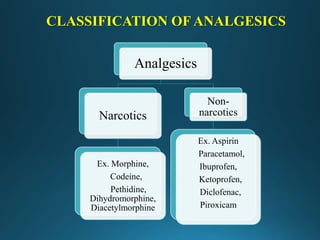
CLASSIFICATION OF ANALGESICS
Analgesics
Narcotics
Ex. Morphine,
Codeine,
Pethidine,
Dihydromorphine,
Diacetylmorphine
Non-
narcotics
Ex. Aspirin
Paracetamol,
Ibuprofen,
Ketoprofen,
Diclofenac,
Piroxicam
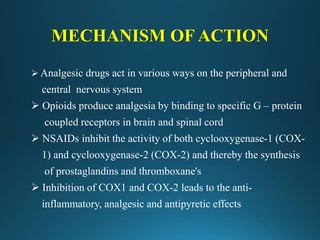
MECHANISM OF ACTION
 Analgesic drugs act in various ways on the peripheral and
central nervous system
 Opioids produce analgesia by binding to specific G – protein
coupled receptors in brain and spinal cord
 NSAIDs inhibit the activity of both cyclooxygenase-1 (COX-
1) and cyclooxygenase-2 (COX-2) and thereby the synthesis
of prostaglandins and thromboxane's
 Inhibition of COX1 and COX-2 leads to the anti-
inflammatory, analgesic and antipyretic effects
SCREENING
MODELS
CENTRALANALGESIC
ACTIVITY
 Hot plate method :
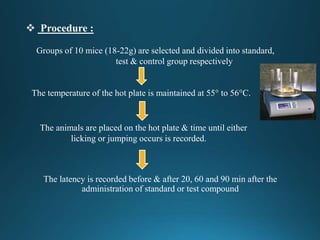
 Procedure :
The latency is recorded before & after 20, 60 and 90 min after the
administration of standard or test compound
Groups of 10 mice (18-22g) are selected and divided into standard,
test & control group respectively
The temperature of the hot plate is maintained at 55° to 56°C.
The animals are placed on the hot plate & time until either
licking or jumping occurs is recorded.
 The prolongation of latency time between the test,
standard and control animals are compared
 Using various doses ED50 values can be calculated
 Grid-shock test :
Male mice (18-20g) are selected and placed
individually in plastic chamber.
The floor of the box is wired with stainless
steel wire.
The stimulus is given in the form of square wave
pulses ( 30 cycles per second)
The output of stimulator is connected to alternate
wires of grid.
The fixed resistance is placed with the grid & parallel to
an oscilloscope to allow calibration in milliamperes.
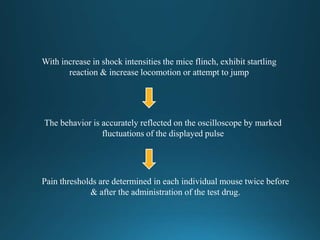
With increase in shock intensities the mice flinch, exhibit startling
reaction & increase locomotion or attempt to jump
The behavior is accurately reflected on the oscilloscope by marked
fluctuations of the displayed pulse
Pain thresholds are determined in each individual mouse twice before
& after the administration of the test drug.
 The current measured in milliamperes is recorded for
each animal before and after administration of the drug
 The average pain threshold values for each group at
each time interval are calculated and statistically
compared with the control values.
 Tail immersion test :
Young female wistar rats ( 170-210 g) are placed into individual
restraining cages leaving the tail hanging out freely
The animals are allowed to adapt to the cages 30
minutes prior to testing
The lower 5 cm portion of tail is marked and this portion is then
immersed in a cup of freshly filled water of exactly 55°C
Within a few seconds the rat reacts by withdrawing the tail. The reaction time is
recorded
The reaction time is determined before and periodically after either oral
or subcutaneous administration of the test substance
PERIPHERALANALGESIC
ACTIVITY
 Writhing test :
 Pain is induced by injecting irritants like acetic
acid into peritoneal cavity of mice
 The animals react with characteristic stretching
behavior which is writhing
 The test is suitable to detect analgesic activity of
peripherally acting drugs
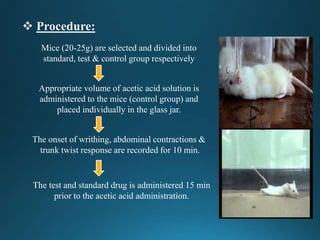
Mice (20-25g) are selected and divided into
standard, test & control group respectively
Appropriate volume of acetic acid solution is
administered to the mice (control group) and
placed individually in the glass jar.
The onset of writhing, abdominal contractions &
trunk twist response are recorded for 10 min.
The test and standard drug is administered 15 min
prior to the acetic acid administration.
 The writhing period is recorded and
compared with the control group
 Writhing response in the drug treated must
be less when compared to the acetic acid
treated control
 Pain in Inflamed Tissue (RANDALL-
SELITTO-Test) :
 This method for measuring analgesic activity is based on the
principle that inflammation increases the sensitivity to pain and
that this sensitivity is susceptible to modification by analgesics
 Inflammation decreases the pain reaction threshold and this low
pain reaction threshold is readily elevated by non-narcotic
analgesics of the salicylate-amidopyrine type as well as by the
narcotic analgesics
 Purpose and rationale :
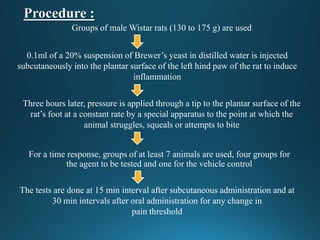
For a time response, groups of at least 7 animals are used, four groups for
the agent to be tested and one for the vehicle control
Groups of male Wistar rats (130 to 175 g) are used
0.1ml of a 20% suspension of Brewer’s yeast in distilled water is injected
subcutaneously into the plantar surface of the left hind paw of the rat to induce
inflammation
Three hours later, pressure is applied through a tip to the plantar surface of the
rat’s foot at a constant rate by a special apparatus to the point at which the
animal struggles, squeals or attempts to bite
The tests are done at 15 min interval after subcutaneous administration and at
30 min intervals after oral administration for any change in
pain threshold
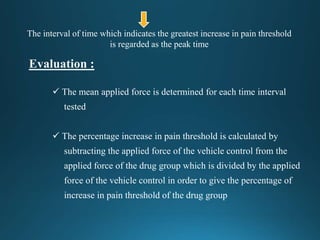
 The mean applied force is determined for each time interval
tested
 The percentage increase in pain threshold is calculated by
subtracting the applied force of the vehicle control from the
applied force of the drug group which is divided by the applied
force of the vehicle control in order to give the percentage of
increase in pain threshold of the drug group
The interval of time which indicates the greatest increase in pain threshold
is regarded as the peak time
Screening models for central and peripheral analgesics

Screening models for central and peripheral analgesics

  • 1.
    SCREENING MODELS FORCENTRAL AND PERIPHERALANALGESICS
  • 2.
    FLOW OF PRESENTATION:  CENTRAL ANALGESIC ACTIVITY  PERIPHERAL ANALGESIC ACTIVITY
  • 3.
    INTRODUCTION  Pain isa symptom of many diseases which requires analgesic treatment  Analgesics is defined as the are agents which selectively relieve pain by acting in the CNS or by peripheral pain mechanisms
  • 4.
    CLASSIFICATION OF ANALGESICS Analgesics Narcotics Ex.Morphine, Codeine, Pethidine, Dihydromorphine, Diacetylmorphine Non- narcotics Ex. Aspirin Paracetamol, Ibuprofen, Ketoprofen, Diclofenac, Piroxicam
  • 5.
    MECHANISM OF ACTION Analgesic drugs act in various ways on the peripheral and central nervous system  Opioids produce analgesia by binding to specific G – protein coupled receptors in brain and spinal cord  NSAIDs inhibit the activity of both cyclooxygenase-1 (COX- 1) and cyclooxygenase-2 (COX-2) and thereby the synthesis of prostaglandins and thromboxane's  Inhibition of COX1 and COX-2 leads to the anti- inflammatory, analgesic and antipyretic effects
  • 6.
  • 7.
  • 9.
     Hot platemethod :
  • 10.
     Procedure : Thelatency is recorded before & after 20, 60 and 90 min after the administration of standard or test compound Groups of 10 mice (18-22g) are selected and divided into standard, test & control group respectively The temperature of the hot plate is maintained at 55° to 56°C. The animals are placed on the hot plate & time until either licking or jumping occurs is recorded.
  • 11.
     The prolongationof latency time between the test, standard and control animals are compared  Using various doses ED50 values can be calculated
  • 12.
  • 13.
    Male mice (18-20g)are selected and placed individually in plastic chamber. The floor of the box is wired with stainless steel wire. The stimulus is given in the form of square wave pulses ( 30 cycles per second) The output of stimulator is connected to alternate wires of grid. The fixed resistance is placed with the grid & parallel to an oscilloscope to allow calibration in milliamperes.
  • 14.
    With increase inshock intensities the mice flinch, exhibit startling reaction & increase locomotion or attempt to jump The behavior is accurately reflected on the oscilloscope by marked fluctuations of the displayed pulse Pain thresholds are determined in each individual mouse twice before & after the administration of the test drug.
  • 15.
     The currentmeasured in milliamperes is recorded for each animal before and after administration of the drug  The average pain threshold values for each group at each time interval are calculated and statistically compared with the control values.
  • 16.
  • 17.
    Young female wistarrats ( 170-210 g) are placed into individual restraining cages leaving the tail hanging out freely The animals are allowed to adapt to the cages 30 minutes prior to testing The lower 5 cm portion of tail is marked and this portion is then immersed in a cup of freshly filled water of exactly 55°C Within a few seconds the rat reacts by withdrawing the tail. The reaction time is recorded The reaction time is determined before and periodically after either oral or subcutaneous administration of the test substance
  • 19.
  • 20.
     Writhing test:  Pain is induced by injecting irritants like acetic acid into peritoneal cavity of mice  The animals react with characteristic stretching behavior which is writhing  The test is suitable to detect analgesic activity of peripherally acting drugs
  • 21.
    Mice (20-25g) areselected and divided into standard, test & control group respectively Appropriate volume of acetic acid solution is administered to the mice (control group) and placed individually in the glass jar. The onset of writhing, abdominal contractions & trunk twist response are recorded for 10 min. The test and standard drug is administered 15 min prior to the acetic acid administration.
  • 22.
     The writhingperiod is recorded and compared with the control group  Writhing response in the drug treated must be less when compared to the acetic acid treated control
  • 23.
     Pain inInflamed Tissue (RANDALL- SELITTO-Test) :  This method for measuring analgesic activity is based on the principle that inflammation increases the sensitivity to pain and that this sensitivity is susceptible to modification by analgesics  Inflammation decreases the pain reaction threshold and this low pain reaction threshold is readily elevated by non-narcotic analgesics of the salicylate-amidopyrine type as well as by the narcotic analgesics  Purpose and rationale :
  • 24.
    For a timeresponse, groups of at least 7 animals are used, four groups for the agent to be tested and one for the vehicle control Groups of male Wistar rats (130 to 175 g) are used 0.1ml of a 20% suspension of Brewer’s yeast in distilled water is injected subcutaneously into the plantar surface of the left hind paw of the rat to induce inflammation Three hours later, pressure is applied through a tip to the plantar surface of the rat’s foot at a constant rate by a special apparatus to the point at which the animal struggles, squeals or attempts to bite The tests are done at 15 min interval after subcutaneous administration and at 30 min intervals after oral administration for any change in pain threshold
  • 25.
     The meanapplied force is determined for each time interval tested  The percentage increase in pain threshold is calculated by subtracting the applied force of the vehicle control from the applied force of the drug group which is divided by the applied force of the vehicle control in order to give the percentage of increase in pain threshold of the drug group The interval of time which indicates the greatest increase in pain threshold is regarded as the peak time