Dr. Devesh pandey
MBBS, MD
 Introduction
 Pathway of pain
 Animal models of acute pain
 Animal models of chronic pain
 Conclusion
 Pain is an unpleasant bodily sensation evoked due to external/
internal noxious stimuli. Various types of pains are seen in
humans like somatic pain, visceral pain etc
 Pain is produced by excitation of receptors, the nocireceptor,
which respond to a broad spectrum of physical and chemical
noxious stimuli. Hence called as nociception
 The afferent fibres that are excited by noxious stimuli are
non-myelinated C-fibres with low conduction velocity & Aδ
myelinated fibres with rapid conduction
 Pain are of two types : acute or chronic
Acute pain is of short duration, and pain which lasts 6months
or longer is chronic pain, it includes cancer pain, arthritic pain
 From the site of pain generation, the pain senses are carried by
Aδ & C fibres whose cell bodies are situated in the dorsal root
ganglion
 The central processes of the neuron, lying in the sensory root
of the spinal nerve enters the dorsal horn to terminate in the
substantia gelatinosa rolandi situated in the tip of dorsal horn
 From the SGR, 2nd order neuron arises crosses to the opposite
side then moves up through the white matter of spinal cord to
reach the brain
 Most of these 2nd order neurons travel up as spinothalamic
tract then ultimately terminates in the proper area of the
thalamus
 From these specific nuclei of thalamus, next order neuron
arises to terminate on cerebral cortex as well as cingulate
gyrus
 The neurotransmitter at synapse between Aδ and 2nd order
neuron is glutamate while between C fibres and 2nd order
neuron is substance P
 Other 2nd order neuron also cross to the opposite side to reach
different area of brain
 The tip of the dorsal horn plays a key role in modification of
pain perception called gate, so also controls the SGR involved
in the incoming traffic of pain
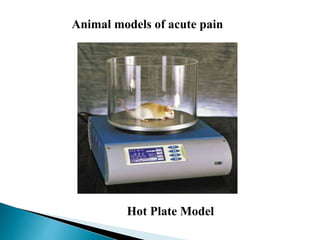
Hot Plate Model
Animal models of acute pain
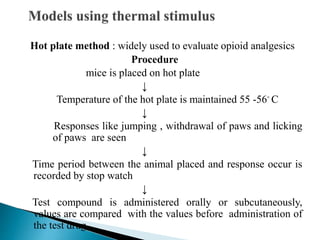
Hot plate method : widely used to evaluate opioid analgesics
Procedure
mice is placed on hot plate
↓
Temperature of the hot plate is maintained 55 -56◦ C
↓
Responses like jumping , withdrawal of paws and licking
of paws are seen
↓
Time period between the animal placed and response occur is
recorded by stop watch
↓
Test compound is administered orally or subcutaneously,
values are compared with the values before administration of
the test drug
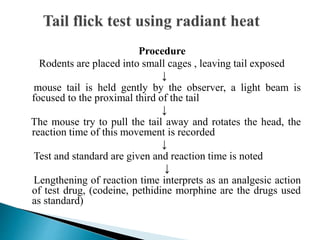
The tail-flick test : In this heat is used as a noxious stimuli.
The stimulus causes the rat to flicks its tail away from the
heat source
The two variant of the tail-flick test :
-Applying radiant heat to a small surface of the tail
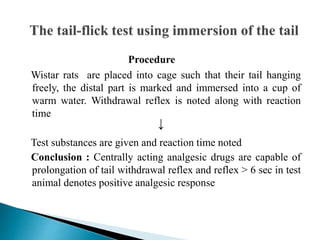
-Involving immersion of tail in water at a predetermined
temperature
Procedure
Rodents are placed into small cages , leaving tail exposed
↓
mouse tail is held gently by the observer, a light beam is
focused to the proximal third of the tail
↓
The mouse try to pull the tail away and rotates the head, the
reaction time of this movement is recorded
↓
Test and standard are given and reaction time is noted
↓
Lengthening of reaction time interprets as an analgesic action
of test drug, (codeine, pethidine morphine are the drugs used
as standard)
Procedure
Wistar rats are placed into cage such that their tail hanging
freely, the distal part is marked and immersed into a cup of
warm water. Withdrawal reflex is noted along with reaction
time
Test substances are given and reaction time noted
Conclusion : Centrally acting analgesic drugs are capable of
prolongation of tail withdrawal reflex and reflex > 6 sec in test
animal denotes positive analgesic response
↓
In this test, tail of rat is immersed in a cold mixture of water &
ethylene glycol at -10◦C
↓
The reaction time is measured as the time taken by the rat to
deflect its tail
Cold ethanol tail –flick test
In this test -20◦C is selected as a noxious stimulus
↓
Male sprague- dawley rats are used and their tail are
submerged halfway into the bath containing a solution of
ethanol
↓
Reaction time is measured until the rat removes its tail from
the bath
↓
Time from immersion to tail removal is measured
Tooth Pulp test :
In this test electrical stimulus is given in rabbits tooth pulp
Procedure
Rabbits are used and anaesthetized, using drill tooth pulp
chamber are exposed close to the two upper incisors
↓
Clamping electrodes are placed into drilled holes
↓
Current is started with 0.2mA and increased until animal start
licking
↓
Test compound is administered, after 2hrs threshold current is
measured and compared with the threshold current prior to
drug administration
Formalin test :
10% formalin is used as a noxious stimuli. By injecting the
formalin solution into the paw of rat, a model of persistent
pain caused by peripheral tissue injuries and inflammation is
created
Procedure
In the dorsum of front paw of wistar rat 10% formalin is
injected and observe for the pain responses which will be in
form of elevation of paw, excessive licking and biting
Pain response scoring is done and after administration of test
drug again scoring is done for comparison
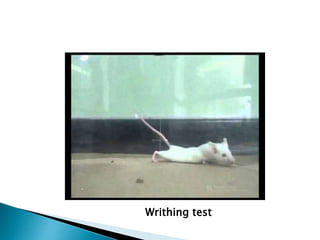
Writhing test
 A model of visceral or peritoneal pain in animals, involves
administration of algogenic agent, used to detect peripheral
analgesic activity of test compound
 Pain is induced by intraperitoneal administration of chemicals
that irritate serous membrane and provoke a stereotyped
behaviour in mouse
Procedure : Rodents are injected i.p. with 0.25 ml of
suspension composed of (Phenylquinone 0.02% suspended in
1% suspension of carboxymethyl cellulose)
 Rodents react with a characteristic stretching behaviour
accompanying with turning movement and extension of hind
limb
 In each test group prior to administration of suspension, test
drug is administered orally. The mice are placed individually
into glass chambers and no. of writhes are recorded for 10min
in each
 Acetic acid, acetylcholine, bradykinin, prostaglandin E1 are
several other chemicals give rise to writhing behaviour
Haffner’s Tail Clip Method: Nociceptive mechanical
stimulus is applied on the hind paw and tail
Procedure : An artery clip is placed at the root of the tail of
the mice to apply noxious stimulus
↓
A quick response is seen as biting of the clip or tail
↓
Reaction time between application of the clip and response is
noted by a stop watch
↓
Test compound administered, after 1 hr procedure is repeated
and reaction time is measured
 Inflammation is induced by subcutaneous administration of
brewer’s yeast and then pressure is applied which increases
the intensity of pain
Procedure: Wistar rats are divided into two groups – test and
control. In test group, test agents are administered and vehicle
is administered in control group
 After ½ hr 0.1 ml of Brewer’s yeast (20%) in distilled water is
injected subcutaneously into plantar surface of left hind paw
of the rat
 After 3hr using a special apparatus (Randall Selitto apparatus)
pressure is applied to the plantar surface of rat’s foot at a
constant rate until animal struggle
 In both groups each animal is tested for its control pain
threshold and then comparison is made between the two
groups
Colburn et.al. evaluated a mechanical visceral pain
model, where chronic intermittent intestinal distension is
produced in the rat using a chronic indwelling
intraduodenal balloon catheter
 Neuropathic pain models: Represents disorder of
neuropathic pain sensation, partial somatosensory nerve
injury is the cause of causalgiform pain disorders in man
Procedure :
 Sprague- Dawley rats are anaesthetized, incision is given and
sciatic nerves of both legs are exposed at the level of mid
thigh
 Chromic gut sutures are tied loosely with a square knot
around the right sciatic nerve. In next few days animal shows a
mild aversion of the affected paw and foot drop
 Halogen projector lamp is focused at the plantar area of one
hind paw, as soon as heat is applied a withdrawal response of
hind paw is seen
The time interval between exposure of heat and withdrawal
response is measured
 A rat model of partial sciatic nerve injury has also been
produced. Unilateral tight ligation of about half of sciatic
nerve rapidly produces sympathetically dependent
neuropathic pain that last many months and resembles
causalgia in humans
 An animal model of persistent neuropathic pain has also been
produced involving spared nerve injury. This involves a
lesion of two of the three terminal branches of the sciatic
nerve
 For experimental study of painful peripheral neuropathies in
patients, hyperalgesia induced by Vincristine in the rat
provides a good model
Procedure : Vincristine 100μg/kg is administered daily for
two weeks in rats. A decrease in mechanical nociception
threshold and hyperalgesia occur after the second day of
administration
Increased response to stimuli during the second week of
Vincristine administration
Responses gradually return to baseline following
discontinuation of treatment
 Painful diabetic neuropathy is one of the most common
complications of insulin-dependent diabetes in man
 Streptozotocin –induced diabetic rat has been a model of
chronic pain as signs of hyperalgesia observed in diabetic
humans
Procedure: Streptozotocin 75mg/kg is administered, animal
subjected to various pain stimuli, with follow up of four weeks
with clinical symptoms and hyperglycemias. A decrease in
threshold to noxious heat stimuli and non-painful thermal and
mechanical stimulation is observed
4 wks after the induction of diabetes, score obtained in rats by
injection of formalin, if score greater than those in normal rats
indicates hyperalgesia
Rat model of incisional pain:
Model helps to understand mechanism of sensitization
caused by surgery and investigate new therapies for post
operative pain. Model revealed that both the sural and
tibial nerve are responsible for transmitting the inputs
from the incision that produces hyperalgesia
Procedure
Longitudinal incision of 1cm through skin of plantar
surface of hind paw. Withdrawal responses are measured
using von frey filament at different areas of wound
before its surgery. Results of tests for withdrawal
responses suggest that a surgical incision of the rat foot
causes mechanical hyperalgesia lasting for several days
after surgery
Rat model of bone cancer pain :
 Sprague- Dawley rats are given intra-tibial injections of
syngeneic MRMT-1 rat mammary gland carcinoma cells,
control rats receive heat killed cells
 Sprague –dawley develop behavioural signs indicative of pain
including mechanical allodynia and mechanical hyperalgesia
 Development of bone tumor and structural damage of bone
was monitored
 Intra-tibial injection produced a rapidly expanding tumor
within the boundaries of the tibia
 No tumor growth, no changes in body weight was observed
after the injection of heat killed MRMT-1 cells
 The general activity of animals after injection with live or heat
killed MRMT-1 was higher than that of the control group
 However the activity of MRMT-1 treated group declined
during the progress of the disease
 Although different pain models based on nociceptive stimuli
(electrical, thermal, mechanical or chemical) have been used
but none of them is ideal. However test using chemical stimuli
closely mimic acute clinical pain
 As far as neuropathic pain is concerned it is difficult to design
a model in animal for both technical and ethical reason that
could measure affective component of pain
THANK YOU