SCREENING METHOD
OF CARDIOVASCULAR
ACTIVITY
1
Introduction
 Herbal drugs having there major action on
cardiovascular disorders are designated as
cardiovascular drugs.
 They can act directly on cardiovascular structure or
through central nervous system, kidney, hormones
which regulates cardiovascular function.
 Screening of this drugs for there activity became
important for there use in human subject.
 Mainly animal studies are carried out for this
purpose
2
Following are the major cardiovascular
disorders
 Arrhythmia
 Angina
 Hypertension
 Congestive heart failure
3
Screening of antiarrhythmic drugs
The screening of anti-arrhythmic is done by
two different methods.
• In-vitro models
1. Lagendroff technique:
• In-vivo models :
 Chemically induced arrhythmia
 Electrically induced arrhythmia
 Exercise induced ventricular fibrillation
4
In-vitro models
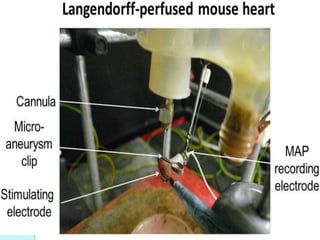
 Lagendroff technique:
 Principle :-
-force of contraction, heart
rate, Incidence and duration of ventricular
fibrillation or ventricular tachycardia is
recorded in the control as well as test
group using this Principle this technique is
carried out.
5
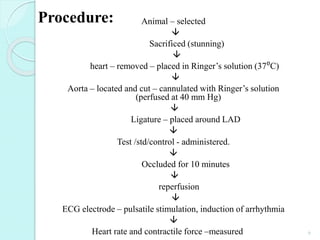
Animal – selected

Sacrificed (stunning)

heart – removed – placed in Ringer’s solution (37⁰C)

Aorta – located and cut – cannulated with Ringer’s solution
(perfused at 40 mm Hg)

Ligature – placed around LAD

Test /std/control - administered.

Occluded for 10 minutes

reperfusion

ECG electrode – pulsatile stimulation, induction of arrhythmia

Heart rate and contractile force –measured
Procedure:
6
7
EVALUATION:
 Heart rate
 Contractile force (force transducer)
 Incidence and duration of ventricular
fibrillation or ventricular tachycardia is
recorded in the control as well as test group
8
In-vivo models :
 Chemically induced arrhythmia
 Electrically induced arrhythmia
 Exercise induced ventricular fibrillation
9
Chemically induced arrhythmia
 A large number of agents are capable of
inducing arrhythmias.
 e.g. anesthetics like chloroform, ether,
followed by a precipitating stimulus such as
adrenaline, some alkaloids cause arrhythmia.
 Principle :- Aconitine acts persistently on
sodium channels and activates them causes
ventricular arrhythmias using this study is
carried out
10
procedure
Animals [Male rats (300-400g)]

Anesthetized

Test / std/control – administered
↓
Aconitine (5μg/kg +0.1N HNO₃) (administered
through saphenous vein)
↓
ECG – Recorded (lead II)
11
 observation
 Anti-arrhythmic effect of test is measured by
the amount of Aconitine/100g animal.
 Includes:
 Ventricular extra systoles
 Ventricular tachycardia
 Ventricular fibrillation
 Death
12
ELECTRICALLY INDUCED
ARHYTHMIAS
PRINCIPLE
 Electrical stimulations – flutters and
fibrillation.
REQUIREMENTS :
 Animals – adult dogs (8-12kg)
13
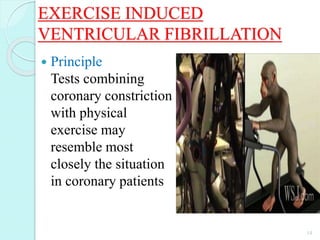
EXERCISE INDUCED
VENTRICULAR FIBRILLATION
 Principle
Tests combining
coronary constriction
with physical
exercise may
resemble most
closely the situation
in coronary patients
14
production of MI
↓
Animals – run on a motor –driven treadmill
↓
Work load - ↑every 3 min for total of 18 min
↓
During last minute-treadmill is stopped- left
circum flex artery- occluded for 2 min
↓
After 10-20 sec of VF – defibrillation is achieved
without any delay by placing large metal plates
across animal’s chest.
observation
HR is measured
15
Screening of anti-anginal drugs
 In Vitro Models
 Isolated heart (Langendorff) technique.
 In Vivo models
 Myocardial ischemic preconditioning model
16
Ischemia preconditioning model
 Principle: Preconditioning(brief duration of ischemia
and reperfusion) can reduce damage produced by
prolonged ischemia and reperfusion
 Rabbits are anaesthetized with ketamine
 Artificial respiration is established and vessels
cannulated
 4- suture is looped around marginal branch of LCA
.Loop is tighten for 5 min, loosened for 10 min
 Test drug administered
 Tighten for 30 min followed by 120 min of
reperfusion
17
observation
 The animals are sacrificed after the
reperfusion duration.
 Comparisons between systemic
hemodynamic data and infarct size studies
are analyzed by ANOVA using statistical
software.
18
Screening of Antihypertension drugs
 IN VIVO MODELS
 ACE Inhibition in rat
 Tail cuff method
IN VITRO
Monocrotaline Induced Pulmonary Hypertension
19
ACE INHIBITION IN RAT
 Principle:
Angiotensin –I is converted to
angiotensin II by ACE which causes increase
in blood pressure using this test drug are
tested.
20
Male Sprague- Dawley rats (200-225gm) are
selected..
They are anaesthetized with 60mg/kg of
phenobarbitone sodium i.v.
The right artery is cannulated for recording the
pressure.
The jujular vein is cannulated for i.v. test
injection.
The B.P is diminished by the administration of
5mg/kg of pentolinium i.p.
Now Ang I is injected i.v. saline.
The injection is repeated in 5min interval until
an identical pressure is attained.
21
The test drug is administered at a dose of
10mg/kg intravenously or 25mg/kg
intradeudenally.
Again Ang I is injected as the similar dose
above.
The diminution of the pressure after the
administration of potent ACE inhibitors is
compared .
22
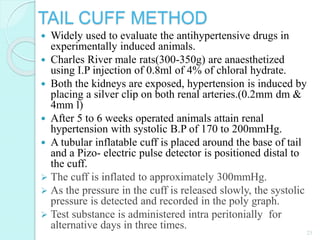
TAIL CUFF METHOD
 Widely used to evaluate the antihypertensive drugs in
experimentally induced animals.
 Charles River male rats(300-350g) are anaesthetized
using I.P injection of 0.8ml of 4% of chloral hydrate.
 Both the kidneys are exposed, hypertension is induced by
placing a silver clip on both renal arteries.(0.2mm dm &
4mm l)
 After 5 to 6 weeks operated animals attain renal
hypertension with systolic B.P of 170 to 200mmHg.
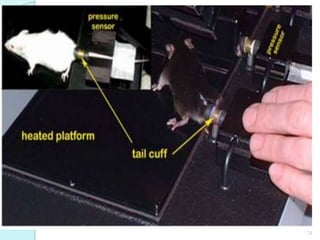
 A tubular inflatable cuff is placed around the base of tail
and a Pizo- electric pulse detector is positioned distal to
the cuff.
 The cuff is inflated to approximately 300mmHg.
 As the pressure in the cuff is released slowly, the systolic
pressure is detected and recorded in the poly graph.
 Test substance is administered intra peritonially for
alternative days in three times.
23
24
IN VITRO MODELS
MONOCROTALINE INDUCED
HYPERTENSION
 MONOCROTALINE, a pyrrolizidine alkaloids
derived from Crotaloria spectabillis.
 Sprague- Dawley rats (200-225gm) of either sex
are selected.
 Animals are fed with test drug for one week prior
to S.C injection of MONOCROTALINE
100mg/kg.
 Animals are sacrificed 7 or 14 days later and their
hearts and lungs are excised.
 Left ventricle and lung are weighed, along with
main, extra and intrapulmonary, artery are
isolated.
 After 1hr arteries are made to contract with KCl.
 Contractions are recorded using lever transducer.
25
 Maximum force generated by an artery is
plotted as a function of applied force and
recorded on a polygraph.
 Contraction and relaxation of agonist
responses of artery are assessed.
 Cumulative Conc. response of KCl,
Angiotension II, and NOR-Epinephrine are
plotted.
 Both the responses are plotted as a function
of negative log of agonist Conc.
 To compare the differences in mean
responses, t-test is applied.
26
Cadiotonic drugs
Isolated heart technique
 Animal :-guinea pig
 Principle:-force of contraction and
coronary flow measurement s carried out
to fin out activity of cardiotonic drug.
27
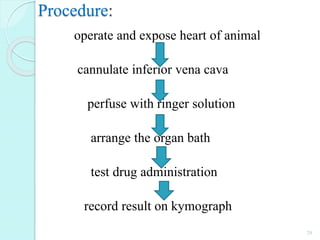
Procedure:
operate and expose heart of animal
cannulate inferior vena cava
perfuse with ringer solution
arrange the organ bath
test drug administration
record result on kymograph
28
Observation
 Calculate heart rate and contraction
amplitude
 A positive chronotropic effect from dose
response curve shows cardiotonic activity.
29
References
 H. Gerhard Vogel (Ed.)Drug Discovery and
Evaluation:Pharmacological Assays,springer
publication
 Dr. S.L. Deore, Dr. S.S. Khadabadi, Dr. B.A.
Baviskar, Pharmacognocy & Phytochemistery,
A comprehensive approach pharma med press.
 Kd tripathi essintials of medical pharmacology
seventh edition jaypee publiction

30

screening method of cardiovascular activity

  • 1.
  • 2.
    Introduction  Herbal drugshaving there major action on cardiovascular disorders are designated as cardiovascular drugs.  They can act directly on cardiovascular structure or through central nervous system, kidney, hormones which regulates cardiovascular function.  Screening of this drugs for there activity became important for there use in human subject.  Mainly animal studies are carried out for this purpose 2
  • 3.
    Following are themajor cardiovascular disorders  Arrhythmia  Angina  Hypertension  Congestive heart failure 3
  • 4.
    Screening of antiarrhythmicdrugs The screening of anti-arrhythmic is done by two different methods. • In-vitro models 1. Lagendroff technique: • In-vivo models :  Chemically induced arrhythmia  Electrically induced arrhythmia  Exercise induced ventricular fibrillation 4
  • 5.
    In-vitro models  Lagendrofftechnique:  Principle :- -force of contraction, heart rate, Incidence and duration of ventricular fibrillation or ventricular tachycardia is recorded in the control as well as test group using this Principle this technique is carried out. 5
  • 6.
    Animal – selected  Sacrificed(stunning)  heart – removed – placed in Ringer’s solution (37⁰C)  Aorta – located and cut – cannulated with Ringer’s solution (perfused at 40 mm Hg)  Ligature – placed around LAD  Test /std/control - administered.  Occluded for 10 minutes  reperfusion  ECG electrode – pulsatile stimulation, induction of arrhythmia  Heart rate and contractile force –measured Procedure: 6
  • 7.
  • 8.
    EVALUATION:  Heart rate Contractile force (force transducer)  Incidence and duration of ventricular fibrillation or ventricular tachycardia is recorded in the control as well as test group 8
  • 9.
    In-vivo models : Chemically induced arrhythmia  Electrically induced arrhythmia  Exercise induced ventricular fibrillation 9
  • 10.
    Chemically induced arrhythmia A large number of agents are capable of inducing arrhythmias.  e.g. anesthetics like chloroform, ether, followed by a precipitating stimulus such as adrenaline, some alkaloids cause arrhythmia.  Principle :- Aconitine acts persistently on sodium channels and activates them causes ventricular arrhythmias using this study is carried out 10
  • 11.
    procedure Animals [Male rats(300-400g)]  Anesthetized  Test / std/control – administered ↓ Aconitine (5μg/kg +0.1N HNO₃) (administered through saphenous vein) ↓ ECG – Recorded (lead II) 11
  • 12.
     observation  Anti-arrhythmiceffect of test is measured by the amount of Aconitine/100g animal.  Includes:  Ventricular extra systoles  Ventricular tachycardia  Ventricular fibrillation  Death 12
  • 13.
    ELECTRICALLY INDUCED ARHYTHMIAS PRINCIPLE  Electricalstimulations – flutters and fibrillation. REQUIREMENTS :  Animals – adult dogs (8-12kg) 13
  • 14.
    EXERCISE INDUCED VENTRICULAR FIBRILLATION Principle Tests combining coronary constriction with physical exercise may resemble most closely the situation in coronary patients 14
  • 15.
    production of MI ↓ Animals– run on a motor –driven treadmill ↓ Work load - ↑every 3 min for total of 18 min ↓ During last minute-treadmill is stopped- left circum flex artery- occluded for 2 min ↓ After 10-20 sec of VF – defibrillation is achieved without any delay by placing large metal plates across animal’s chest. observation HR is measured 15
  • 16.
    Screening of anti-anginaldrugs  In Vitro Models  Isolated heart (Langendorff) technique.  In Vivo models  Myocardial ischemic preconditioning model 16
  • 17.
    Ischemia preconditioning model Principle: Preconditioning(brief duration of ischemia and reperfusion) can reduce damage produced by prolonged ischemia and reperfusion  Rabbits are anaesthetized with ketamine  Artificial respiration is established and vessels cannulated  4- suture is looped around marginal branch of LCA .Loop is tighten for 5 min, loosened for 10 min  Test drug administered  Tighten for 30 min followed by 120 min of reperfusion 17
  • 18.
    observation  The animalsare sacrificed after the reperfusion duration.  Comparisons between systemic hemodynamic data and infarct size studies are analyzed by ANOVA using statistical software. 18
  • 19.
    Screening of Antihypertensiondrugs  IN VIVO MODELS  ACE Inhibition in rat  Tail cuff method IN VITRO Monocrotaline Induced Pulmonary Hypertension 19
  • 20.
    ACE INHIBITION INRAT  Principle: Angiotensin –I is converted to angiotensin II by ACE which causes increase in blood pressure using this test drug are tested. 20
  • 21.
    Male Sprague- Dawleyrats (200-225gm) are selected.. They are anaesthetized with 60mg/kg of phenobarbitone sodium i.v. The right artery is cannulated for recording the pressure. The jujular vein is cannulated for i.v. test injection. The B.P is diminished by the administration of 5mg/kg of pentolinium i.p. Now Ang I is injected i.v. saline. The injection is repeated in 5min interval until an identical pressure is attained. 21
  • 22.
    The test drugis administered at a dose of 10mg/kg intravenously or 25mg/kg intradeudenally. Again Ang I is injected as the similar dose above. The diminution of the pressure after the administration of potent ACE inhibitors is compared . 22
  • 23.
    TAIL CUFF METHOD Widely used to evaluate the antihypertensive drugs in experimentally induced animals.  Charles River male rats(300-350g) are anaesthetized using I.P injection of 0.8ml of 4% of chloral hydrate.  Both the kidneys are exposed, hypertension is induced by placing a silver clip on both renal arteries.(0.2mm dm & 4mm l)  After 5 to 6 weeks operated animals attain renal hypertension with systolic B.P of 170 to 200mmHg.  A tubular inflatable cuff is placed around the base of tail and a Pizo- electric pulse detector is positioned distal to the cuff.  The cuff is inflated to approximately 300mmHg.  As the pressure in the cuff is released slowly, the systolic pressure is detected and recorded in the poly graph.  Test substance is administered intra peritonially for alternative days in three times. 23
  • 24.
  • 25.
    IN VITRO MODELS MONOCROTALINEINDUCED HYPERTENSION  MONOCROTALINE, a pyrrolizidine alkaloids derived from Crotaloria spectabillis.  Sprague- Dawley rats (200-225gm) of either sex are selected.  Animals are fed with test drug for one week prior to S.C injection of MONOCROTALINE 100mg/kg.  Animals are sacrificed 7 or 14 days later and their hearts and lungs are excised.  Left ventricle and lung are weighed, along with main, extra and intrapulmonary, artery are isolated.  After 1hr arteries are made to contract with KCl.  Contractions are recorded using lever transducer. 25
  • 26.
     Maximum forcegenerated by an artery is plotted as a function of applied force and recorded on a polygraph.  Contraction and relaxation of agonist responses of artery are assessed.  Cumulative Conc. response of KCl, Angiotension II, and NOR-Epinephrine are plotted.  Both the responses are plotted as a function of negative log of agonist Conc.  To compare the differences in mean responses, t-test is applied. 26
  • 27.
    Cadiotonic drugs Isolated hearttechnique  Animal :-guinea pig  Principle:-force of contraction and coronary flow measurement s carried out to fin out activity of cardiotonic drug. 27
  • 28.
    Procedure: operate and exposeheart of animal cannulate inferior vena cava perfuse with ringer solution arrange the organ bath test drug administration record result on kymograph 28
  • 29.
    Observation  Calculate heartrate and contraction amplitude  A positive chronotropic effect from dose response curve shows cardiotonic activity. 29
  • 30.
    References  H. GerhardVogel (Ed.)Drug Discovery and Evaluation:Pharmacological Assays,springer publication  Dr. S.L. Deore, Dr. S.S. Khadabadi, Dr. B.A. Baviskar, Pharmacognocy & Phytochemistery, A comprehensive approach pharma med press.  Kd tripathi essintials of medical pharmacology seventh edition jaypee publiction  30