



Pay Attention to This: Attention and Working Memory in Pediatric EpilepsyWilliam S. MacAllister, Ph.D.Pediatric Neuropsychologist
To be discussed…Brief History of ADHDReview of the Diagnostic CriteriaAssociated Features / Comorbid ConditionsAttention Problems in EpilepsyTreatment Considerations
HistoryFirst descriptions of ADHD may have appeared 2500 years agoHippocrates described a patient who had quickened responses to sensory experiences, but also less tenaciousness because the soul moves on quickly to the next impressionCondition was attributed to an overbalance of fire over water
History Continued…George Frederick Still (1902)Defined chief characteristics in 43 kids“defects in moral control”“abnormal incapacity for sustained attention, restlessness, fidgetiness, violent outbursts, destructiveness, non-compliance”Demonstrate little “inhibitory volition”
Encephalitis outbreak of 1917Called attention to the fact that these children showed similar deficits and allowed scientists of the day to draw parallels between these groupsGave rise to the concept of “minimal brain dysfunction”
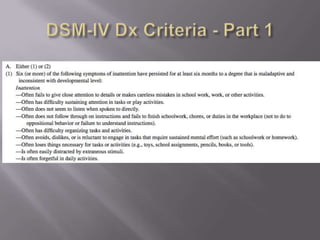
DSM-IV Dx Criteria - Part 1
Inattentive Subtype
Diagnostic Criteria Part 2
ADHD is one of the most common psychiatric conditions of childhoodConsidered one of the best-researched disorders in medicine and the overall data on its validity are far more compelling than for many medical conditions (Goldman et al, 1998)In clinic  samples, boys are 6-10x more likely to be referred for the d/o and 3-4x more likely to be dxMay reflect biases - girls less likely to be disruptive
Several recent epidemiological studies of ADHD have been conductedRowland et al, 2002; Harel & Brown, 2002; Barbaresi et al, 2002; CDC, 2005Prevalence across these studies fairly consistent, with estimates between 6 and 10%Estimated to affect 4.4 million children in U.S.Interestingly, many identified a “treatment gap”
CDC StudyFor example, the CDC study indicated that 7.8% of children met criteria at some point in their lifetime But only 4.3% were treated with medications (only 55% of those with ADHD were treated pharmacologically)
In kids…Higher rates of ER admissions (Leibson et al 2001)More burns, TBI, fracturesDriving accidents more common in adolescenceMore driving offenses (speeding, reckless driving -> suspended licenses)Higher rates of STD’s (4x higher; Fischer, 93)Higher teen pregnancy rates
Associated DisordersLD’sODDTic D/O’sDevelopmental Coordination Disorders
Learning DisabilitiesLD’s are comorbid in over 20% of casesReading disorders (16-39%)Spelling problems (24-27%)Math disorders (13-33%)
DCDApproximately 6% of population with higher rates in ADHDClumsiness, dysgraphia, articulation deficitsLikely due to underlying neural substrates involving cortical-basal ganglia circuitry (see Delong 2002)
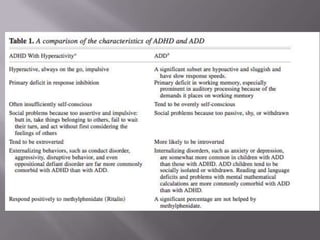
Milich et al, 2002; Coghill et al 2005 believe that ADHD-C and ADHD-I are actually “distinct disorders”
Cognition in EpilepsyWell established that inattention and hyperactivity are behavioral symptoms common in childhood onset epilepsy (Dunn & Austin, 1999)Such symptoms may, in large part, account for the degree of academic underachievement in these children
Prevalence of ADHD in epilepsy varies widely across samples studied and measures employedEpidemiological studies		Rutter et al. (1970): Hyperactivity seen in 4/34 children with epilepsy (Isle of Wight Study: UK)		McDermott et al (1995): Hyperactivity seen is 28% of children with epilepsy, versus 13% in cardiac patients, and 5% in control children		Carlton-Ford et al (1995): Impulsivity seen in 39% of children with current OR past seizures, versus 11% in controls
Teacher ReportHoldsworth and Whitmore (1974) – Teachers report inattention in 42% of children with seizuresSturniolo and Galletti (1994): Inattention or hyperactivity in 58% of children with seizuresNo standardized measures or diagnostic procedures
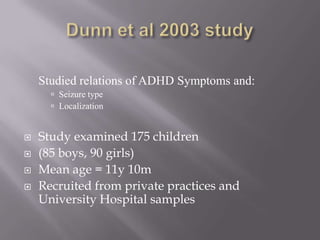
Dunn et al 2003 study	Studied relations of ADHD Symptoms and: Seizure typeLocalizationStudy examined 175 children (85 boys, 90 girls)Mean age = 11y 10mRecruited from private practices and University Hospital samples
MeasuresCBCL (Achenbach)Dimensional instrument of symptomsCSI-4 / ASI-4 (Gadow and Sprafkin)Categorical and Dimensional Based on DSM-4 criteria
Sample characteristics
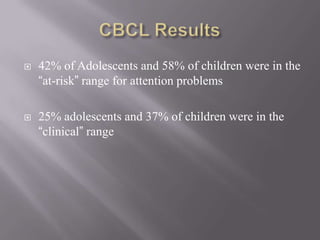
CBCL Results42% of Adolescents and 58% of children were in the “at-risk” range for attention problems25% adolescents and 37% of children were in the “clinical” range
Dunn Studies
ADHD by seizure type
ADHD Prevalence by Focus
Interesting findings of this study:In contrast to ADHD in non-epilepsy patients:Inattentive subtype ADHD was more common than CombinedGirls were more likely to have ADHD than boys
Hermann et al (2007)Studied 75 children and adolescents with new onset epilepsy (ages 8 – 18) and 62 ControlsKSADS Interview, NeuropsychADHD was present in 31% of patients and only 6% of controlsInattentive subtype predominated, with symptoms of ADHD appearing before seizuresChildren with ADHD and epilepsy had higher rates of school interventions/servicesNeuropsych evaluation revealed prominent executive dysfunctionADHD was not associated with epilepsy characteristics or demographic variables
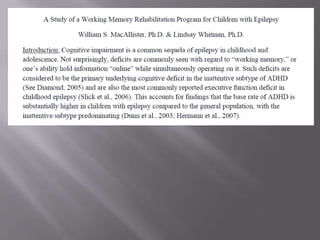
Executive DysfunctionSlick et al 2006BRIEF as primary measure80 children and adolescents with intractable epilepsy
Slick article
Treatment (Pharmacological)Methylphenidate (e.g., Ritalin; MPH) is commonly believed to lower seizure thresholdPDR suggests that methylephenidate is contraindicated in children with epilepsyHowever, no controlled studies have proved this hypothesisOnly isolated case studies seem to support MPH as analeptic
SafetySeveral publications indicate that MPH is safe in children with controlled epilepsy(Feldman et al, 1989) – 10 children with ADHD and Epilepsy – MPH effectively treated ADHD Symptoms and no seizures were seen during the 10 weeks of follow-up.All had abnormal EEG’s that were unchanged during the study
Gross-Tsur et al (1997) 30 Children with epilepsy and ADHD (25 were seizure free on AED’s, 5 with occasional seizures)Those that were seizure free prior to MPH remained so after MPHThose with ongoing seizures did not show an increase in seizure frequency
Gucuyener et al (2003)Followed two groups for one yearone with ADHD and epilepsy, one with ADHD and EEG abnormalities (but no clinical seizures)MPH improved ADHD symptoms in both groupsThe epilepsy group experienced no change in seizure frequency AND EEG’s improvedNo patients in the abnormal EEG group experienced seizures
Summary of MPH studiesMost agree that MPH is not contraindicated in children with ADHDNo compelling evidence that MPH will increase risk of seizures in children with ADHDwill cause seizures in those with ADHD and abnormal EEGor will increase seizure frequency in children with ADHD and epilepsy
Treatment with Amphetamines (e.g., Adderall, Dexedrine, Vyvanse)Effects of these agents in children with ADHD and Epilepsy has NOT been systematically studiedTorres et al (2008) in their review of the evidence noted that:“Amphetamines might be proconvulsant, especially when abused; however there is some evidence that amphetamines may have an anticonvulsant effect in select patients.”“Case series for ADHD plus Epilepsy have reported disappointing response rates to amphetamine”
Atomoxetine (Strattera) No well-controlled trials of Atomoxetine in patients with ADHD and epilepsySummarizing the results of  available data “the rate of the positive response to atomoxetine was disappointing” (Torres et al, 2008)However, it was noted that almost all of the patients placed on Strattera had already had unsuccessful trials of stimulants
Summary of Medication studies suggest that MPH may be the best supported treatment in children with epilepsy and comorbid ADHD
Summary PointsRate of ADHD in children with epilepsy is several times higher than in general population (5 times higher?)Inattentive subtype more commonGirls more affected than boysMay be primary reason for school underachievementAll seizure types at riskMPH may be treatment of choice
What is an Executive Function?Key elements:Anticipation and deployment of attentionImpulse control/self-regulatory processesInitiationWorking memoryMental flexibilityPlanning/organizationProblem solving
What does executive dysfunction look like?Inability to focus or maintain attentionImpulse control deficitsPoor working memoryDifficulties self-monitoringInability to planDisorganizationPoor reasoningPerseveration
NeuroanatomyPFC (particularly dorsolateral PFC) are the last brain regions to myelinatePFC play a critical role in executive fxRegion does not act in isolationPart of broader functional systemHighly interconnected with other regionsDamage to PFC is sufficient, but not necessary for executive dysfunctione.g., subcortical structures (basal ganglia) as well as the cerebellum are also crucial
Yeah… but what is workingmemory? Working Memory: A limited capacity memory system that provides temporary storage to manipulate complex cognitive tasks…
BaddeleyModel of Working Baddeley Model deals mainly with working memory Working memory – “a limited capacity system allowing the temporary storage and manipulation of information necessary for such complex tasks as comprehension, learning, and reasoning” (Baddeley, 2000)Holding information ‘On-line’ while operating on it.
Why is working memory important? Working memory deficits have the potential to adversely affect children in academic pursuits
SchoolNote taking in class requires a tremendous amount of working memoryChildren must dual task as they listen to what the teacher is saying, while concurrently writing down what they have just saidi.e., the ‘lag’ between the teacher’s real time speech and the child’s handwriting necessitates working memory for them to keep up with the demands of the classroom
Academic AchievementSeveral studies have linked executive function deficits (and particularly working memory deficits) to objective performance on academic tasks, even in children who do nothave primary learning disabilities…
Mathematics
Reading Comprehension
So now what? Can anything be done about this?
Adhd study
Stroke study
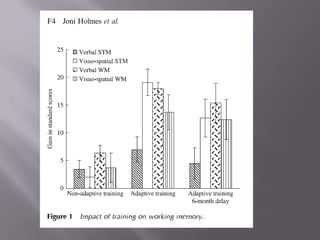
        Holmes study
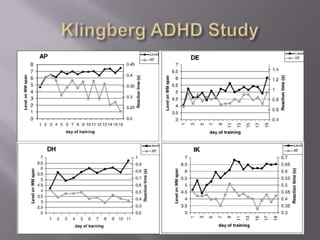
Klingberg ADHD Study
Interested?Call me! Let’s chat!646-558-0852Or Megan Marsh, Ph.D.212-263-8304OR just see me after this talk…

William MacAllister, PhD

  • 1.
    Pay Attention toThis: Attention and Working Memory in Pediatric EpilepsyWilliam S. MacAllister, Ph.D.Pediatric Neuropsychologist
  • 2.
    To be discussed…BriefHistory of ADHDReview of the Diagnostic CriteriaAssociated Features / Comorbid ConditionsAttention Problems in EpilepsyTreatment Considerations
  • 3.
    HistoryFirst descriptions ofADHD may have appeared 2500 years agoHippocrates described a patient who had quickened responses to sensory experiences, but also less tenaciousness because the soul moves on quickly to the next impressionCondition was attributed to an overbalance of fire over water
  • 4.
    History Continued…George FrederickStill (1902)Defined chief characteristics in 43 kids“defects in moral control”“abnormal incapacity for sustained attention, restlessness, fidgetiness, violent outbursts, destructiveness, non-compliance”Demonstrate little “inhibitory volition”
  • 5.
    Encephalitis outbreak of1917Called attention to the fact that these children showed similar deficits and allowed scientists of the day to draw parallels between these groupsGave rise to the concept of “minimal brain dysfunction”
  • 6.
  • 7.
  • 8.
  • 9.
    ADHD is oneof the most common psychiatric conditions of childhoodConsidered one of the best-researched disorders in medicine and the overall data on its validity are far more compelling than for many medical conditions (Goldman et al, 1998)In clinic samples, boys are 6-10x more likely to be referred for the d/o and 3-4x more likely to be dxMay reflect biases - girls less likely to be disruptive
  • 10.
    Several recent epidemiologicalstudies of ADHD have been conductedRowland et al, 2002; Harel & Brown, 2002; Barbaresi et al, 2002; CDC, 2005Prevalence across these studies fairly consistent, with estimates between 6 and 10%Estimated to affect 4.4 million children in U.S.Interestingly, many identified a “treatment gap”
  • 11.
    CDC StudyFor example,the CDC study indicated that 7.8% of children met criteria at some point in their lifetime But only 4.3% were treated with medications (only 55% of those with ADHD were treated pharmacologically)
  • 12.
    In kids…Higher ratesof ER admissions (Leibson et al 2001)More burns, TBI, fracturesDriving accidents more common in adolescenceMore driving offenses (speeding, reckless driving -> suspended licenses)Higher rates of STD’s (4x higher; Fischer, 93)Higher teen pregnancy rates
  • 13.
  • 14.
    Learning DisabilitiesLD’s arecomorbid in over 20% of casesReading disorders (16-39%)Spelling problems (24-27%)Math disorders (13-33%)
  • 15.
    DCDApproximately 6% ofpopulation with higher rates in ADHDClumsiness, dysgraphia, articulation deficitsLikely due to underlying neural substrates involving cortical-basal ganglia circuitry (see Delong 2002)
  • 16.
    Milich et al,2002; Coghill et al 2005 believe that ADHD-C and ADHD-I are actually “distinct disorders”
  • 19.
    Cognition in EpilepsyWellestablished that inattention and hyperactivity are behavioral symptoms common in childhood onset epilepsy (Dunn & Austin, 1999)Such symptoms may, in large part, account for the degree of academic underachievement in these children
  • 20.
    Prevalence of ADHDin epilepsy varies widely across samples studied and measures employedEpidemiological studies Rutter et al. (1970): Hyperactivity seen in 4/34 children with epilepsy (Isle of Wight Study: UK) McDermott et al (1995): Hyperactivity seen is 28% of children with epilepsy, versus 13% in cardiac patients, and 5% in control children Carlton-Ford et al (1995): Impulsivity seen in 39% of children with current OR past seizures, versus 11% in controls
  • 21.
    Teacher ReportHoldsworth andWhitmore (1974) – Teachers report inattention in 42% of children with seizuresSturniolo and Galletti (1994): Inattention or hyperactivity in 58% of children with seizuresNo standardized measures or diagnostic procedures
  • 22.
    Dunn et al2003 study Studied relations of ADHD Symptoms and: Seizure typeLocalizationStudy examined 175 children (85 boys, 90 girls)Mean age = 11y 10mRecruited from private practices and University Hospital samples
  • 23.
    MeasuresCBCL (Achenbach)Dimensional instrumentof symptomsCSI-4 / ASI-4 (Gadow and Sprafkin)Categorical and Dimensional Based on DSM-4 criteria
  • 24.
  • 25.
    CBCL Results42% ofAdolescents and 58% of children were in the “at-risk” range for attention problems25% adolescents and 37% of children were in the “clinical” range
  • 26.
  • 27.
  • 28.
  • 29.
    Interesting findings ofthis study:In contrast to ADHD in non-epilepsy patients:Inattentive subtype ADHD was more common than CombinedGirls were more likely to have ADHD than boys
  • 30.
    Hermann et al(2007)Studied 75 children and adolescents with new onset epilepsy (ages 8 – 18) and 62 ControlsKSADS Interview, NeuropsychADHD was present in 31% of patients and only 6% of controlsInattentive subtype predominated, with symptoms of ADHD appearing before seizuresChildren with ADHD and epilepsy had higher rates of school interventions/servicesNeuropsych evaluation revealed prominent executive dysfunctionADHD was not associated with epilepsy characteristics or demographic variables
  • 31.
    Executive DysfunctionSlick etal 2006BRIEF as primary measure80 children and adolescents with intractable epilepsy
  • 32.
  • 33.
    Treatment (Pharmacological)Methylphenidate (e.g.,Ritalin; MPH) is commonly believed to lower seizure thresholdPDR suggests that methylephenidate is contraindicated in children with epilepsyHowever, no controlled studies have proved this hypothesisOnly isolated case studies seem to support MPH as analeptic
  • 34.
    SafetySeveral publications indicatethat MPH is safe in children with controlled epilepsy(Feldman et al, 1989) – 10 children with ADHD and Epilepsy – MPH effectively treated ADHD Symptoms and no seizures were seen during the 10 weeks of follow-up.All had abnormal EEG’s that were unchanged during the study
  • 35.
    Gross-Tsur et al(1997) 30 Children with epilepsy and ADHD (25 were seizure free on AED’s, 5 with occasional seizures)Those that were seizure free prior to MPH remained so after MPHThose with ongoing seizures did not show an increase in seizure frequency
  • 36.
    Gucuyener et al(2003)Followed two groups for one yearone with ADHD and epilepsy, one with ADHD and EEG abnormalities (but no clinical seizures)MPH improved ADHD symptoms in both groupsThe epilepsy group experienced no change in seizure frequency AND EEG’s improvedNo patients in the abnormal EEG group experienced seizures
  • 37.
    Summary of MPHstudiesMost agree that MPH is not contraindicated in children with ADHDNo compelling evidence that MPH will increase risk of seizures in children with ADHDwill cause seizures in those with ADHD and abnormal EEGor will increase seizure frequency in children with ADHD and epilepsy
  • 38.
    Treatment with Amphetamines(e.g., Adderall, Dexedrine, Vyvanse)Effects of these agents in children with ADHD and Epilepsy has NOT been systematically studiedTorres et al (2008) in their review of the evidence noted that:“Amphetamines might be proconvulsant, especially when abused; however there is some evidence that amphetamines may have an anticonvulsant effect in select patients.”“Case series for ADHD plus Epilepsy have reported disappointing response rates to amphetamine”
  • 39.
    Atomoxetine (Strattera) Nowell-controlled trials of Atomoxetine in patients with ADHD and epilepsySummarizing the results of available data “the rate of the positive response to atomoxetine was disappointing” (Torres et al, 2008)However, it was noted that almost all of the patients placed on Strattera had already had unsuccessful trials of stimulants
  • 40.
    Summary of Medicationstudies suggest that MPH may be the best supported treatment in children with epilepsy and comorbid ADHD
  • 41.
    Summary PointsRate ofADHD in children with epilepsy is several times higher than in general population (5 times higher?)Inattentive subtype more commonGirls more affected than boysMay be primary reason for school underachievementAll seizure types at riskMPH may be treatment of choice
  • 42.
    What is anExecutive Function?Key elements:Anticipation and deployment of attentionImpulse control/self-regulatory processesInitiationWorking memoryMental flexibilityPlanning/organizationProblem solving
  • 43.
    What does executivedysfunction look like?Inability to focus or maintain attentionImpulse control deficitsPoor working memoryDifficulties self-monitoringInability to planDisorganizationPoor reasoningPerseveration
  • 44.
    NeuroanatomyPFC (particularly dorsolateralPFC) are the last brain regions to myelinatePFC play a critical role in executive fxRegion does not act in isolationPart of broader functional systemHighly interconnected with other regionsDamage to PFC is sufficient, but not necessary for executive dysfunctione.g., subcortical structures (basal ganglia) as well as the cerebellum are also crucial
  • 45.
    Yeah… but whatis workingmemory? Working Memory: A limited capacity memory system that provides temporary storage to manipulate complex cognitive tasks…
  • 46.
    BaddeleyModel of WorkingBaddeley Model deals mainly with working memory Working memory – “a limited capacity system allowing the temporary storage and manipulation of information necessary for such complex tasks as comprehension, learning, and reasoning” (Baddeley, 2000)Holding information ‘On-line’ while operating on it.
  • 47.
    Why is workingmemory important? Working memory deficits have the potential to adversely affect children in academic pursuits
  • 48.
    SchoolNote taking inclass requires a tremendous amount of working memoryChildren must dual task as they listen to what the teacher is saying, while concurrently writing down what they have just saidi.e., the ‘lag’ between the teacher’s real time speech and the child’s handwriting necessitates working memory for them to keep up with the demands of the classroom
  • 49.
    Academic AchievementSeveral studieshave linked executive function deficits (and particularly working memory deficits) to objective performance on academic tasks, even in children who do nothave primary learning disabilities…
  • 50.
  • 51.
  • 52.
    So now what?Can anything be done about this?
  • 53.
  • 54.
  • 55.
    Holmes study
  • 56.
  • 59.
    Interested?Call me! Let’schat!646-558-0852Or Megan Marsh, Ph.D.212-263-8304OR just see me after this talk…