Epilepsy & Depression
A q u i c k o v e r v i e w
S a m i S a a d
A s s o c i a t e C o n s u l t a n t P s y c h i a t r y
N e u r o s c i e n c e d e p a r t m e n t
K A M C - M a k k a h
The Topics
Epidemiology
Complications
Risk Factors
Pharmacological
causes
Presentation
Scales
Treatment
Epidemiology
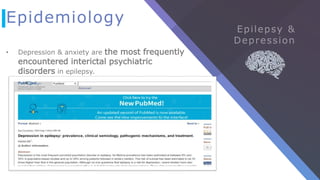
• Depression & anxiety are the most frequently
encountered interictal psychiatric
disorders in epilepsy.
Epidemiology
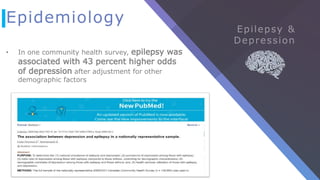
• In one community health survey, epilepsy was
associated with 43 percent higher odds
of depression after adjustment for other
demographic factors
Epidemiology
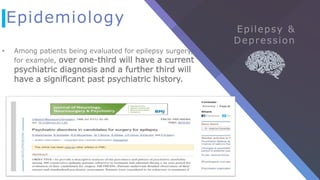
• Among patients being evaluated for epilepsy surgery,
for example, over one-third will have a current
psychiatric diagnosis and a further third will
have a significant past psychiatric history.
Epidemiology
• A further study found higher rates of
depression in epilepsy compared with
mixed group of neurological disorders.
(Kogeorgos J, Fonagy P, Scott DF (1982), Psychiatric symptom patterns of chronic
epileptics attending a neurological clinic: a controlled investigation. Br J Psychiatry
140:236-243.)
Complications
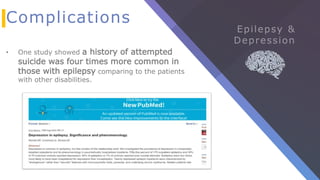
• One study showed a history of attempted
suicide was four times more common in
those with epilepsy comparing to the patients
with other disabilities.
Complications
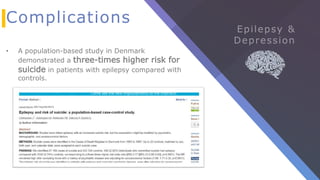
• A population-based study in Denmark
demonstrated a three-times higher risk for
suicide in patients with epilepsy compared with
controls.
Complications
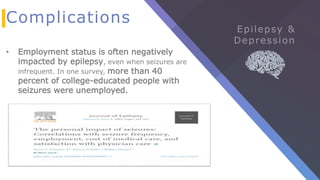
• Employment status is often negatively
impacted by epilepsy, even when seizures are
infrequent. In one survey, more than 40
percent of college-educated people with
seizures were unemployed.
Complications
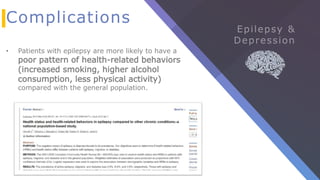
• Patients with epilepsy are more likely to have a
poor pattern of health-related behaviors
(increased smoking, higher alcohol
consumption, less physical activity)
compared with the general population.
Risk factors
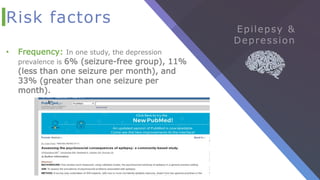
• Frequency: In one study, the depression
prevalence is 6% (seizure-free group), 11%
(less than one seizure per month), and
33% (greater than one seizure per
month).
Risk factors
• The majority of patients with newly diagnosed
epilepsy will have their seizures fully
controlled with the medications and are
probably not an increased risk for
psychiatric disorders. (Lishman)
• Psychiatric disorder is undoubtedly over-
presented in people with chronic
intractable epilepsy. (Lishamn)
Risk factors
• In this study, 50% had been free of seizures in
2 years. In this half, only 4% developed
depression. Almost like the general population in
the study. Depression was found in 10% of
patients who reported less than one seizure
per month and in 21% of those with more
frequent seizures.
Risk factors
• When such patients undergo temporal lobectomy,
becoming seizure-free is associated with an
improvement in depressive symptoms.
Risk factors
• TLE: Depression is often believed to be especially
common in patients with TLE.
Risk factors
• Risk factors for depression in people with epilepsy
include unemployment and activity restriction,
impaired social support, and a perceived
stigma associated with the diagnosis.
Pharmacological
causes
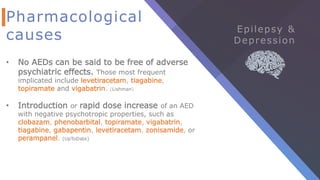
• No AEDs can be said to be free of adverse
psychiatric effects. Those most frequent
implicated include levetiracetam, tiagabine,
topiramate and vigabatrin. (Lishman)
• Introduction or rapid dose increase of an AED
with negative psychotropic properties, such as
clobazam, phenobarbital, topiramate, vigabatrin,
tiagabine, gabapentin, levetiracetam, zonisamide, or
perampanel. (UpToDate)
Pharmacological
causes
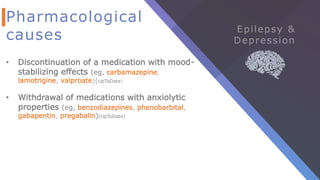
• Discontinuation of a medication with mood-
stabilizing effects (eg, carbamazepine,
lamotrigine, valproate)(UpToDate)
• Withdrawal of medications with anxiolytic
properties (eg, benzodiazepines, phenobarbital,
gabapentin, pregabalin)(UpToDate)
Pharmacological
causes
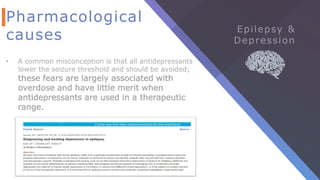
• A common misconception is that all antidepressants
lower the seizure threshold and should be avoided;
these fears are largely associated with
overdose and have little merit when
antidepressants are used in a therapeutic
range.
Pharmacological
causes
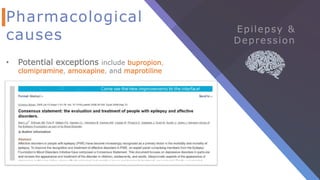
• Potential exceptions include bupropion,
clomipramine, amoxapine, and maprotiline
Presentation
• Several investigators have been struck by the fact
that depressive symptoms in people with epilepsy
often fall short of standard diagnostic criteria
and yet are associated with significant
morbidity (Lishman).
• The terms “interictal dysphoric disorder” and
“dysthemia-like disorder of epilepsy” have been
proposed to describe these presentations. Essentially,
the clinical picture is one of chronic dysthymia which
is interrupted at frequent intervals by brief
periods of normal mood. (Lishman)
Presentation
• It has been suggested that 30-70% of patients with
epilepsy and depression have specific atypical
features, mostly the Prominent Irritability with
Brief Episodes Of Euphoric Mood (Lishman)
• The atypical nature of these presentations is cited as
one reason why depression in epilepsy often
goes unrecognized and untreated (Lishman)
Scales
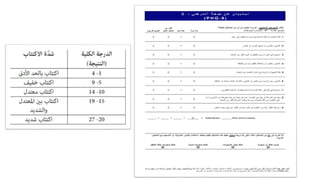
• Patients should be screened for depression at
diagnosis of epilepsy, prior to and following
antiepileptic drug initiation or changes, and at
routine follow-up (eg, yearly). (UpToDate)
• The most common tool we are using is PHQ-9
Scales
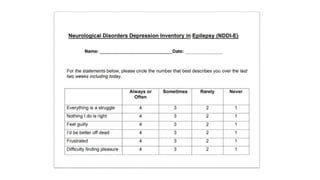
• The NDDI-E is a 6-item questionnaire that
allows for rapid identification of major
depression in epilepsy. NDDI-E scores above 15
are considered positive for depression, with
specificity of 90%, sensitivity of 81% (UpToDate)
Treatment
• Clinicians should not hesitate to prescribe
antidepressants for patients with epilepsy if
they would otherwise be indicated (Lishman)
• The proconvulsant effect of all antidepressant is dose
related. A sensible approach is therefore to start
treatment at relatively low doses and to
increase the dose slowly (Lishman)
Treatment
• As with antidepressant treatment outside the context
of epilepsy, choice of drug and treatment failure will
primarily be determined by side effects
(Lishman)
• TCA should be second line (due to risk of seizure
exacerbation), but are by no means contraindicated in
the presence of epilepsy (Lishman)
Treatment
• Selective serotonin reuptake inhibitors (SSRIs) and
selective serotonin-norepinephrine reuptake inhibitors
(SNRIs) such as venlafaxine have at least some
direct evidence of efficacy in people with
epilepsy. (UpToDate)
• Among the SSRIs, citalopram and escitalopram
may have the fewest effects on the CYP
system. (UpToDate)
Treatment
• CBT may have a special place in the management of
“Seizure phobia”, a term used to describe the not
uncommon situation in which a patient is more
disabled by fear of having seizures than by the
seizures themselves (Lishman).
• Psychotherapy for depression in patients with
epilepsy is underutilized but has been shown to be
effective in several randomized trials (UpToDate)
Treatment
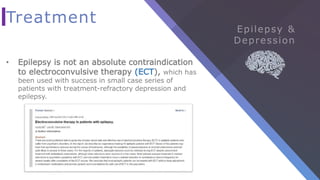
• Epilepsy is not an absolute contraindication
to electroconvulsive therapy (ECT), which has
been used with success in small case series of
patients with treatment-refractory depression and
epilepsy.
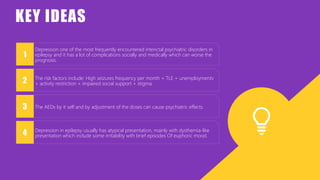
Depression one of the most frequently encountered interictal psychiatric disorders in
epilepsy and it has a lot of complications socially and medically which can worse the
prognosis.
The risk factors include: High seizures frequency per month + TLE + unemploymentv
+ activity restriction + impaired social support + stigma.
The AEDs by it self and by adjustment of the doses can cause psychiatric effects.
Depression in epilepsy usually has atypical presentation, mainly with dysthemia-like
presentation which include some irritability with brief episodes Of euphoric mood.
1
2
3
4
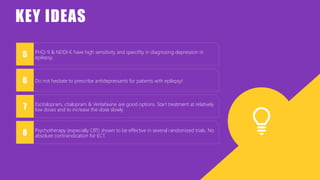
KEY IDEAS
PHQ-9 & NDDI-E have high sensitivity and speicifity in diagnosing depression in
epilepsy.
Do not hesitate to prescribe antidepressants for patients with epilepsy!
Escitalopram, citalopram & Venlafaxine are good options. Start treatment at relatively
low doses and to increase the dose slowly
Psychotherapy (especially CBT) shown to be effective in several randomized trials. No
absolute contraindication for ECT.
5
6
7
8
KEY IDEAS
THANK YOU

Depression & epilepsy

  • 1.
    Epilepsy & Depression Aq u i c k o v e r v i e w S a m i S a a d A s s o c i a t e C o n s u l t a n t P s y c h i a t r y N e u r o s c i e n c e d e p a r t m e n t K A M C - M a k k a h
  • 2.
  • 3.
    Epidemiology • Depression &anxiety are the most frequently encountered interictal psychiatric disorders in epilepsy.
  • 4.
    Epidemiology • In onecommunity health survey, epilepsy was associated with 43 percent higher odds of depression after adjustment for other demographic factors
  • 5.
    Epidemiology • Among patientsbeing evaluated for epilepsy surgery, for example, over one-third will have a current psychiatric diagnosis and a further third will have a significant past psychiatric history.
  • 6.
    Epidemiology • A furtherstudy found higher rates of depression in epilepsy compared with mixed group of neurological disorders. (Kogeorgos J, Fonagy P, Scott DF (1982), Psychiatric symptom patterns of chronic epileptics attending a neurological clinic: a controlled investigation. Br J Psychiatry 140:236-243.)
  • 7.
    Complications • One studyshowed a history of attempted suicide was four times more common in those with epilepsy comparing to the patients with other disabilities.
  • 8.
    Complications • A population-basedstudy in Denmark demonstrated a three-times higher risk for suicide in patients with epilepsy compared with controls.
  • 9.
    Complications • Employment statusis often negatively impacted by epilepsy, even when seizures are infrequent. In one survey, more than 40 percent of college-educated people with seizures were unemployed.
  • 10.
    Complications • Patients withepilepsy are more likely to have a poor pattern of health-related behaviors (increased smoking, higher alcohol consumption, less physical activity) compared with the general population.
  • 11.
    Risk factors • Frequency:In one study, the depression prevalence is 6% (seizure-free group), 11% (less than one seizure per month), and 33% (greater than one seizure per month).
  • 12.
    Risk factors • Themajority of patients with newly diagnosed epilepsy will have their seizures fully controlled with the medications and are probably not an increased risk for psychiatric disorders. (Lishman) • Psychiatric disorder is undoubtedly over- presented in people with chronic intractable epilepsy. (Lishamn)
  • 13.
    Risk factors • Inthis study, 50% had been free of seizures in 2 years. In this half, only 4% developed depression. Almost like the general population in the study. Depression was found in 10% of patients who reported less than one seizure per month and in 21% of those with more frequent seizures.
  • 14.
    Risk factors • Whensuch patients undergo temporal lobectomy, becoming seizure-free is associated with an improvement in depressive symptoms.
  • 15.
    Risk factors • TLE:Depression is often believed to be especially common in patients with TLE.
  • 16.
    Risk factors • Riskfactors for depression in people with epilepsy include unemployment and activity restriction, impaired social support, and a perceived stigma associated with the diagnosis.
  • 17.
    Pharmacological causes • No AEDscan be said to be free of adverse psychiatric effects. Those most frequent implicated include levetiracetam, tiagabine, topiramate and vigabatrin. (Lishman) • Introduction or rapid dose increase of an AED with negative psychotropic properties, such as clobazam, phenobarbital, topiramate, vigabatrin, tiagabine, gabapentin, levetiracetam, zonisamide, or perampanel. (UpToDate)
  • 18.
    Pharmacological causes • Discontinuation ofa medication with mood- stabilizing effects (eg, carbamazepine, lamotrigine, valproate)(UpToDate) • Withdrawal of medications with anxiolytic properties (eg, benzodiazepines, phenobarbital, gabapentin, pregabalin)(UpToDate)
  • 19.
    Pharmacological causes • A commonmisconception is that all antidepressants lower the seizure threshold and should be avoided; these fears are largely associated with overdose and have little merit when antidepressants are used in a therapeutic range.
  • 20.
    Pharmacological causes • Potential exceptionsinclude bupropion, clomipramine, amoxapine, and maprotiline
  • 21.
    Presentation • Several investigatorshave been struck by the fact that depressive symptoms in people with epilepsy often fall short of standard diagnostic criteria and yet are associated with significant morbidity (Lishman). • The terms “interictal dysphoric disorder” and “dysthemia-like disorder of epilepsy” have been proposed to describe these presentations. Essentially, the clinical picture is one of chronic dysthymia which is interrupted at frequent intervals by brief periods of normal mood. (Lishman)
  • 22.
    Presentation • It hasbeen suggested that 30-70% of patients with epilepsy and depression have specific atypical features, mostly the Prominent Irritability with Brief Episodes Of Euphoric Mood (Lishman) • The atypical nature of these presentations is cited as one reason why depression in epilepsy often goes unrecognized and untreated (Lishman)
  • 23.
    Scales • Patients shouldbe screened for depression at diagnosis of epilepsy, prior to and following antiepileptic drug initiation or changes, and at routine follow-up (eg, yearly). (UpToDate) • The most common tool we are using is PHQ-9
  • 25.
    Scales • The NDDI-Eis a 6-item questionnaire that allows for rapid identification of major depression in epilepsy. NDDI-E scores above 15 are considered positive for depression, with specificity of 90%, sensitivity of 81% (UpToDate)
  • 27.
    Treatment • Clinicians shouldnot hesitate to prescribe antidepressants for patients with epilepsy if they would otherwise be indicated (Lishman) • The proconvulsant effect of all antidepressant is dose related. A sensible approach is therefore to start treatment at relatively low doses and to increase the dose slowly (Lishman)
  • 28.
    Treatment • As withantidepressant treatment outside the context of epilepsy, choice of drug and treatment failure will primarily be determined by side effects (Lishman) • TCA should be second line (due to risk of seizure exacerbation), but are by no means contraindicated in the presence of epilepsy (Lishman)
  • 29.
    Treatment • Selective serotoninreuptake inhibitors (SSRIs) and selective serotonin-norepinephrine reuptake inhibitors (SNRIs) such as venlafaxine have at least some direct evidence of efficacy in people with epilepsy. (UpToDate) • Among the SSRIs, citalopram and escitalopram may have the fewest effects on the CYP system. (UpToDate)
  • 30.
    Treatment • CBT mayhave a special place in the management of “Seizure phobia”, a term used to describe the not uncommon situation in which a patient is more disabled by fear of having seizures than by the seizures themselves (Lishman). • Psychotherapy for depression in patients with epilepsy is underutilized but has been shown to be effective in several randomized trials (UpToDate)
  • 31.
    Treatment • Epilepsy isnot an absolute contraindication to electroconvulsive therapy (ECT), which has been used with success in small case series of patients with treatment-refractory depression and epilepsy.
  • 32.
    Depression one ofthe most frequently encountered interictal psychiatric disorders in epilepsy and it has a lot of complications socially and medically which can worse the prognosis. The risk factors include: High seizures frequency per month + TLE + unemploymentv + activity restriction + impaired social support + stigma. The AEDs by it self and by adjustment of the doses can cause psychiatric effects. Depression in epilepsy usually has atypical presentation, mainly with dysthemia-like presentation which include some irritability with brief episodes Of euphoric mood. 1 2 3 4 KEY IDEAS
  • 33.
    PHQ-9 & NDDI-Ehave high sensitivity and speicifity in diagnosing depression in epilepsy. Do not hesitate to prescribe antidepressants for patients with epilepsy! Escitalopram, citalopram & Venlafaxine are good options. Start treatment at relatively low doses and to increase the dose slowly Psychotherapy (especially CBT) shown to be effective in several randomized trials. No absolute contraindication for ECT. 5 6 7 8 KEY IDEAS
  • 34.

Editor's Notes

  • #33 Lorem ipsum dolor sit amet, consectetur adipiscing elit, sed do eiusmod tempor incididunt ut labore et dolore magna aliqua. Ut enim ad minim veniam,
  • #34 Lorem ipsum dolor sit amet, consectetur adipiscing elit, sed do eiusmod tempor incididunt ut labore et dolore magna aliqua. Ut enim ad minim veniam,