HUMAN ANATOMY AND
PHYSIOLOGY-I
SREELAKSHMI S.S
ASSISTANT PROFESSOR
DEPARTMENT OF PHARMACOLOGY
AL SHIFA COLLEGE OF PHARMACY
1
INTRODUCTION TO HUMAN
BODY
 The journey through the human body begins with an overview of the meanings
of anatomy and physiology.
 Two branches of science—anatomy and physiology—provide the foundation
for understanding the body’s parts and functions.
 Anatomy : (process of cutting) is the science of body structures and the
relationships among them.
 Physiology: (physio -nature; logy-study of) is the science of body functions—
how the body parts work.
2
3
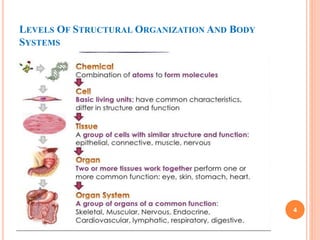
LEVELS OF STRUCTURAL ORGANIZATION AND BODY
SYSTEMS
4
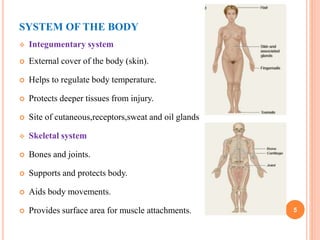
SYSTEM OF THE BODY
 Integumentary system
 External cover of the body (skin).
 Helps to regulate body temperature.
 Protects deeper tissues from injury.
 Site of cutaneous,receptors,sweat and oil glands
 Skeletal system
 Bones and joints.
 Supports and protects body.
 Aids body movements.
 Provides surface area for muscle attachments. 5
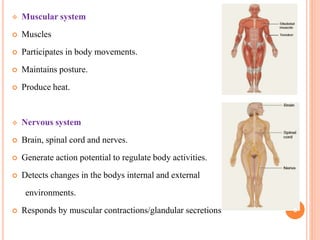
 Muscular system
 Muscles
 Participates in body movements.
 Maintains posture.
 Produce heat.
 Nervous system
 Brain, spinal cord and nerves.
 Generate action potential to regulate body activities.
 Detects changes in the bodys internal and external
environments.
 Responds by muscular contractions/glandular secretions 6
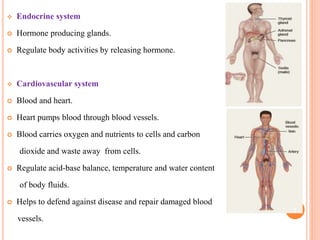
 Endocrine system
 Hormone producing glands.
 Regulate body activities by releasing hormone.
 Cardiovascular system
 Blood and heart.
 Heart pumps blood through blood vessels.
 Blood carries oxygen and nutrients to cells and carbon
dioxide and waste away from cells.
 Regulate acid-base balance, temperature and water content
of body fluids.
 Helps to defend against disease and repair damaged blood
vessels.
7
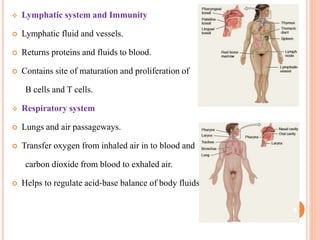
 Lymphatic system and Immunity
 Lymphatic fluid and vessels.
 Returns proteins and fluids to blood.
 Contains site of maturation and proliferation of
B cells and T cells.
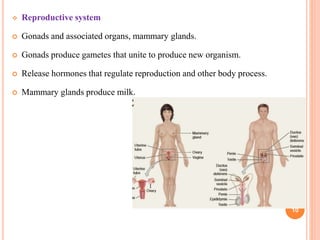
 Respiratory system
 Lungs and air passageways.
 Transfer oxygen from inhaled air in to blood and
carbon dioxide from blood to exhaled air.
 Helps to regulate acid-base balance of body fluids.
8
 Digestive system
 Organs of gastro intestinal tract and accessory organs.
 Achieves physical and chemical breakdown of food.
 Absorb nutrients and excretes solid wastes.
 Urinary system
 Kidney, ureter, urinary bladder and urethra.
 Produce, stores and eliminate urine.
 Regulate volume and chemical composition of blood.
 Maintains acid-base balance.
 Regulate production of red blood cells.
9
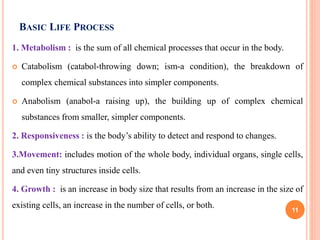
 Reproductive system
 Gonads and associated organs, mammary glands.
 Gonads produce gametes that unite to produce new organism.
 Release hormones that regulate reproduction and other body process.
 Mammary glands produce milk.
10
BASIC LIFE PROCESS
1. Metabolism : is the sum of all chemical processes that occur in the body.
 Catabolism (catabol-throwing down; ism-a condition), the breakdown of
complex chemical substances into simpler components.
 Anabolism (anabol-a raising up), the building up of complex chemical
substances from smaller, simpler components.
2. Responsiveness : is the body’s ability to detect and respond to changes.
3.Movement: includes motion of the whole body, individual organs, single cells,
and even tiny structures inside cells.
4. Growth : is an increase in body size that results from an increase in the size of
existing cells, an increase in the number of cells, or both. 11
5. Differentiation : is the development of a cell from an unspecialized to a
specialized state. Such precursor cells, which can divide and give rise to cells that
undergo differentiation, are known as stem cells.
6. Reproduction : refers either to
(1) the formation of new cells for tissue growth, repair, or replacement, or
(2) the production of a new individual.
 The formation of new cells occurs through cell division.
 The production of a new individual occurs through the fertilization of an ovum
by a sperm cell to form a zygote, followed by repeated cell divisions and the
differentiation of these cells
12
HOMEOSTASIS
 Homeostasis : (homeo-sameness; stasis- standing still) is the condition of
equilibrium (balance) in the body’s internal environment due to the constant
interaction of the body’s many regulatory processes.
 Homeostasis maintains the volume and composition of body fluids, dilute,
watery solutions containing dissolved chemicals that are found inside cells as
well as surrounding them.
 The fluid within cells is intracellular fluid (ICF).
 The fluid outside body cells is extracellular fluid (ECF).
 The ECF that fills the narrow spaces between cells of tissues is known as
interstitial fluid.
13
 ECF within blood vessels is termed blood plasma.
 Lymphatic vessels it is called lymph.
 In and around the brain and spinal cord it is known as cerebrospinal fluid.
 In joints it is referred to as synovial fluid.
 The ECF of the eyes is called aqueous humor and vitreous body.
 The proper functioning of body cells depends on precise regulation of the
composition of the interstitial fluid surrounding them.
14
CONTROL OF HOMEOSTASIS
 Homeostasis in the human body is continually being disturbed.
 In most cases the disruption of homeostasis is mild and temporary, and the
responses of body cells quickly restore balance in the internal environment.
 In some cases the disruption of homeostasis may be intense and prolonged, as
in poisoning, overexposure to temperature extremes, severe infection, or major
surgery.
 The body has many regulating systems that can usually bring the internal
environment back into balance.
 The nervous system and the endocrine system, working together provide the
needed corrective measures.
15
 The nervous system regulates homeostasis by sending electrical signals known
as nerve impulses (action potentials) to organs that can counteract changes
from the balanced state.
 The endocrine system includes many glands that secrete messenger molecules
called hormones into the blood.
Feedback Systems
 The body can regulate its internal environment through many feedback
systems.
 A feedback system or feedback loop is a cycle of events in which the status of
a body condition is monitored, evaluated, changed, remonitored, re evaluated.
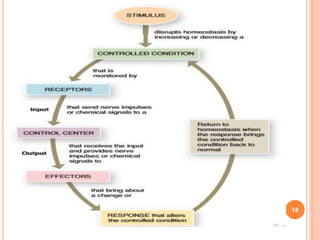
 A feedback system includes three basic components: a receptor, a control
center, and an effector
16
1. A receptor is a body structure that monitors changes in a controlled condition
and sends input to a control center.
 This pathway is called an afferent pathway.
 The input is in the form of nerve impulses or chemical signals.
2. A control center in the body, the brain, sets the range of values within which a
controlled condition should be maintained, evaluates the input it receives from
receptors, and generates output commands when they are needed.
 This pathway is called an efferent pathway.
3. An effector is a body structure that receives output from the control center and
produces a response or effect that changes the controlled condition.
 Nearly every organ or tissue in the body can behave as an effector.
17
18
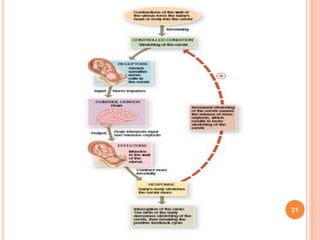
 In a feedback system, the response of the system “feeds back” information to
change the controlled condition,either negating it (negative feedback) or
enhancing it (positive feedback).
Negative Feedback Systems
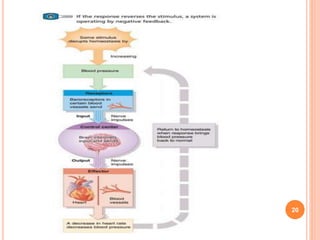
 A negative feedback system reverses a change in a controlled condition.
Positive Feedback Systems
 Unlike a negative feedback system, a positive feedback system tends to
strengthen or reinforce a change in one of the body’s controlled conditions.
19
20
21
 A disorder is any abnormality in structure or function.
 disease is more specific term for an illness characterized by a recognizable set
of signs and symptoms.
 A person with a disease may experience symptoms, subjective changes in body
functions that are not apparent to an observer (headache, nausea, and anxiety).
 Objective changes that a clinician can observe and measure are called signs
(swelling or a rash,fever, high blood pressure, or paralysis).
22
BASIC ANATOMICAL TERMINOLOGY
Body Positions
 Descriptions of any region or part of the human body assume that it is in a
standard position of reference called the anatomical position.
23
Planes and Sections
 Parts of the body relative to planes, imaginary flat surfaces that pass through
the body parts.
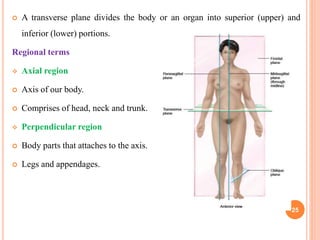
 A sagittal plane (sagitt- arrow) is a vertical plane that divides the body or an
organ into right and left sides.
 when such a plane passes through the midline of the body or an organ and
divides it into equal right and left sides, it is called a midsagittal plane or a
median plane.
 If the sagittal plane does not pass through the midline but instead divides the
body or an organ into unequal right and left sides, it is called a parasagittal
plane.
 A frontal or coronal plane divides the body or an organ into anterior (front)
and posterior (back) portions.
24
 A transverse plane divides the body or an organ into superior (upper) and
inferior (lower) portions.
Regional terms
 Axial region
 Axis of our body.
 Comprises of head, neck and trunk.
 Perpendicular region
 Body parts that attaches to the axis.
 Legs and appendages.
25
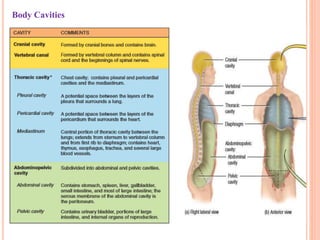
Body Cavities
26
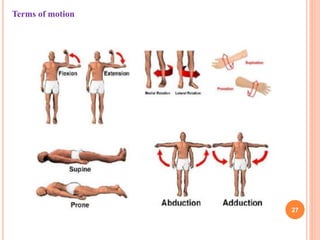
Terms of motion
27
THANK YOU
28

INTRODUCTION TO HUMAN BODY.pptx

  • 1.
    HUMAN ANATOMY AND PHYSIOLOGY-I SREELAKSHMIS.S ASSISTANT PROFESSOR DEPARTMENT OF PHARMACOLOGY AL SHIFA COLLEGE OF PHARMACY 1
  • 2.
    INTRODUCTION TO HUMAN BODY The journey through the human body begins with an overview of the meanings of anatomy and physiology.  Two branches of science—anatomy and physiology—provide the foundation for understanding the body’s parts and functions.  Anatomy : (process of cutting) is the science of body structures and the relationships among them.  Physiology: (physio -nature; logy-study of) is the science of body functions— how the body parts work. 2
  • 3.
  • 4.
    LEVELS OF STRUCTURALORGANIZATION AND BODY SYSTEMS 4
  • 5.
    SYSTEM OF THEBODY  Integumentary system  External cover of the body (skin).  Helps to regulate body temperature.  Protects deeper tissues from injury.  Site of cutaneous,receptors,sweat and oil glands  Skeletal system  Bones and joints.  Supports and protects body.  Aids body movements.  Provides surface area for muscle attachments. 5
  • 6.
     Muscular system Muscles  Participates in body movements.  Maintains posture.  Produce heat.  Nervous system  Brain, spinal cord and nerves.  Generate action potential to regulate body activities.  Detects changes in the bodys internal and external environments.  Responds by muscular contractions/glandular secretions 6
  • 7.
     Endocrine system Hormone producing glands.  Regulate body activities by releasing hormone.  Cardiovascular system  Blood and heart.  Heart pumps blood through blood vessels.  Blood carries oxygen and nutrients to cells and carbon dioxide and waste away from cells.  Regulate acid-base balance, temperature and water content of body fluids.  Helps to defend against disease and repair damaged blood vessels. 7
  • 8.
     Lymphatic systemand Immunity  Lymphatic fluid and vessels.  Returns proteins and fluids to blood.  Contains site of maturation and proliferation of B cells and T cells.  Respiratory system  Lungs and air passageways.  Transfer oxygen from inhaled air in to blood and carbon dioxide from blood to exhaled air.  Helps to regulate acid-base balance of body fluids. 8
  • 9.
     Digestive system Organs of gastro intestinal tract and accessory organs.  Achieves physical and chemical breakdown of food.  Absorb nutrients and excretes solid wastes.  Urinary system  Kidney, ureter, urinary bladder and urethra.  Produce, stores and eliminate urine.  Regulate volume and chemical composition of blood.  Maintains acid-base balance.  Regulate production of red blood cells. 9
  • 10.
     Reproductive system Gonads and associated organs, mammary glands.  Gonads produce gametes that unite to produce new organism.  Release hormones that regulate reproduction and other body process.  Mammary glands produce milk. 10
  • 11.
    BASIC LIFE PROCESS 1.Metabolism : is the sum of all chemical processes that occur in the body.  Catabolism (catabol-throwing down; ism-a condition), the breakdown of complex chemical substances into simpler components.  Anabolism (anabol-a raising up), the building up of complex chemical substances from smaller, simpler components. 2. Responsiveness : is the body’s ability to detect and respond to changes. 3.Movement: includes motion of the whole body, individual organs, single cells, and even tiny structures inside cells. 4. Growth : is an increase in body size that results from an increase in the size of existing cells, an increase in the number of cells, or both. 11
  • 12.
    5. Differentiation :is the development of a cell from an unspecialized to a specialized state. Such precursor cells, which can divide and give rise to cells that undergo differentiation, are known as stem cells. 6. Reproduction : refers either to (1) the formation of new cells for tissue growth, repair, or replacement, or (2) the production of a new individual.  The formation of new cells occurs through cell division.  The production of a new individual occurs through the fertilization of an ovum by a sperm cell to form a zygote, followed by repeated cell divisions and the differentiation of these cells 12
  • 13.
    HOMEOSTASIS  Homeostasis :(homeo-sameness; stasis- standing still) is the condition of equilibrium (balance) in the body’s internal environment due to the constant interaction of the body’s many regulatory processes.  Homeostasis maintains the volume and composition of body fluids, dilute, watery solutions containing dissolved chemicals that are found inside cells as well as surrounding them.  The fluid within cells is intracellular fluid (ICF).  The fluid outside body cells is extracellular fluid (ECF).  The ECF that fills the narrow spaces between cells of tissues is known as interstitial fluid. 13
  • 14.
     ECF withinblood vessels is termed blood plasma.  Lymphatic vessels it is called lymph.  In and around the brain and spinal cord it is known as cerebrospinal fluid.  In joints it is referred to as synovial fluid.  The ECF of the eyes is called aqueous humor and vitreous body.  The proper functioning of body cells depends on precise regulation of the composition of the interstitial fluid surrounding them. 14
  • 15.
    CONTROL OF HOMEOSTASIS Homeostasis in the human body is continually being disturbed.  In most cases the disruption of homeostasis is mild and temporary, and the responses of body cells quickly restore balance in the internal environment.  In some cases the disruption of homeostasis may be intense and prolonged, as in poisoning, overexposure to temperature extremes, severe infection, or major surgery.  The body has many regulating systems that can usually bring the internal environment back into balance.  The nervous system and the endocrine system, working together provide the needed corrective measures. 15
  • 16.
     The nervoussystem regulates homeostasis by sending electrical signals known as nerve impulses (action potentials) to organs that can counteract changes from the balanced state.  The endocrine system includes many glands that secrete messenger molecules called hormones into the blood. Feedback Systems  The body can regulate its internal environment through many feedback systems.  A feedback system or feedback loop is a cycle of events in which the status of a body condition is monitored, evaluated, changed, remonitored, re evaluated.  A feedback system includes three basic components: a receptor, a control center, and an effector 16
  • 17.
    1. A receptoris a body structure that monitors changes in a controlled condition and sends input to a control center.  This pathway is called an afferent pathway.  The input is in the form of nerve impulses or chemical signals. 2. A control center in the body, the brain, sets the range of values within which a controlled condition should be maintained, evaluates the input it receives from receptors, and generates output commands when they are needed.  This pathway is called an efferent pathway. 3. An effector is a body structure that receives output from the control center and produces a response or effect that changes the controlled condition.  Nearly every organ or tissue in the body can behave as an effector. 17
  • 18.
  • 19.
     In afeedback system, the response of the system “feeds back” information to change the controlled condition,either negating it (negative feedback) or enhancing it (positive feedback). Negative Feedback Systems  A negative feedback system reverses a change in a controlled condition. Positive Feedback Systems  Unlike a negative feedback system, a positive feedback system tends to strengthen or reinforce a change in one of the body’s controlled conditions. 19
  • 20.
  • 21.
  • 22.
     A disorderis any abnormality in structure or function.  disease is more specific term for an illness characterized by a recognizable set of signs and symptoms.  A person with a disease may experience symptoms, subjective changes in body functions that are not apparent to an observer (headache, nausea, and anxiety).  Objective changes that a clinician can observe and measure are called signs (swelling or a rash,fever, high blood pressure, or paralysis). 22
  • 23.
    BASIC ANATOMICAL TERMINOLOGY BodyPositions  Descriptions of any region or part of the human body assume that it is in a standard position of reference called the anatomical position. 23
  • 24.
    Planes and Sections Parts of the body relative to planes, imaginary flat surfaces that pass through the body parts.  A sagittal plane (sagitt- arrow) is a vertical plane that divides the body or an organ into right and left sides.  when such a plane passes through the midline of the body or an organ and divides it into equal right and left sides, it is called a midsagittal plane or a median plane.  If the sagittal plane does not pass through the midline but instead divides the body or an organ into unequal right and left sides, it is called a parasagittal plane.  A frontal or coronal plane divides the body or an organ into anterior (front) and posterior (back) portions. 24
  • 25.
     A transverseplane divides the body or an organ into superior (upper) and inferior (lower) portions. Regional terms  Axial region  Axis of our body.  Comprises of head, neck and trunk.  Perpendicular region  Body parts that attaches to the axis.  Legs and appendages. 25
  • 26.
  • 27.
  • 28.