Scoliosis and its orthotic
management
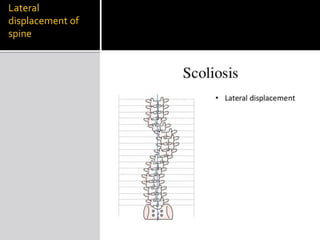
 Scoliosis is defined as the lateral curvature of the
spine in the frontal plane of the body which means
that the vertebral column bends from side to
side.
 This deformity which often develops in childhood
can lead to structural deformity of pelvis ,
vertebrae and thoracic cage .
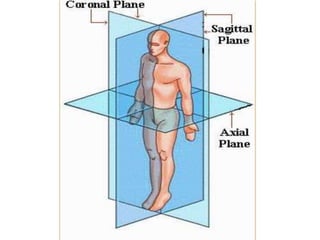
 3 dimensional deformity affecting all the 3 planes
Can be difficult to visualize with 2 dimensional
radiographs
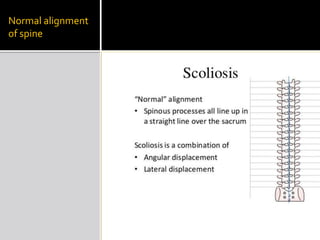
Normal alignment
of spine
Lateral
displacement of
spine
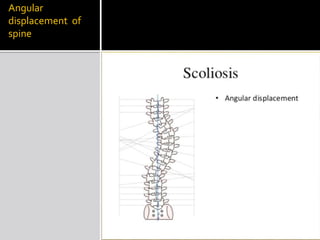
Angular
displacement of
spine
 According to Medtronic study , scoliosis affect 2 %
of women and 0.5% of men in the general
population .
 Now a days present scoliosis population is growing
 People especially women are the one who suffer
from it, most of them don’t known how does it
start nor they require it in fact some individuals
already have scoliosis but they are not aware of it .
 True cause still unknown ……
 Genetics
 Growth hormone secretions
 Connective tissue structure
 Vestibular dysfunction
 Melatonin secretion
 Platelet microstructure
 100%patients have proprioception mechanism
defects
 27 % of cases show brain stem defects
 Mild scoliosis – less than 20 degree
 Moderate-curves from 20 to 40 degree or 50
degree
 Severe –curves of 40 to 50 degree or greater
 Develops between age 8 to 15
 7 times more in females
 80 % of scoliosis origin is unknown
 Mid back pain
 Lower back pain
 Neck pain
 Headache
 Decrease pulmonary dysfunction
 It is an irreversible lateral curvature of the spine .
 Vertebral bodies rotate towards the convex side of
the curve .
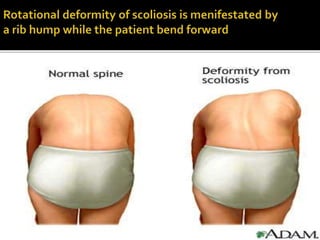
 Rib hump is prominent on forward bending .
 Most common form of scoliosis
 right sided thoracic curves more common
 Three types depending on the age of onset
 Prevalence = 0.3 _ 15.3%
 Risk factors
 Hormonal factors (melatonin) may play a role
 Female gender
 Growth velocity
Infantile
Juvenile
Adolescent
 Idiopathic
1-Infantile scoliosis –
 Onset less than 3 years . No active treatment is
necessary for the non-progressive variety of infantile
idiopathic scoliosis, the curves resolving spontaneously
without treatment.
2-Juvenile scoliosis- Occur in 4 – 12 girls .
 Milwaukee brace is the orthosis of choice because it is
easily adjustable for growth, and in addition, due to its
open design, it does not compress the thorax with
possible tubular thorax and respiratory restriction.
 Adolescent -The indications for orthotic
treatment are a growing child who presents with a
curve of 30 to 40 degree .
 The choices for orthotic treatment are the
Milwaukee brace and theTLSO (Thoraco-lumbo-
sacral orthosis).
 The first successful orthosis for the treatment of
adolescent idiopathic scoliosis was the Milwaukee
brace
 Neuromuscular scoliosis
Neuropathic
• Upper and lower motor neuron
Myopatheic
• Muscular dystrophies
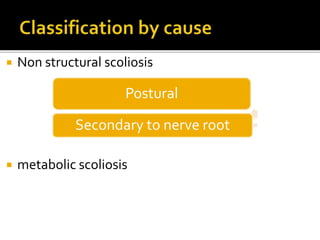
 Non structural scoliosis
 metabolic scoliosis
Postural
Secondary to nerve root
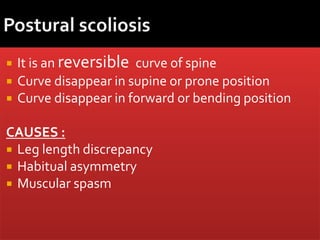
 It is an reversible curve of spine
 Curve disappear in supine or prone position
 Curve disappear in forward or bending position
CAUSES :
 Leg length discrepancy
 Habitual asymmetry
 Muscular spasm
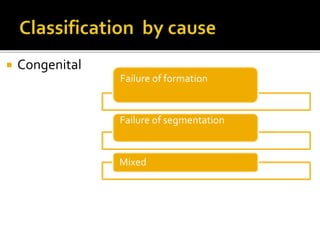
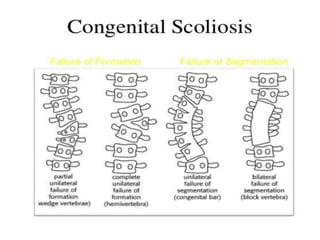
 Congenital
Failure of formation
Failure of segmentation
Mixed
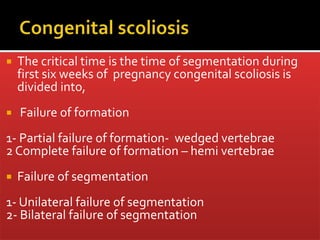
 The critical time is the time of segmentation during
first six weeks of pregnancy congenital scoliosis is
divided into,
 Failure of formation
1- Partial failure of formation- wedged vertebrae
2 Complete failure of formation – hemi vertebrae
 Failure of segmentation
1- Unilateral failure of segmentation
2- Bilateral failure of segmentation
Congenital
scoliosis
 Age and manner in which it was noted .
 The perinatal history , developmental mile stones
 Clinical signs of progression
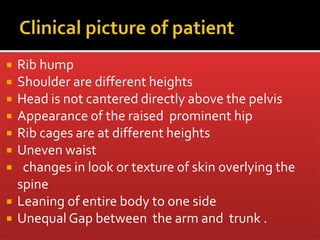
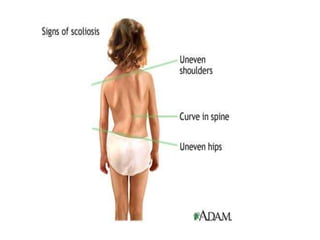
 Rib hump
 Shoulder are different heights
 Head is not cantered directly above the pelvis
 Appearance of the raised prominent hip
 Rib cages are at different heights
 Uneven waist
 changes in look or texture of skin overlying the
spine
 Leaning of entire body to one side
 Unequal Gap between the arm and trunk .
 See gait and ability to walk on toes / heels
 Motor and sensory testing of the lower and upper
extremities
 Check reflexes , asymmetry or a pathologic reflex
(e:g clonus ,a positive babinski s’ ,or a positive
Hoffmann sign )
 A asymmetric abdominal reflex is the most
common neurological abnormality noted with an
common neurological intracranial lesion such as
syrinx ( fluid filled cyst within the spinal cord ) and
spinal cord tumor
 AP standing right and left bending and lateral
radiographs of the entire length of the spine with
an extra long x ray cassette
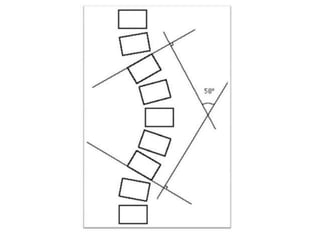
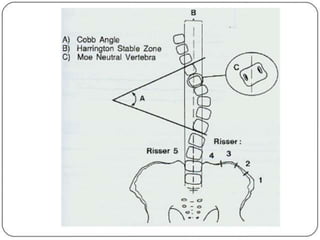
 Measure curves by cobb method
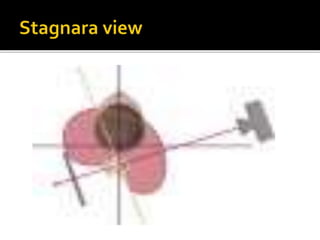
 The rotational deformity by a special stagnara
view in which x ray is positioned parallel to the rib
hump.
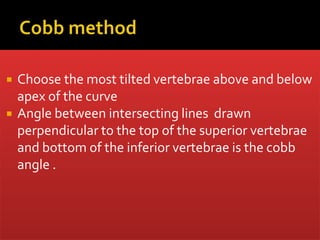
 Choose the most tilted vertebrae above and below
apex of the curve
 Angle between intersecting lines drawn
perpendicular to the top of the superior vertebrae
and bottom of the inferior vertebrae is the cobb
angle .
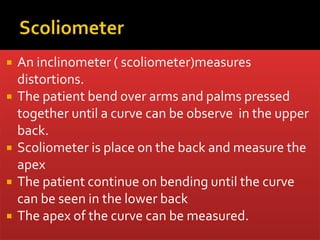
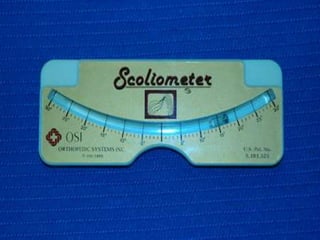
 An inclinometer ( scoliometer)measures
distortions.
 The patient bend over arms and palms pressed
together until a curve can be observe in the upper
back.
 Scoliometer is place on the back and measure the
apex
 The patient continue on bending until the curve
can be seen in the lower back
 The apex of the curve can be measured.
Orthotics treatment of
scoliosis
 In general, treatment with a back brace will be
recommended for patients with a curve that
measures 25 to 40 degrees, and a lot of growth
remaining (patients who are skeletally immature).
 The primary goal of orthotic treatment (a back
brace) for scoliosis is to stop the progression of the
spinal curve.
 Bracing does not typically reduce the degree of
the curve/amount of angulation already present.
 These several types of braces are use ,
 Milwaukee brace
 Thoraco lumbo sacral orthosis(TLSO)
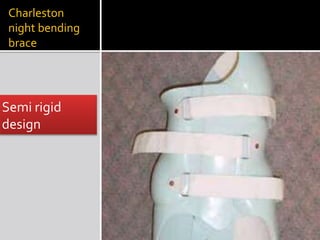
 Charleston night time bending brace
 zero to 30 degree treated with the signs of
progression usually treated with stretching
exercises
 30 to 45 degree orthotic intervention
 above 45 surgical intervention
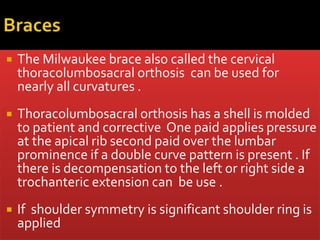
 The Milwaukee brace also called the cervical
thoracolumbosacral orthosis can be used for
nearly all curvatures .
 Thoracolumbosacral orthosis has a shell is molded
to patient and corrective One paid applies pressure
at the apical rib second paid over the lumbar
prominence if a double curve pattern is present . If
there is decompensation to the left or right side a
trochanteric extension can be use .
 If shoulder symmetry is significant shoulder ring is
applied
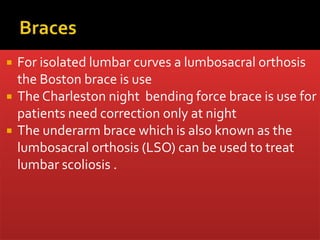
 For isolated lumbar curves a lumbosacral orthosis
the Boston brace is use
 The Charleston night bending force brace is use for
patients need correction only at night
 The underarm brace which is also known as the
lumbosacral orthosis (LSO) can be used to treat
lumbar scoliosis .
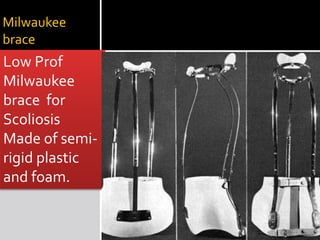
Milwaukee
brace
Low Prof
Milwaukee
brace for
Scoliosis
Made of semi-
rigid plastic
and foam.
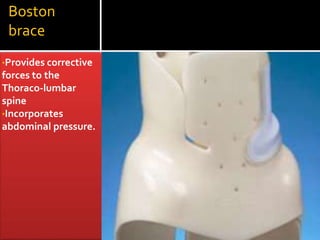
Boston
brace
•Provides corrective
forces to the
Thoraco-lumbar
spine
•Incorporates
abdominal pressure.
Charleston
night bending
brace
Semi rigid
design
Scoilosis

Scoilosis

  • 1.
    Scoliosis and itsorthotic management
  • 3.
     Scoliosis isdefined as the lateral curvature of the spine in the frontal plane of the body which means that the vertebral column bends from side to side.  This deformity which often develops in childhood can lead to structural deformity of pelvis , vertebrae and thoracic cage .  3 dimensional deformity affecting all the 3 planes Can be difficult to visualize with 2 dimensional radiographs
  • 5.
  • 6.
  • 7.
  • 8.
     According toMedtronic study , scoliosis affect 2 % of women and 0.5% of men in the general population .  Now a days present scoliosis population is growing  People especially women are the one who suffer from it, most of them don’t known how does it start nor they require it in fact some individuals already have scoliosis but they are not aware of it .
  • 9.
     True causestill unknown ……  Genetics  Growth hormone secretions  Connective tissue structure  Vestibular dysfunction  Melatonin secretion  Platelet microstructure  100%patients have proprioception mechanism defects  27 % of cases show brain stem defects
  • 10.
     Mild scoliosis– less than 20 degree  Moderate-curves from 20 to 40 degree or 50 degree  Severe –curves of 40 to 50 degree or greater
  • 11.
     Develops betweenage 8 to 15  7 times more in females  80 % of scoliosis origin is unknown
  • 12.
     Mid backpain  Lower back pain  Neck pain  Headache  Decrease pulmonary dysfunction
  • 14.
     It isan irreversible lateral curvature of the spine .  Vertebral bodies rotate towards the convex side of the curve .  Rib hump is prominent on forward bending .
  • 16.
     Most commonform of scoliosis  right sided thoracic curves more common  Three types depending on the age of onset  Prevalence = 0.3 _ 15.3%  Risk factors  Hormonal factors (melatonin) may play a role  Female gender  Growth velocity
  • 17.
  • 18.
    1-Infantile scoliosis – Onset less than 3 years . No active treatment is necessary for the non-progressive variety of infantile idiopathic scoliosis, the curves resolving spontaneously without treatment. 2-Juvenile scoliosis- Occur in 4 – 12 girls .  Milwaukee brace is the orthosis of choice because it is easily adjustable for growth, and in addition, due to its open design, it does not compress the thorax with possible tubular thorax and respiratory restriction.
  • 19.
     Adolescent -Theindications for orthotic treatment are a growing child who presents with a curve of 30 to 40 degree .  The choices for orthotic treatment are the Milwaukee brace and theTLSO (Thoraco-lumbo- sacral orthosis).  The first successful orthosis for the treatment of adolescent idiopathic scoliosis was the Milwaukee brace
  • 20.
     Neuromuscular scoliosis Neuropathic •Upper and lower motor neuron Myopatheic • Muscular dystrophies
  • 21.
     Non structuralscoliosis  metabolic scoliosis Postural Secondary to nerve root
  • 22.
     It isan reversible curve of spine  Curve disappear in supine or prone position  Curve disappear in forward or bending position CAUSES :  Leg length discrepancy  Habitual asymmetry  Muscular spasm
  • 23.
     Congenital Failure offormation Failure of segmentation Mixed
  • 24.
     The criticaltime is the time of segmentation during first six weeks of pregnancy congenital scoliosis is divided into,  Failure of formation 1- Partial failure of formation- wedged vertebrae 2 Complete failure of formation – hemi vertebrae  Failure of segmentation 1- Unilateral failure of segmentation 2- Bilateral failure of segmentation
  • 25.
  • 27.
     Age andmanner in which it was noted .  The perinatal history , developmental mile stones  Clinical signs of progression
  • 28.
     Rib hump Shoulder are different heights  Head is not cantered directly above the pelvis  Appearance of the raised prominent hip  Rib cages are at different heights  Uneven waist  changes in look or texture of skin overlying the spine  Leaning of entire body to one side  Unequal Gap between the arm and trunk .
  • 30.
     See gaitand ability to walk on toes / heels  Motor and sensory testing of the lower and upper extremities  Check reflexes , asymmetry or a pathologic reflex (e:g clonus ,a positive babinski s’ ,or a positive Hoffmann sign )  A asymmetric abdominal reflex is the most common neurological abnormality noted with an common neurological intracranial lesion such as syrinx ( fluid filled cyst within the spinal cord ) and spinal cord tumor
  • 32.
     AP standingright and left bending and lateral radiographs of the entire length of the spine with an extra long x ray cassette  Measure curves by cobb method  The rotational deformity by a special stagnara view in which x ray is positioned parallel to the rib hump.
  • 34.
     Choose themost tilted vertebrae above and below apex of the curve  Angle between intersecting lines drawn perpendicular to the top of the superior vertebrae and bottom of the inferior vertebrae is the cobb angle .
  • 37.
     An inclinometer( scoliometer)measures distortions.  The patient bend over arms and palms pressed together until a curve can be observe in the upper back.  Scoliometer is place on the back and measure the apex  The patient continue on bending until the curve can be seen in the lower back  The apex of the curve can be measured.
  • 39.
  • 40.
     In general,treatment with a back brace will be recommended for patients with a curve that measures 25 to 40 degrees, and a lot of growth remaining (patients who are skeletally immature).  The primary goal of orthotic treatment (a back brace) for scoliosis is to stop the progression of the spinal curve.  Bracing does not typically reduce the degree of the curve/amount of angulation already present.
  • 41.
     These severaltypes of braces are use ,  Milwaukee brace  Thoraco lumbo sacral orthosis(TLSO)  Charleston night time bending brace
  • 42.
     zero to30 degree treated with the signs of progression usually treated with stretching exercises  30 to 45 degree orthotic intervention  above 45 surgical intervention
  • 43.
     The Milwaukeebrace also called the cervical thoracolumbosacral orthosis can be used for nearly all curvatures .  Thoracolumbosacral orthosis has a shell is molded to patient and corrective One paid applies pressure at the apical rib second paid over the lumbar prominence if a double curve pattern is present . If there is decompensation to the left or right side a trochanteric extension can be use .  If shoulder symmetry is significant shoulder ring is applied
  • 44.
     For isolatedlumbar curves a lumbosacral orthosis the Boston brace is use  The Charleston night bending force brace is use for patients need correction only at night  The underarm brace which is also known as the lumbosacral orthosis (LSO) can be used to treat lumbar scoliosis .
  • 45.
  • 46.
    Boston brace •Provides corrective forces tothe Thoraco-lumbar spine •Incorporates abdominal pressure.
  • 47.

Editor's Notes