Rabia Mustafa
King Edward Medical University
 Poliomyelitis, literally meaning “gray spinal
cord inflammation.”
 It is a viral infection.
 It is contagious usually spread from person
to person.
 Only harmful to humans
 Background:
 Orthotic treatment in the context of
rehabilitation medicine is a frequently
applied intervention to promote mobility.
 Orthoses should be used until no further
recovery is anticipated.
 orthoses are given in stage of greatest
paralysis.
 Appropriate orthotic appliances are
prescribed to prevent deformities due to
muscle imbalance.
 Static joint stability usually can be
controlled by orthoses
 Dynamic joint instability eventually results
in a fixed deformity that can not controlled
with orthoses
 No specific treatment.
 Pt. either will or will not recover the muscle
power depend upon the severity of
neurological damage.
 Duties of orthopedic team are to prevent
deformities, to assist returning muscle power
by gradual exercises, and to reduce residual
disability in final stage by the provision of
appropriate appliances or by operations on
joints or muscles.
 The upper limbs the following are commonly prescribed

 Spinal brace:
 To support a weakend spine
 Abdominal support:
 To check abdominal protrusion when the abdominal muscles
are weak
 Knee calliper:
 To hold the knee extended in case of severe quadriceps
paralysis
 Below knee brace:
 To stabilize a flail ankle or foot
 Ankle foot orthoses:
 To hold the foot up when the Dorsiflexion muscles are
paralysed
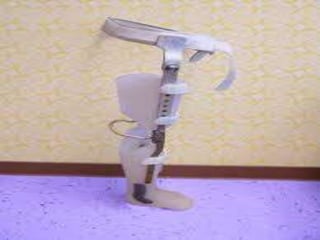
 If the hip abduction power is poor (i.e., < 2),
the appliance will include a pelvic band
with a hip joint (hip-knee-ankle-foot
orthoses) to prevent the lurching gluteus
medius gait.
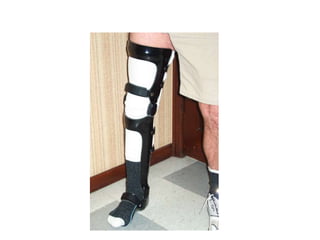
 A knee-ankle-foot orthosis (KAFO) is an orthosis that
covers the knee, ankle and foot.
 When the quadriceps power is 2 or below, the knee has
to be stabilized and hence a knee-ankle-foot orthoses
(full or above-knee calliper) is prescribed.
 Motion at all three of these lower limb areas is affected
by a KAFO.
 can include,
 stopping motion
 limiting motion
 assisting motion in any or all of the 3 planes of motion
saggital, coronal, and axial.
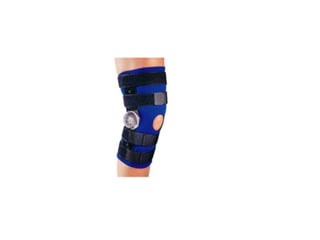
 A knee orthosis (KO) or knee brace is a
brace that extends above and below the
knee joint and is generally worn to support
or align the knee.
 KO prevent flexion or extension instability
of the knee
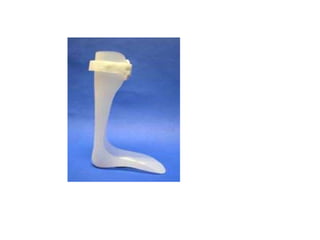
 An ankle-foot orthosis (AFO) is an orthosis or
brace (usually plastic) that supports the ankle
and foot
 When the power of muscles controlling the hip
and knee are normal and the weakness is only
in the dorsiflexors or plantar flexors of the
ankle or invertors or evertors of the foot, the
patient is prescribed an ankle-foot orthoses
(below-knee orthoses or calliper).
 AFOs are externally applied and intended
to control
 position
 motion of the ankle
 compensate for weakness
 or correct deformities.
 It is used to support weak limbs, or to
position a limb with contracted muscles
into a more normal position.
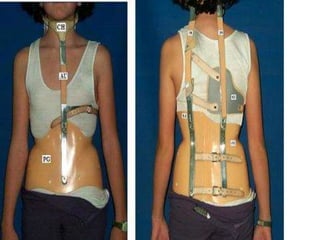
 The Milwaukee brace, also known as a
cervico-thoraco-lumbo-sacral orthosis or
CTLSO.
 Milwaukee brace are use in 3 ways to treat
the scoliosis
 As a corrective apparatus
 Hold the spine in position
 A substitute for surgery
 Is that of biomechanical back up to the
clinical team. From the point of view of the
person with polio, the Orthotist provides
orthoses (splints).
 These include insoles to persons’ shoes,
foot Orthoses, ankle-foot orthoses (AFO),
knee ankle foot orthoses (KAFO) (Short or
long callipers), and spinal jackets.
 .
 In some cases, orthopaedic the majority of
AFOs and KAFOs (callipers) are now made
to a cast, Footwear is also prescribed
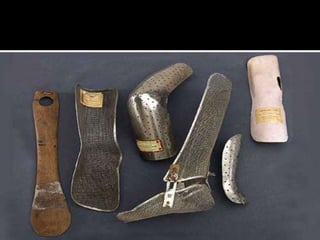
 Old style orthoses of sidebars andT-straps
are not so common anymore and use
lightweight plastics.
 These orthoses are normally lighter and fit
directly inside footwear.This often means
footwear does not have to be Adapted and
walking is made easier.
 The Orthotist, when making orthoses,
considers skeletal alignment, joint integrity
and ease of walking
Orthotic treatment of polio myelitis