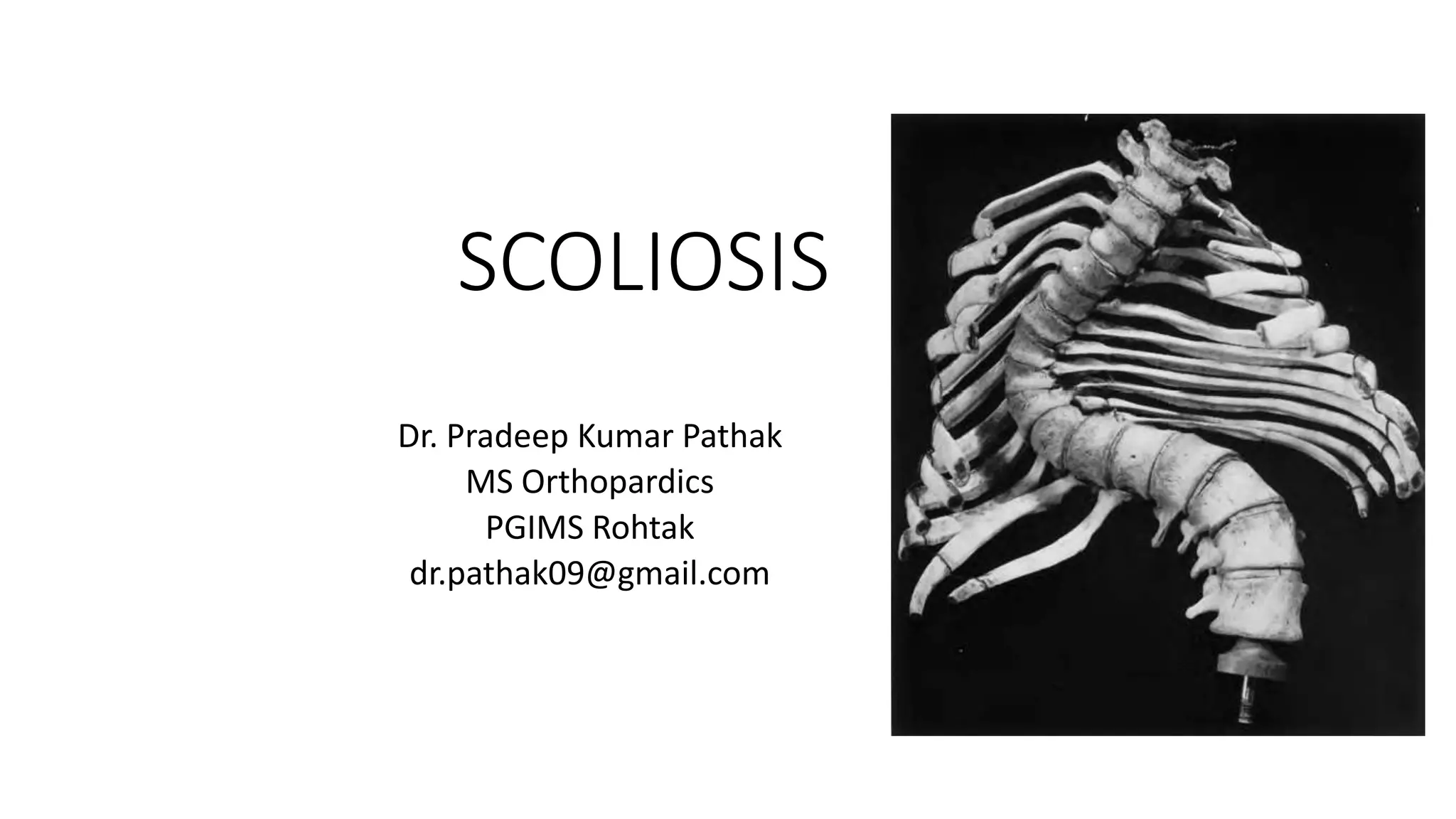
SCOLIOSIS
Dr. Pradeep Kumar Pathak
MS Orthopardics
PGIMS Rohtak
dr.pathak09@gmail.com
Scoliosis reaserch society definition
• Lateral curvature of the spine with an element of axial rotation which
when measured on a standing radiograph should be greater than 10
degrees using cobb method
• complex 3 dimensional deformity-
• frontal : lateral tilting of vertebra
• sagital : lordosis ( extension )
• axial : rotatory component
types of scoliosis
• 1) congenital- present at birth
• 2) infantile- 0-3 years
• 3) juvenile- 4-10 years
• 4) adoloscent- >10 years till skeletal maturity
• 5) adult- after skeletal maturity
• 6) hysterical- nonstructural, menifestation of psychological
disorder
• 7) idiopathic - structural curve, cause unknown
types of curve
• primary curve : the first or earliest curve present
• structural curve : segment of spine that has a fixed lateral curvature
• compensatory curve: secondary curve located above or below the
structural curve that develops to maintain
normal body alignment
types of curve
• cervicothoracic : apex b/w C7-T1
• thoracic curve : apex of curvature b/w T2 and T11
1.Proximal thoracic – Apex at T3, T4 or T5
2.Main thoracic – Apex between T6 and the T11-T12 disc
• Thoracolumar – Thoracolumbar apex between T12 and L1,
• lumbar - apex between the L1 and L4
Idiopathic Scoliosis
• a definitive cause of the deformity has not been established,
• most common
• may have its onset at any age during growth
• infantile, juvenile, adoloscent , adult
Adolescent Idiopathic Scoliosis
• 10- 20 yrs
• F>M
• RIGHT THORACIC
LENKE CURVE TYPES : Adolescent Idiopathic Scoliosis
Pathophysiology
large vertebral body
large disc
broad lamina
thick pedicle
small vertebral body
small disc
narrow lamina
thin pedicle
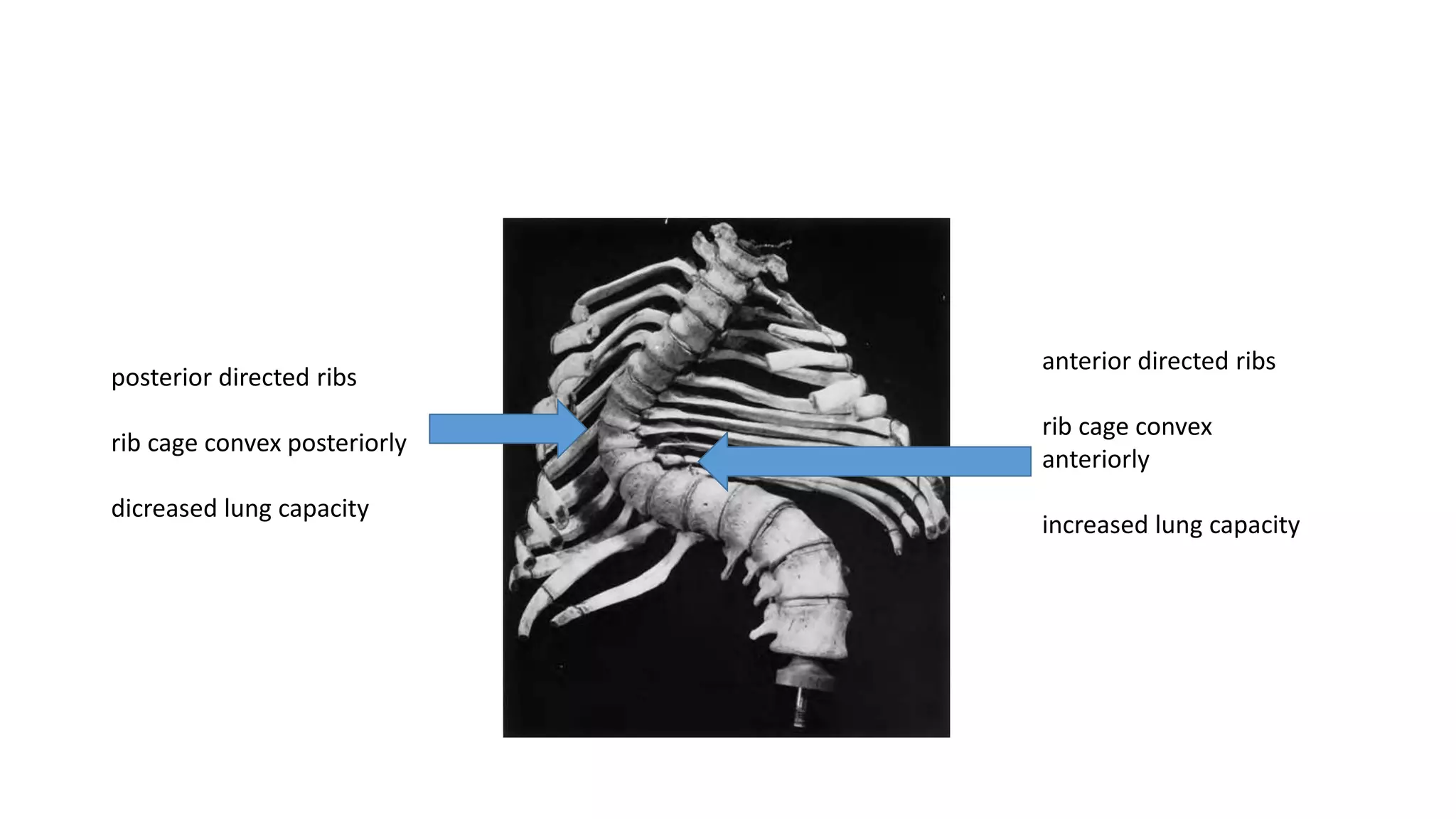
posterior directed ribs
rib cage convex posteriorly
dicreased lung capacity
anterior directed ribs
rib cage convex
anteriorly
increased lung capacity
spinous process rotated towards concavity
transverse process in frontal plane transverse process - close to sagital plane in
midline
convex side
concave side
Clinical Features
Clinical Features
• back pain : spondylolysis, spondylolisthesis, and Scheuermann
kyphosis
• Neurologic deficits are rare in persons with AIS
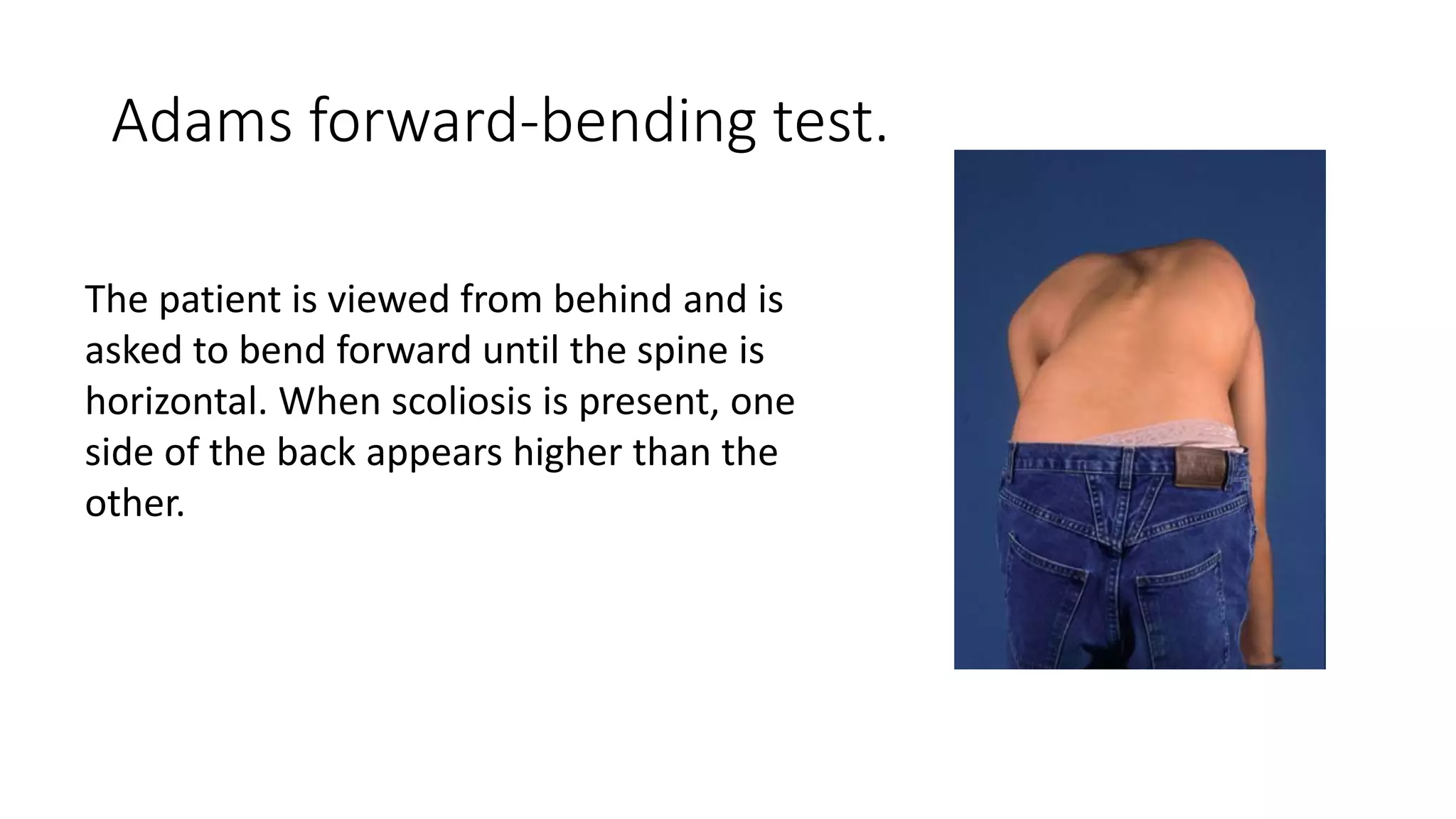
Adams forward-bending test.
The patient is viewed from behind and is
asked to bend forward until the spine is
horizontal. When scoliosis is present, one
side of the back appears higher than the
other.
RADIOGRAPHIC ASSESSMENT
• A standing posteroanterior (PA) long cassette radiograph is the
initial view obtained
• Lateral radiographs
• Side-bending radiographs (vulcrum bending x ray)
• Pelvis x ray
What to assessed in PA radiograph ???
• curve location,
• curve direction,
• curve magnitude,
• end vertebra,
• apical vertebra, and
• Risser sign
• Curve location. The curve location is defined by its apex
Curve Apex
•Cervicothoracic C7 or T1
•Thoracic Between T2 and T11–T12 disc
•Thoracolumbar T12 or L1
•Lumbar Between L1–L2 disc and L4
•Lumbosacral L5 or S1
• Curve direction. Curve direction is determined by the side
of the convexity.
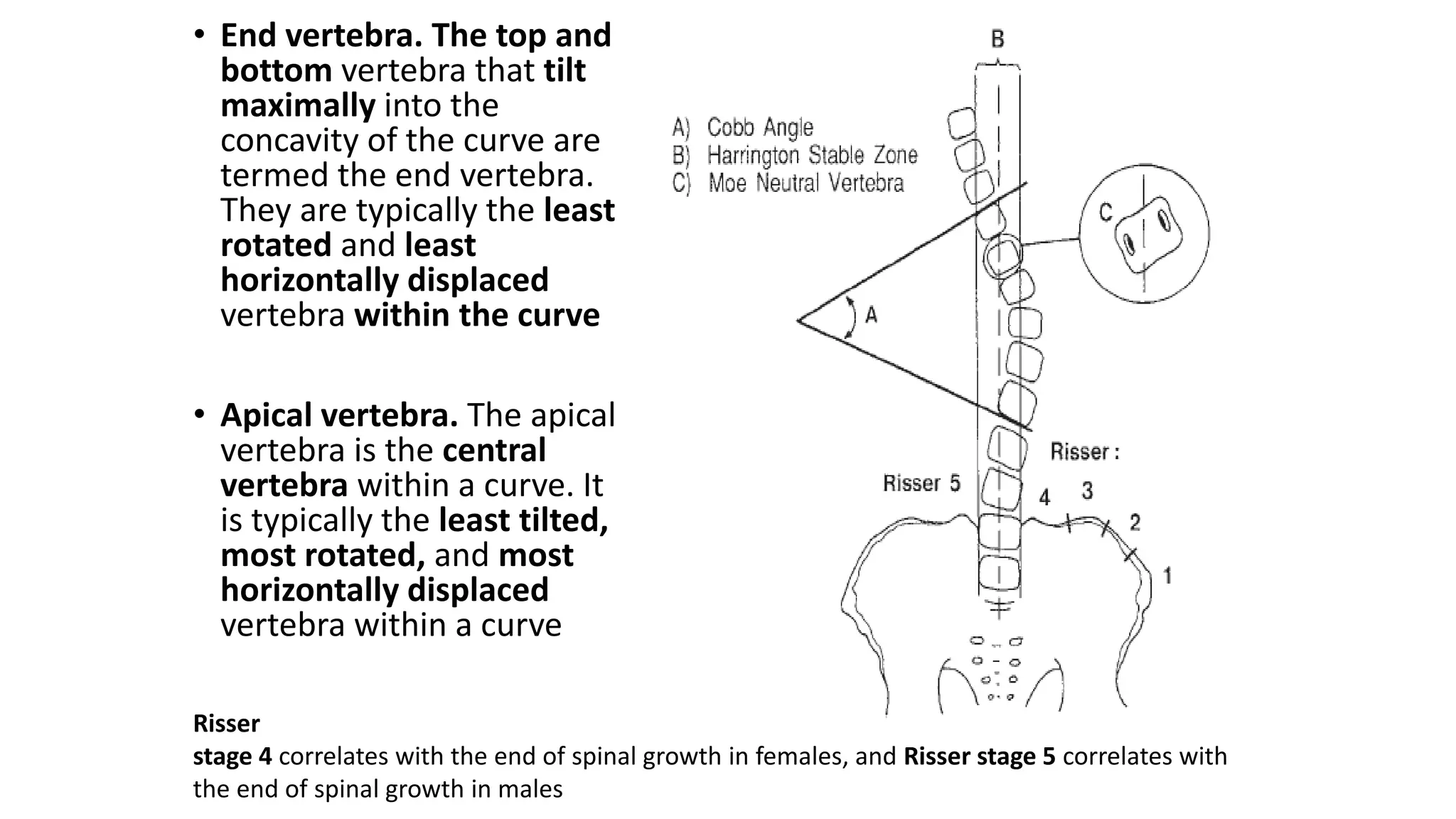
• Curve magnitude. The Cobb-Lippman technique is used to
determine curve magnitude.
Perpendicular lines are drawn in relation to reference lines along the superior
endplate of the upper end vertebra and along the inferior endplate of the lower
end vertebra. The angle created by the intersection of the two perpendicular lines is
termed the Cobb angle and defines the magnitude of the curve.
• End vertebra. The top and
bottom vertebra that tilt
maximally into the
concavity of the curve are
termed the end vertebra.
They are typically the least
rotated and least
horizontally displaced
vertebra within the curve
• Apical vertebra. The apical
vertebra is the central
vertebra within a curve. It
is typically the least tilted,
most rotated, and most
horizontally displaced
vertebra within a curve
Risser
stage 4 correlates with the end of spinal growth in females, and Risser stage 5 correlates with
the end of spinal growth in males
spinal balance
• Measurements of spinal balance are important to assess the amount
of decompensation that exists preoperatively or that can occur
postoperatively
• Coronal balance assess position of head over pelvis
• Trunk balance assesses the position of the thorax over the pelvis and is
measured via lateral trunk shift.
assesment of spinal balance
other investigations
• CT
• MRI
progression: before skeletal maturity
• Female sex - more progression
• Curve pattern (double curves progress more frequently than
single curves)
• remaining growth : Risser 0 with closed triradiate cartilage, and
Risser 1 ( best predictors of the beginning of rapid curve
progression)
• Curve Magnitude: Immature patients (premenarchal, Risser
grade 0) with curves greater than 20 degrees are at substantial
risk for progression of spinal deformity
progrssion: after skeletal maturity
• rate of progression in adulthood is slower
• curves of less than 30 degrees in a mature individual are
unlikely to progress.
• curves that exceed 50 degrees worsen
• Lumbar curves also tend to progress in adulthood
TREATMENT
• no treatment is needed for curves less than 25 degrees, regardless of
the patient’s maturity.
• risser grade 0 - follow up every 3 months
• curve > 20 digrees- every 3 months
• risser grade 3- every 6 months
• curve < 20 digrees - every 6 months
Orthotic (Brace) Treatment
• indicated in growing adolescents (Risser grade 0, 1, or 2) who on
initial evaluation have curves in the range of 30 to 45 degrees
• or
• who have documented progression exceeding 5 degrees in curves
that initially measured 20 to 30 degrees.
• Those who are Risser grade 0 should be considered candidates for
bracing when their curves reach 25 degrees.
Orthotic (Brace) Treatment: contraindication
• large curves (>45 degrees)
• Extreme thoracic hypokyphosis - brace could exacerbate the rib
deformity.
• skeletally mature adolescents (Risser grade 4 or 5 and, if female, 2
years postmenarchal)
BRACES
• Milwaukee brace,
• Boston brace, :
• Wilmington brace,
• Charleston brace,
• Providence brace.
The Milwaukee Brace:
BOSTON Brace
most commonly used brace
effective in single / double curve with apex located at T7 or below
Charleston Brace.
worn only at night for 8 to 10 hours.
reserved for single lumbar or thoracolumbar curves less than 35 degrees
Providence brace.
like the Charleston brace, is used
only at night
Brace Treatment Protocols.
• outcome is better when more hours per day are spent in the brace
• follow up after every 2-4 wk
• any problem in brace wearing should be adressed
• check for any pressure points
• in brace radiograph
• With the Boston brace, a minimum of 40% to 50% curve correction should be
obtained in the brace and with the Charleston and Providence braces, the
amount of in-brace correction should approach 90% for flexible curves and
70% for rigid curves.
Brace Treatment Protocols
• discontinue brace treatment :
• when the girl is approximately 18 to 24 months
postmenarchal
• Risser grade 4 and
• when no further increase in her height has occurred
• in boys, bracing may need to be continued until Risser
grade 5
Surgical Treatment
• goals :
• to reduce the magnitude of the deformity,
• to obtain fusion for prevention of future curve
progression,
• and to do so safely.
Indications for Surgery
• Thoracic curves and double major curves that exceed 50 degrees at
skeletal maturity - always warrants surgery
• Thoracolumbar and lumbar curves of less magnitude, when
associated with marked apical rotation or translational shift , surgery
should be considered when the curves exceed 40 to 45 degrees
• curve > 45 digrees with risser 0, 1, 2
• thoracic lordosis
• significant cosmetic deformity
• pain uncontroled by orthotic m/m
• increasing curve in growing child
prefered surgery
• posterior spinal fusion with instrumentation
• anteriorpinal fusion if younger than <11 years, with open triradiate
cartilage
• risk of crankshaft effect is low : (resumption of the curve secondary to
anterior growth in patients with posterior fusion)
infantile idiopathic scoliosis
• Common in Europe but rare in the United States (1% of cases in United
States)
• Male predominance
• Left thoracic curve pattern is most common
(vs. adolescent idiopathic scoliosis, in which right-sided thoracic curves are typical)
• Association with plagiocephaly, developmental delay, congenital heart
disease, and developmental hip dysplasia
• Two types have been identified: a resolving type
(85%) and a progressive type (15%)
• distinguished by analyzing the rib-vertebral angle
difference (RVAD) and rib phase
Progressive type
• RVAD convex – concaf  >20°
• Rib phase 2
Treatment for
infantile idiopathic scoliosis
• Resolving curves
• observed with serial physical examinations and radiographic monitoring.
• Sleeping in the prone position is recommended
• Progressive curves are treated with serial casting followed by orthotic treatment
with a Milwaukee brace
• Surgery : posterior spinal instrumentation without fusion or the vertically
expandable prosthetic titanium rib (VEPTR).
• Posterior spinal instrumentation and fusion are not recommended
due to:
• restriction of thoracic cage and lung development,
• the risk of crankshaft phenomenon
(persistent anterior spinal growth in the presence of a posterior fusion, leading to recurrent and
increasing spinal deformity).
• In extreme cases, a combined anterior and posterior fusion
procedure is an option but will limit development of the thorax,
lungs, and normal trunk height.
juvenile idiopathic scoliosis
• Less common than adolescent idiopathic scoliosis (12%–16% of all
patients with idiopathic scoliosis)
• Increasing female predominance is noted with increasing age
(female-to-male ratio is 1:1 from 4–6 years and increases to 8–10:1
from 6–10 years)
• Most common curve patterns are right thoracic
• Approximately 70% of curves progress and require some forms of
treatment (bracing or surgery)
• Magnetic resonance imaging (MRI) of the entire spine (also in
infantile idiopathic scoliosis) because spinal deformity may be the
only clue to the presence of a coexistent neural axis abnormality
Treatment of
juvenile idiopathic scoliosis
• Orthotic treatment is initiated for curves in the 25° to 50° range.
• Surgical treatment is considered when curve magnitude exceeds 50°
• Surgical decision making is complex
(the effect of treatment on remaining growth and potential for development of
crankshaft if a single-stage posterior fusion procedure is performed)
• Combined anterior and posterior fusion with posterior instrumentation is an
option for older patients
• Innovative growth modulation techniques such as convex disc stapling are
under investigation and may offer an option for fusionless correction of
scoliosis in the future.
•thank you
Juvenile Idiopathic Scoliosis
• F> M
• RIGHT CONVEXITY more common
• THORACIC curve more common
• age group 4-10 years
• when compared with AIS:
• more likely to progress,
• less likely to respond to bracing, and
• more likely to require surgical treatment than AIS
RVAD , PHASE 1& 2
Juvenile Idiopathic Scoliosis : progression
• steady increase in RVAD - increased progression
• if bracing doesnt improve RVAD : increased need for sx
• kyphosis < 20 digrees
• double major curve
• The level of the most rotated vertebra at the apex of the primary
curve appears to be the most useful factor in determining the
prognosis of patients with juvenile idiopathic scoliosis
• curve apex at T8, T9, or T10 have an 80% chance for requiring sx
Juvenile Idiopathic Scoliosis : treatment
BRACE:
Milwaukee brace, a TLSO is used for thoracic curves with the apex at T8 or
below
infantile idiopathic scoliosis : treatment
• observation :
• curve < 25 digree
• RVAD< 20
• follow up every 6 months
infantile scoliosis TREATMENT : indication
• PROGRESSIVE COBBS ANGLE
• RVAD > 20 DIGREES
• DOUBLE CURVE
• RIB PHASE 2
• CAST -----> BRACE ------> SURGERY
Juvenile Idiopathic Scoliosis : CASTING
• serial casting in general anasthesia
• until child is old enough for satisfactory orthosis
• cast change required every 2-3 months
• under arm cast - if apex is below T9

Scoliosis

  • 1.
    SCOLIOSIS Dr. Pradeep KumarPathak MS Orthopardics PGIMS Rohtak dr.pathak09@gmail.com
  • 2.
    Scoliosis reaserch societydefinition • Lateral curvature of the spine with an element of axial rotation which when measured on a standing radiograph should be greater than 10 degrees using cobb method • complex 3 dimensional deformity- • frontal : lateral tilting of vertebra • sagital : lordosis ( extension ) • axial : rotatory component
  • 3.
    types of scoliosis •1) congenital- present at birth • 2) infantile- 0-3 years • 3) juvenile- 4-10 years • 4) adoloscent- >10 years till skeletal maturity • 5) adult- after skeletal maturity • 6) hysterical- nonstructural, menifestation of psychological disorder • 7) idiopathic - structural curve, cause unknown
  • 6.
    types of curve •primary curve : the first or earliest curve present • structural curve : segment of spine that has a fixed lateral curvature • compensatory curve: secondary curve located above or below the structural curve that develops to maintain normal body alignment
  • 7.
    types of curve •cervicothoracic : apex b/w C7-T1 • thoracic curve : apex of curvature b/w T2 and T11 1.Proximal thoracic – Apex at T3, T4 or T5 2.Main thoracic – Apex between T6 and the T11-T12 disc • Thoracolumar – Thoracolumbar apex between T12 and L1, • lumbar - apex between the L1 and L4
  • 8.
    Idiopathic Scoliosis • adefinitive cause of the deformity has not been established, • most common • may have its onset at any age during growth • infantile, juvenile, adoloscent , adult
  • 9.
    Adolescent Idiopathic Scoliosis •10- 20 yrs • F>M • RIGHT THORACIC
  • 10.
    LENKE CURVE TYPES: Adolescent Idiopathic Scoliosis
  • 11.
    Pathophysiology large vertebral body largedisc broad lamina thick pedicle small vertebral body small disc narrow lamina thin pedicle
  • 12.
    posterior directed ribs ribcage convex posteriorly dicreased lung capacity anterior directed ribs rib cage convex anteriorly increased lung capacity
  • 13.
    spinous process rotatedtowards concavity transverse process in frontal plane transverse process - close to sagital plane in midline convex side concave side
  • 14.
  • 15.
    Clinical Features • backpain : spondylolysis, spondylolisthesis, and Scheuermann kyphosis • Neurologic deficits are rare in persons with AIS
  • 16.
    Adams forward-bending test. Thepatient is viewed from behind and is asked to bend forward until the spine is horizontal. When scoliosis is present, one side of the back appears higher than the other.
  • 17.
    RADIOGRAPHIC ASSESSMENT • Astanding posteroanterior (PA) long cassette radiograph is the initial view obtained • Lateral radiographs • Side-bending radiographs (vulcrum bending x ray) • Pelvis x ray
  • 18.
    What to assessedin PA radiograph ??? • curve location, • curve direction, • curve magnitude, • end vertebra, • apical vertebra, and • Risser sign
  • 19.
    • Curve location.The curve location is defined by its apex Curve Apex •Cervicothoracic C7 or T1 •Thoracic Between T2 and T11–T12 disc •Thoracolumbar T12 or L1 •Lumbar Between L1–L2 disc and L4 •Lumbosacral L5 or S1 • Curve direction. Curve direction is determined by the side of the convexity. • Curve magnitude. The Cobb-Lippman technique is used to determine curve magnitude. Perpendicular lines are drawn in relation to reference lines along the superior endplate of the upper end vertebra and along the inferior endplate of the lower end vertebra. The angle created by the intersection of the two perpendicular lines is termed the Cobb angle and defines the magnitude of the curve.
  • 20.
    • End vertebra.The top and bottom vertebra that tilt maximally into the concavity of the curve are termed the end vertebra. They are typically the least rotated and least horizontally displaced vertebra within the curve • Apical vertebra. The apical vertebra is the central vertebra within a curve. It is typically the least tilted, most rotated, and most horizontally displaced vertebra within a curve Risser stage 4 correlates with the end of spinal growth in females, and Risser stage 5 correlates with the end of spinal growth in males
  • 21.
    spinal balance • Measurementsof spinal balance are important to assess the amount of decompensation that exists preoperatively or that can occur postoperatively • Coronal balance assess position of head over pelvis • Trunk balance assesses the position of the thorax over the pelvis and is measured via lateral trunk shift.
  • 22.
  • 23.
  • 24.
  • 25.
    progression: before skeletalmaturity • Female sex - more progression • Curve pattern (double curves progress more frequently than single curves) • remaining growth : Risser 0 with closed triradiate cartilage, and Risser 1 ( best predictors of the beginning of rapid curve progression) • Curve Magnitude: Immature patients (premenarchal, Risser grade 0) with curves greater than 20 degrees are at substantial risk for progression of spinal deformity
  • 26.
    progrssion: after skeletalmaturity • rate of progression in adulthood is slower • curves of less than 30 degrees in a mature individual are unlikely to progress. • curves that exceed 50 degrees worsen • Lumbar curves also tend to progress in adulthood
  • 27.
  • 28.
    • no treatmentis needed for curves less than 25 degrees, regardless of the patient’s maturity. • risser grade 0 - follow up every 3 months • curve > 20 digrees- every 3 months • risser grade 3- every 6 months • curve < 20 digrees - every 6 months
  • 29.
    Orthotic (Brace) Treatment •indicated in growing adolescents (Risser grade 0, 1, or 2) who on initial evaluation have curves in the range of 30 to 45 degrees • or • who have documented progression exceeding 5 degrees in curves that initially measured 20 to 30 degrees. • Those who are Risser grade 0 should be considered candidates for bracing when their curves reach 25 degrees.
  • 30.
    Orthotic (Brace) Treatment:contraindication • large curves (>45 degrees) • Extreme thoracic hypokyphosis - brace could exacerbate the rib deformity. • skeletally mature adolescents (Risser grade 4 or 5 and, if female, 2 years postmenarchal)
  • 31.
    BRACES • Milwaukee brace, •Boston brace, : • Wilmington brace, • Charleston brace, • Providence brace.
  • 32.
  • 33.
    BOSTON Brace most commonlyused brace effective in single / double curve with apex located at T7 or below
  • 34.
    Charleston Brace. worn onlyat night for 8 to 10 hours. reserved for single lumbar or thoracolumbar curves less than 35 degrees
  • 35.
    Providence brace. like theCharleston brace, is used only at night
  • 36.
    Brace Treatment Protocols. •outcome is better when more hours per day are spent in the brace • follow up after every 2-4 wk • any problem in brace wearing should be adressed • check for any pressure points • in brace radiograph • With the Boston brace, a minimum of 40% to 50% curve correction should be obtained in the brace and with the Charleston and Providence braces, the amount of in-brace correction should approach 90% for flexible curves and 70% for rigid curves.
  • 37.
    Brace Treatment Protocols •discontinue brace treatment : • when the girl is approximately 18 to 24 months postmenarchal • Risser grade 4 and • when no further increase in her height has occurred • in boys, bracing may need to be continued until Risser grade 5
  • 38.
    Surgical Treatment • goals: • to reduce the magnitude of the deformity, • to obtain fusion for prevention of future curve progression, • and to do so safely.
  • 39.
    Indications for Surgery •Thoracic curves and double major curves that exceed 50 degrees at skeletal maturity - always warrants surgery • Thoracolumbar and lumbar curves of less magnitude, when associated with marked apical rotation or translational shift , surgery should be considered when the curves exceed 40 to 45 degrees • curve > 45 digrees with risser 0, 1, 2 • thoracic lordosis • significant cosmetic deformity • pain uncontroled by orthotic m/m • increasing curve in growing child
  • 40.
    prefered surgery • posteriorspinal fusion with instrumentation • anteriorpinal fusion if younger than <11 years, with open triradiate cartilage • risk of crankshaft effect is low : (resumption of the curve secondary to anterior growth in patients with posterior fusion)
  • 41.
    infantile idiopathic scoliosis •Common in Europe but rare in the United States (1% of cases in United States) • Male predominance • Left thoracic curve pattern is most common (vs. adolescent idiopathic scoliosis, in which right-sided thoracic curves are typical) • Association with plagiocephaly, developmental delay, congenital heart disease, and developmental hip dysplasia
  • 42.
    • Two typeshave been identified: a resolving type (85%) and a progressive type (15%) • distinguished by analyzing the rib-vertebral angle difference (RVAD) and rib phase Progressive type • RVAD convex – concaf  >20° • Rib phase 2
  • 44.
    Treatment for infantile idiopathicscoliosis • Resolving curves • observed with serial physical examinations and radiographic monitoring. • Sleeping in the prone position is recommended • Progressive curves are treated with serial casting followed by orthotic treatment with a Milwaukee brace • Surgery : posterior spinal instrumentation without fusion or the vertically expandable prosthetic titanium rib (VEPTR).
  • 46.
    • Posterior spinalinstrumentation and fusion are not recommended due to: • restriction of thoracic cage and lung development, • the risk of crankshaft phenomenon (persistent anterior spinal growth in the presence of a posterior fusion, leading to recurrent and increasing spinal deformity). • In extreme cases, a combined anterior and posterior fusion procedure is an option but will limit development of the thorax, lungs, and normal trunk height.
  • 47.
    juvenile idiopathic scoliosis •Less common than adolescent idiopathic scoliosis (12%–16% of all patients with idiopathic scoliosis) • Increasing female predominance is noted with increasing age (female-to-male ratio is 1:1 from 4–6 years and increases to 8–10:1 from 6–10 years) • Most common curve patterns are right thoracic • Approximately 70% of curves progress and require some forms of treatment (bracing or surgery) • Magnetic resonance imaging (MRI) of the entire spine (also in infantile idiopathic scoliosis) because spinal deformity may be the only clue to the presence of a coexistent neural axis abnormality
  • 48.
    Treatment of juvenile idiopathicscoliosis • Orthotic treatment is initiated for curves in the 25° to 50° range. • Surgical treatment is considered when curve magnitude exceeds 50° • Surgical decision making is complex (the effect of treatment on remaining growth and potential for development of crankshaft if a single-stage posterior fusion procedure is performed) • Combined anterior and posterior fusion with posterior instrumentation is an option for older patients • Innovative growth modulation techniques such as convex disc stapling are under investigation and may offer an option for fusionless correction of scoliosis in the future.
  • 49.
  • 50.
    Juvenile Idiopathic Scoliosis •F> M • RIGHT CONVEXITY more common • THORACIC curve more common • age group 4-10 years • when compared with AIS: • more likely to progress, • less likely to respond to bracing, and • more likely to require surgical treatment than AIS
  • 51.
  • 52.
    Juvenile Idiopathic Scoliosis: progression • steady increase in RVAD - increased progression • if bracing doesnt improve RVAD : increased need for sx • kyphosis < 20 digrees • double major curve • The level of the most rotated vertebra at the apex of the primary curve appears to be the most useful factor in determining the prognosis of patients with juvenile idiopathic scoliosis • curve apex at T8, T9, or T10 have an 80% chance for requiring sx
  • 53.
    Juvenile Idiopathic Scoliosis: treatment BRACE: Milwaukee brace, a TLSO is used for thoracic curves with the apex at T8 or below
  • 65.
    infantile idiopathic scoliosis: treatment • observation : • curve < 25 digree • RVAD< 20 • follow up every 6 months
  • 66.
    infantile scoliosis TREATMENT: indication • PROGRESSIVE COBBS ANGLE • RVAD > 20 DIGREES • DOUBLE CURVE • RIB PHASE 2 • CAST -----> BRACE ------> SURGERY
  • 67.
    Juvenile Idiopathic Scoliosis: CASTING • serial casting in general anasthesia • until child is old enough for satisfactory orthosis • cast change required every 2-3 months • under arm cast - if apex is below T9