PHYSIOTHERAPEUTIC SCOLIOSIS SPECIFIC
EXERCISES (PSSE): RECENT EVIDENCE FOR THEIR
EFFECTIVENESS IN SCOLIOSIS TREATMENT AND
THE POSITION OF THE INTERNATIONAL
SCIENTIFIC SOCIETIES, AN UPDATED REVIEW
Nikos Karavidas, MSc, PT
Certified Schroth (BSPTS) Therapist
Certified Schroth Best Practice Therapist
Certified SEAS Therapist
Certified McKenzie Therapist
MSc Sports Physiotherapy, Cardiff University
Disclosures
 I have nothing to disclose.
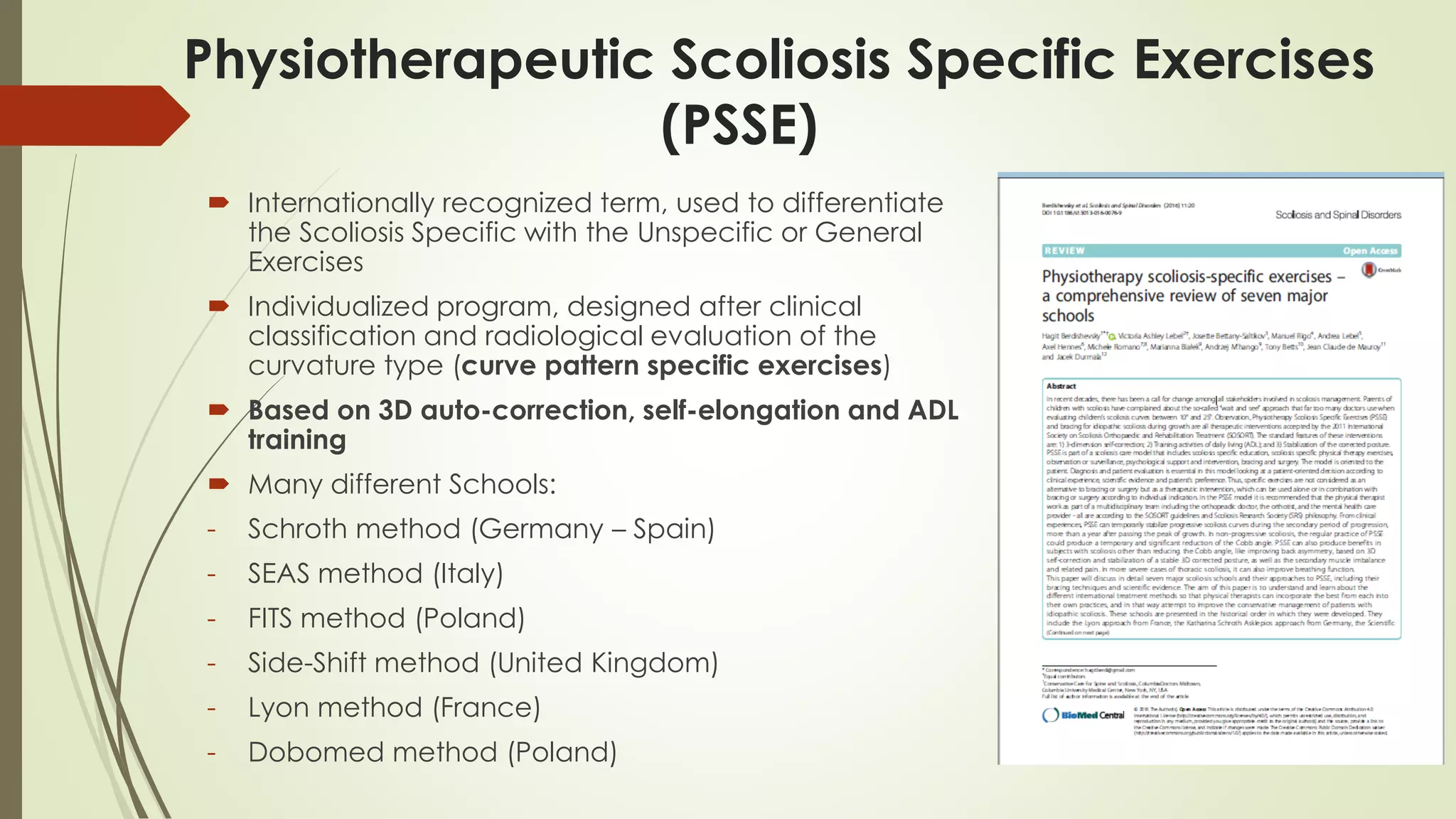
Physiotherapeutic Scoliosis Specific Exercises
(PSSE)
 Internationally recognized term, used to differentiate
the Scoliosis Specific with the Unspecific or General
Exercises
 Individualized program, designed after clinical
classification and radiological evaluation of the
curvature type (curve pattern specific exercises)
 Based on 3D auto-correction, self-elongation and ADL
training
 Many different Schools:
- Schroth method (Germany – Spain)
- SEAS method (Italy)
- FITS method (Poland)
- Side-Shift method (United Kingdom)
- Lyon method (France)
- Dobomed method (Poland)
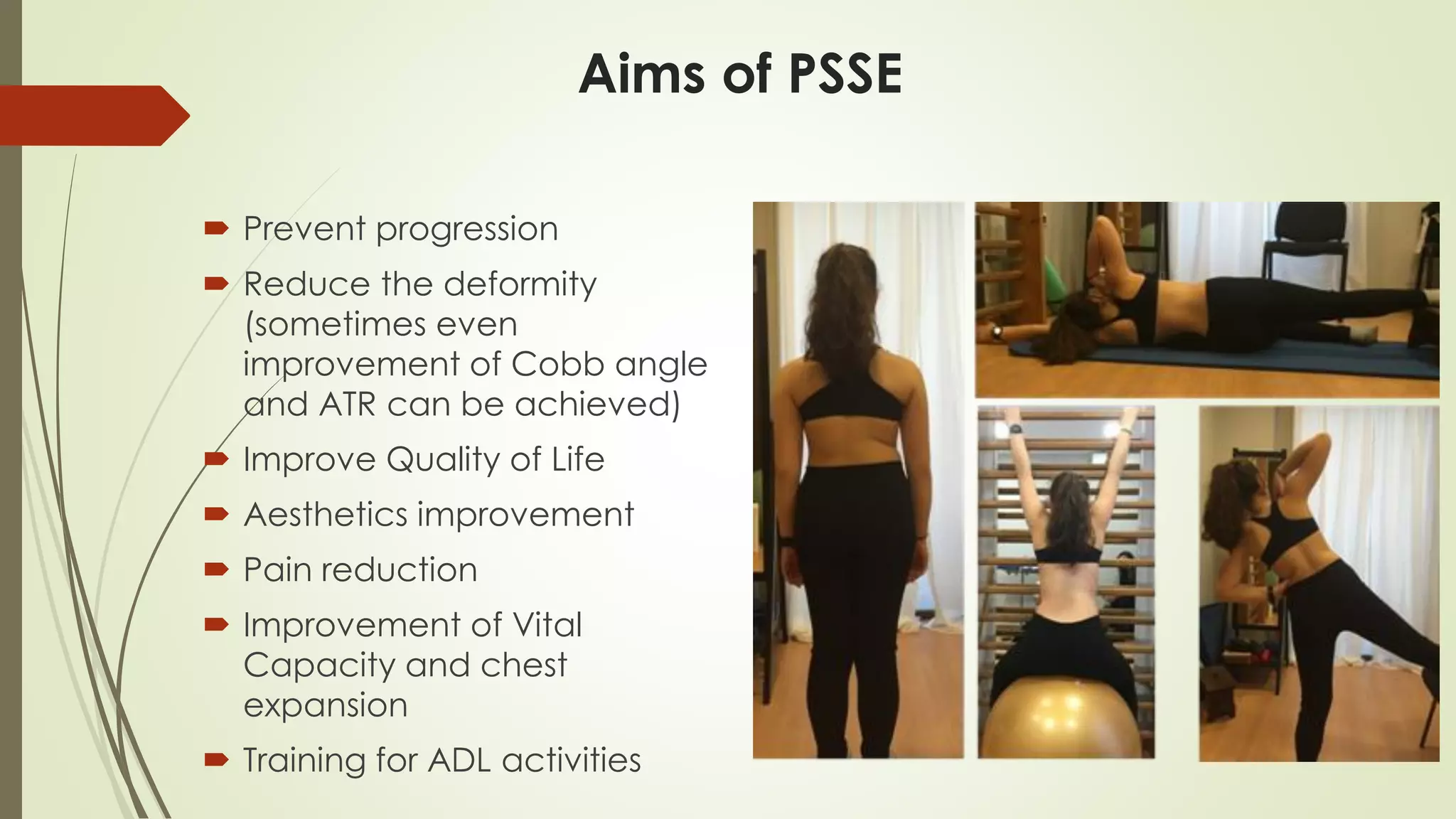
Aims of PSSE
 Prevent progression
 Reduce the deformity
(sometimes even
improvement of Cobb angle
and ATR can be achieved)
 Improve Quality of Life
 Aesthetics improvement
 Pain reduction
 Improvement of Vital
Capacity and chest
expansion
 Training for ADL activities
PSSE indications (SRS – SOSORT guidelines)
Exclusive treatment
 Adolescents with Cobb angle < 25ο ,
Risser 0-3
 Adolescents with Cobb angle 20ο-29ο ,
Risk of progression 40-60% (Lonstein
formula)
 Adolescents with Cobb angle <35ο ,
Risser 4-5
 Adults with painful scoliosis
 Adults of any Cobb angle /Patients
refused surgery
Combined treatment
 Brace indication (adolescents with Cobb
angle 25ο – 40ο , Risser 0-3)
 After spinal fusion (modified program) The prediction of curve progression in untreated idiopathic
scoliosis during growth.
Lonstein and Carlson, 1984
Physiotherapeutic Scoliosis Specific Exercises
(PSSE)
 PSSE is a part of a scoliosis care model, which also includes Observation,
Bracing and Surgery
 PSSE are not offered as an alternative of bracing or surgery
 Supplementary to bracing, when brace is indicated
 PSSE don’t expect to prevent progression during the riskiest period of growth
(peak of growth) in an otherwise progressive scoliosis with potential to go over
45ο
 Avoid Undertreatment of scoliosis by physiotherapists, creating false
expectations, poor treatment results
 Avoid Overtreatment of scoliosis by physiotherapists, any kind of treatment in a
non-progressive scoliosis is a success
 A multidisciplinary team (MD, Orthotist, Specialized Physiotherapist) is needed to
treat scoliosis (SRS-SOSORT guidelines)
Evidence for PSSE (until 2012)
 Cochrane Review (Romano et al 2012)
Some evidence for PSSE, mostly based on a RCT (Wan et al 2005) with many
limitations. Lack of good quality studies.
 Systematic Review (Weiss 2012)
No safe conclusions about PSSE, due to inadequate inclusion criteria in most
studies
 Systematic Review (Mordecai and Dabke 2012)
Previous Systematic Reviews showed some effectiveness of PSSE, but based on
poor methodological quality researches
Literature review
• 1 Systematic Review with
meta-analysis (Level of
Evidence I)
• 4 Randomized Controlled
Trials (RCT)
(Level of Evidence I)
*2 RCT’s (Kuru et al 2015, Wan et al 2005)
low to moderate quality of evidence
• 8 Systematic Reviews
(Level of Evidence II)
• 10 Prospective control studies
(Level of Evidence II)
• Many Retrospective studies
and Case reports (Level of
Evidence III and IV)
RCT – Monticone et al (2014)
European Spine Journal, (2014) 23:1204–1214
110 subjects, 2 groups (1st PSSE, 2nd general exercise),
identical baseline characteristics, 12 months follow-up
Inclusion criteria: Cobb 10ο-25ο, Risser 0-1, Age>10 years
(SRS criteria)
Results
- Cobb angle: PSSE Improvement 69%, Progression 8%,
Stable 23%
Control group Improvement 6%, Progression 39%,
Stable 55%
- ATR: PSSE Improvement by 3.5ο , Control group stable
-SRS-22 (QoL) : PSSE improvement > 0.75 all domains
(pain, function, self-image, mental health), Control group
no significant changes
Conclusions: PSSE can reduce the risk of progression in
mild scoliosis (<25ο) and have significantly better results
than general exercises
RCT – Schreiber et al (2015)
Scoliosis and Spinal Disorders, 2015,10:24
 Schroth method added to standard care
(observation or brace)
 50 patients, 2 groups (1st standard care +
Schroth, 2nd standard care- control), identical
baseline characteristics, 6 months period
 Inclusion criteria: 10-18 years, Cobb 10ο-45ο, Risser
0-2
 Results:
Schroth group Improvement of muscle endurance
and ability to keep an upright posture by 27.5
sec more than control
Schroth group significant improvement of pain and
self-image on SRS-22 questionnaire
 Conclusions: Adding Schroth method to standard
care offers significantly better results than
standard care alone
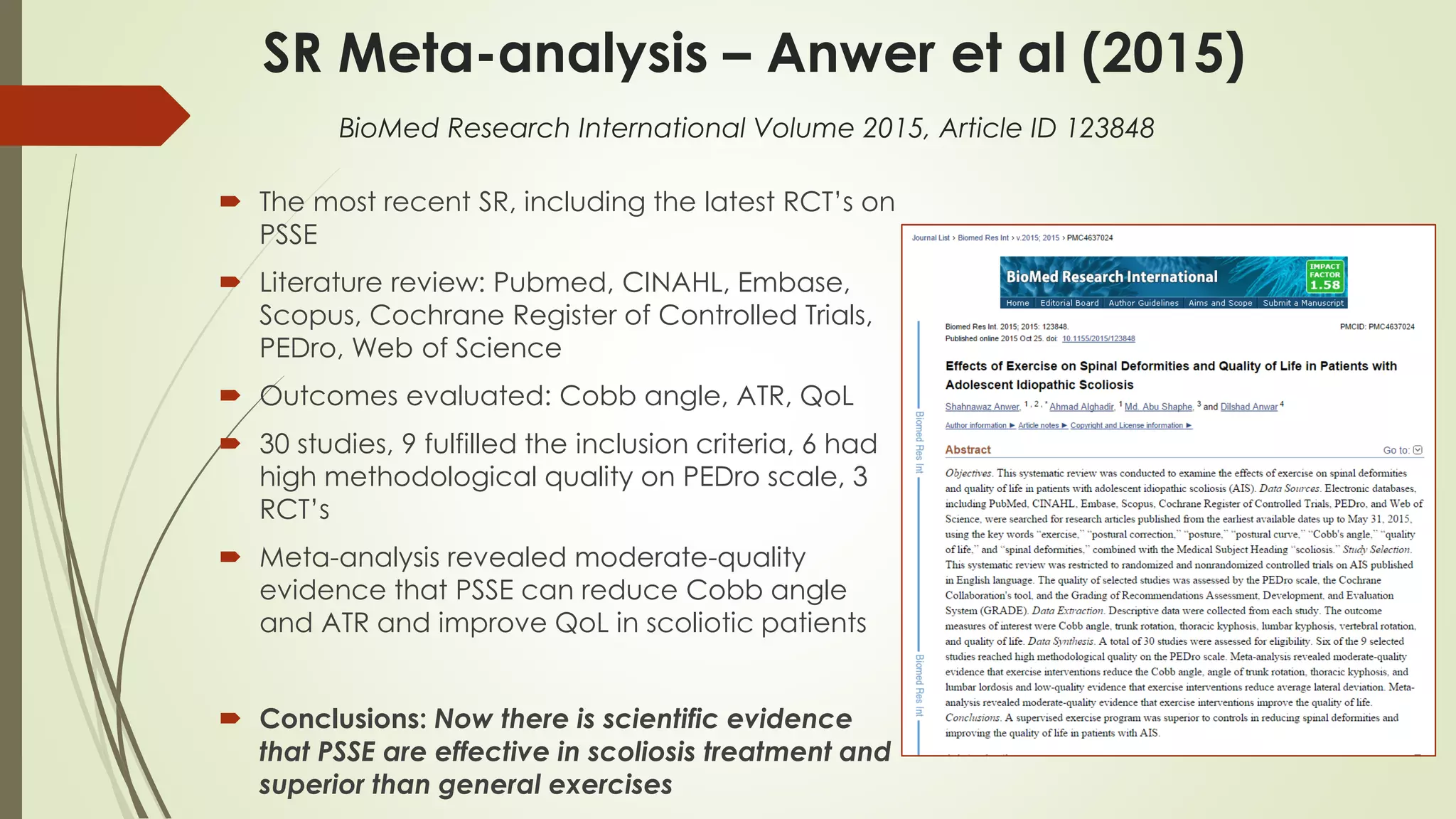
SR Meta-analysis – Anwer et al (2015)
BioMed Research International Volume 2015, Article ID 123848
 The most recent SR, including the latest RCT’s on
PSSE
 Literature review: Pubmed, CINAHL, Embase,
Scopus, Cochrane Register of Controlled Trials,
PEDro, Web of Science
 Outcomes evaluated: Cobb angle, ATR, QoL
 30 studies, 9 fulfilled the inclusion criteria, 6 had
high methodological quality on PEDro scale, 3
RCT’s
 Meta-analysis revealed moderate-quality
evidence that PSSE can reduce Cobb angle
and ATR and improve QoL in scoliotic patients
 Conclusions: Now there is scientific evidence
that PSSE are effective in scoliosis treatment and
superior than general exercises
Case study 1 – Schroth method
25ο 10ο
pre-ex 7 months post-ex pre-ex 7 months post-ex
Case study 1 – Schroth method
pre-ex 7 months post-ex
Case study 2 – Schroth method
29ο 24ο
pre-ex 6 months post-ex
Case study 2 – Schroth method
pre-ex 6 months post-ex
Case study 2 – Schroth method
pre-ex 6 months post-ex
Case study 3 – Schroth method
27ο 30ο 20ο
13/10/2015 07/03/2016 06/10/2016
Case study 3 – Schroth method
03/2016 10/2016
03/2016 10/2016
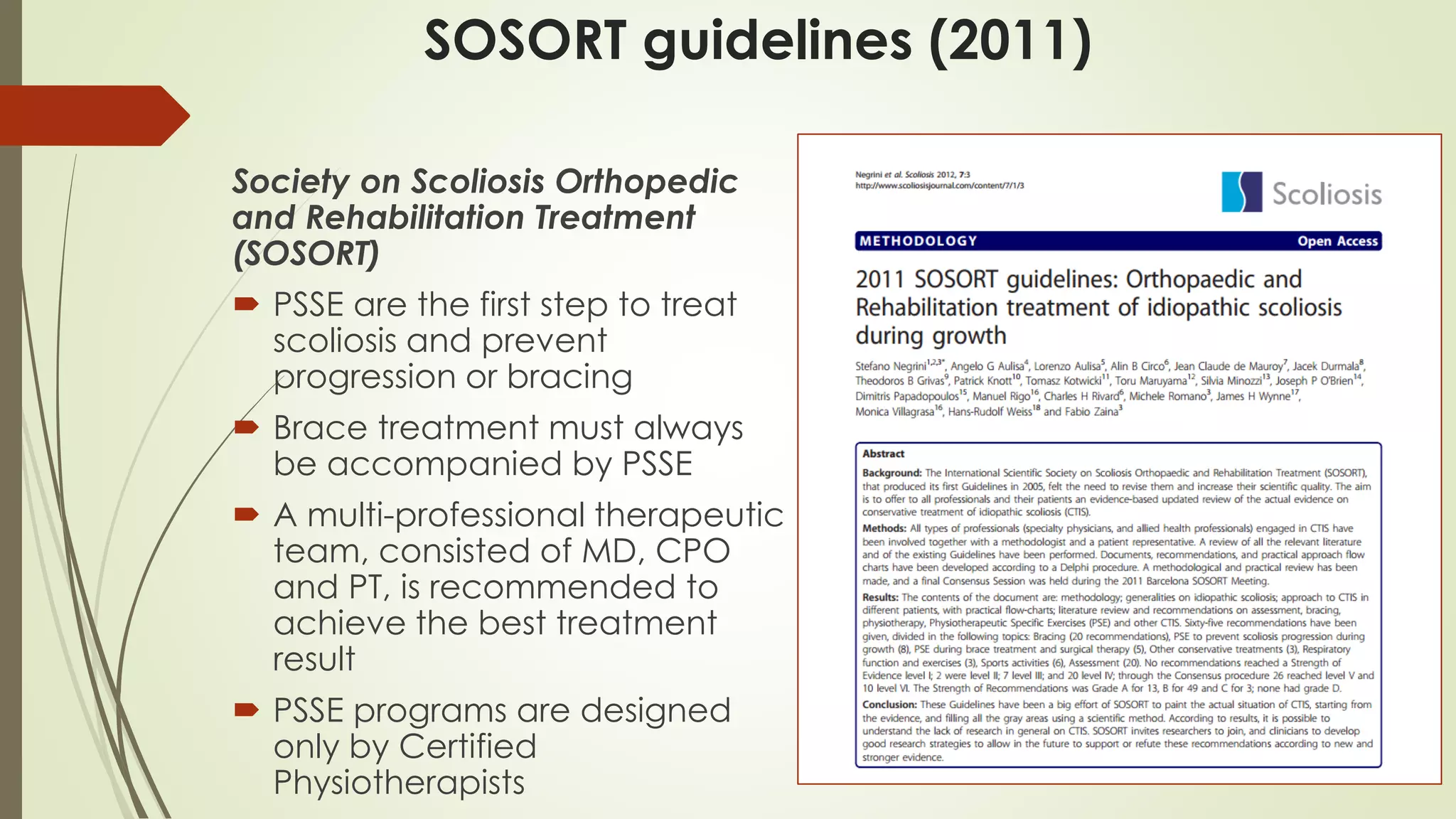
SOSORT guidelines (2011)
Society on Scoliosis Orthopedic
and Rehabilitation Treatment
(SOSORT)
 PSSE are the first step to treat
scoliosis and prevent
progression or bracing
 Brace treatment must always
be accompanied by PSSE
 A multi-professional therapeutic
team, consisted of MD, CPO
and PT, is recommended to
achieve the best treatment
result
 PSSE programs are designed
only by Certified
Physiotherapists
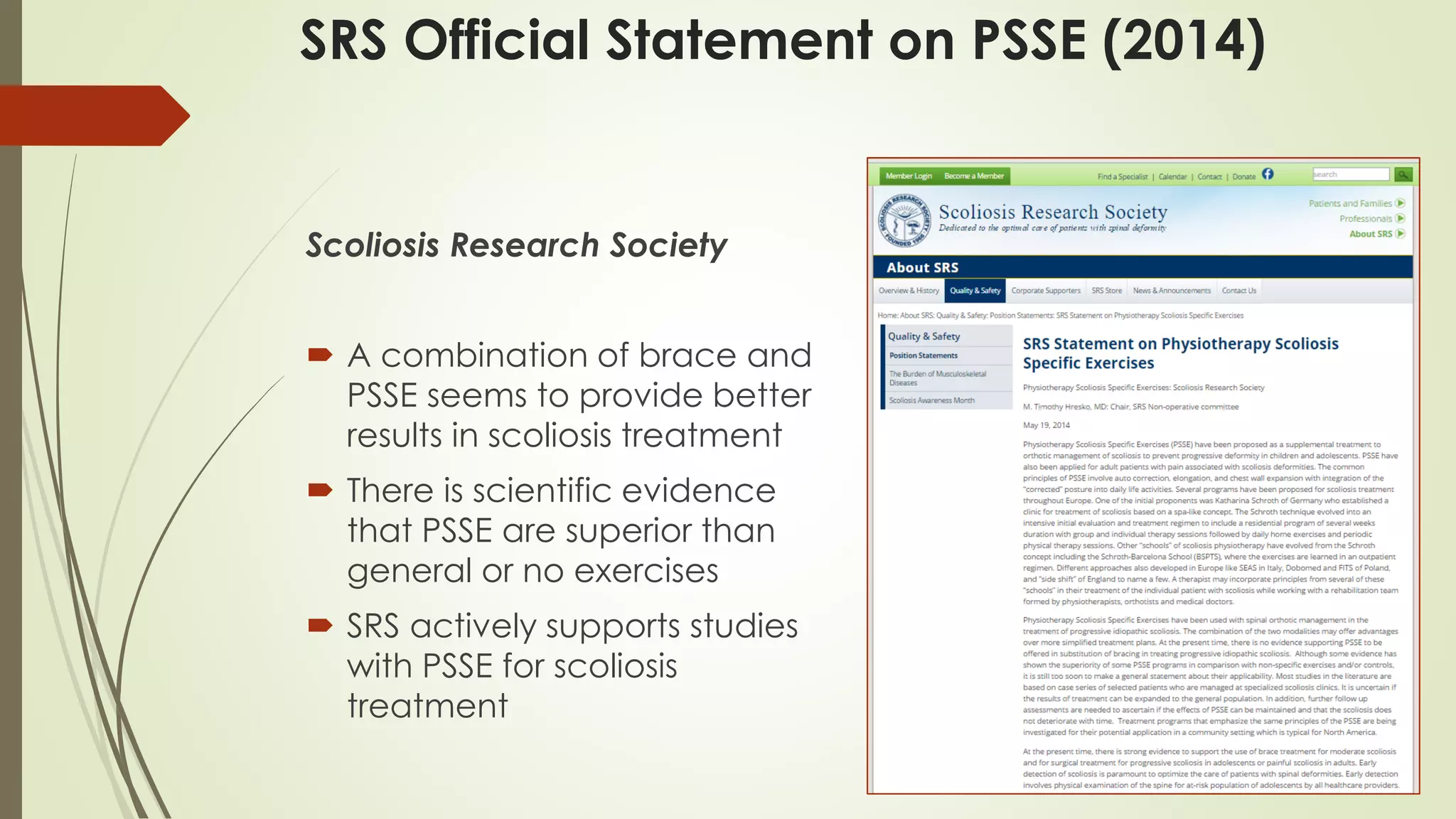
SRS Official Statement on PSSE (2014)
Scoliosis Research Society
 A combination of brace and
PSSE seems to provide better
results in scoliosis treatment
 There is scientific evidence
that PSSE are superior than
general or no exercises
 SRS actively supports studies
with PSSE for scoliosis
treatment
Multicenter Schroth Exercise Trial for Scoliosis
(MultiSETS)
 Research funded and supported by
SRS
 Randomized Control Trial (RCT)
 Purpose:
- Compare Schroth + Standard of Care
(Observation for curves <25ο or Bracing
for curves 25ο-45ο) with Standard of
Care alone
- Determine effectiveness of Schroth
method
 Results expected to be announced in
January 2017
Scoliosis Specific Exercises for At-Risk AIS curves
 Research funded and
supported by SRS
 Randomized Control Trial
(RCT)
 Purpose:
- Compare the treatment
result of a PSSE group and a
control group (observation)
for curves below 25ο
- Research started June 2016
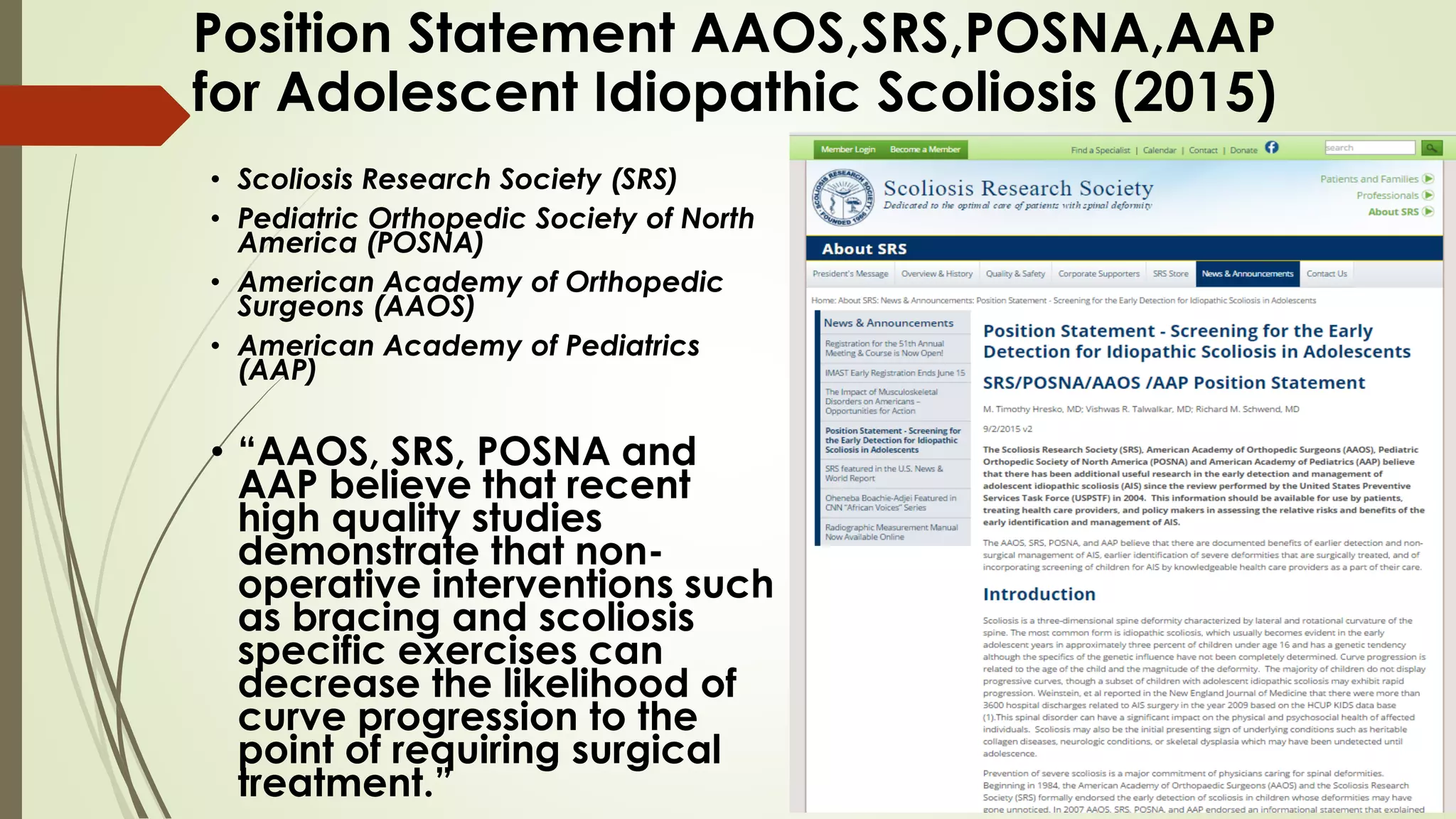
Position Statement AAOS,SRS,POSNA,AAP
for Adolescent Idiopathic Scoliosis (2015)
• Scoliosis Research Society (SRS)
• Pediatric Orthopedic Society of North
America (POSNA)
• American Academy of Orthopedic
Surgeons (AAOS)
• American Academy of Pediatrics
(AAP)
• “AAOS, SRS, POSNA and
AAP believe that recent
high quality studies
demonstrate that non-
operative interventions such
as bracing and scoliosis
specific exercises can
decrease the likelihood of
curve progression to the
point of requiring surgical
treatment.”
Conclusions
High quality evidence for the effectiveness of PSSE
(Level of Evidence I)
According to the existed literature and the International
Scientific Societies guidelines, PSSE must be the first step
to treat AIS for curves <25ο in order to halt the
progression, and PSSE must always accompany bracing,
when brace treatment is indicated
The important role of PSSE is recognized by all the
International Scientific Societies (SRS, SOSORT, POSNA,
AAOS, AAP)
PSSE are superior than general or no exercises, the
program of PSSE is designed only by certified
Physiotherapists
Thank you for your attention
Nikos Karavidas, MSc, PT
Certified Schroth Therapist (BSPTS)
Certified Schroth Best Practice Therapist
Certified SEAS Therapist
Certified McKenzie Therapist
MSc Sports Physiotherapy, Cardiff University
Website: www.skoliosi.com

Physiotherapeutic Scoliosis Specific Exercises (PSSE): Recent evidence for their effectiveness in scoliosis treatment and the position of the international scientific societies : An updated review

  • 1.
    PHYSIOTHERAPEUTIC SCOLIOSIS SPECIFIC EXERCISES(PSSE): RECENT EVIDENCE FOR THEIR EFFECTIVENESS IN SCOLIOSIS TREATMENT AND THE POSITION OF THE INTERNATIONAL SCIENTIFIC SOCIETIES, AN UPDATED REVIEW Nikos Karavidas, MSc, PT Certified Schroth (BSPTS) Therapist Certified Schroth Best Practice Therapist Certified SEAS Therapist Certified McKenzie Therapist MSc Sports Physiotherapy, Cardiff University
  • 2.
    Disclosures  I havenothing to disclose.
  • 3.
    Physiotherapeutic Scoliosis SpecificExercises (PSSE)  Internationally recognized term, used to differentiate the Scoliosis Specific with the Unspecific or General Exercises  Individualized program, designed after clinical classification and radiological evaluation of the curvature type (curve pattern specific exercises)  Based on 3D auto-correction, self-elongation and ADL training  Many different Schools: - Schroth method (Germany – Spain) - SEAS method (Italy) - FITS method (Poland) - Side-Shift method (United Kingdom) - Lyon method (France) - Dobomed method (Poland)
  • 4.
    Aims of PSSE Prevent progression  Reduce the deformity (sometimes even improvement of Cobb angle and ATR can be achieved)  Improve Quality of Life  Aesthetics improvement  Pain reduction  Improvement of Vital Capacity and chest expansion  Training for ADL activities
  • 5.
    PSSE indications (SRS– SOSORT guidelines) Exclusive treatment  Adolescents with Cobb angle < 25ο , Risser 0-3  Adolescents with Cobb angle 20ο-29ο , Risk of progression 40-60% (Lonstein formula)  Adolescents with Cobb angle <35ο , Risser 4-5  Adults with painful scoliosis  Adults of any Cobb angle /Patients refused surgery Combined treatment  Brace indication (adolescents with Cobb angle 25ο – 40ο , Risser 0-3)  After spinal fusion (modified program) The prediction of curve progression in untreated idiopathic scoliosis during growth. Lonstein and Carlson, 1984
  • 6.
    Physiotherapeutic Scoliosis SpecificExercises (PSSE)  PSSE is a part of a scoliosis care model, which also includes Observation, Bracing and Surgery  PSSE are not offered as an alternative of bracing or surgery  Supplementary to bracing, when brace is indicated  PSSE don’t expect to prevent progression during the riskiest period of growth (peak of growth) in an otherwise progressive scoliosis with potential to go over 45ο  Avoid Undertreatment of scoliosis by physiotherapists, creating false expectations, poor treatment results  Avoid Overtreatment of scoliosis by physiotherapists, any kind of treatment in a non-progressive scoliosis is a success  A multidisciplinary team (MD, Orthotist, Specialized Physiotherapist) is needed to treat scoliosis (SRS-SOSORT guidelines)
  • 7.
    Evidence for PSSE(until 2012)  Cochrane Review (Romano et al 2012) Some evidence for PSSE, mostly based on a RCT (Wan et al 2005) with many limitations. Lack of good quality studies.  Systematic Review (Weiss 2012) No safe conclusions about PSSE, due to inadequate inclusion criteria in most studies  Systematic Review (Mordecai and Dabke 2012) Previous Systematic Reviews showed some effectiveness of PSSE, but based on poor methodological quality researches
  • 8.
    Literature review • 1Systematic Review with meta-analysis (Level of Evidence I) • 4 Randomized Controlled Trials (RCT) (Level of Evidence I) *2 RCT’s (Kuru et al 2015, Wan et al 2005) low to moderate quality of evidence • 8 Systematic Reviews (Level of Evidence II) • 10 Prospective control studies (Level of Evidence II) • Many Retrospective studies and Case reports (Level of Evidence III and IV)
  • 9.
    RCT – Monticoneet al (2014) European Spine Journal, (2014) 23:1204–1214 110 subjects, 2 groups (1st PSSE, 2nd general exercise), identical baseline characteristics, 12 months follow-up Inclusion criteria: Cobb 10ο-25ο, Risser 0-1, Age>10 years (SRS criteria) Results - Cobb angle: PSSE Improvement 69%, Progression 8%, Stable 23% Control group Improvement 6%, Progression 39%, Stable 55% - ATR: PSSE Improvement by 3.5ο , Control group stable -SRS-22 (QoL) : PSSE improvement > 0.75 all domains (pain, function, self-image, mental health), Control group no significant changes Conclusions: PSSE can reduce the risk of progression in mild scoliosis (<25ο) and have significantly better results than general exercises
  • 10.
    RCT – Schreiberet al (2015) Scoliosis and Spinal Disorders, 2015,10:24  Schroth method added to standard care (observation or brace)  50 patients, 2 groups (1st standard care + Schroth, 2nd standard care- control), identical baseline characteristics, 6 months period  Inclusion criteria: 10-18 years, Cobb 10ο-45ο, Risser 0-2  Results: Schroth group Improvement of muscle endurance and ability to keep an upright posture by 27.5 sec more than control Schroth group significant improvement of pain and self-image on SRS-22 questionnaire  Conclusions: Adding Schroth method to standard care offers significantly better results than standard care alone
  • 11.
    SR Meta-analysis –Anwer et al (2015) BioMed Research International Volume 2015, Article ID 123848  The most recent SR, including the latest RCT’s on PSSE  Literature review: Pubmed, CINAHL, Embase, Scopus, Cochrane Register of Controlled Trials, PEDro, Web of Science  Outcomes evaluated: Cobb angle, ATR, QoL  30 studies, 9 fulfilled the inclusion criteria, 6 had high methodological quality on PEDro scale, 3 RCT’s  Meta-analysis revealed moderate-quality evidence that PSSE can reduce Cobb angle and ATR and improve QoL in scoliotic patients  Conclusions: Now there is scientific evidence that PSSE are effective in scoliosis treatment and superior than general exercises
  • 12.
    Case study 1– Schroth method 25ο 10ο pre-ex 7 months post-ex pre-ex 7 months post-ex
  • 13.
    Case study 1– Schroth method pre-ex 7 months post-ex pre-ex 7 months post-ex
  • 14.
    Case study 2– Schroth method 29ο 24ο pre-ex 6 months post-ex
  • 15.
    Case study 2– Schroth method pre-ex 6 months post-ex
  • 16.
    Case study 2– Schroth method pre-ex 6 months post-ex
  • 17.
    Case study 3– Schroth method 27ο 30ο 20ο 13/10/2015 07/03/2016 06/10/2016
  • 18.
    Case study 3– Schroth method 03/2016 10/2016 03/2016 10/2016
  • 19.
    SOSORT guidelines (2011) Societyon Scoliosis Orthopedic and Rehabilitation Treatment (SOSORT)  PSSE are the first step to treat scoliosis and prevent progression or bracing  Brace treatment must always be accompanied by PSSE  A multi-professional therapeutic team, consisted of MD, CPO and PT, is recommended to achieve the best treatment result  PSSE programs are designed only by Certified Physiotherapists
  • 20.
    SRS Official Statementon PSSE (2014) Scoliosis Research Society  A combination of brace and PSSE seems to provide better results in scoliosis treatment  There is scientific evidence that PSSE are superior than general or no exercises  SRS actively supports studies with PSSE for scoliosis treatment
  • 21.
    Multicenter Schroth ExerciseTrial for Scoliosis (MultiSETS)  Research funded and supported by SRS  Randomized Control Trial (RCT)  Purpose: - Compare Schroth + Standard of Care (Observation for curves <25ο or Bracing for curves 25ο-45ο) with Standard of Care alone - Determine effectiveness of Schroth method  Results expected to be announced in January 2017
  • 22.
    Scoliosis Specific Exercisesfor At-Risk AIS curves  Research funded and supported by SRS  Randomized Control Trial (RCT)  Purpose: - Compare the treatment result of a PSSE group and a control group (observation) for curves below 25ο - Research started June 2016
  • 23.
    Position Statement AAOS,SRS,POSNA,AAP forAdolescent Idiopathic Scoliosis (2015) • Scoliosis Research Society (SRS) • Pediatric Orthopedic Society of North America (POSNA) • American Academy of Orthopedic Surgeons (AAOS) • American Academy of Pediatrics (AAP) • “AAOS, SRS, POSNA and AAP believe that recent high quality studies demonstrate that non- operative interventions such as bracing and scoliosis specific exercises can decrease the likelihood of curve progression to the point of requiring surgical treatment.”
  • 24.
    Conclusions High quality evidencefor the effectiveness of PSSE (Level of Evidence I) According to the existed literature and the International Scientific Societies guidelines, PSSE must be the first step to treat AIS for curves <25ο in order to halt the progression, and PSSE must always accompany bracing, when brace treatment is indicated The important role of PSSE is recognized by all the International Scientific Societies (SRS, SOSORT, POSNA, AAOS, AAP) PSSE are superior than general or no exercises, the program of PSSE is designed only by certified Physiotherapists
  • 25.
    Thank you foryour attention Nikos Karavidas, MSc, PT Certified Schroth Therapist (BSPTS) Certified Schroth Best Practice Therapist Certified SEAS Therapist Certified McKenzie Therapist MSc Sports Physiotherapy, Cardiff University Website: www.skoliosi.com