How to do a clinical and radiological workup?
SCOLIOSIS
Dr Kshitij Chaudhary
MS, DNB, Fellowship in Spine Surgery (USA).
Consultant Spine Surgeon
Sir HN Reliance Foundation Hospital
Mumbai
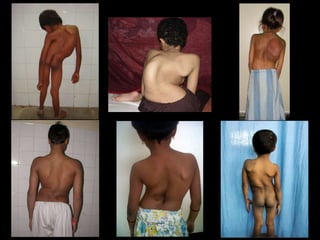
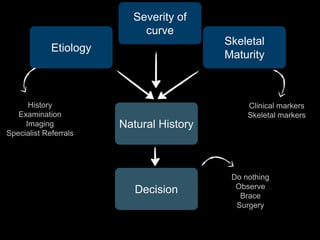
Scoliosis is NOT a diagnosis
Skeletal
Maturity
Natural History
Decision
Etiology
History
Examination
Imaging
Specialist Referrals
Clinical markers
Skeletal markers
Do nothing
Observe
Brace
Surgery
Severity of
curve
Growth and Maturity
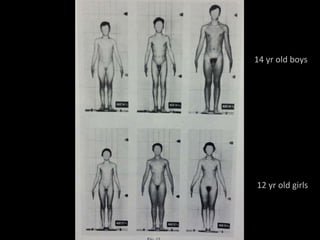
12 yr old girls
14 yr old boys
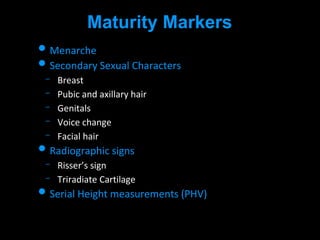
Maturity Markers
• Menarche
• Secondary Sexual Characters
Breast
Pubic and axillary hair
Genitals
Voice change
Facial hair
• Radiographic signs
Risser’s sign
Triradiate Cartilage
• Serial Height measurements (PHV)
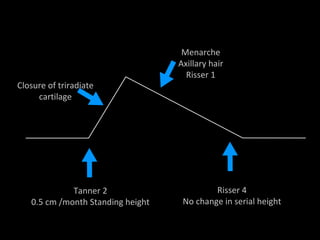
Tanner 2
0.5 cm /month Standing height
Risser 4
No change in serial height
Closure of triradiate
cartilage
Menarche
Axillary hair
Risser 1
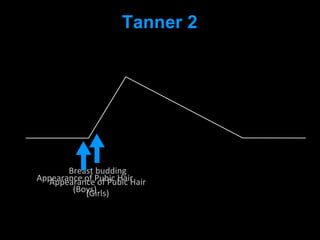
Tanner 2
Breast budding
Appearance of Pubic Hair
(Girls)
Appearance of Pubic Hair
(Boys)
History
Deformity
Pain
Neurologic symptoms
Cardiopulmonary issues
Functional / psychological issues
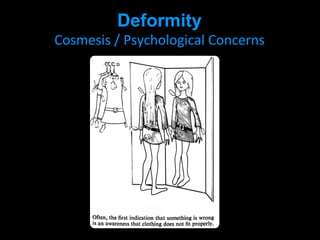
Deformity
Cosmesis / Psychological Concerns
Deformity
• When was it first noticed?
• How was it first noted?
• Is it progressive?
• What treatment has been taken so far? How long?
Details about old records / X-rays
Bracing?
Prior procedures
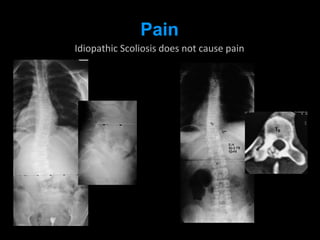
Pain
Idiopathic Scoliosis does not cause pain
Neurologic Symptoms
Especially when angular kyphosis
Gait problems
Loss of balance
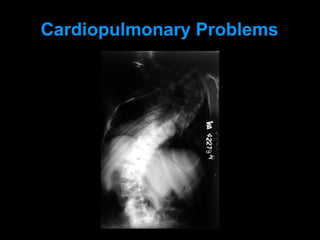
Cardiopulmonary Problems
History
• Birth History
Issues in pregnancy?
Health of mother? Diabetic? Antenatal care appropriate?
Previous pregnancies ending in miscarriages?
Issues during perinatal and postnatal period
Term delivery? C-section or vaginal
ICU / ventilatory care
• Developmental History
Motor milestones
Learning disabilities
Grade in School? Keeping up with peers
Menarche (record in yr+mo)
History
• Family History
Parents and their families (AIS, NM, NF)
Siblings
Examine family if in room - Adam’s test
History
• Past medical or surgical history
Hearing / visual problems
Cleft lip/ palate
Tracheo-esophageal fistula, Anorectal problems
Cardiac murmurs / anomalies
Genitourinary disorders
Respiratory disorders
Neurological disorders
Physical Examination
Spine
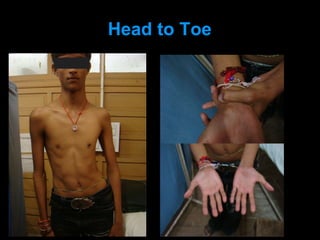
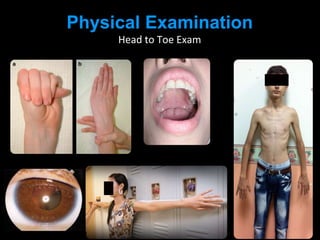
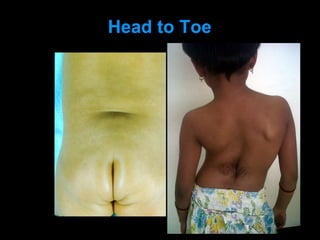
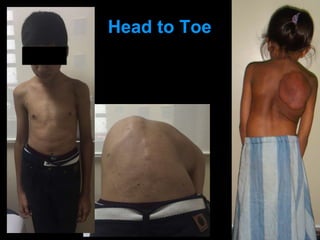
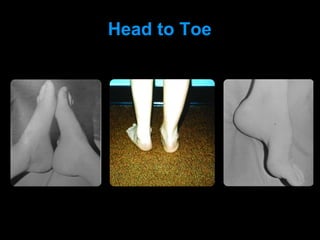
Head to Toe
Neurological
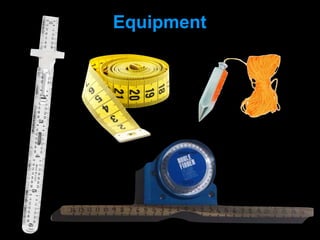
Equipment
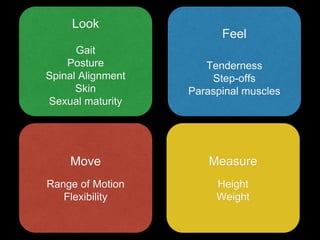
Look
Gait
Posture
Spinal Alignment
Skin
Sexual maturity
Feel
Tenderness
Step-offs
Paraspinal muscles
Move
Range of Motion
Flexibility
Measure
Height
Weight
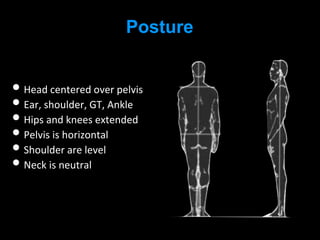
Posture
• Head centered over pelvis
• Ear, shoulder, GT, Ankle
• Hips and knees extended
• Pelvis is horizontal
• Shoulder are level
• Neck is neutral
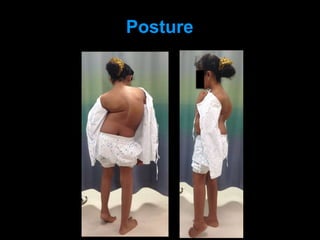
Posture
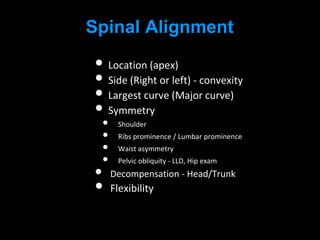
Spinal Alignment
• Location (apex)
• Side (Right or left) - convexity
• Largest curve (Major curve)
• Symmetry
• Shoulder
• Ribs prominence / Lumbar prominence
• Waist asymmetry
• Pelvic obliquity - LLD, Hip exam
• Decompensation - Head/Trunk
• Flexibility
Physical Examination
• Back
• Front
• Side
• Supine
• Prone
• Sitting
• Walking
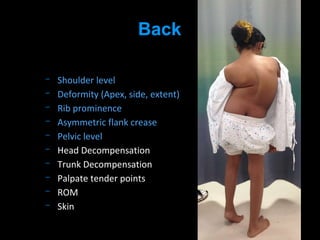
Shoulder level
Deformity (Apex, side, extent)
Rib prominence
Asymmetric flank crease
Pelvic level
Head Decompensation
Trunk Decompensation
Palpate tender points
ROM
Skin
Back
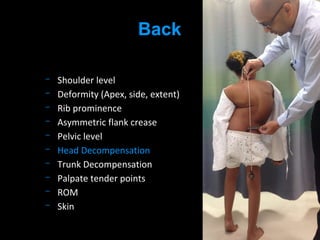
Shoulder level
Deformity (Apex, side, extent)
Rib prominence
Asymmetric flank crease
Pelvic level
Head Decompensation
Trunk Decompensation
Palpate tender points
ROM
Skin
Back
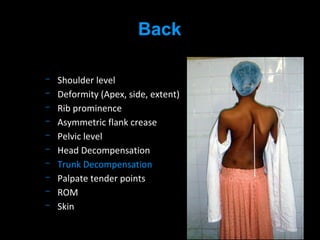
Shoulder level
Deformity (Apex, side, extent)
Rib prominence
Asymmetric flank crease
Pelvic level
Head Decompensation
Trunk Decompensation
Palpate tender points
ROM
Skin
Back
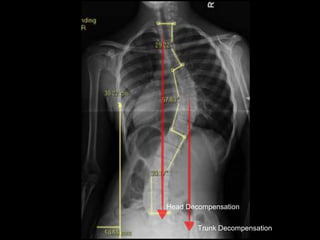
Trunk Decompensation
Head Decompensation
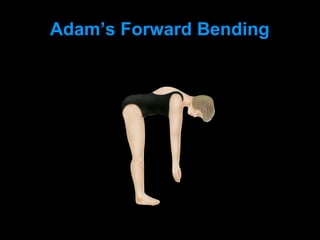
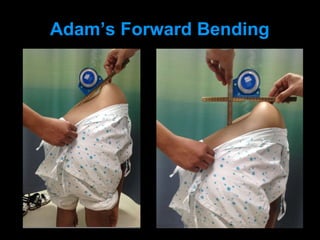
Adam’s Forward Bending
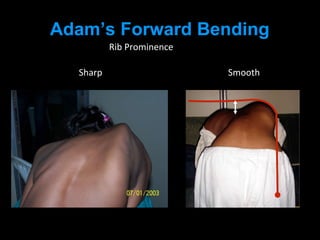
Rib Prominence
Sharp Smooth
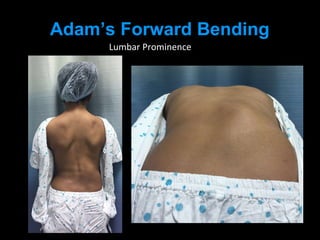
Adam’s Forward Bending
Lumbar Prominence
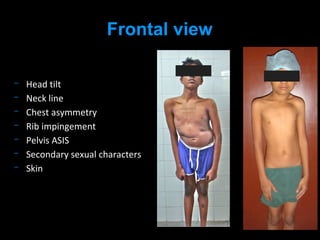
Head tilt
Neck line
Chest asymmetry
Rib impingement
Pelvis ASIS
Secondary sexual characters
Skin
Frontal view
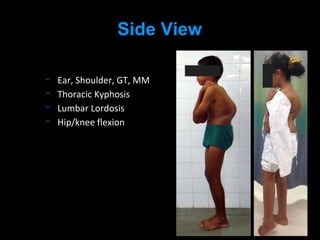
Ear, Shoulder, GT, MM
Thoracic Kyphosis
Lumbar Lordosis
Hip/knee flexion
Side View
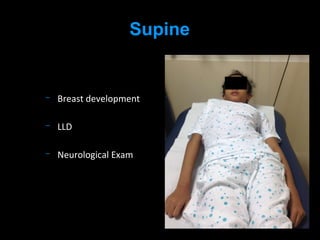
Breast development
LLD
Neurological Exam
Supine
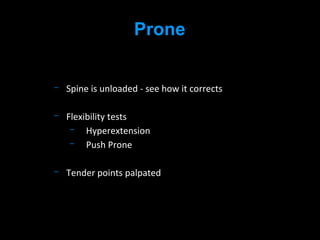
Spine is unloaded - see how it corrects
Flexibility tests
Hyperextension
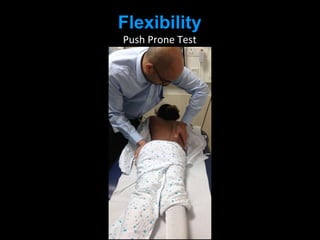
Push Prone
Tender points palpated
Prone
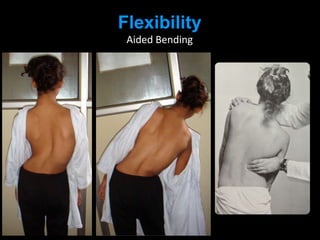
Flexibility
Aided Bending
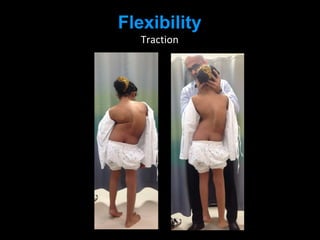
Flexibility
Traction
Flexibility
Push Prone Test
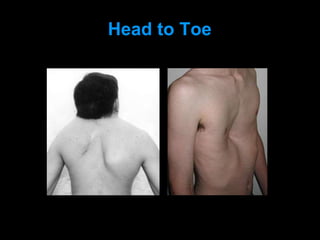
Head to Toe
Head to Toe
Physical Examination
Head to Toe Exam
Head to Toe
Head to Toe
Head to Toe
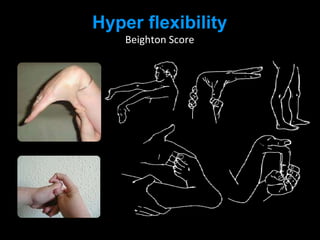
Hyper flexibility
Beighton Score
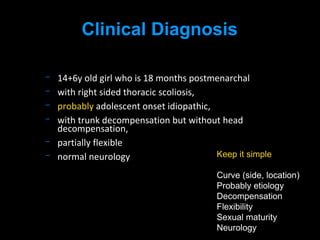
14+6y old girl who is 18 months postmenarchal
with right sided thoracic scoliosis,
probably adolescent onset idiopathic,
with trunk decompensation but without head
decompensation,
partially flexible
normal neurology
Clinical Diagnosis
Keep it simple
Curve (side, location)
Probably etiology
Decompensation
Flexibility
Sexual maturity
Neurology
Thank You

Scoliosis examination

Editor's Notes

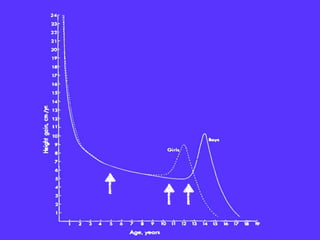
  • #7 Decrease in growth rate from the massive intrauterine growth. Still the growth rate is very high. Decreases up to age 4-5 and then plateaus. Then pubertal growth spurt.
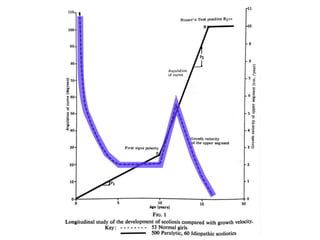
  • #8 By Duval Beaupere Scoliosis progression in two phases. Mathematical relationship Greater the velocity during the first period sharper will be the rise in the second Earlier the age at which puberty starts longer will be the second phase. Concept of Point P. Slope P1 and Slope P2.
  • #9 Upper row all boys are 14.75 years old. Lower row all girls are 12.75 years old.
  • #16 Go in detailed questioning about the nature of pain.
  • #17 Uncommon for scoliosis to have neurological symptoms Scoliosis associated with kyphosis are more likely to have neurological complications Presence may indicate spinal cord anomaly
  • #18 Curves more than 80 to 100. Ask for breathing difficulty Shortness of breath on running with friends Recurrent respiratory infections / hospitalizations