IMRAD FORMAT
Orientation
Rhoda Marie A. Carbonel, MPA, MA Psych
Psychology Faculty, STELA
UB IRB-Ethics Committee Member
10 October 2020
Objectives
• For participants to be familiarized on
the parts of the IMRAD format as an
institutional guideline for research
• For participants to level off on the key
requirements needed to complete their
research manuscripts or protocols
following the IMRAD format
IMRaD
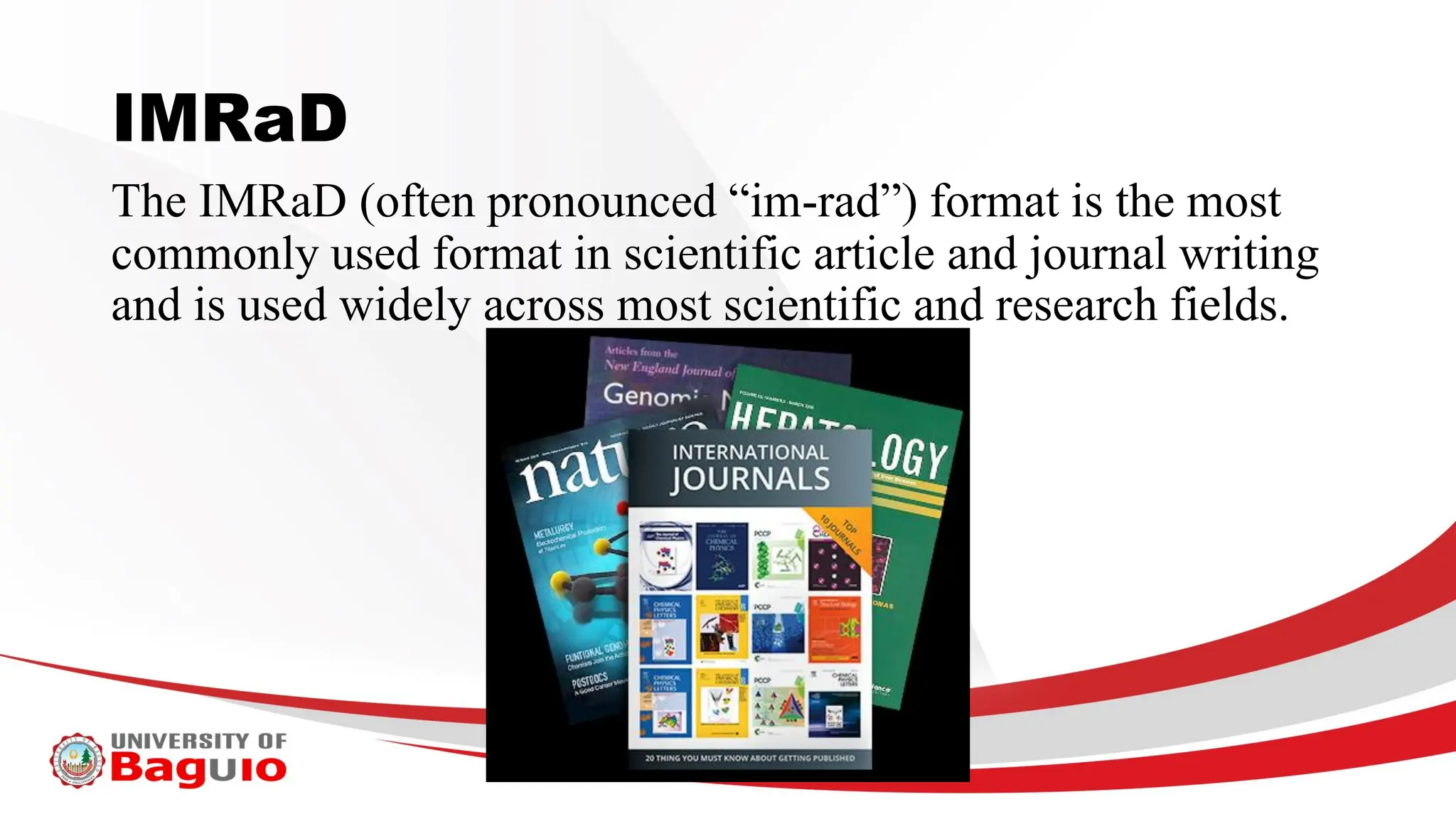
The IMRaD (often pronounced “im-rad”) format is the most
commonly used format in scientific article and journal writing
and is used widely across most scientific and research fields.
IMRaD
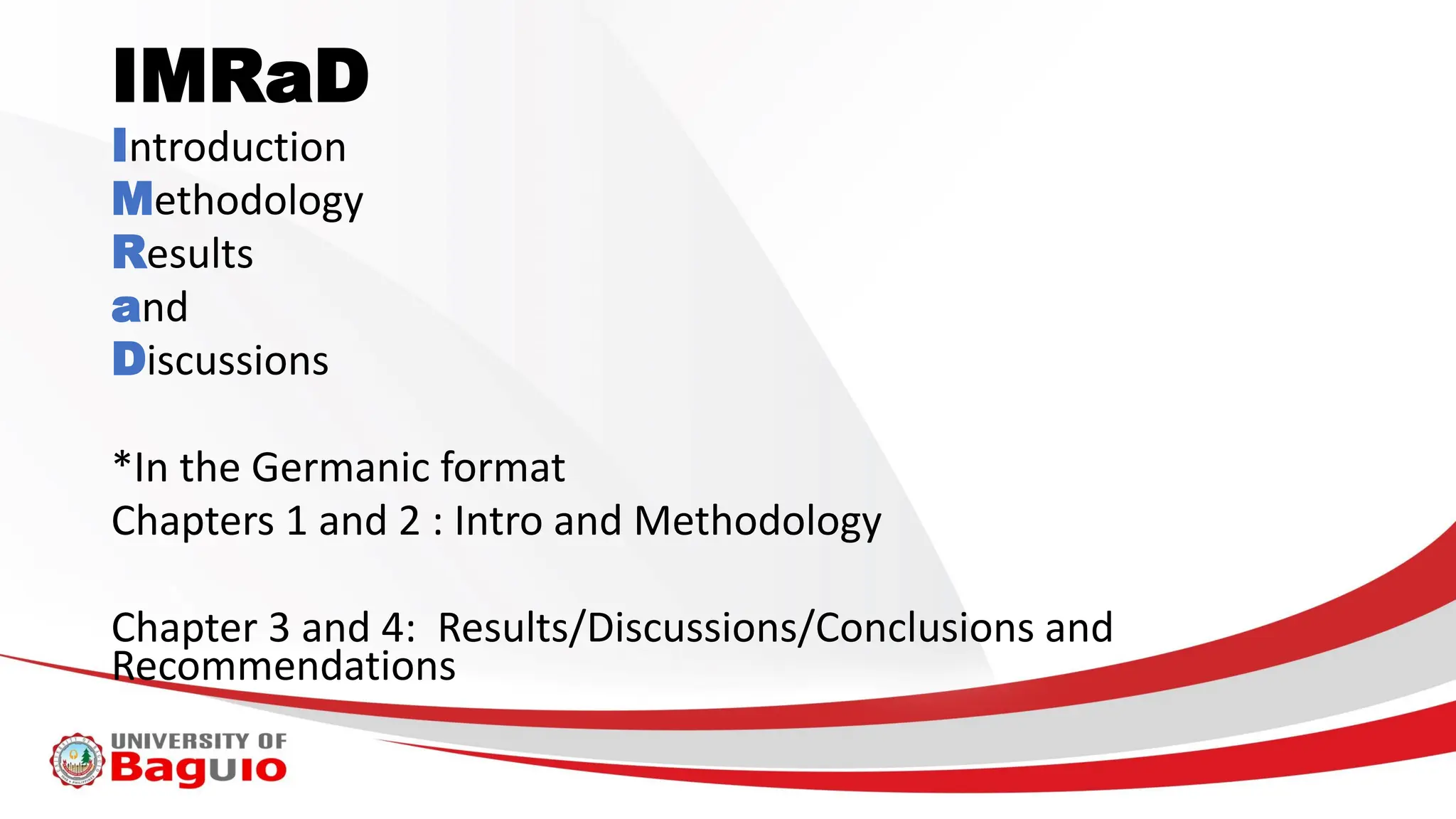
Introduction
Methodology
Results
and
Discussions
*In the Germanic format
Chapters 1 and 2 : Intro and Methodology
Chapter 3 and 4: Results/Discussions/Conclusions and
Recommendations
Reasons behind the migration
To encourage more students, faculty and non-teaching staff
to publish their research work in Journals
Background
• It is the University of Baguio’s institutional format
• Introduced during SY 2018-2019
• Guidelines were released and revisions were recommended by
Faculty through the School Research Anchorpersons
• February 2019 and October 2019 RDC Memo
Technical Aspects of the Paper
Format
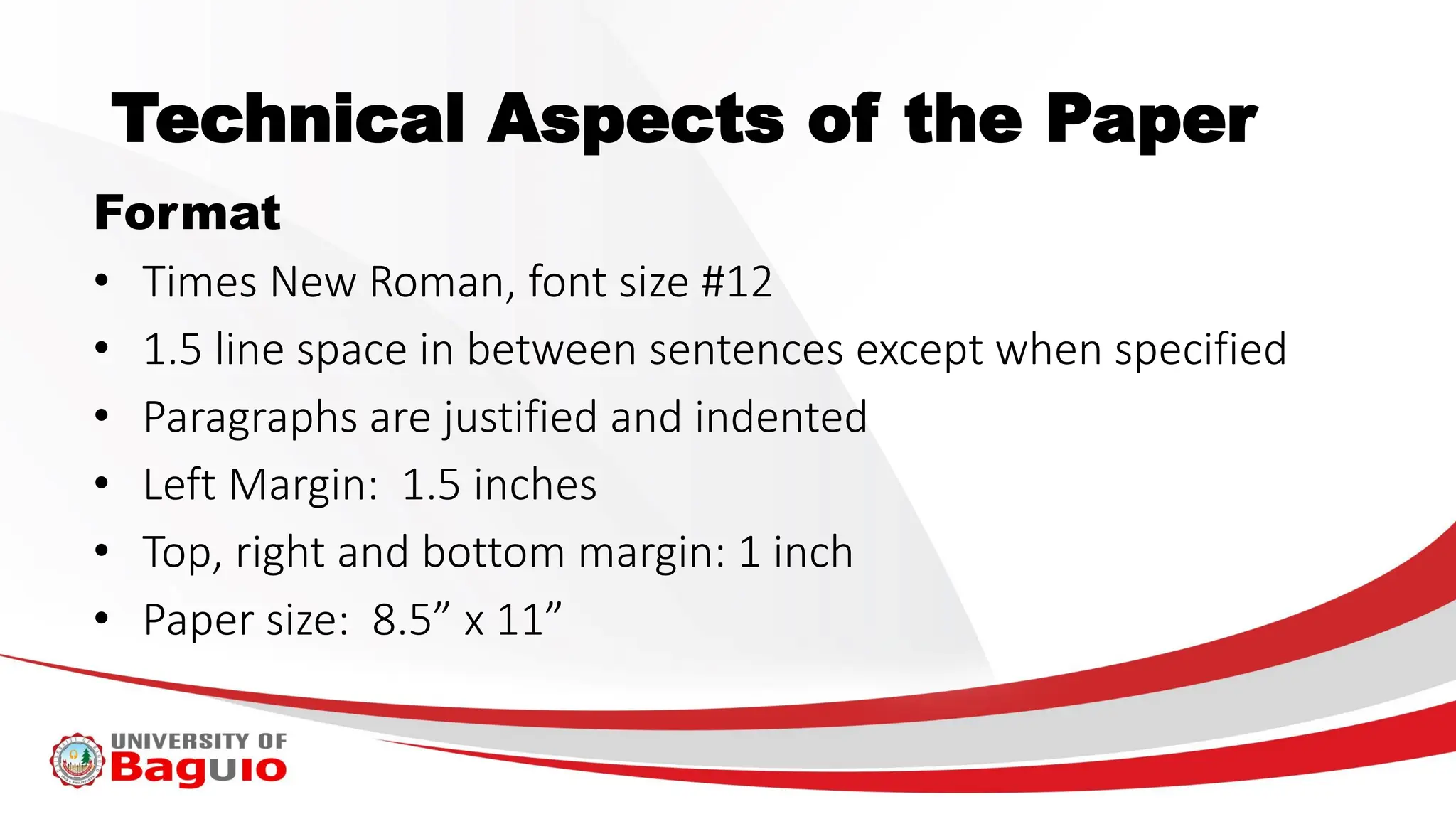
• Times New Roman, font size #12
• 1.5 line space in between sentences except when specified
• Paragraphs are justified and indented
• Left Margin: 1.5 inches
• Top, right and bottom margin: 1 inch
• Paper size: 8.5” x 11”
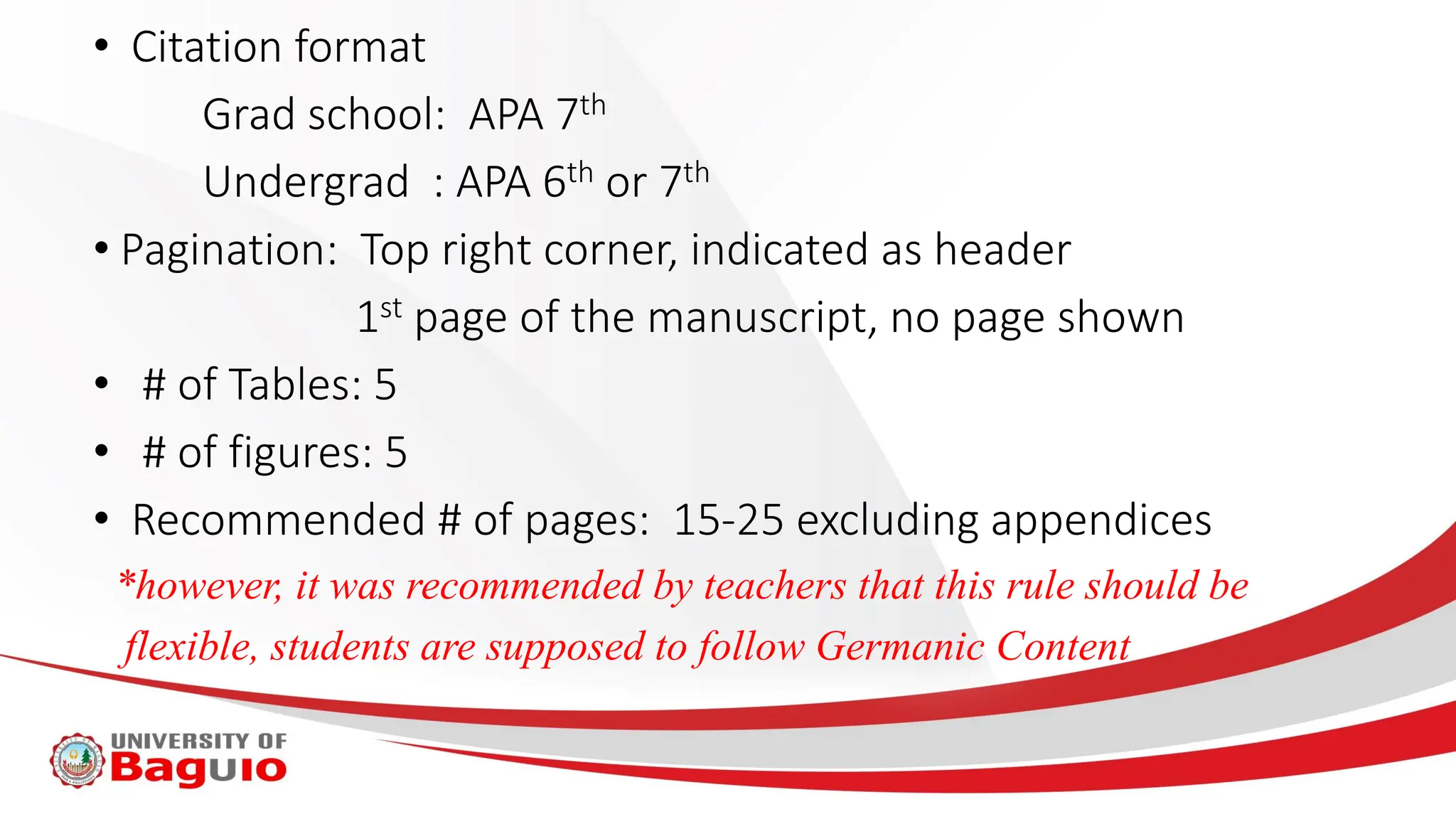
• Citation format
Grad school: APA 7th
Undergrad : APA 6th or 7th
• Pagination: Top right corner, indicated as header
1st page of the manuscript, no page shown
• # of Tables: 5
• # of figures: 5
• Recommended # of pages: 15-25 excluding appendices
*however, it was recommended by teachers that this rule should be
flexible, students are supposed to follow Germanic Content
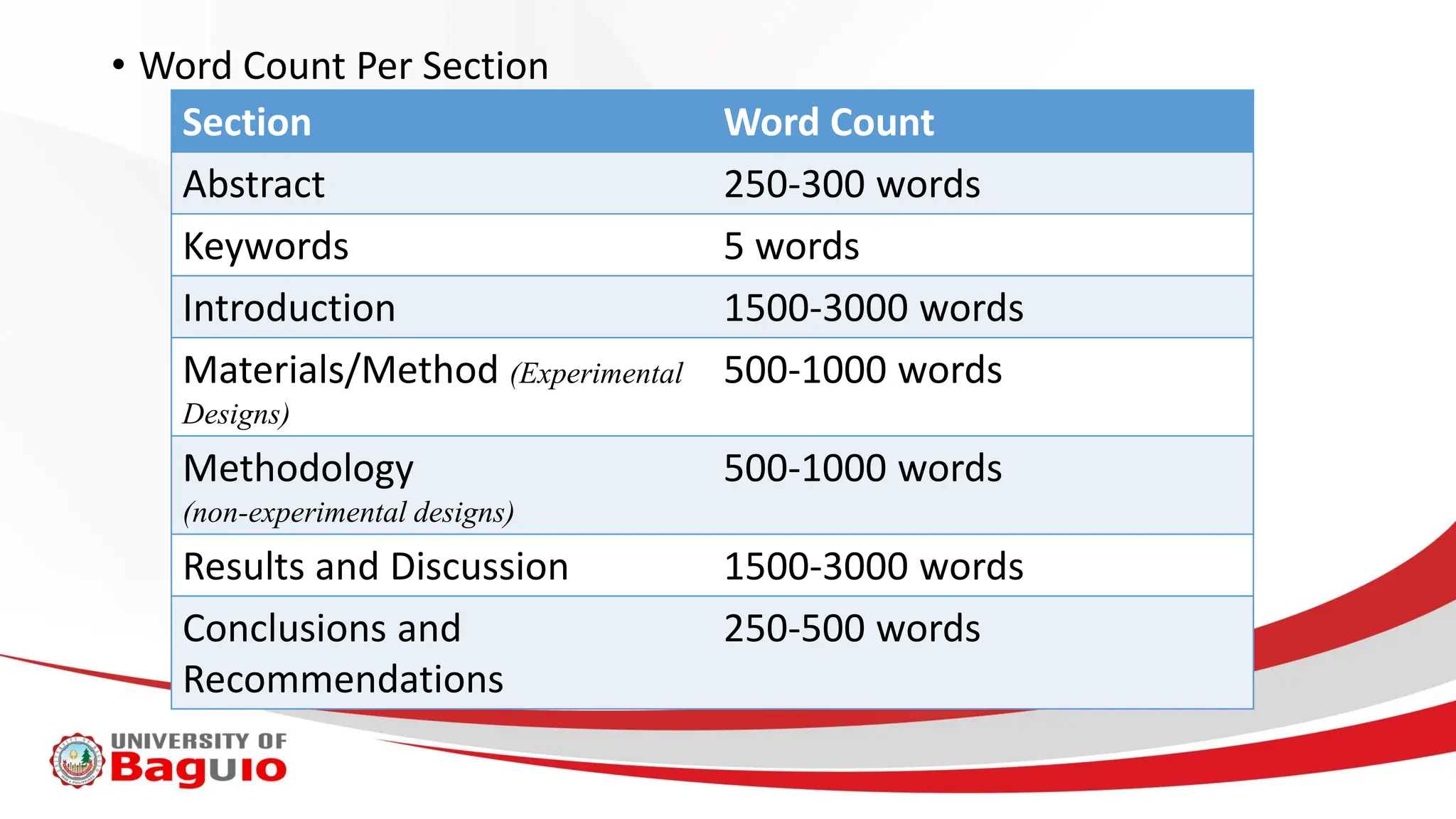
• Word Count Per Section
Section Word Count
Abstract 250-300 words
Keywords 5 words
Introduction 1500-3000 words
Materials/Method (Experimental
Designs)
500-1000 words
Methodology
(non-experimental designs)
500-1000 words
Results and Discussion 1500-3000 words
Conclusions and
Recommendations
250-500 words
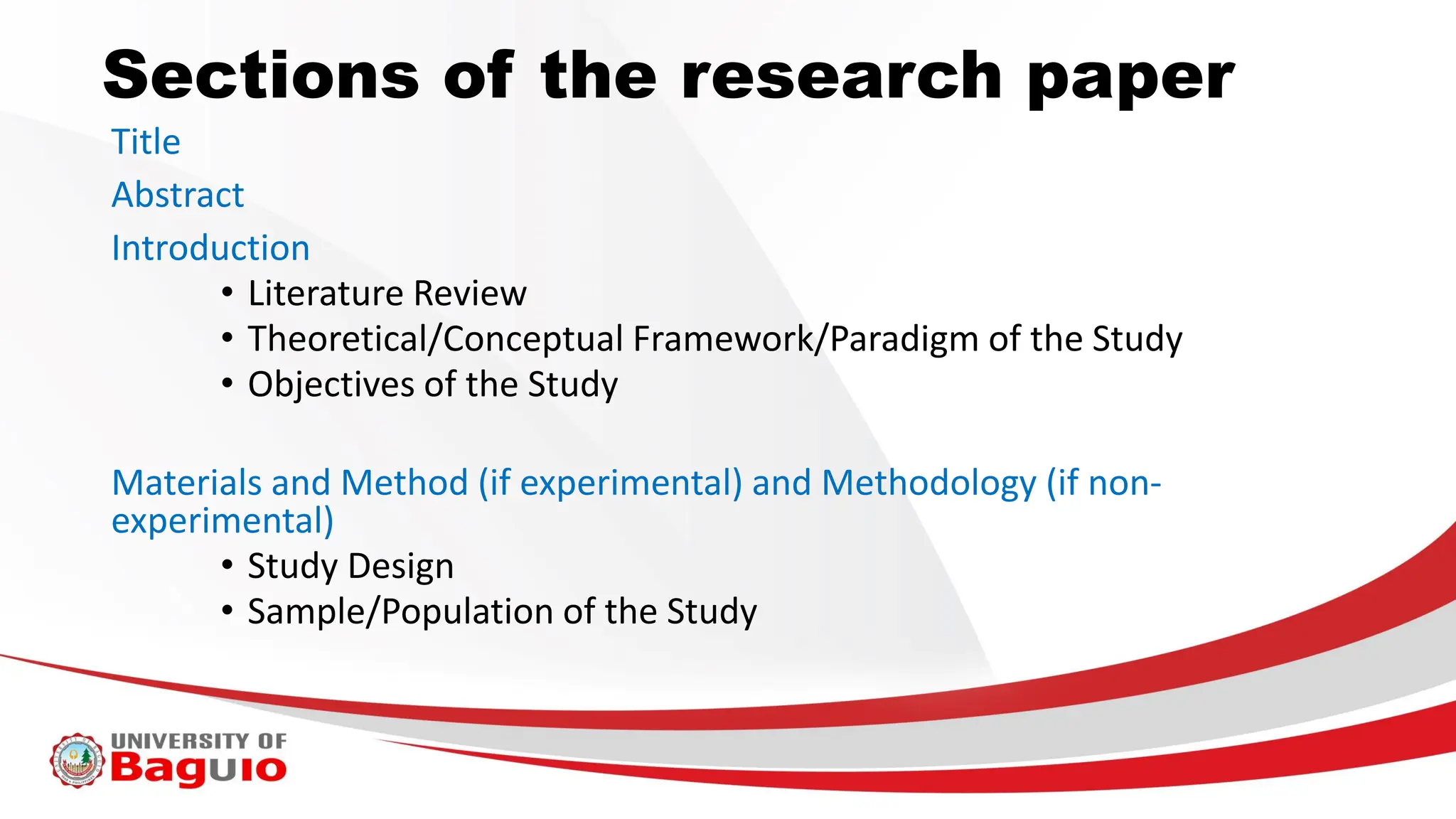
Sections of the research paper
Title
Abstract
Introduction
• Literature Review
• Theoretical/Conceptual Framework/Paradigm of the Study
• Objectives of the Study
Materials and Method (if experimental) and Methodology (if non-
experimental)
• Study Design
• Sample/Population of the Study
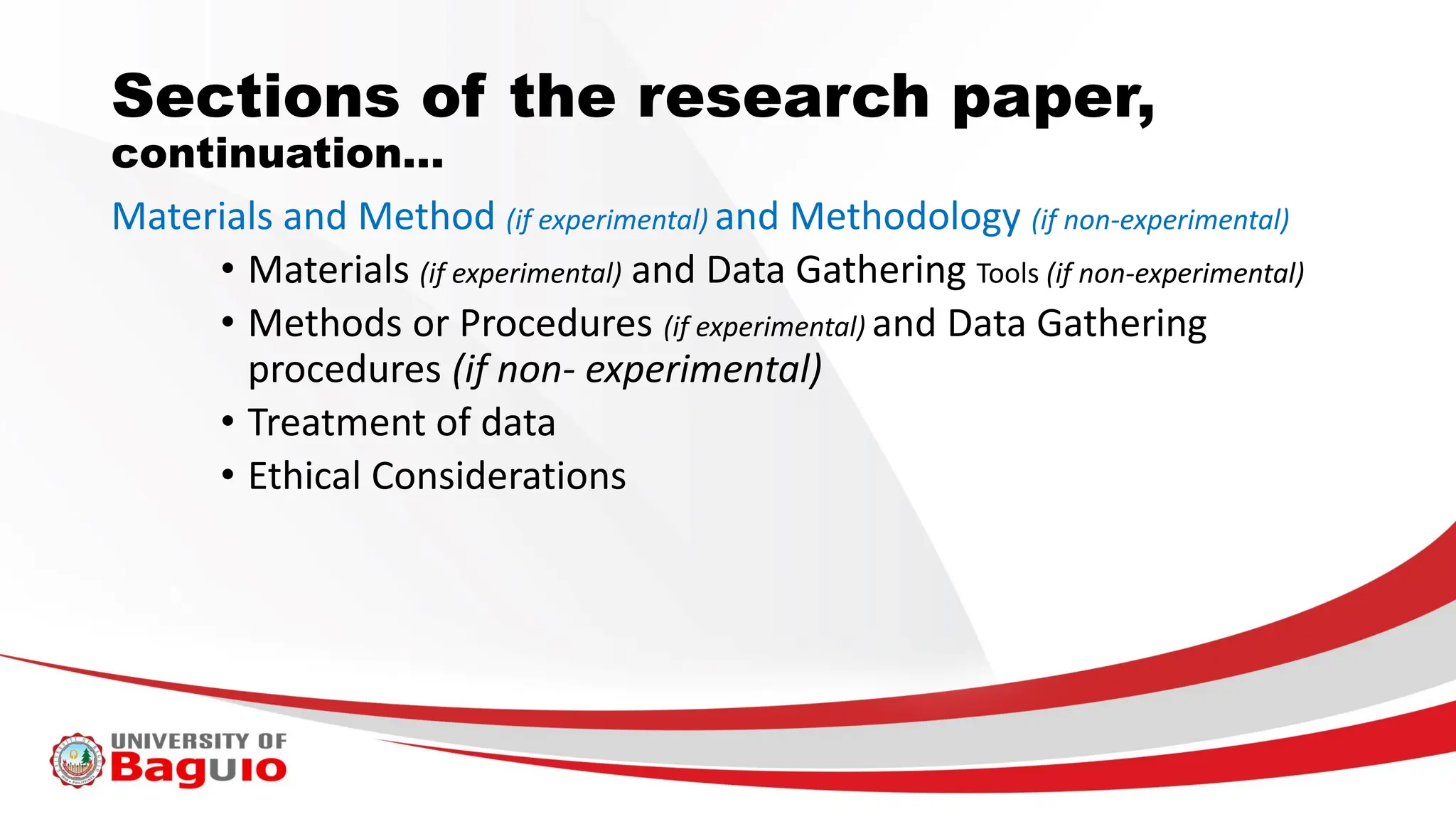
Sections of the research paper,
continuation…
Materials and Method (if experimental) and Methodology (if non-experimental)
• Materials (if experimental) and Data Gathering Tools (if non-experimental)
• Methods or Procedures (if experimental) and Data Gathering
procedures (if non- experimental)
• Treatment of data
• Ethical Considerations
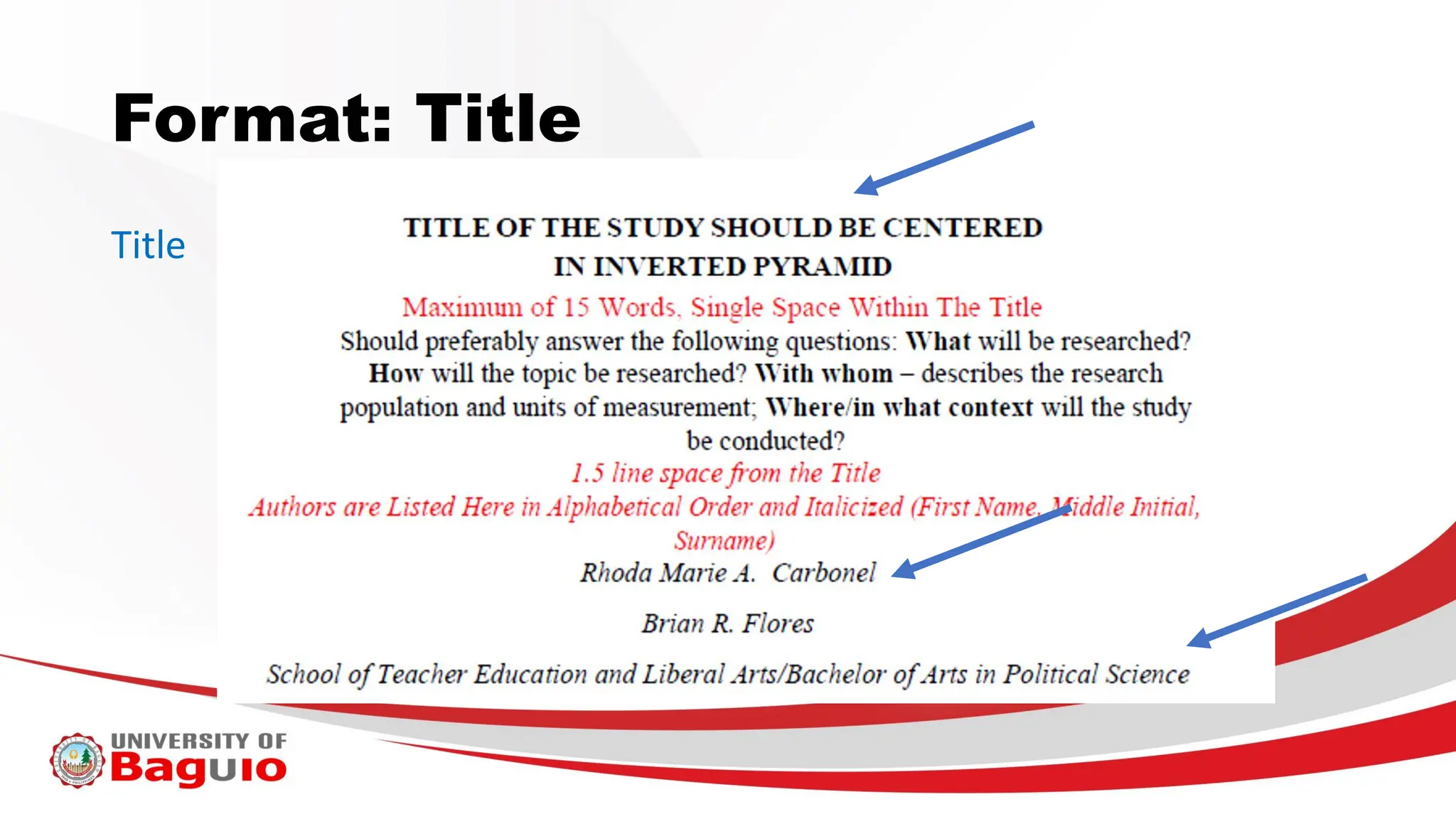
Format: Title
Title
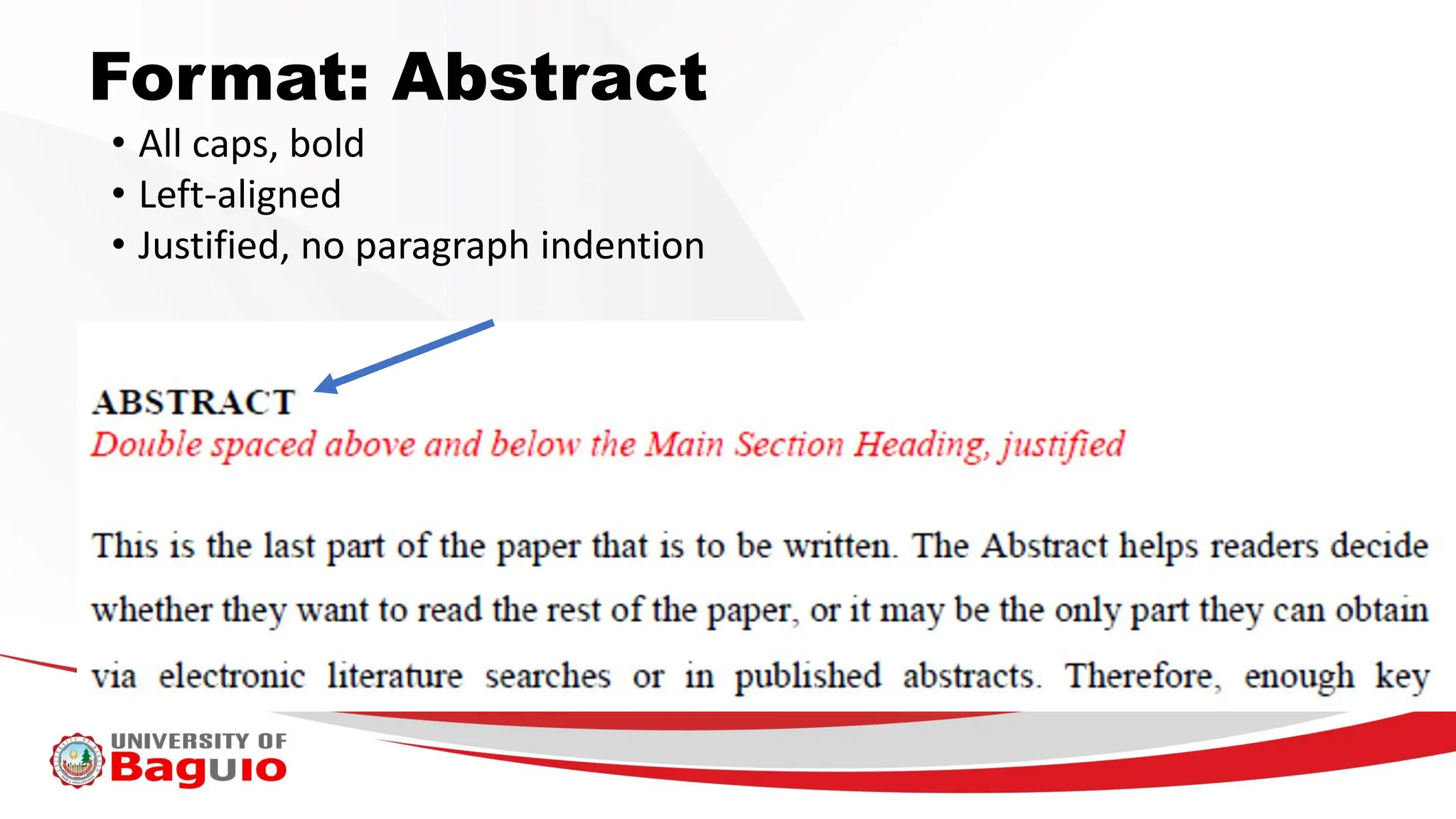
Format: Abstract
• All caps, bold
• Left-aligned
• Justified, no paragraph indention
A
Content: Abstract
• Last to be written, overview, key information
Element 1: what is the overall issue addressed
Element 2: main aim or objectives
Element 3: academic or practical importance of the study
Element 4: methodology
Element 5: main findings
Element 6: statement of conclusions
Element 7: practical implications of the study
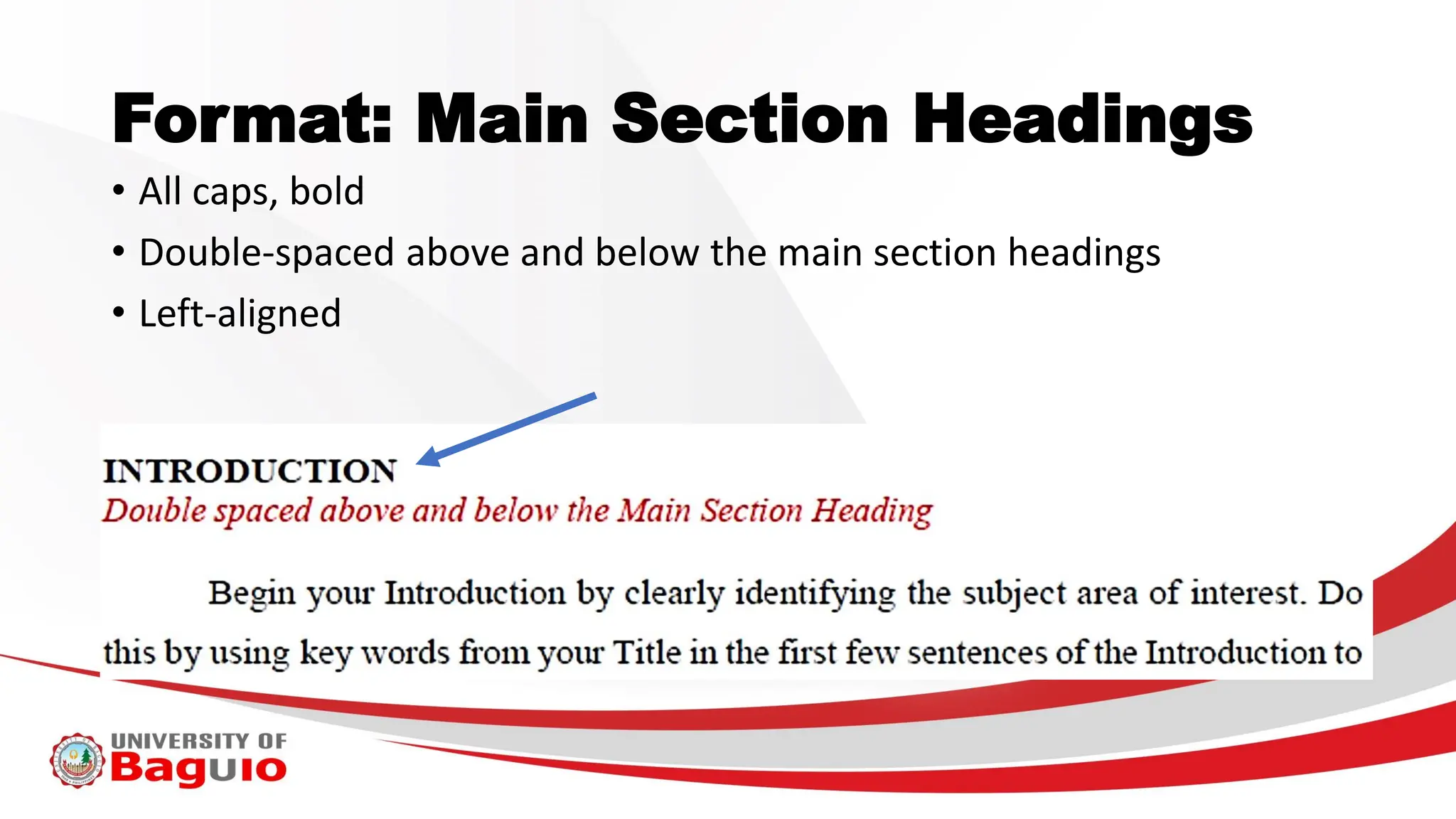
Format: Main Section Headings
• All caps, bold
• Double-spaced above and below the main section headings
• Left-aligned
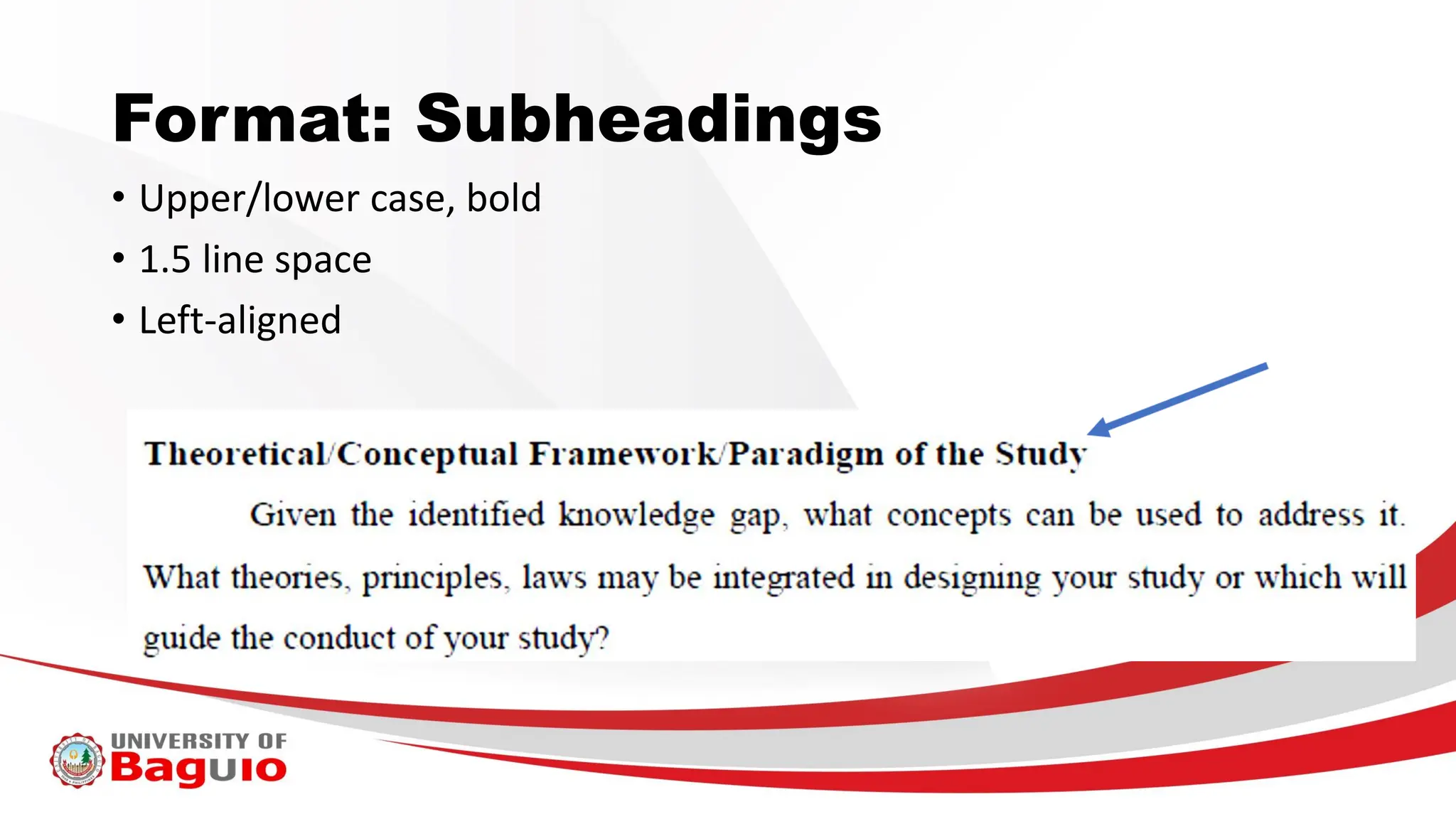
Format: Subheadings
• Upper/lower case, bold
• 1.5 line space
• Left-aligned
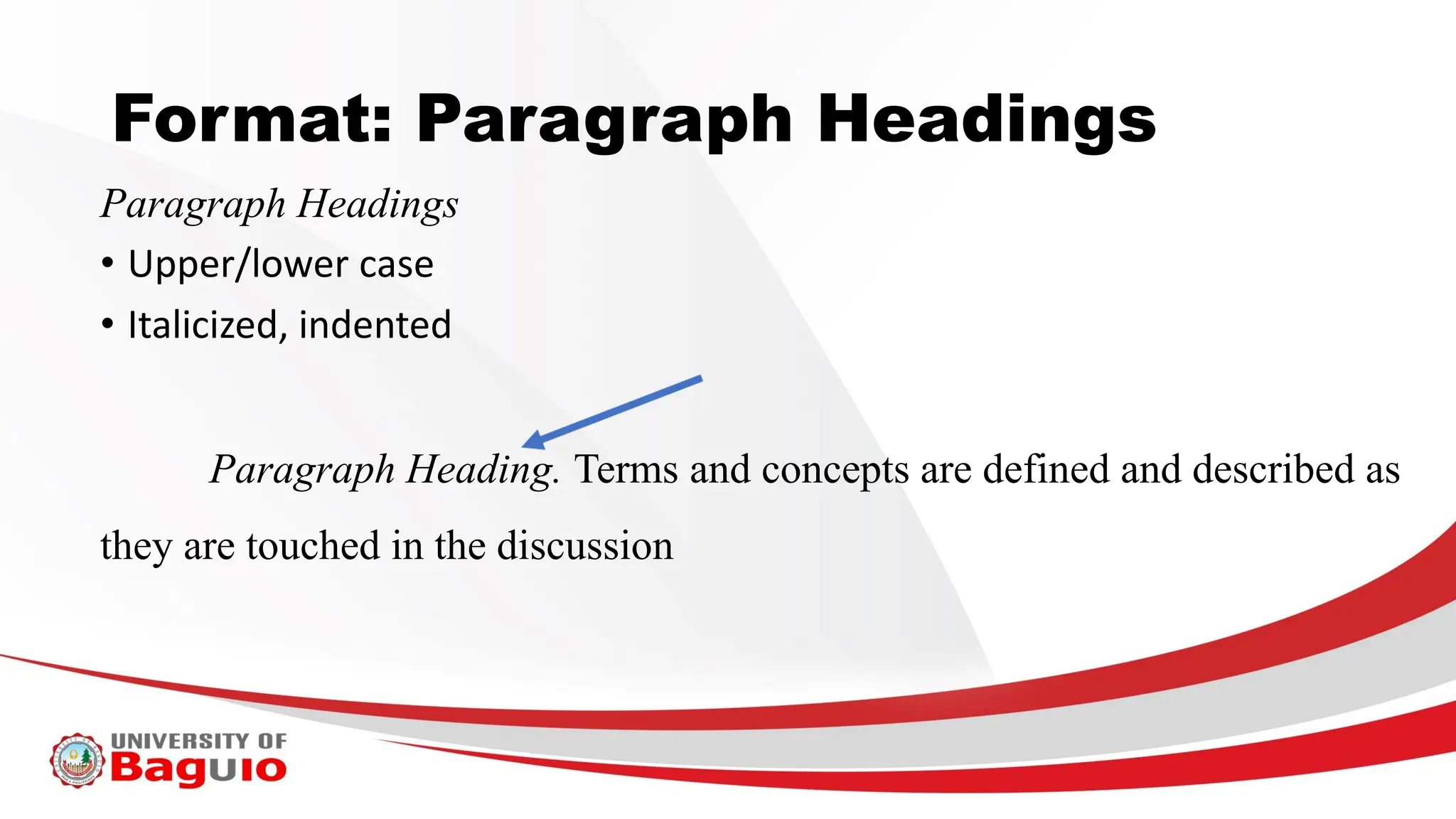
Format: Paragraph Headings
Paragraph Headings
• Upper/lower case
• Italicized, indented
Paragraph Heading. Terms and concepts are defined and described as
they are touched in the discussion
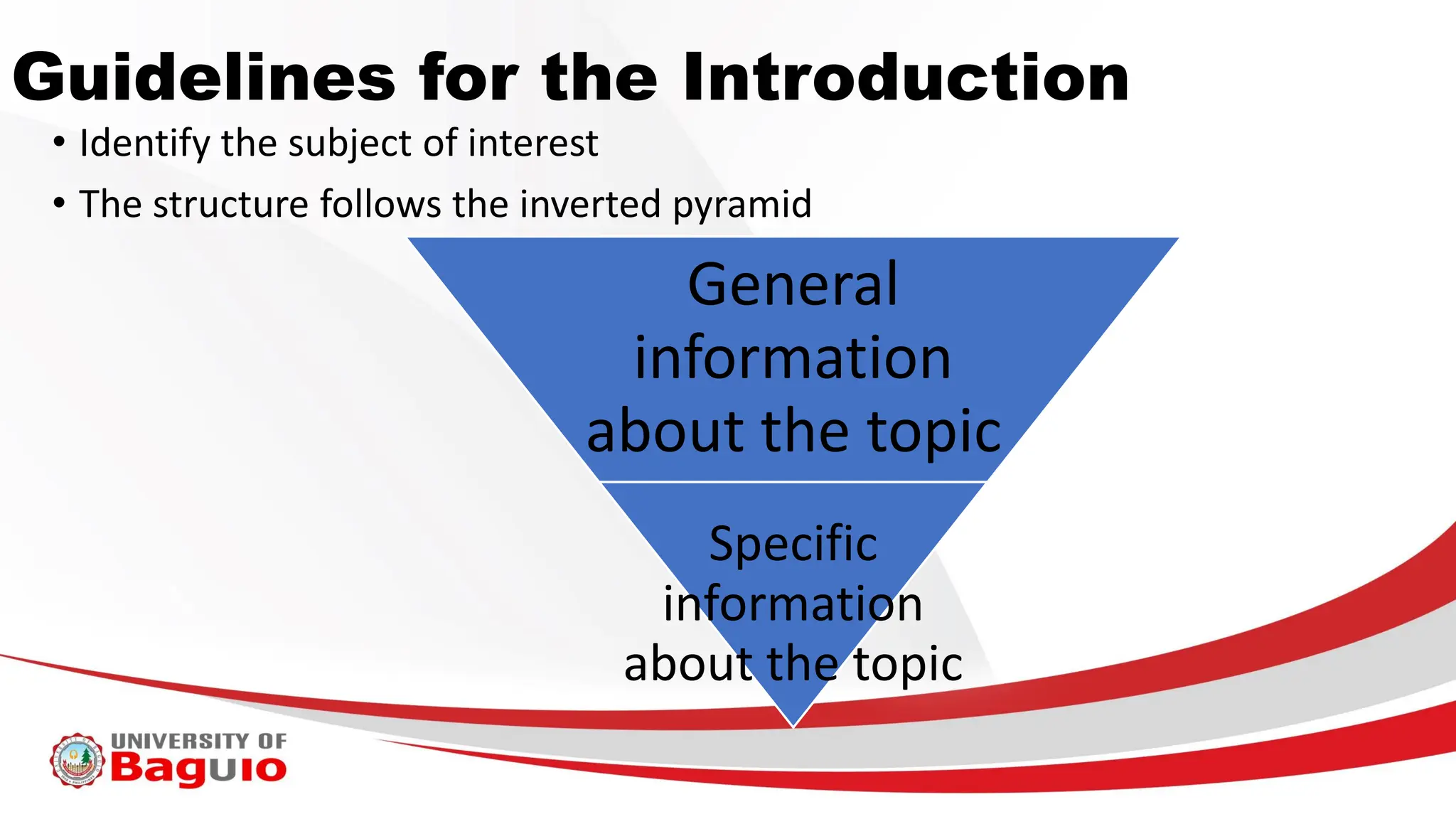
Guidelines for the Introduction
• Identify the subject of interest
• The structure follows the inverted pyramid
General
information
about the topic
Specific
information
about the topic
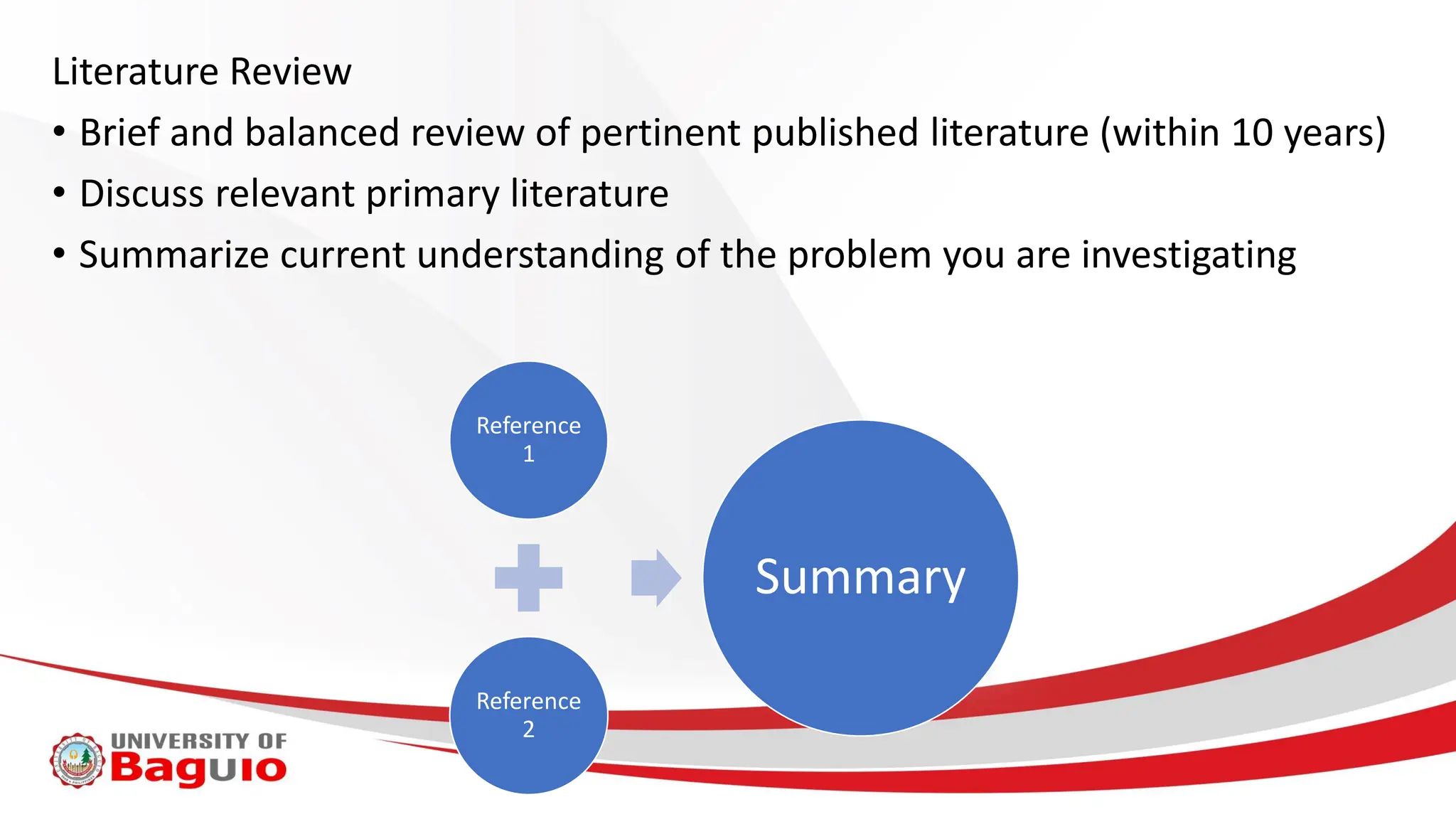
Literature Review
• Brief and balanced review of pertinent published literature (within 10 years)
• Discuss relevant primary literature
• Summarize current understanding of the problem you are investigating
Reference
1
Reference
2
Summary
Literature Review
• emphasize problems or gaps in knowledge
What don’t we know yet?
What do we need to know?
What does the field still need to understand?
What’s been left out of previous research?
Is this a new issue that needs some direction?
Literature Review
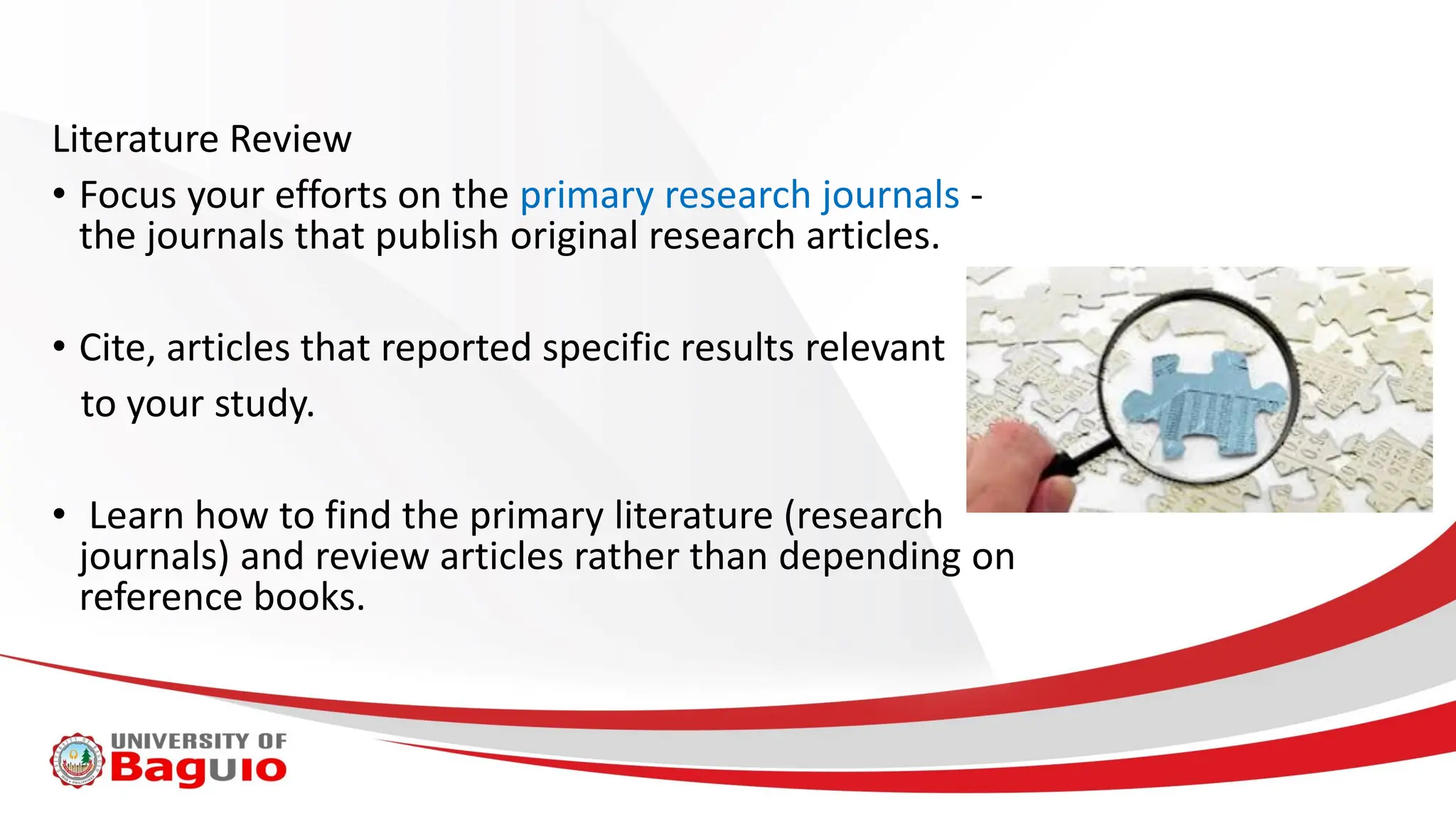
• Focus your efforts on the primary research journals -
the journals that publish original research articles.
• Cite, articles that reported specific results relevant
to your study.
• Learn how to find the primary literature (research
journals) and review articles rather than depending on
reference books.
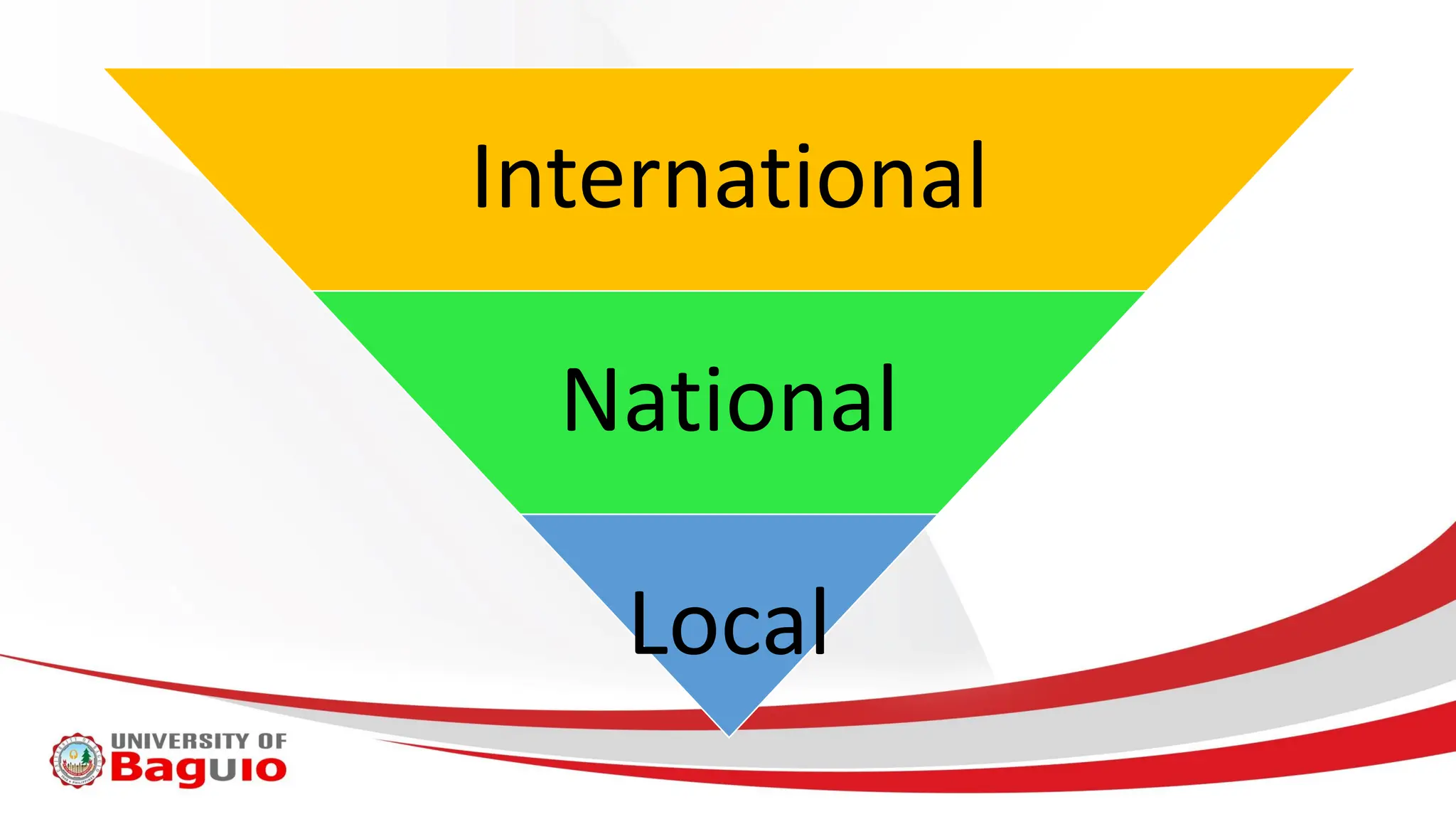
International
National
Local
Theoretical/Conceptual Framework/
Paradigm of the Study
• What theories, principles, laws may be integrated in designing your
study or which will guide the conduct of your study?
• Terms and concepts are defined and described as they are touched in
the discussions
Ex. Variables, constructs, concepts and their operational definitions
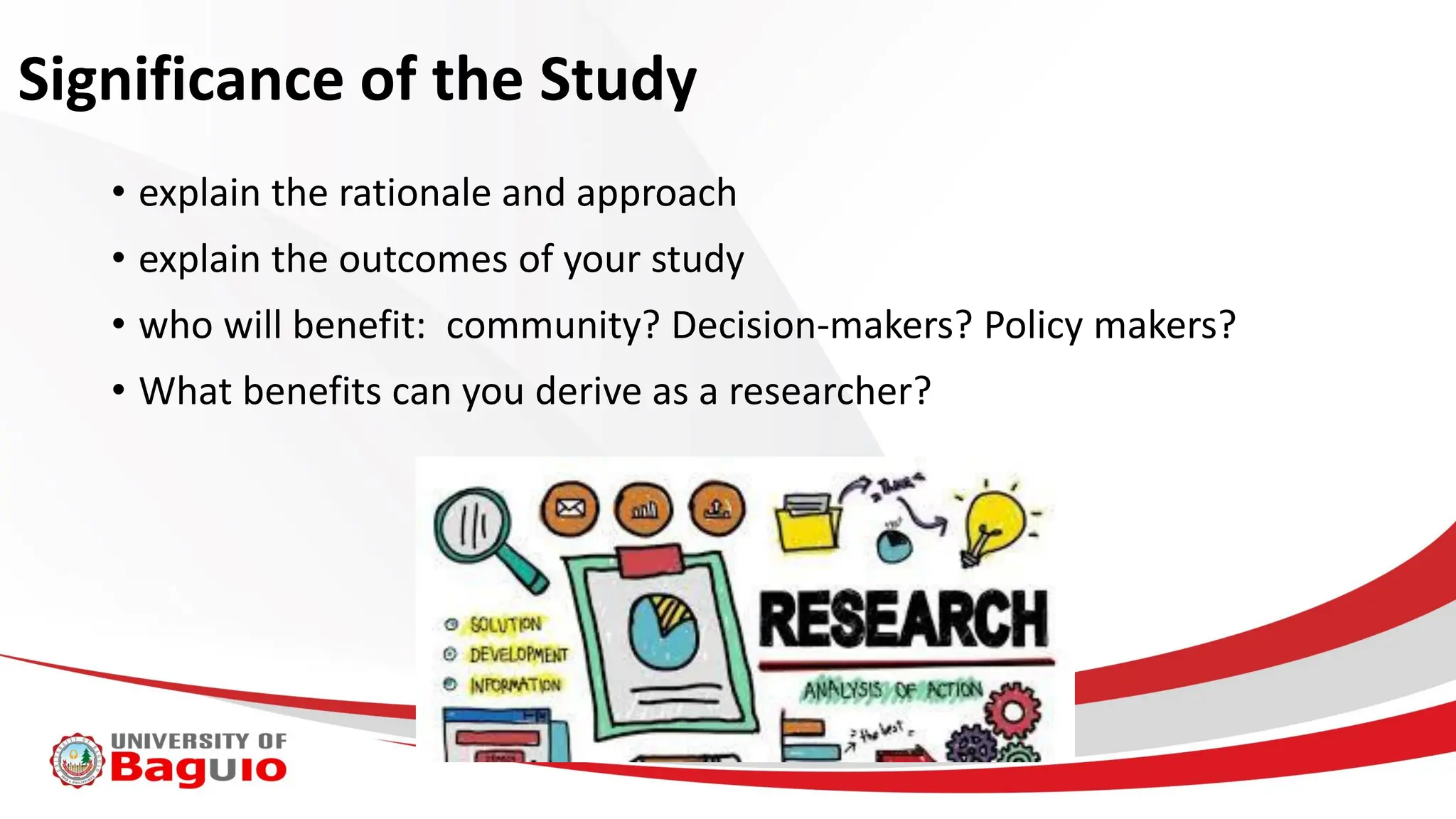
Significance of the Study
• explain the rationale and approach
• explain the outcomes of your study
• who will benefit: community? Decision-makers? Policy makers?
• What benefits can you derive as a researcher?
Objectives of the study
• Mention here the aim of the study and the specific objectives. The
specific objectives are those that you will actually measure.
• *Follow the rules for writing objectives if your study is Quantitative or
Qualitative
• The objectives may be presented in a bulleted list and should be phrased
in the form:
To determine…
To investigate …
To evaluate…
To compare...
Guidelines for the Materials and
Method/ Methodology
• this section needs to be very clear, very specific, very detailed, and only
focused on research.
• show that you arrived at your results by applying valid and reliable
methods.
• You may use the active voice to a certain extent, although this section
requires more use of third person, passive constructions than others.
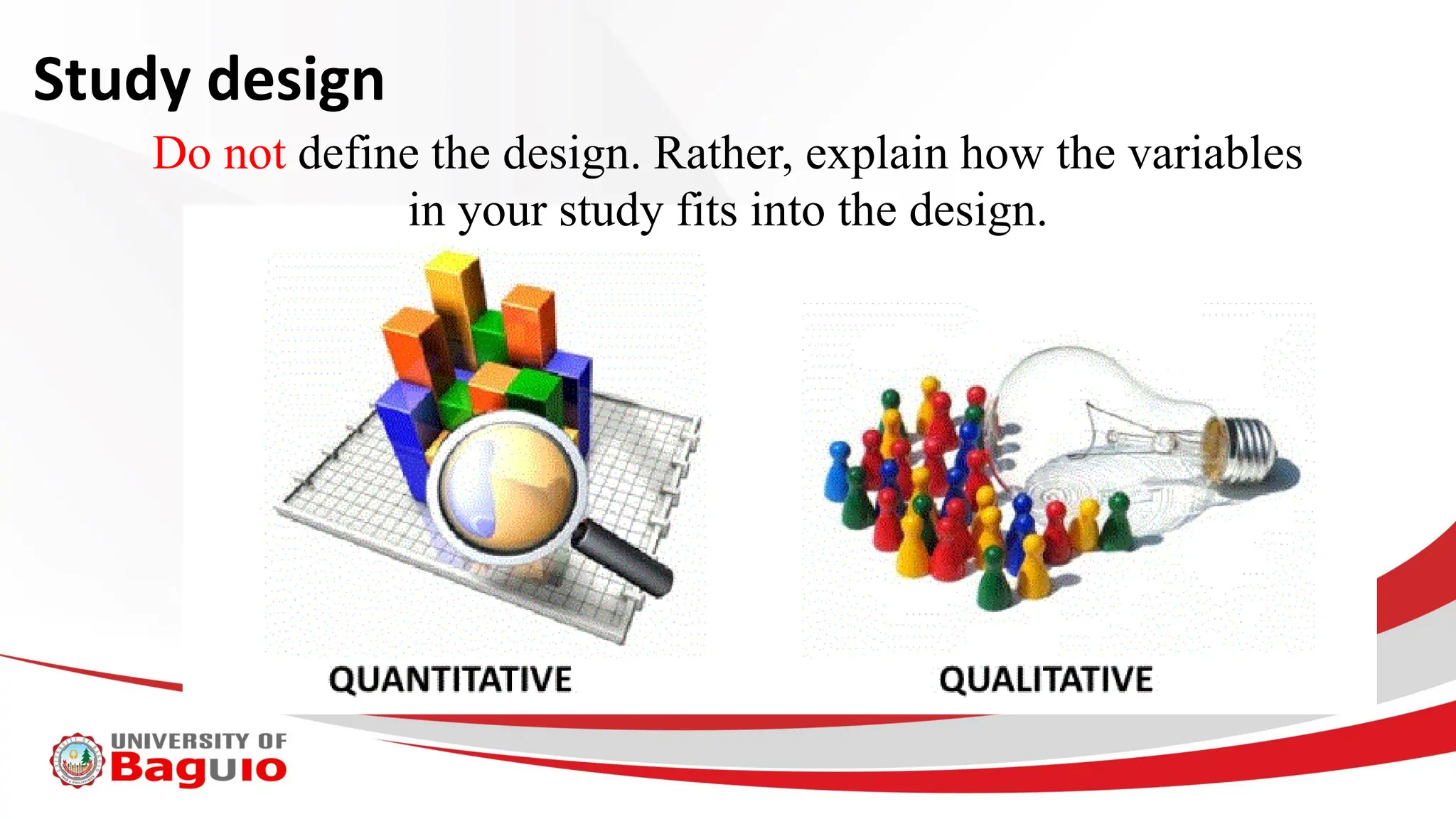
Study design
Do not define the design. Rather, explain how the variables
in your study fits into the design.
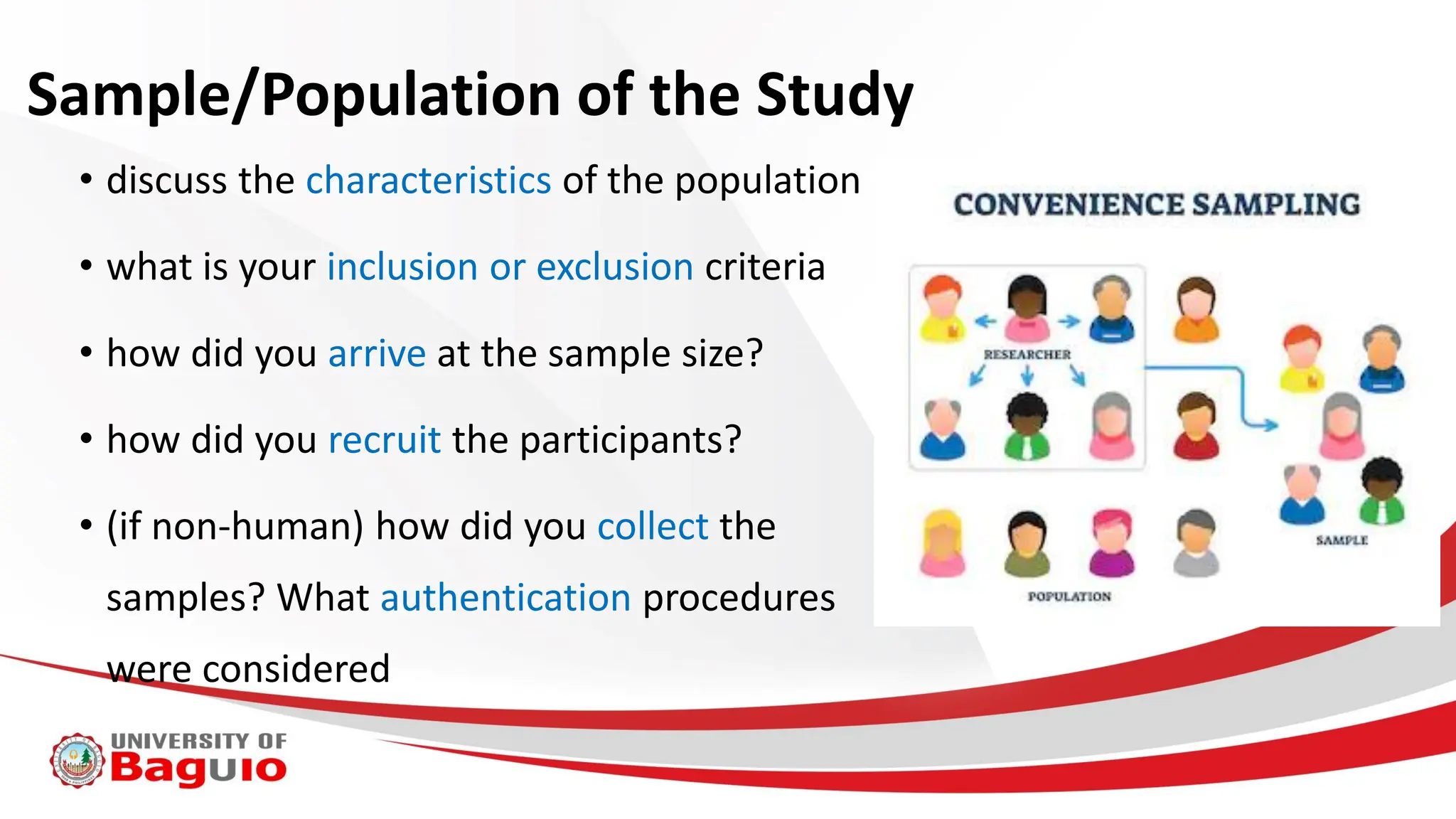
Sample/Population of the Study
• discuss the characteristics of the population
• what is your inclusion or exclusion criteria
• how did you arrive at the sample size?
• how did you recruit the participants?
• (if non-human) how did you collect the
samples? What authentication procedures
were considered
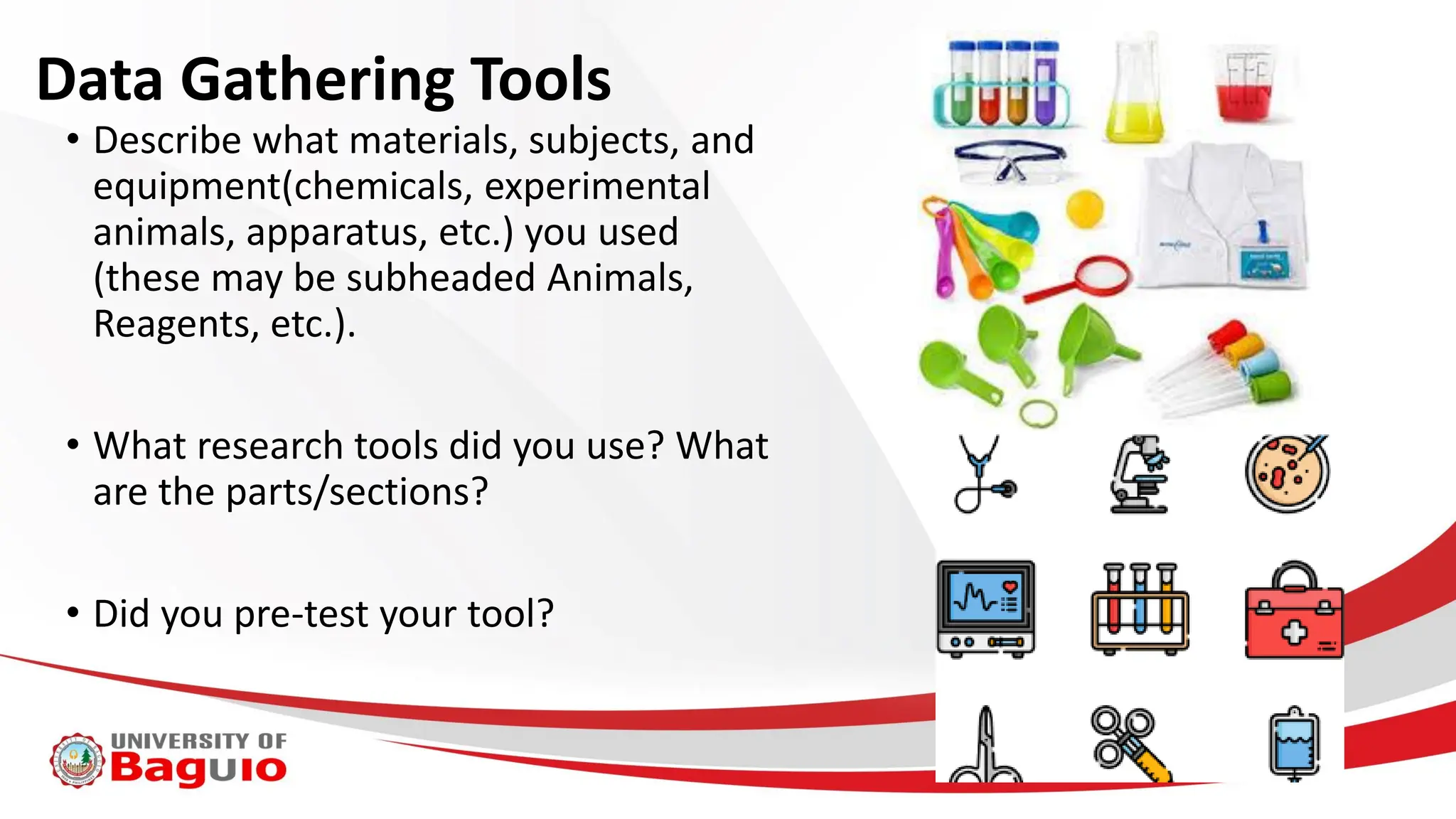
Data Gathering Tools
• Describe what materials, subjects, and
equipment(chemicals, experimental
animals, apparatus, etc.) you used
(these may be subheaded Animals,
Reagents, etc.).
• What research tools did you use? What
are the parts/sections?
• Did you pre-test your tool?
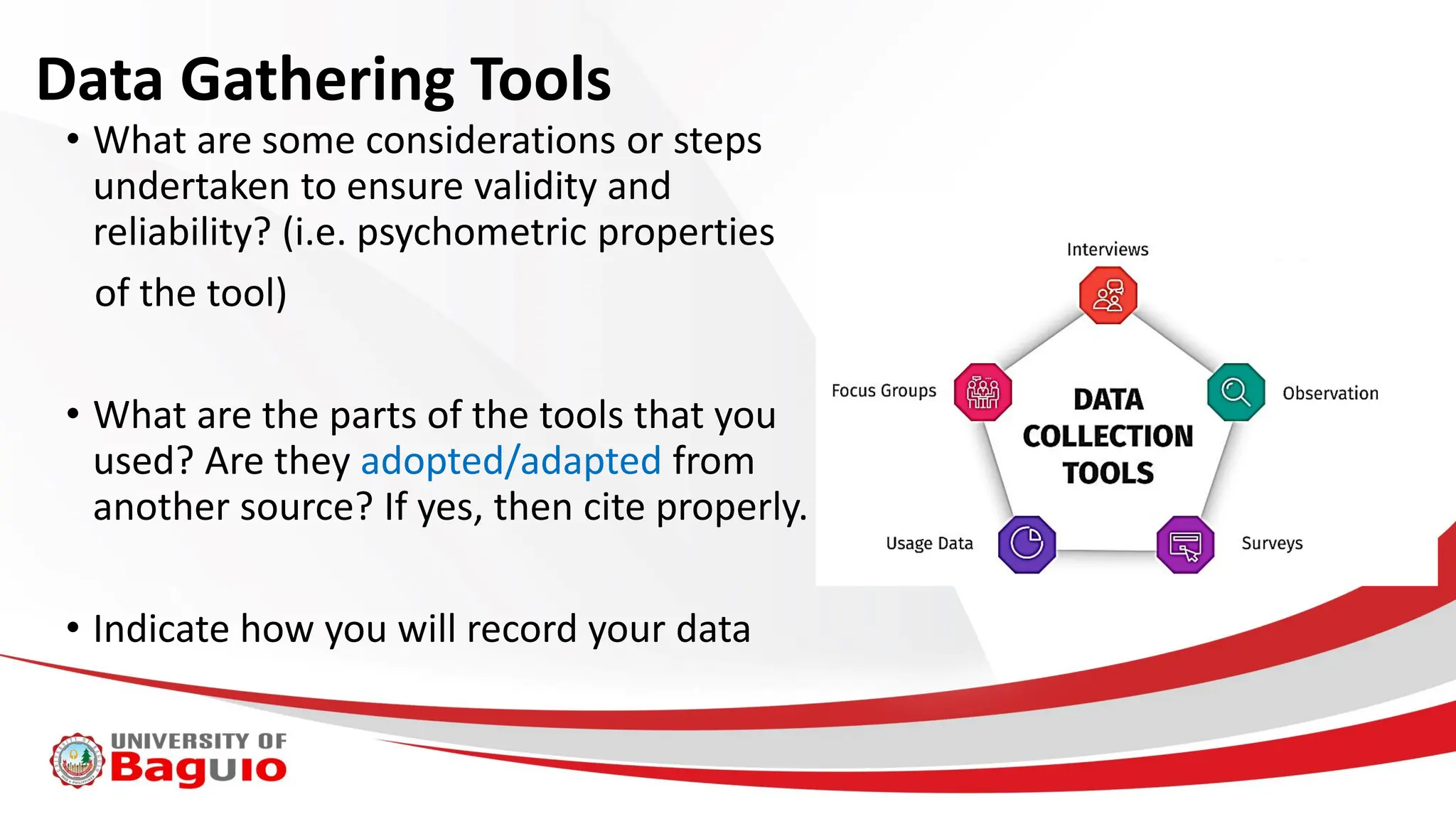
Data Gathering Tools
• What are some considerations or steps
undertaken to ensure validity and
reliability? (i.e. psychometric properties
of the tool)
• What are the parts of the tools that you
used? Are they adopted/adapted from
another source? If yes, then cite properly.
• Indicate how you will record your data
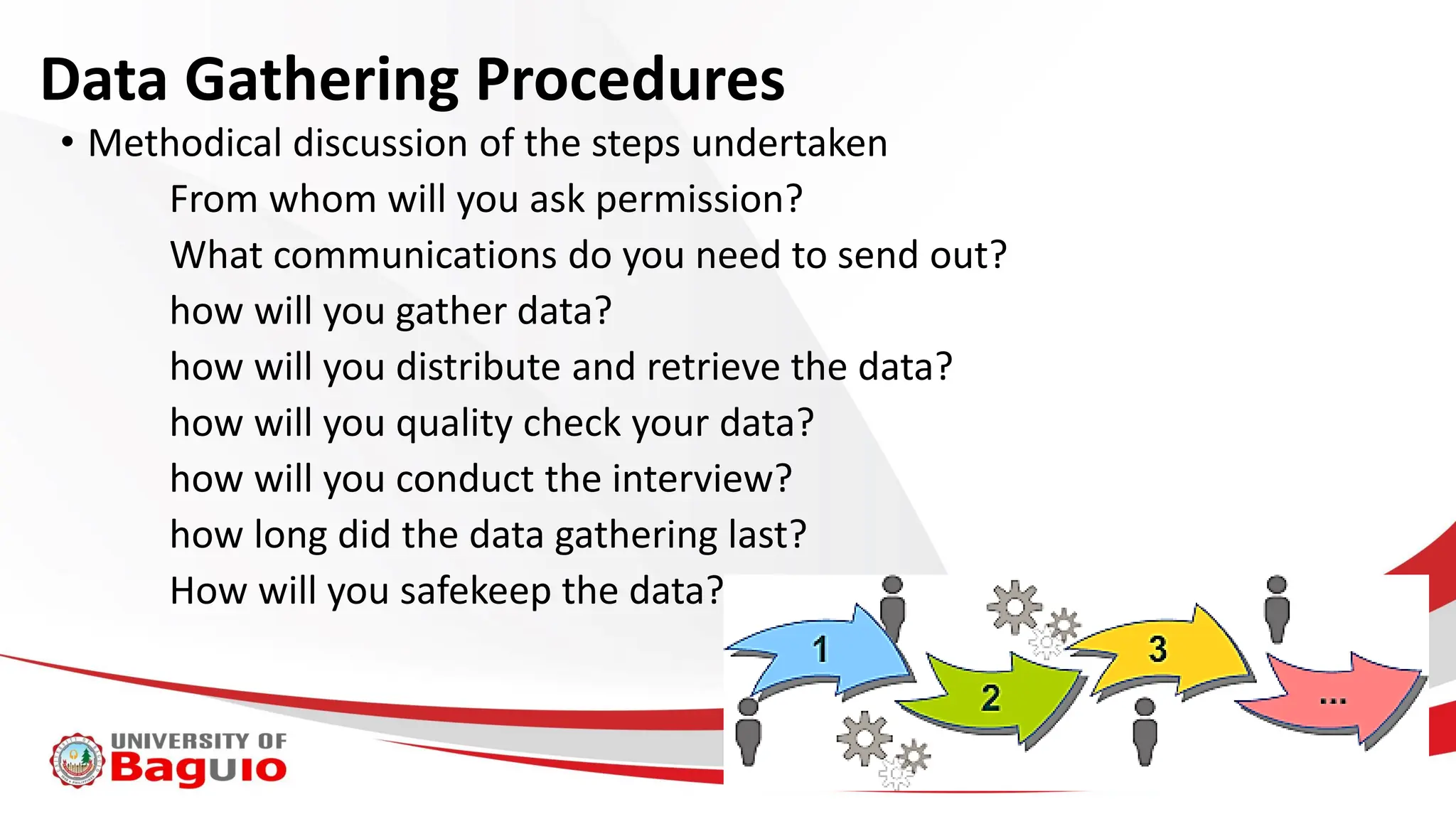
Data Gathering Procedures
• Methodical discussion of the steps undertaken
From whom will you ask permission?
What communications do you need to send out?
how will you gather data?
how will you distribute and retrieve the data?
how will you quality check your data?
how will you conduct the interview?
how long did the data gathering last?
How will you safekeep the data?
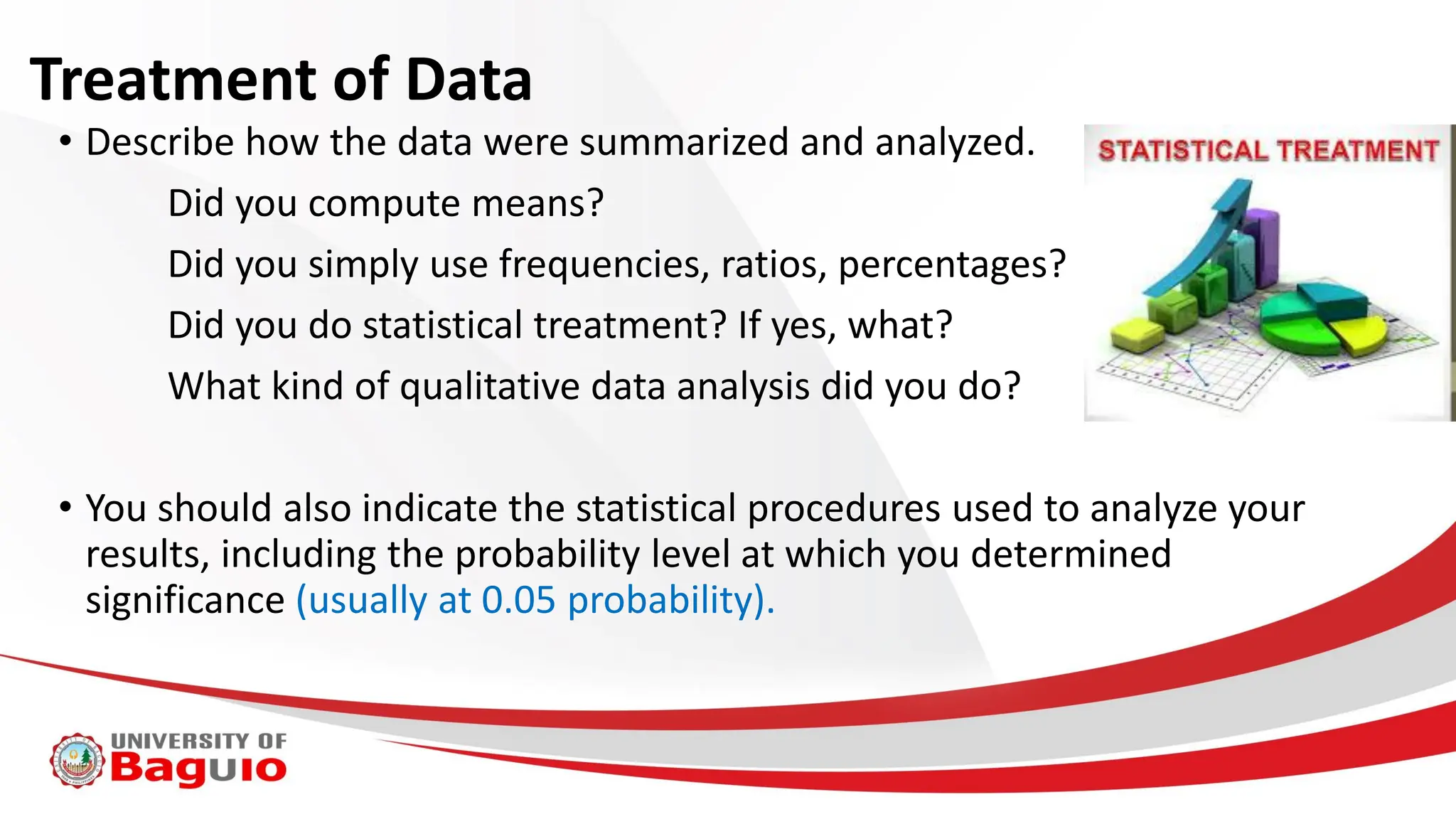
Treatment of Data
• Describe how the data were summarized and analyzed.
Did you compute means?
Did you simply use frequencies, ratios, percentages?
Did you do statistical treatment? If yes, what?
What kind of qualitative data analysis did you do?
• You should also indicate the statistical procedures used to analyze your
results, including the probability level at which you determined
significance (usually at 0.05 probability).
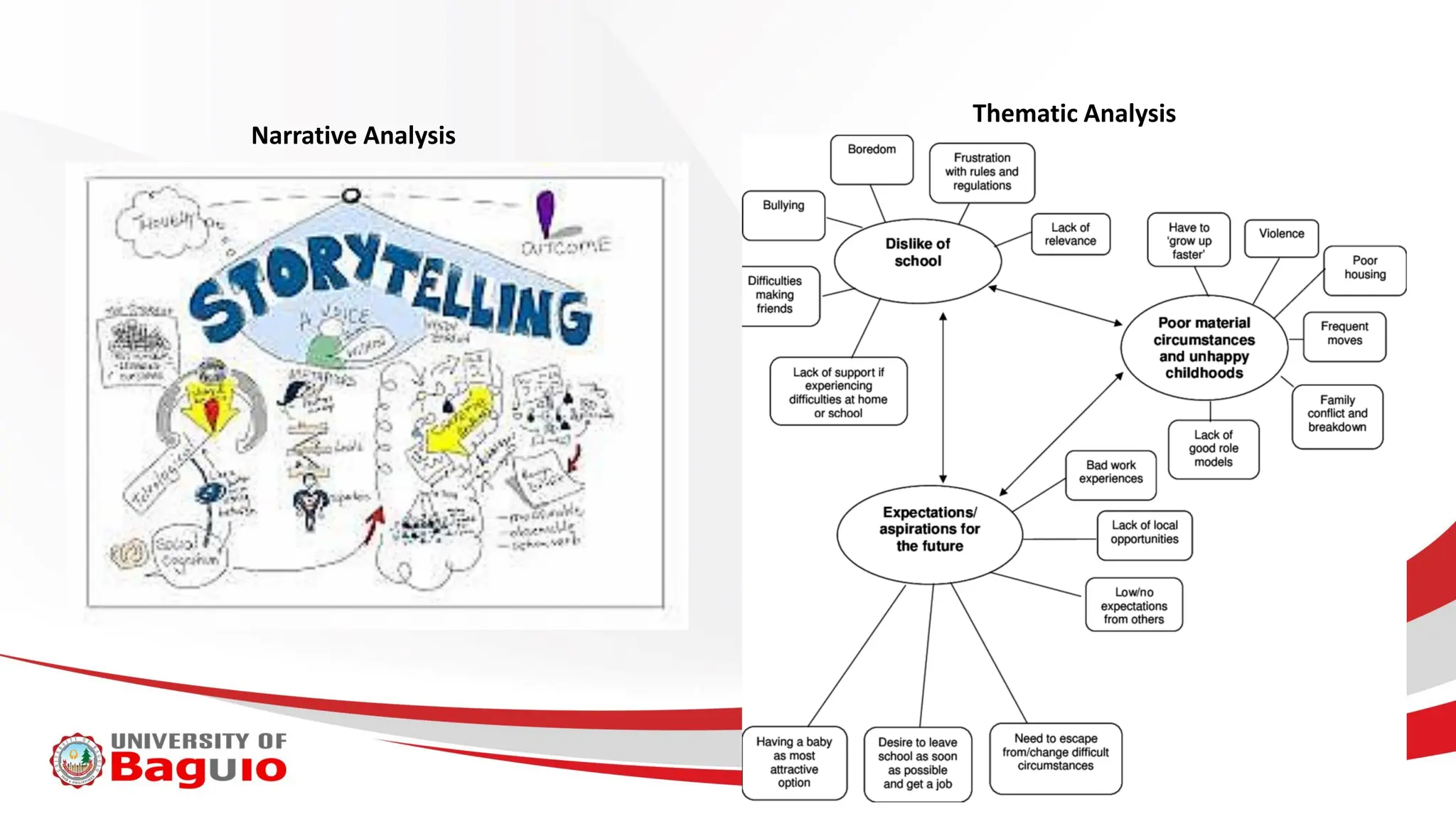
Narrative Analysis
Thematic Analysis
Ethical Considerations
• how anonymity and voluntary participation of the
informants/participants were respected throughout the study (if
informants/participants opted for non-disclosure of identity);
• how confidentiality of information was insured (if
informants/participants opted for non-disclosure of information),
Ethical Considerations
• how risk management measures/strategies for
participants, researchers and auxiliary personnel
were adopted by the researcher
• how informants/participants were selected using non-
discriminatory criteria and processes (unless inclusion
and exclusion criteria are justifiable based on the
nature of the study);
• how the findings of the study will be disseminated to
the beneficiaries.
• Introduce the section by describing the flow of your discussion, present
the results according to the sequence of your objectives
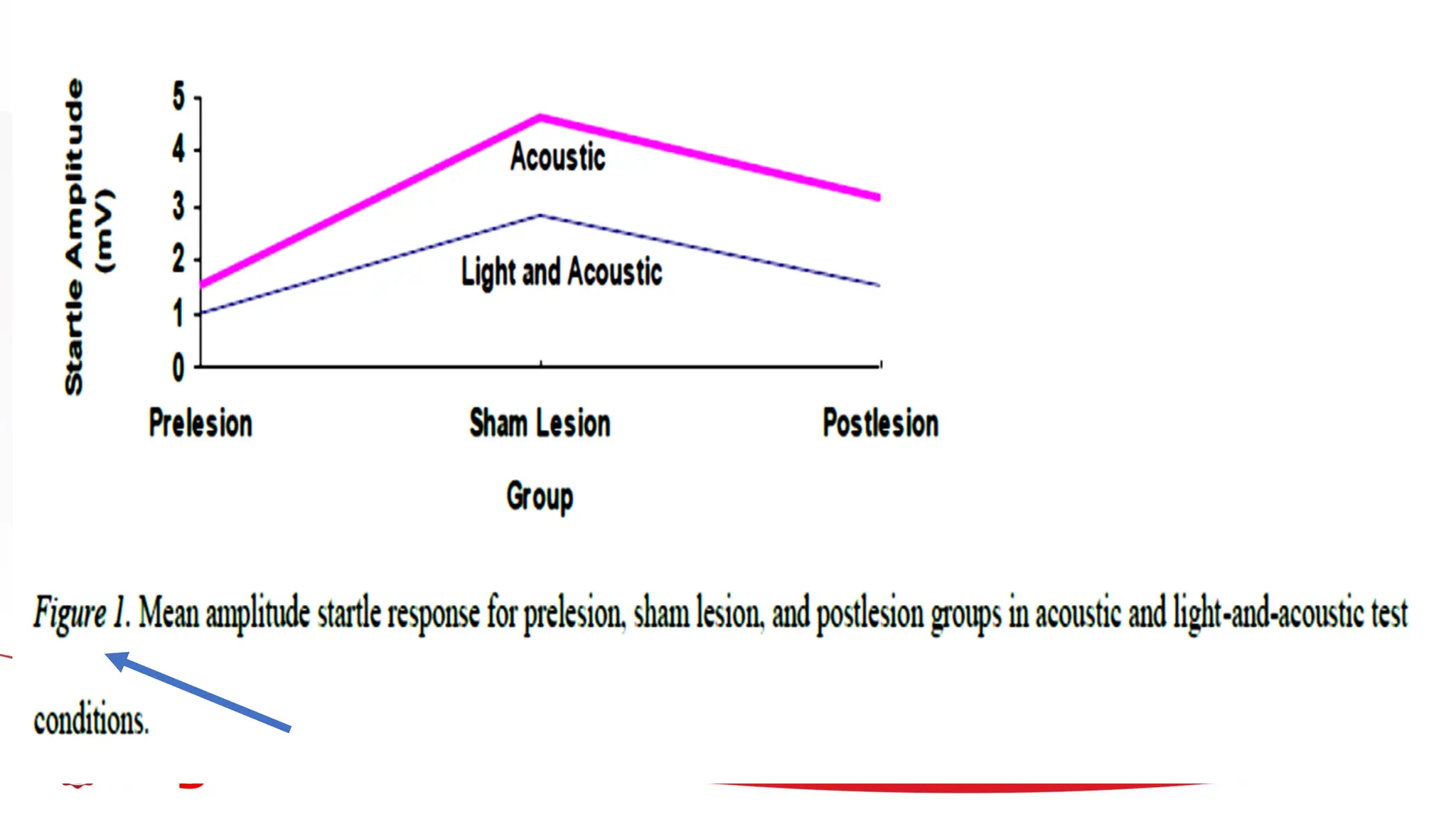
• Textual, graphical, tabular
• Introduce the table first and then discuss the results, support your
findings with corroborations
Guidelines for the Results and
Discussion
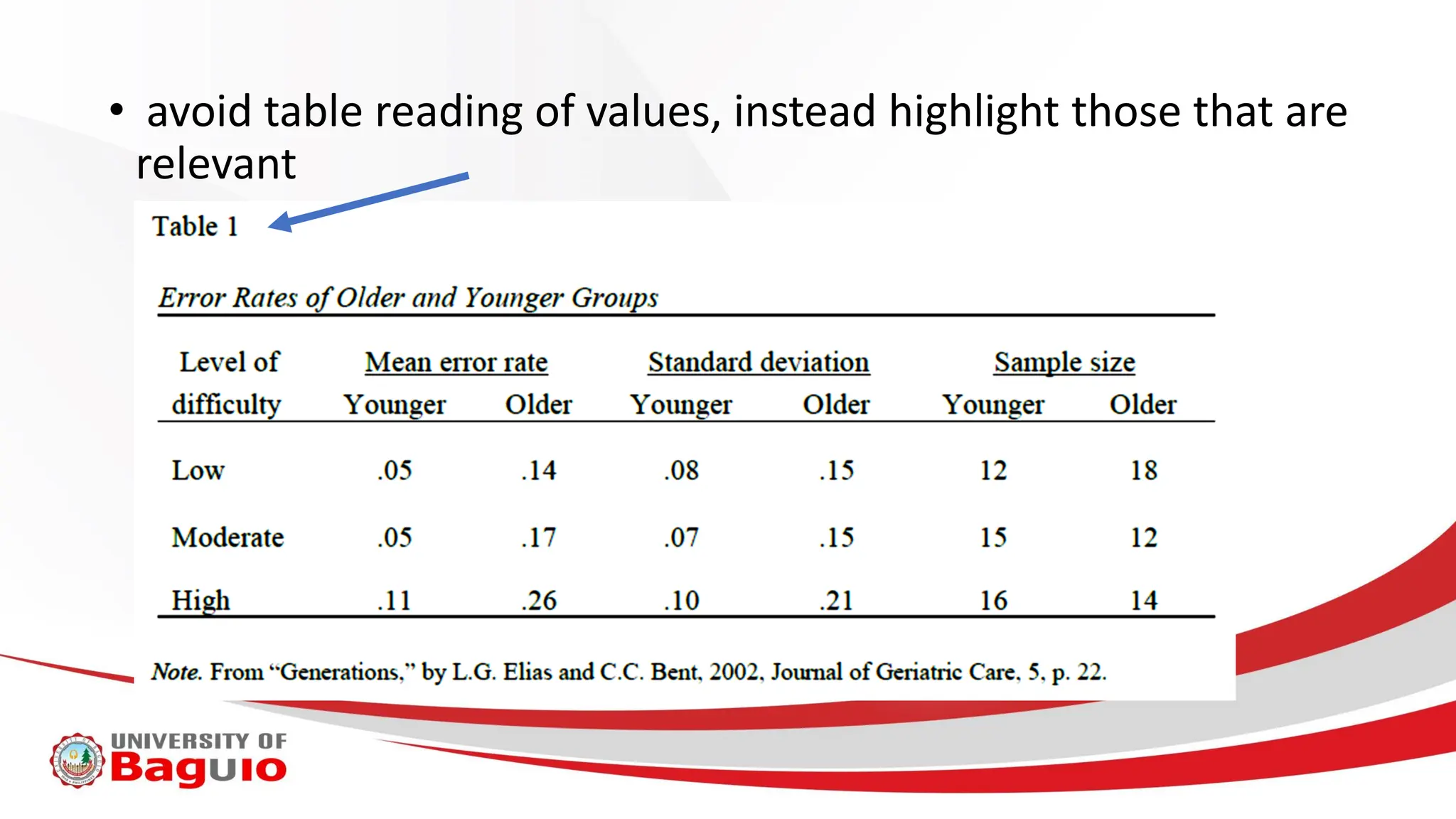
• avoid table reading of values, instead highlight those that are
relevant
• Cite patterns, similarities, differences, negative results, unique results
that have an implication
• Avoid presenting the same data in Table and Figure form
• Always report your results with parenthetical reference to the
statistical conclusion that supports your finding (if statistical tests are
being used in your course).
• This parenthetical reference should include the statistical test used
and the level of significance (test statistic and DF are optional).
Guidelines for Conclusions And
Recommendations
• Conclusions are brief generalizations from the findings
• Conclusions are not mere reiteration or repetition of findings
Avoid
• biased conclusions, incorrect generalizations, deductions,
abstractions
• fallacies (i.e hasty generalizations or equivocation)
• Recommendations are counsels or advice which are feasible and
specific
• Based on the conclusions and meant to improve the problems raised
Do
• Recommend the doable, feasible, economical, practical, efficient
• Recommend specific further studies based on the limitation that you
encountered
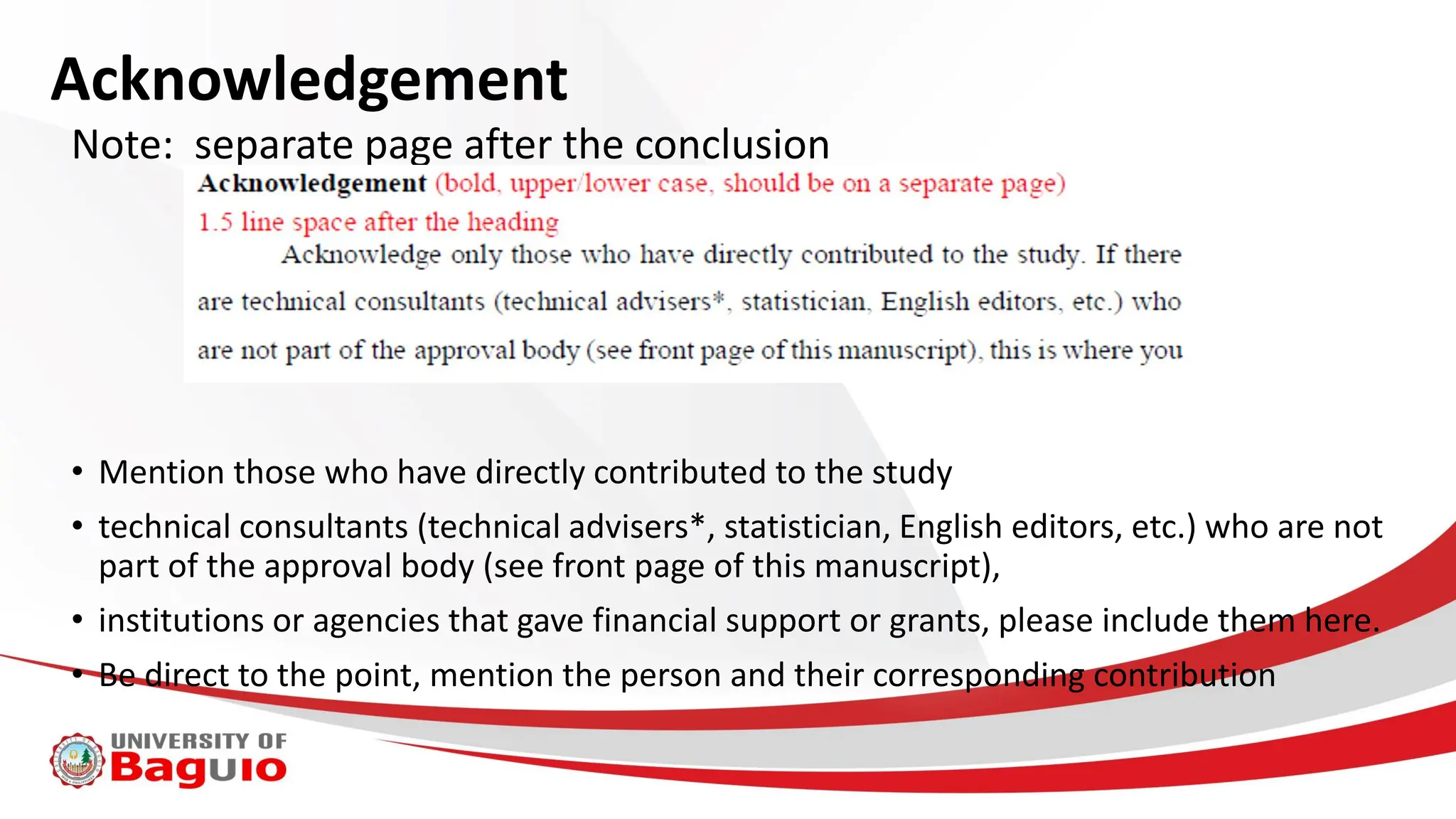
Acknowledgement
Note: separate page after the conclusion
• Mention those who have directly contributed to the study
• technical consultants (technical advisers*, statistician, English editors, etc.) who are not
part of the approval body (see front page of this manuscript),
• institutions or agencies that gave financial support or grants, please include them here.
• Be direct to the point, mention the person and their corresponding contribution
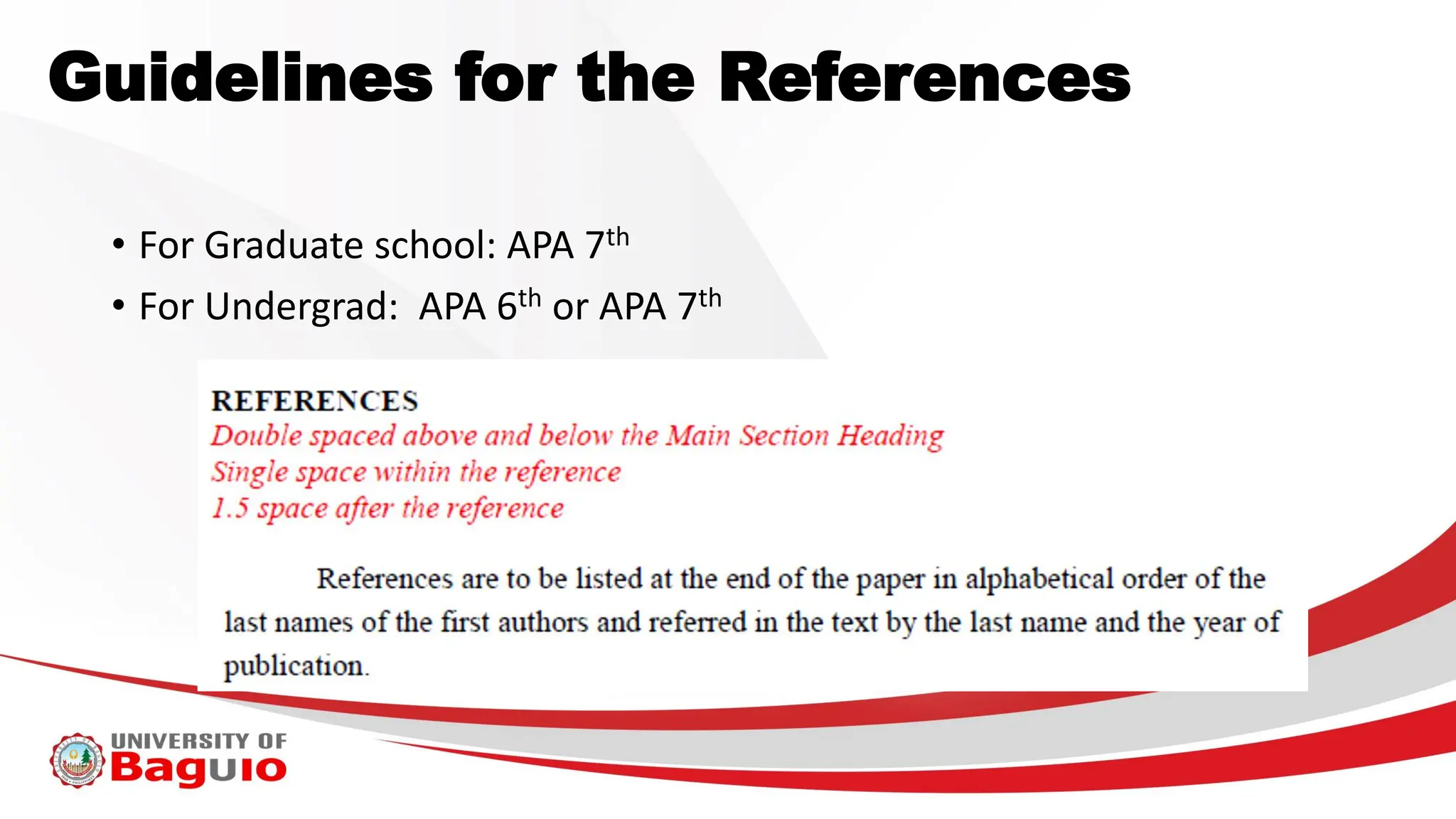
Guidelines for the References
• For Graduate school: APA 7th
• For Undergrad: APA 6th or APA 7th
Appendices
•Sample Data Gathering Tool
•Sample Communications
•Consent Forms/Assent Forms
•Timetable for the Research
•Curriculum Vitae of the Researchers
References:
Szuchman, L.T. (2014). Writing with style. (6th ed.) USA: Wadsworth,
Cengage Learning.
UB Research and Development Center (2019). IMRAD format
guidelines. Baguio City: UBRDC
UB Research and Development Center (2015). Thesis/dissertation
format guidelines. Baguio City: UBRDC
University of Baguio- IMRAD-Format in Research pdf

University of Baguio- IMRAD-Format in Research pdf

  • 1.
    IMRAD FORMAT Orientation Rhoda MarieA. Carbonel, MPA, MA Psych Psychology Faculty, STELA UB IRB-Ethics Committee Member 10 October 2020
  • 2.
    Objectives • For participantsto be familiarized on the parts of the IMRAD format as an institutional guideline for research • For participants to level off on the key requirements needed to complete their research manuscripts or protocols following the IMRAD format
  • 3.
    IMRaD The IMRaD (oftenpronounced “im-rad”) format is the most commonly used format in scientific article and journal writing and is used widely across most scientific and research fields.
  • 4.
    IMRaD Introduction Methodology Results and Discussions *In the Germanicformat Chapters 1 and 2 : Intro and Methodology Chapter 3 and 4: Results/Discussions/Conclusions and Recommendations
  • 5.
    Reasons behind themigration To encourage more students, faculty and non-teaching staff to publish their research work in Journals Background • It is the University of Baguio’s institutional format • Introduced during SY 2018-2019 • Guidelines were released and revisions were recommended by Faculty through the School Research Anchorpersons • February 2019 and October 2019 RDC Memo
  • 6.
    Technical Aspects ofthe Paper Format • Times New Roman, font size #12 • 1.5 line space in between sentences except when specified • Paragraphs are justified and indented • Left Margin: 1.5 inches • Top, right and bottom margin: 1 inch • Paper size: 8.5” x 11”
  • 7.
    • Citation format Gradschool: APA 7th Undergrad : APA 6th or 7th • Pagination: Top right corner, indicated as header 1st page of the manuscript, no page shown • # of Tables: 5 • # of figures: 5 • Recommended # of pages: 15-25 excluding appendices *however, it was recommended by teachers that this rule should be flexible, students are supposed to follow Germanic Content
  • 8.
    • Word CountPer Section Section Word Count Abstract 250-300 words Keywords 5 words Introduction 1500-3000 words Materials/Method (Experimental Designs) 500-1000 words Methodology (non-experimental designs) 500-1000 words Results and Discussion 1500-3000 words Conclusions and Recommendations 250-500 words
  • 9.
    Sections of theresearch paper Title Abstract Introduction • Literature Review • Theoretical/Conceptual Framework/Paradigm of the Study • Objectives of the Study Materials and Method (if experimental) and Methodology (if non- experimental) • Study Design • Sample/Population of the Study
  • 10.
    Sections of theresearch paper, continuation… Materials and Method (if experimental) and Methodology (if non-experimental) • Materials (if experimental) and Data Gathering Tools (if non-experimental) • Methods or Procedures (if experimental) and Data Gathering procedures (if non- experimental) • Treatment of data • Ethical Considerations
  • 11.
  • 12.
    Format: Abstract • Allcaps, bold • Left-aligned • Justified, no paragraph indention A
  • 13.
    Content: Abstract • Lastto be written, overview, key information Element 1: what is the overall issue addressed Element 2: main aim or objectives Element 3: academic or practical importance of the study Element 4: methodology Element 5: main findings Element 6: statement of conclusions Element 7: practical implications of the study
  • 14.
    Format: Main SectionHeadings • All caps, bold • Double-spaced above and below the main section headings • Left-aligned
  • 15.
    Format: Subheadings • Upper/lowercase, bold • 1.5 line space • Left-aligned
  • 16.
    Format: Paragraph Headings ParagraphHeadings • Upper/lower case • Italicized, indented Paragraph Heading. Terms and concepts are defined and described as they are touched in the discussion
  • 17.
    Guidelines for theIntroduction • Identify the subject of interest • The structure follows the inverted pyramid General information about the topic Specific information about the topic
  • 18.
    Literature Review • Briefand balanced review of pertinent published literature (within 10 years) • Discuss relevant primary literature • Summarize current understanding of the problem you are investigating Reference 1 Reference 2 Summary
  • 19.
    Literature Review • emphasizeproblems or gaps in knowledge What don’t we know yet? What do we need to know? What does the field still need to understand? What’s been left out of previous research? Is this a new issue that needs some direction?
  • 20.
    Literature Review • Focusyour efforts on the primary research journals - the journals that publish original research articles. • Cite, articles that reported specific results relevant to your study. • Learn how to find the primary literature (research journals) and review articles rather than depending on reference books.
  • 21.
  • 22.
    Theoretical/Conceptual Framework/ Paradigm ofthe Study • What theories, principles, laws may be integrated in designing your study or which will guide the conduct of your study? • Terms and concepts are defined and described as they are touched in the discussions Ex. Variables, constructs, concepts and their operational definitions
  • 23.
    Significance of theStudy • explain the rationale and approach • explain the outcomes of your study • who will benefit: community? Decision-makers? Policy makers? • What benefits can you derive as a researcher?
  • 24.
    Objectives of thestudy • Mention here the aim of the study and the specific objectives. The specific objectives are those that you will actually measure. • *Follow the rules for writing objectives if your study is Quantitative or Qualitative • The objectives may be presented in a bulleted list and should be phrased in the form: To determine… To investigate … To evaluate… To compare...
  • 25.
    Guidelines for theMaterials and Method/ Methodology • this section needs to be very clear, very specific, very detailed, and only focused on research. • show that you arrived at your results by applying valid and reliable methods. • You may use the active voice to a certain extent, although this section requires more use of third person, passive constructions than others.
  • 26.
    Study design Do notdefine the design. Rather, explain how the variables in your study fits into the design.
  • 27.
    Sample/Population of theStudy • discuss the characteristics of the population • what is your inclusion or exclusion criteria • how did you arrive at the sample size? • how did you recruit the participants? • (if non-human) how did you collect the samples? What authentication procedures were considered
  • 28.
    Data Gathering Tools •Describe what materials, subjects, and equipment(chemicals, experimental animals, apparatus, etc.) you used (these may be subheaded Animals, Reagents, etc.). • What research tools did you use? What are the parts/sections? • Did you pre-test your tool?
  • 29.
    Data Gathering Tools •What are some considerations or steps undertaken to ensure validity and reliability? (i.e. psychometric properties of the tool) • What are the parts of the tools that you used? Are they adopted/adapted from another source? If yes, then cite properly. • Indicate how you will record your data
  • 30.
    Data Gathering Procedures •Methodical discussion of the steps undertaken From whom will you ask permission? What communications do you need to send out? how will you gather data? how will you distribute and retrieve the data? how will you quality check your data? how will you conduct the interview? how long did the data gathering last? How will you safekeep the data?
  • 31.
    Treatment of Data •Describe how the data were summarized and analyzed. Did you compute means? Did you simply use frequencies, ratios, percentages? Did you do statistical treatment? If yes, what? What kind of qualitative data analysis did you do? • You should also indicate the statistical procedures used to analyze your results, including the probability level at which you determined significance (usually at 0.05 probability).
  • 32.
  • 33.
    Ethical Considerations • howanonymity and voluntary participation of the informants/participants were respected throughout the study (if informants/participants opted for non-disclosure of identity); • how confidentiality of information was insured (if informants/participants opted for non-disclosure of information),
  • 34.
    Ethical Considerations • howrisk management measures/strategies for participants, researchers and auxiliary personnel were adopted by the researcher • how informants/participants were selected using non- discriminatory criteria and processes (unless inclusion and exclusion criteria are justifiable based on the nature of the study); • how the findings of the study will be disseminated to the beneficiaries.
  • 35.
    • Introduce thesection by describing the flow of your discussion, present the results according to the sequence of your objectives • Textual, graphical, tabular • Introduce the table first and then discuss the results, support your findings with corroborations Guidelines for the Results and Discussion
  • 36.
    • avoid tablereading of values, instead highlight those that are relevant
  • 38.
    • Cite patterns,similarities, differences, negative results, unique results that have an implication • Avoid presenting the same data in Table and Figure form • Always report your results with parenthetical reference to the statistical conclusion that supports your finding (if statistical tests are being used in your course). • This parenthetical reference should include the statistical test used and the level of significance (test statistic and DF are optional).
  • 39.
    Guidelines for ConclusionsAnd Recommendations • Conclusions are brief generalizations from the findings • Conclusions are not mere reiteration or repetition of findings Avoid • biased conclusions, incorrect generalizations, deductions, abstractions • fallacies (i.e hasty generalizations or equivocation)
  • 40.
    • Recommendations arecounsels or advice which are feasible and specific • Based on the conclusions and meant to improve the problems raised Do • Recommend the doable, feasible, economical, practical, efficient • Recommend specific further studies based on the limitation that you encountered
  • 41.
    Acknowledgement Note: separate pageafter the conclusion • Mention those who have directly contributed to the study • technical consultants (technical advisers*, statistician, English editors, etc.) who are not part of the approval body (see front page of this manuscript), • institutions or agencies that gave financial support or grants, please include them here. • Be direct to the point, mention the person and their corresponding contribution
  • 42.
    Guidelines for theReferences • For Graduate school: APA 7th • For Undergrad: APA 6th or APA 7th
  • 43.
    Appendices •Sample Data GatheringTool •Sample Communications •Consent Forms/Assent Forms •Timetable for the Research •Curriculum Vitae of the Researchers
  • 44.
    References: Szuchman, L.T. (2014).Writing with style. (6th ed.) USA: Wadsworth, Cengage Learning. UB Research and Development Center (2019). IMRAD format guidelines. Baguio City: UBRDC UB Research and Development Center (2015). Thesis/dissertation format guidelines. Baguio City: UBRDC