IMRaD
Research Format
SNS Research Anchor Person
Member, URB-REC
Faculty Member, SNS/ Graduate School
Disclaimer
I do not claim that the content of the presentation is entirely mine.
The concepts were derived from the UB RDC format manual 7th edition
the Publication Manual of APA 7th edition and CRHRDC.
Most of the images I used were taken from the internet.
I also make no claim to be an authority on the topics.
My discussion are based from my educational background, trainings
and workshops attended, and personal experiences.
There is also no conflict of interest between my personal interests and
giving this presentation.
LEARNING OBJECTIVES
By the end of the session, the learner should be able to:
1. realize the importance of IMRaD format;
2. comply properly with IMRaD guidelines;
3. write research paper following the IMRaD format;
4. publish scholarly work in an accredited publication following
the IMRaD guidelines; and
5. organize Public Lectures and Research Presentations guided
by the IMRaD.
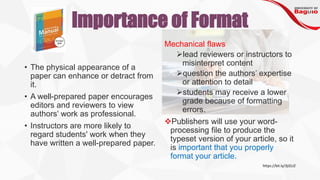
Importance of Format
• The physical appearance of a
paper can enhance or detract from
it.
• A well-prepared paper encourages
editors and reviewers to view
authors' work as professional.
• Instructors are more likely to
regard students' work when they
have written a well-prepared paper.
Mechanical flaws
➢lead reviewers or instructors to
misinterpret content
➢question the authors’ expertise
or attention to detail
➢students may receive a lower
grade because of formatting
errors.
❖Publishers will use your word-
processing file to produce the
typeset version of your article, so it
is important that you properly
format your article.
https://bit.ly/3jIZzJZ
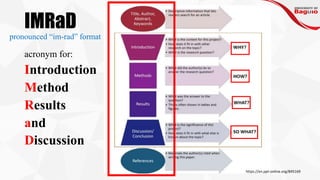
IMRaD
acronym for:
Introduction
Method
Results
and
Discussion
https://en.ppt-online.org/845169
pronounced “im-rad” format
IMRaD
• most commonly used format in
scientific article and journal
writing
• used widely across most
scientific and research fields.
• major components of this format
are similar to the Germanic
format but in a more concise
presentation.
https://www.manuscriptedit.com/scholar-hangout/challenges-prospects-publishing-articles/
Overview
Germanic Format
IMRaD Format
https://bit.ly/3vSzIUR
Reminder
publishers require their own
template in the submission of the
journal
https://bit.ly/3Bi0iIl
https://www.dreamstime.com/photos-images/uniformity.html
Line
spacing
1.5”
Font
style
and
size
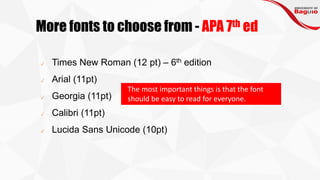
More fonts to choose from - APA 7th ed
✓ Times New Roman (12 pt) – 6th edition
✓ Arial (11pt)
✓ Georgia (11pt)
✓ Calibri (11pt)
✓ Lucida Sans Unicode (10pt)
The most important things is that the font
should be easy to read for everyone.
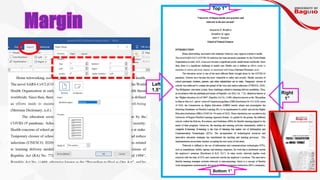
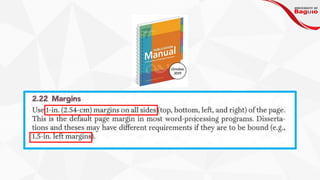
Top 1”
Left
1.5”
Right
1”
Bottom 1”
Where do I find research topic?
1. Research Agenda
•NUHRA
•Basic Education/ NHERA
•Institutional Research Agenda
•School Research Agenda
•Company Research Agenda
Where do I find research topic?
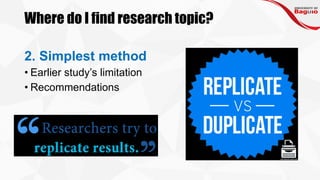
2. Simplest method
• Earlier study’s limitation
• Recommendations
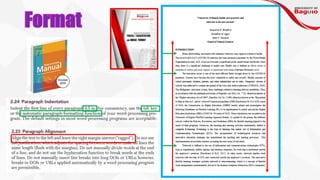
Double
space
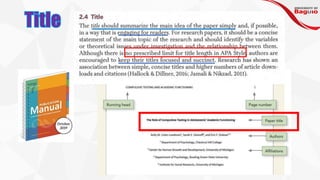
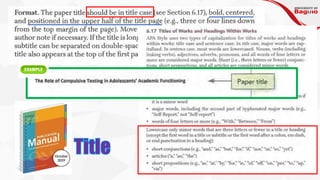
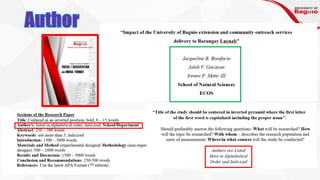
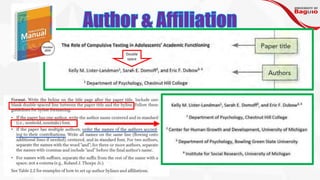
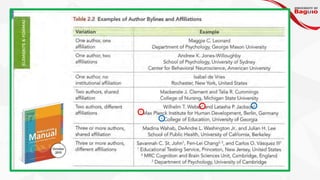
Do not add blank lines between affiliations or between the byline and
the first affiliation.
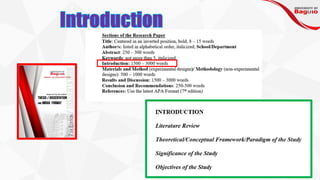
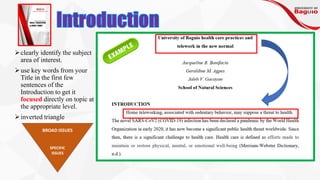
➢clearly identify the subject
area of interest.
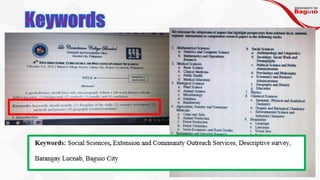
➢use key words from your
Title in the first few
sentences of the
Introduction to get it
focused directly on topic at
the appropriate level.
➢inverted triangle
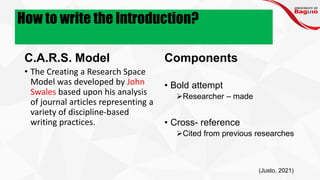
How to write the Introduction?
C.A.R.S. Model
• The Creating a Research Space
Model was developed by John
Swales based upon his analysis
of journal articles representing a
variety of discipline-based
writing practices.
Components
• Bold attempt
➢Researcher – made
• Cross- reference
➢Cited from previous researches
(Justo, 2021)
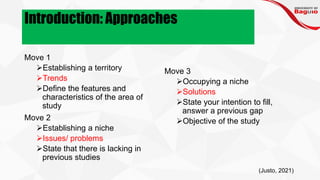
Introduction: Approaches
Move 1
➢Establishing a territory
➢Trends
➢Define the features and
characteristics of the area of
study
Move 2
➢Establishing a niche
➢Issues/ problems
➢State that there is lacking in
previous studies
Move 3
➢Occupying a niche
➢Solutions
➢State your intention to fill,
answer a previous gap
➢Objective of the study
(Justo, 2021)
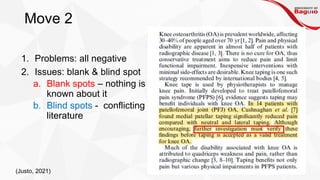
Move 2
1. Problems: all negative
2. Issues: blank & blind spot
a. Blank spots – nothing is
known about it
b. Blind spots - conflicting
literature
(Justo, 2021)
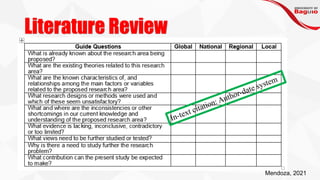
Literature Review
Mendoza, 2021
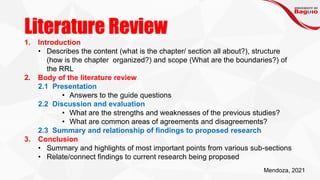
Literature Review
1. Introduction
• Describes the content (what is the chapter/ section all about?), structure
(how is the chapter organized?) and scope (What are the boundaries?) of
the RRL
2. Body of the literature review
2.1 Presentation
• Answers to the guide questions
2.2 Discussion and evaluation
• What are the strengths and weaknesses of the previous studies?
• What are common areas of agreements and disagreements?
2.3 Summary and relationship of findings to proposed research
3. Conclusion
• Summary and highlights of most important points from various sub-sections
• Relate/connect findings to current research being proposed
Mendoza, 2021
Theoretical/
Conceptual Framework/
Paradigm of the Study
• Given the identified knowledge gap, what
concepts can be used to address it.
• What theories, principles, laws may be
integrated in designing your study or
which will guide the conduct of your
study?
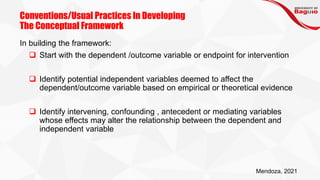
Conventions/Usual Practices In Developing
The Conceptual Framework
In building the framework:
❑ Start with the dependent /outcome variable or endpoint for intervention
❑ Identify potential independent variables deemed to affect the
dependent/outcome variable based on empirical or theoretical evidence
❑ Identify intervening, confounding , antecedent or mediating variables
whose effects may alter the relationship between the dependent and
independent variable
Mendoza, 2021
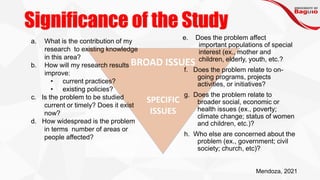
Significance of the Study
BROAD ISSUES
SPECIFIC
ISSUES
e. Does the problem affect
important populations of special
interest (ex., mother and
children, elderly, youth, etc.?
f. Does the problem relate to on-
going programs, projects
activities, or initiatives?
g. Does the problem relate to
broader social, economic or
health issues (ex., poverty;
climate change; status of women
and children, etc.)?
h. Who else are concerned about the
problem (ex., government; civil
society; church, etc)?
a. What is the contribution of my
research to existing knowledge
in this area?
b. How will my research results
improve:
• current practices?
• existing policies?
c. Is the problem to be studied
current or timely? Does it exist
now?
d. How widespread is the problem
in terms number of areas or
people affected?
Mendoza, 2021
GENERAL vs SPECIFIC OBJECTIVES
GENERAL OBJECTIVE
• It reflects the overall purpose of the project
• It states what is expected to be achieved by the study in general
terms
SPECIFIC OBJECTIVES
• They are statements regarding the specific questions expected to be
answered in the study
• They break up the general objective into smaller, logically connected
parts
• They systematically address the various aspects of the problem as
defined in the problem statement
Mendoza, 2021
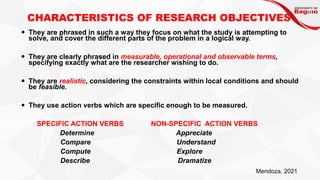
CHARACTERISTICS OF RESEARCH OBJECTIVES
 They are phrased in such a way they focus on what the study is attempting to
solve, and cover the different parts of the problem in a logical way.
 They are clearly phrased in measurable, operational and observable terms,
specifying exactly what are the researcher wishing to do.
 They are realistic, considering the constraints within local conditions and should
be feasible.
 They use action verbs which are specific enough to be measured.
SPECIFIC ACTION VERBS NON-SPECIFIC ACTION VERBS
Determine Appreciate
Compare Understand
Compute Explore
Describe Dramatize
Mendoza, 2021
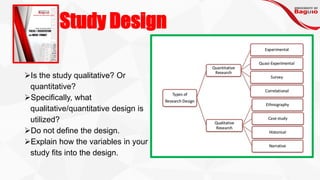
Study Design
➢Is the study qualitative? Or
quantitative?
➢Specifically, what
qualitative/quantitative design is
utilized?
➢Do not define the design.
➢Explain how the variables in your
study fits into the design.
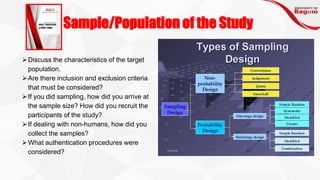
Sample/Population of the Study
➢Discuss the characteristics of the target
population.
➢Are there inclusion and exclusion criteria
that must be considered?
➢If you did sampling, how did you arrive at
the sample size? How did you recruit the
participants of the study?
➢If dealing with non-humans, how did you
collect the samples?
➢What authentication procedures were
considered?
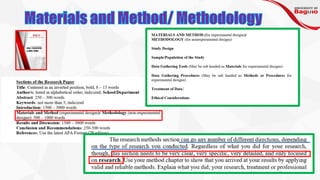
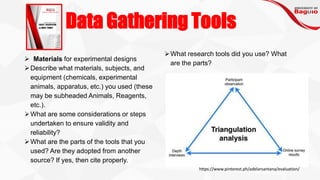
Data Gathering Tools
➢ Materials for experimental designs
➢Describe what materials, subjects, and
equipment (chemicals, experimental
animals, apparatus, etc.) you used (these
may be subheaded Animals, Reagents,
etc.).
➢What are some considerations or steps
undertaken to ensure validity and
reliability?
➢What are the parts of the tools that you
used? Are they adopted from another
source? If yes, then cite properly.
➢What research tools did you use? What
are the parts?
https://www.pinterest.ph/adelarsantana/evaluation/
Data Gathering Procedure
➢Methods or Procedures for
experimental designs
➢Methodical manner describe the steps
that were undertaken.
➢Explain the steps you took in your
experiment.
➢What communications need were
given out?
➢Was there permission from certain
authorities?
➢How did you gather the data?
➢How did you distribute and retrieve
the questionnaires?
➢How did you conduct the interview?
➢How long did the data gathering last?
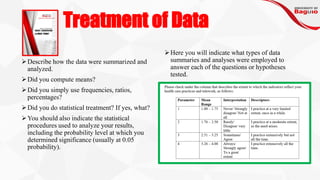
Treatment of Data
➢Describe how the data were summarized and
analyzed.
➢Did you compute means?
➢Did you simply use frequencies, ratios,
percentages?
➢Did you do statistical treatment? If yes, what?
➢You should also indicate the statistical
procedures used to analyze your results,
including the probability level at which you
determined significance (usually at 0.05
probability).
➢Here you will indicate what types of data
summaries and analyses were employed to
answer each of the questions or hypotheses
tested.
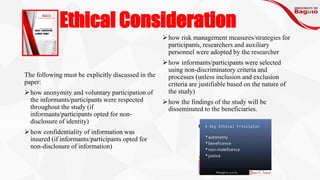
Ethical Consideration
The following must be explicitly discussed in the
paper:
➢how anonymity and voluntary participation of
the informants/participants were respected
throughout the study (if
informants/participants opted for non-
disclosure of identity)
➢how confidentiality of information was
insured (if informants/participants opted for
non-disclosure of information)
➢how risk management measures/strategies for
participants, researchers and auxiliary
personnel were adopted by the researcher
➢how informants/participants were selected
using non-discriminatory criteria and
processes (unless inclusion and exclusion
criteria are justifiable based on the nature of
the study)
➢how the findings of the study will be
disseminated to the beneficiaries.
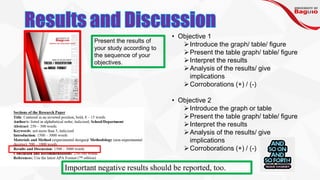
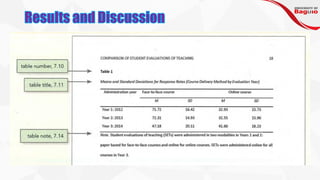
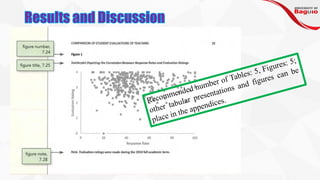
• Objective 1
➢Introduce the graph/ table/ figure
➢Present the table graph/ table/ figure
➢Interpret the results
➢Analysis of the results/ give
implications
➢Corroborations (+) / (-)
• Objective 2
➢Introduce the graph or table
➢Present the table graph/ table/ figure
➢Interpret the results
➢Analysis of the results/ give
implications
➢Corroborations (+) / (-)
Present the results of
your study according to
the sequence of your
objectives.
Important negative results should be reported, too.
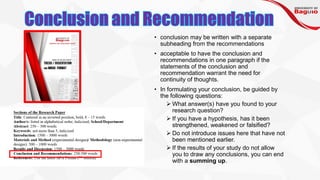
• conclusion may be written with a separate
subheading from the recommendations
• acceptable to have the conclusion and
recommendations in one paragraph if the
statements of the conclusion and
recommendation warrant the need for
continuity of thoughts.
• In formulating your conclusion, be guided by
the following questions:
➢ What answer(s) have you found to your
research question?
➢ If you have a hypothesis, has it been
strengthened, weakened or falsified?
➢ Do not introduce issues here that have not
been mentioned earlier.
➢ If the results of your study do not allow
you to draw any conclusions, you can end
with a summing up.
Acknowledgement
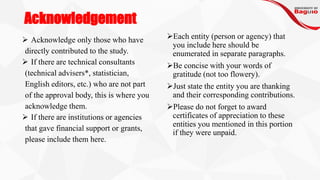
➢ Acknowledge only those who have
directly contributed to the study.
➢ If there are technical consultants
(technical advisers*, statistician,
English editors, etc.) who are not part
of the approval body, this is where you
acknowledge them.
➢ If there are institutions or agencies
that gave financial support or grants,
please include them here.
➢Each entity (person or agency) that
you include here should be
enumerated in separate paragraphs.
➢Be concise with your words of
gratitude (not too flowery).
➢Just state the entity you are thanking
and their corresponding contributions.
➢Please do not forget to award
certificates of appreciation to these
entities you mentioned in this portion
if they were unpaid.
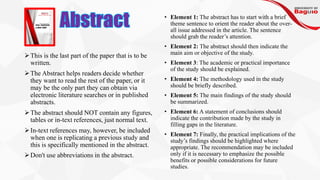
➢This is the last part of the paper that is to be
written.
➢The Abstract helps readers decide whether
they want to read the rest of the paper, or it
may be the only part they can obtain via
electronic literature searches or in published
abstracts.
➢The abstract should NOT contain any figures,
tables or in-text references, just normal text.
➢In-text references may, however, be included
when one is replicating a previous study and
this is specifically mentioned in the abstract.
➢Don't use abbreviations in the abstract.
• Element 1: The abstract has to start with a brief
theme sentence to orient the reader about the over-
all issue addressed in the article. The sentence
should grab the reader’s attention.
• Element 2: The abstract should then indicate the
main aim or objective of the study.
• Element 3: The academic or practical importance
of the study should be explained.
• Element 4: The methodology used in the study
should be briefly described.
• Element 5: The main findings of the study should
be summarized.
• Element 6: A statement of conclusions should
indicate the contribution made by the study in
filling gaps in the literature.
• Element 7: Finally, the practical implications of the
study’s findings should be highlighted where
appropriate. The recommendation may be included
only if it is necessary to emphasize the possible
benefits or possible considerations for future
studies.
A technically sound paper
means an ethically sound
study.

IMRaD Research Format by Dr. Jacqueline (PowerPoinT)

  • 1.
    IMRaD Research Format SNS ResearchAnchor Person Member, URB-REC Faculty Member, SNS/ Graduate School
  • 2.
    Disclaimer I do notclaim that the content of the presentation is entirely mine. The concepts were derived from the UB RDC format manual 7th edition the Publication Manual of APA 7th edition and CRHRDC. Most of the images I used were taken from the internet. I also make no claim to be an authority on the topics. My discussion are based from my educational background, trainings and workshops attended, and personal experiences. There is also no conflict of interest between my personal interests and giving this presentation.
  • 3.
    LEARNING OBJECTIVES By theend of the session, the learner should be able to: 1. realize the importance of IMRaD format; 2. comply properly with IMRaD guidelines; 3. write research paper following the IMRaD format; 4. publish scholarly work in an accredited publication following the IMRaD guidelines; and 5. organize Public Lectures and Research Presentations guided by the IMRaD.
  • 4.
    Importance of Format •The physical appearance of a paper can enhance or detract from it. • A well-prepared paper encourages editors and reviewers to view authors' work as professional. • Instructors are more likely to regard students' work when they have written a well-prepared paper. Mechanical flaws ➢lead reviewers or instructors to misinterpret content ➢question the authors’ expertise or attention to detail ➢students may receive a lower grade because of formatting errors. ❖Publishers will use your word- processing file to produce the typeset version of your article, so it is important that you properly format your article. https://bit.ly/3jIZzJZ

  • 5.
  • 6.
    IMRaD • most commonlyused format in scientific article and journal writing • used widely across most scientific and research fields. • major components of this format are similar to the Germanic format but in a more concise presentation. https://www.manuscriptedit.com/scholar-hangout/challenges-prospects-publishing-articles/
  • 7.
  • 8.
    Reminder publishers require theirown template in the submission of the journal https://bit.ly/3Bi0iIl
  • 9.
  • 10.
  • 11.
    More fonts tochoose from - APA 7th ed ✓ Times New Roman (12 pt) – 6th edition ✓ Arial (11pt) ✓ Georgia (11pt) ✓ Calibri (11pt) ✓ Lucida Sans Unicode (10pt) The most important things is that the font should be easy to read for everyone.
  • 12.
  • 20.
    Where do Ifind research topic? 1. Research Agenda •NUHRA •Basic Education/ NHERA •Institutional Research Agenda •School Research Agenda •Company Research Agenda
  • 21.
    Where do Ifind research topic? 2. Simplest method • Earlier study’s limitation • Recommendations
  • 28.
  • 30.
    Do not addblank lines between affiliations or between the byline and the first affiliation.
  • 32.
    ➢clearly identify thesubject area of interest. ➢use key words from your Title in the first few sentences of the Introduction to get it focused directly on topic at the appropriate level. ➢inverted triangle
  • 34.
    How to writethe Introduction? C.A.R.S. Model • The Creating a Research Space Model was developed by John Swales based upon his analysis of journal articles representing a variety of discipline-based writing practices. Components • Bold attempt ➢Researcher – made • Cross- reference ➢Cited from previous researches (Justo, 2021)
  • 35.
    Introduction: Approaches Move 1 ➢Establishinga territory ➢Trends ➢Define the features and characteristics of the area of study Move 2 ➢Establishing a niche ➢Issues/ problems ➢State that there is lacking in previous studies Move 3 ➢Occupying a niche ➢Solutions ➢State your intention to fill, answer a previous gap ➢Objective of the study (Justo, 2021)
  • 36.
    Move 2 1. Problems:all negative 2. Issues: blank & blind spot a. Blank spots – nothing is known about it b. Blind spots - conflicting literature (Justo, 2021)
  • 37.
  • 38.
    Literature Review 1. Introduction •Describes the content (what is the chapter/ section all about?), structure (how is the chapter organized?) and scope (What are the boundaries?) of the RRL 2. Body of the literature review 2.1 Presentation • Answers to the guide questions 2.2 Discussion and evaluation • What are the strengths and weaknesses of the previous studies? • What are common areas of agreements and disagreements? 2.3 Summary and relationship of findings to proposed research 3. Conclusion • Summary and highlights of most important points from various sub-sections • Relate/connect findings to current research being proposed Mendoza, 2021
  • 39.
    Theoretical/ Conceptual Framework/ Paradigm ofthe Study • Given the identified knowledge gap, what concepts can be used to address it. • What theories, principles, laws may be integrated in designing your study or which will guide the conduct of your study?
  • 40.
    Conventions/Usual Practices InDeveloping The Conceptual Framework In building the framework: ❑ Start with the dependent /outcome variable or endpoint for intervention ❑ Identify potential independent variables deemed to affect the dependent/outcome variable based on empirical or theoretical evidence ❑ Identify intervening, confounding , antecedent or mediating variables whose effects may alter the relationship between the dependent and independent variable Mendoza, 2021
  • 41.
    Significance of theStudy BROAD ISSUES SPECIFIC ISSUES e. Does the problem affect important populations of special interest (ex., mother and children, elderly, youth, etc.? f. Does the problem relate to on- going programs, projects activities, or initiatives? g. Does the problem relate to broader social, economic or health issues (ex., poverty; climate change; status of women and children, etc.)? h. Who else are concerned about the problem (ex., government; civil society; church, etc)? a. What is the contribution of my research to existing knowledge in this area? b. How will my research results improve: • current practices? • existing policies? c. Is the problem to be studied current or timely? Does it exist now? d. How widespread is the problem in terms number of areas or people affected? Mendoza, 2021
  • 42.
    GENERAL vs SPECIFICOBJECTIVES GENERAL OBJECTIVE • It reflects the overall purpose of the project • It states what is expected to be achieved by the study in general terms SPECIFIC OBJECTIVES • They are statements regarding the specific questions expected to be answered in the study • They break up the general objective into smaller, logically connected parts • They systematically address the various aspects of the problem as defined in the problem statement Mendoza, 2021
  • 43.
    CHARACTERISTICS OF RESEARCHOBJECTIVES  They are phrased in such a way they focus on what the study is attempting to solve, and cover the different parts of the problem in a logical way.  They are clearly phrased in measurable, operational and observable terms, specifying exactly what are the researcher wishing to do.  They are realistic, considering the constraints within local conditions and should be feasible.  They use action verbs which are specific enough to be measured. SPECIFIC ACTION VERBS NON-SPECIFIC ACTION VERBS Determine Appreciate Compare Understand Compute Explore Describe Dramatize Mendoza, 2021
  • 45.
    Study Design ➢Is thestudy qualitative? Or quantitative? ➢Specifically, what qualitative/quantitative design is utilized? ➢Do not define the design. ➢Explain how the variables in your study fits into the design.
  • 46.
    Sample/Population of theStudy ➢Discuss the characteristics of the target population. ➢Are there inclusion and exclusion criteria that must be considered? ➢If you did sampling, how did you arrive at the sample size? How did you recruit the participants of the study? ➢If dealing with non-humans, how did you collect the samples? ➢What authentication procedures were considered?
  • 47.
    Data Gathering Tools ➢Materials for experimental designs ➢Describe what materials, subjects, and equipment (chemicals, experimental animals, apparatus, etc.) you used (these may be subheaded Animals, Reagents, etc.). ➢What are some considerations or steps undertaken to ensure validity and reliability? ➢What are the parts of the tools that you used? Are they adopted from another source? If yes, then cite properly. ➢What research tools did you use? What are the parts? https://www.pinterest.ph/adelarsantana/evaluation/
  • 48.
    Data Gathering Procedure ➢Methodsor Procedures for experimental designs ➢Methodical manner describe the steps that were undertaken. ➢Explain the steps you took in your experiment. ➢What communications need were given out? ➢Was there permission from certain authorities? ➢How did you gather the data? ➢How did you distribute and retrieve the questionnaires? ➢How did you conduct the interview? ➢How long did the data gathering last?
  • 49.
    Treatment of Data ➢Describehow the data were summarized and analyzed. ➢Did you compute means? ➢Did you simply use frequencies, ratios, percentages? ➢Did you do statistical treatment? If yes, what? ➢You should also indicate the statistical procedures used to analyze your results, including the probability level at which you determined significance (usually at 0.05 probability). ➢Here you will indicate what types of data summaries and analyses were employed to answer each of the questions or hypotheses tested.
  • 50.
    Ethical Consideration The followingmust be explicitly discussed in the paper: ➢how anonymity and voluntary participation of the informants/participants were respected throughout the study (if informants/participants opted for non- disclosure of identity) ➢how confidentiality of information was insured (if informants/participants opted for non-disclosure of information) ➢how risk management measures/strategies for participants, researchers and auxiliary personnel were adopted by the researcher ➢how informants/participants were selected using non-discriminatory criteria and processes (unless inclusion and exclusion criteria are justifiable based on the nature of the study) ➢how the findings of the study will be disseminated to the beneficiaries.
  • 51.
    • Objective 1 ➢Introducethe graph/ table/ figure ➢Present the table graph/ table/ figure ➢Interpret the results ➢Analysis of the results/ give implications ➢Corroborations (+) / (-) • Objective 2 ➢Introduce the graph or table ➢Present the table graph/ table/ figure ➢Interpret the results ➢Analysis of the results/ give implications ➢Corroborations (+) / (-) Present the results of your study according to the sequence of your objectives. Important negative results should be reported, too.
  • 54.
    • conclusion maybe written with a separate subheading from the recommendations • acceptable to have the conclusion and recommendations in one paragraph if the statements of the conclusion and recommendation warrant the need for continuity of thoughts. • In formulating your conclusion, be guided by the following questions: ➢ What answer(s) have you found to your research question? ➢ If you have a hypothesis, has it been strengthened, weakened or falsified? ➢ Do not introduce issues here that have not been mentioned earlier. ➢ If the results of your study do not allow you to draw any conclusions, you can end with a summing up.
  • 55.
    Acknowledgement ➢ Acknowledge onlythose who have directly contributed to the study. ➢ If there are technical consultants (technical advisers*, statistician, English editors, etc.) who are not part of the approval body, this is where you acknowledge them. ➢ If there are institutions or agencies that gave financial support or grants, please include them here. ➢Each entity (person or agency) that you include here should be enumerated in separate paragraphs. ➢Be concise with your words of gratitude (not too flowery). ➢Just state the entity you are thanking and their corresponding contributions. ➢Please do not forget to award certificates of appreciation to these entities you mentioned in this portion if they were unpaid.
  • 57.
    ➢This is thelast part of the paper that is to be written. ➢The Abstract helps readers decide whether they want to read the rest of the paper, or it may be the only part they can obtain via electronic literature searches or in published abstracts. ➢The abstract should NOT contain any figures, tables or in-text references, just normal text. ➢In-text references may, however, be included when one is replicating a previous study and this is specifically mentioned in the abstract. ➢Don't use abbreviations in the abstract. • Element 1: The abstract has to start with a brief theme sentence to orient the reader about the over- all issue addressed in the article. The sentence should grab the reader’s attention. • Element 2: The abstract should then indicate the main aim or objective of the study. • Element 3: The academic or practical importance of the study should be explained. • Element 4: The methodology used in the study should be briefly described. • Element 5: The main findings of the study should be summarized. • Element 6: A statement of conclusions should indicate the contribution made by the study in filling gaps in the literature. • Element 7: Finally, the practical implications of the study’s findings should be highlighted where appropriate. The recommendation may be included only if it is necessary to emphasize the possible benefits or possible considerations for future studies.
  • 62.
    A technically soundpaper means an ethically sound study.