Memoona Riaz
bsf1701500
Teaching of general science
Topic: Definition of science
Content
• Definition of science
1. How do we define Science.
2. Meaning of General Science.
3. Nature of General Science.
• Science as a process: scientific method.
• Science as a product: Scientific
knowledge.
Learning outcomes
At the end of this presentation students will be able
to understand :
• What is science?
• How do we define science?
• Meaning of science?
• What is the nature of science?
• What is science as a process?
• What is science as a product?
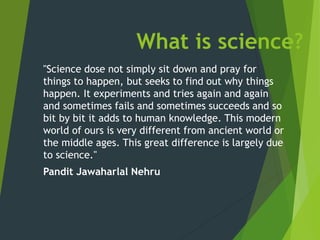
What is science?
"Science dose not simply sit down and pray for
things to happen, but seeks to find out why things
happen. It experiments and tries again and again
and sometimes fails and sometimes succeeds and so
bit by bit it adds to human knowledge. This modern
world of ours is very different from ancient world or
the middle ages. This great difference is largely due
to science."
Pandit Jawaharlal Nehru
How do we define
science?
 According to Webster's New Collegiate
Dictionary, the defination of science is
"knowledge attained trough study or
practice." OR "knowledge covering general
operation of general laws, esp. as obtained
and tested through scientific method and
concerned with the physical worls".
Conti...
 According to dictionary "science is a branch
of knowledge or study dealing with a body of
factd or truths systematically arranged amd
showing the operation of general laws
Meaning of science?
The term science & general science are used
synonymously.
 Einstein defines science as “An attempt to
make the chaotic diversity of our sense
experience correspond to logically uniform
systems of thought.”
 According to the Columbia dictionary
“Science is an accumulated & systematized
learning, in general usage restricted to
natural phenomenon.”
Conti...
 According to Griggs, “In the literal sense science
means the pursuit of knowledge but it has a wider
connotation for our purpose, and can be said to
mean a knowledge of nature in the widest possible
form.”
Conti...
On the basis of these definitions of science we
can say that
• Science is a study of natural phenomenon.
• It is organized & systematized learning.
• It is a body of cumulative & ordered
observations.
• It is the knowledge based on observations,
experiments.
• Science is a process as well as the product.
Nature of Science
It is the study of problems wherever children live.
Formally stated, it is the study of natural
environment which includes physics, chemistry,
biology, geology, etc. Its content is connected with
these subjects but it is a study of problems that
pop into curious children's mind as they grow up.
For e.g.,
1. What makes the wind blow?
2. How can a seed grow into a tree?
3. What makes a rainbow?
Conti...
Finding the answers to such questions is
science. Learning of science is a lengthy and
continuous process. Knowledge acquired
through this is referred to as product. Thus,
science is a process as well as a product.
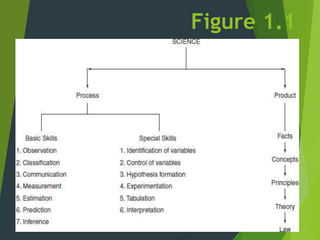
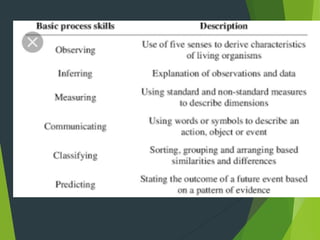
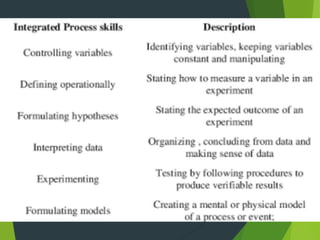
(Figure 1.1).
Figure 1.1
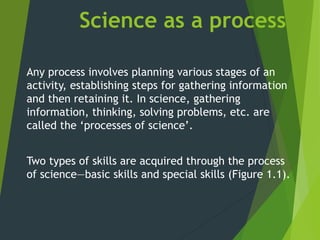
Science as a process
Any process involves planning various stages of an
activity, establishing steps for gathering information
and then retaining it. In science, gathering
information, thinking, solving problems, etc. are
called the ‘processes of science’.
Two types of skills are acquired through the process
of science—basic skills and special skills (Figure 1.1).
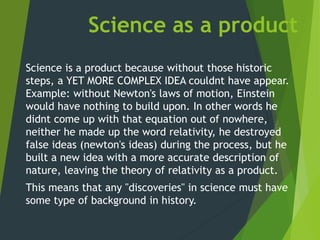
Science as a product
Science is a product because without those historic
steps, a YET MORE COMPLEX IDEA couldnt have appear.
Example: without Newton's laws of motion, Einstein
would have nothing to build upon. In other words he
didnt come up with that equation out of nowhere,
neither he made up the word relativity, he destroyed
false ideas (newton's ideas) during the process, but he
built a new idea with a more accurate description of
nature, leaving the theory of relativity as a product.
This means that any "discoveries" in science must have
some type of background in history.
Memoona riaz wps office

Memoona riaz wps office

  • 1.
    Memoona Riaz bsf1701500 Teaching ofgeneral science Topic: Definition of science
  • 2.
    Content • Definition ofscience 1. How do we define Science. 2. Meaning of General Science. 3. Nature of General Science. • Science as a process: scientific method. • Science as a product: Scientific knowledge.
  • 3.
    Learning outcomes At theend of this presentation students will be able to understand : • What is science? • How do we define science? • Meaning of science? • What is the nature of science? • What is science as a process? • What is science as a product?
  • 4.
    What is science? "Sciencedose not simply sit down and pray for things to happen, but seeks to find out why things happen. It experiments and tries again and again and sometimes fails and sometimes succeeds and so bit by bit it adds to human knowledge. This modern world of ours is very different from ancient world or the middle ages. This great difference is largely due to science." Pandit Jawaharlal Nehru
  • 5.
    How do wedefine science?  According to Webster's New Collegiate Dictionary, the defination of science is "knowledge attained trough study or practice." OR "knowledge covering general operation of general laws, esp. as obtained and tested through scientific method and concerned with the physical worls".
  • 6.
    Conti...  According todictionary "science is a branch of knowledge or study dealing with a body of factd or truths systematically arranged amd showing the operation of general laws
  • 7.
    Meaning of science? Theterm science & general science are used synonymously.  Einstein defines science as “An attempt to make the chaotic diversity of our sense experience correspond to logically uniform systems of thought.”  According to the Columbia dictionary “Science is an accumulated & systematized learning, in general usage restricted to natural phenomenon.”
  • 8.
    Conti...  According toGriggs, “In the literal sense science means the pursuit of knowledge but it has a wider connotation for our purpose, and can be said to mean a knowledge of nature in the widest possible form.”
  • 9.
    Conti... On the basisof these definitions of science we can say that • Science is a study of natural phenomenon. • It is organized & systematized learning. • It is a body of cumulative & ordered observations. • It is the knowledge based on observations, experiments. • Science is a process as well as the product.
  • 10.
    Nature of Science Itis the study of problems wherever children live. Formally stated, it is the study of natural environment which includes physics, chemistry, biology, geology, etc. Its content is connected with these subjects but it is a study of problems that pop into curious children's mind as they grow up. For e.g., 1. What makes the wind blow? 2. How can a seed grow into a tree? 3. What makes a rainbow?
  • 11.
    Conti... Finding the answersto such questions is science. Learning of science is a lengthy and continuous process. Knowledge acquired through this is referred to as product. Thus, science is a process as well as a product. (Figure 1.1).
  • 12.
  • 13.
    Science as aprocess Any process involves planning various stages of an activity, establishing steps for gathering information and then retaining it. In science, gathering information, thinking, solving problems, etc. are called the ‘processes of science’. Two types of skills are acquired through the process of science—basic skills and special skills (Figure 1.1).
  • 16.
    Science as aproduct Science is a product because without those historic steps, a YET MORE COMPLEX IDEA couldnt have appear. Example: without Newton's laws of motion, Einstein would have nothing to build upon. In other words he didnt come up with that equation out of nowhere, neither he made up the word relativity, he destroyed false ideas (newton's ideas) during the process, but he built a new idea with a more accurate description of nature, leaving the theory of relativity as a product. This means that any "discoveries" in science must have some type of background in history.