CHAPTER I
ACTION RESEARCH
DR. RAKHI SAWLANI
WHAT IS RESEARCH?
• “Research” ‘re’ + ‘search’
• ‘re’ means ‘again’ frequentative and intensive
• ‘ search’ means ‘ to find out’
• ‘search’ means ‘enquiry’, ‘investigation’ or ‘ test’
• It is a the systematic investigation into and study of
materials and sources in order to establish facts and
reach new conclusions.
DIFFERENT TYPES OF RESEARCH
WHAT IS ACTION RESEARCH?
Action research can be described as a family of research methodologies
which pursue
ACTION (or Change)
and
RESEARCH (or Understanding)
at the same time.
WHAT IS ACTION RESEARCH?
• It is applied in nature and is associated with
“Hands-On” or small scale research projects.
• It is also known as decision-oriented research since
it necessitated that the researcher is the same
person as the practitioner who will make and
implement the decision based on the findings.
OBJECTIVE OF ACTION RESEARCH
•Action research placed its emphasis on the
solution of a problem in a local setting.
Real Problem Find solutions
PURPOSE/NEED TO CONDUCT
ACTION RESEARCH
• reflecting more deeply and systematically on teaching
practices.
• improving the teaching process and practices for the all round
development of students.
• providing students a better learning environment.
• tackling the problems of access, enrolment, retention and
learning among your students relating to your day to day
classroom activities.
• increasing student achievement.
• improving quality of education.
• generating genuine and sustained improvements in schools.
DEFINITION OF ACTION RESEARCH
• The type of systematic effort by the teachers by
reflecting on their own practices and making
needed changes is called as ‘Action Research’.
• Action research is systematic inquiry one by the
teachers to gather information and subsequently
improve the ways how they teach and how well the
students learn.
SCOPE OF ACTION RESEARCH
UNDERSTANDING STUDENT CHARACTERISTICS {Personal or academic}
• pronunciation problem in english, poor reading ability
• competencies in mathematics,, how to improve problem-solving skills in mathematics,
increasing interest, causes of absenteeism,
• to improve the quality of student writing, process skills in science, inquiry skills in science,
performance/ achievement in science.
• UNDERSTANDING STUDENT BEHAVIOR
• Reasons of shyness in classroom
• low attendance in the classroom, poor reading habits among the students
• study habit, stress level, attitude, anxiety, depression, mental health etc.
WHO CAN PERFORM ACTION RESEARCH?
• School Teachers / Student–Teachers / College Teachers /
Classroom Teachers
• Principals/Head of Departments/ School supervisors
• Workers in the community development
• Practitioners in any field
• Block education officers, district education officers,
inspectors of schools
• Policy Makers
• Counselors
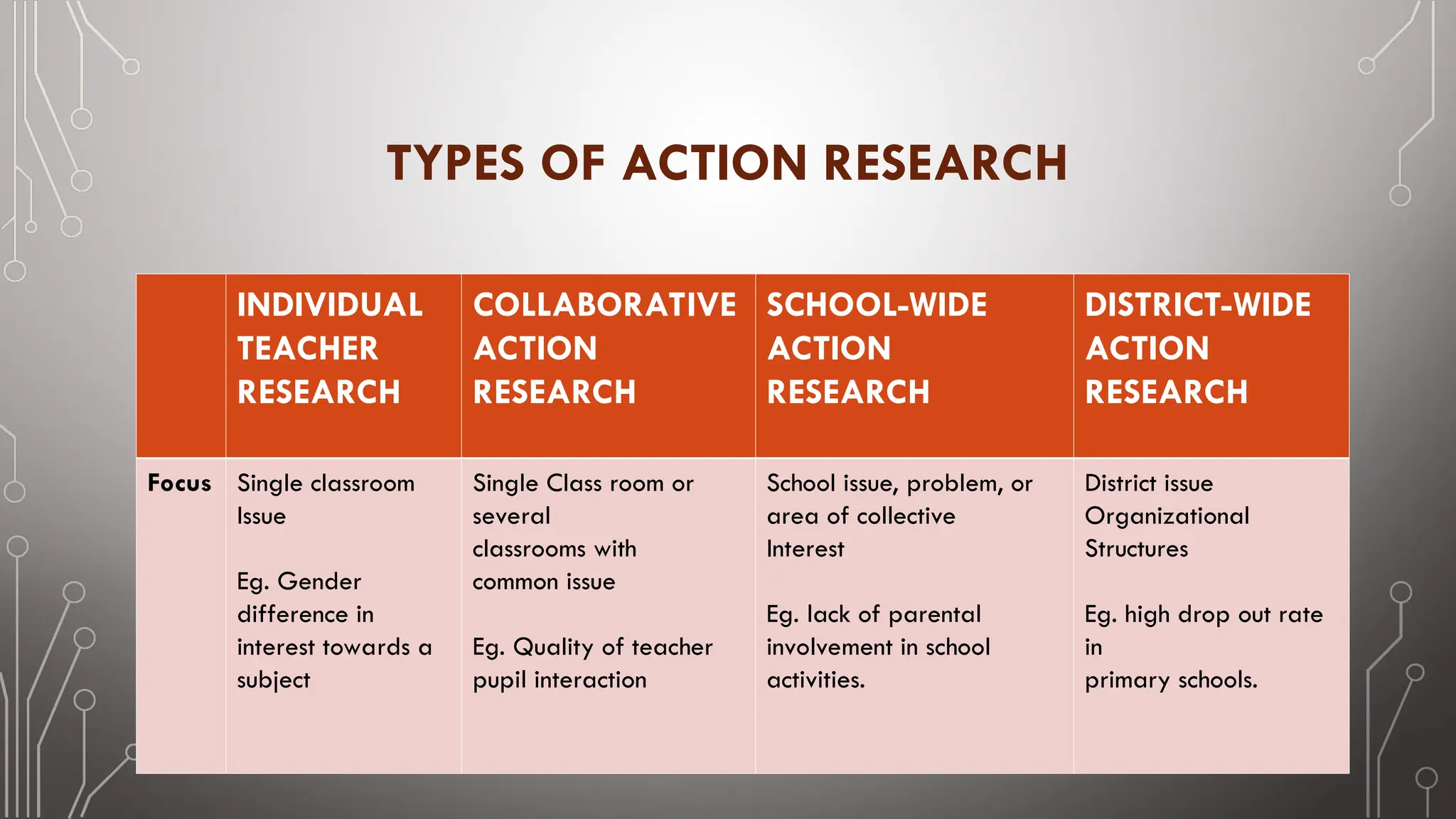
TYPES OF ACTION RESEARCH
INDIVIDUAL
TEACHER
RESEARCH
COLLABORATIVE
ACTION
RESEARCH
SCHOOL-WIDE
ACTION
RESEARCH
DISTRICT-WIDE
ACTION
RESEARCH
Focus Single classroom
Issue
Eg. Gender
difference in
interest towards a
subject
Single Class room or
several
classrooms with
common issue
Eg. Quality of teacher
pupil interaction
School issue, problem, or
area of collective
Interest
Eg. lack of parental
involvement in school
activities.
District issue
Organizational
Structures
Eg. high drop out rate
in
primary schools.
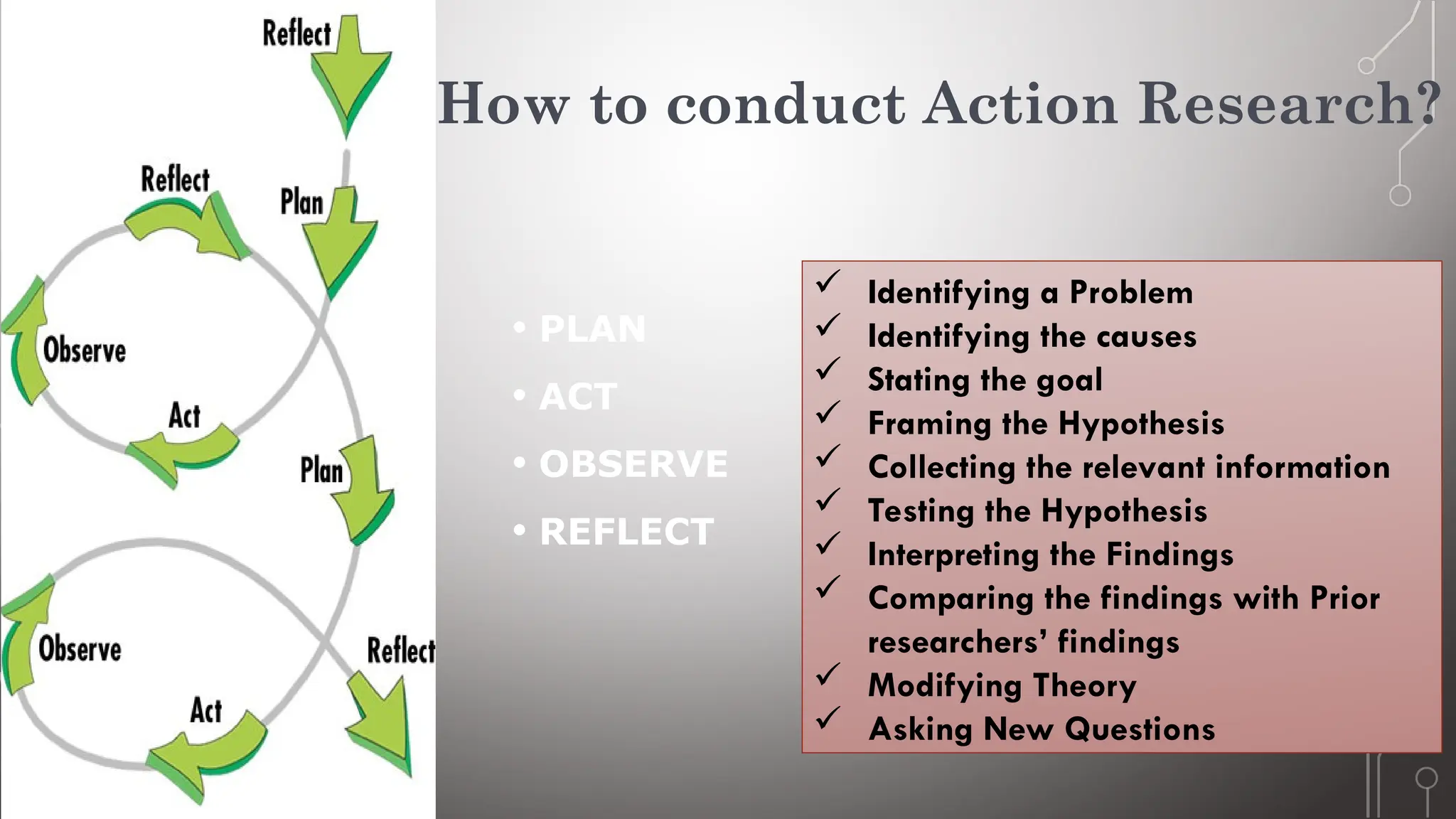
• PLAN
• ACT
• OBSERVE
• REFLECT
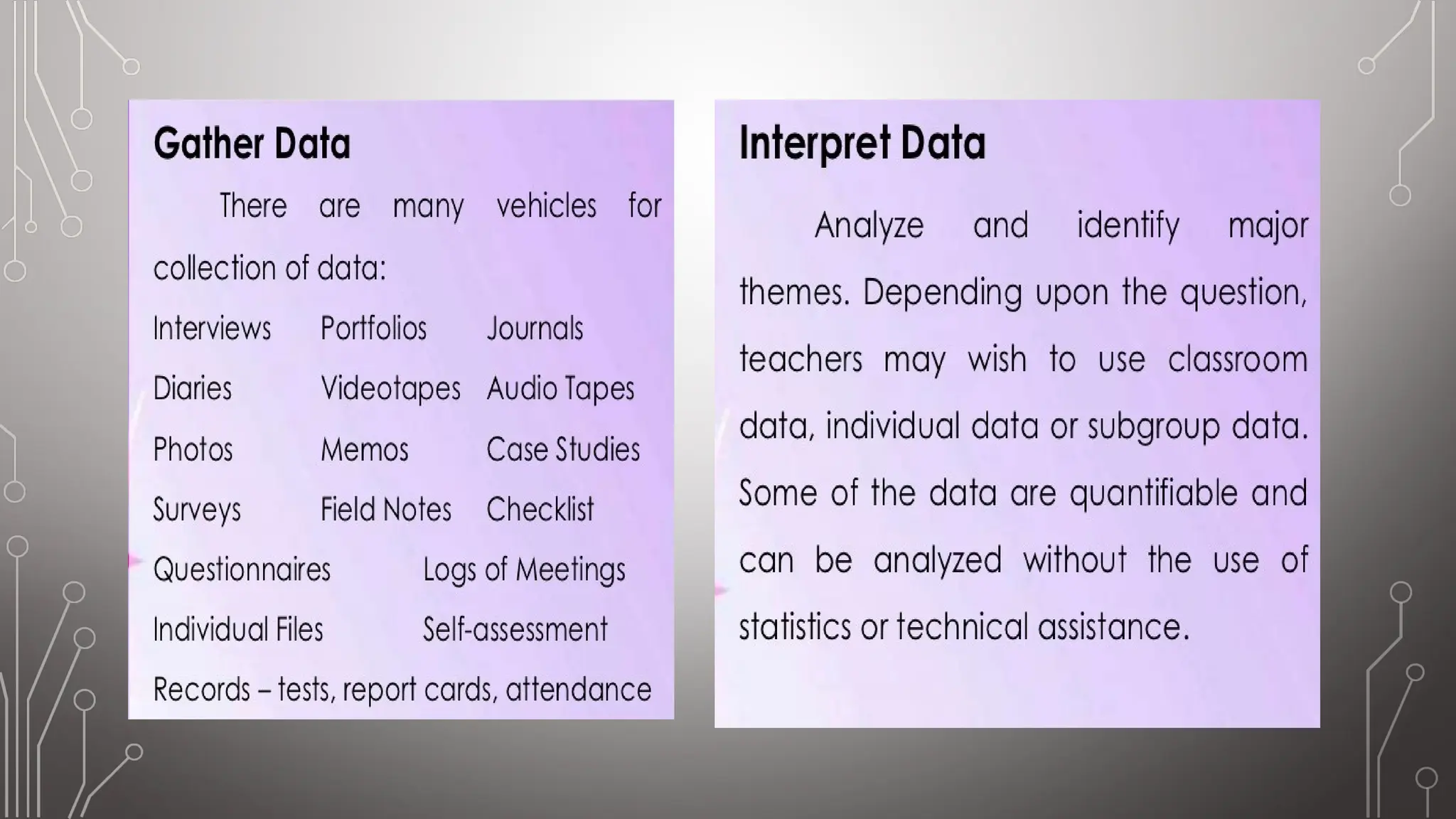
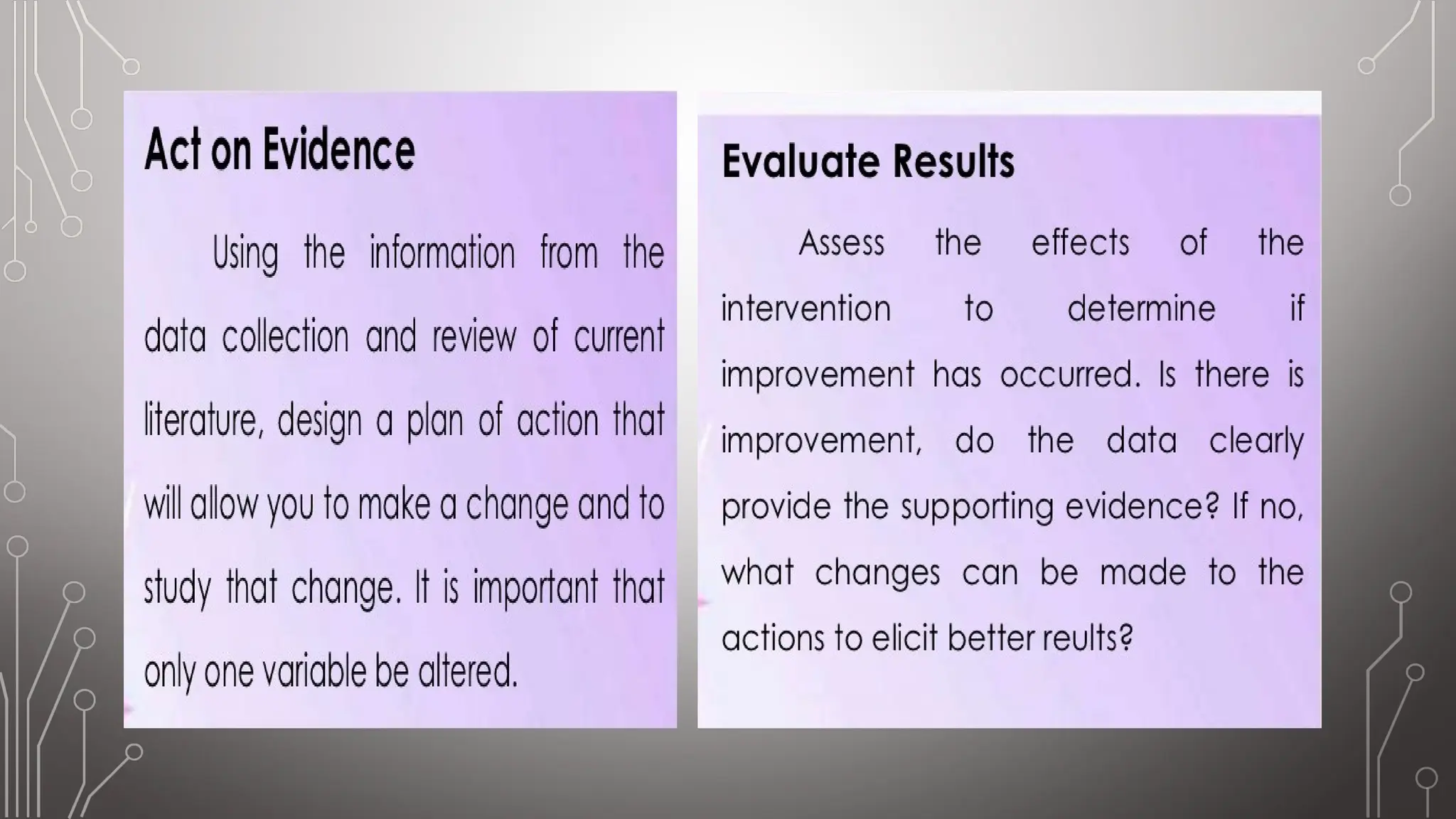
 Identifying a Problem
 Identifying the causes
 Stating the goal
 Framing the Hypothesis
 Collecting the relevant information
 Testing the Hypothesis
 Interpreting the Findings
 Comparing the findings with Prior
researchers’ findings
 Modifying Theory
 Asking New Questions
How to conduct Action Research?
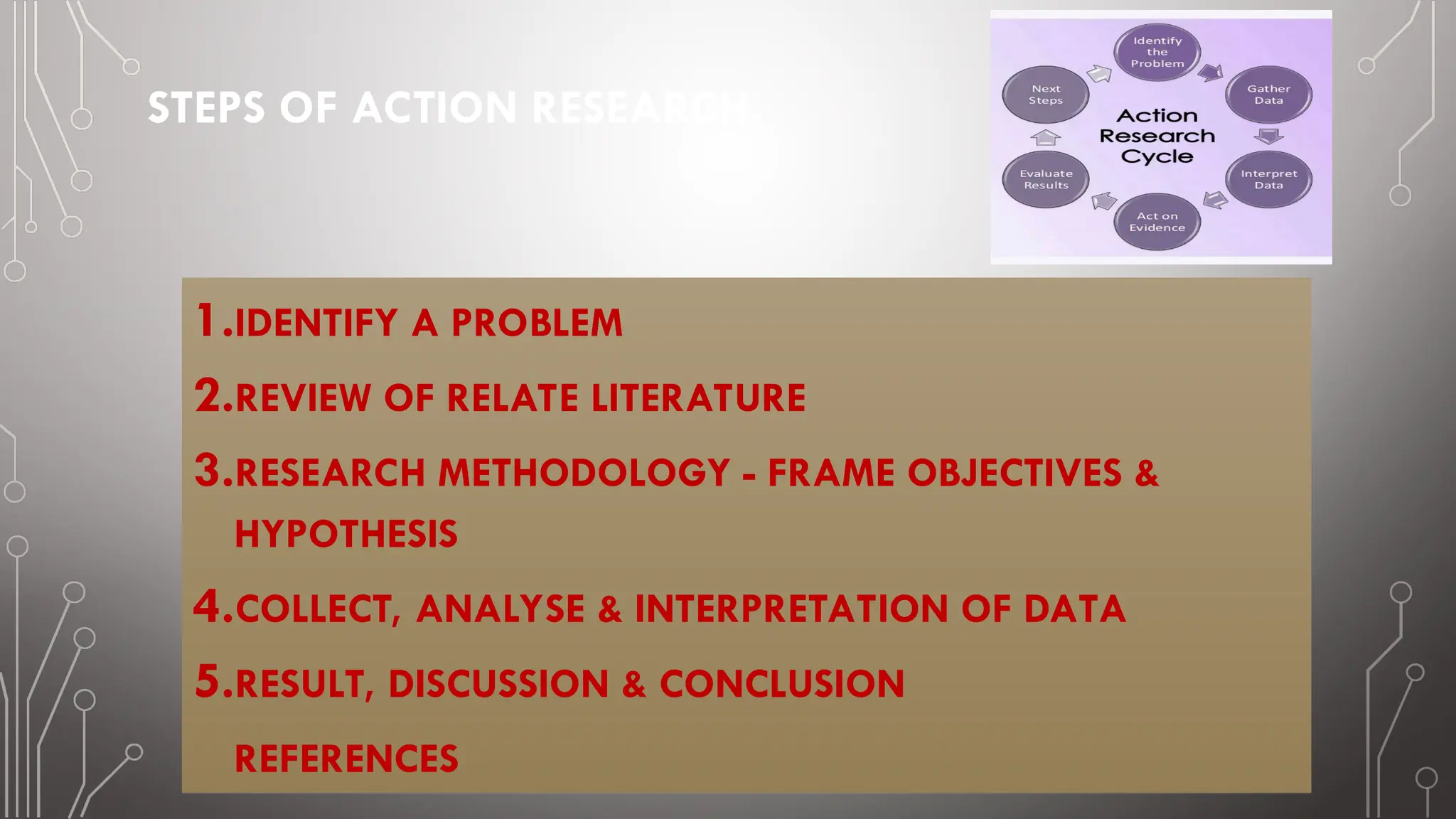
STEPS OF ACTION RESEARCH
1.IDENTIFY A PROBLEM
2.REVIEW OF RELATE LITERATURE
3.RESEARCH METHODOLOGY - FRAME OBJECTIVES &
HYPOTHESIS
4.COLLECT, ANALYSE & INTERPRETATION OF DATA
5.RESULT, DISCUSSION & CONCLUSION
REFERENCES
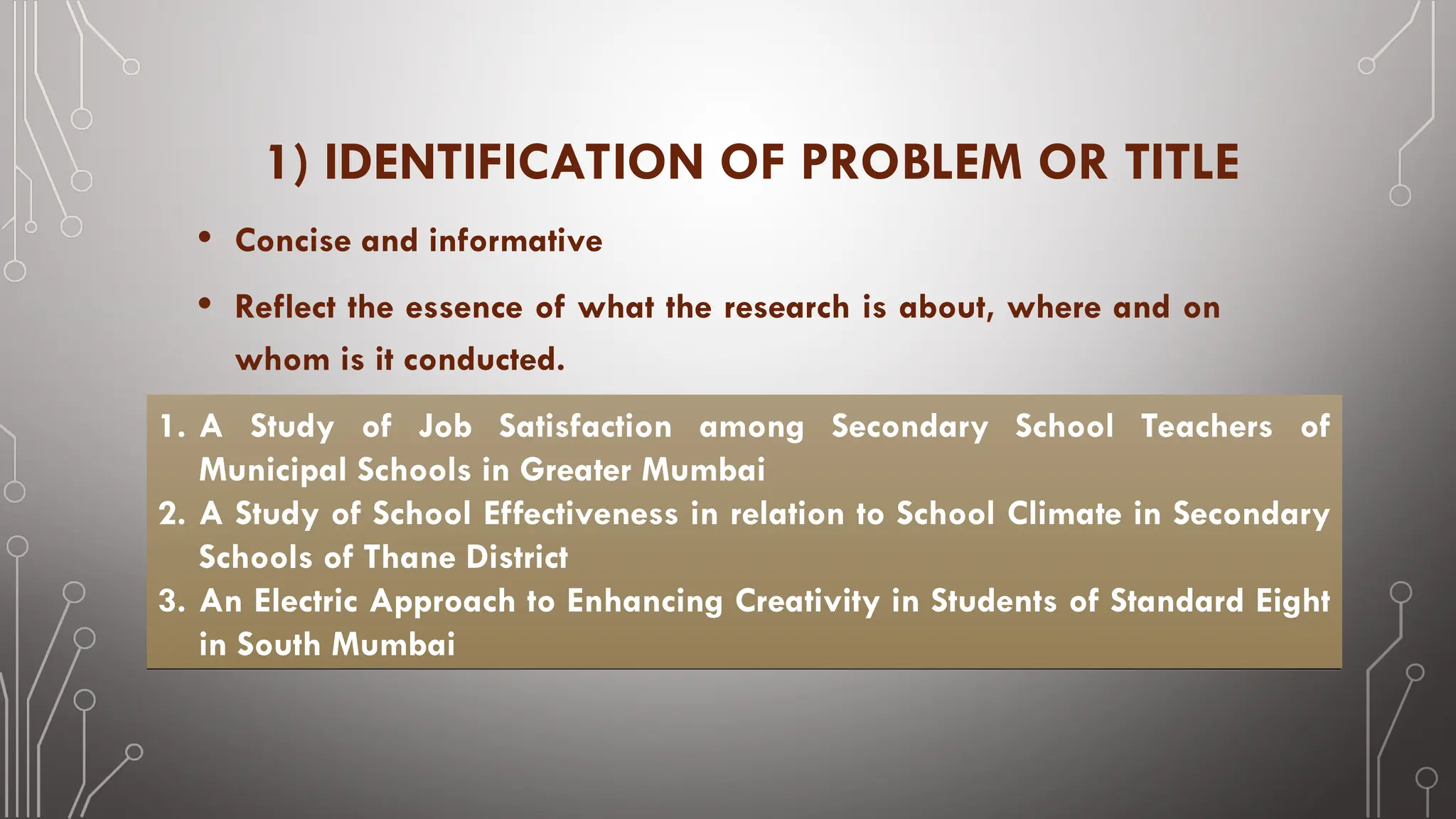
1) IDENTIFICATION OF PROBLEM OR TITLE
• Concise and informative
• Reflect the essence of what the research is about, where and on
whom is it conducted.
1. A Study of Job Satisfaction among Secondary School Teachers of
Municipal Schools in Greater Mumbai
2. A Study of School Effectiveness in relation to School Climate in Secondary
Schools of Thane District
3. An Electric Approach to Enhancing Creativity in Students of Standard Eight
in South Mumbai
2) REVIEW OF RELATED LITERATURE
“RE” + “VIEW”= Look Again
LITERATURE = what others have done
IN THE RELATED AREA
MUST INCLUDE:
At least three Indian Researcher’s Work
At least three foreign Researcher’s work
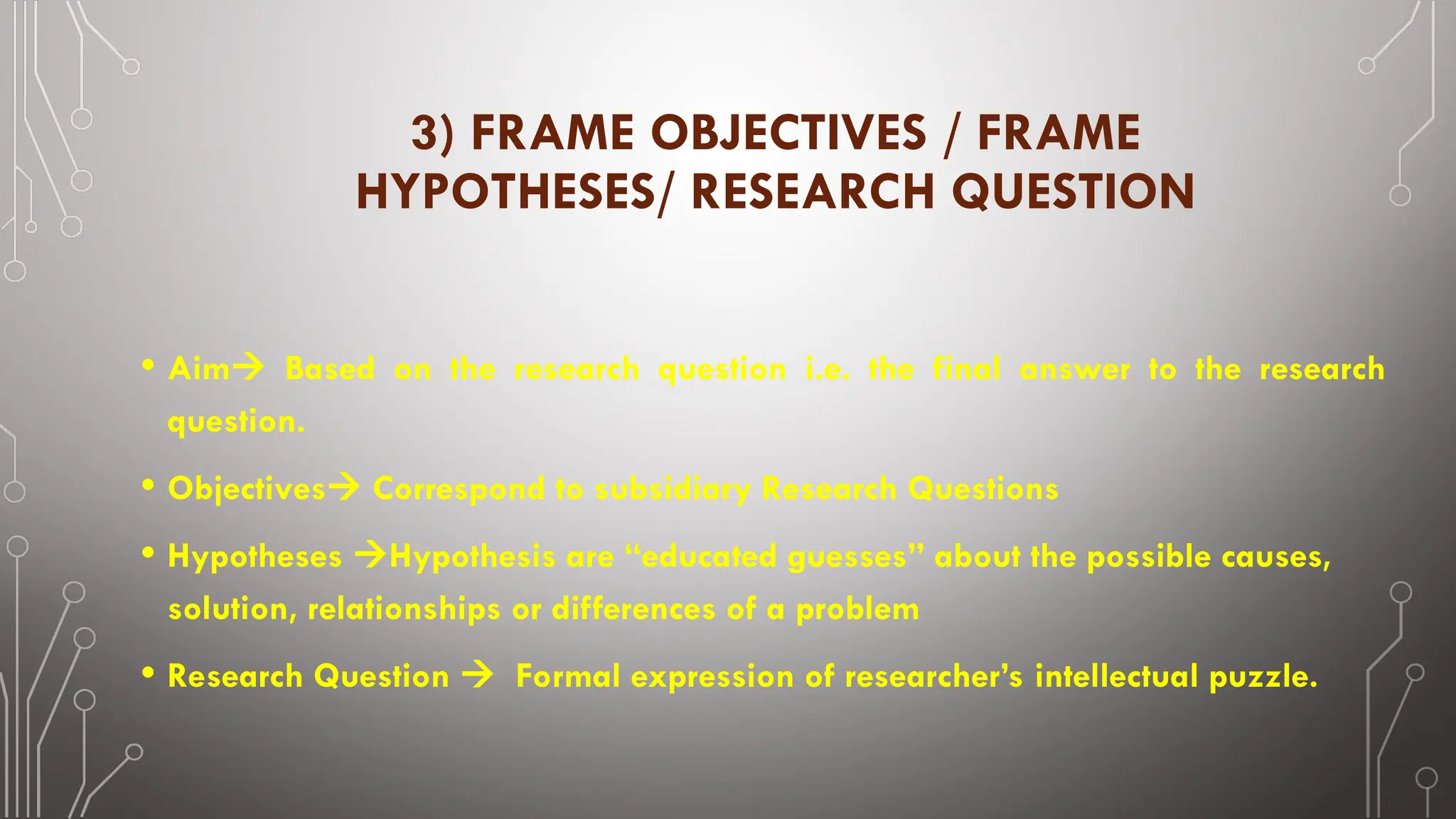
3) FRAME OBJECTIVES / FRAME
HYPOTHESES/ RESEARCH QUESTION
• Aim Based on the research question i.e. the final answer to the research
question.
• Objectives Correspond to subsidiary Research Questions
• Hypotheses Hypothesis are “educated guesses” about the possible causes,
solution, relationships or differences of a problem
• Research Question  Formal expression of researcher’s intellectual puzzle.
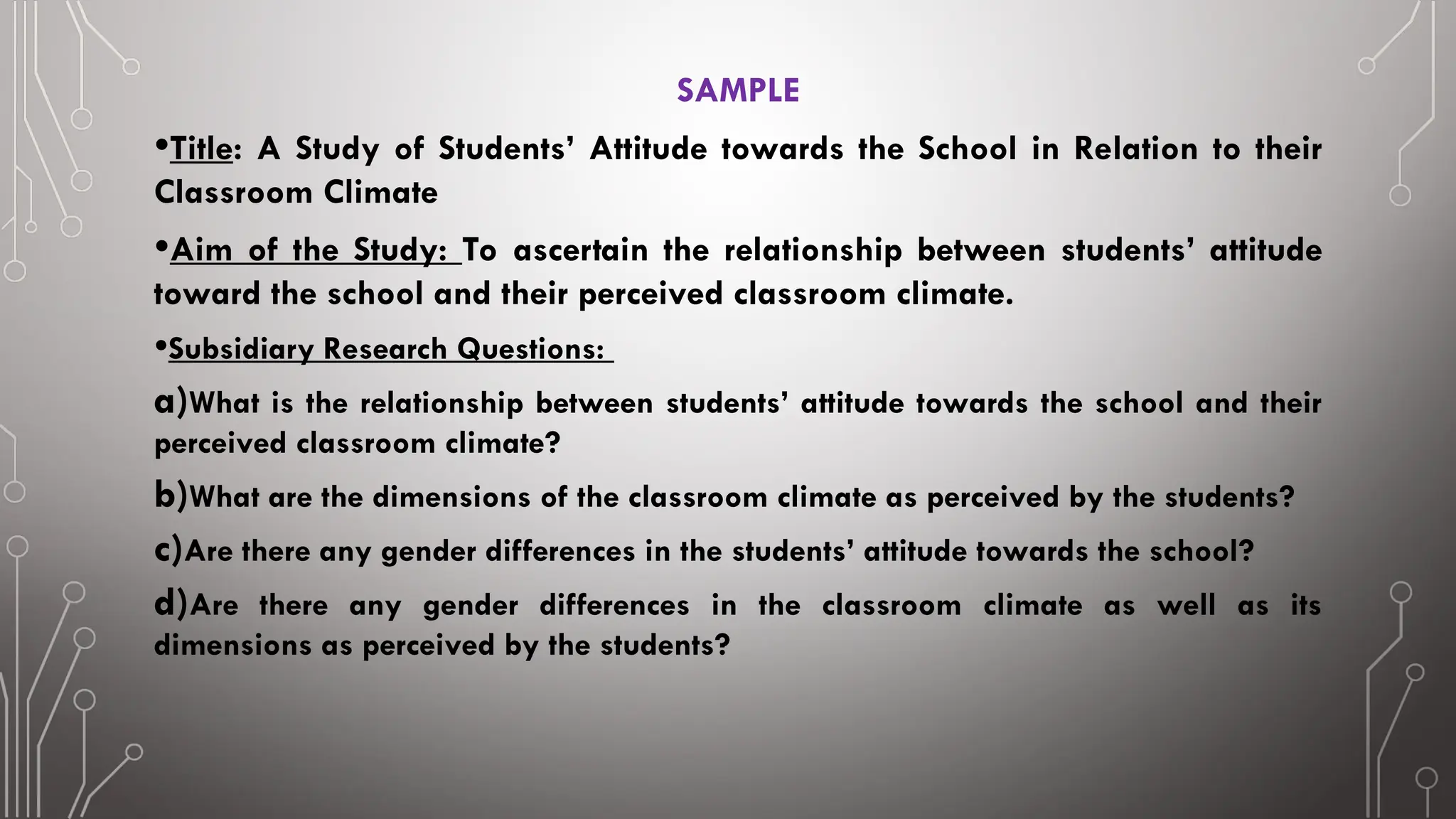
SAMPLE
•Title: A Study of Students’ Attitude towards the School in Relation to their
Classroom Climate
•Aim of the Study: To ascertain the relationship between students’ attitude
toward the school and their perceived classroom climate.
•Subsidiary Research Questions:
a)What is the relationship between students’ attitude towards the school and their
perceived classroom climate?
b)What are the dimensions of the classroom climate as perceived by the students?
c)Are there any gender differences in the students’ attitude towards the school?
d)Are there any gender differences in the classroom climate as well as its
dimensions as perceived by the students?
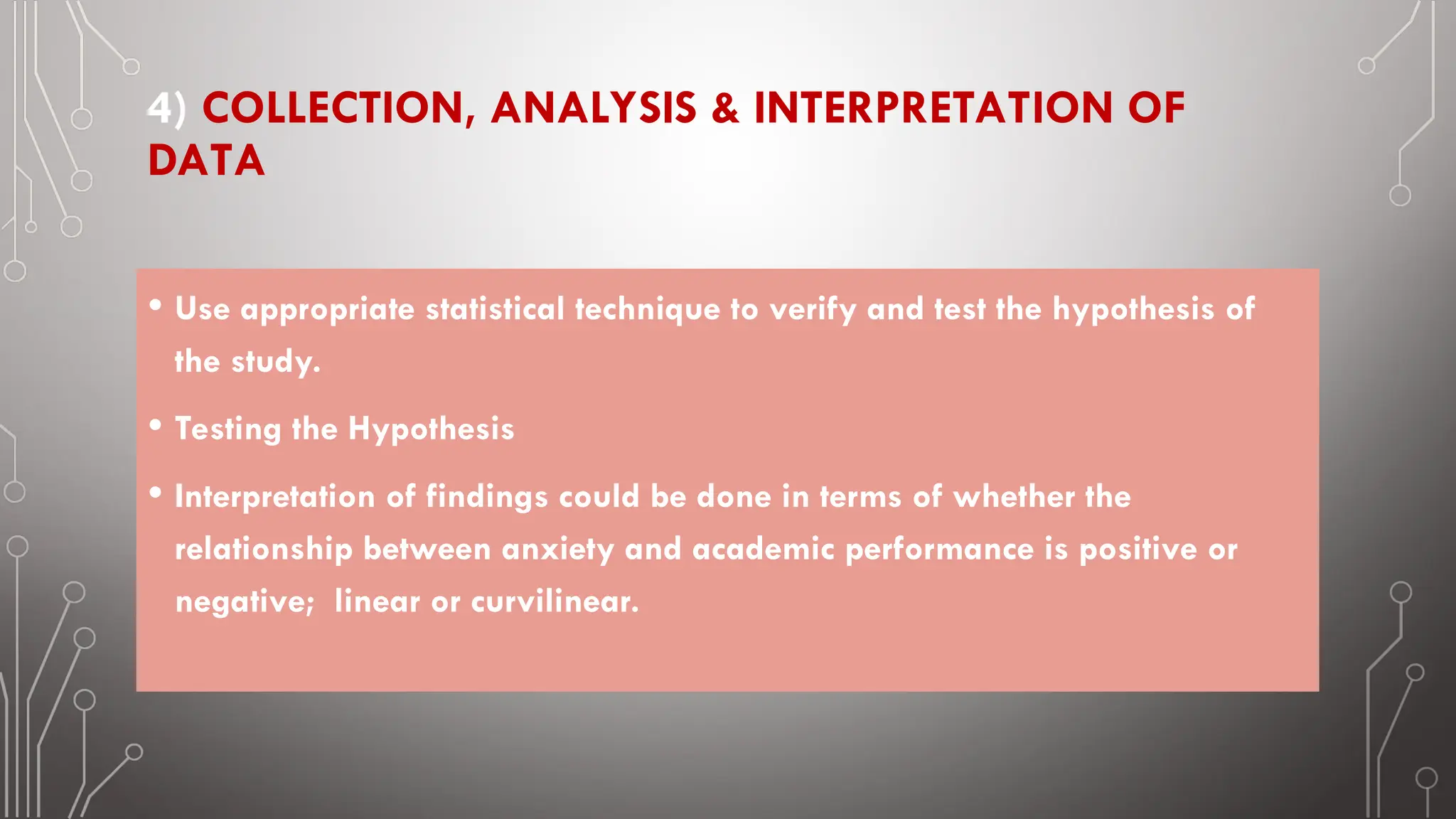
4) COLLECTION, ANALYSIS & INTERPRETATION OF
DATA
• Use appropriate statistical technique to verify and test the hypothesis of
the study.
• Testing the Hypothesis
• Interpretation of findings could be done in terms of whether the
relationship between anxiety and academic performance is positive or
negative; linear or curvilinear.
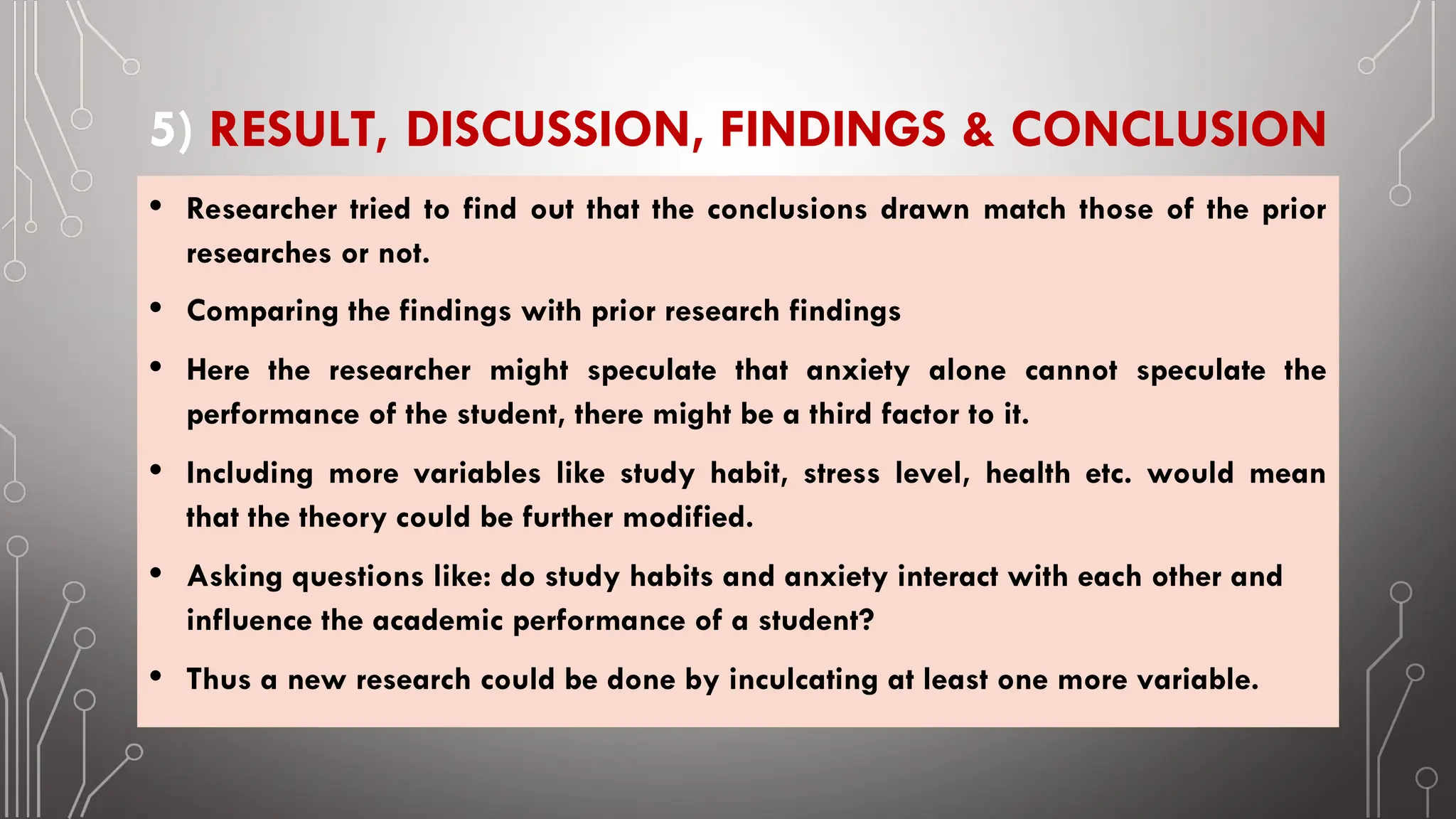
5) RESULT, DISCUSSION, FINDINGS & CONCLUSION
• Researcher tried to find out that the conclusions drawn match those of the prior
researches or not.
• Comparing the findings with prior research findings
• Here the researcher might speculate that anxiety alone cannot speculate the
performance of the student, there might be a third factor to it.
• Including more variables like study habit, stress level, health etc. would mean
that the theory could be further modified.
• Asking questions like: do study habits and anxiety interact with each other and
influence the academic performance of a student?
• Thus a new research could be done by inculcating at least one more variable.
CHAPTER 1: INTRODUCTION
•  Background of the Study
•  Statement of the Problem
•  Theoretical Framework
•  Conceptual Framework
•  Assumptions and Hypothesis
•  Scope and Delimitations of the Study
•  Limitations of the Study
•  Definition of Terms
Introduction
It Discusses Four (4) Relevant Ideas:
 Topic Or Subject Matter: Define And Elaborate Using Methods Of
Paragraph Development Like Classification And Giving Examples
 Importance Of The Topic: Cite The Role That The Topic Plays In
Your Life And The Benefits You Derive From It.
 Reasons For Choosing The Topic: Emphasized What Motivated
You To Choose The Topic.
 Purpose Of The Study: Discusses The Objective Of The Study.
Background Of The Study
Consists Of Statements On What Led The Investigator To Launch The

Study.
May Have Been Generated By Some Empirical Observations, The Need

To Explore The Problem And Some Other Relevant Conditions.
Describe As Clearly As Possible The Problem Intended To Be Addressed

And Refer To The Relevant Literature In The Field.
It Is An Overview Of Factors Which Have Led To The Problem, Comprise

The Problem And Historical Significance Relative To The Problem.
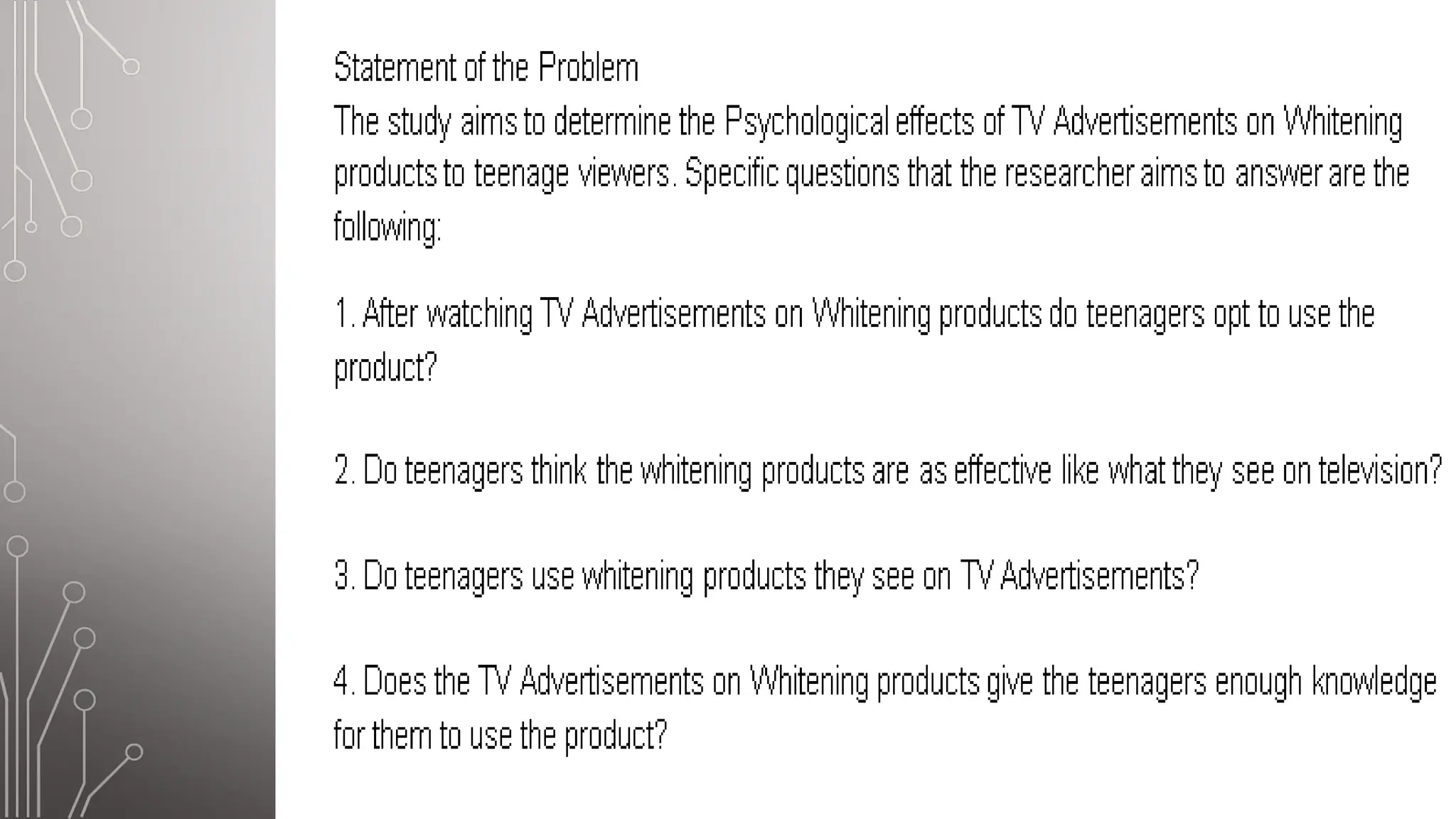
Statement Of The Problem
There Should Be A General Statement Of The Whole
Problem Followed By The Specific Questions
Or Sub Problems Into Which The General Problem Is
Broken Up
• .
Theoretical Framework
 This Is The Foundation Of The Research Study. These Are Highly Related
Theories And Principles That Were Established And Proven By Authorities.
Refers To The Set Of Interrelated Construct, Definitions, And Prepositions

That Presents A Systematic View Of Phenomena An Organized Body That
Explains What Has Been Done And What Has Been Said On The Topic Or
Problem Being Investigated.
• What must be obtained from a theory?
•  The name/s of author/s of the theory must be taken including the place and
• the time / year when he or she postulated such a principle or generalization.
•  the part or parts of the theory that are relevant to your study
•  synthesis by relating to your findings
Conceptual Framework
A Tentative Explanation Or Theoretical Explanation Of The Phenomenon

Or Problem And Serves As The Basis For The Formulation Research
Hypotheses.
Consists Of The Investigator’s Own Position On A Problem After His

Exposure To Various Theories That Have Bearing On The Problem
• The conceptual framework becomes the central theme, the focus, the main
thrust of the study. It serves as a guide in conducting investigation.
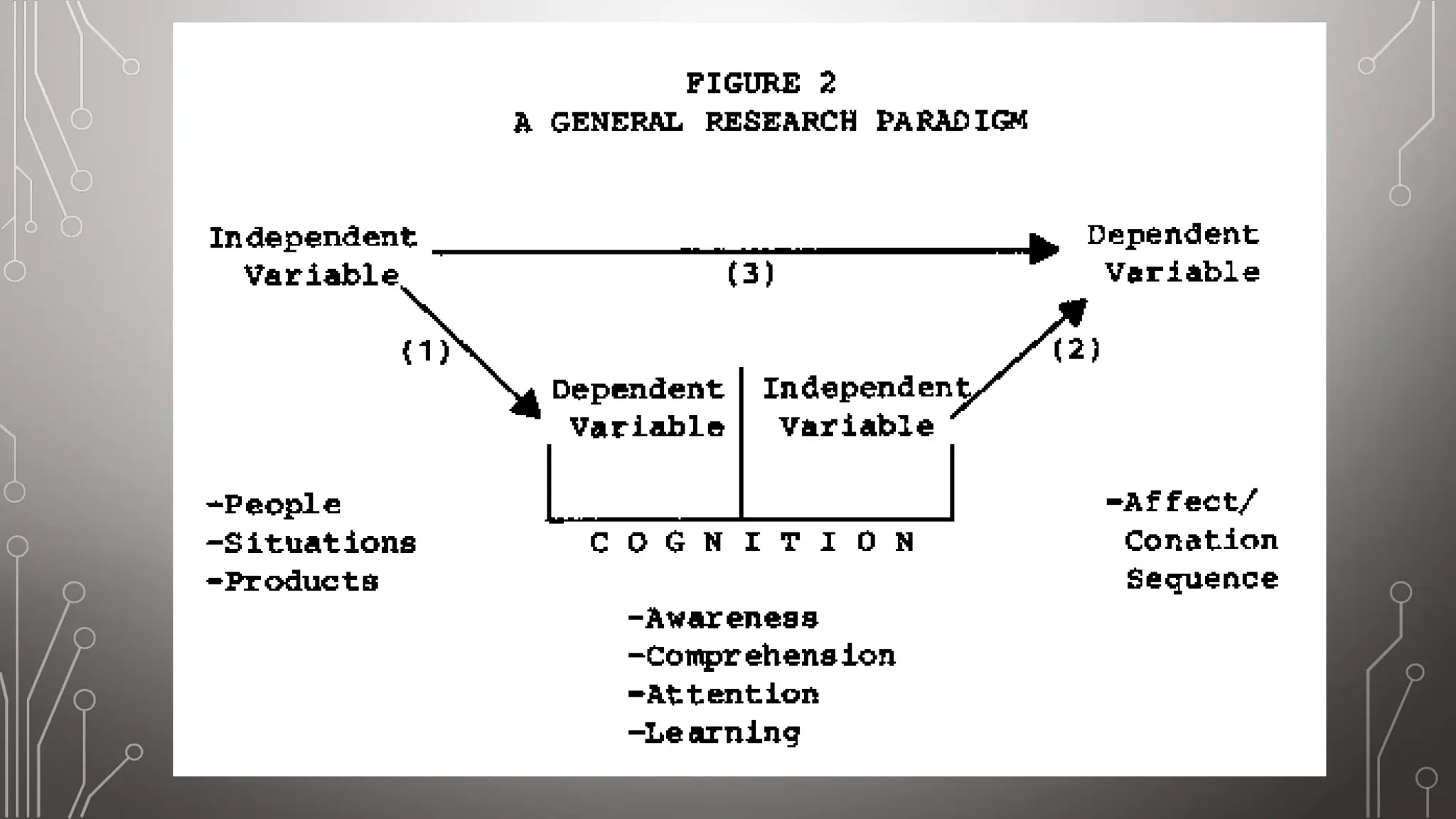
•  Paradigm. A paradigm is a diagrammatic representation of a conceptual
framework. It depicts in a more vivid way what the conceptual framework
wants to convey.
Assumptions
Historical And Descriptive Investigations.
Do Not Need Explicit Hypotheses And Assumptions.
Only Experimental Studies Need Expressly Written Assumptions And Hypotheses.
 Assumptions- A Belief That Forms One Of The Bases For The Research. This Belief
Is Not To Be Tested Or Supported With Empirical Data. Very Often Belief Is Not
Stated In A Research Proposal.
Example:
The researcher might assume that a new teaching strategy will positively impact student
learning.
Example:
They might assume that the school environment is a key factor influencing student
behavior.
Hypothesis Is A Tentative Answer To A Research
Question, It Can Be Derived From The Observation Before
The Research Is Conducted. This Is Called Inductive
Hypothesis. From The Theory. This Is Called Deductive
Hypothesis.
Kinds of Hypothesis
 Research hypothesis is usually developed from
experience, literature or theory, or combination of these.
This is the expected relationship between variables.
 Null hypothesis is the one that states NO relationship
between varibales. The function is to let the research test
the hypothesis statistically.
SCOPE AND DELIMITATIONS
A Brief Statement Of The General Purpose Of The

Study.
The Subject Matter And Topics Studied And Discussed.

The Locale Of The Study, Where The Data Were

Gathered Or The Entity To Which The Data Belong.
The Population Or Universe From Which The

Respondents Were Selected.
This Must Be Large Enough To Make Generalizations

Significant.
The Period Of The Study. This Is The Time, Either

Months Or Years, During Which The Data Were Gathered
Limitations Of The Study
Include The Weaknesses Of The Study Beyond

The Control Of The Researcher.
The Weaknesses Spring Out Of The Inaccuracies

Of The Perceptions Of The Respondents.
Variables
Variable Is The Operationalized Way In Which The Attribute Is Represented
For Further Data Processing.
Values Of Each Variable Statistically "Vary" (Or Are Distributed) Across

The Variable's Domain
Basically, A Variable Is Any Factor That Can Be Controlled, Changed, Or

Measured In An Experiment.
• Types of Variables
•  The independent variable is the one condition that you change in an experiment.
•  The dependent variable is the variable that you measure or observe. It is the
factor that is dependent on the state of the independent variable.
• A controlled variable or constant variable is a variable that does not change
during an experiment.
•  Extraneous variables are "extra“ variables that may influence the outcome of an
experiment, but aren't taken into account during measurement.
Significance Of The Study
 The Rationale, Timeliness And/Or Relevance Of The Study. The Rationale,
Timeliness And/Or Relevance Of The Study To Existing Conditions Must Be
Explained Or Discussed.
 Possible Solutions To Existing Problems Or Improvement To Unsatisfactory
Conditions.
• Who are to be benefited and how they are going to be benefited. It must be
shown who are the individuals, groups, or communities who may be placed
in a more advantageous position on account of the study.
• Possible contribution to the fund of knowledge.
• Possible implications. It should be discussed here that the implications include
the possible causes of the problems discovered, the possible effects of the
problems, and the remedial measures to solve the problems.
DEFINITION OF TERMS
 Only Terms, Words, Or Phrases Which Have Special Or Unique Meanings In The
Study Are Defined.
Terms Should Be Defined Operationally, That Is How They Are Used In The Study.

The Researcher May Develop His Own Definition From The Characteristics Of The Term

Defined.
• Definitions may be taken from encyclopedias, books, magazines and
newspaper articles, dictionaries, and other publications but the researcher
must acknowledge his sources.
•  Definitions should abe brief, clear, and unequivocal as possible.
•  Acronyms should always be spelled out fully
• Conceptual definition
• Operational definition
Action_Research_Chapter1Introduction.ppt

  • 1.
  • 3.
    WHAT IS RESEARCH? •“Research” ‘re’ + ‘search’ • ‘re’ means ‘again’ frequentative and intensive • ‘ search’ means ‘ to find out’ • ‘search’ means ‘enquiry’, ‘investigation’ or ‘ test’ • It is a the systematic investigation into and study of materials and sources in order to establish facts and reach new conclusions.
  • 4.
  • 5.
    WHAT IS ACTIONRESEARCH? Action research can be described as a family of research methodologies which pursue ACTION (or Change) and RESEARCH (or Understanding) at the same time.
  • 6.
    WHAT IS ACTIONRESEARCH? • It is applied in nature and is associated with “Hands-On” or small scale research projects. • It is also known as decision-oriented research since it necessitated that the researcher is the same person as the practitioner who will make and implement the decision based on the findings.
  • 7.
    OBJECTIVE OF ACTIONRESEARCH •Action research placed its emphasis on the solution of a problem in a local setting. Real Problem Find solutions
  • 8.
    PURPOSE/NEED TO CONDUCT ACTIONRESEARCH • reflecting more deeply and systematically on teaching practices. • improving the teaching process and practices for the all round development of students. • providing students a better learning environment. • tackling the problems of access, enrolment, retention and learning among your students relating to your day to day classroom activities. • increasing student achievement. • improving quality of education. • generating genuine and sustained improvements in schools.
  • 9.
    DEFINITION OF ACTIONRESEARCH • The type of systematic effort by the teachers by reflecting on their own practices and making needed changes is called as ‘Action Research’. • Action research is systematic inquiry one by the teachers to gather information and subsequently improve the ways how they teach and how well the students learn.
  • 10.
    SCOPE OF ACTIONRESEARCH UNDERSTANDING STUDENT CHARACTERISTICS {Personal or academic} • pronunciation problem in english, poor reading ability • competencies in mathematics,, how to improve problem-solving skills in mathematics, increasing interest, causes of absenteeism, • to improve the quality of student writing, process skills in science, inquiry skills in science, performance/ achievement in science. • UNDERSTANDING STUDENT BEHAVIOR • Reasons of shyness in classroom • low attendance in the classroom, poor reading habits among the students • study habit, stress level, attitude, anxiety, depression, mental health etc.
  • 11.
    WHO CAN PERFORMACTION RESEARCH? • School Teachers / Student–Teachers / College Teachers / Classroom Teachers • Principals/Head of Departments/ School supervisors • Workers in the community development • Practitioners in any field • Block education officers, district education officers, inspectors of schools • Policy Makers • Counselors
  • 12.
    TYPES OF ACTIONRESEARCH INDIVIDUAL TEACHER RESEARCH COLLABORATIVE ACTION RESEARCH SCHOOL-WIDE ACTION RESEARCH DISTRICT-WIDE ACTION RESEARCH Focus Single classroom Issue Eg. Gender difference in interest towards a subject Single Class room or several classrooms with common issue Eg. Quality of teacher pupil interaction School issue, problem, or area of collective Interest Eg. lack of parental involvement in school activities. District issue Organizational Structures Eg. high drop out rate in primary schools.
  • 13.
    • PLAN • ACT •OBSERVE • REFLECT  Identifying a Problem  Identifying the causes  Stating the goal  Framing the Hypothesis  Collecting the relevant information  Testing the Hypothesis  Interpreting the Findings  Comparing the findings with Prior researchers’ findings  Modifying Theory  Asking New Questions How to conduct Action Research?
  • 14.
    STEPS OF ACTIONRESEARCH 1.IDENTIFY A PROBLEM 2.REVIEW OF RELATE LITERATURE 3.RESEARCH METHODOLOGY - FRAME OBJECTIVES & HYPOTHESIS 4.COLLECT, ANALYSE & INTERPRETATION OF DATA 5.RESULT, DISCUSSION & CONCLUSION REFERENCES
  • 15.
    1) IDENTIFICATION OFPROBLEM OR TITLE • Concise and informative • Reflect the essence of what the research is about, where and on whom is it conducted. 1. A Study of Job Satisfaction among Secondary School Teachers of Municipal Schools in Greater Mumbai 2. A Study of School Effectiveness in relation to School Climate in Secondary Schools of Thane District 3. An Electric Approach to Enhancing Creativity in Students of Standard Eight in South Mumbai
  • 16.
    2) REVIEW OFRELATED LITERATURE “RE” + “VIEW”= Look Again LITERATURE = what others have done IN THE RELATED AREA MUST INCLUDE: At least three Indian Researcher’s Work At least three foreign Researcher’s work
  • 17.
    3) FRAME OBJECTIVES/ FRAME HYPOTHESES/ RESEARCH QUESTION • Aim Based on the research question i.e. the final answer to the research question. • Objectives Correspond to subsidiary Research Questions • Hypotheses Hypothesis are “educated guesses” about the possible causes, solution, relationships or differences of a problem • Research Question  Formal expression of researcher’s intellectual puzzle.
  • 18.
    SAMPLE •Title: A Studyof Students’ Attitude towards the School in Relation to their Classroom Climate •Aim of the Study: To ascertain the relationship between students’ attitude toward the school and their perceived classroom climate. •Subsidiary Research Questions: a)What is the relationship between students’ attitude towards the school and their perceived classroom climate? b)What are the dimensions of the classroom climate as perceived by the students? c)Are there any gender differences in the students’ attitude towards the school? d)Are there any gender differences in the classroom climate as well as its dimensions as perceived by the students?
  • 20.
    4) COLLECTION, ANALYSIS& INTERPRETATION OF DATA • Use appropriate statistical technique to verify and test the hypothesis of the study. • Testing the Hypothesis • Interpretation of findings could be done in terms of whether the relationship between anxiety and academic performance is positive or negative; linear or curvilinear.
  • 23.
    5) RESULT, DISCUSSION,FINDINGS & CONCLUSION • Researcher tried to find out that the conclusions drawn match those of the prior researches or not. • Comparing the findings with prior research findings • Here the researcher might speculate that anxiety alone cannot speculate the performance of the student, there might be a third factor to it. • Including more variables like study habit, stress level, health etc. would mean that the theory could be further modified. • Asking questions like: do study habits and anxiety interact with each other and influence the academic performance of a student? • Thus a new research could be done by inculcating at least one more variable.
  • 26.
    CHAPTER 1: INTRODUCTION • Background of the Study •  Statement of the Problem •  Theoretical Framework •  Conceptual Framework •  Assumptions and Hypothesis •  Scope and Delimitations of the Study •  Limitations of the Study •  Definition of Terms
  • 27.
    Introduction It Discusses Four(4) Relevant Ideas:  Topic Or Subject Matter: Define And Elaborate Using Methods Of Paragraph Development Like Classification And Giving Examples  Importance Of The Topic: Cite The Role That The Topic Plays In Your Life And The Benefits You Derive From It.  Reasons For Choosing The Topic: Emphasized What Motivated You To Choose The Topic.  Purpose Of The Study: Discusses The Objective Of The Study.
  • 29.
    Background Of TheStudy Consists Of Statements On What Led The Investigator To Launch The  Study. May Have Been Generated By Some Empirical Observations, The Need  To Explore The Problem And Some Other Relevant Conditions. Describe As Clearly As Possible The Problem Intended To Be Addressed  And Refer To The Relevant Literature In The Field. It Is An Overview Of Factors Which Have Led To The Problem, Comprise  The Problem And Historical Significance Relative To The Problem.
  • 31.
    Statement Of TheProblem There Should Be A General Statement Of The Whole Problem Followed By The Specific Questions Or Sub Problems Into Which The General Problem Is Broken Up • .
  • 33.
    Theoretical Framework  ThisIs The Foundation Of The Research Study. These Are Highly Related Theories And Principles That Were Established And Proven By Authorities. Refers To The Set Of Interrelated Construct, Definitions, And Prepositions  That Presents A Systematic View Of Phenomena An Organized Body That Explains What Has Been Done And What Has Been Said On The Topic Or Problem Being Investigated. • What must be obtained from a theory? •  The name/s of author/s of the theory must be taken including the place and • the time / year when he or she postulated such a principle or generalization. •  the part or parts of the theory that are relevant to your study •  synthesis by relating to your findings
  • 34.
    Conceptual Framework A TentativeExplanation Or Theoretical Explanation Of The Phenomenon  Or Problem And Serves As The Basis For The Formulation Research Hypotheses. Consists Of The Investigator’s Own Position On A Problem After His  Exposure To Various Theories That Have Bearing On The Problem • The conceptual framework becomes the central theme, the focus, the main thrust of the study. It serves as a guide in conducting investigation. •  Paradigm. A paradigm is a diagrammatic representation of a conceptual framework. It depicts in a more vivid way what the conceptual framework wants to convey.
  • 36.
    Assumptions Historical And DescriptiveInvestigations. Do Not Need Explicit Hypotheses And Assumptions. Only Experimental Studies Need Expressly Written Assumptions And Hypotheses.  Assumptions- A Belief That Forms One Of The Bases For The Research. This Belief Is Not To Be Tested Or Supported With Empirical Data. Very Often Belief Is Not Stated In A Research Proposal. Example: The researcher might assume that a new teaching strategy will positively impact student learning. Example: They might assume that the school environment is a key factor influencing student behavior.
  • 37.
    Hypothesis Is ATentative Answer To A Research Question, It Can Be Derived From The Observation Before The Research Is Conducted. This Is Called Inductive Hypothesis. From The Theory. This Is Called Deductive Hypothesis. Kinds of Hypothesis  Research hypothesis is usually developed from experience, literature or theory, or combination of these. This is the expected relationship between variables.  Null hypothesis is the one that states NO relationship between varibales. The function is to let the research test the hypothesis statistically.
  • 38.
    SCOPE AND DELIMITATIONS ABrief Statement Of The General Purpose Of The  Study. The Subject Matter And Topics Studied And Discussed.  The Locale Of The Study, Where The Data Were  Gathered Or The Entity To Which The Data Belong. The Population Or Universe From Which The  Respondents Were Selected. This Must Be Large Enough To Make Generalizations  Significant. The Period Of The Study. This Is The Time, Either  Months Or Years, During Which The Data Were Gathered
  • 40.
    Limitations Of TheStudy Include The Weaknesses Of The Study Beyond  The Control Of The Researcher. The Weaknesses Spring Out Of The Inaccuracies  Of The Perceptions Of The Respondents.
  • 42.
    Variables Variable Is TheOperationalized Way In Which The Attribute Is Represented For Further Data Processing. Values Of Each Variable Statistically "Vary" (Or Are Distributed) Across  The Variable's Domain Basically, A Variable Is Any Factor That Can Be Controlled, Changed, Or  Measured In An Experiment. • Types of Variables •  The independent variable is the one condition that you change in an experiment. •  The dependent variable is the variable that you measure or observe. It is the factor that is dependent on the state of the independent variable. • A controlled variable or constant variable is a variable that does not change during an experiment. •  Extraneous variables are "extra“ variables that may influence the outcome of an experiment, but aren't taken into account during measurement.
  • 43.
    Significance Of TheStudy  The Rationale, Timeliness And/Or Relevance Of The Study. The Rationale, Timeliness And/Or Relevance Of The Study To Existing Conditions Must Be Explained Or Discussed.  Possible Solutions To Existing Problems Or Improvement To Unsatisfactory Conditions. • Who are to be benefited and how they are going to be benefited. It must be shown who are the individuals, groups, or communities who may be placed in a more advantageous position on account of the study. • Possible contribution to the fund of knowledge. • Possible implications. It should be discussed here that the implications include the possible causes of the problems discovered, the possible effects of the problems, and the remedial measures to solve the problems.
  • 45.
    DEFINITION OF TERMS Only Terms, Words, Or Phrases Which Have Special Or Unique Meanings In The Study Are Defined. Terms Should Be Defined Operationally, That Is How They Are Used In The Study.  The Researcher May Develop His Own Definition From The Characteristics Of The Term  Defined. • Definitions may be taken from encyclopedias, books, magazines and newspaper articles, dictionaries, and other publications but the researcher must acknowledge his sources. •  Definitions should abe brief, clear, and unequivocal as possible. •  Acronyms should always be spelled out fully • Conceptual definition • Operational definition