What are student’sbehaviors
for the processes?
The seven mathematical processes describe the actions of doing mathematics (ie
Problem solving)
Problem solving (develop, select, apply, and compare a variety of problem-
solving strategies as they pose and solve problems and conduct investigations)
Reasoning & Proving (Hypothesizing, Making inferences, conclusions, and
justifications)
Reflecting (Considering data collected, Reflecting on new skills, concepts, and
questions to see how they connect to prior knowledge )
Selecting tools & Computational strategies (select and use a variety of
concrete, visual, and electronic learning tools and appropriate computational
strategies)
Connecting (make connections among mathematical concepts and
procedures, and relate mathematical ideas to situations or phenomena drawn
from other contexts )
Representing (in form of equation)
Communicating (Using mathematical language)
3.
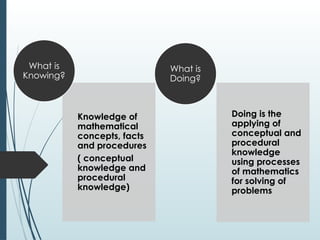
Knowledge of
mathematical
concepts, facts
andprocedures
( conceptual
knowledge and
procedural
knowledge)
What is
Knowing?
Doing is the
applying of
conceptual and
procedural
knowledge
using processes
of mathematics
for solving of
problems
What is
Doing?
4.
Knowing vs Doing
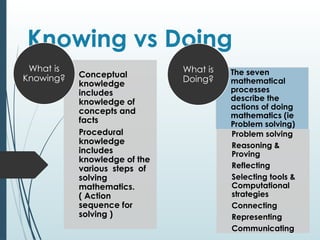
Conceptual
knowledge
includes
knowledgeof
concepts and
facts
Procedural
knowledge
includes
knowledge of the
various steps of
solving
mathematics.
( Action
sequence for
solving )
What is
Knowing?
The seven
mathematical
processes
describe the
actions of doing
mathematics (ie
Problem solving)
Problem solving
Reasoning &
Proving
Reflecting
Selecting tools &
Computational
strategies
Connecting
Representing
Communicating
What is
Doing?
5.
Knowing vs Doing
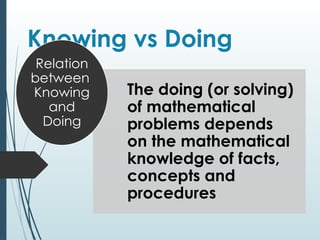
Thedoing (or solving)
of mathematical
problems depends
on the mathematical
knowledge of facts,
concepts and
procedures
Relation
between
Knowing
and
Doing
6.
Knowing vs Doing
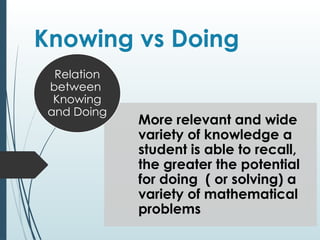
Morerelevant and wide
variety of knowledge a
student is able to recall,
the greater the potential
for doing ( or solving) a
variety of mathematical
problems
Relation
between
Knowing
and Doing
7.
Knowing vs Doing
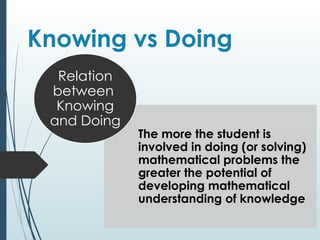
Themore the student is
involved in doing (or solving)
mathematical problems the
greater the potential of
developing mathematical
understanding of knowledge
Relation
between
Knowing
and Doing
8.
Knowing vs Doing
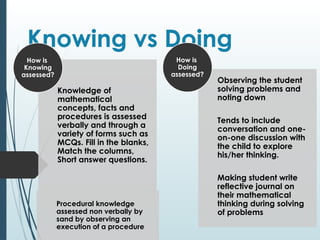
Knowledgeof
mathematical
concepts, facts and
procedures is assessed
verbally and through a
variety of forms such as
MCQs. Fill in the blanks,
Match the columns,
Short answer questions.
Procedural knowledge
assessed non verbally by
sand by observing an
execution of a procedure
How is
Knowing
assessed?
Observing the student
solving problems and
noting down
Tends to include
conversation and one-
on-one discussion with
the child to explore
his/her thinking.
Making student write
reflective journal on
their mathematical
thinking during solving
of problems
How is
Doing
assessed?
9.
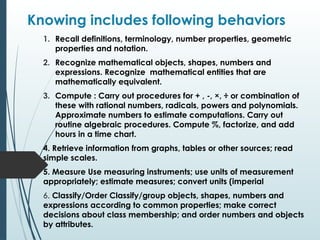
Knowing includes followingbehaviors
1. Recall definitions, terminology, number properties, geometric
properties and notation.
2. Recognize mathematical objects, shapes, numbers and
expressions. Recognize mathematical entities that are
mathematically equivalent.
3. Compute : Carry out procedures for + , -, ×, ÷ or combination of
these with rational numbers, radicals, powers and polynomials.
Approximate numbers to estimate computations. Carry out
routine algebraic procedures. Compute %, factorize, and add
hours in a time chart.
4. Retrieve information from graphs, tables or other sources; read
simple scales.
5. Measure Use measuring instruments; use units of measurement
appropriately; estimate measures; convert units (imperial
6. Classify/Order Classify/group objects, shapes, numbers and
expressions according to common properties; make correct
decisions about class membership; and order numbers and objects
by attributes.
10.
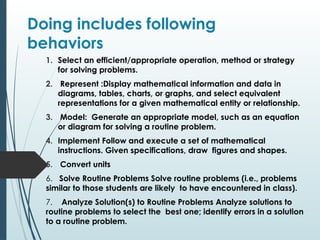
Doing includes following
behaviors
1.Select an efficient/appropriate operation, method or strategy
for solving problems.
2. Represent :Display mathematical information and data in
diagrams, tables, charts, or graphs, and select equivalent
representations for a given mathematical entity or relationship.
3. Model: Generate an appropriate model, such as an equation
or diagram for solving a routine problem.
4. Implement Follow and execute a set of mathematical
instructions. Given specifications, draw figures and shapes.
5. Convert units
6. Solve Routine Problems Solve routine problems (i.e., problems
similar to those students are likely to have encountered in class).
7. Analyze Solution(s) to Routine Problems Analyze solutions to
routine problems to select the best one; identify errors in a solution
to a routine problem.
11.
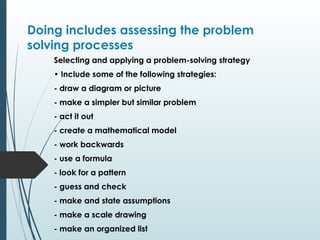
Doing includes assessingthe problem
solving processes
Selecting and applying a problem-solving strategy
• Include some of the following strategies:
- draw a diagram or picture
- make a simpler but similar problem
- act it out
- create a mathematical model
- work backwards
- use a formula
- look for a pattern
- guess and check
- make and state assumptions
- make a scale drawing
- make an organized list
12.
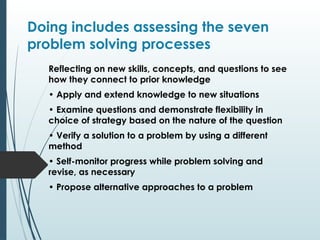
Doing includes assessingthe seven
problem solving processes
Reflecting on new skills, concepts, and questions to see
how they connect to prior knowledge
• Apply and extend knowledge to new situations
• Examine questions and demonstrate flexibility in
choice of strategy based on the nature of the question
• Verify a solution to a problem by using a different
method
• Self-monitor progress while problem solving and
revise, as necessary
• Propose alternative approaches to a problem
13.
Doing includes assessingthe seven
problem solving processes
Use an appropriate tool when:
- an exact answer is needed
- computation involves several numbers or
numbers with more than one digit
- the numbers are not easily calculated
mentally
• Use technology (e.g., graphing
calculators, spreadsheets) explore, gather,
display, manipulate, and present data in a
variety of ways
14.
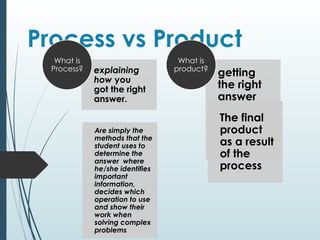
Process vs Product
explaining
howyou
got the right
answer.
Are simply the
methods that the
student uses to
determine the
answer where
he/she identifies
important
information,
decides which
operation to use
and show their
work when
solving complex
problems
What is
Process?
getting
the right
answer
The final
product
as a result
of the
process
What is
product?
15.
The correct processleads
to correct product.
Incorrect product
indicates deficiencies in
processes and
conceptual knowledge.
Relation
between
Process and
Product
16.
Product can beassessed
in following ways
Solve the following- the final answer
Represent in form of equation- the
equation
Construct the geometrical figure- the
geometrical figure
17.
Identifying Gifted, Mathematically
Backwardstudents and learners with
Dyscalculia
Characteristics of Gifted in
Mathematics,
Characteristics of Mathematically
Backward students and
Characteristics of learners with
Dyscalculia
18.
Identifying Gifted students–
Characteristics of Gifted in Mathematics
Few students will exhibit all characteristics and these
characteristics can emerge at different times as the child
develops cognitively, socio-emotionally, and physically.
The highly able mathematics student
independently demonstrates the ability to:
display mathematical thinking and have a keen
awareness for quantitative information in the world around
them.
think logically and symbolically about quantitative,
spatial, and abstract relationships.
perceive, visualize, and generalize numeric and non-
numeric patterns and relationships.
reason analytically, deductively, and inductively.
reverse reasoning processes and switch methods in a
flexible yet systematic manner.
19.
The highly ablemathematics student
independently demonstrates the ability
to:
work, communicate, and justify
mathematical concepts in creative and
intuitive ways, both verbally and in
writing.
transfer learning to novel situations.
formulate probing mathematical
questions that extend or apply concepts.
persist in their search for solutions to
complex, "messy," or "ill-defined" tasks.
organize information and data in a
variety of ways and to disregard
20.
The highly ablemathematics student
independently demonstrates the ability to:
grasp mathematical concepts and strategies
quickly, with good retention, and to relate
mathematical concepts within and across
content areas and real-life situations.
solve problems with multiple and/or alternative
solutions.
use mathematics with self-assurance.
take risks with mathematical concepts and
strategies.
apply a more extensive and in-depth
knowledge of a variety of major mathematical
topics.
apply estimation and mental computation
strategies.
21.
Mathematically Backward Learner
AMathematically Backward learner is one
whose educational attainment falls below
the level of their mental abilities in
mathematics.
22.
Characteristics of mathematically
Backwardlearner
Has difficulty with abstractions due to limited cognitive capacity
Is not logical in thinking
Lacks Imagination
Is unable to detect his/her own errors
Has little power to transfer training
Is not creative in thinking
Low Memory
Distraction and lacking concentration
Inability to express ideas
23.
Dyscalculia - Introduction
Alsocalled mathematical
disability
An individual can be low
in mathematical ability
and yet have above
average IQ
24.
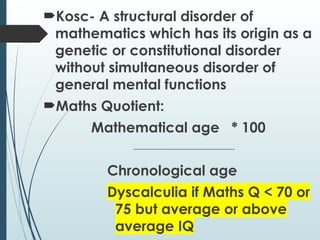
Kosc- A structuraldisorder of
mathematics which has its origin as a
genetic or constitutional disorder
without simultaneous disorder of
general mental functions
Maths Quotient:
Mathematical age * 100
Chronological age
Dyscalculia if Maths Q < 70 or
75 but average or above
average IQ
25.
Characteristics associated
with Dyscalculia
Normalor accelerated language
acquisition:
verbal, writing, reading
Poetic ability.
Good visual memory for the printed
word.
Good in the areas of science,
geometry(figures with logic not
formulas) and creative arts
26.
Mistaken recollectionof names. Poor name/ face
retrieval.
Substitues names beginning with same letter
Difficulty with the abstract concepts of time and direction.
Inability to recall schedules, and sequences of past or
future events.
Inconsistent results in addition ,subtraction multiplication
and division.
Poor mental math ability. Poor with money and credit.
Cannot do financial planning or budgeting. Checkbooks
not balanced.
Short term, not long term financial thinking.
Fails to see the big financial picture.
27.
When writing,reading and recalling numbers, these
common mistakes are made:
number additions, substitutions, transpositions,
omissions and reversals
Inability to grasp and remember math concepts,
rules, formulas and sequence(order of operation)
and basic addition, subtraction , multiplication and
division facts.
Poor long-term memory of concept mastery, may
be able to perform math operations one day, but
draws a blank the next day.
May be able to perform.
28.
Poor ability to“visualize or picture” the
location of the numbers on the face of
clock, the geographical location of states,
countries, oceans, streets etc.
Poor memory for the “layout” of things. May
have a poor sense of direction ,loose things
often and seem absent minded
May have difficulty grasping concept of
formal music education
Difficulty keeping score during games or
difficulty remembering how to keep score in
games like bowling etc.
29.
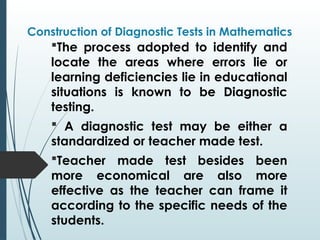
Construction of DiagnosticTests in Mathematics
The process adopted to identify and
locate the areas where errors lie or
learning deficiencies lie in educational
situations is known to be Diagnostic
testing.
A diagnostic test may be either a
standardized or teacher made test.
Teacher made test besides been
more economical are also more
effective as the teacher can frame it
according to the specific needs of the
students.
30.
Steps in Constructionof Diagnostic Tests in
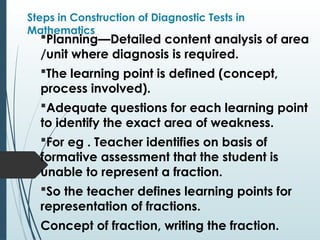
Mathematics
Planning—Detailed content analysis of area
/unit where diagnosis is required.
The learning point is defined (concept,
process involved).
Adequate questions for each learning point
to identify the exact area of weakness.
For eg . Teacher identifies on basis of
formative assessment that the student is
unable to represent a fraction.
So the teacher defines learning points for
representation of fractions.
Concept of fraction, writing the fraction.
31.
Writing items-
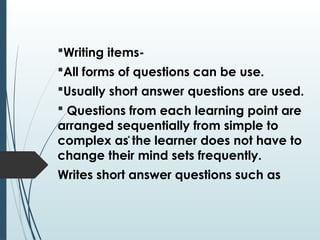
All formsof questions can be use.
Usually short answer questions are used.
Questions from each learning point are
arranged sequentially from simple to
complex as the learner does not have to
change their mind sets frequently.
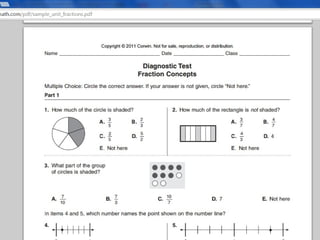
Writes short answer questions such as
32.
Steps in Constructionof Diagnostic Tests
in Mathematics
Writing items- All forms of questions can be use. Usually
short answer questions are used. . Questions from each
learning point are arranged sequentially from simple to
complex as the learner does not have to change their
mind sets frequently.
Writes short answer questions such as
1) Write as fraction 2 ) Shade the portions as
reprseented in fractions
33.
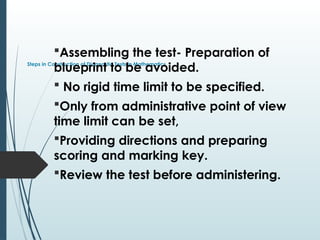
Steps in Constructionof Diagnostic Tests in Mathematics
Assembling the test- Preparation of
blueprint to be avoided.
No rigid time limit to be specified.
Only from administrative point of view
time limit can be set,
Providing directions and preparing
scoring and marking key.
Review the test before administering.
34.
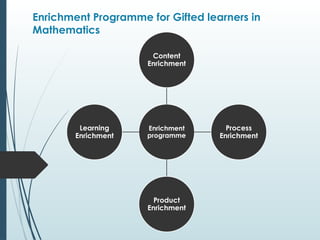
Enrichment Programme forGifted learners in
Mathematics
Enrichment
programme
Content
Enrichment
Process
Enrichment
Product
Enrichment
Learning
Enrichment
35.
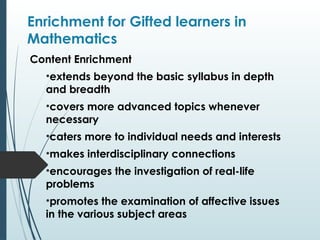
Enrichment for Giftedlearners in
Mathematics
Content Enrichment
•extends beyond the basic syllabus in depth
and breadth
•covers more advanced topics whenever
necessary
•caters more to individual needs and interests
•makes interdisciplinary connections
•encourages the investigation of real-life
problems
•promotes the examination of affective issues
in the various subject areas
36.
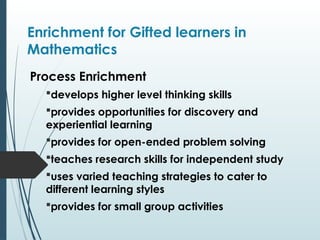
Enrichment for Giftedlearners in
Mathematics
Process Enrichment
develops higher level thinking skills
provides opportunities for discovery and
experiential learning
provides for open-ended problem solving
teaches research skills for independent study
uses varied teaching strategies to cater to
different learning styles
provides for small group activities
37.
Enrichment for Gifted
learnersin Mathematics
Product Enrichment
encourages modes of presentations
beyond traditional assignments
provides for creative expressions
reflects real-world variety
values authentic learning
38.
Enrichment for Gifted
learnersin Mathematics
Learning Environment
provides a supportive and learner-centred
environment
supports risk-taking
provides a stimulating physical environment
provides out-of-school learning experiences
(e.g. field trips and community involvement
programmes)
provides out-of-school extensions (e.g.
mentorship attachments in collaboration with
tertiary institutions)
39.
Remedial Programmes ofEducation for Mathematically Backward Children
Remedy and treatment of backwardness is always
dependent upon the nature and extent of backwardness
present in a particular child and the diagnosis of the
probable causes for such backwardness.
1. Short and Simple Method of Instructions
Educationally backward children require short and simple
methods of instructions based on concrete living
experiences with concrete materials.
Verbal instructions must be reduced excursions, play
activities; dramatization or even games should be
introduced specially for these children.
2. Retention of Self-Confidence
Habits of success must be developed if the child is to retain
the self-confidence which is so vital for him/her. The
teachers should lead him/her very slowly, making sure that
each step is thoroughly mastered before the next is
introduced.
40.
Remedial Programmes ofEducation for Mathematically Backward Children
3. Participation in Extracurricular Activities
The educationally backward children should be encouraged
to participate in extracurricular activities of the school
according to their interests and abilities.
4. Individual Attention
Individual attention should be paid to such matters as health,
social conditions, while teaching in the class. So also, there
must be more of individual instruction than is necessary for
normal children.
5. Desired Outcomes Must is known
The desired outcomes should always be kept in mind.
Interesting but important matters may be given brief attention;
more energy should be expended on that which is important
and essential. Certain abstract technicalities which
characterize each subject should be excluded for the
backward child.
41.
Remedial Programmes ofEducation for Mathematically Backward Children
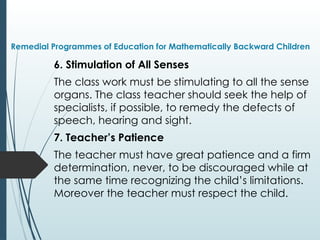
6. Stimulation of All Senses
The class work must be stimulating to all the sense
organs. The class teacher should seek the help of
specialists, if possible, to remedy the defects of
speech, hearing and sight.
7. Teacher’s Patience
The teacher must have great patience and a firm
determination, never, to be discouraged while at
the same time recognizing the child’s limitations.
Moreover the teacher must respect the child.
42.
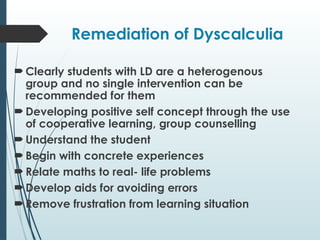
Remediation of Dyscalculia
Clearly students with LD are a heterogenous
group and no single intervention can be
recommended for them
Developing positive self concept through the use
of cooperative learning, group counselling
Understand the student
Begin with concrete experiences
Relate maths to real- life problems
Develop aids for avoiding errors
Remove frustration from learning situation
43.
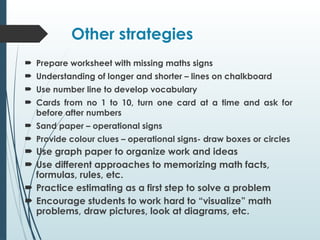
Other strategies
Prepareworksheet with missing maths signs
Understanding of longer and shorter – lines on chalkboard
Use number line to develop vocabulary
Cards from no 1 to 10, turn one card at a time and ask for
before after numbers
Sand paper – operational signs
Provide colour clues – operational signs- draw boxes or circles
Use graph paper to organize work and ideas
Use different approaches to memorizing math facts,
formulas, rules, etc.
Practice estimating as a first step to solve a problem
Encourage students to work hard to “visualize” math
problems, draw pictures, look at diagrams, etc.
44.
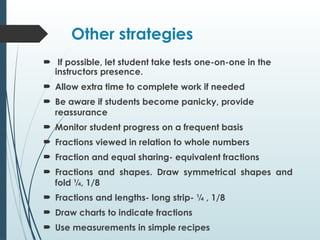
Other strategies
Ifpossible, let student take tests one-on-one in the
instructors presence.
Allow extra time to complete work if needed
Be aware if students become panicky, provide
reassurance
Monitor student progress on a frequent basis
Fractions viewed in relation to whole numbers
Fraction and equal sharing- equivalent fractions
Fractions and shapes. Draw symmetrical shapes and
fold ¼, 1/8
Fractions and lengths- long strip- ¼ , 1/8
Draw charts to indicate fractions
Use measurements in simple recipes
45.
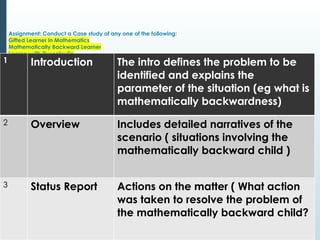
Assignment: Conduct aCase study of any one of the following:
Gifted Learner in Mathematics
Mathematically Backward Learner
Learner with Dyscalculia
1 Introduction The intro defines the problem to be
identified and explains the
parameter of the situation (eg what is
mathematically backwardness)
2 Overview Includes detailed narratives of the
scenario ( situations involving the
mathematically backward child )
3 Status Report Actions on the matter ( What action
was taken to resolve the problem of
the mathematically backward child?