
Cooperative learning
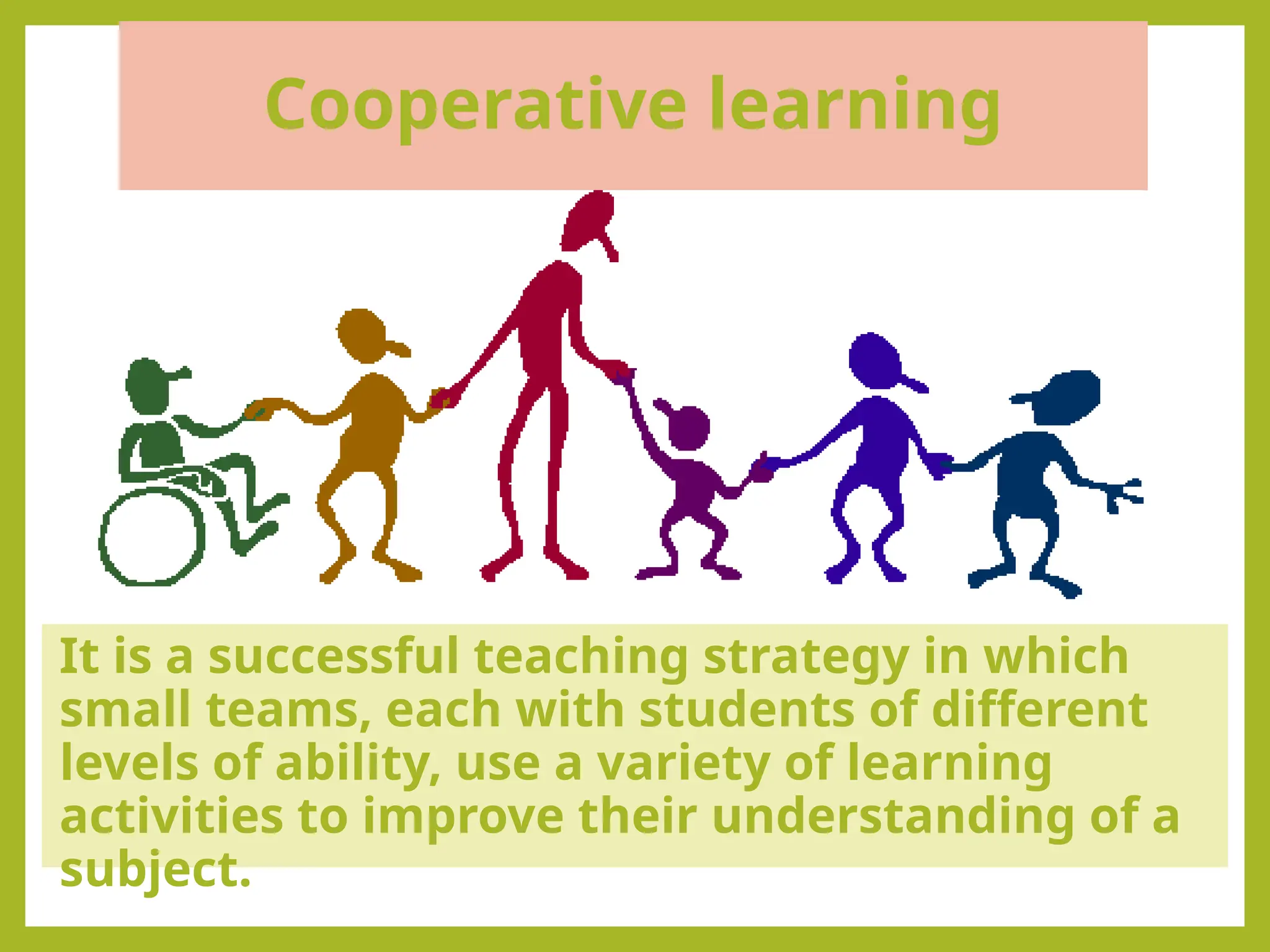
It is a successful teaching strategy in which
small teams, each with students of different
levels of ability, use a variety of learning
activities to improve their understanding of a
subject.
Think-Pair-Share
•It is a cooperative discussion strategy
developed by Frank Lyman and his colleagues
in Maryland.
• It gets its name from the three stages of
student action, with emphasis on what
students are to be DOING at each of those
stages.
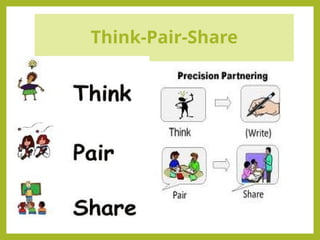
•1) Think : The teacher provokes students‘
thinking with a question or prompt or
observation.
The students should take a few moments
(probably not minutes) just to THINK
about the question.
Think-Pair-
Share
Think-Pair-Share
2) Pair : Using designated partners, nearby
neighbors, or a desk mate, students PAIR
up to talk about the answer each came up
with.
They compare their mental or written
notes and identify the answers they think
are best, most convincing, or most unique.
3) Share : After students talk in pairs for a
few moments , the teacher calls for pairs
to SHARE their thinking with the rest of
the class.
Think-Pair-Share
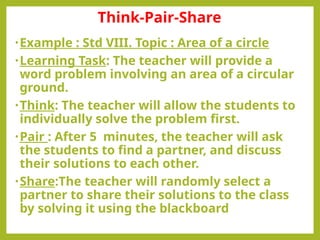
•Example : Std VIII. Topic : Area of a circle
•Learning Task: The teacher will provide a
word problem involving an area of a circular
ground.
•Think: The teacher will allow the students to
individually solve the problem first.
•Pair : After 5 minutes, the teacher will ask
the students to find a partner, and discuss
their solutions to each other.
•Share:The teacher will randomly select a
partner to share their solutions to the class
by solving it using the blackboard
Jigsaw
Jigsaw
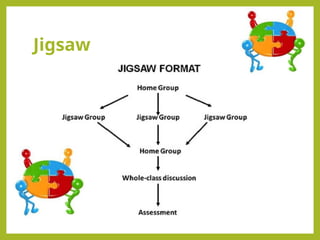
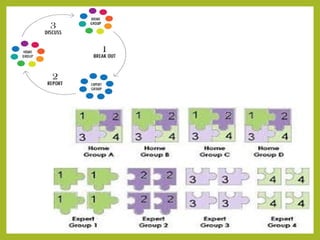
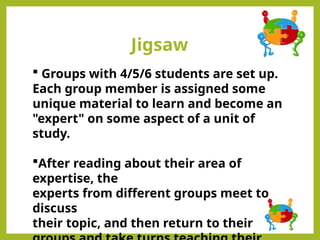
 Groups with 4/5/6 students are set up.
Each group member is assigned some
unique material to learn and become an
"expert" on some aspect of a unit of
study.
After reading about their area of
expertise, the
experts from different groups meet to
discuss
their topic, and then return to their
Jigsaw
Example:
Std : IX Topic: Measures Of Central Tendency
 Learning Task :The students will be able to
solve 2 problems that would require them to
find the mean, median, mode and range from
the given data.
Divide students into 4 members jigsaw
groups.
The groups should be diverse in terms of
gender, ethnicity, race, and ability.
Jigsaw
 Divide the lesson into 4 segments:
1. Solving for the mean from grouped,
ungrouped data
2.Solving for median from the grouped,
ungrouped data
3. Solving for the mode of the grouped,
ungrouped data
4. Finding the range of the given data.
 Assign each student to learn one segment,
making sure students have direct access only to
their own
segment.
Jigsaw
 Give students in these expert groups time to
discuss the main points of their segment and
to rehearse the presentations they will make
to their jigsaw group.
 Bring the students back into their jigsaw
groups.
Ask each student to present her or his
segment to the group.
Encourage others in the group to ask
questions for clarification.
At the end of the session, give a quiz or test
on the material.
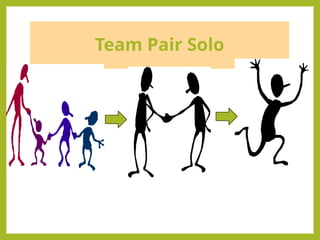
Team Pair Solo
Team Pair Solo
Students do problems first as a team, then
with a partner, and finally on their own.
It is designed to motivate students to tackle
and succeed at problems which initially are
beyond their ability.
By allowing them to work on problems they
could not do alone, first as a team and then
with a partner.
They progress to a point they can do alone
that which at first they could do only with
help.
Team Pair Solo
 Example : Std : VIII
Topic : Construction of Quadrilaterals
Learning Task: Students are able to
construct the quadrilateral using the data
and following the instructions.
Divide students into teams having 4-6
members in each team . Assign each team
with learning material with instructions.
The team learns the procedure with the
help of each other.
The team divides into pairs to clarify the
doubts .
At the end each member draws the
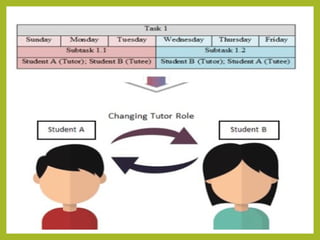
Reciprocal Peer Teaching
Reciprocal teaching is an interactive
strategy and a cooperative learning
instructional method
to promote reading comprehension skills.
Four main strategies used by students in
reciprocal teaching are: Summarizing,
Questioning, Clarifying and Predicting.
Students are instructed to go through
each action after they read a segment of
text.
Reciprocal Peer Teaching
1.Summarizing :
A great way to help students get to know
what they read is through summarizing it.
By putting a segment of text into a
summary, the student has to weed out the
stuff that doesn't matter, identify the
points that do, and put them together in
their own words.
2.Questioning :
Thinking of questions allows students to
identify areas that are confusing, share
their needs for clarification, and ask if
there are connections with material
already read.
Reciprocal Peer Teaching
.
3.Clarifying :
Clarifying is answering the posed questions.
Student can also share their own thoughts
on how they understand the material, if it
will help their classmates.
4.Predicting :
When students predict, they are coming up
with ideas of what can happen next in the
text they just read. It requires that they
consider what has already taken place and
use their imagination to think ahead.
Reciprocal Peer Teaching
.
Example : Std :IX
Topic: Lines and Angles
Objectives: Students will be able to,
 Summarize the meaning of types of lines
and angles.
 Make real-life connections.
 Use prior knowledge to predict what will
happen next.
Learning experience :
1.Ask students to read the chapter ‘Lines and
Angles’ aloud.
Reciprocal Peer Teaching
.
2.Summarizing: Choose one volunteer to
summarize the entire text.
3. Questioning: Student leader asks questions
to provoke discussion.
3.Clarifying: Identify confusing points – ask
students questions such as “This was
confusing to me, can anyone explain?”
4. Predicting: Ask students to predict where
they can see the lines and angles in real life.
At the end ask students to write what they
have learned.
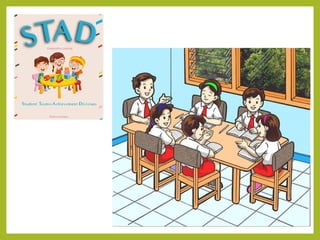
Student Teams-Achievement Divisions (STAD)
A cooperative learning method for mixed-
ability groupings involving team recognition
and group responsibility for individual
learning.
students are assigned to four-member
learning teams that are mixed in
performance level, gender, and ethnicity.
The teacher presents a lesson, and then
students work within their teams to make
sure that all team members have mastered
the lesson.
Finally, all students take individual quizzes
Student Teams-
Achievement Divisions
(STAD)
Steps : 1. Class presentation
2.Formation of study groups (teams)
3. Provision of test or quiz (Quizzes)
4. Improved scoring individual
(Individual Improvement Scores)
5.Awards group (Team Recognition
Example: Std IX Topic: Co-ordinate Geometry
Cooperative Learning
Lesson Plan Components
Lesson Objective
Group Size
Seating Arrangement
(face-to-face)
Assignment of Roles
Materials
Social Skills (directly
taught)
Statement of Task
(positive
interdependence)
Evaluation
(individual
accountability;
include social skills)
Processing
(reflection, how well
we worked together,
how well we
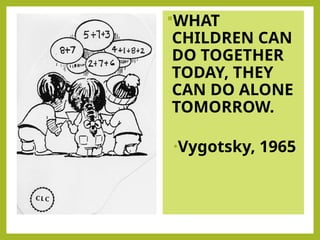
WHAT
CHILDREN CAN
DO TOGETHER
TODAY, THEY
CAN DO ALONE
TOMORROW.
•Vygotsky, 1965
Let’s cooperate!
Cooperative learning strategiesB.Ed.pptx

Cooperative learning strategiesB.Ed.pptx

  • 1.
    Cooperative learning It isa successful teaching strategy in which small teams, each with students of different levels of ability, use a variety of learning activities to improve their understanding of a subject.
  • 2.
  • 3.
    •It is acooperative discussion strategy developed by Frank Lyman and his colleagues in Maryland. • It gets its name from the three stages of student action, with emphasis on what students are to be DOING at each of those stages. •1) Think : The teacher provokes students‘ thinking with a question or prompt or observation. The students should take a few moments (probably not minutes) just to THINK about the question. Think-Pair- Share
  • 4.
    Think-Pair-Share 2) Pair :Using designated partners, nearby neighbors, or a desk mate, students PAIR up to talk about the answer each came up with. They compare their mental or written notes and identify the answers they think are best, most convincing, or most unique. 3) Share : After students talk in pairs for a few moments , the teacher calls for pairs to SHARE their thinking with the rest of the class.
  • 5.
    Think-Pair-Share •Example : StdVIII. Topic : Area of a circle •Learning Task: The teacher will provide a word problem involving an area of a circular ground. •Think: The teacher will allow the students to individually solve the problem first. •Pair : After 5 minutes, the teacher will ask the students to find a partner, and discuss their solutions to each other. •Share:The teacher will randomly select a partner to share their solutions to the class by solving it using the blackboard
  • 6.
  • 8.
    Jigsaw  Groups with4/5/6 students are set up. Each group member is assigned some unique material to learn and become an "expert" on some aspect of a unit of study. After reading about their area of expertise, the experts from different groups meet to discuss their topic, and then return to their
  • 9.
    Jigsaw Example: Std : IXTopic: Measures Of Central Tendency  Learning Task :The students will be able to solve 2 problems that would require them to find the mean, median, mode and range from the given data. Divide students into 4 members jigsaw groups. The groups should be diverse in terms of gender, ethnicity, race, and ability.
  • 10.
    Jigsaw  Divide thelesson into 4 segments: 1. Solving for the mean from grouped, ungrouped data 2.Solving for median from the grouped, ungrouped data 3. Solving for the mode of the grouped, ungrouped data 4. Finding the range of the given data.  Assign each student to learn one segment, making sure students have direct access only to their own segment.
  • 11.
    Jigsaw  Give studentsin these expert groups time to discuss the main points of their segment and to rehearse the presentations they will make to their jigsaw group.  Bring the students back into their jigsaw groups. Ask each student to present her or his segment to the group. Encourage others in the group to ask questions for clarification. At the end of the session, give a quiz or test on the material.
  • 12.
  • 13.
    Team Pair Solo Studentsdo problems first as a team, then with a partner, and finally on their own. It is designed to motivate students to tackle and succeed at problems which initially are beyond their ability. By allowing them to work on problems they could not do alone, first as a team and then with a partner. They progress to a point they can do alone that which at first they could do only with help.
  • 14.
    Team Pair Solo Example : Std : VIII Topic : Construction of Quadrilaterals Learning Task: Students are able to construct the quadrilateral using the data and following the instructions. Divide students into teams having 4-6 members in each team . Assign each team with learning material with instructions. The team learns the procedure with the help of each other. The team divides into pairs to clarify the doubts . At the end each member draws the
  • 15.
    Reciprocal Peer Teaching Reciprocalteaching is an interactive strategy and a cooperative learning instructional method to promote reading comprehension skills. Four main strategies used by students in reciprocal teaching are: Summarizing, Questioning, Clarifying and Predicting. Students are instructed to go through each action after they read a segment of text.
  • 17.
    Reciprocal Peer Teaching 1.Summarizing: A great way to help students get to know what they read is through summarizing it. By putting a segment of text into a summary, the student has to weed out the stuff that doesn't matter, identify the points that do, and put them together in their own words. 2.Questioning : Thinking of questions allows students to identify areas that are confusing, share their needs for clarification, and ask if there are connections with material already read.
  • 18.
    Reciprocal Peer Teaching . 3.Clarifying: Clarifying is answering the posed questions. Student can also share their own thoughts on how they understand the material, if it will help their classmates. 4.Predicting : When students predict, they are coming up with ideas of what can happen next in the text they just read. It requires that they consider what has already taken place and use their imagination to think ahead.
  • 19.
    Reciprocal Peer Teaching . Example: Std :IX Topic: Lines and Angles Objectives: Students will be able to,  Summarize the meaning of types of lines and angles.  Make real-life connections.  Use prior knowledge to predict what will happen next. Learning experience : 1.Ask students to read the chapter ‘Lines and Angles’ aloud.
  • 20.
    Reciprocal Peer Teaching . 2.Summarizing:Choose one volunteer to summarize the entire text. 3. Questioning: Student leader asks questions to provoke discussion. 3.Clarifying: Identify confusing points – ask students questions such as “This was confusing to me, can anyone explain?” 4. Predicting: Ask students to predict where they can see the lines and angles in real life. At the end ask students to write what they have learned.
  • 22.
    Student Teams-Achievement Divisions(STAD) A cooperative learning method for mixed- ability groupings involving team recognition and group responsibility for individual learning. students are assigned to four-member learning teams that are mixed in performance level, gender, and ethnicity. The teacher presents a lesson, and then students work within their teams to make sure that all team members have mastered the lesson. Finally, all students take individual quizzes
  • 23.
    Student Teams- Achievement Divisions (STAD) Steps: 1. Class presentation 2.Formation of study groups (teams) 3. Provision of test or quiz (Quizzes) 4. Improved scoring individual (Individual Improvement Scores) 5.Awards group (Team Recognition Example: Std IX Topic: Co-ordinate Geometry
  • 24.
    Cooperative Learning Lesson PlanComponents Lesson Objective Group Size Seating Arrangement (face-to-face) Assignment of Roles Materials Social Skills (directly taught) Statement of Task (positive interdependence) Evaluation (individual accountability; include social skills) Processing (reflection, how well we worked together, how well we
  • 25.
    WHAT CHILDREN CAN DO TOGETHER TODAY,THEY CAN DO ALONE TOMORROW. •Vygotsky, 1965
  • 26.