ECOSYSTEM
MODULE 2
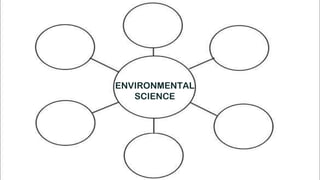
ENVIRONMENTAL
SCIENCE
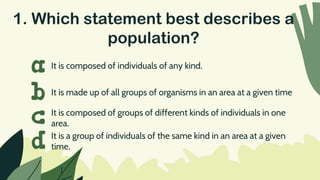
1. Which statement best describes a
population?
It is composed of individuals of any kind.
a
b
c
d
It is made up of all groups of organisms in an area at a given time
It is composed of groups of different kinds of individuals in one
area.
It is a group of individuals of the same kind in an area at a given
time.
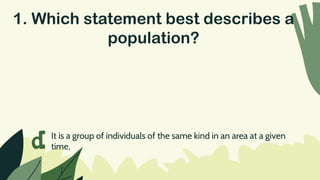
1. Which statement best describes a
population?
d It is a group of individuals of the same kind in an area at a given
time.
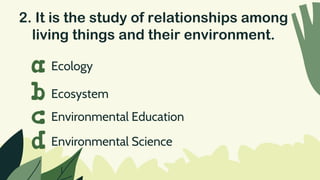
2. It is the study of relationships among
living things and their environment.
Ecology
a
b
c
d
Ecosystem
Environmental Education
Environmental Science
2. It is the study of relationships among
living things and their environment.
Ecology
a
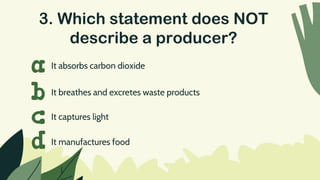
3. Which statement does NOT
describe a producer?
It absorbs carbon dioxide
a
b
c
d
It breathes and excretes waste products
It captures light
It manufactures food
3. Which statement does NOT
describe a producer?
b It breathes and excretes waste products
4. Which of the following consumers are
fed on dead and decaying organisms?
autotrophs
a
b
c
d
decomposers
primary consumers
tertiary consumers
4. Which of the following consumers are
fed on dead and decaying organisms?
b decomposers
5. Which of the following is NOT an
abiotic factor of ecosystem?
air
a
b
c
d
plants
soil
temperature
5. Which of the following is NOT an
abiotic factor of ecosystem?
b plants
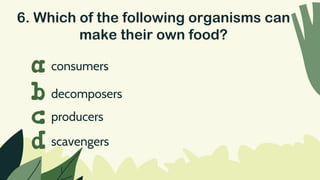
6. Which of the following organisms can
make their own food?
consumers
a
b
c
d
decomposers
producers
scavengers
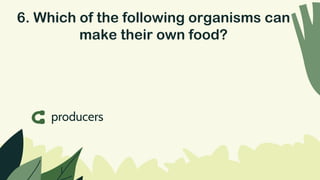
6. Which of the following organisms can
make their own food?
c producers
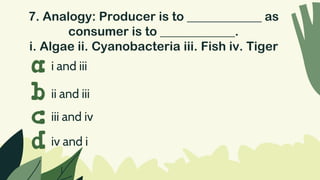
7. Analogy: Producer is to ____________ as
consumer is to ____________.
i. Algae ii. Cyanobacteria iii. Fish iv. Tiger
i and iii
a
b
c
d
ii and iii
iii and iv
iv and i
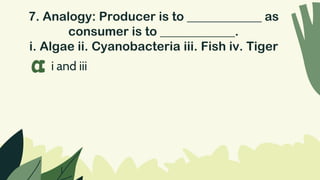
7. Analogy: Producer is to ____________ as
consumer is to ____________.
i. Algae ii. Cyanobacteria iii. Fish iv. Tiger
i and iii
a
8. Which of the following organism can
survive in a freshwater ecosystem?
Barracudas
a
b
c
d
Lobster
Starfish
Tawilis
8. Which of the following organism can
survive in a freshwater ecosystem?
d Tawilis
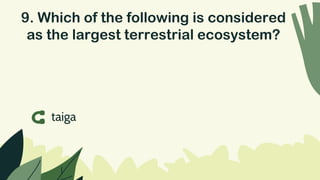
9. Which of the following is considered
as the largest terrestrial ecosystem?
desert
a
b
c
d
forest
taiga
tundra
9. Which of the following is considered
as the largest terrestrial ecosystem?
desert
a
b
c
d
forest
taiga
tundra
9. Which of the following is considered
as the largest terrestrial ecosystem?
c taiga
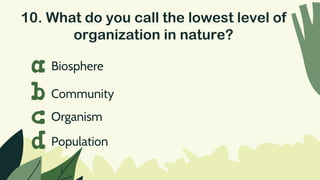
10. What do you call the lowest level of
organization in nature?
Biosphere
a
b
c
d
Community
Organism
Population
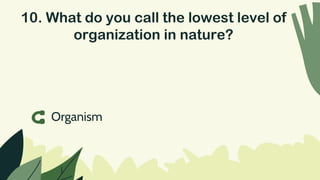
10. What do you call the lowest level of
organization in nature?
c Organism
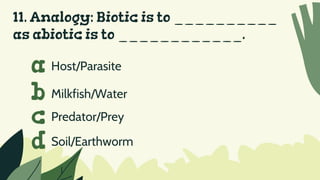
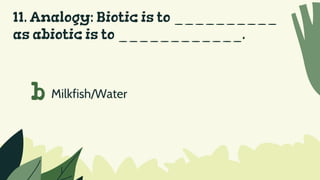
11. Analogy: Biotic is to __________
as abiotic is to ____________.
Host/Parasite
a
b
c
d
Milkfish/Water
Predator/Prey
Soil/Earthworm
11. Analogy: Biotic is to __________
as abiotic is to ____________.
b Milkfish/Water
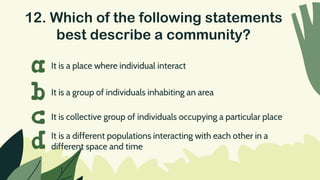
12. Which of the following statements
best describe a community?
It is a place where individual interact
a
b
c
d
It is a group of individuals inhabiting an area
It is collective group of individuals occupying a particular place
It is a different populations interacting with each other in a
different space and time
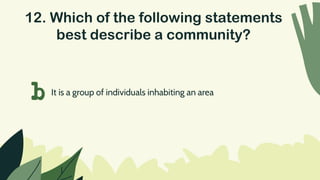
12. Which of the following statements
best describe a community?
b It is a group of individuals inhabiting an area
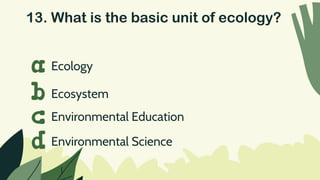
13. What is the basic unit of ecology?
Ecology
a
b
c
d
Ecosystem
Environmental Education
Environmental Science
13. What is the basic unit of ecology?
b Ecosystem
14. What will happen to the ecosystem if
the decomposers are absence?
The ecosystem will not be affected
a
b
c
d
The ecosystem will have more nutrients
The ecosystem will have more producers and consumers
The waste and dead organisms would not be released back into
the ecosystem
14. What will happen to the ecosystem if
the decomposers are absence?
d The waste and dead organisms would not be released back into
the ecosystem
15. Which of the following is an example
of a natural ecosystem?
forest
a
b
c
d
garden
fish pond
zoo
15. Which of the following is an example
of a natural ecosystem?
forest
a
WIKARAMBULAN
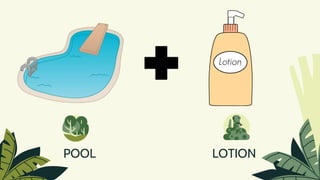
POOL LOTION
POLLUTION
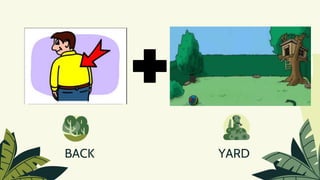
BACK YARD
BACKYARD
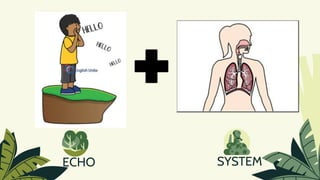
ECHO SYSTEM
ECOSYSTEM
POUR REST
FOREST
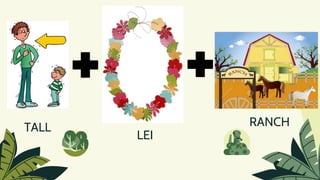
TALL
LEI
RANCH
TOLERANCE
MAN MAID
MAN-MADE
LESSON 1
Introduction to
Ecology
ECOLOGY
comes from the Greek words
oikos, which means “house” and
logos, means “to study”.
a science which study the
relationships between human
and other organisms, and their
environment.
ECOLOGISTS
concerned with how
organisms interact with their
environment.
ECOSYSTEM
An ecosystem is the basic functional
unit of ecology, which comes from the
Greek word “oikos” - home and
“sistema”-system.
Living things and
non-living things
plants
animals
microorganisms
Living things
soil climate
water energy
air temperature
Non-Living things
Living thing + non-living thing =
ecosystem
One will not survive without the
other.
Food
Shelter
Reproduction
Protection
KINDS OF
ECOSYSTEM
NATURAL
ARTIFICIAL/
MAN-MADE
Natural Ecosystem
it is created by natural
condition or no human
intervention.
Artificial/Man-made
Ecosystem
it is created, manipulated
and controlled by humans.
Artificial/Man-made
Ecosystem
you can control the types and
numbers of species to be included.
you can also manipulate other
abiotic factors.
TWO TYPES OF
NATURAL
ECOSYSTEM
1. Terrestrial ecosystem
this ecosystem is related
to land.
Forest
A forest is a large area that has many
trees and other plants that support
many animals and birds.
Two Types of Forest
Tropical Temperate
found near the equator
it results into frequent heavy
rainfall and thunderstorm
climate has lot of sunlight and
slight seasonal variation
have a climatic conditions
such as cold with moderate
seasonal variations
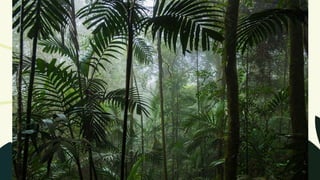
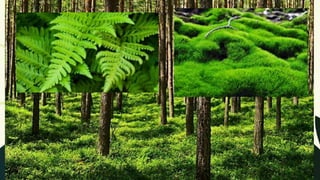
they have typical ferns,
mosses and very tall trees
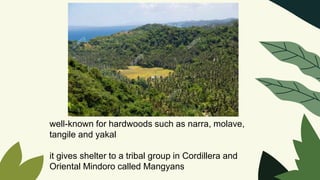
well-known for hardwoods such as narra, molave,
tangile and yakal
it gives shelter to a tribal group in Cordillera and
Oriental Mindoro called Mangyans
What are some benefits
that we can get from
forest?
Grasslands
It is another terrestrial ecosystem that can be
found all over the world except in Polar Regions.
an ecosystem where there is less rainfall and
frequent fires that suppress the growth of trees
and bushes.
It is commonly called as “savanna or prairie”.
grasslands in Mt. Pulag located at Central Cordillera
of northern Luzon
Tundra
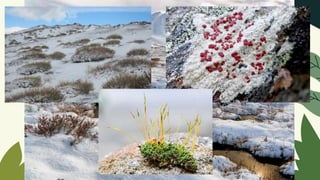
there are no trees in Tundra
it is located at the Polar Regions (or simply the
opposite of grasslands)
The soil is permanently frozen or permafrost.
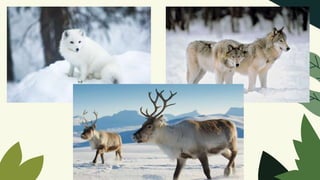
Only shrubs, lichens and mosses dominate the
place in terms of plants while in animals, there
are arctic foxes, wolves and reindeers.
Deserts
It occupies about 35% of the world’s land areas.
The driest region on Earth.
Less rainfall occurs and the atmosphere is dry.
3 Types of Deserts
1. Tropical
where wind blows sand dunes are very
common and it only has few species.
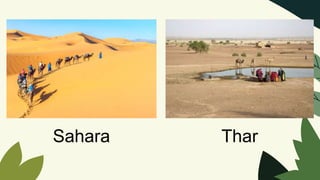
Examples are Sahara (Africa) and Thar
(Rajasthan) desert.
Sahara Thar
3 Types of Deserts
2. Temperate
characterized by very hot summer and
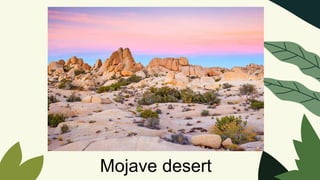
very cold winter time. Mojave desert in
South California is an example.
Mojave desert
3 Types of Deserts
3. Cold deserts
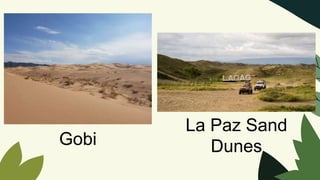
which Gobi desert in China is one good
example of this. In the Philippines, we
have La Paz Sand Dunes in Laoag, Ilocos
Norte.
Gobi
La Paz Sand
Dunes
Taiga
The largest terrestrial biome in the world.
The average temperature is below freezing point.
Winters are cold and summers are warm.
Lots of conifers grow here.
It is prone to wildfires.
Many trees have adapted to this by growing thick
bark.
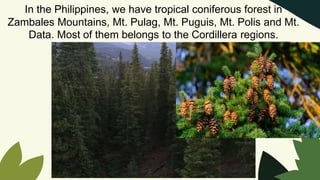
In the Philippines, we have tropical coniferous forest in
Zambales Mountains, Mt. Pulag, Mt. Puguis, Mt. Polis and Mt.
Data. Most of them belongs to the Cordillera regions.
2. Aquatic ecosystem
this ecosystem is related
to water.
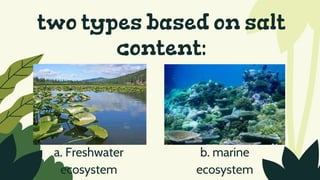
two types based on salt
content:
a. Freshwater
ecosystem
b. marine
ecosystem
Freshwater ecosystem
Earth is made up of 3% freshwater which
includes rivers, lakes, ponds and streams.
Many plants and animals live here.
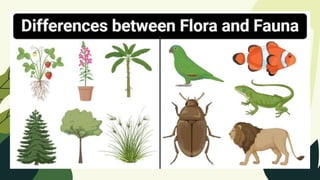
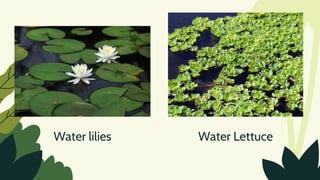
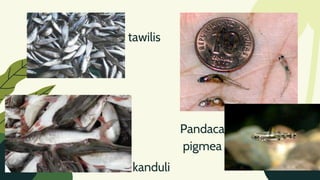
Some of them are water lilies and water Lettuce
for flora, and for fauna we have tawilis, Pandaca
pigmea, kanduli.
Water lilies Water Lettuce
tawilis
Pandaca
pigmea
kanduli
Marine ecosystem
made up the 97% of the Earth’s watery part.
The oceans are the largest marine ecosystem in
the world, which are considered to be home for
many diverse fish, mammals, invertebrates and
birds.
LESSON 2
Relationships of
Different
Component in the
ecosystem
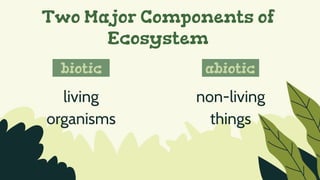
Two Major Components of
Ecosystem
biotic abiotic
living
organisms
non-living
things
Biotic components
The living organisms in an ecosystem
collectively form its community called
biotic community.
The members of biotic components of
an ecosystem are grouped into three
based on how they get food.
Producers (Autotrophs)
Produce their food by themselves through
the process called photosynthesis.
Examples are trees and all green plants.
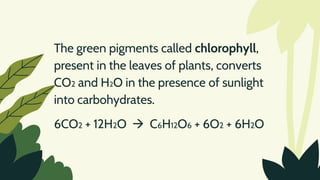
The green pigments called chlorophyll,
present in the leaves of plants, converts
CO2 and H2O in the presence of sunlight
into carbohydrates.
6CO2 + 12H2O  C6H12O6 + 6O2 + 6H2O
Consumers (Heterotrophs)
They feed on autotrophs or other
heterotrophs to obtain energy (herbivores,
carnivores, omnivores, decomposers).
Consumers are classified as:
(a) Primary consumers
Herbivores
-plant-eaters
They directly depend on plants for their
food.
Examples: goat, deer, carabao, cow, horse,
etc.,
Consumers are classified as:
(b) Secondary consumers
Primary Carnivores
-flesh-eaters
They feed directly on herbivores for their
food.
Examples: snakes, foxes
Consumers are classified as:
(c) Tertiary consumers
Secondary Carnivores
-Meat-eaters
They depend on the primary carnivores
for their food.
Examples: Lion, tiger
Decomposers (Saprotrophs)
These are microorganisms that attack the dead
bodies of plants and animals, like bacteria and
fungi.
During the decomposition, they decompose dead
bodies into simpler compounds and inorganic
nutrients are being released.
The inorganic nutrients together with other organic
substances are then utilized by the producers for
the synthesis of their own food.
Abiotic components
The non-living components (physical or
chemical) of ecosystem collectively form a
community called abiotic community.
Examples are soil, water, air, climate,
sunlight, energy, nutrients, etc.,
Physical components
these includes raw materials, climate,
energy, and mineral which are useful for
the growth and maintenance of its
member.
Chemical components
the organic components of an ecosystem that are
source of essential nutrients, such as proteins and
amino acids, all of which are synthesized by the
biota (flora and fauna) of an ecosystem.
Examples are organic substances like lipids,
carbohydrates, proteins, etc., while inorganic
substances are micro ( Co, Cu, Al, etc.,) and macro
( P, K, O, C, H, etc.,) elements.
“ You can’t have one
without the other”.
-Stacy Tornio
What do you think
will happen if there
is no decomposers?
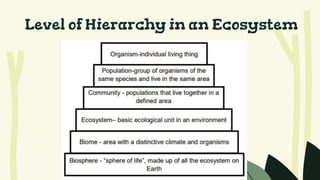
Level of Hierarchy in an Ecosystem
LESSON 3
Law of Tolerance
The group of organisms will thrive in
an ecosystem if the level of abiotic
factors fall within the range of
tolerance appropriate to its
individual.
According to Victor E. Shelford, was an American zoologist
and animal ecologist who helped to establish ecology as a
distinct field of study in 1913, Law of Tolerance states that
“the presence and success of an organism depend upon the
completeness of a complex of conditions. In addition to
this, Howard Thomas Odum, was an American ecologist,
further discuss the absence or failure of an organism can be
controlled by qualitative or quantitative deficiency or excess
with respect to any one of the several factors, which may
approach the limits of tolerance for that organism”.
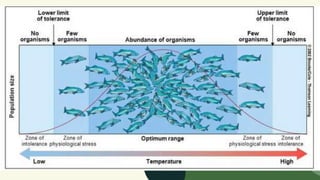
environmental factor has two zones:
the zone of tolerance and zone of
intolerance.
Zone of Tolerance
i. Optimum Zone:
The zone where growth, reproduction and survival
capacity is high. Maximum numbers of organisms are
found in this zone.
ii. Stress Zones:
The stress zone is found on either side of the optimum
range in which the activity slows down. These are the
zones of physiological stress and only a few organisms
are found in these zones.
Zone of Intolerance
In the zone of intolerance or lethal zones,
the intensity of the environmental
factor is too low or high. No organism
can survive in this zone.
During this time of pandemic,
what are the good things that it
brings to our environment? to
your self?
Assignment #3:
1. Define Limiting Factor.
2. What is Law of
Conservation of Mass?
3. What is Law of
Thermodynamics?
CREDITS: This presentation template was
created by Slidesgo, including icons by Flaticon,
and infographics & images by Freepik
THANKS

Q1 Module 2 (Ecosystem).pptx

  • 1.
  • 2.
  • 3.
    1. Which statementbest describes a population? It is composed of individuals of any kind. a b c d It is made up of all groups of organisms in an area at a given time It is composed of groups of different kinds of individuals in one area. It is a group of individuals of the same kind in an area at a given time.
  • 4.
    1. Which statementbest describes a population? d It is a group of individuals of the same kind in an area at a given time.
  • 5.
    2. It isthe study of relationships among living things and their environment. Ecology a b c d Ecosystem Environmental Education Environmental Science
  • 6.
    2. It isthe study of relationships among living things and their environment. Ecology a
  • 7.
    3. Which statementdoes NOT describe a producer? It absorbs carbon dioxide a b c d It breathes and excretes waste products It captures light It manufactures food
  • 8.
    3. Which statementdoes NOT describe a producer? b It breathes and excretes waste products
  • 9.
    4. Which ofthe following consumers are fed on dead and decaying organisms? autotrophs a b c d decomposers primary consumers tertiary consumers
  • 10.
    4. Which ofthe following consumers are fed on dead and decaying organisms? b decomposers
  • 11.
    5. Which ofthe following is NOT an abiotic factor of ecosystem? air a b c d plants soil temperature
  • 12.
    5. Which ofthe following is NOT an abiotic factor of ecosystem? b plants
  • 13.
    6. Which ofthe following organisms can make their own food? consumers a b c d decomposers producers scavengers
  • 14.
    6. Which ofthe following organisms can make their own food? c producers
  • 15.
    7. Analogy: Produceris to ____________ as consumer is to ____________. i. Algae ii. Cyanobacteria iii. Fish iv. Tiger i and iii a b c d ii and iii iii and iv iv and i
  • 16.
    7. Analogy: Produceris to ____________ as consumer is to ____________. i. Algae ii. Cyanobacteria iii. Fish iv. Tiger i and iii a
  • 17.
    8. Which ofthe following organism can survive in a freshwater ecosystem? Barracudas a b c d Lobster Starfish Tawilis
  • 18.
    8. Which ofthe following organism can survive in a freshwater ecosystem? d Tawilis
  • 19.
    9. Which ofthe following is considered as the largest terrestrial ecosystem? desert a b c d forest taiga tundra
  • 20.
    9. Which ofthe following is considered as the largest terrestrial ecosystem? desert a b c d forest taiga tundra
  • 21.
    9. Which ofthe following is considered as the largest terrestrial ecosystem? c taiga
  • 22.
    10. What doyou call the lowest level of organization in nature? Biosphere a b c d Community Organism Population
  • 23.
    10. What doyou call the lowest level of organization in nature? c Organism
  • 24.
    11. Analogy: Bioticis to __________ as abiotic is to ____________. Host/Parasite a b c d Milkfish/Water Predator/Prey Soil/Earthworm
  • 25.
    11. Analogy: Bioticis to __________ as abiotic is to ____________. b Milkfish/Water
  • 26.
    12. Which ofthe following statements best describe a community? It is a place where individual interact a b c d It is a group of individuals inhabiting an area It is collective group of individuals occupying a particular place It is a different populations interacting with each other in a different space and time
  • 27.
    12. Which ofthe following statements best describe a community? b It is a group of individuals inhabiting an area
  • 28.
    13. What isthe basic unit of ecology? Ecology a b c d Ecosystem Environmental Education Environmental Science
  • 29.
    13. What isthe basic unit of ecology? b Ecosystem
  • 30.
    14. What willhappen to the ecosystem if the decomposers are absence? The ecosystem will not be affected a b c d The ecosystem will have more nutrients The ecosystem will have more producers and consumers The waste and dead organisms would not be released back into the ecosystem
  • 31.
    14. What willhappen to the ecosystem if the decomposers are absence? d The waste and dead organisms would not be released back into the ecosystem
  • 32.
    15. Which ofthe following is an example of a natural ecosystem? forest a b c d garden fish pond zoo
  • 33.
    15. Which ofthe following is an example of a natural ecosystem? forest a
  • 34.
  • 35.
  • 36.
  • 37.
  • 38.
  • 39.
  • 40.
  • 41.
  • 42.
  • 43.
  • 44.
  • 45.
  • 46.
  • 47.
  • 48.
  • 49.
    comes from theGreek words oikos, which means “house” and logos, means “to study”.
  • 50.
    a science whichstudy the relationships between human and other organisms, and their environment.
  • 51.
    ECOLOGISTS concerned with how organismsinteract with their environment.
  • 52.
  • 53.
    An ecosystem isthe basic functional unit of ecology, which comes from the Greek word “oikos” - home and “sistema”-system.
  • 54.
  • 55.
  • 56.
    soil climate water energy airtemperature Non-Living things
  • 57.
    Living thing +non-living thing = ecosystem
  • 58.
    One will notsurvive without the other.
  • 59.
  • 60.
  • 61.
  • 62.
    Natural Ecosystem it iscreated by natural condition or no human intervention.
  • 63.
    Artificial/Man-made Ecosystem it is created,manipulated and controlled by humans.
  • 64.
    Artificial/Man-made Ecosystem you can controlthe types and numbers of species to be included. you can also manipulate other abiotic factors.
  • 66.
  • 67.
    1. Terrestrial ecosystem thisecosystem is related to land.
  • 68.
    Forest A forest isa large area that has many trees and other plants that support many animals and birds.
  • 69.
    Two Types ofForest Tropical Temperate found near the equator it results into frequent heavy rainfall and thunderstorm climate has lot of sunlight and slight seasonal variation have a climatic conditions such as cold with moderate seasonal variations they have typical ferns, mosses and very tall trees
  • 72.
    well-known for hardwoodssuch as narra, molave, tangile and yakal it gives shelter to a tribal group in Cordillera and Oriental Mindoro called Mangyans
  • 73.
    What are somebenefits that we can get from forest?
  • 74.
    Grasslands It is anotherterrestrial ecosystem that can be found all over the world except in Polar Regions. an ecosystem where there is less rainfall and frequent fires that suppress the growth of trees and bushes. It is commonly called as “savanna or prairie”.
  • 75.
    grasslands in Mt.Pulag located at Central Cordillera of northern Luzon
  • 76.
    Tundra there are notrees in Tundra it is located at the Polar Regions (or simply the opposite of grasslands) The soil is permanently frozen or permafrost. Only shrubs, lichens and mosses dominate the place in terms of plants while in animals, there are arctic foxes, wolves and reindeers.
  • 79.
    Deserts It occupies about35% of the world’s land areas. The driest region on Earth. Less rainfall occurs and the atmosphere is dry.

  • 80.
    3 Types ofDeserts 1. Tropical where wind blows sand dunes are very common and it only has few species. Examples are Sahara (Africa) and Thar (Rajasthan) desert.
  • 81.
  • 82.
    3 Types ofDeserts 2. Temperate characterized by very hot summer and very cold winter time. Mojave desert in South California is an example.
  • 83.
  • 84.
    3 Types ofDeserts 3. Cold deserts which Gobi desert in China is one good example of this. In the Philippines, we have La Paz Sand Dunes in Laoag, Ilocos Norte.
  • 85.
  • 86.
    Taiga The largest terrestrialbiome in the world. The average temperature is below freezing point. Winters are cold and summers are warm. Lots of conifers grow here. It is prone to wildfires. Many trees have adapted to this by growing thick bark.
  • 87.
    In the Philippines,we have tropical coniferous forest in Zambales Mountains, Mt. Pulag, Mt. Puguis, Mt. Polis and Mt. Data. Most of them belongs to the Cordillera regions.
  • 88.
    2. Aquatic ecosystem thisecosystem is related to water.
  • 89.
    two types basedon salt content: a. Freshwater ecosystem b. marine ecosystem
  • 90.
    Freshwater ecosystem Earth ismade up of 3% freshwater which includes rivers, lakes, ponds and streams. Many plants and animals live here. Some of them are water lilies and water Lettuce for flora, and for fauna we have tawilis, Pandaca pigmea, kanduli.
  • 92.
  • 93.
  • 94.
    Marine ecosystem made upthe 97% of the Earth’s watery part. The oceans are the largest marine ecosystem in the world, which are considered to be home for many diverse fish, mammals, invertebrates and birds.
  • 96.
  • 97.
    Two Major Componentsof Ecosystem biotic abiotic living organisms non-living things
  • 98.
    Biotic components The livingorganisms in an ecosystem collectively form its community called biotic community.
  • 99.
    The members ofbiotic components of an ecosystem are grouped into three based on how they get food. Producers (Autotrophs) Produce their food by themselves through the process called photosynthesis. Examples are trees and all green plants.
  • 100.
    The green pigmentscalled chlorophyll, present in the leaves of plants, converts CO2 and H2O in the presence of sunlight into carbohydrates. 6CO2 + 12H2O  C6H12O6 + 6O2 + 6H2O
  • 101.
    Consumers (Heterotrophs) They feedon autotrophs or other heterotrophs to obtain energy (herbivores, carnivores, omnivores, decomposers).
  • 102.
    Consumers are classifiedas: (a) Primary consumers Herbivores -plant-eaters They directly depend on plants for their food. Examples: goat, deer, carabao, cow, horse, etc.,
  • 103.
    Consumers are classifiedas: (b) Secondary consumers Primary Carnivores -flesh-eaters They feed directly on herbivores for their food. Examples: snakes, foxes
  • 104.
    Consumers are classifiedas: (c) Tertiary consumers Secondary Carnivores -Meat-eaters They depend on the primary carnivores for their food. Examples: Lion, tiger
  • 105.
    Decomposers (Saprotrophs) These aremicroorganisms that attack the dead bodies of plants and animals, like bacteria and fungi. During the decomposition, they decompose dead bodies into simpler compounds and inorganic nutrients are being released. The inorganic nutrients together with other organic substances are then utilized by the producers for the synthesis of their own food.
  • 106.
    Abiotic components The non-livingcomponents (physical or chemical) of ecosystem collectively form a community called abiotic community. Examples are soil, water, air, climate, sunlight, energy, nutrients, etc.,
  • 107.
    Physical components these includesraw materials, climate, energy, and mineral which are useful for the growth and maintenance of its member.
  • 108.
    Chemical components the organiccomponents of an ecosystem that are source of essential nutrients, such as proteins and amino acids, all of which are synthesized by the biota (flora and fauna) of an ecosystem. Examples are organic substances like lipids, carbohydrates, proteins, etc., while inorganic substances are micro ( Co, Cu, Al, etc.,) and macro ( P, K, O, C, H, etc.,) elements.
  • 109.
    “ You can’thave one without the other”. -Stacy Tornio
  • 110.
    What do youthink will happen if there is no decomposers?
  • 111.
    Level of Hierarchyin an Ecosystem
  • 112.
    LESSON 3 Law ofTolerance
  • 113.
    The group oforganisms will thrive in an ecosystem if the level of abiotic factors fall within the range of tolerance appropriate to its individual.
  • 114.
    According to VictorE. Shelford, was an American zoologist and animal ecologist who helped to establish ecology as a distinct field of study in 1913, Law of Tolerance states that “the presence and success of an organism depend upon the completeness of a complex of conditions. In addition to this, Howard Thomas Odum, was an American ecologist, further discuss the absence or failure of an organism can be controlled by qualitative or quantitative deficiency or excess with respect to any one of the several factors, which may approach the limits of tolerance for that organism”.
  • 115.
    environmental factor hastwo zones: the zone of tolerance and zone of intolerance.
  • 116.
    Zone of Tolerance i.Optimum Zone: The zone where growth, reproduction and survival capacity is high. Maximum numbers of organisms are found in this zone. ii. Stress Zones: The stress zone is found on either side of the optimum range in which the activity slows down. These are the zones of physiological stress and only a few organisms are found in these zones.
  • 117.
    Zone of Intolerance Inthe zone of intolerance or lethal zones, the intensity of the environmental factor is too low or high. No organism can survive in this zone.
  • 119.
    During this timeof pandemic, what are the good things that it brings to our environment? to your self?
  • 120.
    Assignment #3: 1. DefineLimiting Factor. 2. What is Law of Conservation of Mass? 3. What is Law of Thermodynamics?
  • 121.
    CREDITS: This presentationtemplate was created by Slidesgo, including icons by Flaticon, and infographics & images by Freepik THANKS

Editor's Notes

  • #6 Environmental Science
  • #7 Environmental Science
  • #10 Environmental Science
  • #11 Environmental Science
  • #12 Environmental Science
  • #13 Environmental Science
  • #14 Environmental Science
  • #15 Environmental Science
  • #16 Environmental Science
  • #17 Environmental Science
  • #18 Environmental Science
  • #19 Environmental Science
  • #20 Environmental Science
  • #21 Environmental Science
  • #22 Environmental Science
  • #23 Environmental Science
  • #24 Environmental Science
  • #25 Environmental Science
  • #26 Environmental Science
  • #29 Environmental Science
  • #30 Environmental Science
  • #33 Environmental Science
  • #34 Environmental Science
  • #78 shrubs, lichens and mosses
  • #79 arctic foxes, wolves and reindeers
  • #113 Why do you think some people likes Filipino complexion or color? Or on our part, we like fair or white skin?
  • #114 Each species has a set of environmental conditions within which it can best survive and reproduce. This example points out an important aspect of tolerance ranges – different types of organisms have different tolerance ranges for the same factor. 
  • #119 Tolerance range may change