MILLER/SPOOLMAN
LIVING IN THE ENVIRONMENT 17TH


                  CHAPTER 2
                  Science, Matter, Energy,
                  and Systems
Core Case Study: A Story About a
             Forest
• Hubbard Brook Experimental Forest in New Hampshire

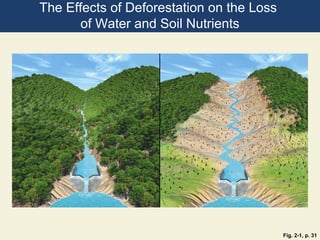
• Compared the loss of water and nutrients from an uncut
  forest (control site) with one that had been stripped
  (experimental site)

• Stripped site:
   • 30-40% more runoff
   • More dissolved nutrients
   • More soil erosion
The Effects of Deforestation on the Loss
       of Water and Soil Nutrients


                                           Fig. 2-1, p. 31
Science Is a Search for Order
           in Nature (1)
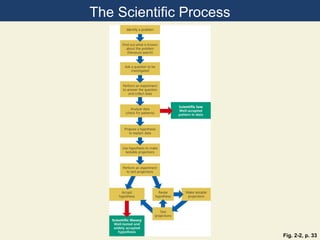
• Identify a problem
• Find out what is known about the problem
• Ask a question to be investigated
• Gather data through experiments
• Propose a scientific hypothesis
Science Is a Search for Order
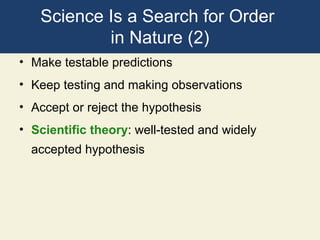
           in Nature (2)
• Make testable predictions
• Keep testing and making observations
• Accept or reject the hypothesis
• Scientific theory: well-tested and widely
  accepted hypothesis
The Scientific Process


                         Fig. 2-2, p. 33
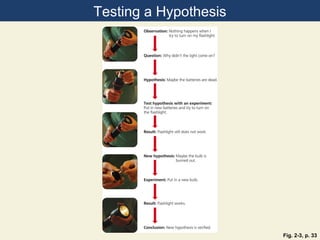
Testing a Hypothesis


                       Fig. 2-3, p. 33
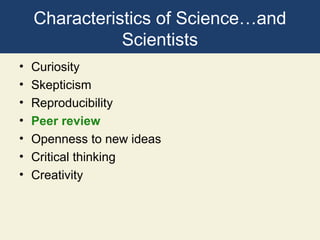
Characteristics of Science…and
               Scientists
•   Curiosity
•   Skepticism
•   Reproducibility
•   Peer review
•   Openness to new ideas
•   Critical thinking
•   Creativity
Science Focus: Easter Island: Revisions to
         a Popular Environmental Story
•   Some revisions to a popular environmental story
•   Polynesians arrived about 800 years ago
•   Population may have reached 3000
•   Used trees in an unsustainable manner, but rats
    may have multiplied and eaten the seeds of the
    trees
Stone Statues on Easter Island


                                 Fig. 2-A, p. 35
Scientific Theories and Laws Are the
  Most Important Results of Science
• Scientific theory
  • Widely tested
  • Supported by extensive evidence
  • Accepted by most scientists in a particular area

• Scientific law, law of nature
The Results of Science Can Be
 Tentative, Reliable, or Unreliable
• Tentative science, frontier science

• Reliable science

• Unreliable science
Science Has Some Limitations

1. Particular hypotheses, theories, or laws have a high
   probability of being true while not being absolute
2. Bias can be minimized by scientists
3. Environmental phenomena involve interacting variables
   and complex interactions
4. Statistical methods may be used to estimate very large
   or very small numbers
5. Scientific process is limited to the natural world
Science Focus: Statistics and
             Probability
• Statistics
  • Collect, organize, and interpret numerical data


• Probability
  • The chance that something will happen or be
    valid
  • Need large enough sample size
Matter Consists of Elements and
           Compounds
• Matter
  • Has mass and takes up space

• Elements
  • Unique properties
  • Cannot be broken down chemically into other
    substances

• Compounds
  • Two or more different elements bonded together
    in fixed proportions
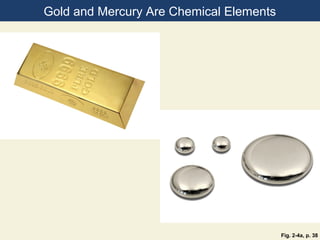
Gold and Mercury Are Chemical Elements


                                         Fig. 2-4a, p. 38
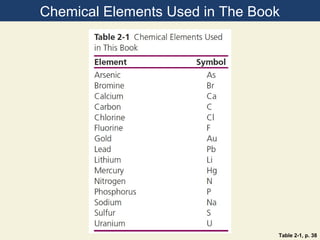
Chemical Elements Used in The Book


                                 Table 2-1, p. 38
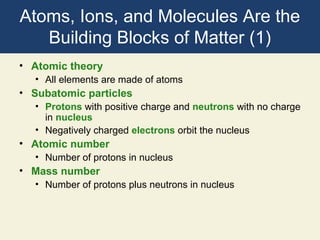
Atoms, Ions, and Molecules Are the
   Building Blocks of Matter (1)
• Atomic theory
  • All elements are made of atoms
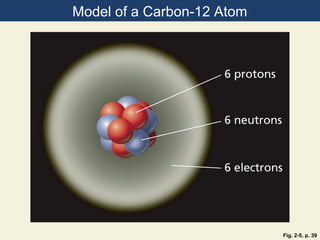
• Subatomic particles
  • Protons with positive charge and neutrons with no charge
    in nucleus
  • Negatively charged electrons orbit the nucleus
• Atomic number
  • Number of protons in nucleus
• Mass number
  • Number of protons plus neutrons in nucleus
Model of a Carbon-12 Atom


                            Fig. 2-5, p. 39
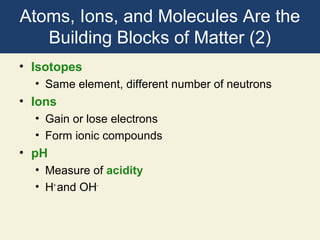
Atoms, Ions, and Molecules Are the
   Building Blocks of Matter (2)
• Isotopes
  • Same element, different number of neutrons
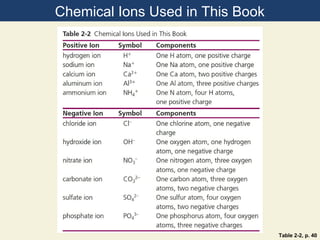
• Ions
  • Gain or lose electrons
  • Form ionic compounds
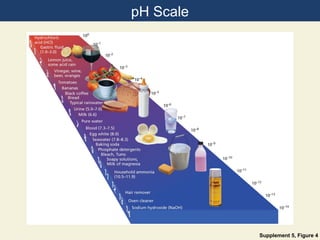
• pH
  • Measure of acidity
  • H+ and OH-
Chemical Ions Used in This Book


                                  Table 2-2, p. 40
pH Scale


           Supplement 5, Figure 4
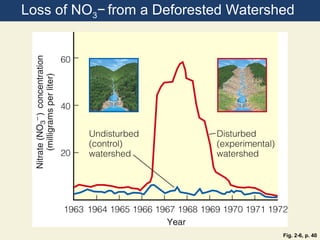
Loss of NO3− from a Deforested Watershed


                                      Fig. 2-6, p. 40
Atoms, Ions, and Molecules Are the
   Building Blocks of Matter (3)
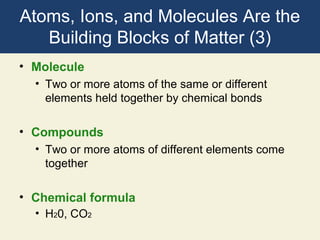
• Molecule
  • Two or more atoms of the same or different
    elements held together by chemical bonds

• Compounds
  • Two or more atoms of different elements come
    together

• Chemical formula
  • H20, CO2
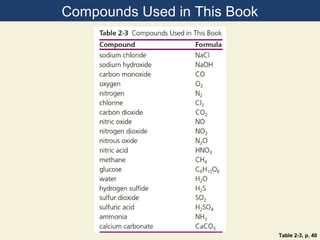
Compounds Used in This Book


                              Table 2-3, p. 40
Organic Compounds Are the
         Chemicals of Life
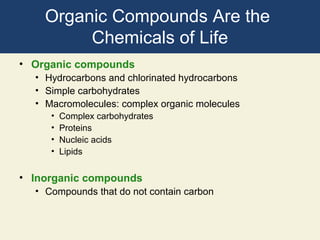
• Organic compounds
  • Hydrocarbons and chlorinated hydrocarbons
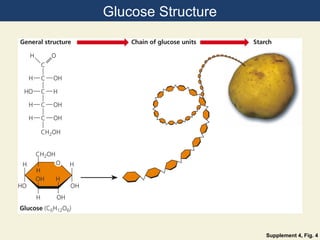
  • Simple carbohydrates
  • Macromolecules: complex organic molecules
     •   Complex carbohydrates
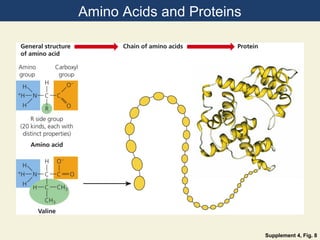
     •   Proteins
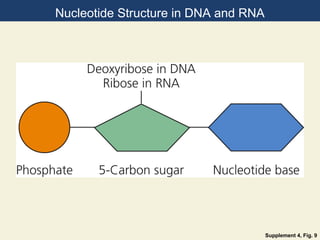
     •   Nucleic acids
     •   Lipids

• Inorganic compounds
  • Compounds that do not contain carbon
Glucose Structure


                    Supplement 4, Fig. 4
Amino Acids and Proteins


                           Supplement 4, Fig. 8
Nucleotide Structure in DNA and RNA


                                      Supplement 4, Fig. 9
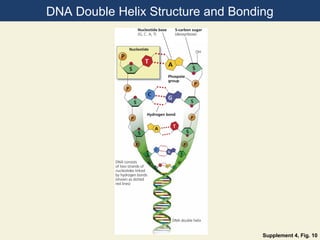
DNA Double Helix Structure and Bonding


                                    Supplement 4, Fig. 10
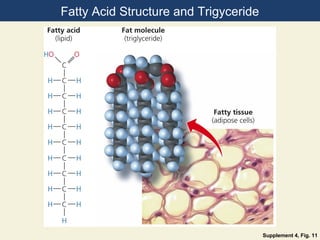
Fatty Acid Structure and Trigyceride


                                       Supplement 4, Fig. 11
Matter Comes to Life through
 Genes, Chromosomes, and Cells
• Cells: fundamental units of life; all organisms
  are composed of one or more cells

• Genes
   • Sequences of nucleotides within DNA
   • Instructions for proteins
   • Create inheritable traits


• Chromosomes: composed of many genes
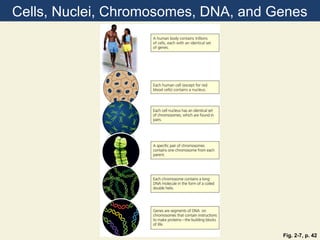
Cells, Nuclei, Chromosomes, DNA, and Genes


                                      Fig. 2-7, p. 42
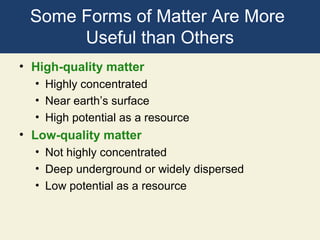
Some Forms of Matter Are More
      Useful than Others
• High-quality matter
  • Highly concentrated
  • Near earth’s surface
  • High potential as a resource
• Low-quality matter
  • Not highly concentrated
  • Deep underground or widely dispersed
  • Low potential as a resource
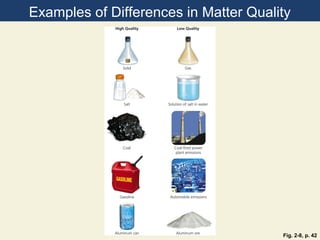
Examples of Differences in Matter Quality


                                       Fig. 2-8, p. 42
Matter Undergoes Physical,
  Chemical, and Nuclear Changes
• Physical change
  • No change in chemical composition
• Chemical change, chemical reaction
  • Change in chemical composition
  • Reactants and products
• Nuclear change
  • Natural radioactive decay
     • Radioisotopes: unstable
  • Nuclear fission
  • Nuclear fusion
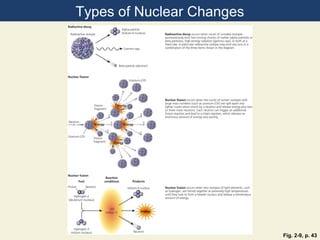
Types of Nuclear Changes


                           Fig. 2-9, p. 43
We Cannot Create or Destroy
             Matter
• Law of conservation of matter

  • Whenever matter undergoes a physical or
    chemical change, no atoms are created or
    destroyed
Energy Comes in Many Forms (1)
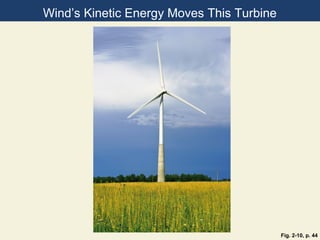
• Kinetic energy
   • Flowing water
   • Wind
   • Heat
      • Transferred by radiation, conduction, or convection
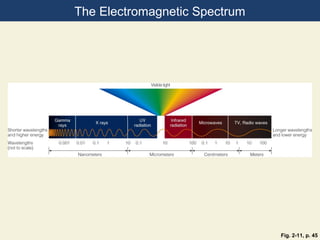
   • Electromagnetic radiation
      • Energy moves in waves, X rays, UV rays


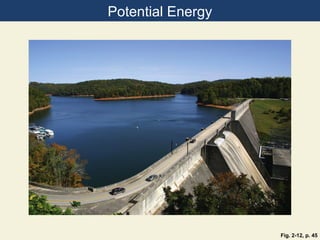
• Potential energy
   • Stored energy
      • Can be changed into kinetic energy
Wind’s Kinetic Energy Moves This Turbine


                                           Fig. 2-10, p. 44
The Electromagnetic Spectrum


                               Fig. 2-11, p. 45
Potential Energy


                   Fig. 2-12, p. 45
Energy Comes in Many Forms (2)

• Sun provides 99% of earth’s energy
  •   Warms earth to comfortable temperature
  •   Plant photosynthesis
  •   Winds
  •   Hydropower
  •   Biomass
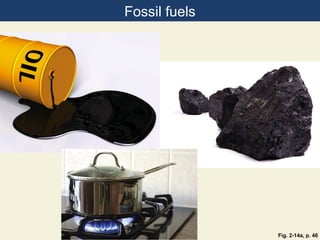
  •   Fossil fuels: oil, coal, natural gas
Fossil fuels


               Fig. 2-14a, p. 46
Some Types of Energy Are More
      Useful Than Others
• High-quality energy
  •   High capacity to do work
  •   Concentrated
  •   High-temperature heat
  •   Strong winds
  •   Fossil fuels
• Low-quality energy
  • Low capacity to do work
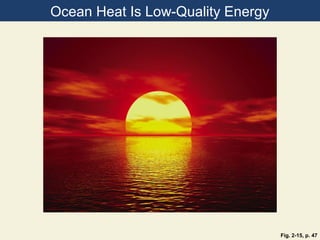
  • Dispersed
Ocean Heat Is Low-Quality Energy


                                   Fig. 2-15, p. 47
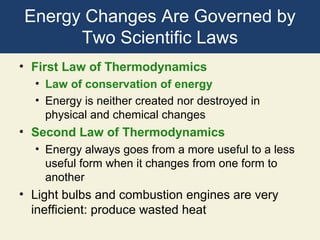
Energy Changes Are Governed by
      Two Scientific Laws
• First Law of Thermodynamics
  • Law of conservation of energy
  • Energy is neither created nor destroyed in
    physical and chemical changes
• Second Law of Thermodynamics
  • Energy always goes from a more useful to a less
    useful form when it changes from one form to
    another
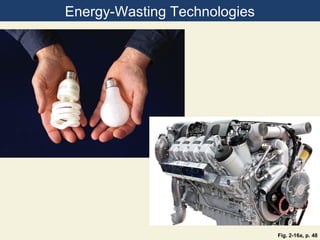
• Light bulbs and combustion engines are very
  inefficient: produce wasted heat
Energy-Wasting Technologies


                              Fig. 2-16a, p. 48
Systems Have Inputs, Flows,
           and Outputs
• System
   • Set of components that interact in a regular way
   • Human body, earth, the economy

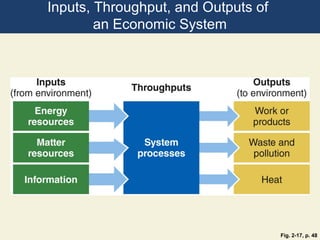
• Inputs from the environment

• Flows, throughputs of matter and energy

• Outputs to the environment
Inputs, Throughput, and Outputs of
        an Economic System


                                     Fig. 2-17, p. 48
Systems Respond to Change
      through Feedback Loops
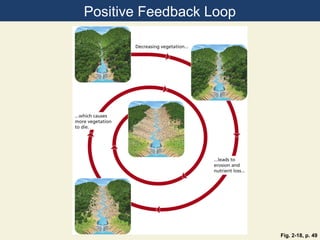
• Positive feedback loop
  • Causes system to change further in the same
    direction
  • Can cause major environmental problems

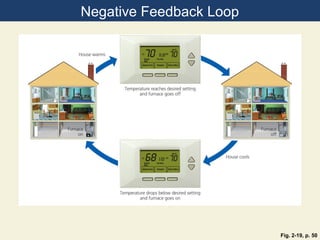
• Negative, or corrective, feedback loop
  • Causes system to change in opposite direction
Positive Feedback Loop


                         Fig. 2-18, p. 49
Negative Feedback Loop


                         Fig. 2-19, p. 50
Time Delays Can Allow a System
    to Reach a Tipping Point
• Time delays vary
  • Between the input of a feedback stimulus and the
    response to it


• Tipping point, threshold level
  • Causes a shift in the behavior of a system
  • Melting of polar ice
  • Population growth
System Effects Can Be Amplified
        through Synergy
• Synergistic interaction, synergy
  • Two or more processes combine in such a way
    that combined effect is greater than the two
    separate effects
  • Helpful
     • Studying with a partner
  • Harmful
     • E.g., Smoking and inhaling asbestos particles
Three Big Ideas

1. There is no away.

2. You cannot get something for nothing.

3. You cannot break even.