Action Research 2013
Science Competency Based NAT
Intervention Program on
Grade Six Union Elementary School
Pupils
Union Elementary School
Mankilam, Tagum City
Built into action research is the proviso that, if as a teacher I am dissatisfied with what is already going on,
I will have the confidence and resolution to attempt to change it.
I will not be content with the status quo.
Mrs. Ernita B. Panen
Principal 1
Mr. Lynard Bobby L. Asirit
Teacher 1/ Researcher
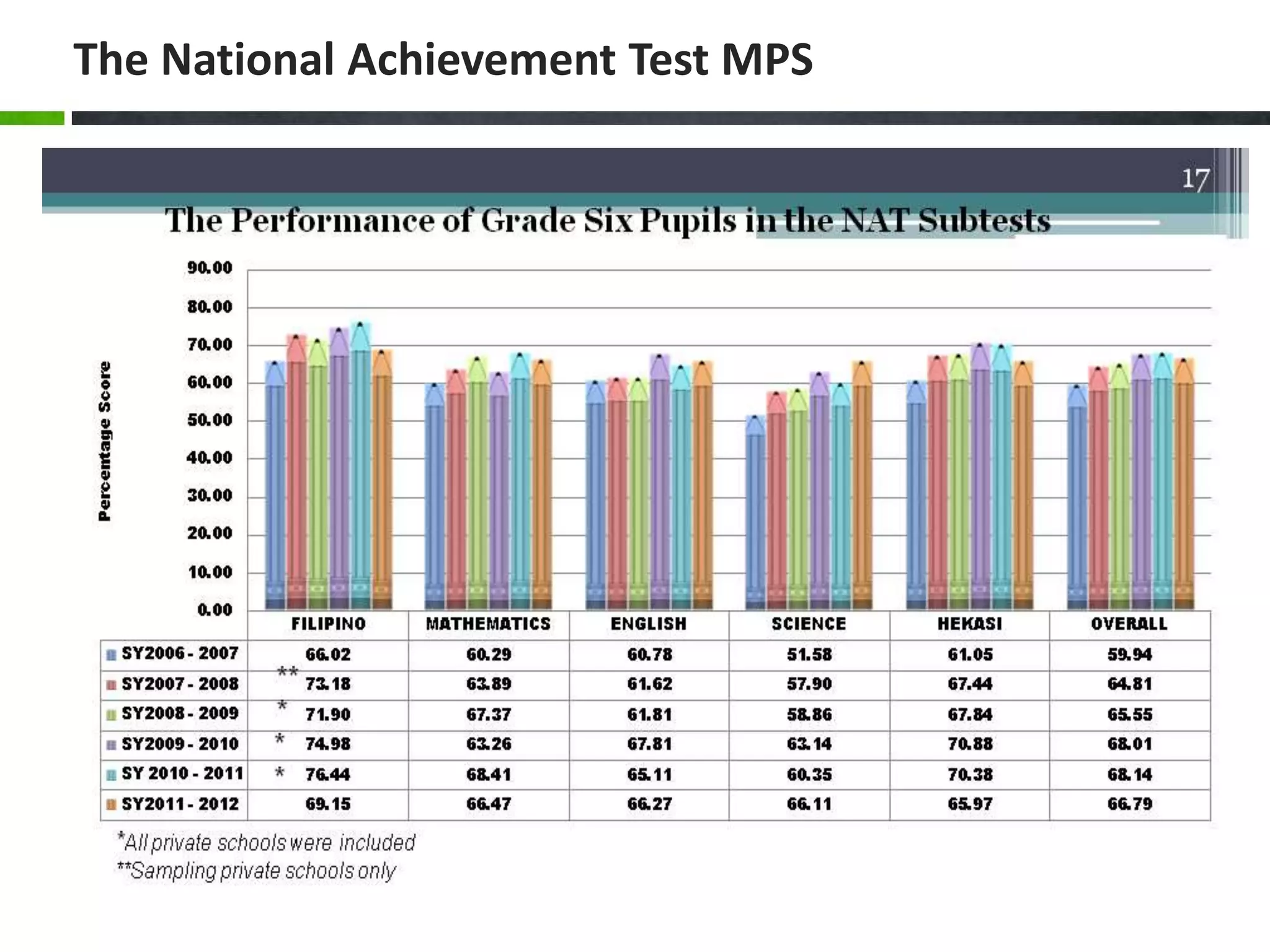
The National Achievement Test MPS
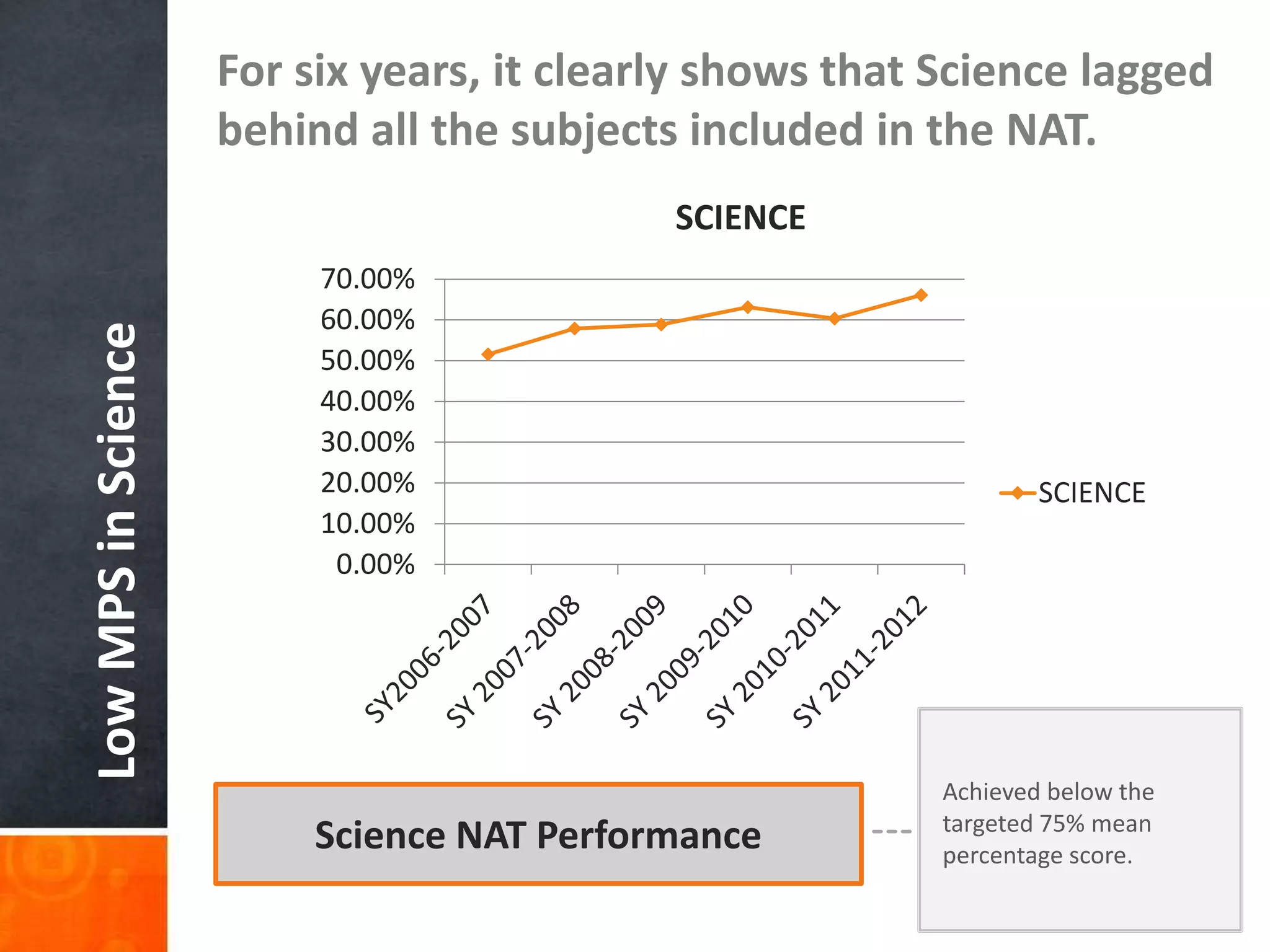
LowMPSinScience
For six years, it clearly shows that Science lagged
behind all the subjects included in the NAT.
Achieved below the
targeted 75% mean
percentage score.
Science NAT Performance
0.00%
10.00%
20.00%
30.00%
40.00%
50.00%
60.00%
70.00%
SCIENCE
SCIENCE
The flagging and critical performance in
the National Achievement Test for Grade VI
specially in Science, needs effective
intervention programs and procedures without
it the factors affecting the NAT performance as
commonly researched are likely to continue and
retard the achievement of the school.
This study will be deemed important to increase and
maintain high science MPS of the test scores of the Grade VI pupils
of Union Elementary School, through the use of Competency-
Based NAT Intervention Program.
Union Elementary School’s Action Research
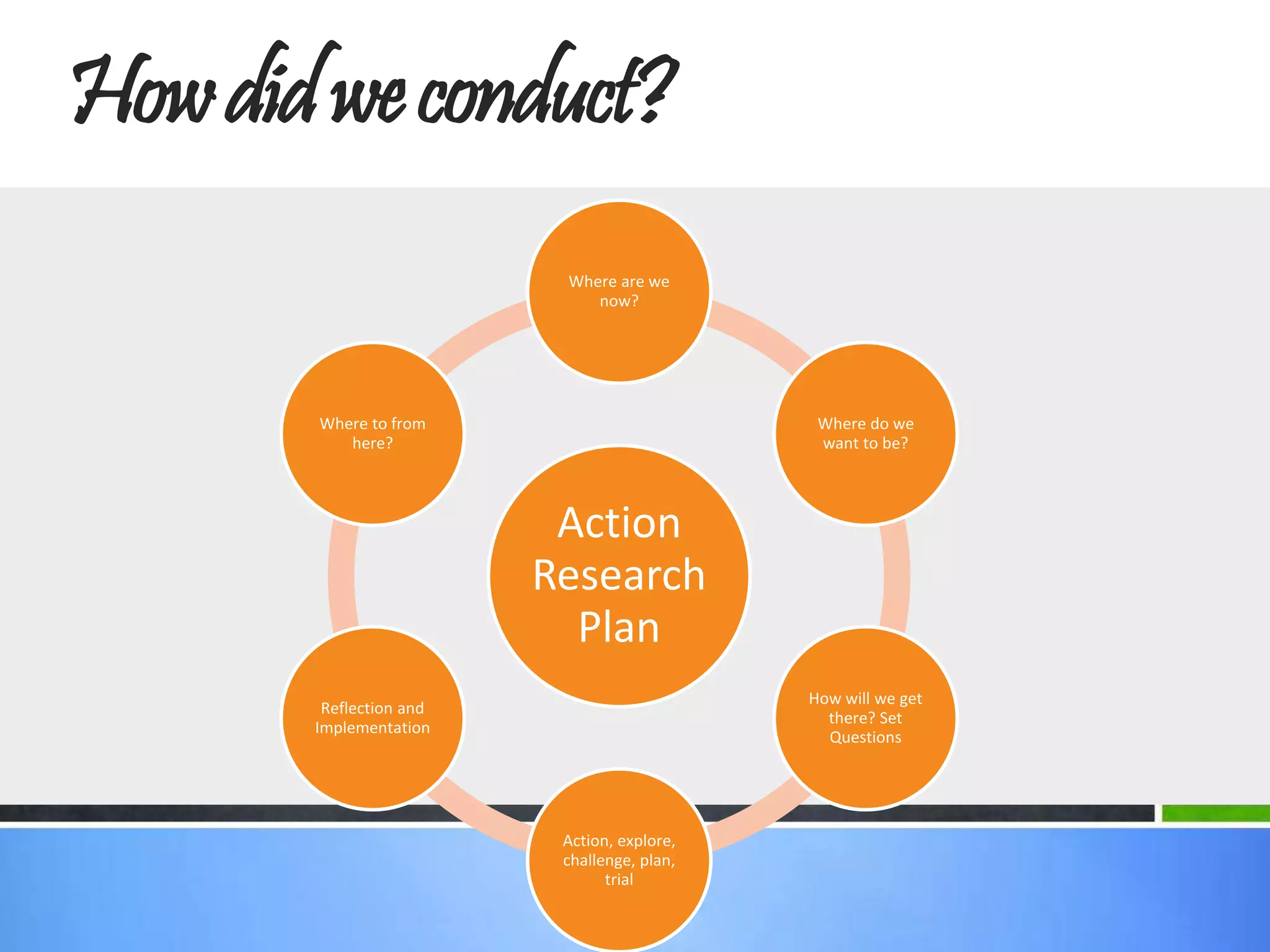
Howdidweconduct?
Action
Research
Plan
Where are we
now?
Where do we
want to be?
How will we get
there? Set
Questions
Action, explore,
challenge, plan,
trial
Reflection and
Implementation
Where to from
here?
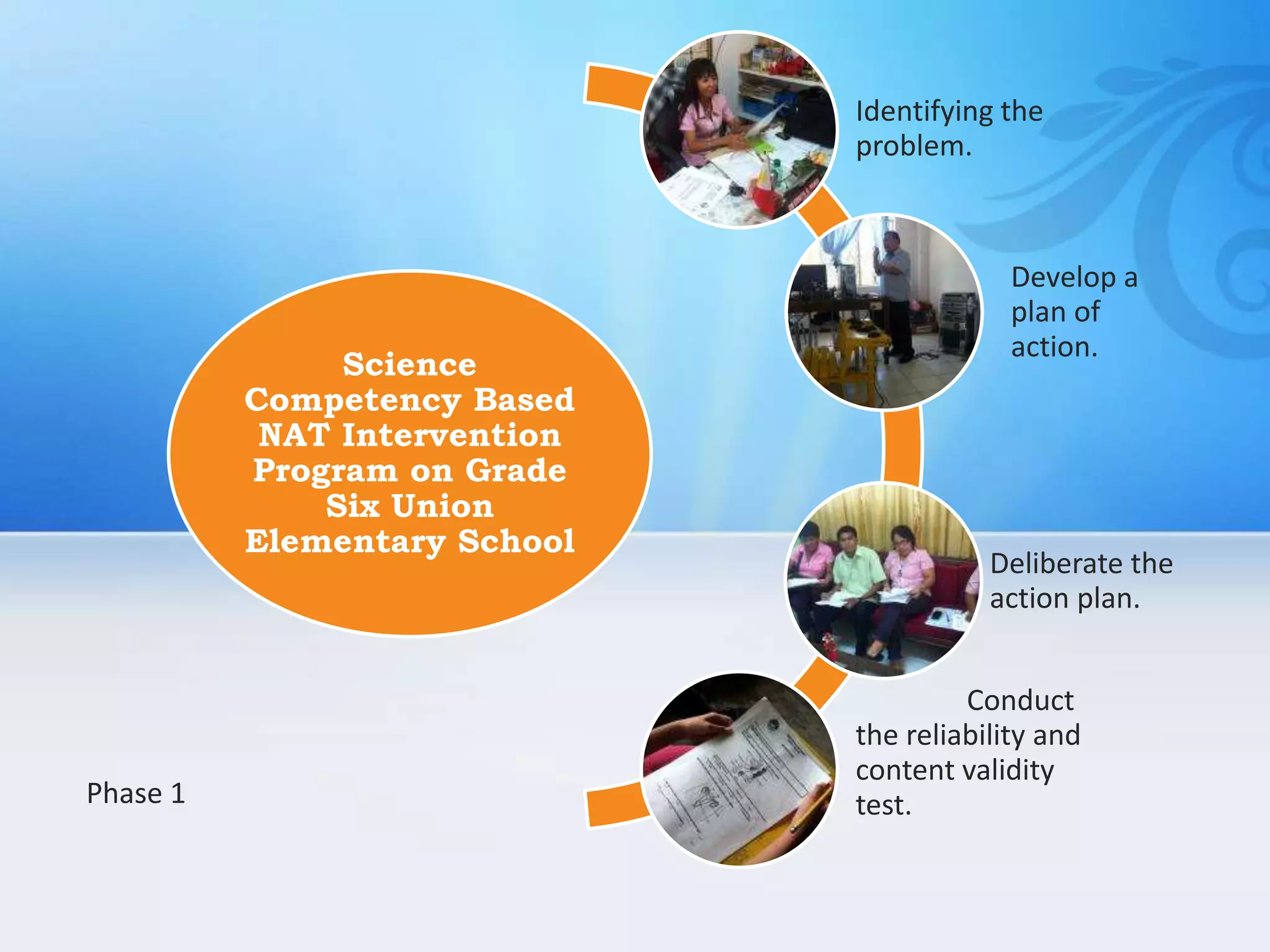
Science
Competency Based
NAT Intervention
Program on Grade
Six Union
Elementary School
Identifying the
problem.
Develop a
plan of
action.
Deliberate the
action plan.
Conduct
the reliability and
content validity
test.Phase 1
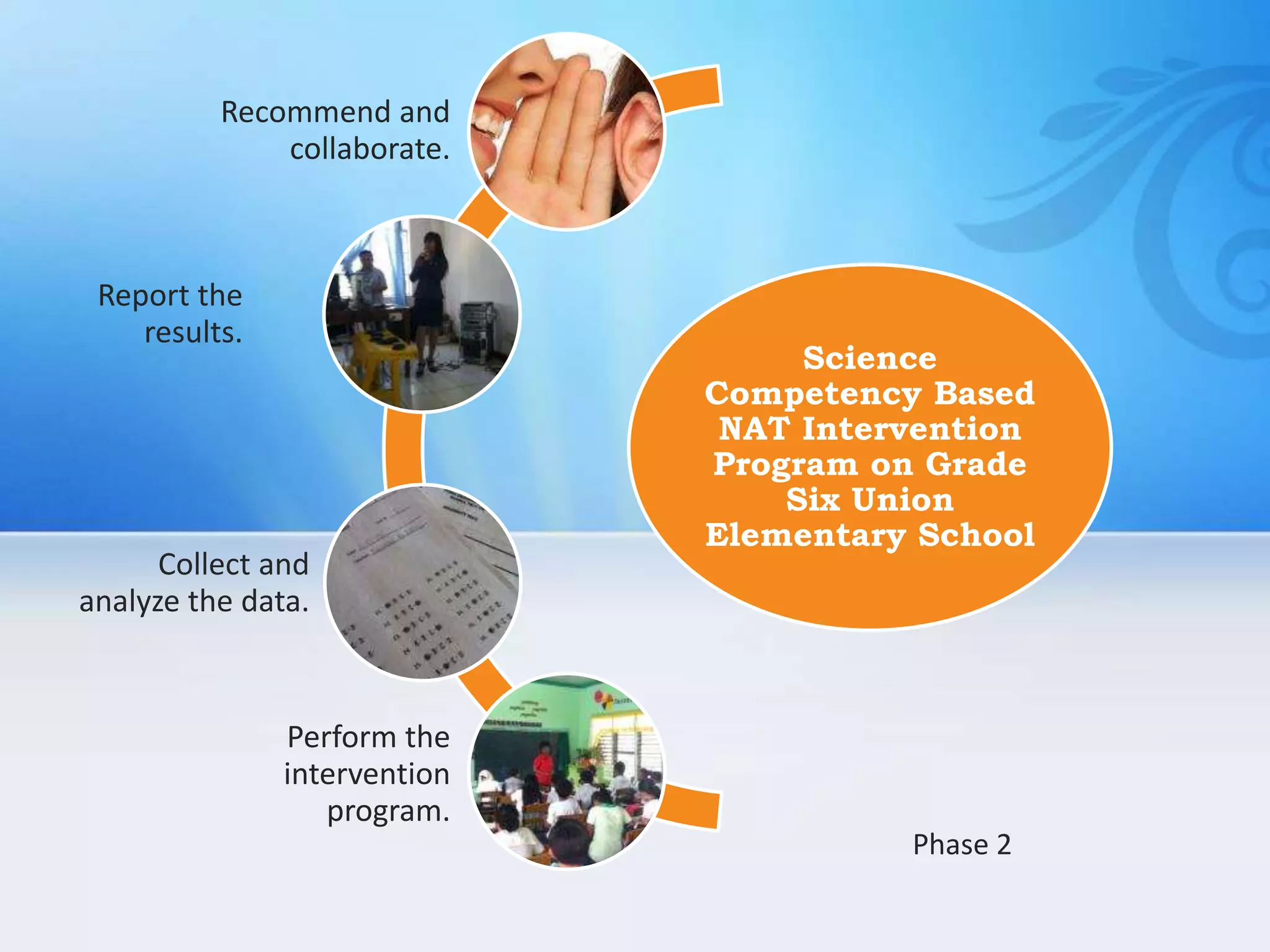
Science
Competency Based
NAT Intervention
Program on Grade
Six Union
Elementary School
Recommend and
collaborate.
Report the
results.
Collect and
analyze the data.
Perform the
intervention
program.
Phase 2
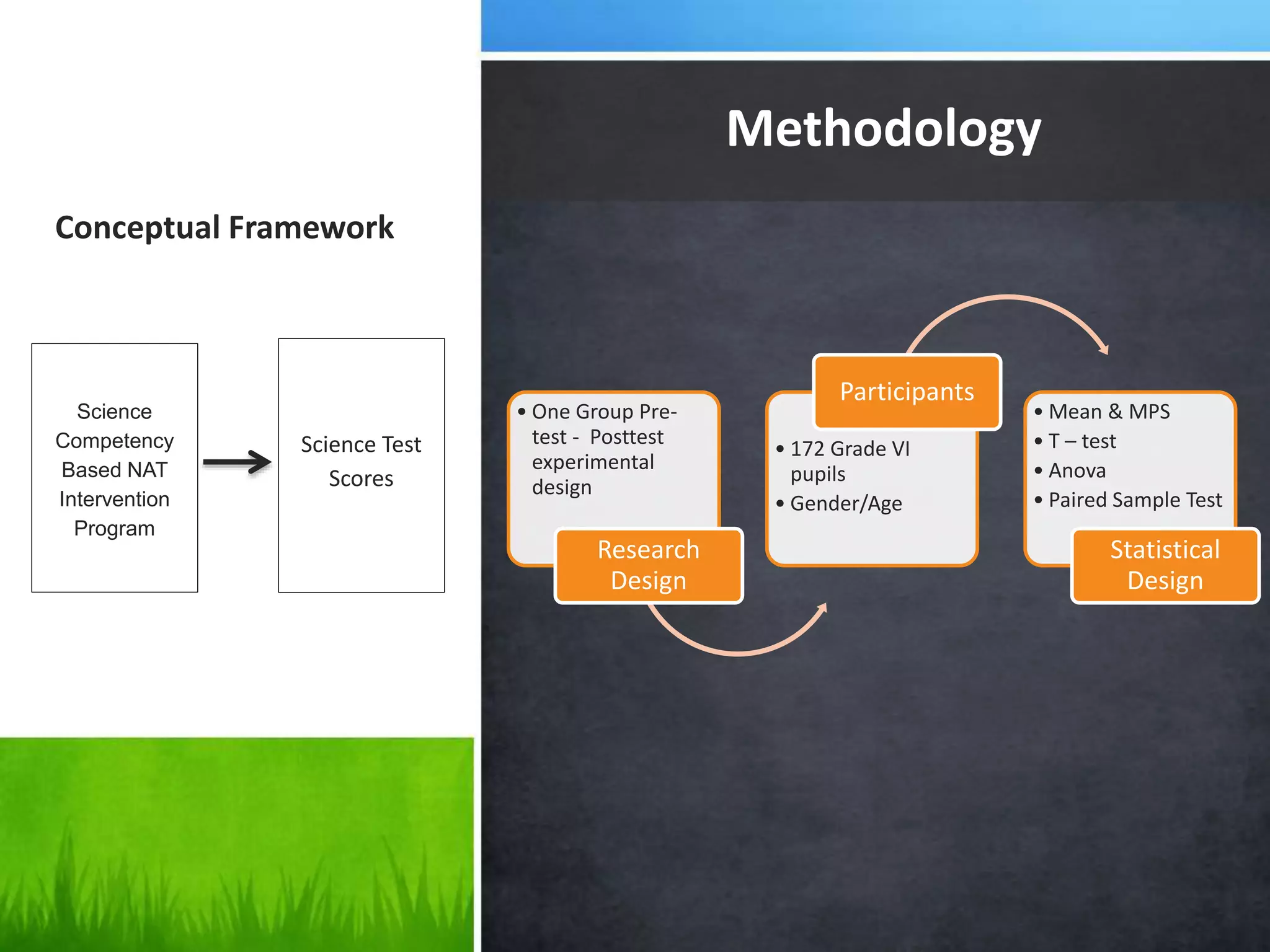
Conceptual Framework
Methodology
Science
Competency
Based NAT
Intervention
Program
Science Test
Scores
• One Group Pre-
test - Posttest
experimental
design
Research
Design
• 172 Grade VI
pupils
• Gender/Age
Participants
• Mean & MPS
• T – test
• Anova
• Paired Sample Test
Statistical
Design
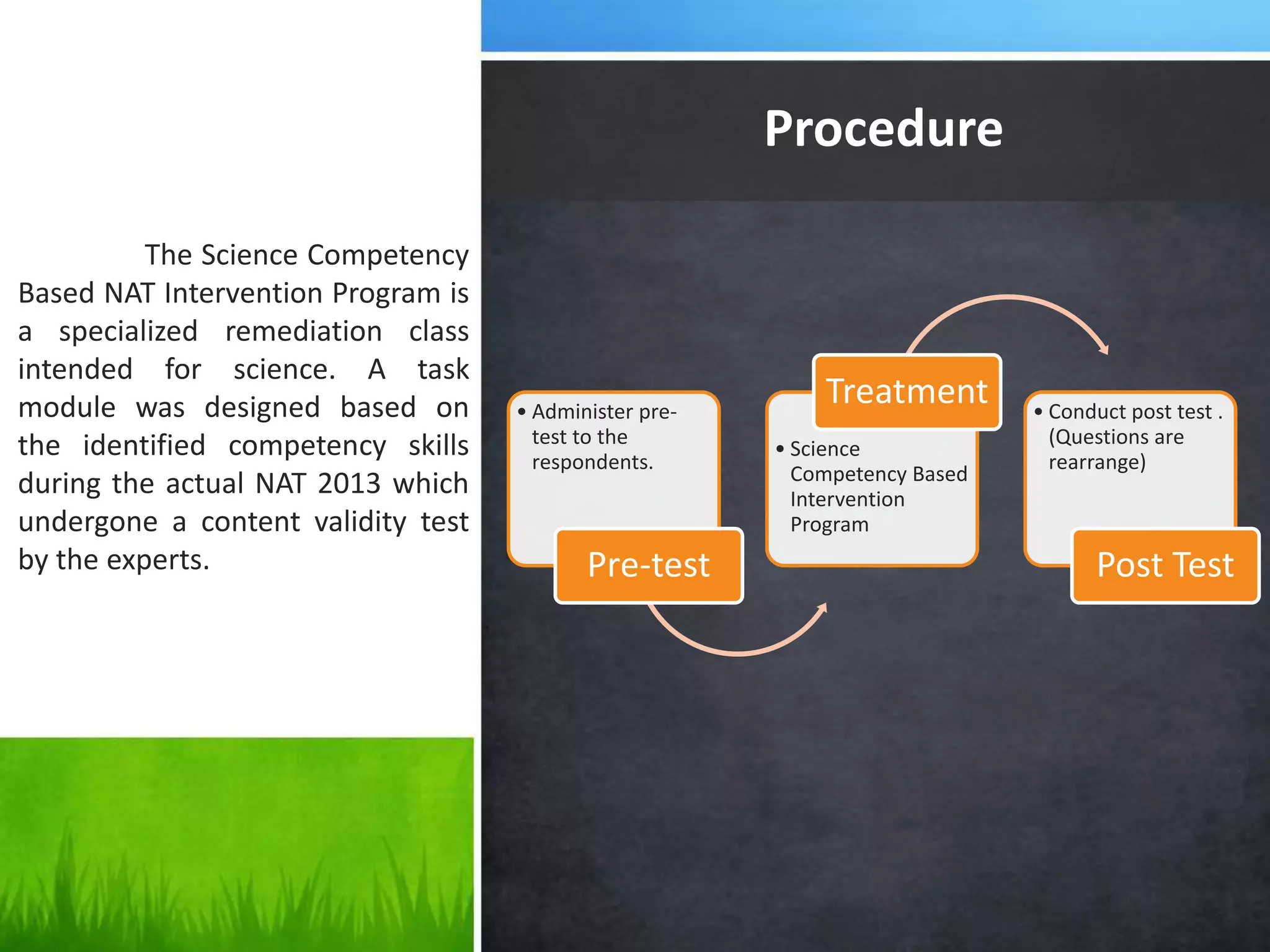
Procedure
• Administer pre-
test to the
respondents.
Pre-test
• Science
Competency Based
Intervention
Program
Treatment • Conduct post test .
(Questions are
rearrange)
Post Test
The Science Competency
Based NAT Intervention Program is
a specialized remediation class
intended for science. A task
module was designed based on
the identified competency skills
during the actual NAT 2013 which
undergone a content validity test
by the experts.
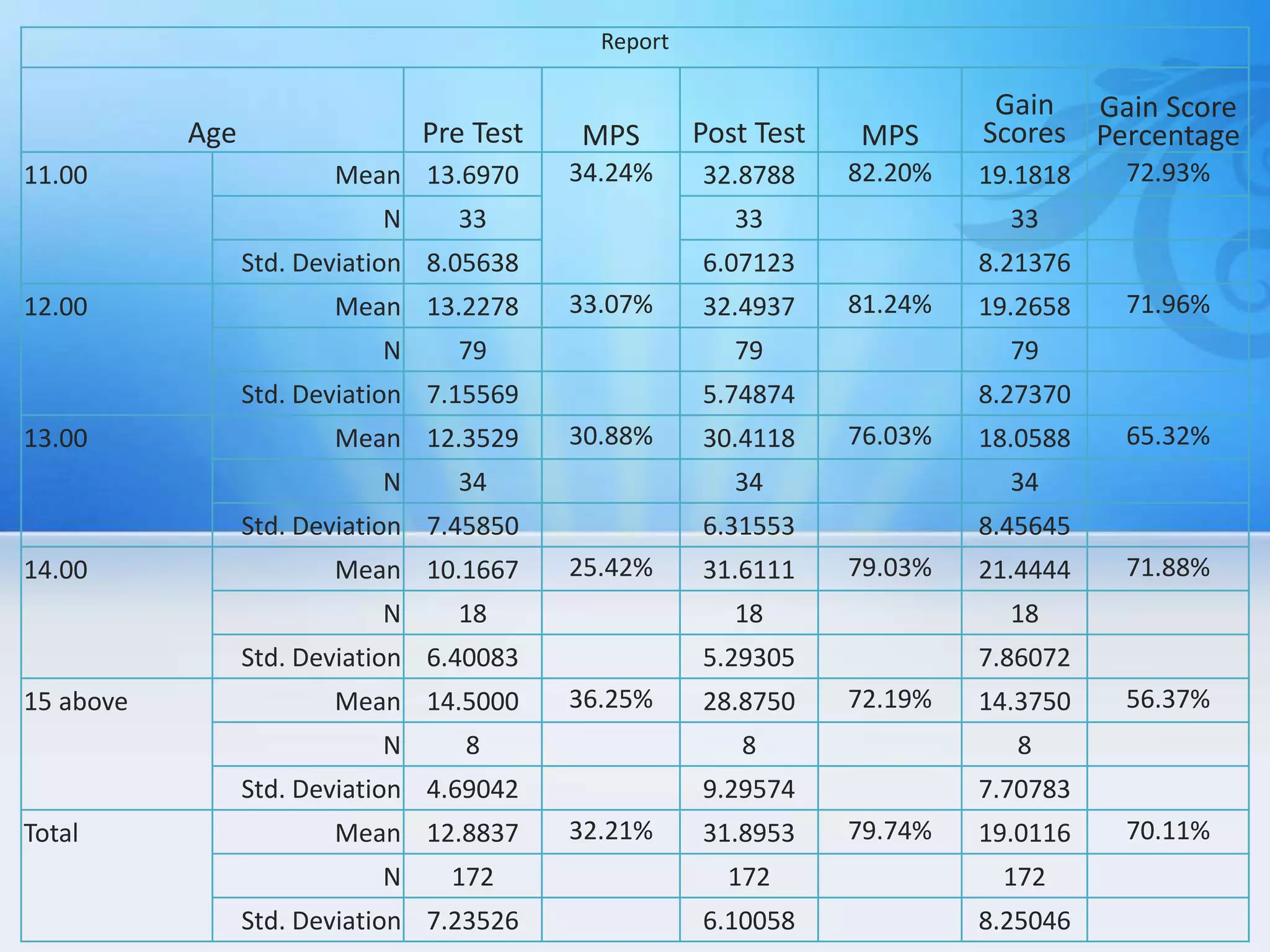
Report
Age Pre Test MPS Post Test MPS
Gain
Scores
Gain Score
Percentage
11.00 Mean 13.6970 34.24% 32.8788 82.20% 19.1818 72.93%
N 33 33 33
Std. Deviation 8.05638 6.07123 8.21376
12.00 Mean 13.2278 33.07% 32.4937 81.24% 19.2658 71.96%
N 79 79 79
Std. Deviation 7.15569 5.74874 8.27370
13.00 Mean 12.3529 30.88% 30.4118 76.03% 18.0588 65.32%
N 34 34 34
Std. Deviation 7.45850 6.31553 8.45645
14.00 Mean 10.1667 25.42% 31.6111 79.03% 21.4444 71.88%
N 18 18 18
Std. Deviation 6.40083 5.29305 7.86072
15 above Mean 14.5000 36.25% 28.8750 72.19% 14.3750 56.37%
N 8 8 8
Std. Deviation 4.69042 9.29574 7.70783
Total Mean 12.8837 32.21% 31.8953 79.74% 19.0116 70.11%
N 172 172 172
Std. Deviation 7.23526 6.10058 8.25046
According to Cascio (2008) in her study entitled, “Race to
the top? Relative age and student achievement”, “children
assigned to classrooms where they were relatively old – or where
their classmates were on average young – performed worse on
tests than children of the same age assigned to classrooms
where they were relatively young”.
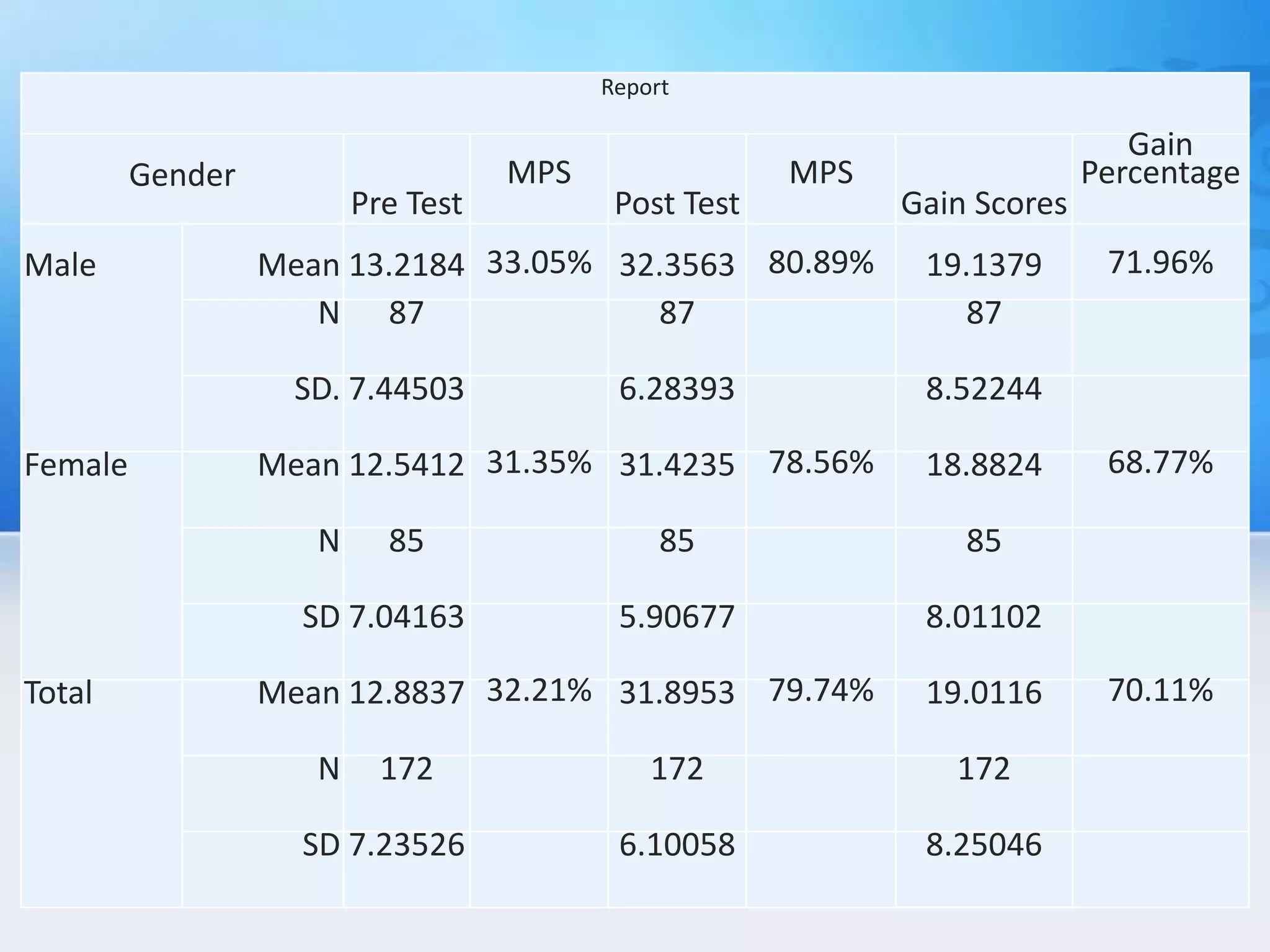
Report
Gender
Pre Test
MPS
Post Test
MPS
Gain Scores
Gain
Percentage
Male Mean 13.2184 33.05% 32.3563 80.89% 19.1379 71.96%
N 87 87 87
SD. 7.44503 6.28393 8.52244
Female Mean 12.5412 31.35% 31.4235 78.56% 18.8824 68.77%
N 85 85 85
SD 7.04163 5.90677 8.01102
Total Mean 12.8837 32.21% 31.8953 79.74% 19.0116 70.11%
N 172 172 172
SD 7.23526 6.10058 8.25046
In the correlation study of Neathery (1997) on gender
and science achievement, “males rated science as a subject more
exciting than females”, conversely, the findings of other
researchers, as quoted by Neathery (1997), “show that male
students demonstrate more positive attitudes toward science
than do females (Czerniak & Chiarelott, 1984; Kahle, 1983;
Schibeci & Riley, 1986).
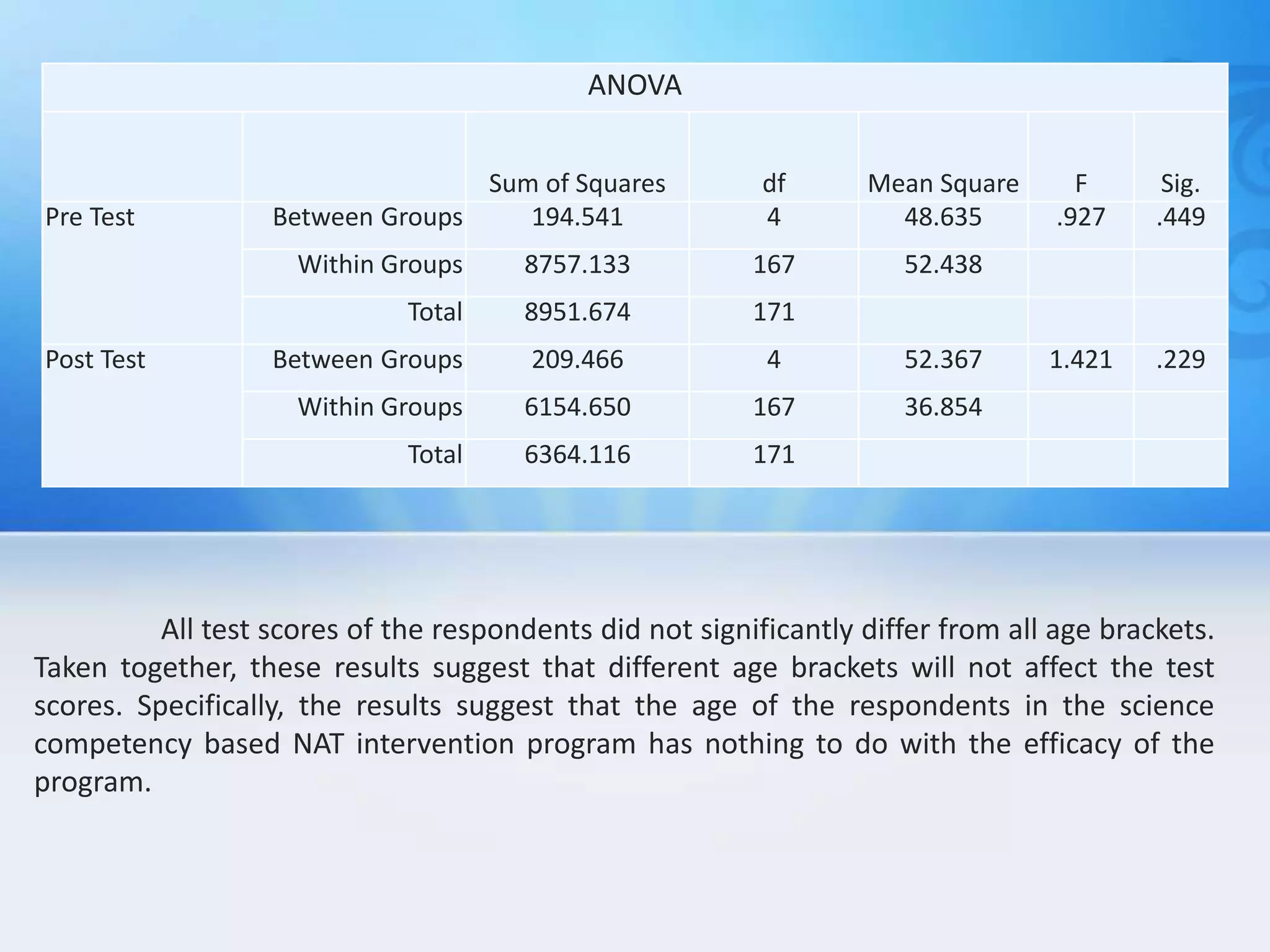
ANOVA
Sum of Squares df Mean Square F Sig.
Pre Test Between Groups 194.541 4 48.635 .927 .449
Within Groups 8757.133 167 52.438
Total 8951.674 171
Post Test Between Groups 209.466 4 52.367 1.421 .229
Within Groups 6154.650 167 36.854
Total 6364.116 171
All test scores of the respondents did not significantly differ from all age brackets.
Taken together, these results suggest that different age brackets will not affect the test
scores. Specifically, the results suggest that the age of the respondents in the science
competency based NAT intervention program has nothing to do with the efficacy of the
program.
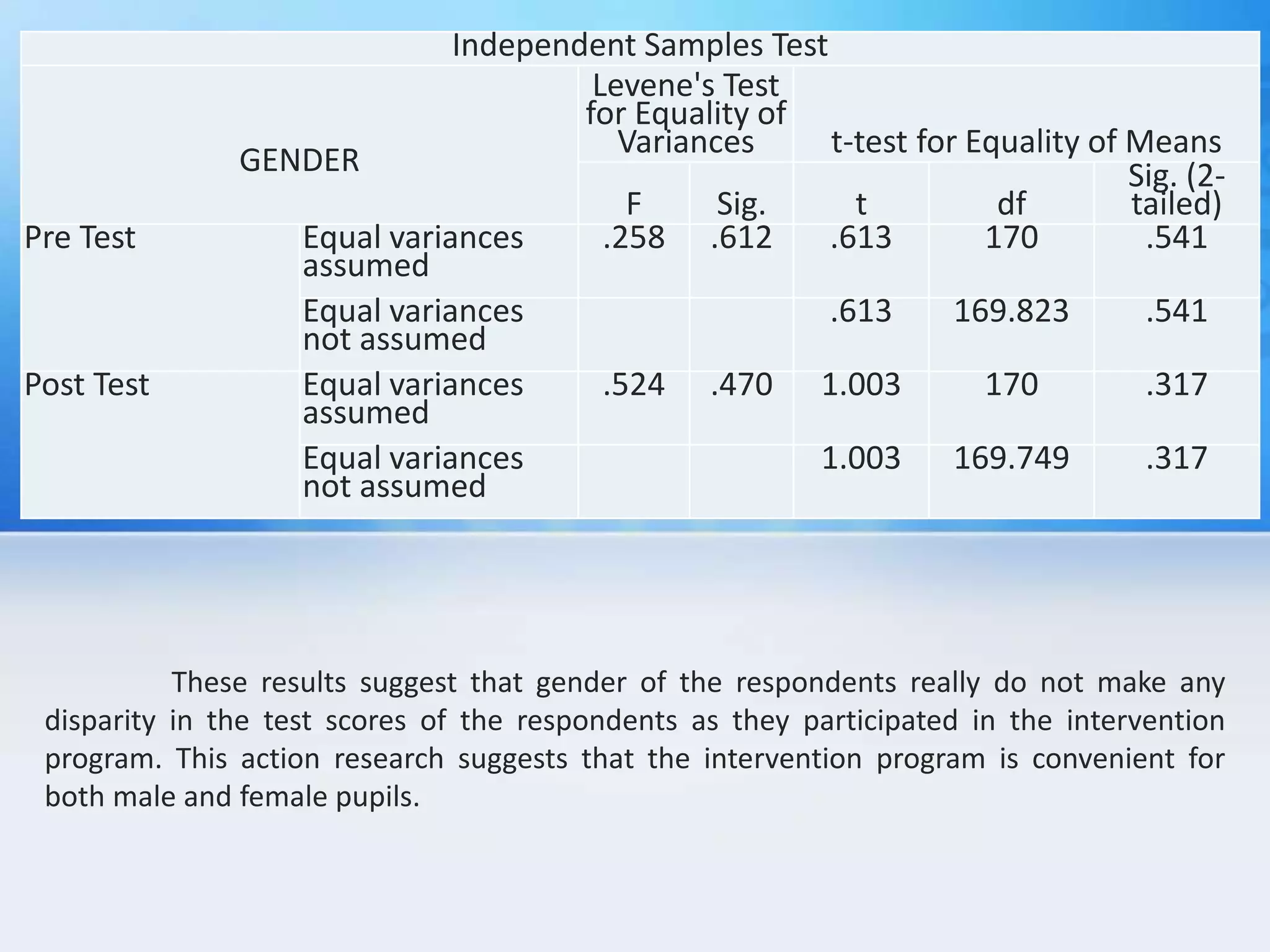
These results suggest that gender of the respondents really do not make any
disparity in the test scores of the respondents as they participated in the intervention
program. This action research suggests that the intervention program is convenient for
both male and female pupils.
Independent Samples Test
GENDER
Levene's Test
for Equality of
Variances t-test for Equality of Means
F Sig. t df
Sig. (2-
tailed)
Pre Test Equal variances
assumed
.258 .612 .613 170 .541
Equal variances
not assumed
.613 169.823 .541
Post Test Equal variances
assumed
.524 .470 1.003 170 .317
Equal variances
not assumed
1.003 169.749 .317
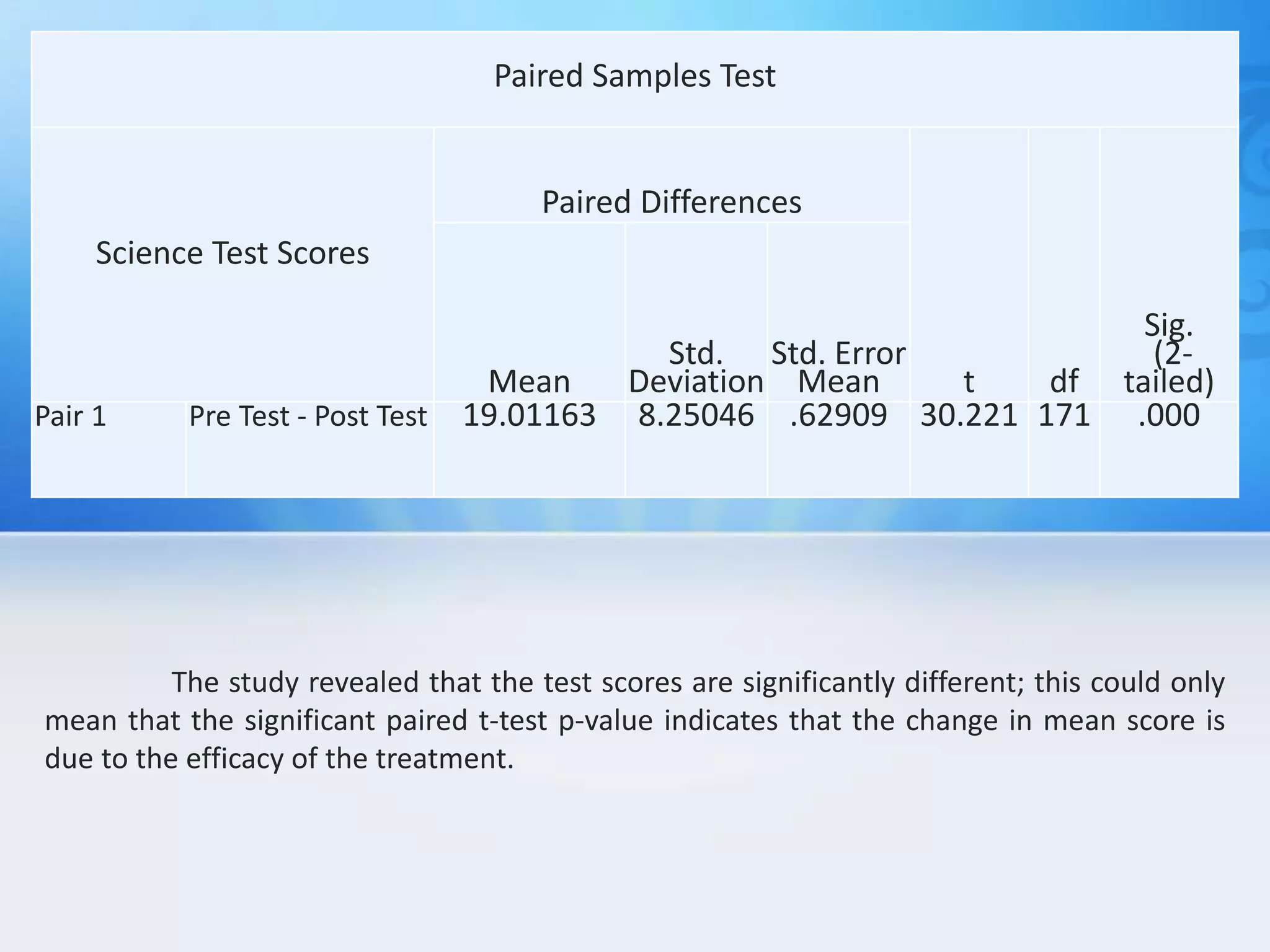
The study revealed that the test scores are significantly different; this could only
mean that the significant paired t-test p-value indicates that the change in mean score is
due to the efficacy of the treatment.
Paired Samples Test
Science Test Scores
Paired Differences
t df
Sig.
(2-
tailed)Mean
Std.
Deviation
Std. Error
Mean
Pair 1 Pre Test - Post Test 19.01163 8.25046 .62909 30.221 171 .000
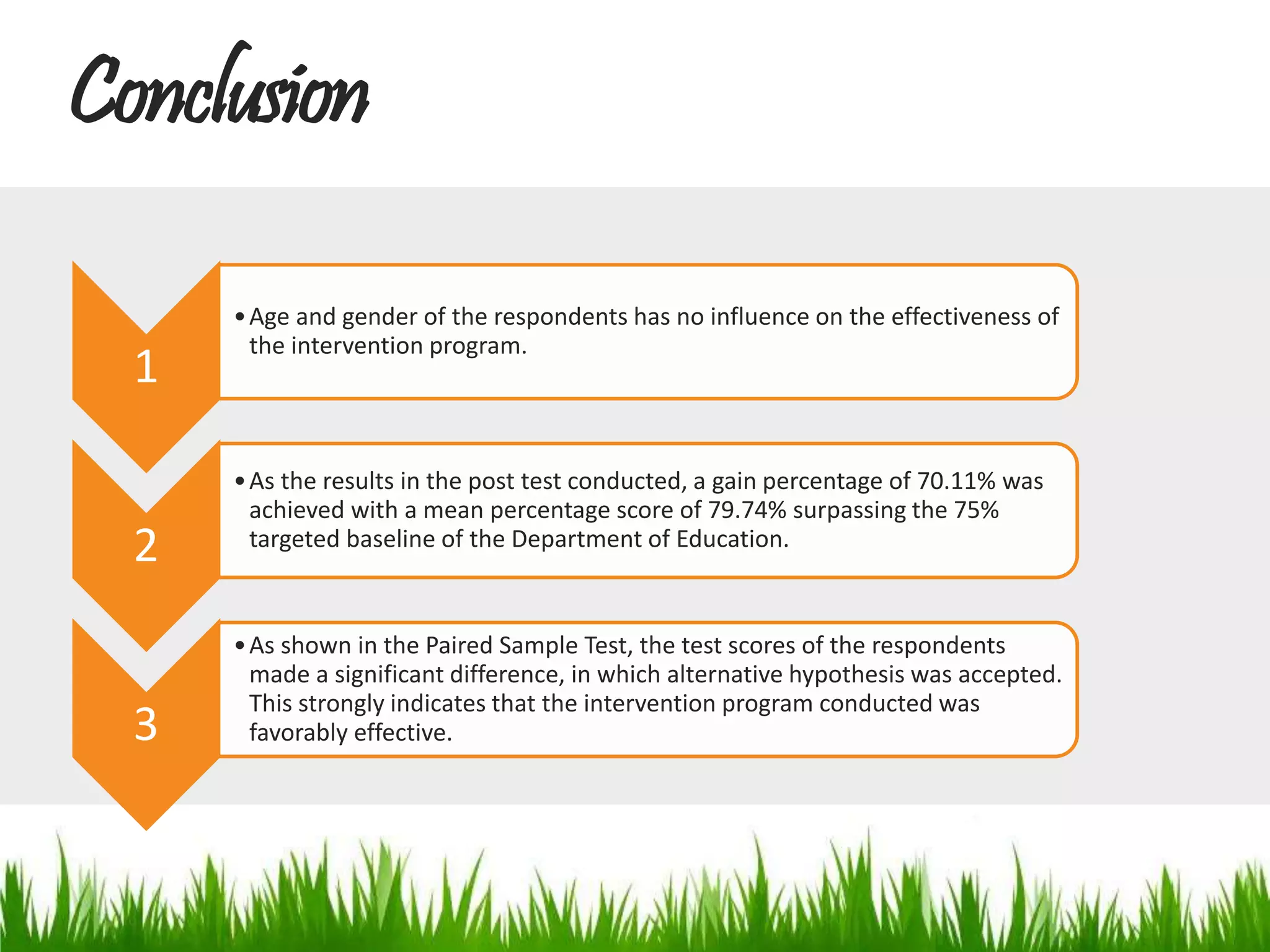
Conclusion
1
•Age and gender of the respondents has no influence on the effectiveness of
the intervention program.
2
•As the results in the post test conducted, a gain percentage of 70.11% was
achieved with a mean percentage score of 79.74% surpassing the 75%
targeted baseline of the Department of Education.
3
•As shown in the Paired Sample Test, the test scores of the respondents
made a significant difference, in which alternative hypothesis was accepted.
This strongly indicates that the intervention program conducted was
favorably effective.
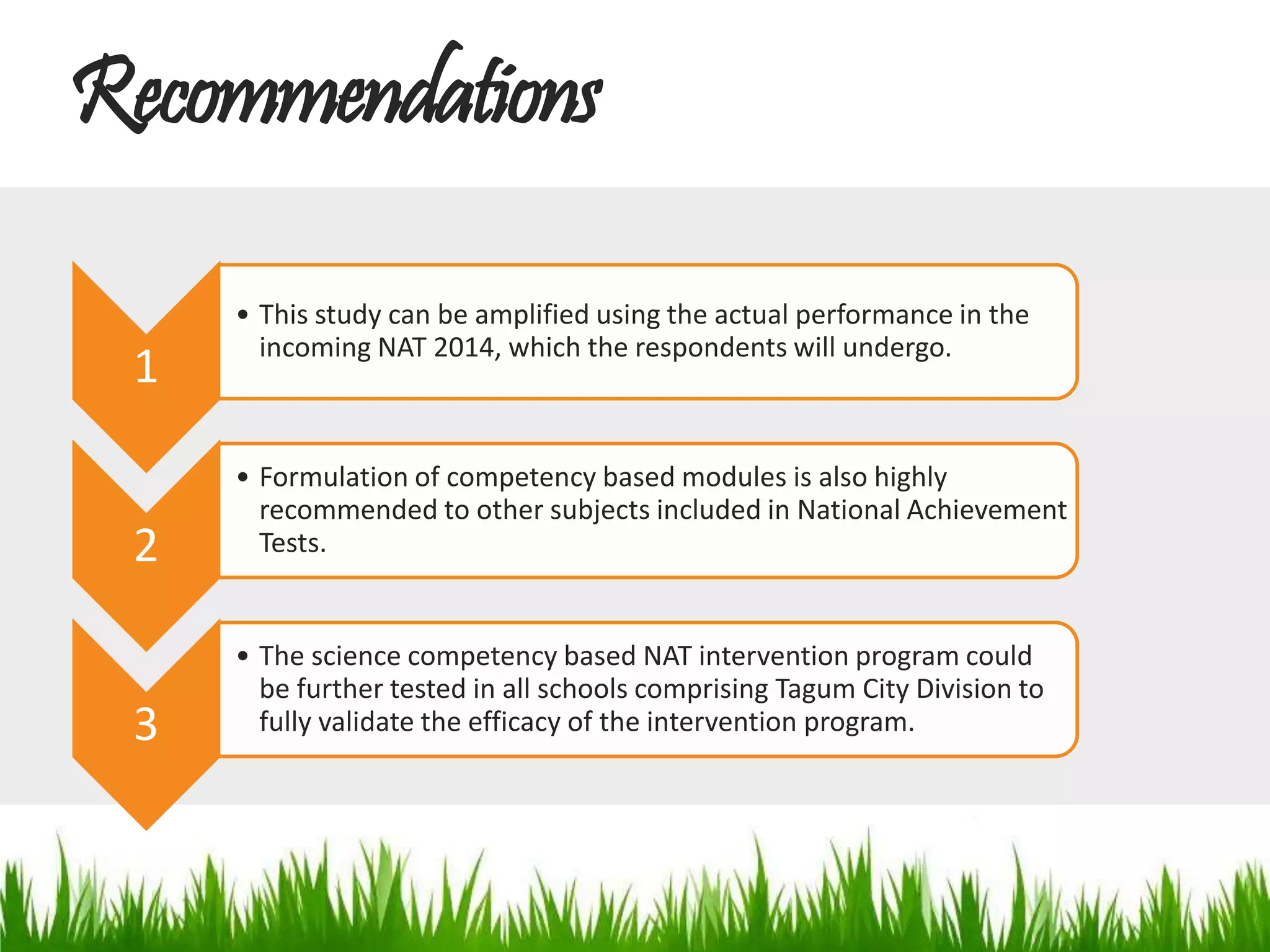
Recommendations
1
• This study can be amplified using the actual performance in the
incoming NAT 2014, which the respondents will undergo.
2
• Formulation of competency based modules is also highly
recommended to other subjects included in National Achievement
Tests.
3
• The science competency based NAT intervention program could
be further tested in all schools comprising Tagum City Division to
fully validate the efficacy of the intervention program.

Science competency based nat intervention program: PAPER PRESENTATION

  • 1.
    Action Research 2013 ScienceCompetency Based NAT Intervention Program on Grade Six Union Elementary School Pupils
  • 2.
    Union Elementary School Mankilam,Tagum City Built into action research is the proviso that, if as a teacher I am dissatisfied with what is already going on, I will have the confidence and resolution to attempt to change it. I will not be content with the status quo. Mrs. Ernita B. Panen Principal 1 Mr. Lynard Bobby L. Asirit Teacher 1/ Researcher
  • 3.
  • 4.
    LowMPSinScience For six years,it clearly shows that Science lagged behind all the subjects included in the NAT. Achieved below the targeted 75% mean percentage score. Science NAT Performance 0.00% 10.00% 20.00% 30.00% 40.00% 50.00% 60.00% 70.00% SCIENCE SCIENCE
  • 5.
    The flagging andcritical performance in the National Achievement Test for Grade VI specially in Science, needs effective intervention programs and procedures without it the factors affecting the NAT performance as commonly researched are likely to continue and retard the achievement of the school.
  • 6.
    This study willbe deemed important to increase and maintain high science MPS of the test scores of the Grade VI pupils of Union Elementary School, through the use of Competency- Based NAT Intervention Program. Union Elementary School’s Action Research
  • 7.
    Howdidweconduct? Action Research Plan Where are we now? Wheredo we want to be? How will we get there? Set Questions Action, explore, challenge, plan, trial Reflection and Implementation Where to from here?
  • 8.
    Science Competency Based NAT Intervention Programon Grade Six Union Elementary School Identifying the problem. Develop a plan of action. Deliberate the action plan. Conduct the reliability and content validity test.Phase 1
  • 9.
    Science Competency Based NAT Intervention Programon Grade Six Union Elementary School Recommend and collaborate. Report the results. Collect and analyze the data. Perform the intervention program. Phase 2
  • 10.
    Conceptual Framework Methodology Science Competency Based NAT Intervention Program ScienceTest Scores • One Group Pre- test - Posttest experimental design Research Design • 172 Grade VI pupils • Gender/Age Participants • Mean & MPS • T – test • Anova • Paired Sample Test Statistical Design
  • 11.
    Procedure • Administer pre- testto the respondents. Pre-test • Science Competency Based Intervention Program Treatment • Conduct post test . (Questions are rearrange) Post Test The Science Competency Based NAT Intervention Program is a specialized remediation class intended for science. A task module was designed based on the identified competency skills during the actual NAT 2013 which undergone a content validity test by the experts.
  • 12.
    Report Age Pre TestMPS Post Test MPS Gain Scores Gain Score Percentage 11.00 Mean 13.6970 34.24% 32.8788 82.20% 19.1818 72.93% N 33 33 33 Std. Deviation 8.05638 6.07123 8.21376 12.00 Mean 13.2278 33.07% 32.4937 81.24% 19.2658 71.96% N 79 79 79 Std. Deviation 7.15569 5.74874 8.27370 13.00 Mean 12.3529 30.88% 30.4118 76.03% 18.0588 65.32% N 34 34 34 Std. Deviation 7.45850 6.31553 8.45645 14.00 Mean 10.1667 25.42% 31.6111 79.03% 21.4444 71.88% N 18 18 18 Std. Deviation 6.40083 5.29305 7.86072 15 above Mean 14.5000 36.25% 28.8750 72.19% 14.3750 56.37% N 8 8 8 Std. Deviation 4.69042 9.29574 7.70783 Total Mean 12.8837 32.21% 31.8953 79.74% 19.0116 70.11% N 172 172 172 Std. Deviation 7.23526 6.10058 8.25046
  • 13.
    According to Cascio(2008) in her study entitled, “Race to the top? Relative age and student achievement”, “children assigned to classrooms where they were relatively old – or where their classmates were on average young – performed worse on tests than children of the same age assigned to classrooms where they were relatively young”.
  • 14.
    Report Gender Pre Test MPS Post Test MPS GainScores Gain Percentage Male Mean 13.2184 33.05% 32.3563 80.89% 19.1379 71.96% N 87 87 87 SD. 7.44503 6.28393 8.52244 Female Mean 12.5412 31.35% 31.4235 78.56% 18.8824 68.77% N 85 85 85 SD 7.04163 5.90677 8.01102 Total Mean 12.8837 32.21% 31.8953 79.74% 19.0116 70.11% N 172 172 172 SD 7.23526 6.10058 8.25046
  • 15.
    In the correlationstudy of Neathery (1997) on gender and science achievement, “males rated science as a subject more exciting than females”, conversely, the findings of other researchers, as quoted by Neathery (1997), “show that male students demonstrate more positive attitudes toward science than do females (Czerniak & Chiarelott, 1984; Kahle, 1983; Schibeci & Riley, 1986).
  • 16.
    ANOVA Sum of Squaresdf Mean Square F Sig. Pre Test Between Groups 194.541 4 48.635 .927 .449 Within Groups 8757.133 167 52.438 Total 8951.674 171 Post Test Between Groups 209.466 4 52.367 1.421 .229 Within Groups 6154.650 167 36.854 Total 6364.116 171 All test scores of the respondents did not significantly differ from all age brackets. Taken together, these results suggest that different age brackets will not affect the test scores. Specifically, the results suggest that the age of the respondents in the science competency based NAT intervention program has nothing to do with the efficacy of the program.
  • 17.
    These results suggestthat gender of the respondents really do not make any disparity in the test scores of the respondents as they participated in the intervention program. This action research suggests that the intervention program is convenient for both male and female pupils. Independent Samples Test GENDER Levene's Test for Equality of Variances t-test for Equality of Means F Sig. t df Sig. (2- tailed) Pre Test Equal variances assumed .258 .612 .613 170 .541 Equal variances not assumed .613 169.823 .541 Post Test Equal variances assumed .524 .470 1.003 170 .317 Equal variances not assumed 1.003 169.749 .317
  • 18.
    The study revealedthat the test scores are significantly different; this could only mean that the significant paired t-test p-value indicates that the change in mean score is due to the efficacy of the treatment. Paired Samples Test Science Test Scores Paired Differences t df Sig. (2- tailed)Mean Std. Deviation Std. Error Mean Pair 1 Pre Test - Post Test 19.01163 8.25046 .62909 30.221 171 .000
  • 19.
    Conclusion 1 •Age and genderof the respondents has no influence on the effectiveness of the intervention program. 2 •As the results in the post test conducted, a gain percentage of 70.11% was achieved with a mean percentage score of 79.74% surpassing the 75% targeted baseline of the Department of Education. 3 •As shown in the Paired Sample Test, the test scores of the respondents made a significant difference, in which alternative hypothesis was accepted. This strongly indicates that the intervention program conducted was favorably effective.
  • 20.
    Recommendations 1 • This studycan be amplified using the actual performance in the incoming NAT 2014, which the respondents will undergo. 2 • Formulation of competency based modules is also highly recommended to other subjects included in National Achievement Tests. 3 • The science competency based NAT intervention program could be further tested in all schools comprising Tagum City Division to fully validate the efficacy of the intervention program.

Editor's Notes

  • #2 This presentation demonstrates the new capabilities of PowerPoint and it is best viewed in SlideShow. These slides are designed to give you great ideas for the presentations you’ll create in PowerPoint 2010! For more sample templates, click the File tab, and then on the New tab, click Sample Templates.