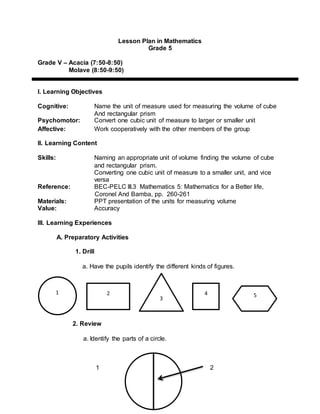
Lesson Plan in Mathematics
Grade 5
Grade V – Acacia (7:50-8:50)
Molave (8:50-9:50)
I. Learning Objectives
Cognitive: Name the unit of measure used for measuring the volume of cube
And rectangular prism
Psychomotor: Convert one cubic unit of measure to larger or smaller unit
Affective: Work cooperatively with the other members of the group
II. Learning Content
Skills: Naming an appropriate unit of volume finding the volume of cube
and rectangular prism.
Converting one cubic unit of measure to a smaller unit, and vice
versa
Reference: BEC-PELC III.3 Mathematics 5: Mathematics for a Better life,
Coronel And Bamba, pp. 260-261
Materials: PPT presentation of the units for measuring volume
Value: Accuracy
III. Learning Experiences
A. Preparatory Activities
1. Drill
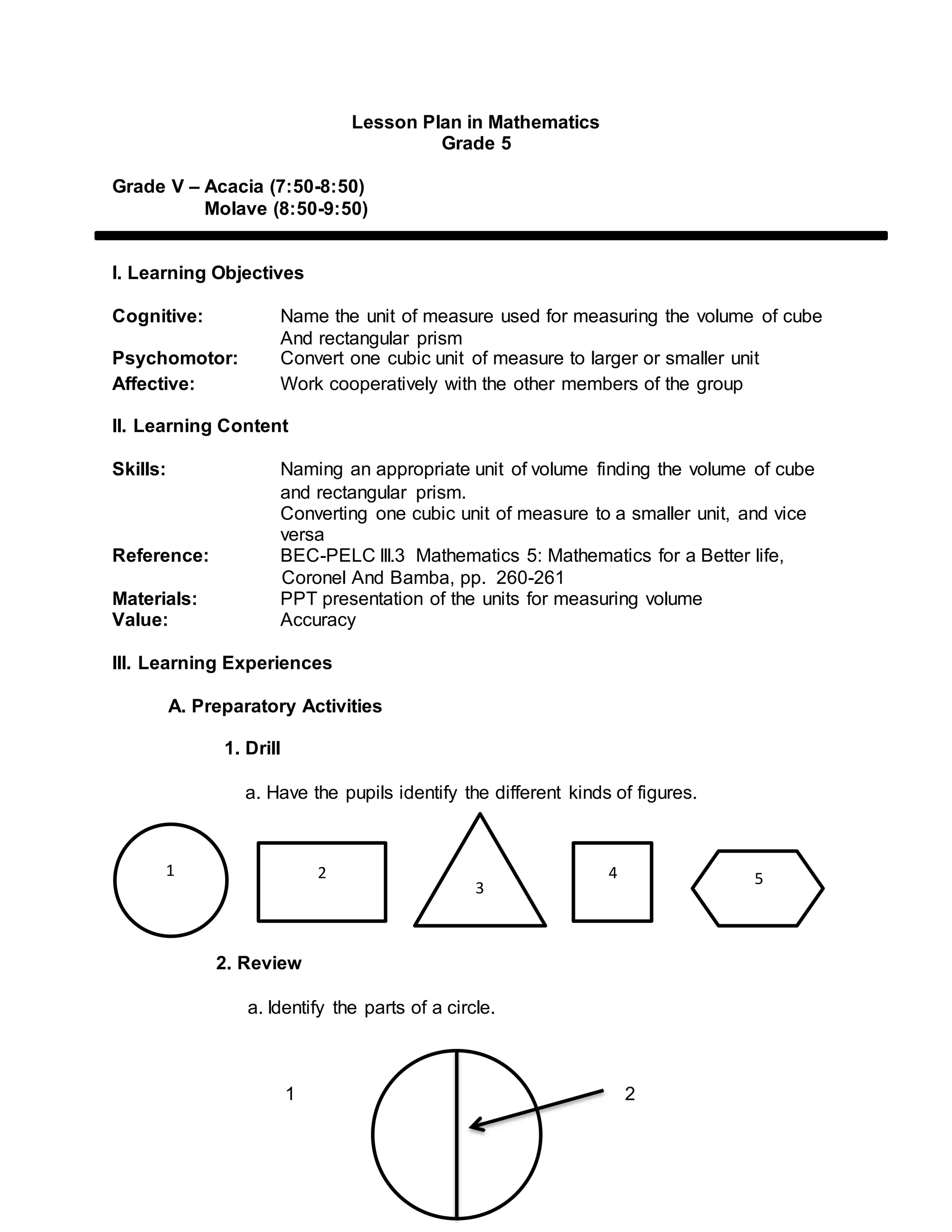
a. Have the pupils identify the different kinds of figures.
2. Review
a. Identify the parts of a circle.
1 2
1 2
3
4 5
3
b. Review on finding the diameter and radius of a circle.
Game: Flash and Tell
 5 representatives from the boys, and 5 from girls.
 As the teacher flashes card with the diameter d, a pupil in
line will give the value of the radius r. If the card flashed has
the value of radius, pupils will give the value of diameter.
 The pupil who can give the correct answer first earns point.
 The group with the most number of points wins the game.
1. d = 7 6. r = 150
2. r = 9 7. r = 75
3. r = 24 8. d = 40
4. d = 36 9. d = 72
5. d = 42 10. r = 300
3. Motivation
Ask the pupils: What shape is the lot on which your house stands?
Do you have any idea how large your lot is?
B. Developmental Activities
1. Presentation
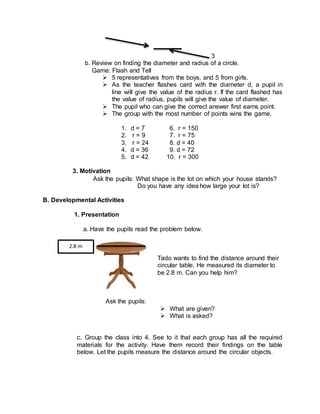
a. Have the pupils read the problem below.
Tado wants to find the distance around their
circular table. He measured its diameter to
be 2.8 m. Can you help him?
Ask the pupils:
 What are given?
 What is asked?
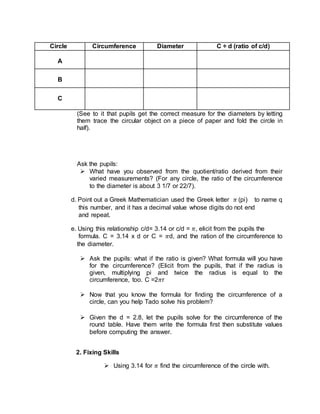
c. Group the class into 4. See to it that each group has all the required
materials for the activity. Have them record their findings on the table
below. Let the pupils measure the distance around the circular objects.
2.8 m
(See to it that pupils get the correct measure for the diameters by letting
them trace the circular object on a piece of paper and fold the circle in
half).
Ask the pupils:
 What have you observed from the quotient/ratio derived from their
varied measurements? (For any circle, the ratio of the circumference
to the diameter is about 3 1/7 or 22/7).
d. Point out a Greek Mathematician used the Greek letter 𝜋 (pi) to name q
this number, and it has a decimal value whose digits do not end
and repeat.
e. Using this relationship c/d= 3.14 or c/d = 𝜋, elicit from the pupils the
formula. C = 3.14 x d or C = 𝜋d, and the ration of the circumference to
the diameter.
 Ask the pupils: what if the ratio is given? What formula will you have
for the circumference? (Elicit from the pupils, that if the radius is
given, multiplying pi and twice the radius is equal to the
circumference, too. C =2𝜋r
 Now that you know the formula for finding the circumference of a
circle, can you help Tado solve his problem?
 Given the d = 2.8, let the pupils solve for the circumference of the
round table. Have them write the formula first then substitute values
before computing the answer.
2. Fixing Skills
 Using 3.14 for 𝜋 find the circumference of the circle with.
Circle Circumference Diameter C ÷ d (ratio of c/d)
A
B
C
1. d = 12 cm
2. d = 5 cm
3. r = 2 cm
4. r = 1.5 cm
5. d = 3.5 cm
3. Generalization
Ask the pupils: What is the formula for the circumference of the
circle?
4. Application
 Using 22/7 for 𝜋, find the circumference of:
a. r = 2 m b. d = 42 cm c . r = 5 m
IV. Evaluation
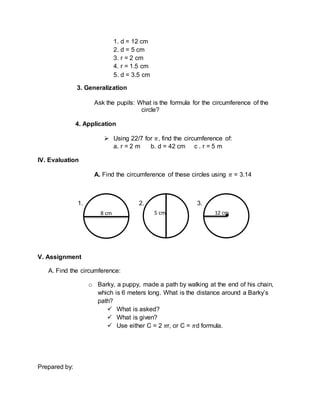
A. Find the circumference of these circles using 𝜋 = 3.14
1. 2. 3.
V. Assignment
A. Find the circumference:
o Barky, a puppy, made a path by walking at the end of his chain,
which is 6 meters long. What is the distance around a Barky’s
path?
 What is asked?
 What is given?
 Use either C = 2 𝜋r, or C = 𝜋d formula.
Prepared by:
8 cm 5 cm 12 cm
RENEL R. SITON
Intern
Checked:
LYNARD BOBBY L. ASIRIT
Critic Teacher

Circumference of circle...

  • 1.
    Lesson Plan inMathematics Grade 5 Grade V – Acacia (7:50-8:50) Molave (8:50-9:50) I. Learning Objectives Cognitive: Name the unit of measure used for measuring the volume of cube And rectangular prism Psychomotor: Convert one cubic unit of measure to larger or smaller unit Affective: Work cooperatively with the other members of the group II. Learning Content Skills: Naming an appropriate unit of volume finding the volume of cube and rectangular prism. Converting one cubic unit of measure to a smaller unit, and vice versa Reference: BEC-PELC III.3 Mathematics 5: Mathematics for a Better life, Coronel And Bamba, pp. 260-261 Materials: PPT presentation of the units for measuring volume Value: Accuracy III. Learning Experiences A. Preparatory Activities 1. Drill a. Have the pupils identify the different kinds of figures. 2. Review a. Identify the parts of a circle. 1 2 1 2 3 4 5
  • 2.
    3 b. Review onfinding the diameter and radius of a circle. Game: Flash and Tell  5 representatives from the boys, and 5 from girls.  As the teacher flashes card with the diameter d, a pupil in line will give the value of the radius r. If the card flashed has the value of radius, pupils will give the value of diameter.  The pupil who can give the correct answer first earns point.  The group with the most number of points wins the game. 1. d = 7 6. r = 150 2. r = 9 7. r = 75 3. r = 24 8. d = 40 4. d = 36 9. d = 72 5. d = 42 10. r = 300 3. Motivation Ask the pupils: What shape is the lot on which your house stands? Do you have any idea how large your lot is? B. Developmental Activities 1. Presentation a. Have the pupils read the problem below. Tado wants to find the distance around their circular table. He measured its diameter to be 2.8 m. Can you help him? Ask the pupils:  What are given?  What is asked? c. Group the class into 4. See to it that each group has all the required materials for the activity. Have them record their findings on the table below. Let the pupils measure the distance around the circular objects. 2.8 m
  • 3.
    (See to itthat pupils get the correct measure for the diameters by letting them trace the circular object on a piece of paper and fold the circle in half). Ask the pupils:  What have you observed from the quotient/ratio derived from their varied measurements? (For any circle, the ratio of the circumference to the diameter is about 3 1/7 or 22/7). d. Point out a Greek Mathematician used the Greek letter 𝜋 (pi) to name q this number, and it has a decimal value whose digits do not end and repeat. e. Using this relationship c/d= 3.14 or c/d = 𝜋, elicit from the pupils the formula. C = 3.14 x d or C = 𝜋d, and the ration of the circumference to the diameter.  Ask the pupils: what if the ratio is given? What formula will you have for the circumference? (Elicit from the pupils, that if the radius is given, multiplying pi and twice the radius is equal to the circumference, too. C =2𝜋r  Now that you know the formula for finding the circumference of a circle, can you help Tado solve his problem?  Given the d = 2.8, let the pupils solve for the circumference of the round table. Have them write the formula first then substitute values before computing the answer. 2. Fixing Skills  Using 3.14 for 𝜋 find the circumference of the circle with. Circle Circumference Diameter C ÷ d (ratio of c/d) A B C
  • 4.
    1. d =12 cm 2. d = 5 cm 3. r = 2 cm 4. r = 1.5 cm 5. d = 3.5 cm 3. Generalization Ask the pupils: What is the formula for the circumference of the circle? 4. Application  Using 22/7 for 𝜋, find the circumference of: a. r = 2 m b. d = 42 cm c . r = 5 m IV. Evaluation A. Find the circumference of these circles using 𝜋 = 3.14 1. 2. 3. V. Assignment A. Find the circumference: o Barky, a puppy, made a path by walking at the end of his chain, which is 6 meters long. What is the distance around a Barky’s path?  What is asked?  What is given?  Use either C = 2 𝜋r, or C = 𝜋d formula. Prepared by: 8 cm 5 cm 12 cm
  • 5.
    RENEL R. SITON Intern Checked: LYNARDBOBBY L. ASIRIT Critic Teacher