A Psychologycal Report
On
Non- Verbal Group Inteligence Test (NVGIT)
Prepared by
Sujit Kumar Bhoi
Intrigated BE.d & ME.d
Regd.No-2229CUKMR-44
Submitted to
Mr.T Arun Chirshtoper
Assistant Professor in CUK
CENTRAL UNIVERSITY OF KASHMIR
2024
1
INTRODUCTION
It is a matter of common observation that the human being not only different their
physical structure and physical ability but also they greatly differ in their mental
abilities in our day to day conversation we often comment that a particular child or
individual is very intelligence all such comment based on ours observation of the
performance or behaviour of the individual concend in comparison to other of his
group such. Such type of mental abilities which helps a person to adjust to new
situation. Slove problem quickly to thing in abstract way are generally refered to as
intelligence.
Intelligence has been conceptualized as “Individuals differ from one another in their
ability to understand complex ideas, to adapt effectively to the environment, to learn
from experience, to engage in various forms of reasoning, to overcome obstacles by
taking thought.” American Psychological Association . “A global concept that
involves an individual's ability to act purposefully, think rationally, and deal
effectively with the environment.” D. Wechsler. Intelligence is not a single, unitary
ability, but rather a composite of several functions. The term denotes that combination
of abilities required for survival and advancement within a particular
culture.” A. Anastasi.
Although contemporary definitions of intelligence vary considerably, experts
generally agree that intelligence involves mental abilities such as logic, reasoning,
problem-solving, and planning. Specifically, current definitions tend to suggest that
intelligence is the ability to:
Learn from experience: The acquisition, retention, and use of knowledge is an
important component of intelligence.
Recognize problems: To use knowledge, people first must identify the problems it
might address.
Solve problems: People must then use what they have learned to come up with
solutions to problems.1
Research on intelligence plays a significant role in many areas including educational
program funding, job applicant screening, and testing to identify children who need
additional academic help.
Objective of the test
 To find out intellectual ability of the students and to find out range of
intelligence.
 To explore the intellectual capacity in the specific areas and to identify
children who need additional academic help
Delimitations of the test
2
The test is delimited to the class VIII students of the New Dream Land Educational
Institute who have regular students in section blue.
METHOD AND ADMINISTRATION OF THE TEST
The methodology part of the study under investigation that refers to the methods and
procedures used for the test. It includes the method used for drawing out a sample,
test items used in conducted a test, and procedure for NON- VERBAL GROUP
INTELIGENCE TEST (NVGIT) and interprete the abtain score in the test . In the
group intelligence test , the selection of the test item is a very essential task. It also
helps the examiner to analyse and interpret score used by the examiner to examine the
NON – VERBAL GROUP INTELIGENCE TEST. The method and interpitation used
for the test are structured with the following sub-headings;
 Sample
 Test item for Test
 The procedure of Test
 Techniques of Data Analysis and Interpretation
Sample
The main objective of the test was to find out intellectual ability of the students and to
find out range of intelligence and to explore the intellectual capacity in the specific
areas and to identify children who need additional academic help. For this purpose,the
investigator conducted a test on 20 students from class VIII in New Dreamland
Educational Institute Beehama ,Gandarbal.
Test item for Test
The investigator used a standardzied test item NON- VERBAL GROUP
INTELIGENCE TEST (NVGIT) to conducted a test for class VIII students of the
New Dream Land Educational Institute Ganderbal regarding group intelligence test.
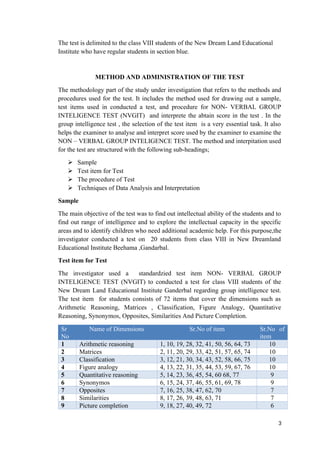
The test item for students consists of 72 items that cover the dimensions such as
Arithmetic Reasoning, Matrices , Classification, Figure Analogy, Quantitative
Reasoning, Synonymos, Opposites, Similarities And Picture Completion.
Sr
No
Name of Dimensions Sr.No of item Sr.No of
item
1 Arithmetic reasoning 1, 10, 19, 28, 32, 41, 50, 56, 64, 73 10
2 Matrices 2, 11, 20, 29, 33, 42, 51, 57, 65, 74 10
3 Classification 3, 12, 21, 30, 34, 43, 52, 58, 66, 75 10
4 Figure analogy 4, 13, 22, 31, 35, 44, 53, 59, 67, 76 10
5 Quantitative reasoning 5, 14, 23, 36, 45, 54, 60 68, 77 9
6 Synonymos 6, 15, 24, 37, 46, 55, 61, 69, 78 9
7 Opposites 7, 16, 25, 38, 47, 62, 70 7
8 Similarities 8, 17, 26, 39, 48, 63, 71 7
9 Picture completion 9, 18, 27, 40, 49, 72 6
3
TOTAL
78
The procedure of Test
Firstly, the investigator used test items of the standarzied questionnaire on the non-
verbal group intelligence test. Then, the investigator established meeting with the
students of class viii students in the school classroom to request the students to tick
the answer as per their knowledge and experiences. The investigator gives general
instructions to the students for test .The test is an omnibus type, consisting of different
kinds of Items in nine sub- tests. There is a separate answer sheet for writing the
responses. Remember all the writing goes on the answer sheet only. Do not mark on
the booklet in any manner. Do not open the booklet until you are asked to do so. Read
the directions and do the examples carefully. Carefully read the direction given for
each item as how to mark the response and give responses as you are directed. Put a
cross (x) on the answer sheet against the right response you have chosen for any
question. If you want to change any response, put a circle (O) and then mark a cross
on the new response. Time limit for the test in 20 minutes. Get you doubts clarified
before the testing begins. No question will be entertained when the test begins. (A)
Now I will distribute the booklet along with the answer sheet. But do not open the
Booklet until you are asked to do so. (Distributed). (B) Take the answer sheet and fill
in the spaces provided. (Filled up).(C) Open then booklet for reading directions and
solving examples. (Opened). After that the investigator provide items set to the
students. The students were requested to fill up the basic information i.e., name of the
student, , name of the school, name of the parents and year of enrolment. The
respondents were also requested to fill the questionnaire carefully by choosing the
correct and possible alternative from the option such as different dimentions. There is
only right answers when you find out the right answer, just put a cross mark on the
answers sheet against the appropriate numbers provided. The test's scoring process is
rather straightforward. One right response is worth one point, or one mark, in the
scoring system. Incorrect answers carry no weight or penalty. Scoring requires the use
of a transparent stencil key that must be provided. Accurately change the numbers on
the response page by fixing the score stencil key. Subsequently, the marked answers
that are visible through the perforations ought to be considered as accurate answers.
The scores for the subtests should be totaled and recorded in the columns on the right
side of the answer sheet, along with the grand total at the bottom. At last, after
completing these formalities, the investigator collected answers sheet from the class
viii students of New Dream Land Educational Institute Ganderba l.
Techniques of Data Analysis and Interpretation
In order to answer all the test items (1-78) on the basis of collected data the
investigator used range of row scores within the group of percentile rank scale for
classification. The investigator administered the test on 20 students of the same age on
the scoring. The test it is found that the 75 % students range of intelligence various
from 35 to 40. 10 % students range score was 54 to 67 and 15 % students score 19 to
22. There fore it can be established that the 10 %students secured highest score 54 to
4
67 is said top more intlligent. In this way the 15 % students secured is less intelligent
in this class viii. This can be said that the children are not having equal intelletual
capacity in all students.as for normal provability cruve.
Sl
no
Name of the
students
D1 D2 D3 D4 D5 D6 D7 D8 D9 TOTAL
1 Suhana Silal 7 4 5 8 6 7 5 4 6 52
2
3
4
5
6
7
8
9
10
11
12
13
14
15
16
17
18
19
20
5
Findings
The investigator conducted his test on nine specific areas to measure intellectual
ability. It was found that students are not re- markeble in all the areas on which test
was done. Some students are re- markeble in same specific areas then others. Based
on the above analysis, it concluded that the majority of students (75%) reported
average score in the intelligence test, 15% reported that the slightly week and 10%
reported that the very good and excellent as for the normal provability cruve.
Discussion
Intelligence tests can contain bias which can benefit specific groups because of the
words used in the questions. As a result of this, people in the specific groups will test
higher than those not in this group, not to mention cultural experiences can affect test
scores. People have different skills and abilities that a traditional intelligence test may
not be able to measure. An intelligence test can determine and be valid for basic and
general knowledge results, but not for an overall picture of how smart a person really
is. Basically, using intelligence test results to measure a person’s ability is not a good
idea based on the problems that can arise, so IQ testing should be avoided. Based on
the above analysis, it concluded that the majority of students (75%) reported average
score in the intelligence test, 15% reported that the slightly week and 10% reported
that the very good and excellent as for the normal provability cruve. The investigator
conducted his test on nine specific areas to measure intellectual ability. It was found
that students are not re- markeble in all the areas on which test was done. Some
students are re- markeble in same specific areas then others some students.
Conclusion
In Conclusion, it can be said that the class viii students from New Dream Land
Educational Institute Ganderbal students belongs to different background and they
faced several personal and educational problems due to socio economic ststus of
family. Analysis of the data revealed that students were having Arithmetic reasoning
problems and most of the students faced problems in understanding the concept taught
them through minimum time.
6
References
A. Anastasi. What counselors should know about the use and interpretation of
psychological tests. Journal of Counseling and Development, 70(5):610–
615, 1992.
U. Neisser, G. Boodoo, T. J. Bouchard, Jr., A. W. Boykin, N. Brody, S. J. Ceci, D. F.
Halpern, J. C. Loehlin, R. Perloff, R. J. Sternberg, and S. Urbina. Intelligence:
Knowns and unknowns. American Psychologist, 51(2):77–101, 96.
A. Newell and H. A. Simon. Computer science as empirical enquiry: Symbols and
search. Communications of the ACM 19, 3:113–126, 1976.
J. Piaget. The psychology of intelligence. Routledge, New York, 1963.
D. Poole, A. Mackworth, and R. Goebel. Computational Intelligence: A logical
approach. Oxford University Press, New York, NY, USA, 1998.
D. K. Simonton. An interview with Dr. Simonton. In J. A. Plucker, editor, Human
intelligence: Historical influences, current controversies, teaching resources.
http://www.indiana.edu/∼intell, 2003.
D. Wechsler. The measurement and appraisal of adult intelligence. Williams &
Wilkinds, Baltimore, 4 edition, 1958.
7
8

non verbal group intelligence test.dUUUUUocx

  • 1.
    A Psychologycal Report On Non-Verbal Group Inteligence Test (NVGIT) Prepared by Sujit Kumar Bhoi Intrigated BE.d & ME.d Regd.No-2229CUKMR-44 Submitted to Mr.T Arun Chirshtoper Assistant Professor in CUK CENTRAL UNIVERSITY OF KASHMIR 2024 1
  • 2.
    INTRODUCTION It is amatter of common observation that the human being not only different their physical structure and physical ability but also they greatly differ in their mental abilities in our day to day conversation we often comment that a particular child or individual is very intelligence all such comment based on ours observation of the performance or behaviour of the individual concend in comparison to other of his group such. Such type of mental abilities which helps a person to adjust to new situation. Slove problem quickly to thing in abstract way are generally refered to as intelligence. Intelligence has been conceptualized as “Individuals differ from one another in their ability to understand complex ideas, to adapt effectively to the environment, to learn from experience, to engage in various forms of reasoning, to overcome obstacles by taking thought.” American Psychological Association . “A global concept that involves an individual's ability to act purposefully, think rationally, and deal effectively with the environment.” D. Wechsler. Intelligence is not a single, unitary ability, but rather a composite of several functions. The term denotes that combination of abilities required for survival and advancement within a particular culture.” A. Anastasi. Although contemporary definitions of intelligence vary considerably, experts generally agree that intelligence involves mental abilities such as logic, reasoning, problem-solving, and planning. Specifically, current definitions tend to suggest that intelligence is the ability to: Learn from experience: The acquisition, retention, and use of knowledge is an important component of intelligence. Recognize problems: To use knowledge, people first must identify the problems it might address. Solve problems: People must then use what they have learned to come up with solutions to problems.1 Research on intelligence plays a significant role in many areas including educational program funding, job applicant screening, and testing to identify children who need additional academic help. Objective of the test  To find out intellectual ability of the students and to find out range of intelligence.  To explore the intellectual capacity in the specific areas and to identify children who need additional academic help Delimitations of the test 2
  • 3.
    The test isdelimited to the class VIII students of the New Dream Land Educational Institute who have regular students in section blue. METHOD AND ADMINISTRATION OF THE TEST The methodology part of the study under investigation that refers to the methods and procedures used for the test. It includes the method used for drawing out a sample, test items used in conducted a test, and procedure for NON- VERBAL GROUP INTELIGENCE TEST (NVGIT) and interprete the abtain score in the test . In the group intelligence test , the selection of the test item is a very essential task. It also helps the examiner to analyse and interpret score used by the examiner to examine the NON – VERBAL GROUP INTELIGENCE TEST. The method and interpitation used for the test are structured with the following sub-headings;  Sample  Test item for Test  The procedure of Test  Techniques of Data Analysis and Interpretation Sample The main objective of the test was to find out intellectual ability of the students and to find out range of intelligence and to explore the intellectual capacity in the specific areas and to identify children who need additional academic help. For this purpose,the investigator conducted a test on 20 students from class VIII in New Dreamland Educational Institute Beehama ,Gandarbal. Test item for Test The investigator used a standardzied test item NON- VERBAL GROUP INTELIGENCE TEST (NVGIT) to conducted a test for class VIII students of the New Dream Land Educational Institute Ganderbal regarding group intelligence test. The test item for students consists of 72 items that cover the dimensions such as Arithmetic Reasoning, Matrices , Classification, Figure Analogy, Quantitative Reasoning, Synonymos, Opposites, Similarities And Picture Completion. Sr No Name of Dimensions Sr.No of item Sr.No of item 1 Arithmetic reasoning 1, 10, 19, 28, 32, 41, 50, 56, 64, 73 10 2 Matrices 2, 11, 20, 29, 33, 42, 51, 57, 65, 74 10 3 Classification 3, 12, 21, 30, 34, 43, 52, 58, 66, 75 10 4 Figure analogy 4, 13, 22, 31, 35, 44, 53, 59, 67, 76 10 5 Quantitative reasoning 5, 14, 23, 36, 45, 54, 60 68, 77 9 6 Synonymos 6, 15, 24, 37, 46, 55, 61, 69, 78 9 7 Opposites 7, 16, 25, 38, 47, 62, 70 7 8 Similarities 8, 17, 26, 39, 48, 63, 71 7 9 Picture completion 9, 18, 27, 40, 49, 72 6 3
  • 4.
    TOTAL 78 The procedure ofTest Firstly, the investigator used test items of the standarzied questionnaire on the non- verbal group intelligence test. Then, the investigator established meeting with the students of class viii students in the school classroom to request the students to tick the answer as per their knowledge and experiences. The investigator gives general instructions to the students for test .The test is an omnibus type, consisting of different kinds of Items in nine sub- tests. There is a separate answer sheet for writing the responses. Remember all the writing goes on the answer sheet only. Do not mark on the booklet in any manner. Do not open the booklet until you are asked to do so. Read the directions and do the examples carefully. Carefully read the direction given for each item as how to mark the response and give responses as you are directed. Put a cross (x) on the answer sheet against the right response you have chosen for any question. If you want to change any response, put a circle (O) and then mark a cross on the new response. Time limit for the test in 20 minutes. Get you doubts clarified before the testing begins. No question will be entertained when the test begins. (A) Now I will distribute the booklet along with the answer sheet. But do not open the Booklet until you are asked to do so. (Distributed). (B) Take the answer sheet and fill in the spaces provided. (Filled up).(C) Open then booklet for reading directions and solving examples. (Opened). After that the investigator provide items set to the students. The students were requested to fill up the basic information i.e., name of the student, , name of the school, name of the parents and year of enrolment. The respondents were also requested to fill the questionnaire carefully by choosing the correct and possible alternative from the option such as different dimentions. There is only right answers when you find out the right answer, just put a cross mark on the answers sheet against the appropriate numbers provided. The test's scoring process is rather straightforward. One right response is worth one point, or one mark, in the scoring system. Incorrect answers carry no weight or penalty. Scoring requires the use of a transparent stencil key that must be provided. Accurately change the numbers on the response page by fixing the score stencil key. Subsequently, the marked answers that are visible through the perforations ought to be considered as accurate answers. The scores for the subtests should be totaled and recorded in the columns on the right side of the answer sheet, along with the grand total at the bottom. At last, after completing these formalities, the investigator collected answers sheet from the class viii students of New Dream Land Educational Institute Ganderba l. Techniques of Data Analysis and Interpretation In order to answer all the test items (1-78) on the basis of collected data the investigator used range of row scores within the group of percentile rank scale for classification. The investigator administered the test on 20 students of the same age on the scoring. The test it is found that the 75 % students range of intelligence various from 35 to 40. 10 % students range score was 54 to 67 and 15 % students score 19 to 22. There fore it can be established that the 10 %students secured highest score 54 to 4
  • 5.
    67 is saidtop more intlligent. In this way the 15 % students secured is less intelligent in this class viii. This can be said that the children are not having equal intelletual capacity in all students.as for normal provability cruve. Sl no Name of the students D1 D2 D3 D4 D5 D6 D7 D8 D9 TOTAL 1 Suhana Silal 7 4 5 8 6 7 5 4 6 52 2 3 4 5 6 7 8 9 10 11 12 13 14 15 16 17 18 19 20 5
  • 6.
    Findings The investigator conductedhis test on nine specific areas to measure intellectual ability. It was found that students are not re- markeble in all the areas on which test was done. Some students are re- markeble in same specific areas then others. Based on the above analysis, it concluded that the majority of students (75%) reported average score in the intelligence test, 15% reported that the slightly week and 10% reported that the very good and excellent as for the normal provability cruve. Discussion Intelligence tests can contain bias which can benefit specific groups because of the words used in the questions. As a result of this, people in the specific groups will test higher than those not in this group, not to mention cultural experiences can affect test scores. People have different skills and abilities that a traditional intelligence test may not be able to measure. An intelligence test can determine and be valid for basic and general knowledge results, but not for an overall picture of how smart a person really is. Basically, using intelligence test results to measure a person’s ability is not a good idea based on the problems that can arise, so IQ testing should be avoided. Based on the above analysis, it concluded that the majority of students (75%) reported average score in the intelligence test, 15% reported that the slightly week and 10% reported that the very good and excellent as for the normal provability cruve. The investigator conducted his test on nine specific areas to measure intellectual ability. It was found that students are not re- markeble in all the areas on which test was done. Some students are re- markeble in same specific areas then others some students. Conclusion In Conclusion, it can be said that the class viii students from New Dream Land Educational Institute Ganderbal students belongs to different background and they faced several personal and educational problems due to socio economic ststus of family. Analysis of the data revealed that students were having Arithmetic reasoning problems and most of the students faced problems in understanding the concept taught them through minimum time. 6
  • 7.
    References A. Anastasi. Whatcounselors should know about the use and interpretation of psychological tests. Journal of Counseling and Development, 70(5):610– 615, 1992. U. Neisser, G. Boodoo, T. J. Bouchard, Jr., A. W. Boykin, N. Brody, S. J. Ceci, D. F. Halpern, J. C. Loehlin, R. Perloff, R. J. Sternberg, and S. Urbina. Intelligence: Knowns and unknowns. American Psychologist, 51(2):77–101, 96. A. Newell and H. A. Simon. Computer science as empirical enquiry: Symbols and search. Communications of the ACM 19, 3:113–126, 1976. J. Piaget. The psychology of intelligence. Routledge, New York, 1963. D. Poole, A. Mackworth, and R. Goebel. Computational Intelligence: A logical approach. Oxford University Press, New York, NY, USA, 1998. D. K. Simonton. An interview with Dr. Simonton. In J. A. Plucker, editor, Human intelligence: Historical influences, current controversies, teaching resources. http://www.indiana.edu/∼intell, 2003. D. Wechsler. The measurement and appraisal of adult intelligence. Williams & Wilkinds, Baltimore, 4 edition, 1958. 7
  • 8.