Symbolic Logic Worksheet 3 
Name: ____________________________________ Score: ____________ 
Section: __________________________________ Date: ____________ 
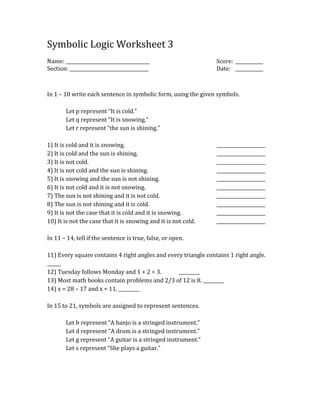
In 1 – 10 write each sentence in symbolic form, using the given symbols. 
Let p represent “It is cold.” 
Let q represent “It is snowing.” 
Let r represent “the sun is shining.” 
1) It is cold and it is snowing. _____________________ 
2) It is cold and the sun is shining. _____________________ 
3) It is not cold. _____________________ 
4) It is not cold and the sun is shining. _____________________ 
5) It is snowing and the sun is not shining. _____________________ 
6) It is not cold and it is not snowing. _____________________ 
7) The sun is not shining and it is not cold. _____________________ 
8) The sun is not shining and it is cold. _____________________ 
9) It is not the case that it is cold and it is snowing. _____________________ 
10) It is not the case that it is snowing and it is not cold. _____________________ 
In 11 – 14, tell if the sentence is true, false, or open. 
11) Every square contains 4 right angles and every triangle contains 1 right angle. 
______ 
12) Tuesday follows Monday and 1 + 2 = 3. _________ 
13) Most math books contain problems and 2/3 of 12 is 8. _________ 
14) x = 28 – 17 and x = 11. _________ 
In 15 to 21, symbols are assigned to represent sentences. 
Let b represent “A banjo is a stringed instrument.” 
Let d represent “A drum is a stringed instrument.” 
Let g represent “A guitar is a stringed instrument.” 
Let s represent “She plays a guitar.”
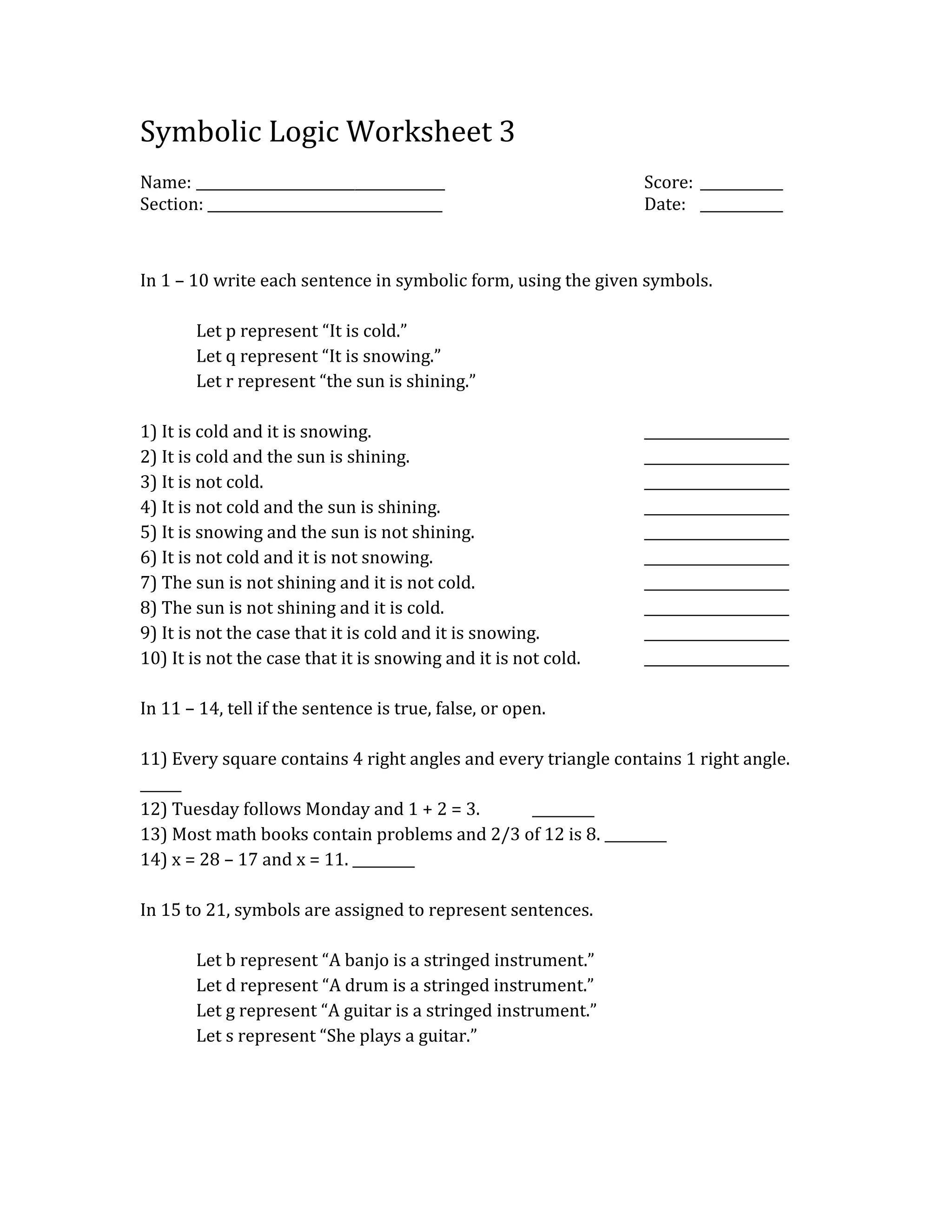
For each sentence given in symbolic form: a) Write a complete sentence in words to 
show what the symbols represent. b) Tell if the sentence is true, false, or open. 
15) b Λ g 18) b Λ ~ d 19) ~ s Λ d 20) ~ d Λ ~ b 
21) ~ (d Λ b) 
In 22 – 29, give the word, phrase, or symbol that can be placed in the blank to make 
the resulting sentence true. 
22) When p is true and q is true, then p Λ q is ___________. 
23) When p is false, then p Λ q is __________. 
24) If p is true, or q is true, but not both, then p Λ q is __________. 
25) When p Λ q is true, then p is ______ and q is _________ . 
26) When p Λ ~ q is true, then p is ______ and q is ________. 
27) When ~ p Λ q is true, then p is ______ and q is ________. 
28) When p is false and q is true, then ~ (p Λ q) is ________. 
29) If both p and q are false, then ~ p Λ ~ q is ________. 
30) When p and q represent two simple sentences, the conditional if p then q is written 
symbolically as ________________. 
31) The conditional if q then p is written symbolically as ______________. 
32) The conditional p → q is false only when p is ________ and q is __________. 
33) When the conclusion q is true, the p → q must be _____________. 
34) When the hypothesis p is false, the p → q must be ______________. 
35) If the hypothesis p is true and the conditional p → q is true, then the conclusion q 
must be ___________. 
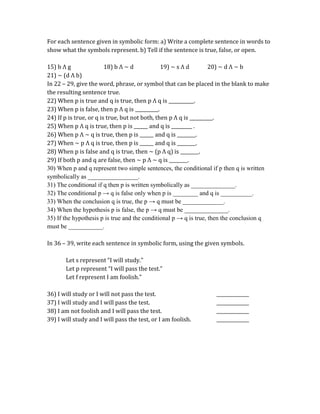
In 36 – 39, write each sentence in symbolic form, using the given symbols. 
Let s represent “I will study.” 
Let p represent “I will pass the test.” 
Let f represent I am foolish.” 
36) I will study or I will not pass the test. ______________ 
37) I will study and I will pass the test. ______________ 
38) I am not foolish and I will pass the test. ______________ 
39) I will study and I will pass the test, or I am foolish. ______________
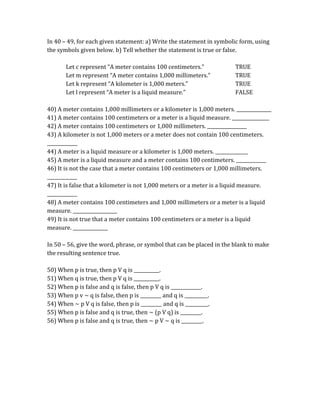
In 40 – 49, for each given statement: a) Write the statement in symbolic form, using 
the symbols given below. b) Tell whether the statement is true or false. 
Let c represent “A meter contains 100 centimeters.” TRUE 
Let m represent “A meter contains 1,000 millimeters.” TRUE 
Let k represent “A kilometer is 1,000 meters.” TRUE 
Let l represent “A meter is a liquid measure.” FALSE 
40) A meter contains 1,000 millimeters or a kilometer is 1,000 meters. _______________ 
41) A meter contains 100 centimeters or a meter is a liquid measure. ________________ 
42) A meter contains 100 centimeters or 1,000 millimeters. _________________ 
43) A kilometer is not 1,000 meters or a meter does not contain 100 centimeters. 
_____________ 
44) A meter is a liquid measure or a kilometer is 1,000 meters. ______________ 
45) A meter is a liquid measure and a meter contains 100 centimeters. _____________ 
46) It is not the case that a meter contains 100 centimeters or 1,000 millimeters. 
_____________ 
47) It is false that a kilometer is not 1,000 meters or a meter is a liquid measure. 
_____________ 
48) A meter contains 100 centimeters and 1,000 millimeters or a meter is a liquid 
measure. ___________________ 
49) It is not true that a meter contains 100 centimeters or a meter is a liquid 
measure. _______________ 
In 50 – 56, give the word, phrase, or symbol that can be placed in the blank to make 
the resulting sentence true. 
50) When p is true, then p V q is ___________. 
51) When q is true, then p V q is ___________. 
52) When p is false and q is false, then p V q is _____________. 
53) When p v ~ q is false, then p is _________ and q is __________. 
54) When ~ p V q is false, then p is _________ and q is __________. 
55) When p is false and q is true, then ~ (p V q) is _________. 
56) When p is false and q is true, then ~ p V ~ q is _________.

Symbolic logic worksheet 3

  • 1.
    Symbolic Logic Worksheet3 Name: ____________________________________ Score: ____________ Section: __________________________________ Date: ____________ In 1 – 10 write each sentence in symbolic form, using the given symbols. Let p represent “It is cold.” Let q represent “It is snowing.” Let r represent “the sun is shining.” 1) It is cold and it is snowing. _____________________ 2) It is cold and the sun is shining. _____________________ 3) It is not cold. _____________________ 4) It is not cold and the sun is shining. _____________________ 5) It is snowing and the sun is not shining. _____________________ 6) It is not cold and it is not snowing. _____________________ 7) The sun is not shining and it is not cold. _____________________ 8) The sun is not shining and it is cold. _____________________ 9) It is not the case that it is cold and it is snowing. _____________________ 10) It is not the case that it is snowing and it is not cold. _____________________ In 11 – 14, tell if the sentence is true, false, or open. 11) Every square contains 4 right angles and every triangle contains 1 right angle. ______ 12) Tuesday follows Monday and 1 + 2 = 3. _________ 13) Most math books contain problems and 2/3 of 12 is 8. _________ 14) x = 28 – 17 and x = 11. _________ In 15 to 21, symbols are assigned to represent sentences. Let b represent “A banjo is a stringed instrument.” Let d represent “A drum is a stringed instrument.” Let g represent “A guitar is a stringed instrument.” Let s represent “She plays a guitar.”
  • 2.
    For each sentencegiven in symbolic form: a) Write a complete sentence in words to show what the symbols represent. b) Tell if the sentence is true, false, or open. 15) b Λ g 18) b Λ ~ d 19) ~ s Λ d 20) ~ d Λ ~ b 21) ~ (d Λ b) In 22 – 29, give the word, phrase, or symbol that can be placed in the blank to make the resulting sentence true. 22) When p is true and q is true, then p Λ q is ___________. 23) When p is false, then p Λ q is __________. 24) If p is true, or q is true, but not both, then p Λ q is __________. 25) When p Λ q is true, then p is ______ and q is _________ . 26) When p Λ ~ q is true, then p is ______ and q is ________. 27) When ~ p Λ q is true, then p is ______ and q is ________. 28) When p is false and q is true, then ~ (p Λ q) is ________. 29) If both p and q are false, then ~ p Λ ~ q is ________. 30) When p and q represent two simple sentences, the conditional if p then q is written symbolically as ________________. 31) The conditional if q then p is written symbolically as ______________. 32) The conditional p → q is false only when p is ________ and q is __________. 33) When the conclusion q is true, the p → q must be _____________. 34) When the hypothesis p is false, the p → q must be ______________. 35) If the hypothesis p is true and the conditional p → q is true, then the conclusion q must be ___________. In 36 – 39, write each sentence in symbolic form, using the given symbols. Let s represent “I will study.” Let p represent “I will pass the test.” Let f represent I am foolish.” 36) I will study or I will not pass the test. ______________ 37) I will study and I will pass the test. ______________ 38) I am not foolish and I will pass the test. ______________ 39) I will study and I will pass the test, or I am foolish. ______________
  • 3.
    In 40 –49, for each given statement: a) Write the statement in symbolic form, using the symbols given below. b) Tell whether the statement is true or false. Let c represent “A meter contains 100 centimeters.” TRUE Let m represent “A meter contains 1,000 millimeters.” TRUE Let k represent “A kilometer is 1,000 meters.” TRUE Let l represent “A meter is a liquid measure.” FALSE 40) A meter contains 1,000 millimeters or a kilometer is 1,000 meters. _______________ 41) A meter contains 100 centimeters or a meter is a liquid measure. ________________ 42) A meter contains 100 centimeters or 1,000 millimeters. _________________ 43) A kilometer is not 1,000 meters or a meter does not contain 100 centimeters. _____________ 44) A meter is a liquid measure or a kilometer is 1,000 meters. ______________ 45) A meter is a liquid measure and a meter contains 100 centimeters. _____________ 46) It is not the case that a meter contains 100 centimeters or 1,000 millimeters. _____________ 47) It is false that a kilometer is not 1,000 meters or a meter is a liquid measure. _____________ 48) A meter contains 100 centimeters and 1,000 millimeters or a meter is a liquid measure. ___________________ 49) It is not true that a meter contains 100 centimeters or a meter is a liquid measure. _______________ In 50 – 56, give the word, phrase, or symbol that can be placed in the blank to make the resulting sentence true. 50) When p is true, then p V q is ___________. 51) When q is true, then p V q is ___________. 52) When p is false and q is false, then p V q is _____________. 53) When p v ~ q is false, then p is _________ and q is __________. 54) When ~ p V q is false, then p is _________ and q is __________. 55) When p is false and q is true, then ~ (p V q) is _________. 56) When p is false and q is true, then ~ p V ~ q is _________.