Copyright © Houghton Mifflin Company. All rights reserved. 13–1
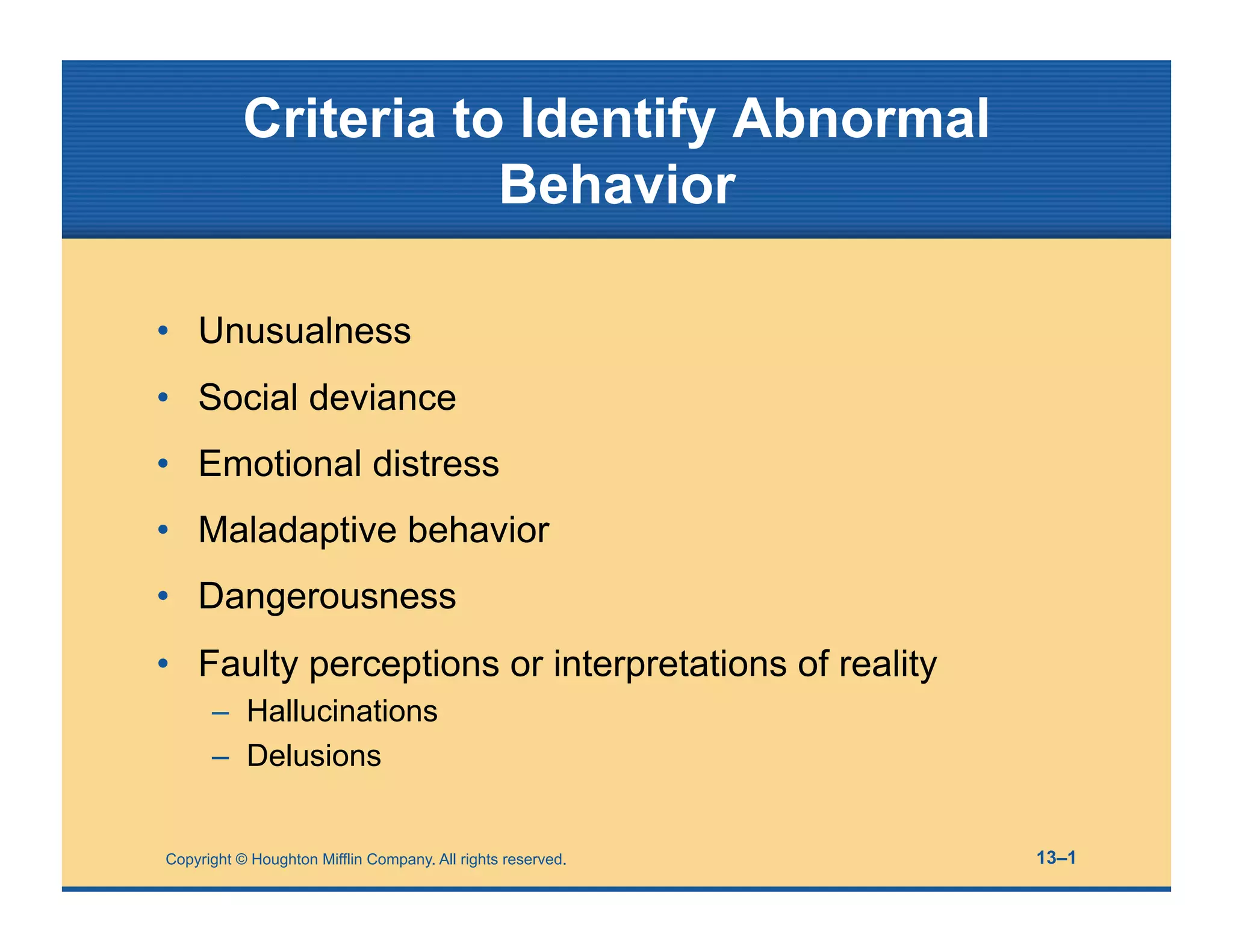
Criteria to Identify Abnormal
Behavior
• Unusualness
• Social deviance
• Emotional distress
• Maladaptive behavior
• Dangerousness
• Faulty perceptions or interpretations of reality
– Hallucinations
– Delusions
Copyright © Houghton Mifflin Company. All rights reserved. 13–2
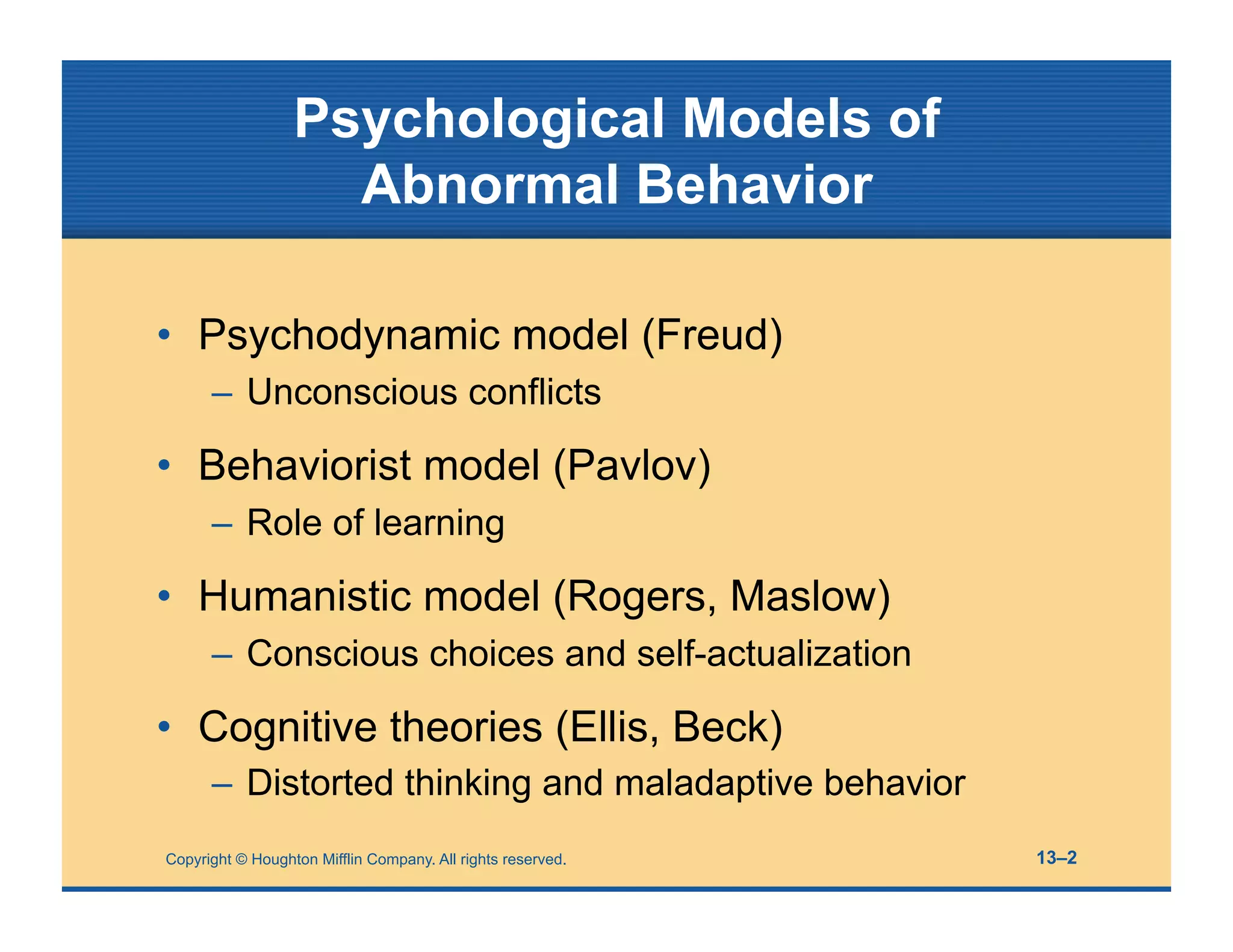
Psychological Models of
Abnormal Behavior
• Psychodynamic model (Freud)
– Unconscious conflicts
• Behaviorist model (Pavlov)
– Role of learning
• Humanistic model (Rogers, Maslow)
– Conscious choices and self-actualization
• Cognitive theories (Ellis, Beck)
– Distorted thinking and maladaptive behavior
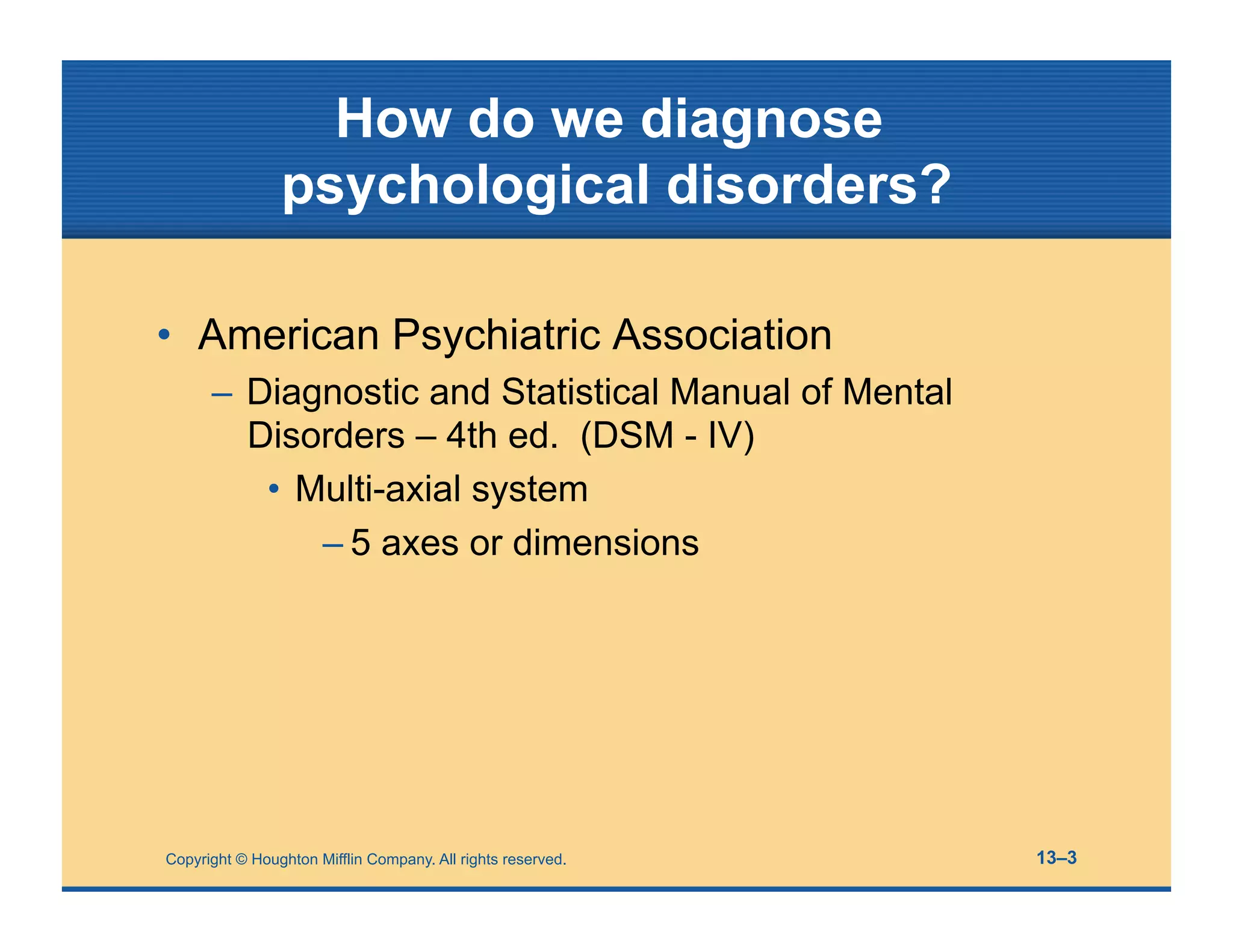
How do we diagnose
psychological disorders?
• American Psychiatric Association
– Diagnostic and Statistical Manual of Mental
Disorders – 4th ed. (DSM - IV)
• Multi-axial system
– 5 axes or dimensions
Copyright © Houghton Mifflin Company. All rights reserved. 13–3
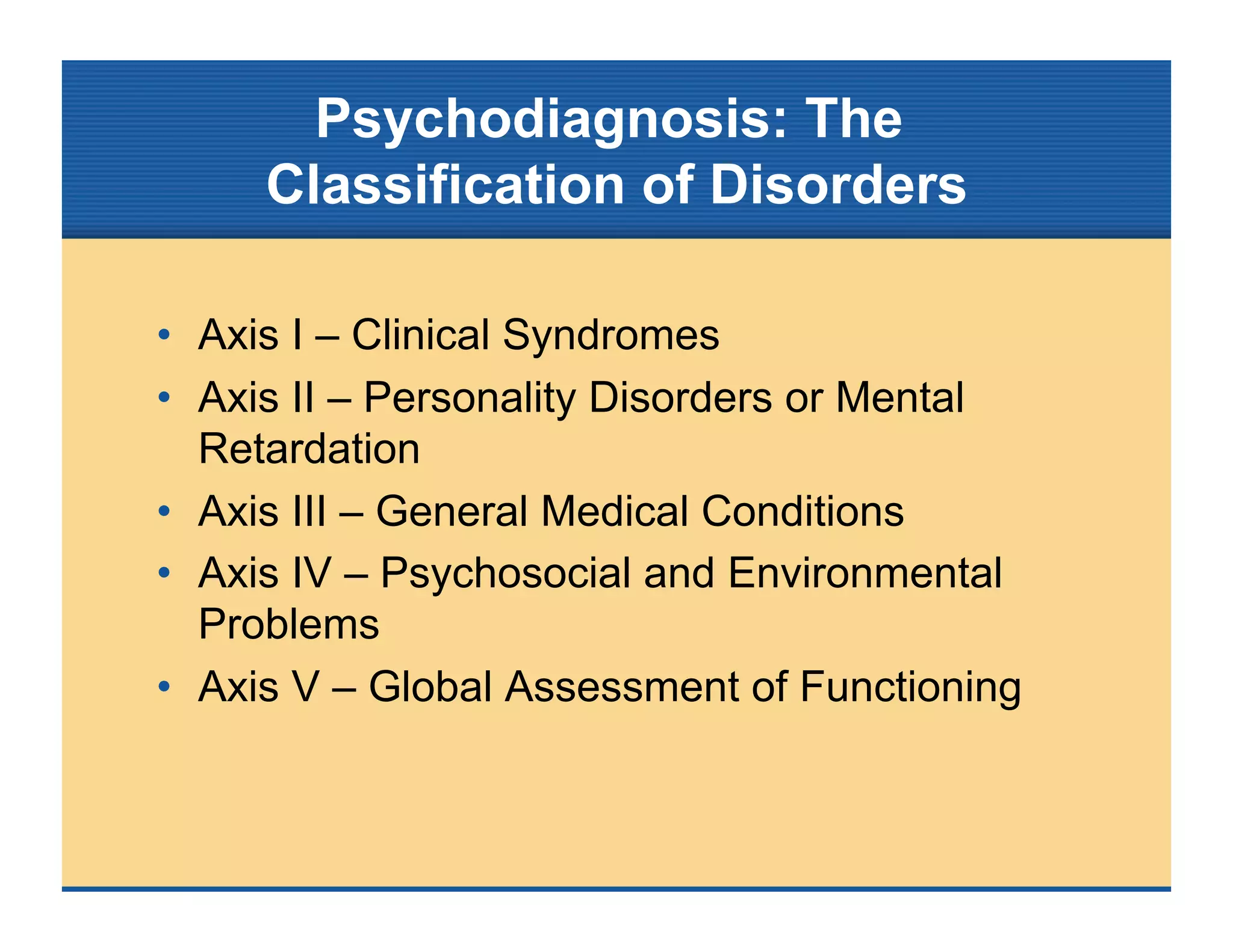
Psychodiagnosis: The
Classification of Disorders
• Axis I – Clinical Syndromes
• Axis II – Personality Disorders or Mental
Retardation
• Axis III – General Medical Conditions
• Axis IV – Psychosocial and Environmental
Problems
• Axis V – Global Assessment of Functioning
Copyright © Houghton Mifflin Company. All rights reserved. 13–5
Psychological Disorders
• Distinctive patterns of abnormal behavior
– Mental disorders or illnesses
• Rates of disorders
– Rather common
– About 50% in lifetime
• Classification
– Diagnostic and Statistical Manual of Mental
Disorders (DSM-IV-TR)
Copyright © Houghton Mifflin Company. All rights reserved. 13–6
Types of Anxiety Disorders
• Phobias
– Social phobias
– Specific phobias (acrophobia, claustrophobia)
– Agoraphobia
• Panic disorder
• Generalized anxiety disorder (GAD)
• Obsessive-compulsive disorder (OCD)
Copyright © Houghton Mifflin Company. All rights reserved. 13–7
Causes of Anxiety Disorders
• Biological factors
– Disturbances in neurotransmitter functioning
– Genetic influences
• Psychological factors
– Classical and operant conditioning
– Cognitive factors
Copyright © Houghton Mifflin Company. All rights reserved. 13–8
Mood Disorders
• Severe or persistent disturbances of mood
– Limit ability to function
• Include
– Depressive disorders
– Bipolar disorders
Copyright © Houghton Mifflin Company. All rights reserved. 13–9
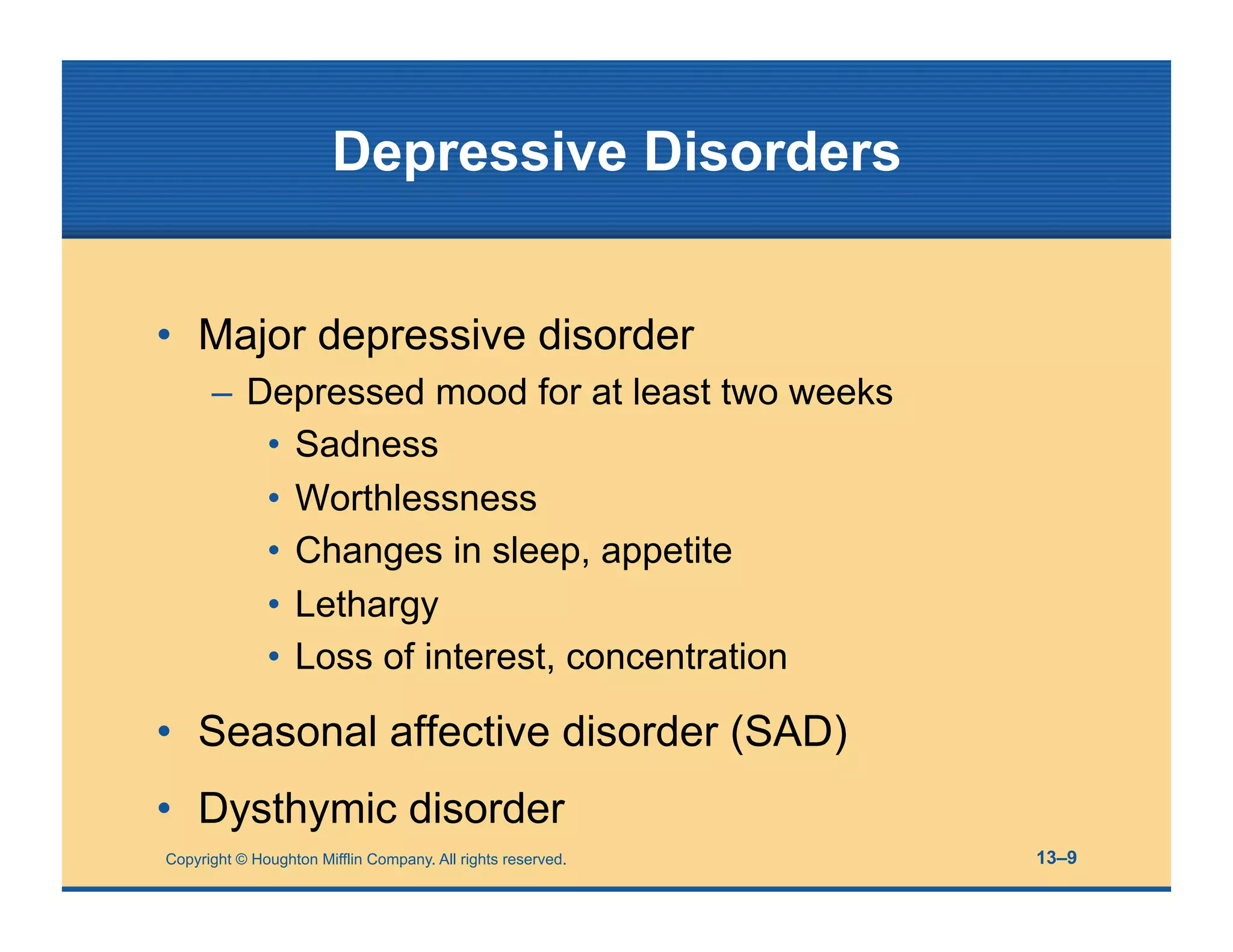
Depressive Disorders
• Major depressive disorder
– Depressed mood for at least two weeks
• Sadness
• Worthlessness
• Changes in sleep, appetite
• Lethargy
• Loss of interest, concentration
• Seasonal affective disorder (SAD)
• Dysthymic disorder
Copyright © Houghton Mifflin Company. All rights reserved. 13–10
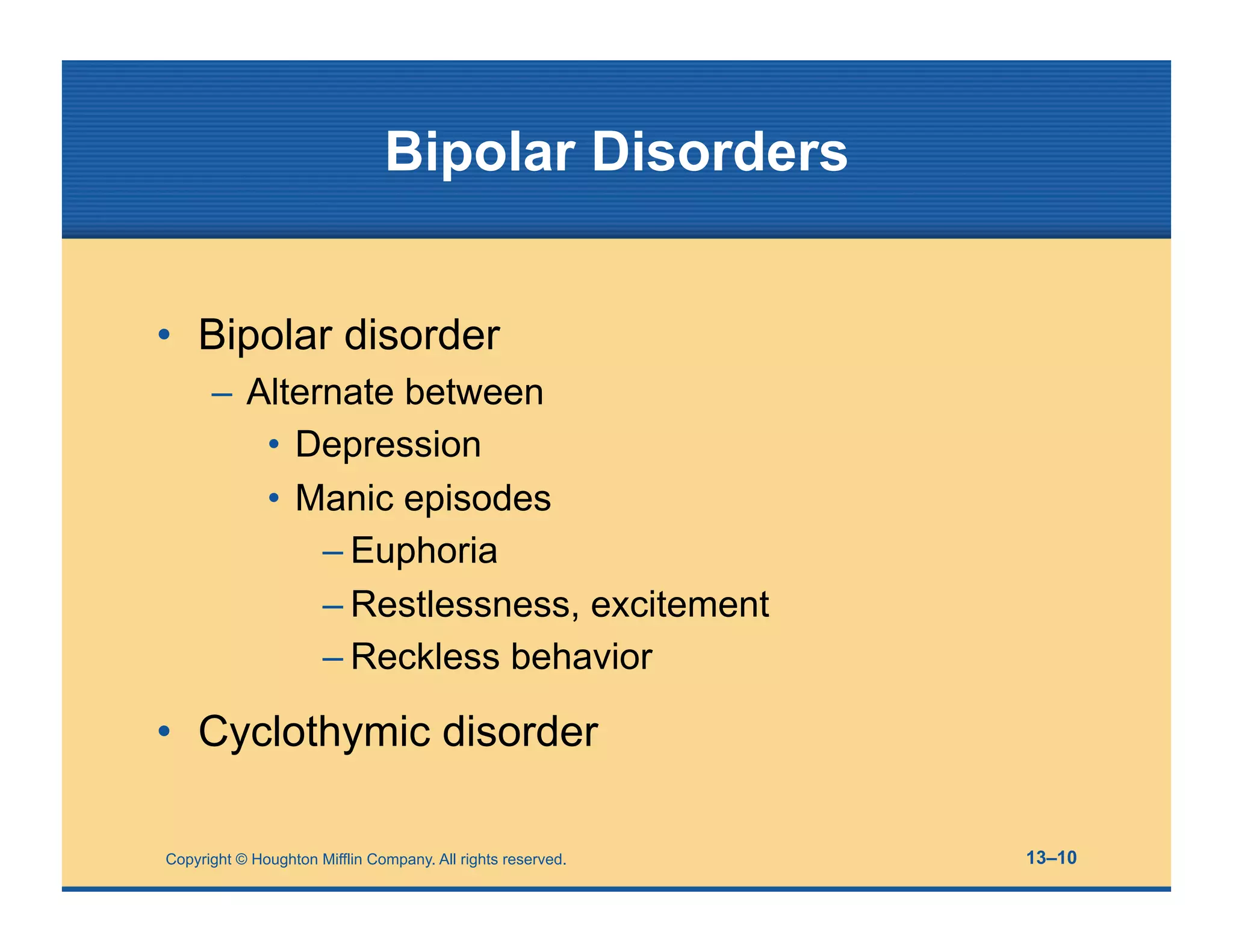
Bipolar Disorders
• Bipolar disorder
– Alternate between
• Depression
• Manic episodes
– Euphoria
– Restlessness, excitement
– Reckless behavior
• Cyclothymic disorder
Copyright © Houghton Mifflin Company. All rights reserved. 13–11
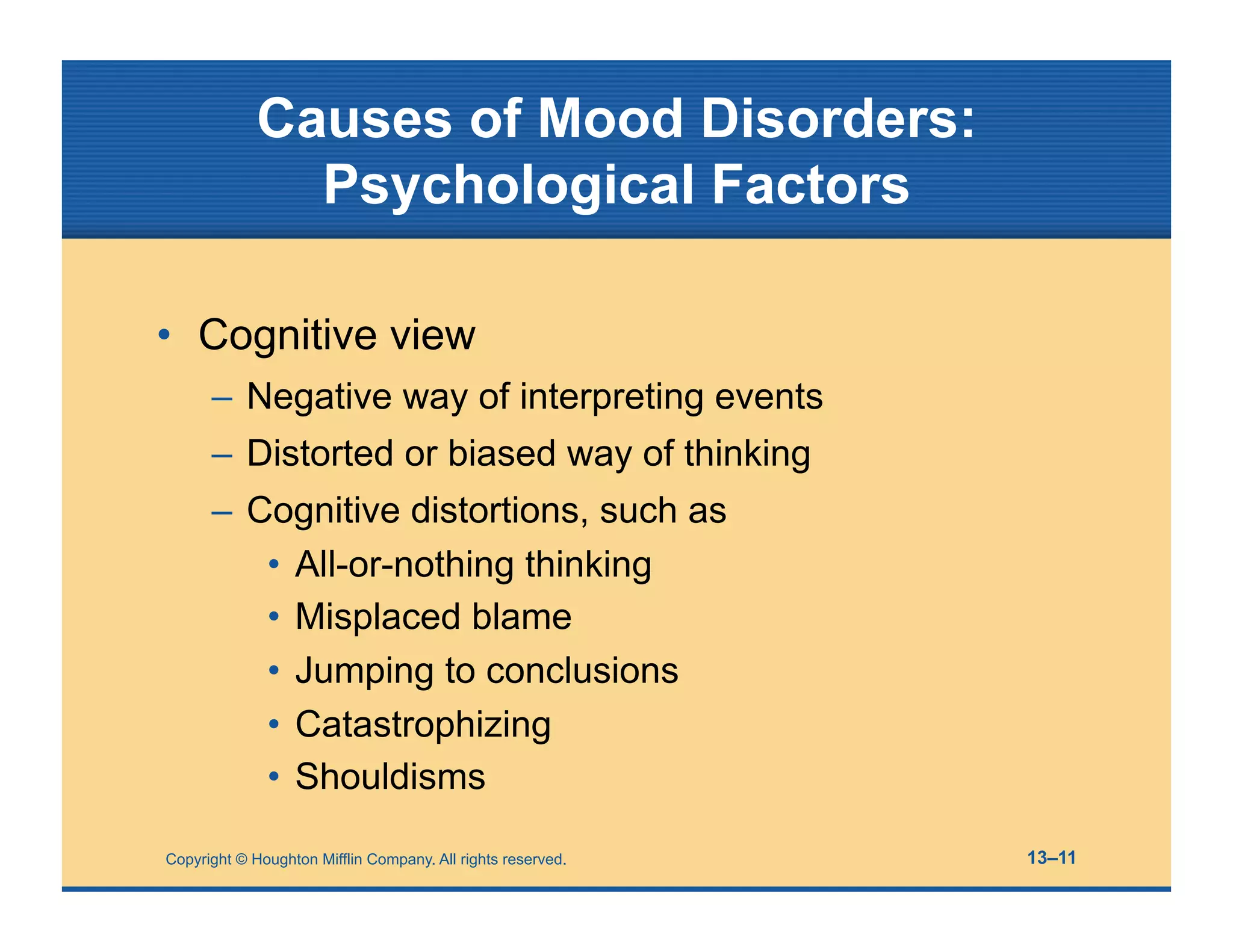
Causes of Mood Disorders:
Psychological Factors
• Cognitive view
– Negative way of interpreting events
– Distorted or biased way of thinking
– Cognitive distortions, such as
• All-or-nothing thinking
• Misplaced blame
• Jumping to conclusions
• Catastrophizing
• Shouldisms
Copyright © Houghton Mifflin Company. All rights reserved. 13–12
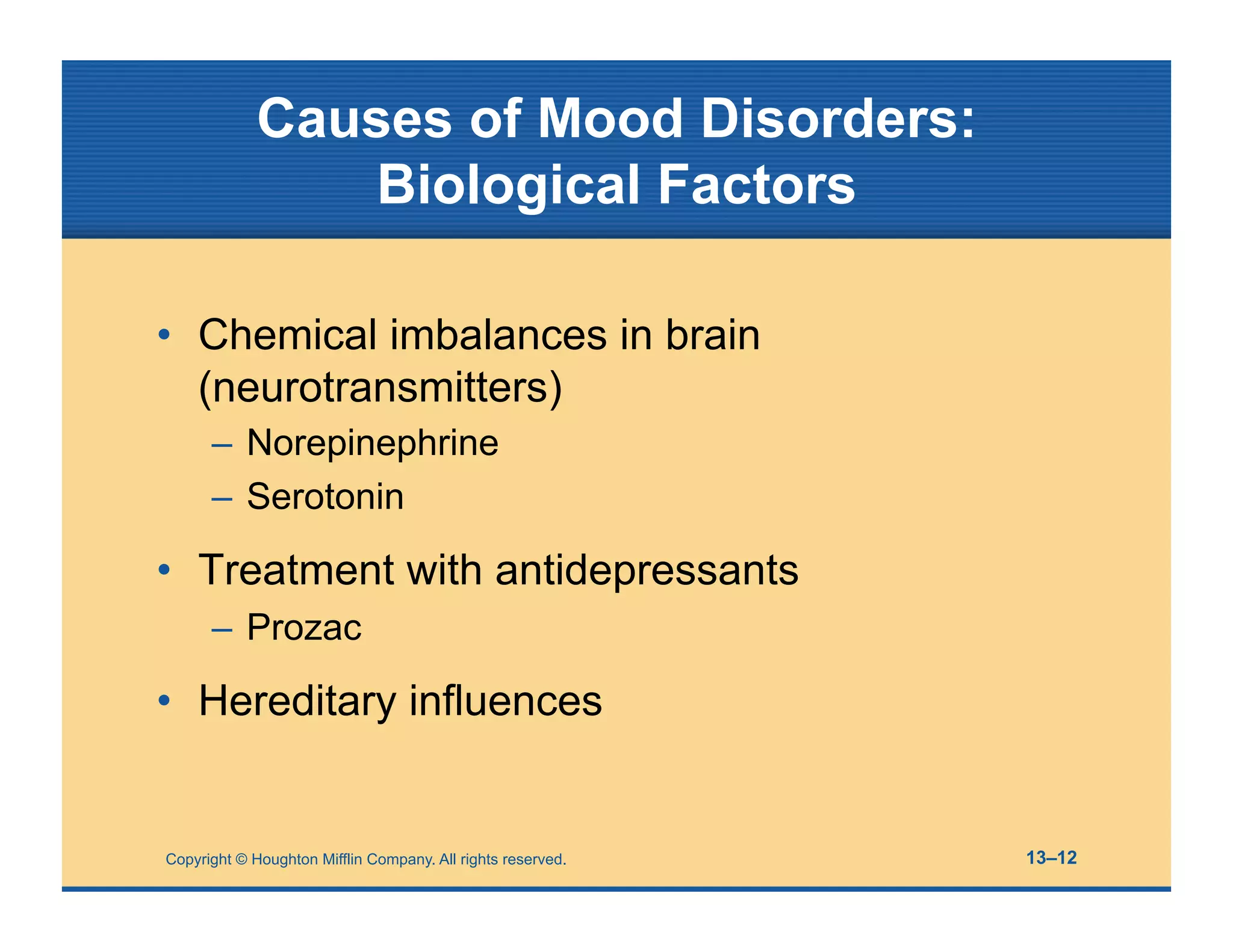
Causes of Mood Disorders:
Biological Factors
• Chemical imbalances in brain
(neurotransmitters)
– Norepinephrine
– Serotonin
• Treatment with antidepressants
– Prozac
• Hereditary influences
Copyright © Houghton Mifflin Company. All rights reserved. 13–13
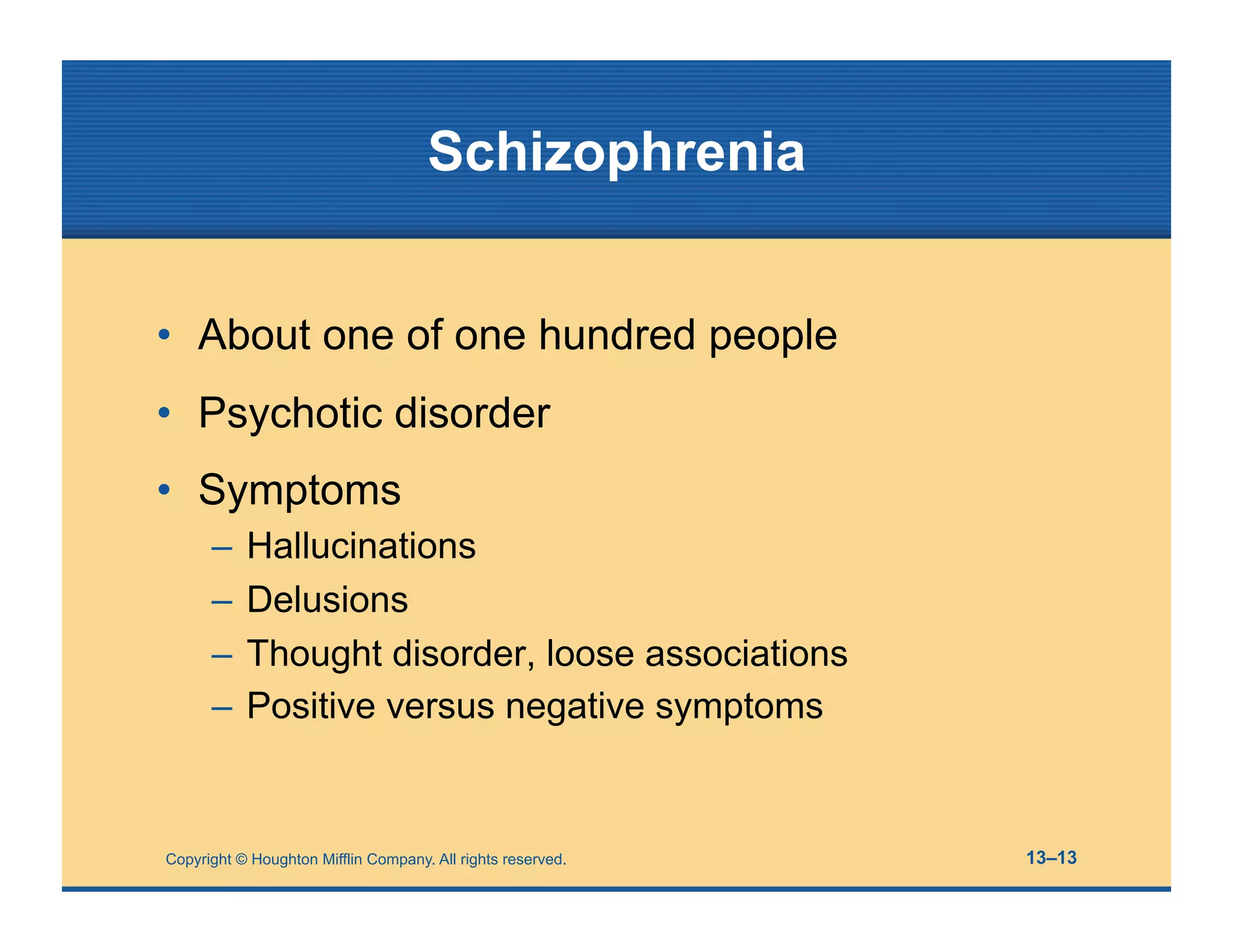
Schizophrenia
• About one of one hundred people
• Psychotic disorder
• Symptoms
– Hallucinations
– Delusions
– Thought disorder, loose associations
– Positive versus negative symptoms
Copyright © Houghton Mifflin Company. All rights reserved. 13–14
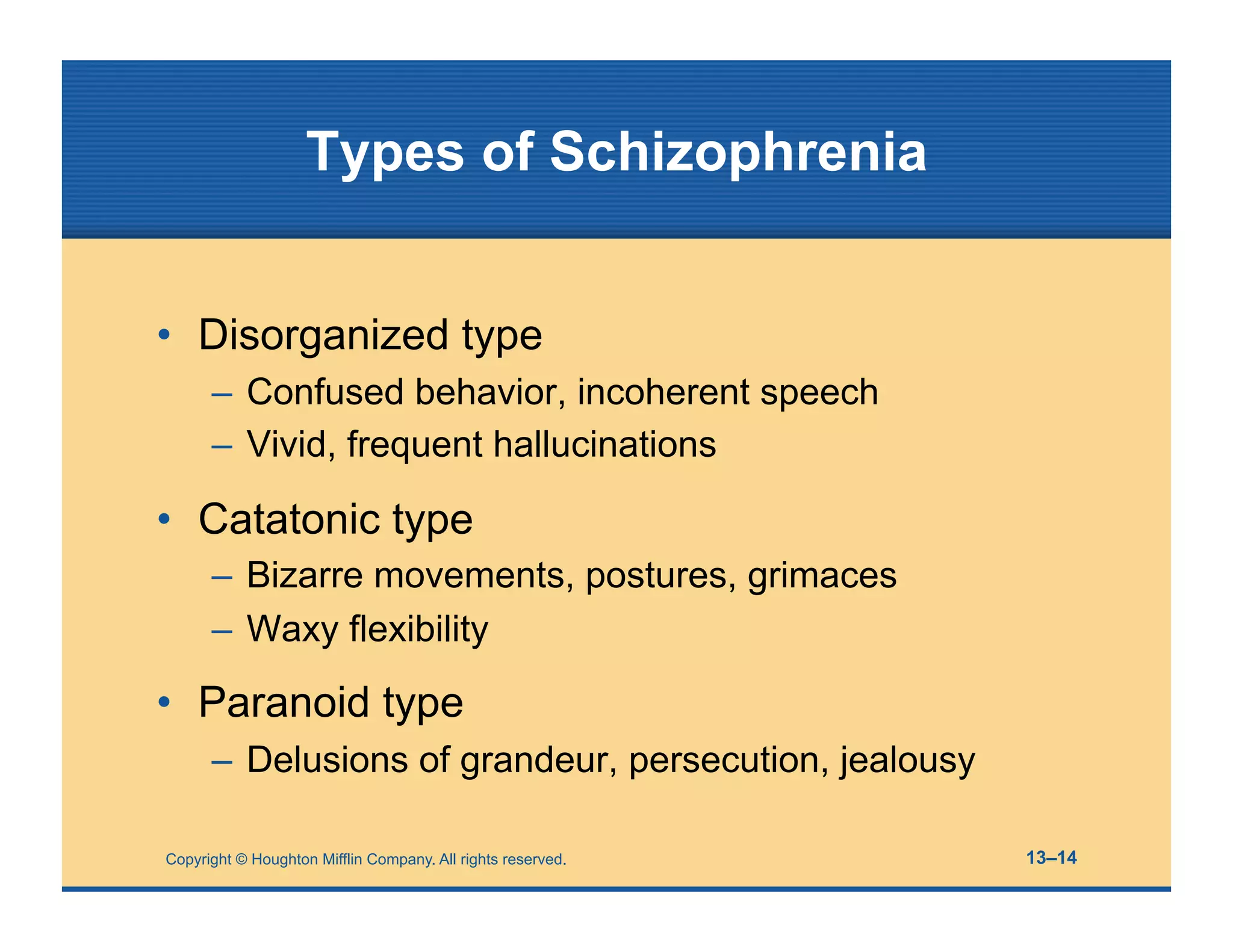
Types of Schizophrenia
• Disorganized type
– Confused behavior, incoherent speech
– Vivid, frequent hallucinations
• Catatonic type
– Bizarre movements, postures, grimaces
– Waxy flexibility
• Paranoid type
– Delusions of grandeur, persecution, jealousy
Copyright © Houghton Mifflin Company. All rights reserved. 13–15
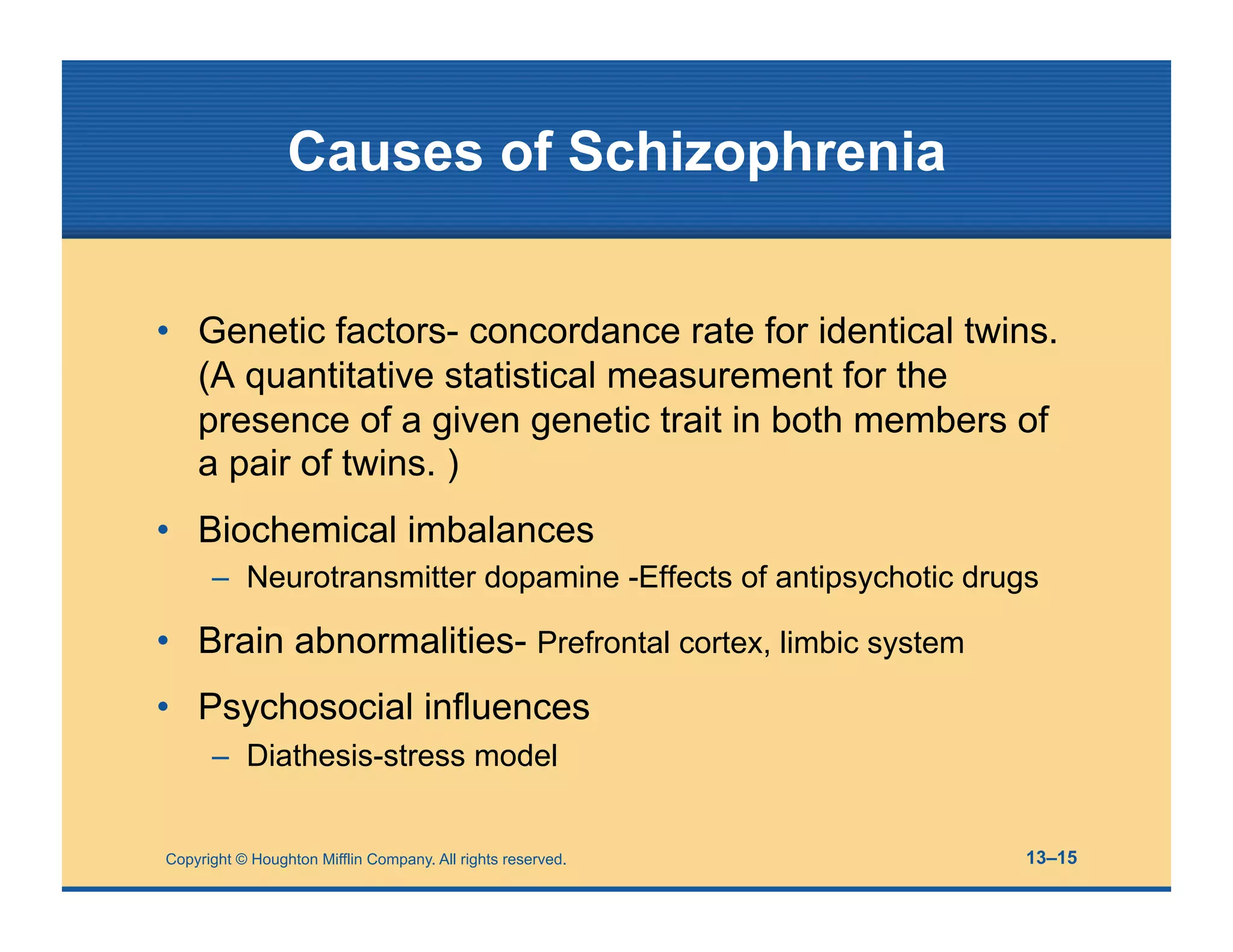
Causes of Schizophrenia
• Genetic factors- concordance rate for identical twins.
(A quantitative statistical measurement for the
presence of a given genetic trait in both members of
a pair of twins. )
• Biochemical imbalances
– Neurotransmitter dopamine -Effects of antipsychotic drugs
• Brain abnormalities- Prefrontal cortex, limbic system
• Psychosocial influences
– Diathesis-stress model
Copyright © Houghton Mifflin Company. All rights reserved. 13–16
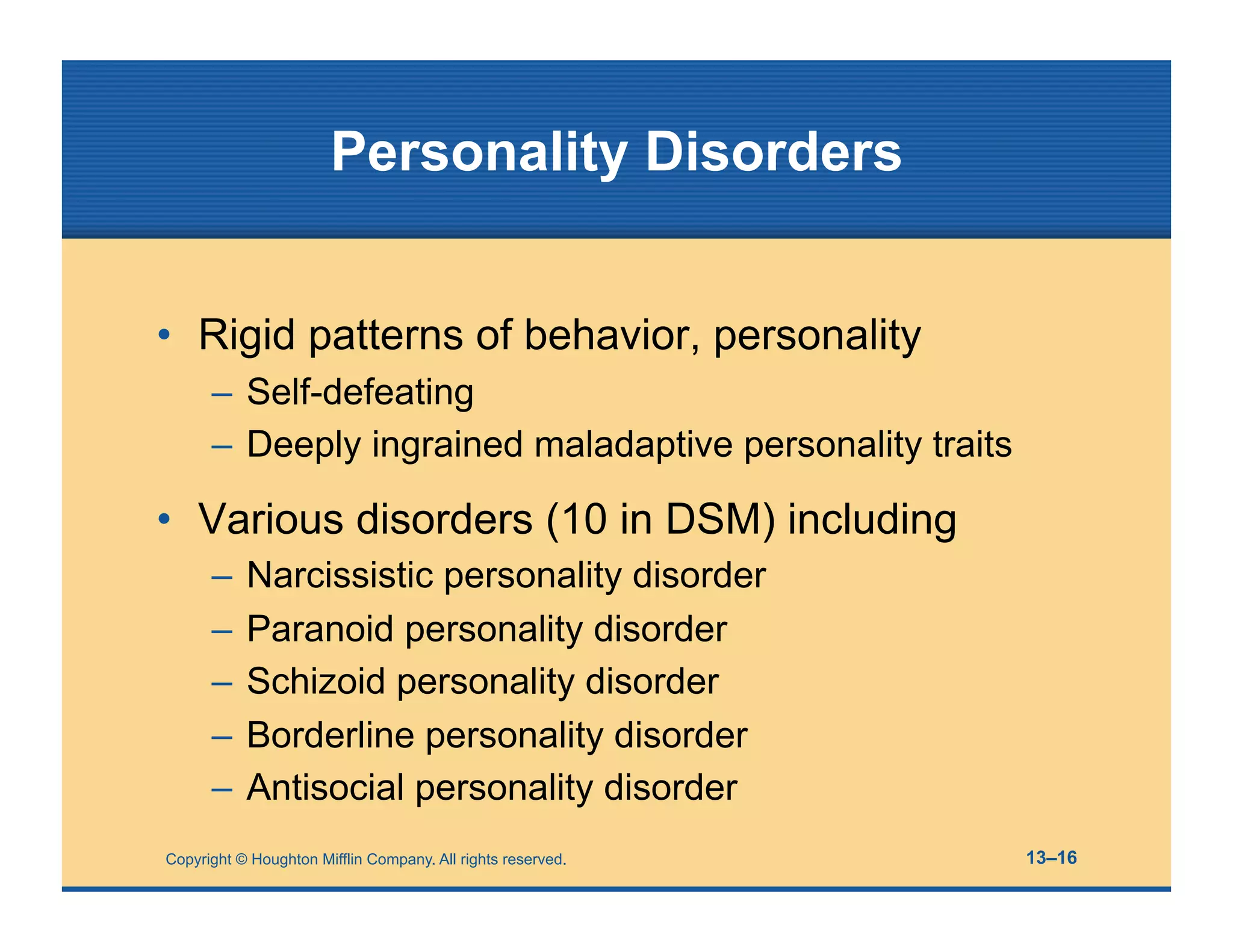
Personality Disorders
• Rigid patterns of behavior, personality
– Self-defeating
– Deeply ingrained maladaptive personality traits
• Various disorders (10 in DSM) including
– Narcissistic personality disorder
– Paranoid personality disorder
– Schizoid personality disorder
– Borderline personality disorder
– Antisocial personality disorder

pyschdisorders_notes.pdf

  • 1.
    Copyright © HoughtonMifflin Company. All rights reserved. 13–1 Criteria to Identify Abnormal Behavior • Unusualness • Social deviance • Emotional distress • Maladaptive behavior • Dangerousness • Faulty perceptions or interpretations of reality – Hallucinations – Delusions
  • 2.
    Copyright © HoughtonMifflin Company. All rights reserved. 13–2 Psychological Models of Abnormal Behavior • Psychodynamic model (Freud) – Unconscious conflicts • Behaviorist model (Pavlov) – Role of learning • Humanistic model (Rogers, Maslow) – Conscious choices and self-actualization • Cognitive theories (Ellis, Beck) – Distorted thinking and maladaptive behavior
  • 3.
    How do wediagnose psychological disorders? • American Psychiatric Association – Diagnostic and Statistical Manual of Mental Disorders – 4th ed. (DSM - IV) • Multi-axial system – 5 axes or dimensions Copyright © Houghton Mifflin Company. All rights reserved. 13–3
  • 4.
    Psychodiagnosis: The Classification ofDisorders • Axis I – Clinical Syndromes • Axis II – Personality Disorders or Mental Retardation • Axis III – General Medical Conditions • Axis IV – Psychosocial and Environmental Problems • Axis V – Global Assessment of Functioning
  • 5.
    Copyright © HoughtonMifflin Company. All rights reserved. 13–5 Psychological Disorders • Distinctive patterns of abnormal behavior – Mental disorders or illnesses • Rates of disorders – Rather common – About 50% in lifetime • Classification – Diagnostic and Statistical Manual of Mental Disorders (DSM-IV-TR)
  • 6.
    Copyright © HoughtonMifflin Company. All rights reserved. 13–6 Types of Anxiety Disorders • Phobias – Social phobias – Specific phobias (acrophobia, claustrophobia) – Agoraphobia • Panic disorder • Generalized anxiety disorder (GAD) • Obsessive-compulsive disorder (OCD)
  • 7.
    Copyright © HoughtonMifflin Company. All rights reserved. 13–7 Causes of Anxiety Disorders • Biological factors – Disturbances in neurotransmitter functioning – Genetic influences • Psychological factors – Classical and operant conditioning – Cognitive factors
  • 8.
    Copyright © HoughtonMifflin Company. All rights reserved. 13–8 Mood Disorders • Severe or persistent disturbances of mood – Limit ability to function • Include – Depressive disorders – Bipolar disorders
  • 9.
    Copyright © HoughtonMifflin Company. All rights reserved. 13–9 Depressive Disorders • Major depressive disorder – Depressed mood for at least two weeks • Sadness • Worthlessness • Changes in sleep, appetite • Lethargy • Loss of interest, concentration • Seasonal affective disorder (SAD) • Dysthymic disorder
  • 10.
    Copyright © HoughtonMifflin Company. All rights reserved. 13–10 Bipolar Disorders • Bipolar disorder – Alternate between • Depression • Manic episodes – Euphoria – Restlessness, excitement – Reckless behavior • Cyclothymic disorder
  • 11.
    Copyright © HoughtonMifflin Company. All rights reserved. 13–11 Causes of Mood Disorders: Psychological Factors • Cognitive view – Negative way of interpreting events – Distorted or biased way of thinking – Cognitive distortions, such as • All-or-nothing thinking • Misplaced blame • Jumping to conclusions • Catastrophizing • Shouldisms
  • 12.
    Copyright © HoughtonMifflin Company. All rights reserved. 13–12 Causes of Mood Disorders: Biological Factors • Chemical imbalances in brain (neurotransmitters) – Norepinephrine – Serotonin • Treatment with antidepressants – Prozac • Hereditary influences
  • 13.
    Copyright © HoughtonMifflin Company. All rights reserved. 13–13 Schizophrenia • About one of one hundred people • Psychotic disorder • Symptoms – Hallucinations – Delusions – Thought disorder, loose associations – Positive versus negative symptoms
  • 14.
    Copyright © HoughtonMifflin Company. All rights reserved. 13–14 Types of Schizophrenia • Disorganized type – Confused behavior, incoherent speech – Vivid, frequent hallucinations • Catatonic type – Bizarre movements, postures, grimaces – Waxy flexibility • Paranoid type – Delusions of grandeur, persecution, jealousy
  • 15.
    Copyright © HoughtonMifflin Company. All rights reserved. 13–15 Causes of Schizophrenia • Genetic factors- concordance rate for identical twins. (A quantitative statistical measurement for the presence of a given genetic trait in both members of a pair of twins. ) • Biochemical imbalances – Neurotransmitter dopamine -Effects of antipsychotic drugs • Brain abnormalities- Prefrontal cortex, limbic system • Psychosocial influences – Diathesis-stress model
  • 16.
    Copyright © HoughtonMifflin Company. All rights reserved. 13–16 Personality Disorders • Rigid patterns of behavior, personality – Self-defeating – Deeply ingrained maladaptive personality traits • Various disorders (10 in DSM) including – Narcissistic personality disorder – Paranoid personality disorder – Schizoid personality disorder – Borderline personality disorder – Antisocial personality disorder