GME Journal ClubSukanya Sil,  MDInternal Medicine PGY-1October 19, 2010
Annals of Internal Medicine3 Aug. 2010, Annals Vol. 153,  p147-157Weight and Metabolic Outcomes After 2 Years on a Low-Carbohydrate Versus Low-Fat Diet: A Randomized Trial3 Aug. 2010, Annals Vol. 153,  p147-157.
OverviewWeight and Metabolic Outcomes After 2 Years on a Low-Carbohydrate Versus Low-Fat Diet: A Randomized Trial OverviewBackgroundObjectiveDesignPatientsInterventionMeasurementsResultsLimitationsUSRDA ArticleOVERVIEWReferencesRecap
Weight and Metabolic Outcomes After 2 Years on a Low-Carbohydrate Versus Low-Fat Diet: A Randomized Trial Data from several randomized trials over the past 6 years demonstrated that low-carbohydrate diets produced greater short-term (6 months) weight loss than low-fat, calorie-restricted diets. The longer-term (1 to 2 years) results are mixed.Some studies found greater weight loss with low-carbohydrate diets than with low-fat diets whereas others found no difference However, weight loss with either diet was usually minimal presumably because of the modest dose of behavioral treatment provided in these studies.BACKGROUND
Weight and Metabolic Outcomes After 2 Years on a Low-Carbohydrate Versus Low-Fat Diet: A Randomized Trial The only 2-year randomized, controlled trial of a low-carbohydrate diet to date found greater 2-year weight loss with a low carbohydrate than a low-fat diet (6).The Israel-based study used visual prompts in a cafeteria setting to guide the selection of the main meal (lunch). Whether the results would be similar in different settings and cultures is unknown.Few previous studies have evaluated the effect of low-carbohydrate diets on symptoms or bone, and the assessments have been limited to 6 months (3, 4).BACKGROUND
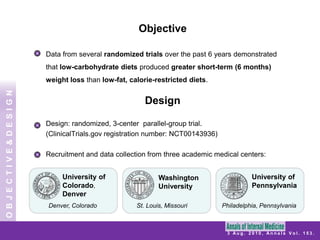
ObjectiveData from several randomized trials over the past 6 years demonstrated that low-carbohydrate diets produced greater short-term (6 months) weight loss than low-fat, calorie-restricted diets. DesignDesign: randomized, 3-center  parallel-group trial. (ClinicalTrials.gov registration number: NCT00143936)Recruitment and data collection from three academic medical centers:OBJECTIVE&DESIGNUniversity of PennsylvaniaUniversity of Colorado, DenverWashingtonUniversity Philadelphia, PennsylvaniaDenver, ColoradoSt. Louis, Missouri
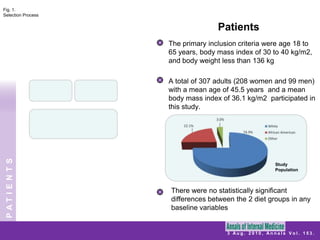
PatientsFig. 1.  Selection ProcessThe primary inclusion criteria were age 18 to 65 years, body mass index of 30 to 40 kg/m2, and body weight less than 136 kgA total of 307 adults (208 women and 99 men) with a mean age of 45.5 years  and a mean body mass index of 36.1 kg/m2  participated in this study.PATIENTSStudyPopulationThere were no statistically significant differences between the 2 diet groups in any baseline variables
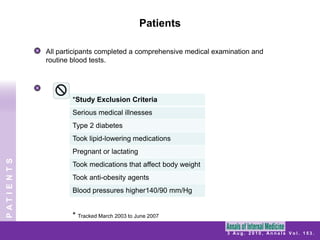
PatientsAll participants completed a comprehensive medical examination and routine blood tests.PATIENTS* Tracked March 2003 to June 2007
InterventionA low-carbohydrate diet consisting of:   limited carbohydrate intake (20 g/d for 3 months)
   low–glycemic index vegetables
   unrestricted consumption of fat and protein.After 3 months, participants in the low-carbohydrate diet group increased their carbohydrate intake (5 g/d per wk) until a stable and desired weight was achieved.A low-fat diet consisted of limited energy intake (1200 to 1800 kcal/d; 30% calories from fat).Both diets were combined with comprehensive behavioral treatmentINTERVENTION
InterventionAll participants received comprehensive, in-person group behavioral treatment:   initially weekly for 20 weeks, every other week for 20 weeks.
   after every other month for the remainder of the 2-year study period.
   each treatment session lasted 75 to 90 minutes. Topics included self-monitoring, stimulus control, and relapse management. All participants were prescribed the same level of physical activity (principally walking),beginning at week 4, with 4 sessions of 20 minutes each and progressing by week 19 to 4 sessions of 50 minutes each. Group sessions reviewed participants’ completion of their eating and activity records, as well as other skill buildersINTERVENTION
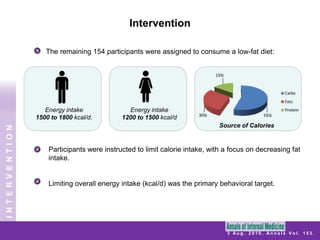
InterventionThe remaining 154 participants were assigned to consume a low-fat diet:Energy intake 1500 to 1800 kcal/d.Energy intake1200 to 1500 kcal/dSource of CaloriesParticipants were instructed to limit calorie intake, with a focus on decreasing fat intake. Limiting overall energy intake (kcal/d) was the primary behavioral target.INTERVENTION
MeasurementsWeight at 2 years was the primary outcome.Secondary measures included:   weight at 3, 6, and 12 months
   serum lipid concentrations
   blood pressure
   urinary ketones
   symptoms
   bone mineral density
   body composition throughout the studyMEASUREMENTS
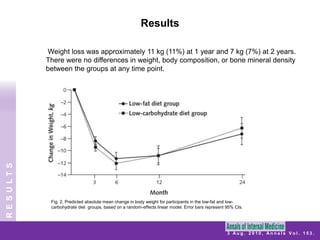
Results Weight loss was approximately 11 kg (11%) at 1 year and 7 kg (7%) at 2 years.  There were no differences in weight, body composition, or bone mineral density between the groups at any time point.RESULTSFig. 2. Predicted absolute mean change in body weight for participants in the low-fat and low-carbohydrate diet  groups, based on a random-effects linear model. Error bars represent 95% CIs.
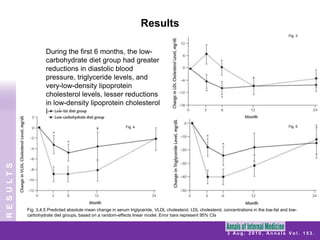
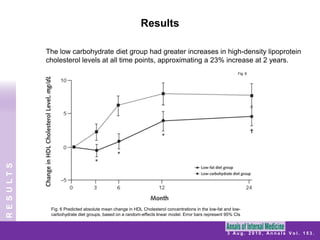
ResultsFig. 3During the first 6 months, the low-carbohydrate diet group had greater reductions in diastolic blood pressure, triglyceride levels, and very-low-density lipoprotein cholesterol levels, lesser reductions in low-density lipoprotein cholesterol levels.Fig. 5Fig. 4RESULTSFig. 3,4,5Predicted absolute mean change in serum triglyceride, VLDL cholesterol, LDL cholesterol, concentrations in the low-fat and low-carbohydrate diet groups, based on a random-effects linear model. Error bars represent 95% CIs

Gme journal6

  • 1.
    GME Journal ClubSukanyaSil, MDInternal Medicine PGY-1October 19, 2010
  • 2.
    Annals of InternalMedicine3 Aug. 2010, Annals Vol. 153, p147-157Weight and Metabolic Outcomes After 2 Years on a Low-Carbohydrate Versus Low-Fat Diet: A Randomized Trial3 Aug. 2010, Annals Vol. 153, p147-157.
  • 3.
    OverviewWeight and MetabolicOutcomes After 2 Years on a Low-Carbohydrate Versus Low-Fat Diet: A Randomized Trial OverviewBackgroundObjectiveDesignPatientsInterventionMeasurementsResultsLimitationsUSRDA ArticleOVERVIEWReferencesRecap
  • 4.
    Weight and MetabolicOutcomes After 2 Years on a Low-Carbohydrate Versus Low-Fat Diet: A Randomized Trial Data from several randomized trials over the past 6 years demonstrated that low-carbohydrate diets produced greater short-term (6 months) weight loss than low-fat, calorie-restricted diets. The longer-term (1 to 2 years) results are mixed.Some studies found greater weight loss with low-carbohydrate diets than with low-fat diets whereas others found no difference However, weight loss with either diet was usually minimal presumably because of the modest dose of behavioral treatment provided in these studies.BACKGROUND
  • 5.
    Weight and MetabolicOutcomes After 2 Years on a Low-Carbohydrate Versus Low-Fat Diet: A Randomized Trial The only 2-year randomized, controlled trial of a low-carbohydrate diet to date found greater 2-year weight loss with a low carbohydrate than a low-fat diet (6).The Israel-based study used visual prompts in a cafeteria setting to guide the selection of the main meal (lunch). Whether the results would be similar in different settings and cultures is unknown.Few previous studies have evaluated the effect of low-carbohydrate diets on symptoms or bone, and the assessments have been limited to 6 months (3, 4).BACKGROUND
  • 6.
    ObjectiveData from severalrandomized trials over the past 6 years demonstrated that low-carbohydrate diets produced greater short-term (6 months) weight loss than low-fat, calorie-restricted diets. DesignDesign: randomized, 3-center parallel-group trial. (ClinicalTrials.gov registration number: NCT00143936)Recruitment and data collection from three academic medical centers:OBJECTIVE&DESIGNUniversity of PennsylvaniaUniversity of Colorado, DenverWashingtonUniversity Philadelphia, PennsylvaniaDenver, ColoradoSt. Louis, Missouri
  • 7.
    PatientsFig. 1. Selection ProcessThe primary inclusion criteria were age 18 to 65 years, body mass index of 30 to 40 kg/m2, and body weight less than 136 kgA total of 307 adults (208 women and 99 men) with a mean age of 45.5 years and a mean body mass index of 36.1 kg/m2 participated in this study.PATIENTSStudyPopulationThere were no statistically significant differences between the 2 diet groups in any baseline variables
  • 8.
    PatientsAll participants completeda comprehensive medical examination and routine blood tests.PATIENTS* Tracked March 2003 to June 2007
  • 9.
    InterventionA low-carbohydrate dietconsisting of: limited carbohydrate intake (20 g/d for 3 months)
  • 10.
    low–glycemic index vegetables
  • 11.
    unrestricted consumption of fat and protein.After 3 months, participants in the low-carbohydrate diet group increased their carbohydrate intake (5 g/d per wk) until a stable and desired weight was achieved.A low-fat diet consisted of limited energy intake (1200 to 1800 kcal/d; 30% calories from fat).Both diets were combined with comprehensive behavioral treatmentINTERVENTION
  • 12.
    InterventionAll participants receivedcomprehensive, in-person group behavioral treatment: initially weekly for 20 weeks, every other week for 20 weeks.
  • 13.
    after every other month for the remainder of the 2-year study period.
  • 14.
    each treatment session lasted 75 to 90 minutes. Topics included self-monitoring, stimulus control, and relapse management. All participants were prescribed the same level of physical activity (principally walking),beginning at week 4, with 4 sessions of 20 minutes each and progressing by week 19 to 4 sessions of 50 minutes each. Group sessions reviewed participants’ completion of their eating and activity records, as well as other skill buildersINTERVENTION
  • 15.
    InterventionThe remaining 154participants were assigned to consume a low-fat diet:Energy intake 1500 to 1800 kcal/d.Energy intake1200 to 1500 kcal/dSource of CaloriesParticipants were instructed to limit calorie intake, with a focus on decreasing fat intake. Limiting overall energy intake (kcal/d) was the primary behavioral target.INTERVENTION
  • 16.
    MeasurementsWeight at 2years was the primary outcome.Secondary measures included: weight at 3, 6, and 12 months
  • 17.
    serum lipid concentrations
  • 18.
    blood pressure
  • 19.
    urinary ketones
  • 20.
    symptoms
  • 21.
    bone mineral density
  • 22.
    body composition throughout the studyMEASUREMENTS
  • 23.
    Results Weight losswas approximately 11 kg (11%) at 1 year and 7 kg (7%) at 2 years. There were no differences in weight, body composition, or bone mineral density between the groups at any time point.RESULTSFig. 2. Predicted absolute mean change in body weight for participants in the low-fat and low-carbohydrate diet groups, based on a random-effects linear model. Error bars represent 95% CIs.
  • 24.
    ResultsFig. 3During thefirst 6 months, the low-carbohydrate diet group had greater reductions in diastolic blood pressure, triglyceride levels, and very-low-density lipoprotein cholesterol levels, lesser reductions in low-density lipoprotein cholesterol levels.Fig. 5Fig. 4RESULTSFig. 3,4,5Predicted absolute mean change in serum triglyceride, VLDL cholesterol, LDL cholesterol, concentrations in the low-fat and low-carbohydrate diet groups, based on a random-effects linear model. Error bars represent 95% CIs