PERSONALITY
DISORDERS
CLUSTER B: ANTISOCIAL(301.7) BORDERLINE (301.83)
HISTRIONIC(301.50) NARCISSISTIC (301.81)
Introduction to Personality Disorders
 What is Personality Disorders: A personality disorder
is a type of mental disorder in which you have a
rigid and unhealthy pattern of thinking, functioning
and behaving. A person with a personality disorder
has trouble perceiving and relating to situations
and to people. This causes significant problems and
limitations in relationships, social encounters, work
and school.
 Personality disorders usually begin in the teenage
years or early adulthood. There are many types of
personality disorders. Some types may become less
obvious throughout middle age.
Introduction to Personality
Disorders continue
 Personality is the combination of thoughts, emotions and
behaviors that makes you unique. It's the way you view,
understand and relate to the outside world, as well as how
you see yourself. Personality forms during childhood, shaped
through an interaction of two factors:
 Your genes. Certain personality traits may be passed on to
you by your parents through inherited genes. These traits are
sometimes called your temperament.
 Your environment. This involves the surroundings you grew up
in, events that occurred, and relationships with family
members and others.
 Personality disorders are thought to be caused by a
combination of these genetic and environmental influences.
Your genes may make you vulnerable to developing a
personality disorder, and a life situation may trigger the
actual development.
What are the symptoms of
Personality Disorders
 What are the symptoms of Personality Disorder?
There are several types of personality
disorders that are grouped into three
clusters, based on similar
characteristics and symptoms. Many
people with one personality disorder
may also have signs and symptoms of
at least one additional personality
disorder.
Personality disorders are grouped
into three clusters:
 Cluster (A) personality disorders are characterized by
odd, eccentric thinking or behavior. They include
paranoid personality disorder, schizoid personality
disorder and schizotypal personality disorder.
 Cluster (B) personality disorders are characterized by
dramatic, overly emotional or unpredictable thinking or
behavior. They include antisocial personality disorder,
borderline personality disorder, histrionic personality
disorder and narcissistic personality disorder.
Personality disorders are grouped
into three clusters: continue
 Cluster C personality disorders are characterized
by anxious, fearful thinking or behavior. They
include avoidant personality disorder,
dependent personality disorder and obsessive-
compulsive personality disorder. It's not
necessary to exhibit all the signs and symptoms
listed for a disorder to be diagnosed.
Cluster (B) Personality Disorders:
Antisocial, Borderline, Histrionic,
and Narcissistic
Antisocial
Antisocial Personality Disorder (DSM 5: 301.7):
Persons afflicted with ASPD violate social norms
and, specifically, behaviors that are prohibited by
the criminal code. ASPD may shoplift, break and
enter households. Assault with weapons, steal
automobiles, or even commit murder. Not all
persons with ASPD will commit all of these
behaviors. Several serial killers were diagnose
with ASPD such as Ted Bundy, John Wayne Gacy,
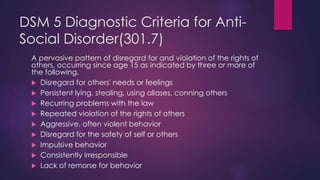
DSM 5 Diagnostic Criteria for Anti-
Social Disorder(301.7)
A pervasive pattern of disregard for and violation of the rights of
others, occurring since age 15 as indicated by three or more of
the following.
 Disregard for others' needs or feelings
 Persistent lying, stealing, using aliases, conning others
 Recurring problems with the law
 Repeated violation of the rights of others
 Aggressive, often violent behavior
 Disregard for the safety of self or others
 Impulsive behavior
 Consistently irresponsible
 Lack of remorse for behavior

PERSONALITY DISORDERS DSM5

  • 1.
    PERSONALITY DISORDERS CLUSTER B: ANTISOCIAL(301.7)BORDERLINE (301.83) HISTRIONIC(301.50) NARCISSISTIC (301.81)
  • 2.
    Introduction to PersonalityDisorders  What is Personality Disorders: A personality disorder is a type of mental disorder in which you have a rigid and unhealthy pattern of thinking, functioning and behaving. A person with a personality disorder has trouble perceiving and relating to situations and to people. This causes significant problems and limitations in relationships, social encounters, work and school.  Personality disorders usually begin in the teenage years or early adulthood. There are many types of personality disorders. Some types may become less obvious throughout middle age.
  • 3.
    Introduction to Personality Disorderscontinue  Personality is the combination of thoughts, emotions and behaviors that makes you unique. It's the way you view, understand and relate to the outside world, as well as how you see yourself. Personality forms during childhood, shaped through an interaction of two factors:  Your genes. Certain personality traits may be passed on to you by your parents through inherited genes. These traits are sometimes called your temperament.  Your environment. This involves the surroundings you grew up in, events that occurred, and relationships with family members and others.  Personality disorders are thought to be caused by a combination of these genetic and environmental influences. Your genes may make you vulnerable to developing a personality disorder, and a life situation may trigger the actual development.
  • 4.
    What are thesymptoms of Personality Disorders  What are the symptoms of Personality Disorder? There are several types of personality disorders that are grouped into three clusters, based on similar characteristics and symptoms. Many people with one personality disorder may also have signs and symptoms of at least one additional personality disorder.
  • 5.
    Personality disorders aregrouped into three clusters:  Cluster (A) personality disorders are characterized by odd, eccentric thinking or behavior. They include paranoid personality disorder, schizoid personality disorder and schizotypal personality disorder.  Cluster (B) personality disorders are characterized by dramatic, overly emotional or unpredictable thinking or behavior. They include antisocial personality disorder, borderline personality disorder, histrionic personality disorder and narcissistic personality disorder.
  • 6.
    Personality disorders aregrouped into three clusters: continue  Cluster C personality disorders are characterized by anxious, fearful thinking or behavior. They include avoidant personality disorder, dependent personality disorder and obsessive- compulsive personality disorder. It's not necessary to exhibit all the signs and symptoms listed for a disorder to be diagnosed.
  • 7.
    Cluster (B) PersonalityDisorders: Antisocial, Borderline, Histrionic, and Narcissistic
  • 8.
    Antisocial Antisocial Personality Disorder(DSM 5: 301.7): Persons afflicted with ASPD violate social norms and, specifically, behaviors that are prohibited by the criminal code. ASPD may shoplift, break and enter households. Assault with weapons, steal automobiles, or even commit murder. Not all persons with ASPD will commit all of these behaviors. Several serial killers were diagnose with ASPD such as Ted Bundy, John Wayne Gacy,
  • 9.
    DSM 5 DiagnosticCriteria for Anti- Social Disorder(301.7) A pervasive pattern of disregard for and violation of the rights of others, occurring since age 15 as indicated by three or more of the following.  Disregard for others' needs or feelings  Persistent lying, stealing, using aliases, conning others  Recurring problems with the law  Repeated violation of the rights of others  Aggressive, often violent behavior  Disregard for the safety of self or others  Impulsive behavior  Consistently irresponsible  Lack of remorse for behavior