Meaning of Scaling
 Scaling describe the procedures of assigning of
numbers 0r symbols (i.e., quantitative measures) to
subjective abstract concepts (or properties of objects)
This can be done in two ways viz.,
1. Making a judgement about some characteristic of
an individual and then placing him directly on a scale
that has been defined in terms of that characteristic.
2. Constructing questionnaires in such a way that the
score of individual’s responses assigns him a place on
a scale.
 Scaling involves creating a continuum upon which
measured objects are located.
These scale –point positions are so related to each
other that when the first point happens to be the
highest point, the second point indicates a higher
degree in terms of a given characteristic as compared
to the third point and the third point indicates a
higher degree as compared to the fourth and so on.
Numbers for measuring the distinctions of degree
in the attitudes/opinions are, thus, assigned to
individuals corresponding to their scale-positions.
Scaling has been defined as a “procedure for the
assignment of numbers (or other symbols ) to a
property of objects in order to impart some of the
characteristics of numbers to the properties in
question. ”
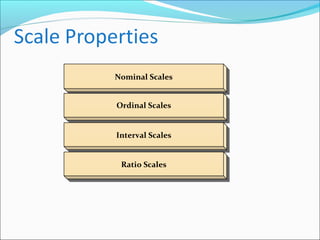
Nominal ScalesNominal Scales
Ordinal ScalesOrdinal Scales
Interval ScalesInterval Scales
Ratio ScalesRatio Scales
Scale Properties:
In nominal scale the numbers serve only as labels or
tags for identifying and classifying objects.
The ordinal scale is a ranking scale in which numbers
are assigned to objects to indicate the relative extent
to which the objects possess some characteristic.
In interval scale numerically equal distances on the
scale represent equal values in the characteristic
being measured.
The ratio scale possesses all the properties of the
nominal, ordinal, and interval scales. It has an
absolute zero point.
Nominal Scale
A nominal scale is the simplest of the four scale types and
in which the numbers or letters assigned to objects serve
as labels for identification or classification.
Example:
 Males = 1, Females = 2
 Sales Zone A = Islamabad, Sales Zone B = Rawalpindi
 Drink A = Pepsi Cola, Drink B = 7-Up, Drink C = Miranda
Ordinal Scale:
Ordinal measurements describe order, but not relative
size or degree of difference between the items measured.
In this scale type,the numbers assigned to objects or
events represent the rank order (1st
,2nd
,3rd
,etc) of the entities
assessed.
A likert scale is a type of ordinal scale and may also use
names with an order such as:
❖ “Bad”, “medium” and “good”
❖ “very satisfied”, “satisfied”, “neutral”, “unsatisfied”,
“very unsatisfied”
Example of an ordinal scale:
The result of a horse race, which says only which
horses arrived first, second, or third but include no
information about race times.
Another example is military rank; they have an
order, but no well defined numerical difference
between ranks.
 Examples of Ordinal:
 Career Opportunities = Moderate, Good, Excellent
 Investment Climate = Bad, inadequate, fair, good, very good
 Merit = A grade, B grade, C grade, D grade
A problem with ordinal scales is that the difference between
categories on the scale is hard to quantify, ie., excellent is better
than good but how much is excellent better?
Interval Scale
An interval scale is a scale that not only arranges objects
or alternatives according to their respective magnitudes,
but also distinguishes this ordered arrangement in units of
equal intervals (i.e. interval scales indicate order (as in
ordinal scales) and also the distance in the order).
Examples:
 Temperature Scale in Fahrenheit
Interval scales allow comparisons of the differences of magnitude
(e.g. of attitudes) but do not allow determinations of the actual
strength of the magnitude.
Ratio Scale
A ratio scale is a scale that possesses absolute rather than
relative qualities and has an absolute zero.
Examples:
 Money
 Weight
 Distance
 Temperature on the Kelvin Scale
Interval scales allow comparisons of the differences of magnitude
(e.g. of attitudes) as well as determinations of the actual strength
of the magnitude.
Scale Classification Bases
The number of assigning procedures or the scaling
procedures may be broadly classified on the following
bases:
 Subject orientation
 Response form
 Degree of subjectivity
 Scale properties
 Number of dimensions
 Scale construction techniques
Subject Orientation:
Under it a scale may be designed to measure
characteristics of the respondent who completes it or
to judge the stimulus object which is presented to the
respondent.
In respect of the former, we presume that the stimuli
presented are sufficiently homogeneous so that the
between stimuli variation is small as compared to the
variation among respondents.
In the latter approach, we ask the respondent to
judge some specific object in terms of one or more
dimensions and we presume that the between-
respondent variation will be small as compared to
the variation among the different stimuli presented to
respondents for judging.
Response form:
Under this we may classify the scales as categorical
and comparative.
Categorical scales are also known as rating scales.
These scales are used when a respondent scores some
object without direct reference to other objects.
Under comparative scales, which are also known as
ranking scales, the respondent is asked to compare
two or more objects.
Degree of subjectivity:
With this basis the scale date may be based on
whether we measure subjective personal preferences
or simply make non-preference judgements.
In the former case , the respondent is asked to
choose which person he favours or which solution
he would like to see employed, whereas in the latter
case he is simply asked to judge which person is
more effective in some aspect or which solution will
take fewer resources without reflecting any
personal preference.
Number of dimensions:
In respect of this basis, scales can be classified as
‘ unidimensional’ and ‘multidimensional’ scales.
Under the former we measure only one attribute of
the respondent or object, whereas multidimensional
scaling recognizes that an object might be described
better by using the concept of an attribute space of
‘n’ dimensions, rather than a single-dimension
continuum.
Scale construction techniques:
Following are the five main techniques by which
scales can be developed.
 Arbitrary approach
 Consensus approach
 Item analysis approach
 Cumulative scales
 Factor scales
Arbitrary approach:
It is an approach where scale is developed on ad hoc
basis. This is the most widely used approach. It is
presumed that such scales measure the concepts for
which they have been designed, although there is
little evidence to support such an assumption.
Consensus approach:
Here a panel of judges evaluate the items chosen for
inclusion in the instrument in terms of whether they
are relevant to the topic area and unambiguous in
implication.
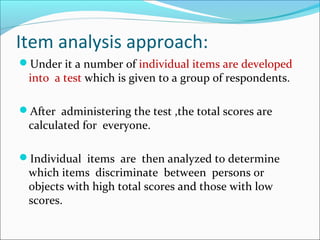
Item analysis approach:
Under it a number of individual items are developed
into a test which is given to a group of respondents.
After administering the test ,the total scores are
calculated for everyone.
Individual items are then analyzed to determine
which items discriminate between persons or
objects with high total scores and those with low
scores.
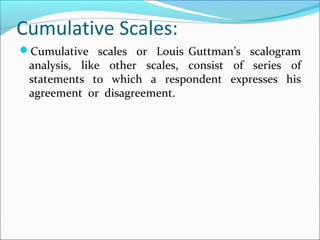
Cumulative Scales:
Cumulative scales or Louis Guttman’s scalogram
analysis, like other scales, consist of series of
statements to which a respondent expresses his
agreement or disagreement.
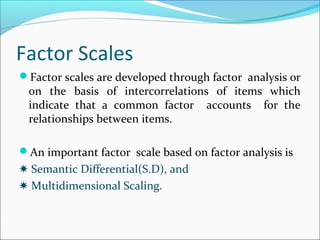
Factor Scales
Factor scales are developed through factor analysis or
on the basis of intercorrelations of items which
indicate that a common factor accounts for the
relationships between items.
An important factor scale based on factor analysis is
✸ Semantic Differential(S.D), and
✸ Multidimensional Scaling.
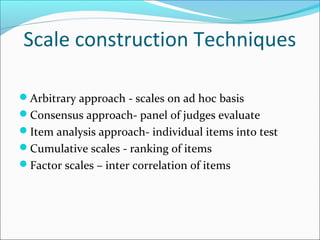
Scale construction Techniques
Arbitrary approach - scales on ad hoc basis
Consensus approach- panel of judges evaluate
Item analysis approach- individual items into test
Cumulative scales - ranking of items
Factor scales – inter correlation of items
Important Scaling Techniques
The important scaling techniques often used in the
context of research specially in context of social or
business research are as follows:
Rating Scales
Ranking Scales
Rating Scales:
 The rating scale involves qualitative description of a
limited number of aspects of a thing or of traits of a
person.
 These ratings may be in such forms as “like-dislike”,
“ above average, average, below average” etc.
 There is no specific rule whether to use a two-points
scale, three-point scale or scale with still more points.
 In practice, three to seven points scales are generally
used for the simple reason that more points on a scale
provide an opportunity for greater sensitivity of
measurement.
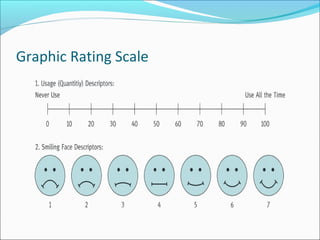
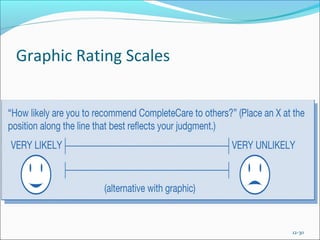
Graphic rating scale
The graphic rating scale is quite simple and is
commonly used in practice. Under it the various
points are usually put along the line to form a
continuum and the rater indicates his rating by
simply making a mark (such as ✔ ) at the appropriate
point on a line that runs from one extreme to the
other.
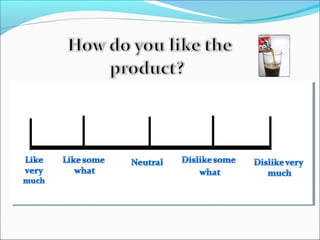
The following is an example of five-points graphic
rating scale when we wish to ascertain people’s liking
or disliking any product:
Graphic Rating Scale
Graphic Rating Scales
12-30
Itemized rating scale:
The itemized rating scale(also known as numerical
scale) presents a series of statements from which a
respondent selects one as best reflecting his
evaluation.
Suppose we wish to inquire as to how well does a
worker get along with his fellow workers?
In such a situation we may ask the respondent to
select one, to express his opinion, from the following:
He is almost always involved in some friction with a
fellow worker.
He is often at odds with one or more of his fellow
workers.
He sometimes gets involved in friction.
He infrequently becomes involved in friction with
others.
He almost never gets involved in friction with fellow
workers.
Selected Itemized Rating Scales
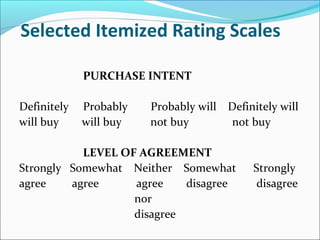
PURCHASE INTENT
Definitely Probably Probably will Definitely will
will buy will buy not buy not buy
LEVEL OF AGREEMENT
Strongly Somewhat Neither Somewhat Strongly
agree agree agree disagree disagree
nor
disagree
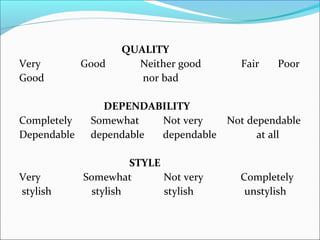
QUALITY
Very Good Neither good Fair Poor
Good nor bad
DEPENDABILITY
Completely Somewhat Not very Not dependable
Dependable dependable dependable at all
STYLE
Very Somewhat Not very Completely
stylish stylish stylish unstylish
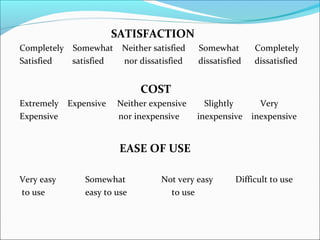
SATISFACTION
Completely Somewhat Neither satisfied Somewhat Completely
Satisfied satisfied nor dissatisfied dissatisfied dissatisfied
COST
Extremely Expensive Neither expensive Slightly Very
Expensive nor inexpensive inexpensive inexpensive
EASE OF USE
Very easy Somewhat Not very easy Difficult to use
to use easy to use to use
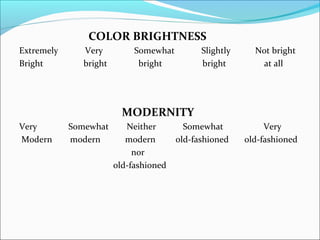
COLOR BRIGHTNESS
Extremely Very Somewhat Slightly Not bright
Bright bright bright bright at all
MODERNITY
Very Somewhat Neither Somewhat Very
Modern modern modern old-fashioned old-fashioned
nor
old-fashioned
Ranking Scales:
There are two generally used approaches of ranking
scales viz.,
 Method of paired comparisons
 Method of rank order
Method of paired comparisons:
Under it the respondent can express his attitude
by making a choice between two objects, say
between a new flavour of soft drinks and an
established brand of drink.
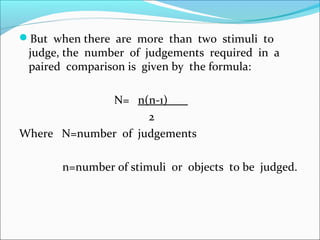
But when there are more than two stimuli to
judge, the number of judgements required in a
paired comparison is given by the formula:
N= n(n-1)
2
Where N=number of judgements
n=number of stimuli or objects to be judged.
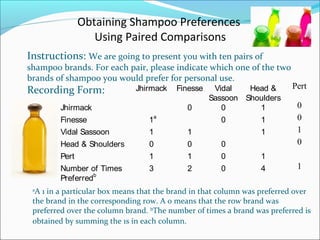
Obtaining Shampoo Preferences
Using Paired Comparisons
Instructions: We are going to present you with ten pairs of
shampoo brands. For each pair, please indicate which one of the two
brands of shampoo you would prefer for personal use.
Recording Form: Jhirmack Finesse Vidal
Sassoon
Head &
Shoulders
Pert
Jhirmack 0 0 1 0
Finesse 1a
0 1 0
Vidal Sassoon 1 1 1 1
Head & Shoulders 0 0 0 0
Pert 1 1 0 1
Number of Times
Preferredb
3 2 0 4 1
a
A 1 in a particular box means that the brand in that column was preferred over
the brand in the corresponding row. A 0 means that the row brand was
preferred over the column brand. b
The number of times a brand was preferred is
obtained by summing the 1s in each column.
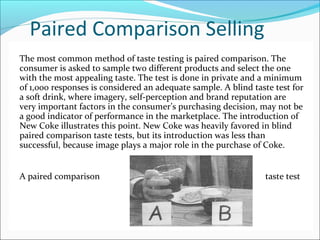
Paired Comparison Selling
The most common method of taste testing is paired comparison. The
consumer is asked to sample two different products and select the one
with the most appealing taste. The test is done in private and a minimum
of 1,000 responses is considered an adequate sample. A blind taste test for
a soft drink, where imagery, self-perception and brand reputation are
very important factors in the consumer’s purchasing decision, may not be
a good indicator of performance in the marketplace. The introduction of
New Coke illustrates this point. New Coke was heavily favored in blind
paired comparison taste tests, but its introduction was less than
successful, because image plays a major role in the purchase of Coke.
A paired comparison taste test
Comparative Scaling Techniques
Rank Order Scaling
Respondents are presented with several objects
simultaneously and asked to order or rank them
according to some criterion.
It is possible that the respondent may dislike the brand
ranked 1 in an absolute sense.
Furthermore, rank order scaling also results in ordinal
data.
Only (n - 1) scaling decisions need be made in rank
order scaling.
Preference for Toothpaste Brands
Using Rank Order Scaling
Instructions: Rank the various brands of toothpaste in order of
preference. Begin by picking out the one brand that you like
most and assign it a number 1. Then find the second most
preferred brand and assign it a number 2. Continue this
procedure until you have ranked all the brands of toothpaste in
order of preference. The least preferred brand should be
assigned a rank of 10.
No two brands should receive the same rank number.
The criterion of preference is entirely up to you. There is no
right or wrong answer. Just try to be consistent.
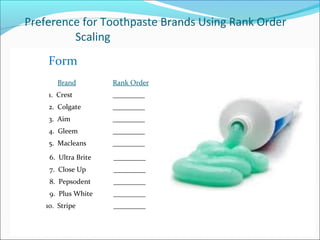
Brand Rank Order
1. Crest _________
2. Colgate _________
3. Aim _________
4. Gleem _________
5. Macleans _________
6. Ultra Brite _________
7. Close Up _________
8. Pepsodent _________
9. Plus White _________
10. Stripe _________
Preference for Toothpaste Brands Using Rank Order
Scaling
Form

Scaling 120121081027-phpapp01

  • 1.
    Meaning of Scaling Scaling describe the procedures of assigning of numbers 0r symbols (i.e., quantitative measures) to subjective abstract concepts (or properties of objects) This can be done in two ways viz., 1. Making a judgement about some characteristic of an individual and then placing him directly on a scale that has been defined in terms of that characteristic.
  • 2.
    2. Constructing questionnairesin such a way that the score of individual’s responses assigns him a place on a scale.  Scaling involves creating a continuum upon which measured objects are located.
  • 3.
    These scale –pointpositions are so related to each other that when the first point happens to be the highest point, the second point indicates a higher degree in terms of a given characteristic as compared to the third point and the third point indicates a higher degree as compared to the fourth and so on.
  • 4.
    Numbers for measuringthe distinctions of degree in the attitudes/opinions are, thus, assigned to individuals corresponding to their scale-positions. Scaling has been defined as a “procedure for the assignment of numbers (or other symbols ) to a property of objects in order to impart some of the characteristics of numbers to the properties in question. ”
  • 5.
    Nominal ScalesNominal Scales OrdinalScalesOrdinal Scales Interval ScalesInterval Scales Ratio ScalesRatio Scales
  • 6.
    Scale Properties: In nominalscale the numbers serve only as labels or tags for identifying and classifying objects. The ordinal scale is a ranking scale in which numbers are assigned to objects to indicate the relative extent to which the objects possess some characteristic. In interval scale numerically equal distances on the scale represent equal values in the characteristic being measured. The ratio scale possesses all the properties of the nominal, ordinal, and interval scales. It has an absolute zero point.
  • 7.
    Nominal Scale A nominalscale is the simplest of the four scale types and in which the numbers or letters assigned to objects serve as labels for identification or classification. Example:  Males = 1, Females = 2  Sales Zone A = Islamabad, Sales Zone B = Rawalpindi  Drink A = Pepsi Cola, Drink B = 7-Up, Drink C = Miranda
  • 8.
    Ordinal Scale: Ordinal measurementsdescribe order, but not relative size or degree of difference between the items measured. In this scale type,the numbers assigned to objects or events represent the rank order (1st ,2nd ,3rd ,etc) of the entities assessed. A likert scale is a type of ordinal scale and may also use names with an order such as: ❖ “Bad”, “medium” and “good” ❖ “very satisfied”, “satisfied”, “neutral”, “unsatisfied”, “very unsatisfied”
  • 9.
    Example of anordinal scale: The result of a horse race, which says only which horses arrived first, second, or third but include no information about race times. Another example is military rank; they have an order, but no well defined numerical difference between ranks.
  • 10.
     Examples ofOrdinal:  Career Opportunities = Moderate, Good, Excellent  Investment Climate = Bad, inadequate, fair, good, very good  Merit = A grade, B grade, C grade, D grade A problem with ordinal scales is that the difference between categories on the scale is hard to quantify, ie., excellent is better than good but how much is excellent better?
  • 11.
    Interval Scale An intervalscale is a scale that not only arranges objects or alternatives according to their respective magnitudes, but also distinguishes this ordered arrangement in units of equal intervals (i.e. interval scales indicate order (as in ordinal scales) and also the distance in the order). Examples:  Temperature Scale in Fahrenheit Interval scales allow comparisons of the differences of magnitude (e.g. of attitudes) but do not allow determinations of the actual strength of the magnitude.
  • 12.
    Ratio Scale A ratioscale is a scale that possesses absolute rather than relative qualities and has an absolute zero. Examples:  Money  Weight  Distance  Temperature on the Kelvin Scale Interval scales allow comparisons of the differences of magnitude (e.g. of attitudes) as well as determinations of the actual strength of the magnitude.
  • 13.
    Scale Classification Bases Thenumber of assigning procedures or the scaling procedures may be broadly classified on the following bases:  Subject orientation  Response form  Degree of subjectivity  Scale properties  Number of dimensions  Scale construction techniques
  • 14.
    Subject Orientation: Under ita scale may be designed to measure characteristics of the respondent who completes it or to judge the stimulus object which is presented to the respondent. In respect of the former, we presume that the stimuli presented are sufficiently homogeneous so that the between stimuli variation is small as compared to the variation among respondents.
  • 15.
    In the latterapproach, we ask the respondent to judge some specific object in terms of one or more dimensions and we presume that the between- respondent variation will be small as compared to the variation among the different stimuli presented to respondents for judging.
  • 16.
    Response form: Under thiswe may classify the scales as categorical and comparative. Categorical scales are also known as rating scales. These scales are used when a respondent scores some object without direct reference to other objects. Under comparative scales, which are also known as ranking scales, the respondent is asked to compare two or more objects.
  • 17.
    Degree of subjectivity: Withthis basis the scale date may be based on whether we measure subjective personal preferences or simply make non-preference judgements. In the former case , the respondent is asked to choose which person he favours or which solution he would like to see employed, whereas in the latter case he is simply asked to judge which person is more effective in some aspect or which solution will take fewer resources without reflecting any personal preference.
  • 18.
    Number of dimensions: Inrespect of this basis, scales can be classified as ‘ unidimensional’ and ‘multidimensional’ scales. Under the former we measure only one attribute of the respondent or object, whereas multidimensional scaling recognizes that an object might be described better by using the concept of an attribute space of ‘n’ dimensions, rather than a single-dimension continuum.
  • 19.
    Scale construction techniques: Followingare the five main techniques by which scales can be developed.  Arbitrary approach  Consensus approach  Item analysis approach  Cumulative scales  Factor scales
  • 20.
    Arbitrary approach: It isan approach where scale is developed on ad hoc basis. This is the most widely used approach. It is presumed that such scales measure the concepts for which they have been designed, although there is little evidence to support such an assumption. Consensus approach: Here a panel of judges evaluate the items chosen for inclusion in the instrument in terms of whether they are relevant to the topic area and unambiguous in implication.
  • 21.
    Item analysis approach: Underit a number of individual items are developed into a test which is given to a group of respondents. After administering the test ,the total scores are calculated for everyone. Individual items are then analyzed to determine which items discriminate between persons or objects with high total scores and those with low scores.
  • 22.
    Cumulative Scales: Cumulative scalesor Louis Guttman’s scalogram analysis, like other scales, consist of series of statements to which a respondent expresses his agreement or disagreement.
  • 23.
    Factor Scales Factor scalesare developed through factor analysis or on the basis of intercorrelations of items which indicate that a common factor accounts for the relationships between items. An important factor scale based on factor analysis is ✸ Semantic Differential(S.D), and ✸ Multidimensional Scaling.
  • 24.
    Scale construction Techniques Arbitraryapproach - scales on ad hoc basis Consensus approach- panel of judges evaluate Item analysis approach- individual items into test Cumulative scales - ranking of items Factor scales – inter correlation of items
  • 25.
    Important Scaling Techniques Theimportant scaling techniques often used in the context of research specially in context of social or business research are as follows: Rating Scales Ranking Scales
  • 26.
    Rating Scales:  Therating scale involves qualitative description of a limited number of aspects of a thing or of traits of a person.  These ratings may be in such forms as “like-dislike”, “ above average, average, below average” etc.  There is no specific rule whether to use a two-points scale, three-point scale or scale with still more points.  In practice, three to seven points scales are generally used for the simple reason that more points on a scale provide an opportunity for greater sensitivity of measurement.
  • 27.
    Graphic rating scale Thegraphic rating scale is quite simple and is commonly used in practice. Under it the various points are usually put along the line to form a continuum and the rater indicates his rating by simply making a mark (such as ✔ ) at the appropriate point on a line that runs from one extreme to the other. The following is an example of five-points graphic rating scale when we wish to ascertain people’s liking or disliking any product:
  • 29.
  • 30.
  • 31.
    Itemized rating scale: Theitemized rating scale(also known as numerical scale) presents a series of statements from which a respondent selects one as best reflecting his evaluation. Suppose we wish to inquire as to how well does a worker get along with his fellow workers? In such a situation we may ask the respondent to select one, to express his opinion, from the following:
  • 32.
    He is almostalways involved in some friction with a fellow worker. He is often at odds with one or more of his fellow workers. He sometimes gets involved in friction. He infrequently becomes involved in friction with others. He almost never gets involved in friction with fellow workers.
  • 33.
    Selected Itemized RatingScales PURCHASE INTENT Definitely Probably Probably will Definitely will will buy will buy not buy not buy LEVEL OF AGREEMENT Strongly Somewhat Neither Somewhat Strongly agree agree agree disagree disagree nor disagree
  • 34.
    QUALITY Very Good Neithergood Fair Poor Good nor bad DEPENDABILITY Completely Somewhat Not very Not dependable Dependable dependable dependable at all STYLE Very Somewhat Not very Completely stylish stylish stylish unstylish
  • 35.
    SATISFACTION Completely Somewhat Neithersatisfied Somewhat Completely Satisfied satisfied nor dissatisfied dissatisfied dissatisfied COST Extremely Expensive Neither expensive Slightly Very Expensive nor inexpensive inexpensive inexpensive EASE OF USE Very easy Somewhat Not very easy Difficult to use to use easy to use to use
  • 36.
    COLOR BRIGHTNESS Extremely VerySomewhat Slightly Not bright Bright bright bright bright at all MODERNITY Very Somewhat Neither Somewhat Very Modern modern modern old-fashioned old-fashioned nor old-fashioned
  • 37.
    Ranking Scales: There aretwo generally used approaches of ranking scales viz.,  Method of paired comparisons  Method of rank order Method of paired comparisons: Under it the respondent can express his attitude by making a choice between two objects, say between a new flavour of soft drinks and an established brand of drink.
  • 38.
    But when thereare more than two stimuli to judge, the number of judgements required in a paired comparison is given by the formula: N= n(n-1) 2 Where N=number of judgements n=number of stimuli or objects to be judged.
  • 39.
    Obtaining Shampoo Preferences UsingPaired Comparisons Instructions: We are going to present you with ten pairs of shampoo brands. For each pair, please indicate which one of the two brands of shampoo you would prefer for personal use. Recording Form: Jhirmack Finesse Vidal Sassoon Head & Shoulders Pert Jhirmack 0 0 1 0 Finesse 1a 0 1 0 Vidal Sassoon 1 1 1 1 Head & Shoulders 0 0 0 0 Pert 1 1 0 1 Number of Times Preferredb 3 2 0 4 1 a A 1 in a particular box means that the brand in that column was preferred over the brand in the corresponding row. A 0 means that the row brand was preferred over the column brand. b The number of times a brand was preferred is obtained by summing the 1s in each column.
  • 40.
    Paired Comparison Selling Themost common method of taste testing is paired comparison. The consumer is asked to sample two different products and select the one with the most appealing taste. The test is done in private and a minimum of 1,000 responses is considered an adequate sample. A blind taste test for a soft drink, where imagery, self-perception and brand reputation are very important factors in the consumer’s purchasing decision, may not be a good indicator of performance in the marketplace. The introduction of New Coke illustrates this point. New Coke was heavily favored in blind paired comparison taste tests, but its introduction was less than successful, because image plays a major role in the purchase of Coke. A paired comparison taste test
  • 41.
    Comparative Scaling Techniques RankOrder Scaling Respondents are presented with several objects simultaneously and asked to order or rank them according to some criterion. It is possible that the respondent may dislike the brand ranked 1 in an absolute sense. Furthermore, rank order scaling also results in ordinal data. Only (n - 1) scaling decisions need be made in rank order scaling.
  • 42.
    Preference for ToothpasteBrands Using Rank Order Scaling Instructions: Rank the various brands of toothpaste in order of preference. Begin by picking out the one brand that you like most and assign it a number 1. Then find the second most preferred brand and assign it a number 2. Continue this procedure until you have ranked all the brands of toothpaste in order of preference. The least preferred brand should be assigned a rank of 10. No two brands should receive the same rank number. The criterion of preference is entirely up to you. There is no right or wrong answer. Just try to be consistent.
  • 43.
    Brand Rank Order 1.Crest _________ 2. Colgate _________ 3. Aim _________ 4. Gleem _________ 5. Macleans _________ 6. Ultra Brite _________ 7. Close Up _________ 8. Pepsodent _________ 9. Plus White _________ 10. Stripe _________ Preference for Toothpaste Brands Using Rank Order Scaling Form

Editor's Notes

  • #31 From Exhibit 12-3: The graphic rating scale was originally created to enable researchers to discern fine differences. Theoretically, an infinite number of ratings is possible if participants are sophisticated enough to differentiate and record them. They are instructed to mark their response at any point along a continuum. Usually, the score is a measure of length from either endpoint. The results are treated as interval data. The difficulty is in coding and analysis. Graphic rating scales use pictures, icons, or other visuals to communicate with the rater and represent a variety of data types. Graphic scales are often used with children.