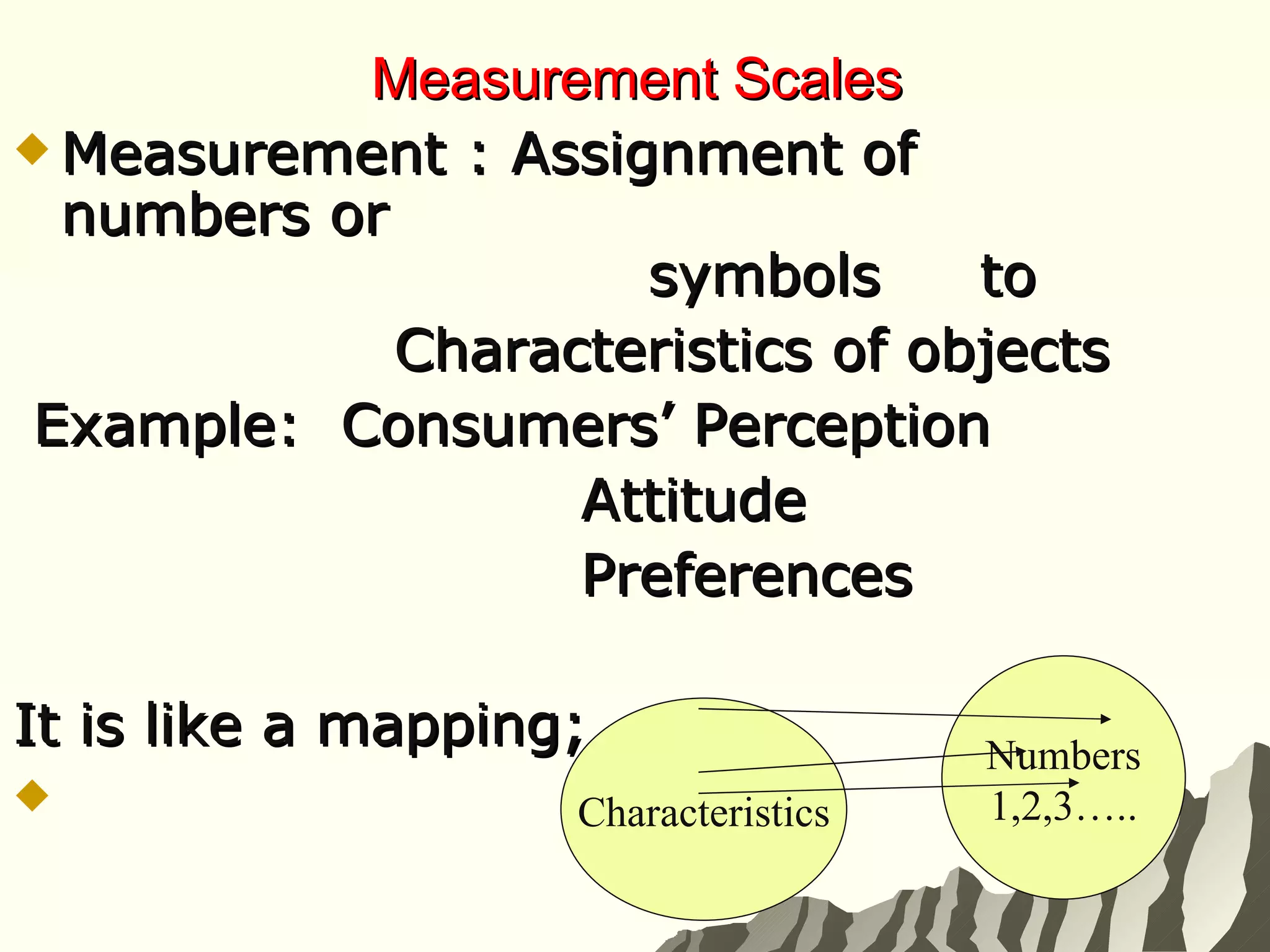
Measurement Scales Measurement : Assignment of numbers or  symbols  to Characteristics of objects Example:  Consumers’ Perception   Attitude   Preferences  It is like a mapping;  Characteristics Numbers 1,2,3…..
Scaling Scaling is extension of  ‘ Measurement ’ Scaling  is  creating a range or continuum on which measured objectives are located. Example: Measurement of attitude :    favorable or unfavorable Scaling creates four levels: Very favorable, favorable, Unfavorable, Very unfavorable. Measurement assigns the number: 4,3,2,1
Measurement Scales Nominal Ordinal Interval  Ratio
Measurement Scales: examples Nominal:  Categories, Identification, roll nos. Ordinal: Rankings., Preferences, Most popular brand(s)  Interval : Temperature, Grading in exams, User categories Ratio: Length, Marks in exams, Distance, Salaries
Scale Nominal   Numbers  Assigned   to Runners Ordinal Rank Order of Winners Interval Performance Rating on a   0 to 10 Scale Ratio Time to  Finish, in  Seconds   Primary Scales of Measurement 3 Finish Finish 8.2 9.1 9.6 15.2 14.1 13.4 7 8 Third place Second place First place
Primary Scales of Measurement
Nominal  Ordinal   Ratio Scale  Scale  Scale Preference   Rs spent last  No.  Store   Rankings  1. Ahuja Sons 2. Home Saaz 3. K-mart 4. Nanz 5. Aastha   6. Ebony   7. Target   8. Jagdish Store 9. BigJos   Illustration of Primary Scales of Measurement Interval Scale  Preference Ratings 1-7  11-17
Comparison Interval :  Y= a + b X Here difference between two measurement is equal, the ratio is not equal Example: Very good  Good  Poor  Very Poor Scale A  4  3  2  1 Scale B  2  1  0  -- 1 Ratio of Very good to good is  4/3=1.33 in scale A ,while the same is 2/1=2.0 in scale B. Difference is equal  Ratio :  Y= b X
Assigning scores to interval Scale  A five point interval scale could be as follows: Very happy Happy Neither happy nor unhappy Unhappy Very unhappy Now the question is what numerical scores could be assigned  to the five categories ? Does it  really  matter ?
Measurement Scales What measurement scale will you use for the following? Do you own a washing machine? What is your marital status ? How many books are there in your library? How satisfactory is bank’s service? Describe your preference for brands of shampoo? Your attendance in the Business Research class ? How many members watch DD-1 during the prime time in your household?
Scaling Techniques Non-comparative Scales Comparative Scales Paired Comparison Rank Order Constant Sum Q-Sort and Other Procedures Continuous Rating Scales Itemized Rating Scales Likert Semantic Differential Stapel A Classification of Scaling Techniques
Scaling Techniques: Attitude and Rating scales  Scaling Comparative Monadic Or Non-Comparative
Scaling Techniques: Attitude and Rating scales Comparative Paired comparison Rank Order Constant  Sum Q- Sort
Attitude and Rating scales: COMPARATIVE Paired comparison  : here  two objects at a time  are taken and  better one is identified Rank Order : according to specified ( or unspecified i.e. overall )criterion the ranking is done Constant sum : Usually 10 ( or 100) points are distributed among the objects to reflect the differences and gaps Q-Sort  (or Ordered Category sorting): ranks are given to groups of objects, differences are  indicated among groups . Indexing or magnitude estimation : the ‘best’  object is given  a score of 100, others are rated as per this comparison Fractionation : Here the best object is rated as 1, others as fractions of 1 NON -COMPARATIVE
Obtaining Shampoo Preferences Using Paired Comparisons Instructions:  We are going to present you with ten pairs of shampoo brands. For each pair, please indicate which one of the two brands of shampoo you would prefer for personal use.  Recording Form:   a A 1 in a particular box means that the brand in that column was preferred over the brand in the corresponding row. A 0 means that the row brand was preferred over the column brand.  b The number of times a brand was preferred is obtained by summing the 1s in each column.
Paired Comparison Analysis Suppose 100 consumers compare five tyre brands as follows: Brand Dunlop Modi Ceat GoodYear MRF Dunlop - 80 59 52 77 Modi 20 - 60 46 56 Ceat 41 40 - 61 60 G.Year 48 54 39 - 67 MRF 23 44 40 33 -
All the frequencies shown in the previous table are divided from the total number of respondents( 100 here). Brand Dunlop Modi Ceat GoodYear MRF Dunlop - 0.80 0.59 0.52 0.77 Modi 0.20 - 0.60 0.46 0.56 Ceat 0.41 0.40 - 0.61 0.60 G.Year 0.48 0.54 0.39 - 0.67 MRF 0.23 0.44 0.40 0.33 -
Write z-scores: This table presents z values corresponding to percentage points departure from  0.5  ( Ex Modi-Dunlop : 0.84 is z value for an area of 0.30) Total Distance -1.86  +0.53  -0.04  -0.21  +1.58  Avg.  Distance -0.37  +0.11  -0.01  +0.04  +0.32 Shift from origin 0.0  0.48  0.36  0.41  0.69 Brand Dunlop Modi Ceat GoodYear MRF Dunlop - +.84 +0.23 +0.05 +0.74 Modi -0.84 - +0.26 -0.10 +0.15 Ceat -0.23 -0.26 - +0.28 +0.25 G.Year -0.05 +0.10 -0.28 - +0.44 MRF -0.74 -0.15 -0.25 -0.44 -
Paired Comparison Scaling The most common method of  taste testing is paired comparison.  The consumer is asked to sample two different products and select the one with the most appealing taste. The test is done in private and a minimum of 1,000 responses is considered an adequate sample. A  blind taste test for a soft drink , where  imagery, self-perception and brand reputation  are very important factors in the consumer’s purchasing decision,  may not be a good indicator of performance in the marketplace . The introduction of New Coke illustrates this point . New Coke was heavily favored in blind paired comparison taste tests, but its introduction was less than successful , because image plays a major role in the purchase of Coke. A paired comparison  taste test
Other issues related to ranking A  ranking-grid is always  better than simple ranking In a grid , a frequency table is prepared for all objects ranked  Only ‘top’  ranking will lead to partial picture only An analysis of ‘first two’ is more explicit Similarly an analysis of ‘first three’ I even better
Example:  if a question “ Which  colour do you prefer?” is asked of ( say) 100 respondents. The first preference response may be : Red  45 ,  Blue  44 ,  Yellow 11 Then the ranking is 1.Red, 2.Blue, 3. Yellow Let us look at the complete picture ( frequency of respondents) Rank  I  Rank II  Rank III RED  45 6 49 BLUE  44 54 02 Yellow   11 40 49 Let us now introduce  a score of 3 for Rank I. score of 2 for rank II and a score of 1 for rank III When only First preference is taken , It is Red, Blue, Yellow When three preferences are taken  Blue ( 2.42),  Red ( 1.96).and Yellow( 1.62) See the difference?
Preference for Toothpaste Brands Using Rank Order Scaling Instructions:  Rank the various brands of toothpaste in order of preference. Begin by picking out the one brand that you like most and assign it a number 1. Then find the second most preferred brand and assign it a number 2. Continue this procedure until you have ranked all the brands of toothpaste in order of preference. The least preferred brand should be assigned a rank of 10.  No two brands should receive the same rank number.   The criterion of preference is entirely up to you. There is no right or wrong answer. Just try to be consistent.
Brand   Rank Order     1.  Crest   _________   2.  Colgate   _________   3.  Aim   _________   4.  Anchor   _________  5.  Macleans   _________ 6.  Ultra Brite     _________ 7.  Close Up     _________ 8.  Pepsodent     _________  9.  Plus White     _________  10.  Forhans     _________
Importance of Bathing Soap Attributes Using a Constant Sum Scale Constant Sum Scale  On the next slide, there are  eight attributes  of bathing soaps. Please allocate 100 points among the attributes so that your allocation reflects the relative importance you attach to each attribute. The more points an attribute receives, the more important the attribute is. If an attribute is not at all important, assign it zero points. If an attribute is twice as important as some other attribute, it should receive twice as many points.
Form Average Responses of Three Segments   Attribute  Segment I  Segment II  Segment III 1. Mildness 2. Lather   3. Shrinkage   4. Price   5. Fragrance   6. Packaging   7. Moisturizing   8. Cleaning Power Sum
Scaling Techniques: Attitude and Rating scales Non Comparative or Monadic Continuous Rating Scales Itemized Rating Scales Likert Type Semantic  Differential Staple Pictorial
Attitude and Rating scales Graphic or Continuous  Scales  Poles ( extreme points) are  defined Pictorial Scales Different measurements are expressed with pictures/ line-drawings/ other forms  Itemized Scales ( also known as  Discrete) Several categories defined All categories may or may not be numbered Some times only extreme points are numbered ( variations are used depending on the variables, respondents)
Attitude and Rating scales Considerations in developing a scale Number of categories More or Less Where to stop ( maximum no. of categories) Balanced /Unbalanced Odd or Even number of categories Neutral Point ( forced / Non-forced) Genuine neutral point  or  Escape route for the respondents
Attitude and Rating scales Advantage & disadvantage Graphic : + Easy to explain, Maximum flexibility  _Difficult to measure ( requires computerized /  magnetic recognition readers)  _ Subjective interpretation of middle points  Itemized or  Discrete / Marked + Easy to explain to the respondent + works well  with ‘ limited ’ categories + Easy to analyze _ Difficult with ‘ many’ categories Verbal expression should be  distinguishable Pictorial + Best for children/ respondents with less education
Thermometer Scale Instructions:   Please indicate  how much you like McDonald’s  hamburgers by coloring in the thermometer. Start at the bottom and color up to the temperature level that best indicates how strong your preference is.   Form: Smiling Face Scale   Instructions:   Please point to the face that shows how much you like the Barbie Doll. If you do not like the Barbie Doll at all, you would point to Face 1. If you liked it very much, you would point to Face 5.   Form: 1 2 3 4 5 Some Pictorial Rating Scale Configurations Like very much Dislike very much 100  75  50  25  0
Attitude and Rating scales Can the Monadic ( non-comparative scale be used for comparison)? How? Example ?
1) Number of categories  Although there is no single, optimal number,   traditional guidelines suggest that there should be   between five and nine categories     2) Balanced vs. unbalanced  In general, the scale should be balanced to obtain   objective data   3) Odd/ even no. of categories  If a neutral or indifferent scale response is possible   from at least some of the respondents, an odd   number of categories should be used     4)   Forced vs. non-forced   In situations where the respondents are expected   to have no opinion, the  accuracy of the data may   be improved by a non-forced scale   5) Verbal description  An argument can be made for labeling all or many   scale categories. The category descriptions should   be located as close to the response categories as    possible  6)  Physical form     A number of options should be tried and the best   selected   Summary of Itemized Scale Decisions
Attitude and Rating scales: Some standard  Scales Thurstone:   Agreement /Disagreement  on a large number of statements ( usually 11) Time consuming ,  Tiring, dissuading  , Long process  of identifying Likert: Five point( usually) Levels of Agreement /Disagreement Easy to explain /develop
Attitude and Rating scales Stap el : Unipolar,10 point interval, rating from +5 to -5 Balanced without neutral point Semantic Differential ( usually) 7 point  scale Bi polar, with a neutral point, rating +3 to -3
Summative scale Attitude /Dimension to be used is divided into several statements and Likert scale of 5  points ( or 4/6/7 etc.) to be used for every statement. The scores of each statement are then summed up to measure the total score on that dimension Example: to measure brand loyalty  of consumers or organizational commitment of employees
Loyalty: I always use this brand Strongly Agree  5 Agree 4 Cant say  3 Dis Agree  2 Strongly disagree 1 I am willing to pay more for this brand I will postpone the purchase if this brand was not available ……… .. …… ..
Balanced Scores To make a comparison between two attributes /dimensions Example: For me ………. Comes first Profit  Customer    satisfaction ________________________________ 5  4  3  2  1  0  1  2  3  4  5
Basic Non-comparative Scales
A Semantic Differential Scale for Measuring Self- Concepts, Person Concepts, and Product Concepts 1) Rugged :---:---:---:---:---:---:---: Delicate     2) Excitable :---:---:---:---:---:---:---: Calm 3) Uncomfortable :---:---:---:---:---:---:---: Comfortable   4) Dominating :---:---:---:---:---:---:---: Submissive     5) Thrifty :---:---:---:---:---:---:---: Indulgent     6) Pleasant :---:---:---:---:---:---:---: Unpleasant     7) Contemporary :---:---:---:---:---:---:---: Obsolete       8) Organized :---:---:---:---:---:---:---: Unorganized   9) Rational :---:---:---:---:---:---:---: Emotional   10) Youthful :---:---:---:---:---:---:---: Mature     11) Formal :---:---:---:---:---:---:---: Informal     12) Orthodox :---:---:---:---:---:---:---: Liberal   13) Complex :---:---:---:---:---:---:---: Simple   14) Colorless :---:---:---:---:---:---:---: Colorful 15) Modest :---:---:---:---:---:---:---: Vain
Jovan Musk for Men is   Jovan Musk for Men is   Extremely good  Extremely good   Very good   Very good   Good     Good   Bad    Somewhat good Very bad    Bad   Extremely bad     Very bad Balanced and Unbalanced Scales Balanced Scale Unbalanced Scale
A variety of scale configurations may be employed to measure the gentleness of Cheer detergent. Some examples include:    Cheer detergent is:   1) Very harsh  --- --- --- --- --- ---  ---  Very gentle   2) Very harsh  1   2  3   4  5  6  7  Very gentle   3)  . Very harsh   . . .  Neither harsh nor gentle  . .  .  Very gentle   4)  ____  ____  ____  ____  ____  ____  ____  Very  Somewhat  Neither harsh  Somewhat  Gentle  Very  harsh  Harsh  harsh  nor gentle  gentle  gentle   5)  Very     Neither harsh   Very  harsh    nor gentle  gentle Rating Scale Configurations -3 -1 0 +1 +2 -2 +3 Cheer

6 measurement & scaling

  • 1.
    Measurement Scales Measurement: Assignment of numbers or symbols to Characteristics of objects Example: Consumers’ Perception Attitude Preferences It is like a mapping; Characteristics Numbers 1,2,3…..
  • 2.
    Scaling Scaling isextension of ‘ Measurement ’ Scaling is creating a range or continuum on which measured objectives are located. Example: Measurement of attitude : favorable or unfavorable Scaling creates four levels: Very favorable, favorable, Unfavorable, Very unfavorable. Measurement assigns the number: 4,3,2,1
  • 3.
    Measurement Scales NominalOrdinal Interval Ratio
  • 4.
    Measurement Scales: examplesNominal: Categories, Identification, roll nos. Ordinal: Rankings., Preferences, Most popular brand(s) Interval : Temperature, Grading in exams, User categories Ratio: Length, Marks in exams, Distance, Salaries
  • 5.
    Scale Nominal Numbers Assigned to Runners Ordinal Rank Order of Winners Interval Performance Rating on a 0 to 10 Scale Ratio Time to Finish, in Seconds Primary Scales of Measurement 3 Finish Finish 8.2 9.1 9.6 15.2 14.1 13.4 7 8 Third place Second place First place
  • 6.
    Primary Scales ofMeasurement
  • 7.
    Nominal Ordinal Ratio Scale Scale Scale Preference Rs spent last No. Store Rankings 1. Ahuja Sons 2. Home Saaz 3. K-mart 4. Nanz 5. Aastha 6. Ebony 7. Target 8. Jagdish Store 9. BigJos Illustration of Primary Scales of Measurement Interval Scale Preference Ratings 1-7 11-17
  • 8.
    Comparison Interval : Y= a + b X Here difference between two measurement is equal, the ratio is not equal Example: Very good Good Poor Very Poor Scale A 4 3 2 1 Scale B 2 1 0 -- 1 Ratio of Very good to good is 4/3=1.33 in scale A ,while the same is 2/1=2.0 in scale B. Difference is equal Ratio : Y= b X
  • 9.
    Assigning scores tointerval Scale A five point interval scale could be as follows: Very happy Happy Neither happy nor unhappy Unhappy Very unhappy Now the question is what numerical scores could be assigned to the five categories ? Does it really matter ?
  • 10.
    Measurement Scales Whatmeasurement scale will you use for the following? Do you own a washing machine? What is your marital status ? How many books are there in your library? How satisfactory is bank’s service? Describe your preference for brands of shampoo? Your attendance in the Business Research class ? How many members watch DD-1 during the prime time in your household?
  • 11.
    Scaling Techniques Non-comparativeScales Comparative Scales Paired Comparison Rank Order Constant Sum Q-Sort and Other Procedures Continuous Rating Scales Itemized Rating Scales Likert Semantic Differential Stapel A Classification of Scaling Techniques
  • 12.
    Scaling Techniques: Attitudeand Rating scales Scaling Comparative Monadic Or Non-Comparative
  • 13.
    Scaling Techniques: Attitudeand Rating scales Comparative Paired comparison Rank Order Constant Sum Q- Sort
  • 14.
    Attitude and Ratingscales: COMPARATIVE Paired comparison : here two objects at a time are taken and better one is identified Rank Order : according to specified ( or unspecified i.e. overall )criterion the ranking is done Constant sum : Usually 10 ( or 100) points are distributed among the objects to reflect the differences and gaps Q-Sort (or Ordered Category sorting): ranks are given to groups of objects, differences are indicated among groups . Indexing or magnitude estimation : the ‘best’ object is given a score of 100, others are rated as per this comparison Fractionation : Here the best object is rated as 1, others as fractions of 1 NON -COMPARATIVE
  • 15.
    Obtaining Shampoo PreferencesUsing Paired Comparisons Instructions: We are going to present you with ten pairs of shampoo brands. For each pair, please indicate which one of the two brands of shampoo you would prefer for personal use. Recording Form: a A 1 in a particular box means that the brand in that column was preferred over the brand in the corresponding row. A 0 means that the row brand was preferred over the column brand. b The number of times a brand was preferred is obtained by summing the 1s in each column.
  • 16.
    Paired Comparison AnalysisSuppose 100 consumers compare five tyre brands as follows: Brand Dunlop Modi Ceat GoodYear MRF Dunlop - 80 59 52 77 Modi 20 - 60 46 56 Ceat 41 40 - 61 60 G.Year 48 54 39 - 67 MRF 23 44 40 33 -
  • 17.
    All the frequenciesshown in the previous table are divided from the total number of respondents( 100 here). Brand Dunlop Modi Ceat GoodYear MRF Dunlop - 0.80 0.59 0.52 0.77 Modi 0.20 - 0.60 0.46 0.56 Ceat 0.41 0.40 - 0.61 0.60 G.Year 0.48 0.54 0.39 - 0.67 MRF 0.23 0.44 0.40 0.33 -
  • 18.
    Write z-scores: Thistable presents z values corresponding to percentage points departure from 0.5 ( Ex Modi-Dunlop : 0.84 is z value for an area of 0.30) Total Distance -1.86 +0.53 -0.04 -0.21 +1.58 Avg. Distance -0.37 +0.11 -0.01 +0.04 +0.32 Shift from origin 0.0 0.48 0.36 0.41 0.69 Brand Dunlop Modi Ceat GoodYear MRF Dunlop - +.84 +0.23 +0.05 +0.74 Modi -0.84 - +0.26 -0.10 +0.15 Ceat -0.23 -0.26 - +0.28 +0.25 G.Year -0.05 +0.10 -0.28 - +0.44 MRF -0.74 -0.15 -0.25 -0.44 -
  • 19.
    Paired Comparison ScalingThe most common method of taste testing is paired comparison. The consumer is asked to sample two different products and select the one with the most appealing taste. The test is done in private and a minimum of 1,000 responses is considered an adequate sample. A blind taste test for a soft drink , where imagery, self-perception and brand reputation are very important factors in the consumer’s purchasing decision, may not be a good indicator of performance in the marketplace . The introduction of New Coke illustrates this point . New Coke was heavily favored in blind paired comparison taste tests, but its introduction was less than successful , because image plays a major role in the purchase of Coke. A paired comparison taste test
  • 20.
    Other issues relatedto ranking A ranking-grid is always better than simple ranking In a grid , a frequency table is prepared for all objects ranked Only ‘top’ ranking will lead to partial picture only An analysis of ‘first two’ is more explicit Similarly an analysis of ‘first three’ I even better
  • 21.
    Example: ifa question “ Which colour do you prefer?” is asked of ( say) 100 respondents. The first preference response may be : Red 45 , Blue 44 , Yellow 11 Then the ranking is 1.Red, 2.Blue, 3. Yellow Let us look at the complete picture ( frequency of respondents) Rank I Rank II Rank III RED 45 6 49 BLUE 44 54 02 Yellow 11 40 49 Let us now introduce a score of 3 for Rank I. score of 2 for rank II and a score of 1 for rank III When only First preference is taken , It is Red, Blue, Yellow When three preferences are taken Blue ( 2.42), Red ( 1.96).and Yellow( 1.62) See the difference?
  • 22.
    Preference for ToothpasteBrands Using Rank Order Scaling Instructions: Rank the various brands of toothpaste in order of preference. Begin by picking out the one brand that you like most and assign it a number 1. Then find the second most preferred brand and assign it a number 2. Continue this procedure until you have ranked all the brands of toothpaste in order of preference. The least preferred brand should be assigned a rank of 10. No two brands should receive the same rank number. The criterion of preference is entirely up to you. There is no right or wrong answer. Just try to be consistent.
  • 23.
    Brand Rank Order 1. Crest _________ 2. Colgate _________ 3. Aim _________ 4. Anchor _________ 5. Macleans _________ 6. Ultra Brite _________ 7. Close Up _________ 8. Pepsodent _________ 9. Plus White _________ 10. Forhans _________
  • 24.
    Importance of BathingSoap Attributes Using a Constant Sum Scale Constant Sum Scale On the next slide, there are eight attributes of bathing soaps. Please allocate 100 points among the attributes so that your allocation reflects the relative importance you attach to each attribute. The more points an attribute receives, the more important the attribute is. If an attribute is not at all important, assign it zero points. If an attribute is twice as important as some other attribute, it should receive twice as many points.
  • 25.
    Form Average Responsesof Three Segments Attribute Segment I Segment II Segment III 1. Mildness 2. Lather 3. Shrinkage 4. Price 5. Fragrance 6. Packaging 7. Moisturizing 8. Cleaning Power Sum
  • 26.
    Scaling Techniques: Attitudeand Rating scales Non Comparative or Monadic Continuous Rating Scales Itemized Rating Scales Likert Type Semantic Differential Staple Pictorial
  • 27.
    Attitude and Ratingscales Graphic or Continuous Scales Poles ( extreme points) are defined Pictorial Scales Different measurements are expressed with pictures/ line-drawings/ other forms Itemized Scales ( also known as Discrete) Several categories defined All categories may or may not be numbered Some times only extreme points are numbered ( variations are used depending on the variables, respondents)
  • 28.
    Attitude and Ratingscales Considerations in developing a scale Number of categories More or Less Where to stop ( maximum no. of categories) Balanced /Unbalanced Odd or Even number of categories Neutral Point ( forced / Non-forced) Genuine neutral point or Escape route for the respondents
  • 29.
    Attitude and Ratingscales Advantage & disadvantage Graphic : + Easy to explain, Maximum flexibility _Difficult to measure ( requires computerized / magnetic recognition readers) _ Subjective interpretation of middle points Itemized or Discrete / Marked + Easy to explain to the respondent + works well with ‘ limited ’ categories + Easy to analyze _ Difficult with ‘ many’ categories Verbal expression should be distinguishable Pictorial + Best for children/ respondents with less education
  • 30.
    Thermometer Scale Instructions: Please indicate how much you like McDonald’s hamburgers by coloring in the thermometer. Start at the bottom and color up to the temperature level that best indicates how strong your preference is. Form: Smiling Face Scale Instructions: Please point to the face that shows how much you like the Barbie Doll. If you do not like the Barbie Doll at all, you would point to Face 1. If you liked it very much, you would point to Face 5. Form: 1 2 3 4 5 Some Pictorial Rating Scale Configurations Like very much Dislike very much 100 75 50 25 0
  • 31.
    Attitude and Ratingscales Can the Monadic ( non-comparative scale be used for comparison)? How? Example ?
  • 32.
    1) Number ofcategories Although there is no single, optimal number, traditional guidelines suggest that there should be between five and nine categories 2) Balanced vs. unbalanced In general, the scale should be balanced to obtain objective data 3) Odd/ even no. of categories If a neutral or indifferent scale response is possible from at least some of the respondents, an odd number of categories should be used 4) Forced vs. non-forced In situations where the respondents are expected to have no opinion, the accuracy of the data may be improved by a non-forced scale 5) Verbal description An argument can be made for labeling all or many scale categories. The category descriptions should be located as close to the response categories as possible 6) Physical form A number of options should be tried and the best selected Summary of Itemized Scale Decisions
  • 33.
    Attitude and Ratingscales: Some standard Scales Thurstone: Agreement /Disagreement on a large number of statements ( usually 11) Time consuming , Tiring, dissuading , Long process of identifying Likert: Five point( usually) Levels of Agreement /Disagreement Easy to explain /develop
  • 34.
    Attitude and Ratingscales Stap el : Unipolar,10 point interval, rating from +5 to -5 Balanced without neutral point Semantic Differential ( usually) 7 point scale Bi polar, with a neutral point, rating +3 to -3
  • 35.
    Summative scale Attitude/Dimension to be used is divided into several statements and Likert scale of 5 points ( or 4/6/7 etc.) to be used for every statement. The scores of each statement are then summed up to measure the total score on that dimension Example: to measure brand loyalty of consumers or organizational commitment of employees
  • 36.
    Loyalty: I alwaysuse this brand Strongly Agree 5 Agree 4 Cant say 3 Dis Agree 2 Strongly disagree 1 I am willing to pay more for this brand I will postpone the purchase if this brand was not available ……… .. …… ..
  • 37.
    Balanced Scores Tomake a comparison between two attributes /dimensions Example: For me ………. Comes first Profit Customer satisfaction ________________________________ 5 4 3 2 1 0 1 2 3 4 5
  • 38.
  • 39.
    A Semantic DifferentialScale for Measuring Self- Concepts, Person Concepts, and Product Concepts 1) Rugged :---:---:---:---:---:---:---: Delicate 2) Excitable :---:---:---:---:---:---:---: Calm 3) Uncomfortable :---:---:---:---:---:---:---: Comfortable 4) Dominating :---:---:---:---:---:---:---: Submissive 5) Thrifty :---:---:---:---:---:---:---: Indulgent 6) Pleasant :---:---:---:---:---:---:---: Unpleasant 7) Contemporary :---:---:---:---:---:---:---: Obsolete 8) Organized :---:---:---:---:---:---:---: Unorganized 9) Rational :---:---:---:---:---:---:---: Emotional 10) Youthful :---:---:---:---:---:---:---: Mature 11) Formal :---:---:---:---:---:---:---: Informal 12) Orthodox :---:---:---:---:---:---:---: Liberal 13) Complex :---:---:---:---:---:---:---: Simple 14) Colorless :---:---:---:---:---:---:---: Colorful 15) Modest :---:---:---:---:---:---:---: Vain
  • 40.
    Jovan Musk forMen is Jovan Musk for Men is Extremely good Extremely good Very good Very good Good Good Bad Somewhat good Very bad Bad Extremely bad Very bad Balanced and Unbalanced Scales Balanced Scale Unbalanced Scale
  • 41.
    A variety ofscale configurations may be employed to measure the gentleness of Cheer detergent. Some examples include: Cheer detergent is: 1) Very harsh --- --- --- --- --- --- --- Very gentle 2) Very harsh 1 2 3 4 5 6 7 Very gentle 3) . Very harsh . . . Neither harsh nor gentle . . . Very gentle 4) ____ ____ ____ ____ ____ ____ ____ Very Somewhat Neither harsh Somewhat Gentle Very harsh Harsh harsh nor gentle gentle gentle 5) Very Neither harsh Very harsh nor gentle gentle Rating Scale Configurations -3 -1 0 +1 +2 -2 +3 Cheer