Unit of Competency: Prepare Freehand Drawing
Module No.: 1 Module Title: Preparing freehand Drawing
Republic of the Philippines
Department of the Education
PUBLIC TECHNICAL-VOCATIONAL
HIGH SCHOOLS
ACKNOWLEDGMENT
Copyright Department of Education 2008
First Published JUNE 2008
This draft was prepared during the Competency-Based Learning
Materials Development Workshop conducted at the Marikina Hotel,
Marikina City on February 18-22, 2008 and Development Academy of
the Philippines (DAP) on May 5-10, 2008.
This learning instrument was developed by the following
personnel:
Technology Teachers:
Mario S. Gregorio, Ed.D.
Tagum National Trade School
Tagum City, Davao del Norte, Region XI
Roy S. Luneta
Bauan Technical High School
Bauan, Batangas
Ariel F. Maglalang
Assemblywoman Felicita G. Bernardino
Memorial Trade School, Lias, Marilao, Bulacan, Region III
Juanito Bugaoisan
Don Alejandro Roces, Sr. Science and Technology
San Fernando, La Union
Arlene V. Tobias
Mabalacat Technical High School
Mabalacat, Pampanga
Facilitator:
Aida T. Galura
Angeles City National Trade School
Sunset Valley, Angeles City
Encoders:
Mel Contapay
Office of Legal Affairs
Department of Education
Meralco Ave., Pasig City
Maria Riza Zamora
DepED Budget Division
Meralco Ave., Pasig City
The Refinement And Enrichment Of The Competency-Based
Curriculum and Competency-Based Learning Materials was done in
Marikina Hotel, Marikina City on April 13-18, 2009 through the
concerted effort of the following writers:
Technology Teachers:
Mario S. Gregorio Ed. D.
Tagum National Trade School
Tagum City, Davao del Norte, Region 11
Condrado C. Casulla
Pangasinan School of Arts and Trades
Lingayen, Pangasinan, Region 01
Nelson M. Arisga
Malvar National High School
Malvar, Batangas, Region 4A
Alexander M. Latoga
Manuel S. Enverga Memorial College of Arts and Trades
Mauban, Quezon, Region 4A
Mirasol F. Dasig
San Pedro Relocation Center National High School
San Pedro, Laguna
Region 4A
Contextual Writer:
Marvin R. Viernes
Muntinlupa Business High School
Muntinlupa City, NCR
Encoder:
Lawrence D. Cruz
DepEd EID-TS
DepEd Complex Meralco Ave.
Quezon City
Jeffree O. Ponce
DepEd EID-TS
DepEd Complex Meralco Ave.
Quezon City
Facilitator:
Orlando E. Manuel PhD
Principal
Cabarroguis National School of Arts and Trades
Cabarroguis, Quirino
Region 02
This work was funded by the Department of Education.
REFERENCES AND FURTHER READING
Giesecke, Mitchell, and Spencer. Technical Drawing; The Macmillan
Company: 1949.
French and Vierck. Engineering Drawing; MacGraw, Hill Book Company,10th
editon: 1960
German M. Manaois. Drafting 1 and 2; Phoenix Publishing:1983
Norman Stirling. Introduction to Technical Drawing; Delmar Publishing:
1977
TABLE OF CONTENTS
Perform Different Lettering
Styles &Techniques
Page
How to Use this Module ……………………………………………….. I
Introduction ……………………………………………….. ii
Technical Terms …………………………………………………………. iii
Learning Outcome 1- Perform Different Lettering
Styles &Techniques ……………………………………………………..
1
Learning Experiences/Activities …………………………………. 2
Information Sheet 1.1 …………………………………………… 3
Self – Check 1.1 ……………………………………………………… 10
Learning Outcome 2 – Sketch Simple Objects ……………………… 12
Learning Experiences/Activities ………………………………….. 13
Information Sheet 2.1 ……………………………………………… 14
Self Check 2.1 ………………………………………………………… 17
Learning Outcome 3 – Perform Freehand Sketches ………………… 18
Learning Experiences/Activities …………………………………….. 19
Information Sheet 3.1 ……………………………………………… 20
Self – Check 3.1 ……………………………………………… 30
Operation Sheet 3.1 ……………………………………………… 33
Self – Check 3.2 ……………………………………………… 35
Assessment Resources …………………………………………………..
Answer Key ………………………………………………
36
38-41
HOW TO USE THIS MODULE
Activities are properly arranged in this module to help you work on
your own pace. This module also covers the knowledge, skills, and desirable
attitude you need in technical drawing.
A Pre-assessment precedes the learning activities in each module to
determine your learning level and need.
The Learning Activity Page gives the sequence of the learning task.
This page serves as the road map in achieving the desired objectives.
When you are able to accomplish all the tasks required, a post-
assessment is given to check if the student is already competent with the
specified learning outcome/s and ready for the next task.
Definitions of terms are provided in this module for your better
understanding.
Program/Course : TECHNICAL DRAWING I
Unit of Competency : PREPARE FREEHAND DRAWING
Module Title : Preparing Freehand Drawing
INTRODUCTION
People around the world speak with different languages but they come
up with common understanding on drawing. That’s the reason why drawing
becomes a universal language.
This module is intended to provide a thorough coverage of technical
drawing for use as a classroom text and/or as a reference manual.
Performing freehand sketches, sketching simple object: and perform different
lettering styles and techniques are discussed in the module. Equipped with
all the concepts, the student can then competently transmit the ideas
through a drawing.
SUMMARY OF LEARNING OUTCOMES
Upon the completion of this module, you will be able to:
LO1 Perform different lettering styles and techniques.
LO2 Sketch simple objects.
LO3 Perform sketches.
TECHNICAL TERMS
Accented is a form of heavy and light elements of letters.
Slant line is an inclined line.
Style is the manner of designing or shaping a drawing.
Sketching is a preliminary drafting.
Stroke is the technique of printing letters.
Uppercase Letters are the big letters of the alphabets.
Proportion refers to the quality standard of shape, figure, form of object or
drawing.
Freehand Drawing. is performed without the use of mechanical drawing
instruments. it is purely done by pencil rendering.
1
Program/Course : TECHNICAL DRAWING I
Unit of Competency : PREPARE FREEHAND DRAWING
Module Title : Preparing Freehand Drawing
Learning Outcome 1 : Perform different lettering styles and
techniques
Assessment Criteria
1. Importance of lettering is properly explained
2. Each style of letter is performed on commercial standards.
3. Care and maintenance of lettering instruments are properly observed
and practiced.
4. Appropriate lettering instruments are correctly used.
5. Decorative letter styles are creatively done for a particular purpose.
References:
1. Giesecke, Mitchell, and Spencer. Technical Drawing; The Macmillan
Company: 1949.
2. French and Vierck. Engineering Drawing; MacGraw, Hill Book
Company,10th editon: 1960
3. German M. Manaois. Drafting 1 and 2; Phoenix Publishing:1983
4. Norman Stirling. Introduction to Technical Drawing; Delmar Publishing:
1977
2
LEARNING EXPERIENCES/ACTIVITIES
Learning Outcome # 1: Perform different lettering styles and
techniques
Learning Activities Special Instruction
1. Read information sheet no. 1
2. Answer self check no. 1.1 to
test your knowledge about
lettering.
3. Review the information sheet if
some items were not properly
carried out.
 Try to answer the self check.
3
INFORMATION SHEET # 1.1
Skill in lettering is a basic requirement for a student in drawing. He
must be exposed to the lettering activities to orient him on the quality
standard in printing letters.
Lettering is used as a form of communication. As applied in drawing,
it adds beauty if it is well-printed. Likewise, it can destroy the appearance of
the drawing once it is not done well.
The Four Group of Letters
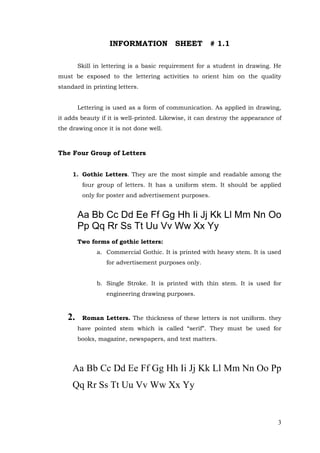
1. Gothic Letters. They are the most simple and readable among the
four group of letters. It has a uniform stem. It should be applied
only for poster and advertisement purposes.
Aa Bb Cc Dd Ee Ff Gg Hh Ii Jj Kk Ll Mm Nn Oo
Pp Qq Rr Ss Tt Uu Vv Ww Xx Yy
Two forms of gothic letters:
a. Commercial Gothic. It is printed with heavy stem. It is used
for advertisement purposes only.
b. Single Stroke. It is printed with thin stem. It is used for
engineering drawing purposes.
2. Roman Letters. The thickness of these letters is not uniform. they
have pointed stem which is called “serif”. They must be used for
books, magazine, newspapers, and text matters.
Aa Bb Cc Dd Ee Ff Gg Hh Ii Jj Kk Ll Mm Nn Oo Pp
Qq Rr Ss Tt Uu Vv Ww Xx Yy
4
The Three Classics of Roman Letters:
a. Old Roman Letters. They are printed by means of layout
form using the flexible lettering pen. The thickness of the
thin stem must be ½ from the thickness of the heavy
stem.
b. Modern Roman Letters. They are printed in single stroke
using the speedball pen.
c. Modified Roman. Similar to Modern Roman, they are
printed in single stroke using the speedball pen.
However, this style must be printed in the absence of
serif.
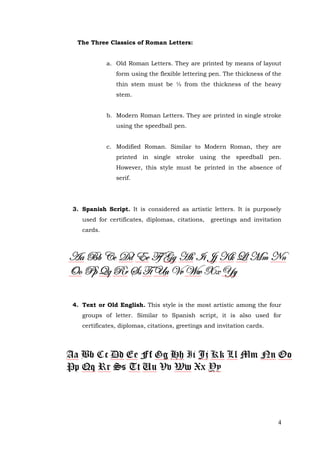
3. Spanish Script. It is considered as artistic letters. It is purposely
used for certificates, diplomas, citations, greetings and invitation
cards.
4. Text or Old English. This style is the most artistic among the four
groups of letter. Similar to Spanish script, it is also used for
certificates, diplomas, citations, greetings and invitation cards.
5
The Rule of Stability of letters
This refers to the standard rules to be considered in printing the
letters particularly on the following:
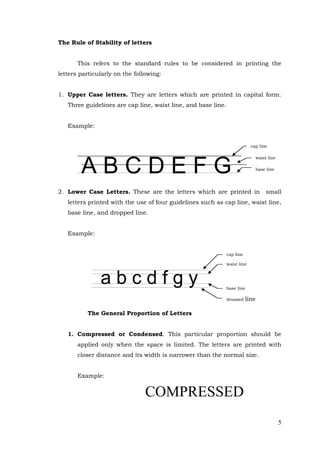
1. Upper Case letters. They are letters which are printed in capital form.
Three guidelines are cap line, waist line, and base line.
Example:
2. Lower Case Letters. These are the letters which are printed in small
letters printed with the use of four guidelines such as cap line, waist line,
base line, and dropped line.
Example:
The General Proportion of Letters
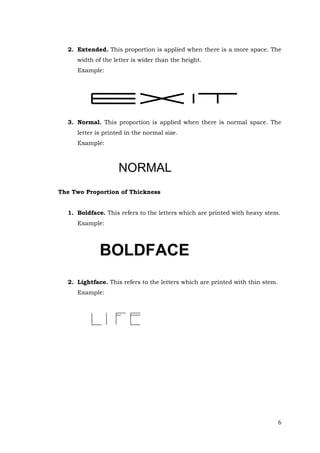
1. Compressed or Condensed. This particular proportion should be
applied only when the space is limited. The letters are printed with
closer distance and its width is narrower than the normal size.
Example:
COMPRESSED
A B C D E F G
cap line
waist line
base line
a b c d f g y
cap line
waist line
dropped line
base line
6
2. Extended. This proportion is applied when there is a more space. The
width of the letter is wider than the height.
Example:
3. Normal. This proportion is applied when there is normal space. The
letter is printed in the normal size.
Example:
NORMAL
The Two Proportion of Thickness
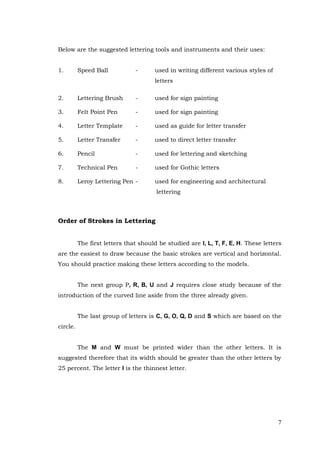
1. Boldface. This refers to the letters which are printed with heavy stem.
Example:
BOLDFACE
2. Lightface. This refers to the letters which are printed with thin stem.
Example:
7
Below are the suggested lettering tools and instruments and their uses:
1. Speed Ball - used in writing different various styles of
letters
2. Lettering Brush - used for sign painting
3. Felt Point Pen - used for sign painting
4. Letter Template - used as guide for letter transfer
5. Letter Transfer - used to direct letter transfer
6. Pencil - used for lettering and sketching
7. Technical Pen - used for Gothic letters
8. Leroy Lettering Pen - used for engineering and architectural
lettering
Order of Strokes in Lettering
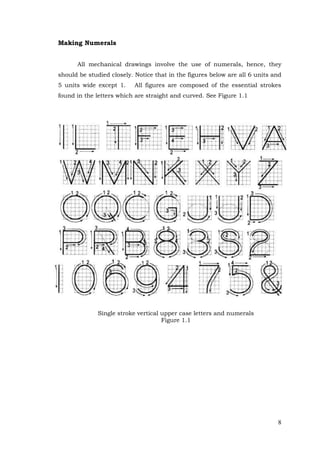
The first letters that should be studied are I, L, T, F, E, H. These letters
are the easiest to draw because the basic strokes are vertical and horizontal.
You should practice making these letters according to the models.
The next group P, R, B, U and J requires close study because of the
introduction of the curved line aside from the three already given.
The last group of letters is C, G, O, Q, D and S which are based on the
circle.
The M and W must be printed wider than the other letters. It is
suggested therefore that its width should be greater than the other letters by
25 percent. The letter I is the thinnest letter.
8
Making Numerals
All mechanical drawings involve the use of numerals, hence, they
should be studied closely. Notice that in the figures below are all 6 units and
5 units wide except 1. All figures are composed of the essential strokes
found in the letters which are straight and curved. See Figure 1.1
Single stroke vertical upper case letters and numerals
Figure 1.1
9
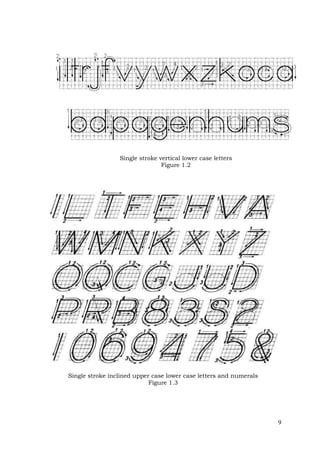
Single stroke vertical lower case letters
Figure 1.2
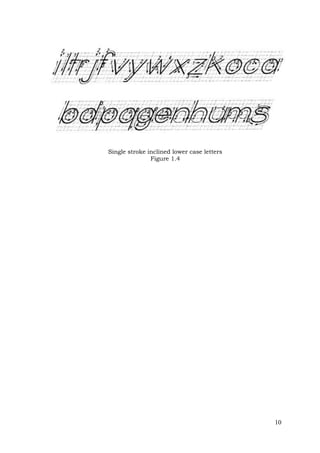
Single stroke inclined upper case lower case letters and numerals
Figure 1.3
10
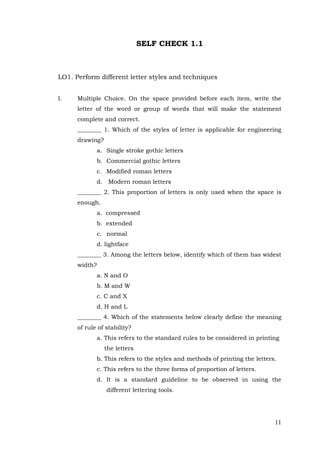
Single stroke inclined lower case letters
Figure 1.4
11
SELF CHECK 1.1
LO1. Perform different letter styles and techniques
I. Multiple Choice. On the space provided before each item, write the
letter of the word or group of words that will make the statement
complete and correct.
________ 1. Which of the styles of letter is applicable for engineering
drawing?
a. Single stroke gothic letters
b. Commercial gothic letters
c. Modified roman letters
d. Modern roman letters
________ 2. This proportion of letters is only used when the space is
enough.
a. compressed
b. extended
c. normal
d. lightface
________ 3. Among the letters below, identify which of them has widest
width?
a. N and O
b. M and W
c. C and X
d. H and L
________ 4. Which of the statements below clearly define the meaning
of rule of stability?
a. This refers to the standard rules to be considered in printing
the letters
b. This refers to the styles and methods of printing the letters.
c. This refers to the three forms of proportion of letters.
d. It is a standard guideline to be observed in using the
different lettering tools.
12
________ 5. Which of the proportion of letters below is applicable for
limited space?
a. compressed proportion
b. extended proportion
c. normal proportion
d. boldface proportion
II. Answer the following questions briefly:
1. Discuss the effect of the lettering on the drawing when it is not
properly printed.
2. How important is lettering in the drawing?
III. Direction : Illustrate the selected letters below in the form of
Gothic,
and Roman letters.
A, B, K, M, R, X, and Y
13
Program/Course : TECHNICAL DRAWING I
Unit of Competency : PREPARE FREEHAND DRAWING
Module Title : Preparing Freehand Drawing
LO2. Sketch simple objects
Assessment Criteria
1. Principle of sketching objects is properly discussed.
2. Different shapes of objects are correctly identified.
3. All principles of proportion in sketching simple objects based on
commercial standards are explained.
4. Procedure in sketching is correctly followed.
References:
1. Giesecke, Mitchell, and Spencer. Technical Drawing; The Macmillan
Company: 1949.
2. French and Vierck. Engineering Drawing; MacGraw, Hill Book
Company,10th editon: 1960
3. German M. Manaois. Drafting 1 and 2; Phoenix Publishing:1983
4. Norman Stirling. Introduction to Technical Drawing; Delmar Publishing:
1977
14
LEARNING EXPERIENCES/ACTIVITIES
Learning Outcome # 2: Sketch Simple Object
Learning Activities Special Instruction
2. Read information sheet no. 2
3. Answer self check no. 2.1 for
better understanding.
 Try to answer the self check.
 Try to follow the procedure
correctly.
15
INFORMATION SHEET 2.1
Sketching is a basic skill to be learned by the student before he will
be exposed to higher level of drawing activities.
Sketching is a preliminary layout or draft before making it into final
drawing. This can be done in a light line forms with the use of sketching
tools and materials.
Principles of Sketching Objects
Before doing sketching activities, it is important to know the basic
principles in sketching. The following are:
 Analyze the proportions of the subject.
 Mentally picture out the basic shape of subject.
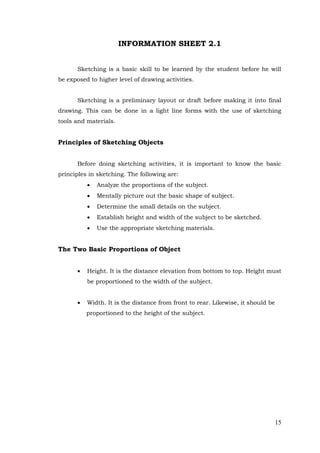
 Determine the small details on the subject.
 Establish height and width of the subject to be sketched.
 Use the appropriate sketching materials.
The Two Basic Proportions of Object
 Height. It is the distance elevation from bottom to top. Height must
be proportioned to the width of the subject.
 Width. It is the distance from front to rear. Likewise, it should be
proportioned to the height of the subject.
16
Basic Shapes of Objects
1. Rectangle - has its opposite sides equal and all its angles are
right angles.
2. Square - has four equal sides and angles
3. Hexagon – is a polygon having six equal sides
17
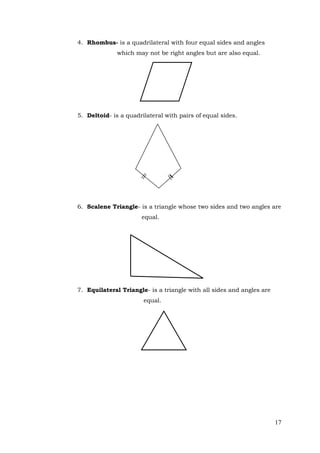
4. Rhombus- is a quadrilateral with four equal sides and angles
which may not be right angles but are also equal.
5. Deltoid- is a quadrilateral with pairs of equal sides.
6. Scalene Triangle- is a triangle whose two sides and two angles are
equal.
7. Equilateral Triangle- is a triangle with all sides and angles are
equal.
18
8. Circle. A figure which has an angle of 360 degrees.
9. Oblong. An elliptical figure which shapes originates from the
circle.
19
SELF CHECK 2.1
LO2. Sketch simple object
Direction : A. Identify the terms referred in the following.
____________________1.The most important role in freehand sketching.
____________________2.A polygon with six equal sides.
_____________________3. A quadrilateral with four equal sides and four equal
right angles.
____________________4. A quadrilateral which opposite sides are equal and
whose angles are also right angles.
____________________5. A quadrilateral with two opposite side parallel.
____________________6. A triangle where all sides and angles are equal.
___________________ 7. A quadrilateral with pairs of sides are equal.
B. Enumerate what are being asked.
8-10 Give the three basic shapes of an object.
20
Program/Course : TECHNICAL DRAWING I
Unit of Competency : PREPARE FREEHAND DRAWING
Module Title : Preparing Freehand Drawing
Learning outcome 3: Perform freehand sketches
Assessment Criteria
1. Drawing pencils are selected based on specific job requirements.
2. Proper care and manipulation of drawing tools, materials and
equipment are observed and practiced.
3. Techniques on line exercises are demonstrated according to standard
procedure.
4. Shading techniques are applied making use of appropriate standard
specification.
5. Pencil rendering techniques are applied according to appropriate
drawing materials.
6. Creativity on value scale in shading is applied.
References:
1. Giesecke, Mitchell, and Spencer. Technical Drawing; The Macmillan
Company: 1949.
2. French and Vierck. Engineering Drawing; MacGraw, Hill Book
Company,10th editon: 1960
3. German M. Manaois. Drafting 1 and 2; Phoenix Publishing:1983
4. Norman Stirling. Introduction to Technical Drawing; Delmar Publishing:
1977
21
LEARNING ACTIVITIES/ EXPERIENCES
Learning Outcome # 3: Perform Sketches
Learning Activities Special Instruction
1. Read information sheet no. 3.
2. Answer self check no. 3.1 to
test your understanding.
3. If not able to answer all items
correctly, review again the
information no. 3
4. Read operation sheet no. 3.1
 Observe carefully the
teacher’s demonstration
5. Read operation sheet no. 3.2,
analyze the given procedure.
6. Perform self check no. 3.2 to
test your knowledge on
freehand sketches.
 Try to answer the self check.
 Ask the teacher when some
items are difficult to
understand.
 Ask your teacher for some
clarifications.
22
INFORMATION SHEET 3.1
LO3. Perform freehand drawing
Drawing Principles Freehand and Sketching
Freehand sketches are of great assistance to the designers in
organizing their thought and recording their ideas. They are effective and
economical means of formulating various solutions to a given problem so
that a choice can be made between them at the outset. Often, much time
can be made between them at the outset. Much time can be lost if the
designer starts his scaled layout before adequate preliminary study with the
aid of sketches. Information concerning changes design, covering
replacement of broken parts or lost drawing, is usually conveyed through
sketches.
Drawing Tools, Equipment, and Materials
1. Drawing Paper- is manufactured in four colors, namely: white, cream,
light green and buff. It comes in different sizes of
various sheet thickness.
2. Ruler- is used for marking out distances as well as for measuring
purposes.
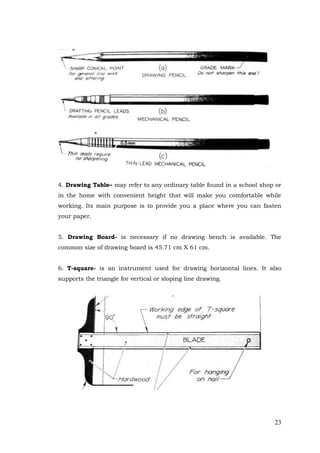
3. Pencil- is manufactured in various grades of hardness ranging from 7H
which is very soft up to 9H. The lead of pencil is a
mixture graphite, clay and wax. The clay makes the lead
hard. The harder the pencil is, the lighter the line is
produced.
23
4. Drawing Table– may refer to any ordinary table found in a school shop or
in the home with convenient height that will make you comfortable while
working. Its main purpose is to provide you a place where you can fasten
your paper.
5. Drawing Board- is necessary if no drawing bench is available. The
common size of drawing board is 45.71 cm X 61 cm.
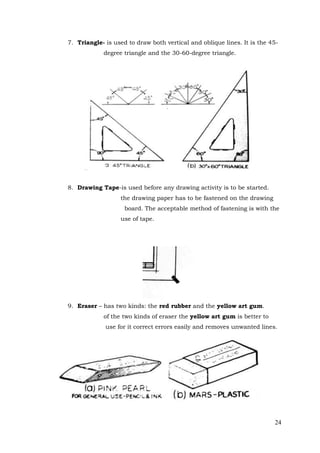
6. T-square- is an instrument used for drawing horizontal lines. It also
supports the triangle for vertical or sloping line drawing.
24
7. Triangle- is used to draw both vertical and oblique lines. It is the 45-
degree triangle and the 30-60-degree triangle.
8. Drawing Tape-is used before any drawing activity is to be started.
the drawing paper has to be fastened on the drawing
board. The acceptable method of fastening is with the
use of tape.
9. Eraser – has two kinds: the red rubber and the yellow art gum.
of the two kinds of eraser the yellow art gum is better to
use for it correct errors easily and removes unwanted lines.
25
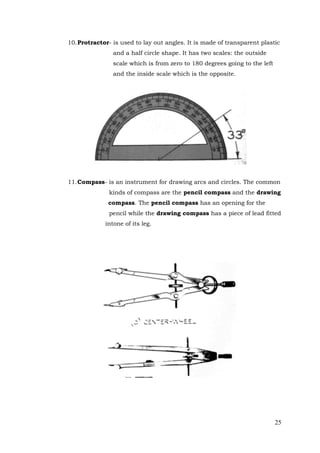
10.Protractor- is used to lay out angles. It is made of transparent plastic
and a half circle shape. It has two scales: the outside
scale which is from zero to 180 degrees going to the left
and the inside scale which is the opposite.
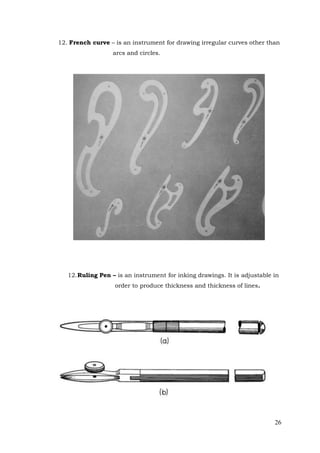
11.Compass- is an instrument for drawing arcs and circles. The common
kinds of compass are the pencil compass and the drawing
compass. The pencil compass has an opening for the
pencil while the drawing compass has a piece of lead fitted
intone of its leg.
26
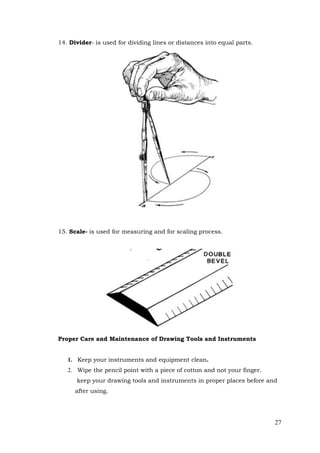
12. French curve – is an instrument for drawing irregular curves other than
arcs and circles.
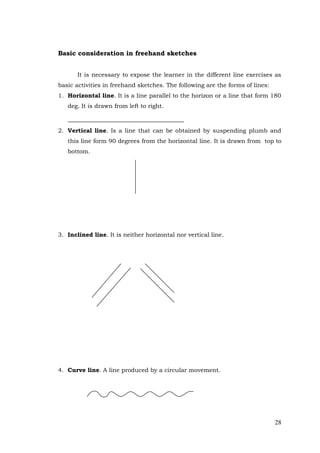
12.Ruling Pen – is an instrument for inking drawings. It is adjustable in
order to produce thickness and thickness of lines.
27
14. Divider- is used for dividing lines or distances into equal parts.
15. Scale- is used for measuring and for scaling process.
Proper Care and Maintenance of Drawing Tools and Instruments
1. Keep your instruments and equipment clean.
2. Wipe the pencil point with a piece of cotton and not your finger.
keep your drawing tools and instruments in proper places before and
after using.
28
Basic consideration in freehand sketches
It is necessary to expose the learner in the different line exercises as
basic activities in freehand sketches. The following are the forms of lines:
1. Horizontal line. It is a line parallel to the horizon or a line that form 180
deg. It is drawn from left to right.
2. Vertical line. Is a line that can be obtained by suspending plumb and
this line form 90 degrees from the horizontal line. It is drawn from top to
bottom.
3. Inclined line. It is neither horizontal nor vertical line.
4. Curve line. A line produced by a circular movement.
29
Importance of Shading in freehand drawing and sketches
Shading is the process of making the visible surfaces of an object. It is
applied in a variety of tones or values.
The following are the tones or values of shading:
1. Light Values. This represents the surface which receives the
greatest amount of light.
2. The Medium Values. This represents the surface which receives
less amount of light.
3. Dark Values. This represents the surface very little amount of
light.
In shading application, the source of light is assumed to be coming
from the upper left-hand corner of the drawing paper and rays of light are
imagined to be inclining at an angle of 45 degrees.
Techniques in Shading Application
1. Apply the lightest shading on the part of a surface which receives
more light.
2. Shade the portion of a surface which receives less light with medium
values.
3. Shade the portion of a surface which receives little amount of light
with a heavy shade.
30
Methods of shading application
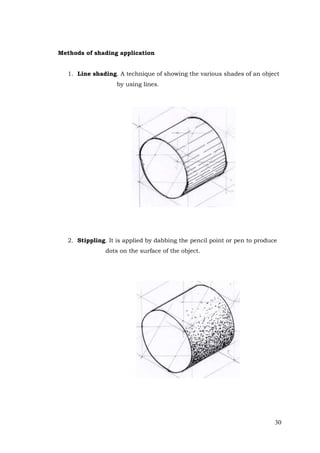
1. Line shading. A technique of showing the various shades of an object
by using lines.
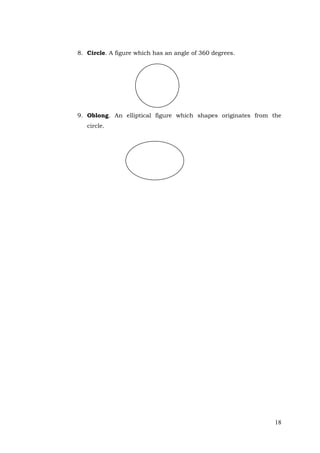
2. Stippling. It is applied by dabbing the pencil point or pen to produce
dots on the surface of the object.
31
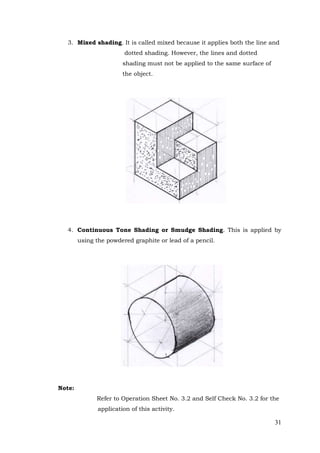
3. Mixed shading. It is called mixed because it applies both the line and
dotted shading. However, the lines and dotted
shading must not be applied to the same surface of
the object.
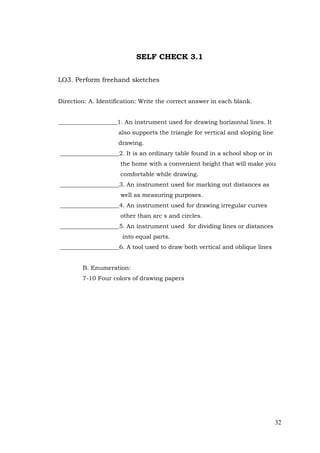
4. Continuous Tone Shading or Smudge Shading. This is applied by
using the powdered graphite or lead of a pencil.
Note:
Refer to Operation Sheet No. 3.2 and Self Check No. 3.2 for the
application of this activity.
32
SELF CHECK 3.1
LO3. Perform freehand sketches
Direction: A. Identification: Write the correct answer in each blank.
____________________1. An instrument used for drawing horizontal lines. It
also supports the triangle for vertical and sloping line
drawing.
____________________2. It is an ordinary table found in a school shop or in
the home with a convenient height that will make you
comfortable while drawing.
____________________3. An instrument used for marking out distances as
well as measuring purposes.
____________________4. An instrument used for drawing irregular curves
other than arc s and circles.
____________________5. An instrument used for dividing lines or distances
into equal parts.
____________________6. A tool used to draw both vertical and oblique lines
B. Enumeration:
7-10 Four colors of drawing papers
33
OPERATION SHEET 3.1
LO3. Perform freehand sketches
Skill in line exercises is a basic requirement prior to exposing
the learner to higher drawing activities considering that all forms of
drawing emanates from a line, it might be horizontal, vertical,
inclined, and curve lines.
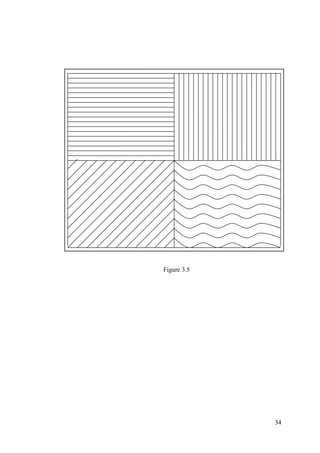
Procedures in sketching horizontal, vertical, inclined, and curve lines
1. Sketch a rectangle at 120 mm x 160 mm.
2. Divide the rectangle into four equal parts.
3. Sketch horizontal lines on the first part of the rectangle, start
at the left going to the right. (Each line must have 5mm gap
distance).
4. Sketch vertical lines on the second part of the rectangle.
Start at the top down to the bottom. (Each line must have
5mm gap distance).
5. Sketch inclined lines on the third part of the rectangle with a
downward stroke. (Each line must have 5mm gap distance).
6. Sketch curve lines from left to right. (Each line must have
5mm gap distance).
(See figure 3.5)
34
Figure 3.5
35
OPERATION SHEET 3.2
LO3. Perform freehand drawing
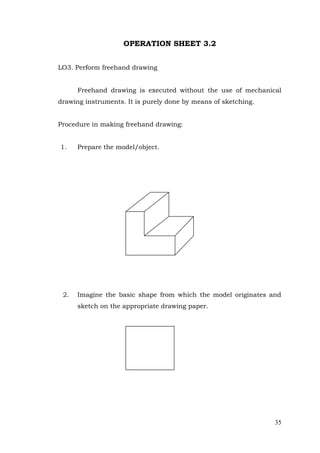
Freehand drawing is executed without the use of mechanical
drawing instruments. It is purely done by means of sketching.
Procedure in making freehand drawing:
1. Prepare the model/object.
2. Imagine the basic shape from which the model originates and
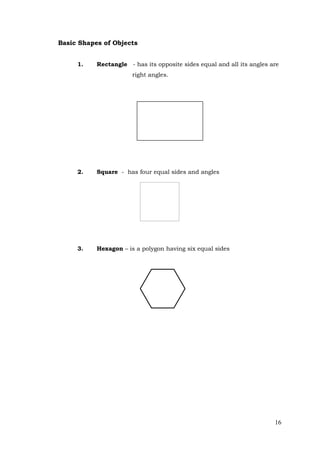
sketch on the appropriate drawing paper.
36
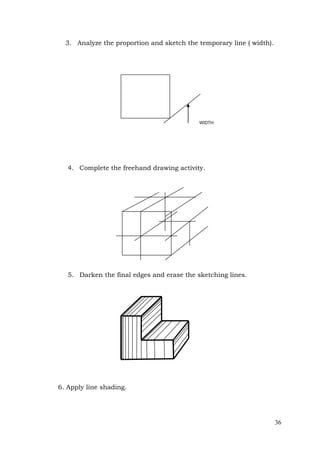
3. Analyze the proportion and sketch the temporary line ( width).
4. Complete the freehand drawing activity.
5. Darken the final edges and erase the sketching lines.
6. Apply line shading.
WIDTH
37
SELF CHECK 3.2
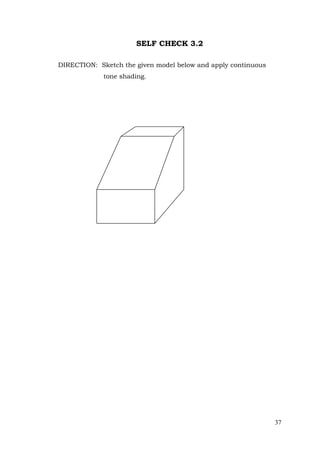
DIRECTION: Sketch the given model below and apply continuous
tone shading.
38
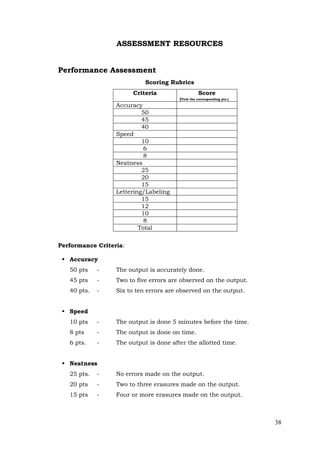
ASSESSMENT RESOURCES
Performance Assessment
Scoring Rubrics
Criteria Score
(Tick the corresponding pts.)
Accuracy
50
45
40
Speed
10
6
8
Neatness
25
20
15
Lettering/Labeling
15
12
10
8
Total
Performance Criteria:
 Accuracy
50 pts - The output is accurately done.
45 pts - Two to five errors are observed on the output.
40 pts. - Six to ten errors are observed on the output.
 Speed
10 pts - The output is done 5 minutes before the time.
8 pts - The output is done on time.
6 pts. - The output is done after the allotted time.
 Neatness
25 pts. - No errors made on the output.
20 pts - Two to three erasures made on the output.
15 pts - Four or more erasures made on the output.
39
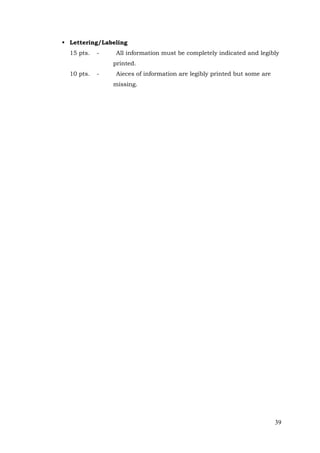
 Lettering/Labeling
15 pts. - All information must be completely indicated and legibly
printed.
10 pts. - Aieces of information are legibly printed but some are
missing.
40
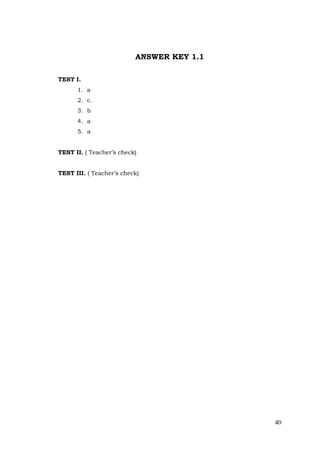
ANSWER KEY 1.1
TEST I.
1. a
2. c.
3. b
4. a
5. a
TEST II. ( Teacher’s check)
TEST III. ( Teacher’s check)
41
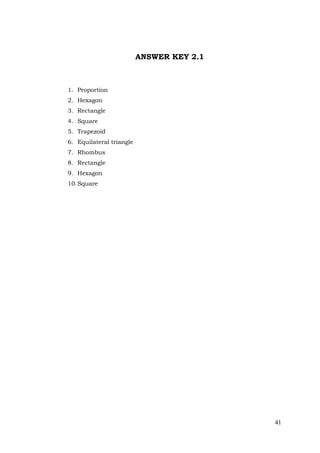
ANSWER KEY 2.1
1. Proportion
2. Hexagon
3. Rectangle
4. Square
5. Trapezoid
6. Equilateral triangle
7. Rhombus
8. Rectangle
9. Hexagon
10.Square
42
ANSWER KEY # 3.1
1. T-square
2. Drawing table
3. Scale
4. French curve
5. Divider
6. Triangle
7. White
8. Cream
9. Light and green
10.Buff
43
ANSWER KEY # 3.2
(Teacher’s Check)
ANSWER KEY 3.1
a. Octahedron
b. Tetrahedron
c. Hexahedron
d. Icosahedron
e. Dodecahedron

Module-1-Preparing-Freehand-Drawing.doc

  • 1.
    Unit of Competency:Prepare Freehand Drawing Module No.: 1 Module Title: Preparing freehand Drawing Republic of the Philippines Department of the Education PUBLIC TECHNICAL-VOCATIONAL HIGH SCHOOLS
  • 2.
    ACKNOWLEDGMENT Copyright Department ofEducation 2008 First Published JUNE 2008 This draft was prepared during the Competency-Based Learning Materials Development Workshop conducted at the Marikina Hotel, Marikina City on February 18-22, 2008 and Development Academy of the Philippines (DAP) on May 5-10, 2008. This learning instrument was developed by the following personnel: Technology Teachers: Mario S. Gregorio, Ed.D. Tagum National Trade School Tagum City, Davao del Norte, Region XI Roy S. Luneta Bauan Technical High School Bauan, Batangas Ariel F. Maglalang Assemblywoman Felicita G. Bernardino Memorial Trade School, Lias, Marilao, Bulacan, Region III Juanito Bugaoisan Don Alejandro Roces, Sr. Science and Technology San Fernando, La Union Arlene V. Tobias Mabalacat Technical High School Mabalacat, Pampanga Facilitator: Aida T. Galura Angeles City National Trade School Sunset Valley, Angeles City
  • 3.
    Encoders: Mel Contapay Office ofLegal Affairs Department of Education Meralco Ave., Pasig City Maria Riza Zamora DepED Budget Division Meralco Ave., Pasig City The Refinement And Enrichment Of The Competency-Based Curriculum and Competency-Based Learning Materials was done in Marikina Hotel, Marikina City on April 13-18, 2009 through the concerted effort of the following writers: Technology Teachers: Mario S. Gregorio Ed. D. Tagum National Trade School Tagum City, Davao del Norte, Region 11 Condrado C. Casulla Pangasinan School of Arts and Trades Lingayen, Pangasinan, Region 01 Nelson M. Arisga Malvar National High School Malvar, Batangas, Region 4A Alexander M. Latoga Manuel S. Enverga Memorial College of Arts and Trades Mauban, Quezon, Region 4A Mirasol F. Dasig San Pedro Relocation Center National High School San Pedro, Laguna Region 4A Contextual Writer: Marvin R. Viernes Muntinlupa Business High School Muntinlupa City, NCR
  • 4.
    Encoder: Lawrence D. Cruz DepEdEID-TS DepEd Complex Meralco Ave. Quezon City Jeffree O. Ponce DepEd EID-TS DepEd Complex Meralco Ave. Quezon City Facilitator: Orlando E. Manuel PhD Principal Cabarroguis National School of Arts and Trades Cabarroguis, Quirino Region 02 This work was funded by the Department of Education. REFERENCES AND FURTHER READING Giesecke, Mitchell, and Spencer. Technical Drawing; The Macmillan Company: 1949. French and Vierck. Engineering Drawing; MacGraw, Hill Book Company,10th editon: 1960 German M. Manaois. Drafting 1 and 2; Phoenix Publishing:1983 Norman Stirling. Introduction to Technical Drawing; Delmar Publishing: 1977
  • 5.
    TABLE OF CONTENTS PerformDifferent Lettering Styles &Techniques Page How to Use this Module ……………………………………………….. I Introduction ……………………………………………….. ii Technical Terms …………………………………………………………. iii Learning Outcome 1- Perform Different Lettering Styles &Techniques …………………………………………………….. 1 Learning Experiences/Activities …………………………………. 2 Information Sheet 1.1 …………………………………………… 3 Self – Check 1.1 ……………………………………………………… 10 Learning Outcome 2 – Sketch Simple Objects ……………………… 12 Learning Experiences/Activities ………………………………….. 13 Information Sheet 2.1 ……………………………………………… 14 Self Check 2.1 ………………………………………………………… 17 Learning Outcome 3 – Perform Freehand Sketches ………………… 18 Learning Experiences/Activities …………………………………….. 19 Information Sheet 3.1 ……………………………………………… 20 Self – Check 3.1 ……………………………………………… 30 Operation Sheet 3.1 ……………………………………………… 33 Self – Check 3.2 ……………………………………………… 35 Assessment Resources ………………………………………………….. Answer Key ……………………………………………… 36 38-41
  • 6.
    HOW TO USETHIS MODULE Activities are properly arranged in this module to help you work on your own pace. This module also covers the knowledge, skills, and desirable attitude you need in technical drawing. A Pre-assessment precedes the learning activities in each module to determine your learning level and need. The Learning Activity Page gives the sequence of the learning task. This page serves as the road map in achieving the desired objectives. When you are able to accomplish all the tasks required, a post- assessment is given to check if the student is already competent with the specified learning outcome/s and ready for the next task. Definitions of terms are provided in this module for your better understanding.
  • 7.
    Program/Course : TECHNICALDRAWING I Unit of Competency : PREPARE FREEHAND DRAWING Module Title : Preparing Freehand Drawing INTRODUCTION People around the world speak with different languages but they come up with common understanding on drawing. That’s the reason why drawing becomes a universal language. This module is intended to provide a thorough coverage of technical drawing for use as a classroom text and/or as a reference manual. Performing freehand sketches, sketching simple object: and perform different lettering styles and techniques are discussed in the module. Equipped with all the concepts, the student can then competently transmit the ideas through a drawing. SUMMARY OF LEARNING OUTCOMES Upon the completion of this module, you will be able to: LO1 Perform different lettering styles and techniques. LO2 Sketch simple objects. LO3 Perform sketches.
  • 8.
    TECHNICAL TERMS Accented isa form of heavy and light elements of letters. Slant line is an inclined line. Style is the manner of designing or shaping a drawing. Sketching is a preliminary drafting. Stroke is the technique of printing letters. Uppercase Letters are the big letters of the alphabets. Proportion refers to the quality standard of shape, figure, form of object or drawing. Freehand Drawing. is performed without the use of mechanical drawing instruments. it is purely done by pencil rendering.
  • 9.
    1 Program/Course : TECHNICALDRAWING I Unit of Competency : PREPARE FREEHAND DRAWING Module Title : Preparing Freehand Drawing Learning Outcome 1 : Perform different lettering styles and techniques Assessment Criteria 1. Importance of lettering is properly explained 2. Each style of letter is performed on commercial standards. 3. Care and maintenance of lettering instruments are properly observed and practiced. 4. Appropriate lettering instruments are correctly used. 5. Decorative letter styles are creatively done for a particular purpose. References: 1. Giesecke, Mitchell, and Spencer. Technical Drawing; The Macmillan Company: 1949. 2. French and Vierck. Engineering Drawing; MacGraw, Hill Book Company,10th editon: 1960 3. German M. Manaois. Drafting 1 and 2; Phoenix Publishing:1983 4. Norman Stirling. Introduction to Technical Drawing; Delmar Publishing: 1977
  • 10.
    2 LEARNING EXPERIENCES/ACTIVITIES Learning Outcome# 1: Perform different lettering styles and techniques Learning Activities Special Instruction 1. Read information sheet no. 1 2. Answer self check no. 1.1 to test your knowledge about lettering. 3. Review the information sheet if some items were not properly carried out.  Try to answer the self check.
  • 11.
    3 INFORMATION SHEET #1.1 Skill in lettering is a basic requirement for a student in drawing. He must be exposed to the lettering activities to orient him on the quality standard in printing letters. Lettering is used as a form of communication. As applied in drawing, it adds beauty if it is well-printed. Likewise, it can destroy the appearance of the drawing once it is not done well. The Four Group of Letters 1. Gothic Letters. They are the most simple and readable among the four group of letters. It has a uniform stem. It should be applied only for poster and advertisement purposes. Aa Bb Cc Dd Ee Ff Gg Hh Ii Jj Kk Ll Mm Nn Oo Pp Qq Rr Ss Tt Uu Vv Ww Xx Yy Two forms of gothic letters: a. Commercial Gothic. It is printed with heavy stem. It is used for advertisement purposes only. b. Single Stroke. It is printed with thin stem. It is used for engineering drawing purposes. 2. Roman Letters. The thickness of these letters is not uniform. they have pointed stem which is called “serif”. They must be used for books, magazine, newspapers, and text matters. Aa Bb Cc Dd Ee Ff Gg Hh Ii Jj Kk Ll Mm Nn Oo Pp Qq Rr Ss Tt Uu Vv Ww Xx Yy
  • 12.
    4 The Three Classicsof Roman Letters: a. Old Roman Letters. They are printed by means of layout form using the flexible lettering pen. The thickness of the thin stem must be ½ from the thickness of the heavy stem. b. Modern Roman Letters. They are printed in single stroke using the speedball pen. c. Modified Roman. Similar to Modern Roman, they are printed in single stroke using the speedball pen. However, this style must be printed in the absence of serif. 3. Spanish Script. It is considered as artistic letters. It is purposely used for certificates, diplomas, citations, greetings and invitation cards. 4. Text or Old English. This style is the most artistic among the four groups of letter. Similar to Spanish script, it is also used for certificates, diplomas, citations, greetings and invitation cards.
  • 13.
    5 The Rule ofStability of letters This refers to the standard rules to be considered in printing the letters particularly on the following: 1. Upper Case letters. They are letters which are printed in capital form. Three guidelines are cap line, waist line, and base line. Example: 2. Lower Case Letters. These are the letters which are printed in small letters printed with the use of four guidelines such as cap line, waist line, base line, and dropped line. Example: The General Proportion of Letters 1. Compressed or Condensed. This particular proportion should be applied only when the space is limited. The letters are printed with closer distance and its width is narrower than the normal size. Example: COMPRESSED A B C D E F G cap line waist line base line a b c d f g y cap line waist line dropped line base line
  • 14.
    6 2. Extended. Thisproportion is applied when there is a more space. The width of the letter is wider than the height. Example: 3. Normal. This proportion is applied when there is normal space. The letter is printed in the normal size. Example: NORMAL The Two Proportion of Thickness 1. Boldface. This refers to the letters which are printed with heavy stem. Example: BOLDFACE 2. Lightface. This refers to the letters which are printed with thin stem. Example:
  • 15.
    7 Below are thesuggested lettering tools and instruments and their uses: 1. Speed Ball - used in writing different various styles of letters 2. Lettering Brush - used for sign painting 3. Felt Point Pen - used for sign painting 4. Letter Template - used as guide for letter transfer 5. Letter Transfer - used to direct letter transfer 6. Pencil - used for lettering and sketching 7. Technical Pen - used for Gothic letters 8. Leroy Lettering Pen - used for engineering and architectural lettering Order of Strokes in Lettering The first letters that should be studied are I, L, T, F, E, H. These letters are the easiest to draw because the basic strokes are vertical and horizontal. You should practice making these letters according to the models. The next group P, R, B, U and J requires close study because of the introduction of the curved line aside from the three already given. The last group of letters is C, G, O, Q, D and S which are based on the circle. The M and W must be printed wider than the other letters. It is suggested therefore that its width should be greater than the other letters by 25 percent. The letter I is the thinnest letter.
  • 16.
    8 Making Numerals All mechanicaldrawings involve the use of numerals, hence, they should be studied closely. Notice that in the figures below are all 6 units and 5 units wide except 1. All figures are composed of the essential strokes found in the letters which are straight and curved. See Figure 1.1 Single stroke vertical upper case letters and numerals Figure 1.1
  • 17.
    9 Single stroke verticallower case letters Figure 1.2 Single stroke inclined upper case lower case letters and numerals Figure 1.3
  • 18.
    10 Single stroke inclinedlower case letters Figure 1.4
  • 19.
    11 SELF CHECK 1.1 LO1.Perform different letter styles and techniques I. Multiple Choice. On the space provided before each item, write the letter of the word or group of words that will make the statement complete and correct. ________ 1. Which of the styles of letter is applicable for engineering drawing? a. Single stroke gothic letters b. Commercial gothic letters c. Modified roman letters d. Modern roman letters ________ 2. This proportion of letters is only used when the space is enough. a. compressed b. extended c. normal d. lightface ________ 3. Among the letters below, identify which of them has widest width? a. N and O b. M and W c. C and X d. H and L ________ 4. Which of the statements below clearly define the meaning of rule of stability? a. This refers to the standard rules to be considered in printing the letters b. This refers to the styles and methods of printing the letters. c. This refers to the three forms of proportion of letters. d. It is a standard guideline to be observed in using the different lettering tools.
  • 20.
    12 ________ 5. Whichof the proportion of letters below is applicable for limited space? a. compressed proportion b. extended proportion c. normal proportion d. boldface proportion II. Answer the following questions briefly: 1. Discuss the effect of the lettering on the drawing when it is not properly printed. 2. How important is lettering in the drawing? III. Direction : Illustrate the selected letters below in the form of Gothic, and Roman letters. A, B, K, M, R, X, and Y
  • 21.
    13 Program/Course : TECHNICALDRAWING I Unit of Competency : PREPARE FREEHAND DRAWING Module Title : Preparing Freehand Drawing LO2. Sketch simple objects Assessment Criteria 1. Principle of sketching objects is properly discussed. 2. Different shapes of objects are correctly identified. 3. All principles of proportion in sketching simple objects based on commercial standards are explained. 4. Procedure in sketching is correctly followed. References: 1. Giesecke, Mitchell, and Spencer. Technical Drawing; The Macmillan Company: 1949. 2. French and Vierck. Engineering Drawing; MacGraw, Hill Book Company,10th editon: 1960 3. German M. Manaois. Drafting 1 and 2; Phoenix Publishing:1983 4. Norman Stirling. Introduction to Technical Drawing; Delmar Publishing: 1977
  • 22.
    14 LEARNING EXPERIENCES/ACTIVITIES Learning Outcome# 2: Sketch Simple Object Learning Activities Special Instruction 2. Read information sheet no. 2 3. Answer self check no. 2.1 for better understanding.  Try to answer the self check.  Try to follow the procedure correctly.
  • 23.
    15 INFORMATION SHEET 2.1 Sketchingis a basic skill to be learned by the student before he will be exposed to higher level of drawing activities. Sketching is a preliminary layout or draft before making it into final drawing. This can be done in a light line forms with the use of sketching tools and materials. Principles of Sketching Objects Before doing sketching activities, it is important to know the basic principles in sketching. The following are:  Analyze the proportions of the subject.  Mentally picture out the basic shape of subject.  Determine the small details on the subject.  Establish height and width of the subject to be sketched.  Use the appropriate sketching materials. The Two Basic Proportions of Object  Height. It is the distance elevation from bottom to top. Height must be proportioned to the width of the subject.  Width. It is the distance from front to rear. Likewise, it should be proportioned to the height of the subject.
  • 24.
    16 Basic Shapes ofObjects 1. Rectangle - has its opposite sides equal and all its angles are right angles. 2. Square - has four equal sides and angles 3. Hexagon – is a polygon having six equal sides
  • 25.
    17 4. Rhombus- isa quadrilateral with four equal sides and angles which may not be right angles but are also equal. 5. Deltoid- is a quadrilateral with pairs of equal sides. 6. Scalene Triangle- is a triangle whose two sides and two angles are equal. 7. Equilateral Triangle- is a triangle with all sides and angles are equal.
  • 26.
    18 8. Circle. Afigure which has an angle of 360 degrees. 9. Oblong. An elliptical figure which shapes originates from the circle.
  • 27.
    19 SELF CHECK 2.1 LO2.Sketch simple object Direction : A. Identify the terms referred in the following. ____________________1.The most important role in freehand sketching. ____________________2.A polygon with six equal sides. _____________________3. A quadrilateral with four equal sides and four equal right angles. ____________________4. A quadrilateral which opposite sides are equal and whose angles are also right angles. ____________________5. A quadrilateral with two opposite side parallel. ____________________6. A triangle where all sides and angles are equal. ___________________ 7. A quadrilateral with pairs of sides are equal. B. Enumerate what are being asked. 8-10 Give the three basic shapes of an object.
  • 28.
    20 Program/Course : TECHNICALDRAWING I Unit of Competency : PREPARE FREEHAND DRAWING Module Title : Preparing Freehand Drawing Learning outcome 3: Perform freehand sketches Assessment Criteria 1. Drawing pencils are selected based on specific job requirements. 2. Proper care and manipulation of drawing tools, materials and equipment are observed and practiced. 3. Techniques on line exercises are demonstrated according to standard procedure. 4. Shading techniques are applied making use of appropriate standard specification. 5. Pencil rendering techniques are applied according to appropriate drawing materials. 6. Creativity on value scale in shading is applied. References: 1. Giesecke, Mitchell, and Spencer. Technical Drawing; The Macmillan Company: 1949. 2. French and Vierck. Engineering Drawing; MacGraw, Hill Book Company,10th editon: 1960 3. German M. Manaois. Drafting 1 and 2; Phoenix Publishing:1983 4. Norman Stirling. Introduction to Technical Drawing; Delmar Publishing: 1977
  • 29.
    21 LEARNING ACTIVITIES/ EXPERIENCES LearningOutcome # 3: Perform Sketches Learning Activities Special Instruction 1. Read information sheet no. 3. 2. Answer self check no. 3.1 to test your understanding. 3. If not able to answer all items correctly, review again the information no. 3 4. Read operation sheet no. 3.1  Observe carefully the teacher’s demonstration 5. Read operation sheet no. 3.2, analyze the given procedure. 6. Perform self check no. 3.2 to test your knowledge on freehand sketches.  Try to answer the self check.  Ask the teacher when some items are difficult to understand.  Ask your teacher for some clarifications.
  • 30.
    22 INFORMATION SHEET 3.1 LO3.Perform freehand drawing Drawing Principles Freehand and Sketching Freehand sketches are of great assistance to the designers in organizing their thought and recording their ideas. They are effective and economical means of formulating various solutions to a given problem so that a choice can be made between them at the outset. Often, much time can be made between them at the outset. Much time can be lost if the designer starts his scaled layout before adequate preliminary study with the aid of sketches. Information concerning changes design, covering replacement of broken parts or lost drawing, is usually conveyed through sketches. Drawing Tools, Equipment, and Materials 1. Drawing Paper- is manufactured in four colors, namely: white, cream, light green and buff. It comes in different sizes of various sheet thickness. 2. Ruler- is used for marking out distances as well as for measuring purposes. 3. Pencil- is manufactured in various grades of hardness ranging from 7H which is very soft up to 9H. The lead of pencil is a mixture graphite, clay and wax. The clay makes the lead hard. The harder the pencil is, the lighter the line is produced.
  • 31.
    23 4. Drawing Table–may refer to any ordinary table found in a school shop or in the home with convenient height that will make you comfortable while working. Its main purpose is to provide you a place where you can fasten your paper. 5. Drawing Board- is necessary if no drawing bench is available. The common size of drawing board is 45.71 cm X 61 cm. 6. T-square- is an instrument used for drawing horizontal lines. It also supports the triangle for vertical or sloping line drawing.
  • 32.
    24 7. Triangle- isused to draw both vertical and oblique lines. It is the 45- degree triangle and the 30-60-degree triangle. 8. Drawing Tape-is used before any drawing activity is to be started. the drawing paper has to be fastened on the drawing board. The acceptable method of fastening is with the use of tape. 9. Eraser – has two kinds: the red rubber and the yellow art gum. of the two kinds of eraser the yellow art gum is better to use for it correct errors easily and removes unwanted lines.
  • 33.
    25 10.Protractor- is usedto lay out angles. It is made of transparent plastic and a half circle shape. It has two scales: the outside scale which is from zero to 180 degrees going to the left and the inside scale which is the opposite. 11.Compass- is an instrument for drawing arcs and circles. The common kinds of compass are the pencil compass and the drawing compass. The pencil compass has an opening for the pencil while the drawing compass has a piece of lead fitted intone of its leg.
  • 34.
    26 12. French curve– is an instrument for drawing irregular curves other than arcs and circles. 12.Ruling Pen – is an instrument for inking drawings. It is adjustable in order to produce thickness and thickness of lines.
  • 35.
    27 14. Divider- isused for dividing lines or distances into equal parts. 15. Scale- is used for measuring and for scaling process. Proper Care and Maintenance of Drawing Tools and Instruments 1. Keep your instruments and equipment clean. 2. Wipe the pencil point with a piece of cotton and not your finger. keep your drawing tools and instruments in proper places before and after using.
  • 36.
    28 Basic consideration infreehand sketches It is necessary to expose the learner in the different line exercises as basic activities in freehand sketches. The following are the forms of lines: 1. Horizontal line. It is a line parallel to the horizon or a line that form 180 deg. It is drawn from left to right. 2. Vertical line. Is a line that can be obtained by suspending plumb and this line form 90 degrees from the horizontal line. It is drawn from top to bottom. 3. Inclined line. It is neither horizontal nor vertical line. 4. Curve line. A line produced by a circular movement.
  • 37.
    29 Importance of Shadingin freehand drawing and sketches Shading is the process of making the visible surfaces of an object. It is applied in a variety of tones or values. The following are the tones or values of shading: 1. Light Values. This represents the surface which receives the greatest amount of light. 2. The Medium Values. This represents the surface which receives less amount of light. 3. Dark Values. This represents the surface very little amount of light. In shading application, the source of light is assumed to be coming from the upper left-hand corner of the drawing paper and rays of light are imagined to be inclining at an angle of 45 degrees. Techniques in Shading Application 1. Apply the lightest shading on the part of a surface which receives more light. 2. Shade the portion of a surface which receives less light with medium values. 3. Shade the portion of a surface which receives little amount of light with a heavy shade.
  • 38.
    30 Methods of shadingapplication 1. Line shading. A technique of showing the various shades of an object by using lines. 2. Stippling. It is applied by dabbing the pencil point or pen to produce dots on the surface of the object.
  • 39.
    31 3. Mixed shading.It is called mixed because it applies both the line and dotted shading. However, the lines and dotted shading must not be applied to the same surface of the object. 4. Continuous Tone Shading or Smudge Shading. This is applied by using the powdered graphite or lead of a pencil. Note: Refer to Operation Sheet No. 3.2 and Self Check No. 3.2 for the application of this activity.
  • 40.
    32 SELF CHECK 3.1 LO3.Perform freehand sketches Direction: A. Identification: Write the correct answer in each blank. ____________________1. An instrument used for drawing horizontal lines. It also supports the triangle for vertical and sloping line drawing. ____________________2. It is an ordinary table found in a school shop or in the home with a convenient height that will make you comfortable while drawing. ____________________3. An instrument used for marking out distances as well as measuring purposes. ____________________4. An instrument used for drawing irregular curves other than arc s and circles. ____________________5. An instrument used for dividing lines or distances into equal parts. ____________________6. A tool used to draw both vertical and oblique lines B. Enumeration: 7-10 Four colors of drawing papers
  • 41.
    33 OPERATION SHEET 3.1 LO3.Perform freehand sketches Skill in line exercises is a basic requirement prior to exposing the learner to higher drawing activities considering that all forms of drawing emanates from a line, it might be horizontal, vertical, inclined, and curve lines. Procedures in sketching horizontal, vertical, inclined, and curve lines 1. Sketch a rectangle at 120 mm x 160 mm. 2. Divide the rectangle into four equal parts. 3. Sketch horizontal lines on the first part of the rectangle, start at the left going to the right. (Each line must have 5mm gap distance). 4. Sketch vertical lines on the second part of the rectangle. Start at the top down to the bottom. (Each line must have 5mm gap distance). 5. Sketch inclined lines on the third part of the rectangle with a downward stroke. (Each line must have 5mm gap distance). 6. Sketch curve lines from left to right. (Each line must have 5mm gap distance). (See figure 3.5)
  • 42.
  • 43.
    35 OPERATION SHEET 3.2 LO3.Perform freehand drawing Freehand drawing is executed without the use of mechanical drawing instruments. It is purely done by means of sketching. Procedure in making freehand drawing: 1. Prepare the model/object. 2. Imagine the basic shape from which the model originates and sketch on the appropriate drawing paper.
  • 44.
    36 3. Analyze theproportion and sketch the temporary line ( width). 4. Complete the freehand drawing activity. 5. Darken the final edges and erase the sketching lines. 6. Apply line shading. WIDTH
  • 45.
    37 SELF CHECK 3.2 DIRECTION:Sketch the given model below and apply continuous tone shading.
  • 46.
    38 ASSESSMENT RESOURCES Performance Assessment ScoringRubrics Criteria Score (Tick the corresponding pts.) Accuracy 50 45 40 Speed 10 6 8 Neatness 25 20 15 Lettering/Labeling 15 12 10 8 Total Performance Criteria:  Accuracy 50 pts - The output is accurately done. 45 pts - Two to five errors are observed on the output. 40 pts. - Six to ten errors are observed on the output.  Speed 10 pts - The output is done 5 minutes before the time. 8 pts - The output is done on time. 6 pts. - The output is done after the allotted time.  Neatness 25 pts. - No errors made on the output. 20 pts - Two to three erasures made on the output. 15 pts - Four or more erasures made on the output.
  • 47.
    39  Lettering/Labeling 15 pts.- All information must be completely indicated and legibly printed. 10 pts. - Aieces of information are legibly printed but some are missing.
  • 48.
    40 ANSWER KEY 1.1 TESTI. 1. a 2. c. 3. b 4. a 5. a TEST II. ( Teacher’s check) TEST III. ( Teacher’s check)
  • 49.
    41 ANSWER KEY 2.1 1.Proportion 2. Hexagon 3. Rectangle 4. Square 5. Trapezoid 6. Equilateral triangle 7. Rhombus 8. Rectangle 9. Hexagon 10.Square
  • 50.
    42 ANSWER KEY #3.1 1. T-square 2. Drawing table 3. Scale 4. French curve 5. Divider 6. Triangle 7. White 8. Cream 9. Light and green 10.Buff
  • 51.
    43 ANSWER KEY #3.2 (Teacher’s Check) ANSWER KEY 3.1 a. Octahedron b. Tetrahedron c. Hexahedron d. Icosahedron e. Dodecahedron