Scales
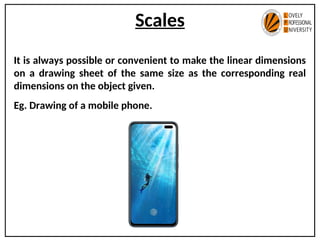
It is alwayspossible or convenient to make the linear dimensions
on a drawing sheet of the same size as the corresponding real
dimensions on the object given.
Eg. Drawing of a mobile phone.
3.
Scales
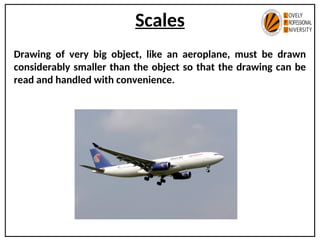
Drawing of verybig object, like an aeroplane, must be drawn
considerably smaller than the object so that the drawing can be
read and handled with convenience.
4.
Scales
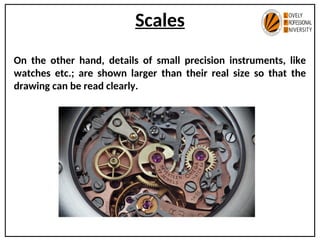
On the otherhand, details of small precision instruments, like
watches etc.; are shown larger than their real size so that the
drawing can be read clearly.
5.
Scales
The proportionby which the drawing of a given
object is enlarged or reduced is called the scale of the
drawing.
6.
Representative Fraction
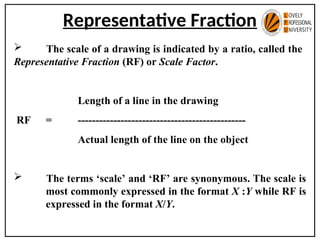
Thescale of a drawing is indicated by a ratio, called the
Representative Fraction (RF) or Scale Factor.
Length of a line in the drawing
RF = -----------------------------------------------
Actual length of the line on the object
The terms ‘scale’ and ‘RF’ are synonymous. The scale is
most commonly expressed in the format X :Y while RF is
expressed in the format X/Y.
Sizes of Scale
1.Reducing Scale
When huge objects are to be drawn, they are reduced in size on
the drawing. The scales used for these objects are called
reducing scales. It is clear that the length of the object on the
drawing is less than the actual length of the object. Reducing
scales are mentioned in the format 1 :Y, where Y is greater
than 1. Hence, RF < 1.
For eg:- 1:2 means drawing made to one HALF of the actual size.
Objects like multi-storeyed buildings, bridges, boilers, huge
machinery, ships, aeroplanes, etc., are drawn to reducing
scales.
9.
Sizes of Scale
2.Enlarging Scale
When smaller objects are to be drawn, they often need to be
enlarged. The scales used in such cases are called enlarging
scales. Obviously, the length of an object on the drawing is
more than the corresponding actual length of the object.
Enlarging scales are mentioned in the format X : 1, where X is
greater than 1. Clearly, RF > 1.
For eg: - 2:1 means drawing made to twice the actual size
Enlarging scales are used for objects like screws and gears used in
small electronic gadgets, wristwatch parts, resistors,
transistors, ICs.
10.
Sizes of Scale
3.Full Scale
When an object is drawn on the sheet to its actual size, it is said
to be drawn to full scale. As the length on the drawing is equal
to the actual length of the object, the full scale is expressed as
1:1. Obviously, for full scale, RF = 1.
Full scales are used for objects like mobile phone, calculators, etc.
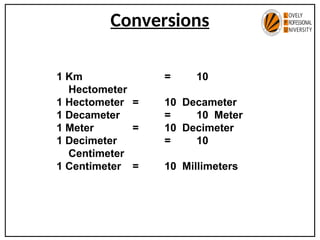
Conversions
1 Km =10
Hectometer
1 Hectometer = 10 Decameter
1 Decameter = 10 Meter
1 Meter = 10 Decimeter
1 Decimeter = 10
Centimeter
1 Centimeter = 10 Millimeters
13.
Types of Scale
1.Plain Scale:
It is a line divided into suitable number of equal parts or units,
the first part of which is subdivided into small parts.
It represents either 2 main units or 1 unit and its sub division
(fractions).
It can measure lengths up to 1 decimal place. (eg: 3.5 m, 2.7
cm)
14.
Types of Scale
2.Diagonal Scale:
In diagonal scale the smallest unit on plain scale is further
subdivided by using diagonal principle.
It represents either 3 units or only one unit and its fractions up
to second place of decimal point.
It can measure lengths upto 2 decimal place. (eg: 3.56 m, 2.78
cm)
15.
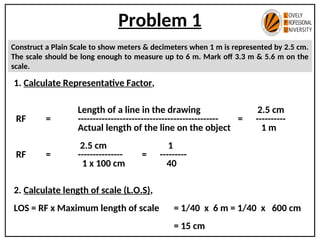
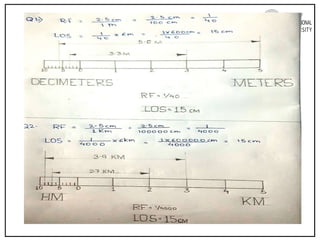
Problem 1
Construct aPlain Scale to show meters & decimeters when 1 m is represented by 2.5 cm.
The scale should be long enough to measure up to 6 m. Mark off 3.3 m & 5.6 m on the
scale.
1. Calculate Representative Factor,
Length of a line in the drawing 2.5 cm
RF = ----------------------------------------------- = ----------
Actual length of the line on the object 1 m
2.5 cm 1
RF = --------------- = ---------
1 x 100 cm 40
2. Calculate length of scale (L.O.S),
LOS = RF x Maximum length of scale = 1/40 x 6 m = 1/40 x 600 cm
= 15 cm
16.
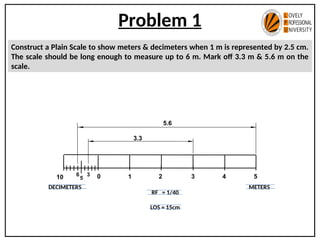
Problem 1
0 12 3 4 5
METERS
10
DECIMETERS
RF = 1/40
LOS = 15cm
5
3
3.3
5.6
6
Construct a Plain Scale to show meters & decimeters when 1 m is represented by 2.5 cm.
The scale should be long enough to measure up to 6 m. Mark off 3.3 m & 5.6 m on the
scale.
17.
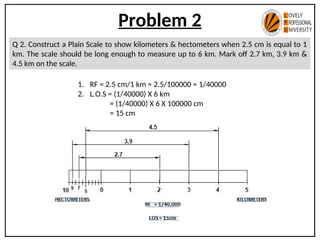
Problem 2
Q 2.Construct a Plain Scale to show kilometers & hectometers when 2.5 cm is equal to 1
km. The scale should be long enough to measure up to 6 km. Mark off 2.7 km, 3.9 km &
4.5 km on the scale.
1. RF = 2.5 cm/1 km = 2.5/100000 = 1/40000
2. L.O.S = (1/40000) X 6 km
= (1/40000) X 6 X 100000 cm
= 15 cm
18.
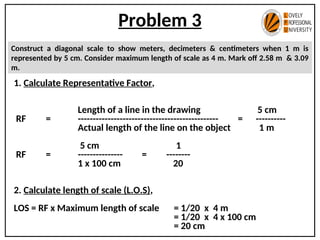
Problem 3
Construct adiagonal scale to show meters, decimeters & centimeters when 1 m is
represented by 5 cm. Consider maximum length of scale as 4 m. Mark off 2.58 m & 3.09
m.
1. Calculate Representative Factor,
Length of a line in the drawing 5 cm
RF = ----------------------------------------------- = ----------
Actual length of the line on the object 1 m
5 cm 1
RF = --------------- = --------
1 x 100 cm 20
2. Calculate length of scale (L.O.S),
LOS = RF x Maximum length of scale = 1/20 x 4 m
= 1/20 x 4 x 100 cm
= 20 cm
19.
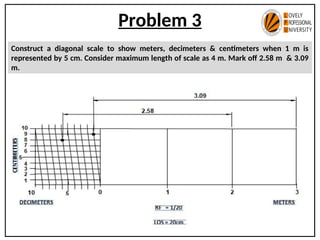
Problem 3
Construct adiagonal scale to show meters, decimeters & centimeters when 1 m is
represented by 5 cm. Consider maximum length of scale as 4 m. Mark off 2.58 m & 3.09
m.
20.
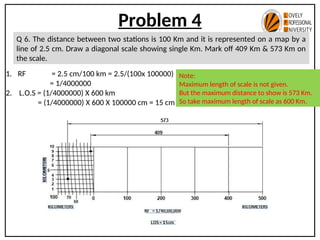
Problem 4
Q 6.The distance between two stations is 100 Km and it is represented on a map by a
line of 2.5 cm. Draw a diagonal scale showing single Km. Mark off 409 Km & 573 Km on
the scale.
1. RF = 2.5 cm/100 km = 2.5/(100x 100000)
= 1/4000000
2. L.O.S = (1/4000000) X 600 km
= (1/4000000) X 600 X 100000 cm = 15 cm
Note:
Maximum length of scale is not given.
But the maximum distance to show is 573 Km.
So take maximum length of scale as 600 Km.
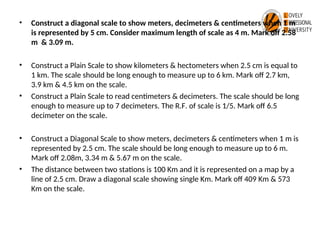
• Construct adiagonal scale to show meters, decimeters & centimeters when 1 m
is represented by 5 cm. Consider maximum length of scale as 4 m. Mark off 2.58
m & 3.09 m.
• Construct a Plain Scale to show kilometers & hectometers when 2.5 cm is equal to
1 km. The scale should be long enough to measure up to 6 km. Mark off 2.7 km,
3.9 km & 4.5 km on the scale.
• Construct a Plain Scale to read centimeters & decimeters. The scale should be long
enough to measure up to 7 decimeters. The R.F. of scale is 1/5. Mark off 6.5
decimeter on the scale.
• Construct a Diagonal Scale to show meters, decimeters & centimeters when 1 m is
represented by 2.5 cm. The scale should be long enough to measure up to 6 m.
Mark off 2.08m, 3.34 m & 5.67 m on the scale.
• The distance between two stations is 100 Km and it is represented on a map by a
line of 2.5 cm. Draw a diagonal scale showing single Km. Mark off 409 Km & 573
Km on the scale.