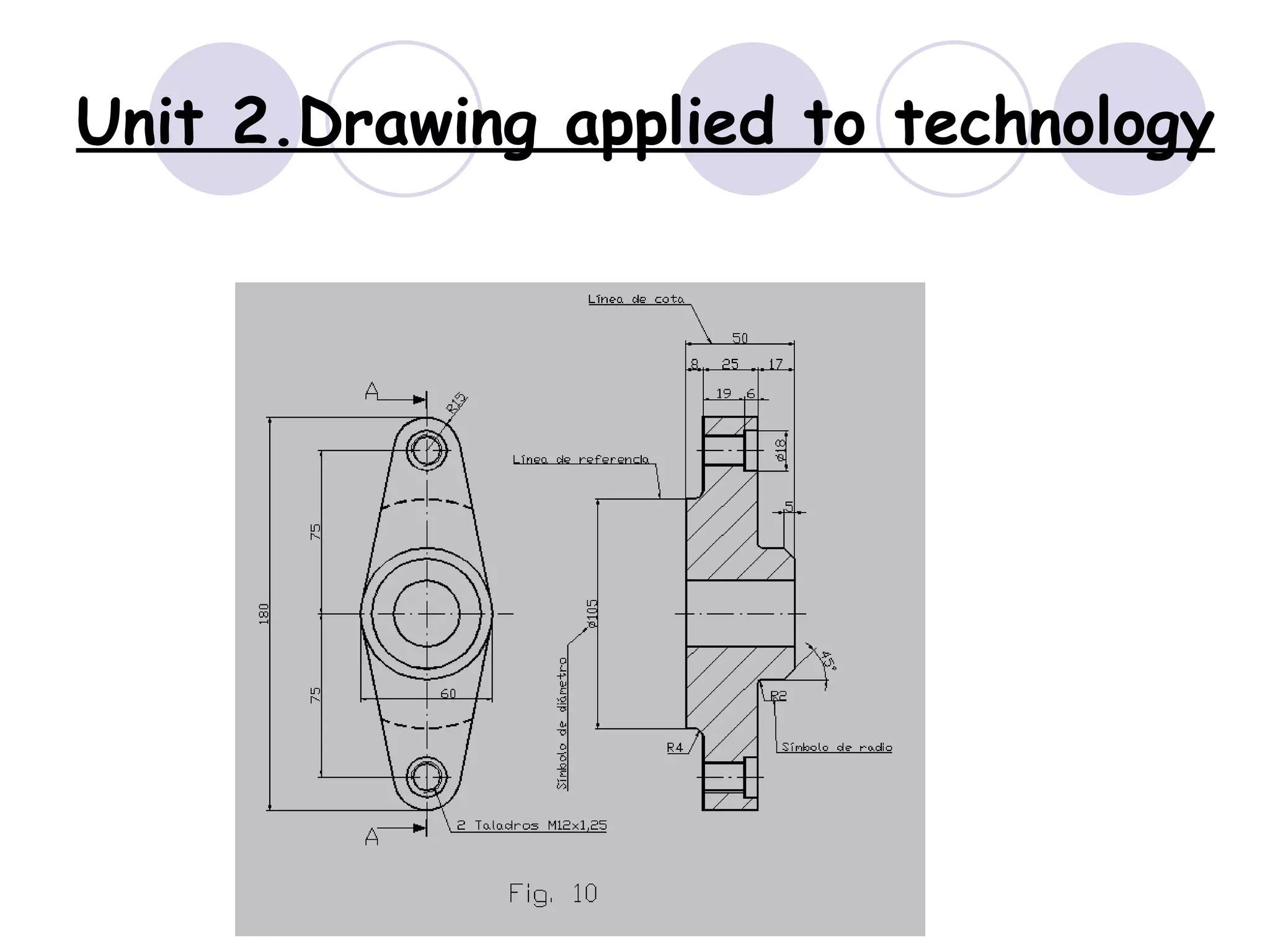
Unit 2.Drawing applied to technology
What are we going to see in this unit? 2.1 Drawing tools and how to use them 2.2 Drafts and sketches 2.3 Drafting scale 2.4 Diedric system 2.5 Marking and standardizing Unit 2.Drawing applied to technology
2.1 Drawing materials and instruments Paper Paper is made of cellulose that is obtained from trees  The paper size that we use is A4 . It is the result of dividing 1 m 2  (A0) four times by half the longest side.
2.1 Drawing materials and instruments Pencil A pencil has a lead covered with wood. The lead is made with graphite and clay  clay Graphite Lead Wood cover
2.1 Drawing materials and instruments Pencil hardness The more clay it contains the harder the lead will be. We use letter H for hard pencils and letter B for soft ones. Hard: H   Soft: B less clay More clay Technique draw Artistic draw 5H 4H 5B 6B 3B B H 3H 4B 2B HB 2H 6H Very soft Soft Medium Hard Very hard
2.1 Drawing materials and instruments Mechanical pencils They hold a graphite lead. They can be used for technical drawing (if used )with a soft lead. ERASERS Erasers are made of  rubber,  they absorb  graphite and erase it.
2.1 DRAWING TOOLS THE RULER It is a precision tool that makes it possible to measure and to transfer a distance.    TRIANGULAR SET SQUARE   A set square  is a tool for drawing perpendicular (vertical) and parallel lines and for obtaining angles.  There are 2 types of  trianglular set squares   A 45 degree   A 60 degree
2.1 Drawing materials and instruments How to draw vertical and parallel lines with the set square Vertical: Parallel: Activity : Draw the set squares in your notebook as you can see them in both positions
2.1 Drawing materials and instruments Activity :Draw a chessboard using the set square . The separation between squares is 2 cm! square 16 cm 16 cm
2.1 Drawing materials and instruments Drawing angles: we can get  15º, 30º, 45º, 60º, 75º, 90º, 120º, 135º…angles combining the 30º, 45º , 60º and the 90º angles from the set squares You don't have to copy them because you can find them in your text book on page 25
2.1 Drawing materials and instruments Drawing angles exercise: you have to obtain , 45º, 75º, 90º, 120º angles combining the  set squares
2.1 Drawing materials and instruments The Compass It is used for drawing circles and angles  Advice: sharpen the lead tip by rubbing it on a fingernail file
2.2 DRAFT AND SKETCH DRAFT:  It   is a free hand drawing (just with a pencil). We show an idea or object without totally defining it.  Page 41
2.2 DRAFT AND SKETCH ATTENTION!  A DRAFT IS NOT A BAD DRAWING AND A SKETCH IS NOT A GOOD DRAWING !!!!!!
2.2 DRAFT AND SKETCH The sketch :  It   is a free hand drawing too , but it includes the measures, therefore it shows the precise size and a shape similar to the final drawing.  measure Page 41
2.2 DRAFT AND SKETCH Activity : draw a sketch of your home cupboard.
2.2 DRAFT AND SKETCH the Sketch
2.3  Drafting scale We define  scale  as the relation between the drawing size and the real object A model uses a reduction scale
2.3  Drafting scale 1:2 The Drawing size The Real size Page 38
2.3  Drafting scale 1 cm measured on the drawing  is equivalent to 1200cm  in reality Page 38 1200 reality 1cm drawing 1:1200
2.3  Drafting scale Scale types: Reduction scale:  it is used to represent big objects ,  so they can be drawn on  paper We usually use: 1:2  1:5  1:10… In this example we have reduced 1000 times the real size of the tree 1:1000 Real drawn Real Real
2.3  Drafting scale Enlargement scale:  it is used to represent small objects so we can see them on  paper  It is used: 2:1  5:1  10:1 … In this example the drawing is two times the real object Drawing Real Safety pin 2:1 2:1
2.3  Drafting scale An example of scale application Let’s draw a pencil that is 10cm high and 1cm wide using different scales: 2:1, 1:2, 1:4 1cm 10cm
2.3  Drafting scale Scale 2:1 Real 2:1 1 wide 10 1 Real 2 Drawn High
2.3  Drafting scale Scale 1:2 2:1 Real 1:2 1 wide 10 2 Real 1 Drawn High
2.3  Drafting scale Scale 1:4 Real 2:1 1:2 1:4 Real 2:1 1:2 Real 1:2 2:1 Real 1:2 1 wide 10 4 Real 1 Drawn High
2.3  Drafting scale Scale exercise This drawing is 4,5cm long and 2,5 cm high, if we have used a 1:100 scale How high and long is the real car? 4.5cm 2.5cm
2.3  Drafting scale Scale 1:100 250 2,5 High 450 100 Real 4,5 1 Drawn Long 4.5cm 2.5cm
2.3  Drafting scale Activity: Let’s draw a plan of your classroom using your feet and your hands applying the suitable scale to draw it 1 foot: 20cm 1 hand: 10cm
31 feet are equivalent to 620cm 24 feet are equivalent to 480cm 4,5 hands = 45cm 3,5 hands=35cm Therefore we have 2.3 Drafting scale 4hands x 18cm/hand= 72cm 3hands x 18cm/hand= 54cm 31 feet x 20cm/foot= 620cm 24 feet x 20cm/foot=480cm
2.3 Drafting scale Which scale could we use to draw the classroom and your desks on your notebooks? 54cm 72cm Desk 480cm 620cm Classroom width length
2.3 Drafting scale Let’s use the  1:100  scale , so the drawing will be 100 times smaller than reality 480 4,8 wide 620 100 Real 6,2 1 Drawn Long  Classroom 54 0,54 wide 72 100 Real 0,72 1 Drawn Long  Desks
2.3  Drafting scale Homework: Draw a plan of your bedroom using your feet and your hands. Apply a 1:25 scale to draw it 1 foot: 20cm 1 hand: 10cm
15feet= 300cm 20 pies = 400cm 70 100 Bed  150 150 Desk 200 330 bedroom Wide lenght habitación
2.4 Diedric system
2.4 Diedric system The diedric system represents the objects using a perpendicular projection on a plane
2.4 Diedric system The projection or  VIEW  consists of drawing just what we see when we are perpendicular to the object and to the plane Page 28
2.4 Diedric system To define an object we only need 3 views,  floor, front and profile: Floor view : from the top of the object Front view: facing the object Profile view: from the side Profile view Floor view  Front view Front view Floor view  Profile view
Draw the left profile, floor and front view of your pencil case.
2.4 Diedric system Diedric Rules The front is usually indicated with an arrow The views distribution The front is always on top of the floor The profile is situated the other way round, that is, the left profile is situated on the right front floor  Left profile Right profile floor  front
2.4 Diedric system Remember: The same height:  the object has the same height on the floor and on the profile views The same width:  on the front and on the floor views The same depth:  on the floor and on the profile views
2.4 Diedric system Exercise : Draw the front, left profile and floor views of the class chair
2.4 Diedric system Exercise : Draw the front, profile and floor views of the class chair
2.4 Diedric system Where do we have to be situated to see these objects like circles?
2.4 Diedric system
2.4 Diedric system Exercise 11: Complete the views of the following objects Page 31
2.4 Diedric system Exercise 11: Complete the views of the following objects
2.4 Diedric system Non visible lines:  when we know there is a hidden line we have to draw it using a discontinuous line hidden line
2.4 Diedric system Insert video
2.4 Diedric system Activity : draw the front, floor and right profile views of this figure colouring each face in one colour.
2.4 Diedric system Activity : draw the front, floor y left profile views of this figure colouring each face in a different colour.
2.4 Diedric system Exercice: draw the right profile, front and floor views of these objects
2.4 Diedric system
2.4 Diedric system
2.5 Marking and standardizing The standardizing  is the group of rules that defines technical drawing . For example: For paper size we use the  DIN rule: A0,A1,A2… The lines are : Thick continuous lines:  are used to outline objects Thick discontinuous lines:  indicate hidden lines Thin continuous lines:  are used for auxiliary measures and reference lines
2.5 Marking and standardizing Measure line Auxuliary Line Measure  Reference line
2.5 Marking and standardizing Outside thick continuous line Thick discontinuous line for a hidden edge
2.5 Marking and standardizing Marking :  indicating the real dimensions above the object
2.5 Marking and standardizing Activity:  draw these views indicating which rules are broken Correct Wrong Correct Wrong Correct Wrong Correct Wrong
2.5 Marking and standardizing. The measure lines: We place them parallel to the edge and slightly separated They are limited by the auxiliary lines The arrows are thin and enlongated, they go from one side to the other Marking follows some rules: see page 37
2.5 Marking and standardizing Auxiliary lines We place them perpendicular to the measure lines They cross the measure line a little bit They never cut the measure line
2.5 Marking and standardizing Activity:  draw these views indicating which rules are broken Correct Wrong
2.5 Marking and standardizing The measures: We indicate the real measure in milimetres, but “mm” is  never written They are placed above the measure line, never under it We only use the extrictly necessary measures
2.5 Marking and standardizing Activity:  draw these views indicating which rules are broken Correct Wrong
Activity : Draw the front, left profile and floor views of your pencil marking the measures 2.5 Marking and standardizing
Let’s revise  the important terms
What are we going to see in this unit? 2.1 Drawing tools and how to use them 2.2 Drafts and sketches 2.3 Drafting scale 2.4 Diedric system 2.5 Marking and standardizing Unit 2.Drawing applied to technology
Vocabulary  Paper size  Cellulose Clay, graphite, lead Hard and soft pencils Erasers, technical pencil Sixty and forty-five degree rules Sketch, draft, free hand drawing, measures Scale, real and drawn size, reduction, enlargement scales To be reduced 100 times… Length, height, width Long, high, wide.

Eng Dibujo1eso

  • 1.
  • 2.
    What are wegoing to see in this unit? 2.1 Drawing tools and how to use them 2.2 Drafts and sketches 2.3 Drafting scale 2.4 Diedric system 2.5 Marking and standardizing Unit 2.Drawing applied to technology
  • 3.
    2.1 Drawing materialsand instruments Paper Paper is made of cellulose that is obtained from trees The paper size that we use is A4 . It is the result of dividing 1 m 2 (A0) four times by half the longest side.
  • 4.
    2.1 Drawing materialsand instruments Pencil A pencil has a lead covered with wood. The lead is made with graphite and clay clay Graphite Lead Wood cover
  • 5.
    2.1 Drawing materialsand instruments Pencil hardness The more clay it contains the harder the lead will be. We use letter H for hard pencils and letter B for soft ones. Hard: H Soft: B less clay More clay Technique draw Artistic draw 5H 4H 5B 6B 3B B H 3H 4B 2B HB 2H 6H Very soft Soft Medium Hard Very hard
  • 6.
    2.1 Drawing materialsand instruments Mechanical pencils They hold a graphite lead. They can be used for technical drawing (if used )with a soft lead. ERASERS Erasers are made of rubber, they absorb graphite and erase it.
  • 7.
    2.1 DRAWING TOOLSTHE RULER It is a precision tool that makes it possible to measure and to transfer a distance. TRIANGULAR SET SQUARE A set square is a tool for drawing perpendicular (vertical) and parallel lines and for obtaining angles. There are 2 types of trianglular set squares A 45 degree A 60 degree
  • 8.
    2.1 Drawing materialsand instruments How to draw vertical and parallel lines with the set square Vertical: Parallel: Activity : Draw the set squares in your notebook as you can see them in both positions
  • 9.
    2.1 Drawing materialsand instruments Activity :Draw a chessboard using the set square . The separation between squares is 2 cm! square 16 cm 16 cm
  • 10.
    2.1 Drawing materialsand instruments Drawing angles: we can get 15º, 30º, 45º, 60º, 75º, 90º, 120º, 135º…angles combining the 30º, 45º , 60º and the 90º angles from the set squares You don't have to copy them because you can find them in your text book on page 25
  • 11.
    2.1 Drawing materialsand instruments Drawing angles exercise: you have to obtain , 45º, 75º, 90º, 120º angles combining the set squares
  • 12.
    2.1 Drawing materialsand instruments Drawing angles exercise: you have to obtain , 45º, 75º, 90º, 120º angles combining the set squares
  • 13.
    2.1 Drawing materialsand instruments The Compass It is used for drawing circles and angles Advice: sharpen the lead tip by rubbing it on a fingernail file
  • 14.
    2.2 DRAFT ANDSKETCH DRAFT: It is a free hand drawing (just with a pencil). We show an idea or object without totally defining it. Page 41
  • 15.
    2.2 DRAFT ANDSKETCH ATTENTION! A DRAFT IS NOT A BAD DRAWING AND A SKETCH IS NOT A GOOD DRAWING !!!!!!
  • 16.
    2.2 DRAFT ANDSKETCH The sketch : It is a free hand drawing too , but it includes the measures, therefore it shows the precise size and a shape similar to the final drawing. measure Page 41
  • 17.
    2.2 DRAFT ANDSKETCH Activity : draw a sketch of your home cupboard.
  • 18.
    2.2 DRAFT ANDSKETCH the Sketch
  • 19.
    2.3 Draftingscale We define scale as the relation between the drawing size and the real object A model uses a reduction scale
  • 20.
    2.3 Draftingscale 1:2 The Drawing size The Real size Page 38
  • 21.
    2.3 Draftingscale 1 cm measured on the drawing is equivalent to 1200cm in reality Page 38 1200 reality 1cm drawing 1:1200
  • 22.
    2.3 Draftingscale Scale types: Reduction scale: it is used to represent big objects , so they can be drawn on paper We usually use: 1:2 1:5 1:10… In this example we have reduced 1000 times the real size of the tree 1:1000 Real drawn Real Real
  • 23.
    2.3 Draftingscale Enlargement scale: it is used to represent small objects so we can see them on paper It is used: 2:1 5:1 10:1 … In this example the drawing is two times the real object Drawing Real Safety pin 2:1 2:1
  • 24.
    2.3 Draftingscale An example of scale application Let’s draw a pencil that is 10cm high and 1cm wide using different scales: 2:1, 1:2, 1:4 1cm 10cm
  • 25.
    2.3 Draftingscale Scale 2:1 Real 2:1 1 wide 10 1 Real 2 Drawn High
  • 26.
    2.3 Draftingscale Scale 1:2 2:1 Real 1:2 1 wide 10 2 Real 1 Drawn High
  • 27.
    2.3 Draftingscale Scale 1:4 Real 2:1 1:2 1:4 Real 2:1 1:2 Real 1:2 2:1 Real 1:2 1 wide 10 4 Real 1 Drawn High
  • 28.
    2.3 Draftingscale Scale exercise This drawing is 4,5cm long and 2,5 cm high, if we have used a 1:100 scale How high and long is the real car? 4.5cm 2.5cm
  • 29.
    2.3 Draftingscale Scale 1:100 250 2,5 High 450 100 Real 4,5 1 Drawn Long 4.5cm 2.5cm
  • 30.
    2.3 Draftingscale Activity: Let’s draw a plan of your classroom using your feet and your hands applying the suitable scale to draw it 1 foot: 20cm 1 hand: 10cm
  • 31.
    31 feet areequivalent to 620cm 24 feet are equivalent to 480cm 4,5 hands = 45cm 3,5 hands=35cm Therefore we have 2.3 Drafting scale 4hands x 18cm/hand= 72cm 3hands x 18cm/hand= 54cm 31 feet x 20cm/foot= 620cm 24 feet x 20cm/foot=480cm
  • 32.
    2.3 Drafting scaleWhich scale could we use to draw the classroom and your desks on your notebooks? 54cm 72cm Desk 480cm 620cm Classroom width length
  • 33.
    2.3 Drafting scaleLet’s use the 1:100 scale , so the drawing will be 100 times smaller than reality 480 4,8 wide 620 100 Real 6,2 1 Drawn Long Classroom 54 0,54 wide 72 100 Real 0,72 1 Drawn Long Desks
  • 34.
    2.3 Draftingscale Homework: Draw a plan of your bedroom using your feet and your hands. Apply a 1:25 scale to draw it 1 foot: 20cm 1 hand: 10cm
  • 35.
    15feet= 300cm 20pies = 400cm 70 100 Bed 150 150 Desk 200 330 bedroom Wide lenght habitación
  • 36.
  • 37.
    2.4 Diedric systemThe diedric system represents the objects using a perpendicular projection on a plane
  • 38.
    2.4 Diedric systemThe projection or VIEW consists of drawing just what we see when we are perpendicular to the object and to the plane Page 28
  • 39.
    2.4 Diedric systemTo define an object we only need 3 views, floor, front and profile: Floor view : from the top of the object Front view: facing the object Profile view: from the side Profile view Floor view Front view Front view Floor view Profile view
  • 40.
    Draw the leftprofile, floor and front view of your pencil case.
  • 41.
    2.4 Diedric systemDiedric Rules The front is usually indicated with an arrow The views distribution The front is always on top of the floor The profile is situated the other way round, that is, the left profile is situated on the right front floor Left profile Right profile floor front
  • 42.
    2.4 Diedric systemRemember: The same height: the object has the same height on the floor and on the profile views The same width: on the front and on the floor views The same depth: on the floor and on the profile views
  • 43.
    2.4 Diedric systemExercise : Draw the front, left profile and floor views of the class chair
  • 44.
    2.4 Diedric systemExercise : Draw the front, profile and floor views of the class chair
  • 45.
    2.4 Diedric systemWhere do we have to be situated to see these objects like circles?
  • 46.
  • 47.
    2.4 Diedric systemExercise 11: Complete the views of the following objects Page 31
  • 48.
    2.4 Diedric systemExercise 11: Complete the views of the following objects
  • 49.
    2.4 Diedric systemExercise 11: Complete the views of the following objects
  • 50.
    2.4 Diedric systemExercise 11: Complete the views of the following objects
  • 51.
    2.4 Diedric systemNon visible lines: when we know there is a hidden line we have to draw it using a discontinuous line hidden line
  • 52.
    2.4 Diedric systemInsert video
  • 53.
    2.4 Diedric systemActivity : draw the front, floor and right profile views of this figure colouring each face in one colour.
  • 54.
    2.4 Diedric systemActivity : draw the front, floor y left profile views of this figure colouring each face in a different colour.
  • 55.
    2.4 Diedric systemExercice: draw the right profile, front and floor views of these objects
  • 56.
  • 57.
  • 58.
    2.5 Marking andstandardizing The standardizing is the group of rules that defines technical drawing . For example: For paper size we use the DIN rule: A0,A1,A2… The lines are : Thick continuous lines: are used to outline objects Thick discontinuous lines: indicate hidden lines Thin continuous lines: are used for auxiliary measures and reference lines
  • 59.
    2.5 Marking andstandardizing Measure line Auxuliary Line Measure Reference line
  • 60.
    2.5 Marking andstandardizing Outside thick continuous line Thick discontinuous line for a hidden edge
  • 61.
    2.5 Marking andstandardizing Marking : indicating the real dimensions above the object
  • 62.
    2.5 Marking andstandardizing Activity: draw these views indicating which rules are broken Correct Wrong Correct Wrong Correct Wrong Correct Wrong
  • 63.
    2.5 Marking andstandardizing. The measure lines: We place them parallel to the edge and slightly separated They are limited by the auxiliary lines The arrows are thin and enlongated, they go from one side to the other Marking follows some rules: see page 37
  • 64.
    2.5 Marking andstandardizing Auxiliary lines We place them perpendicular to the measure lines They cross the measure line a little bit They never cut the measure line
  • 65.
    2.5 Marking andstandardizing Activity: draw these views indicating which rules are broken Correct Wrong
  • 66.
    2.5 Marking andstandardizing The measures: We indicate the real measure in milimetres, but “mm” is never written They are placed above the measure line, never under it We only use the extrictly necessary measures
  • 67.
    2.5 Marking andstandardizing Activity: draw these views indicating which rules are broken Correct Wrong
  • 68.
    Activity : Drawthe front, left profile and floor views of your pencil marking the measures 2.5 Marking and standardizing
  • 69.
    Let’s revise the important terms
  • 70.
    What are wegoing to see in this unit? 2.1 Drawing tools and how to use them 2.2 Drafts and sketches 2.3 Drafting scale 2.4 Diedric system 2.5 Marking and standardizing Unit 2.Drawing applied to technology
  • 71.
    Vocabulary Papersize Cellulose Clay, graphite, lead Hard and soft pencils Erasers, technical pencil Sixty and forty-five degree rules Sketch, draft, free hand drawing, measures Scale, real and drawn size, reduction, enlargement scales To be reduced 100 times… Length, height, width Long, high, wide.