FLITCHED BEAMS
GUIDED BY-
Prof- PRIYANKA CHATORAJ
PRESENTED BY-
GROUP- 2
OVERVIEW
 WHAT IS A BEAM?
 TYPES OF BEAMS
 WHAT IS A COMPOSITE BEAM?
 TYPES OF COMPOSITE BEAMS
 WHAT IS A FLITCHED BEAM?
 DESIGN PRINCIPLE OF A FLITCHED BEAM
 APPLICATIONS & ADVANTAGES
 LIMITATIONS & DRAWBACKS
WHAT IS A BEAM?
• A beam is a structural element that is capable of withstanding load primarily by
resisting against bending.
• The bending force induced into the material of the beam as a result of the
external loads, own weight, span and external reactions to these loads is called
a bending moment.
• Beams are characterized by their profile (shape of cross-section), their length, and
their material.
TYPES OF BEAMS
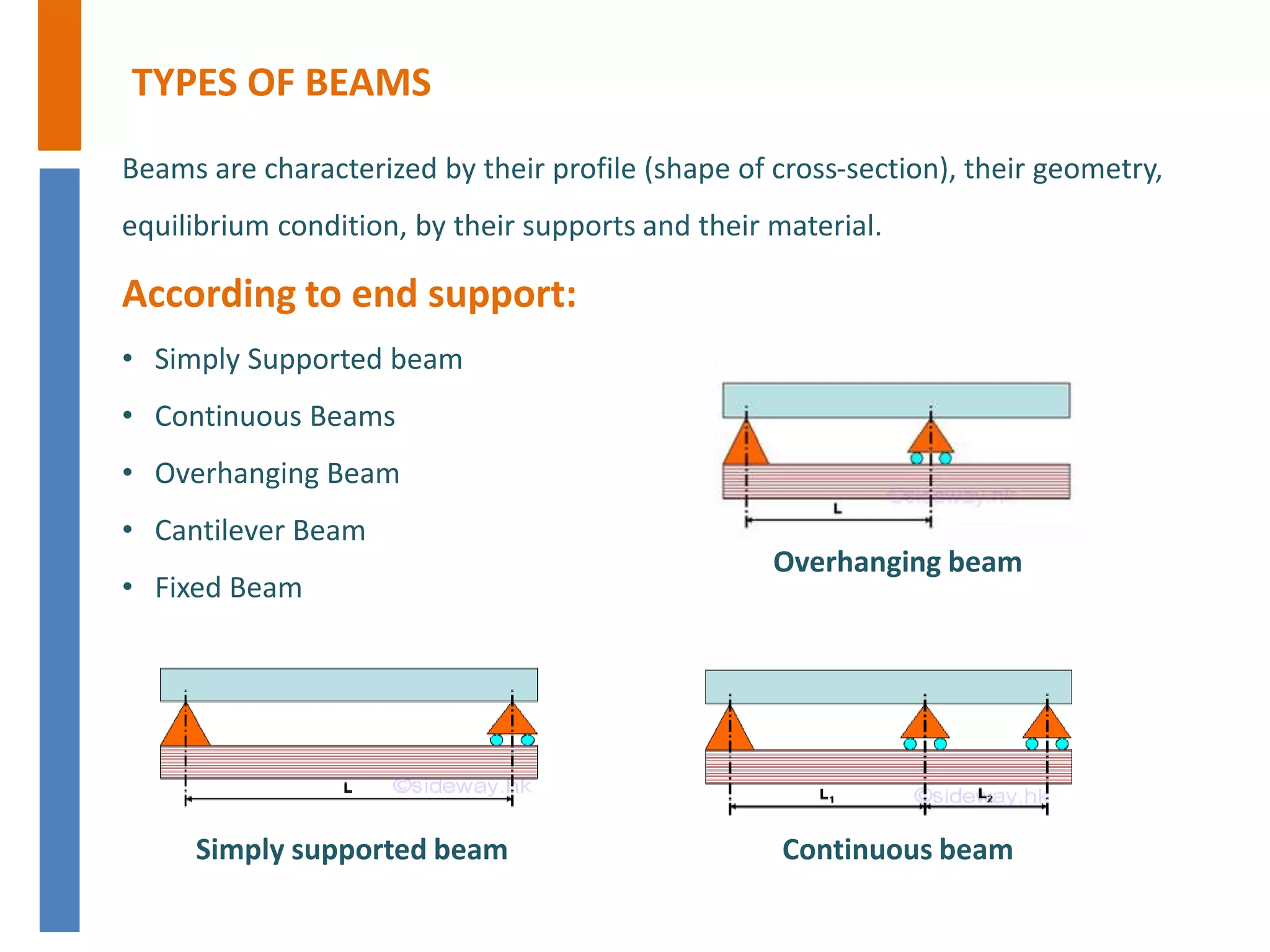
Beams are characterized by their profile (shape of cross-section), their geometry,
equilibrium condition, by their supports and their material.
According to end support:
• Simply Supported beam
• Continuous Beams
• Overhanging Beam
• Cantilever Beam
• Fixed Beam
Overhanging beam
Simply supported beam Continuous beam
According to cross section:
A beam may have different cross section. The most common cross section of
beam are as follow.
• I Beam
• T Beam
• C beam
According to Geometry:
• Straight beam
• Curved beam
• Tapper beam
According to equilibrium:
• Statistically determinate beam
• Statistically indeterminate beam
According to material:
• Timber beam
• Steel beam
• Concrete beam
WHAT IS COMPOSITE BEAM ?
• A structural member composed of two or more dissimilar materials joined
together to act as a unit in which the resulting system is stronger than the
sum of its parts.
• There are two main benefits of composite action in structural members
first, by rigidly joining the two parts together , the resulting system is
stronger than the sum of its parts. Second, composite action can better
use the properties of each constituent material
TYPES OF COMPOSITE BEAMS
1. BEAMS OF UNSYMMETRICAL STRUCTURES
2. BEAMS OF UNIFORM STRENGHT
3. FLITCHED BEAMS
WHAT IS A FLITCHED BEAM ?
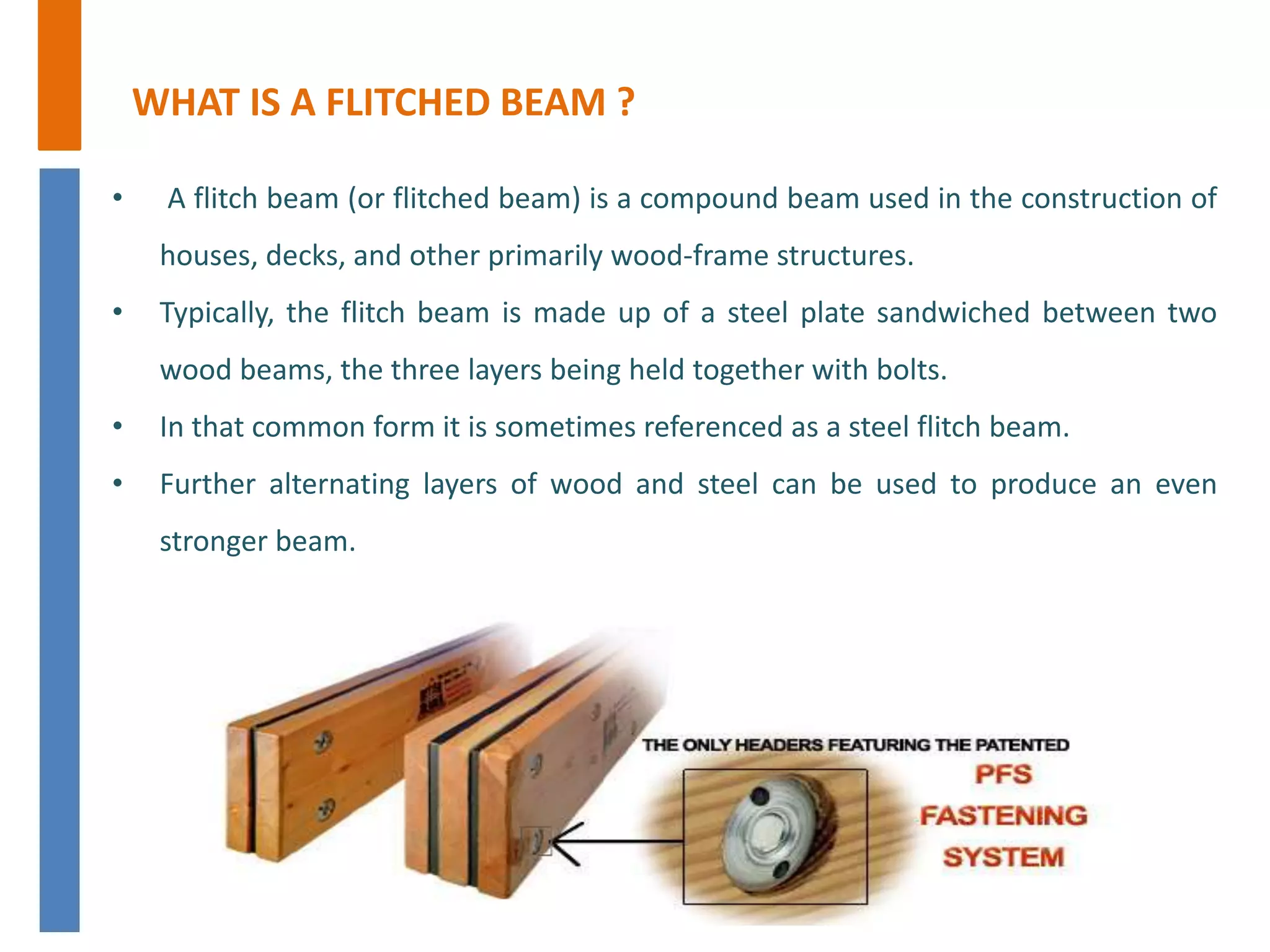
• A flitch beam (or flitched beam) is a compound beam used in the construction of
houses, decks, and other primarily wood-frame structures.
• Typically, the flitch beam is made up of a steel plate sandwiched between two
wood beams, the three layers being held together with bolts.
• In that common form it is sometimes referenced as a steel flitch beam.
• Further alternating layers of wood and steel can be used to produce an even
stronger beam.
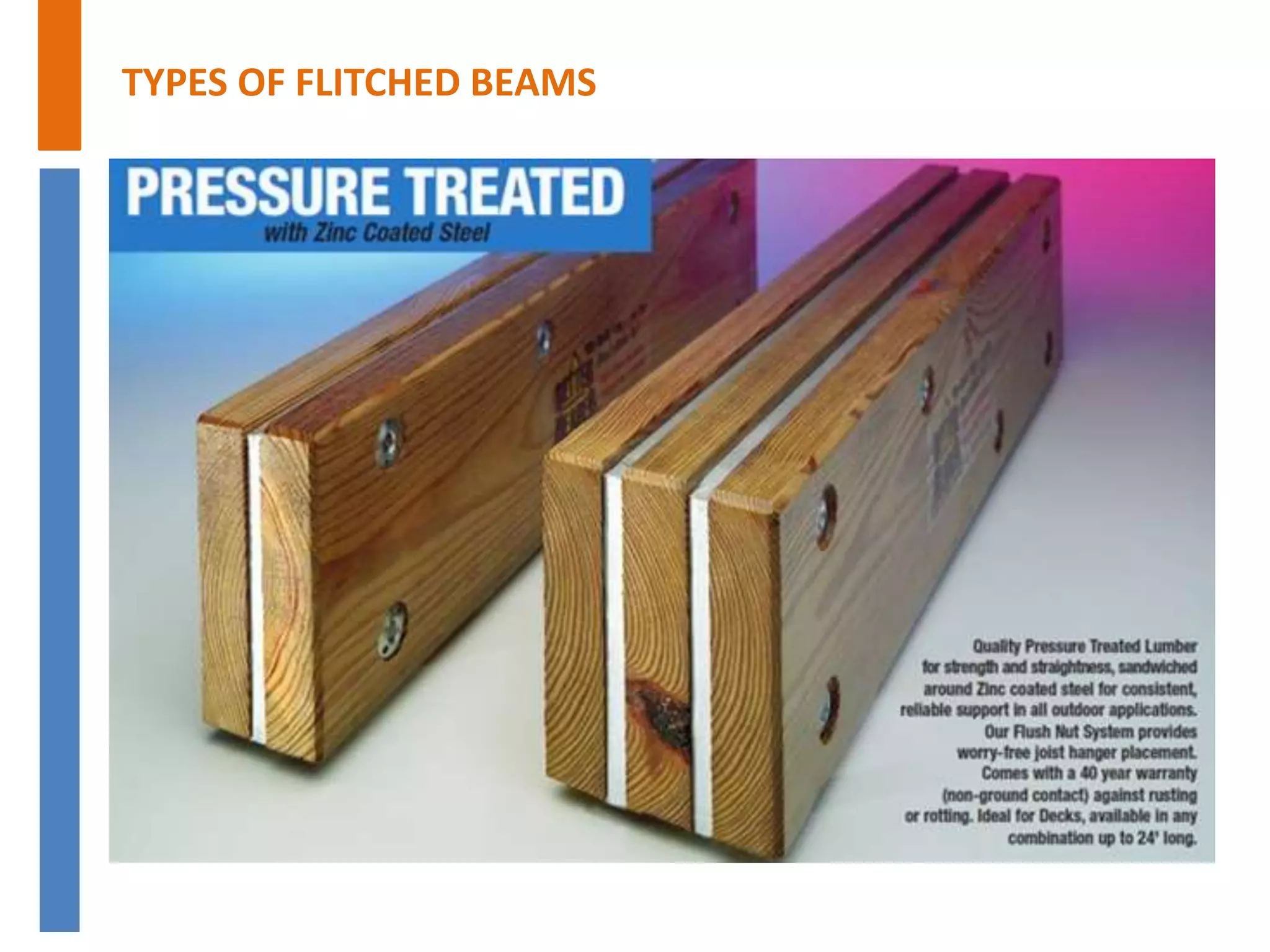
TYPES OF FLITCHED BEAMS
THEORY OF COMPOSITE SECTION
Consider a beam of composite section made up of two different materials say
( timber and steel)
Where they behave like a single piece and on application of load they bend to
same radius of curvature
In such cases the total moment of resistance will be equal to the sum of
moments of individual sections
12
E1- Modulus of elasticity of part1
I1-Moment of inertia of part1
M1-Moment of resistance for part1
S1- Stress in part1
Z1-Modulus of section for part1
Similarly, E2, I2, M2, S2 and Z2 are corresponding
values of part2
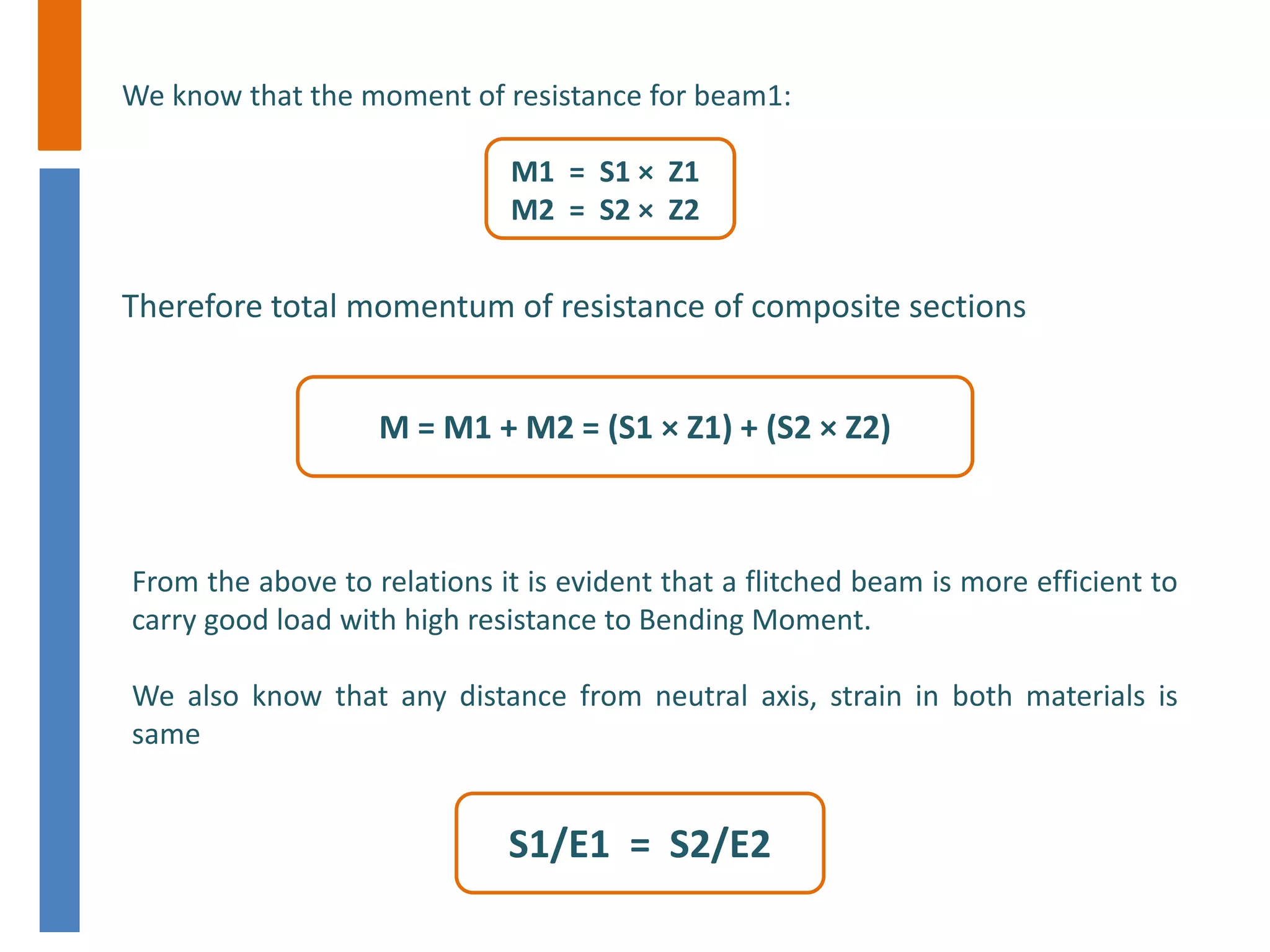
We know that the moment of resistance for beam1:
M1 = S1 × Z1
M2 = S2 × Z2
Therefore total momentum of resistance of composite sections
M = M1 + M2 = (S1 × Z1) + (S2 × Z2)
From the above to relations it is evident that a flitched beam is more efficient to
carry good load with high resistance to Bending Moment.
We also know that any distance from neutral axis, strain in both materials is
same
S1/E1 = S2/E2
APPLICATIONS & ADVANTAGES
• Flitch beams are significantly stronger than wood alone.
• They require less depth than a wood-only beam of the same
strength
• They are much lighter than a steel beam of the same size.
• They can still be nailed to the rest of a wooden structure.
• Flitch beams can also be created from existing in-situ joists or
beams permitting easier renovations.
LIMITATONS & DRAWBACKS
• Due to the high cost of labour, use of this type of beam has greatly
declined.
• The advent of high-strength engineered lumber which uses modern
adhesives and lower cost wood fibres has rendered this system largely
obsolete.
• Engineered lumber is cut to length and installed similar to sawn lumber.
• The flitch requires shop fabrication and/or field bolting.
• This coupled with a much increased self weight of the beam (11.4
pounds (5.2 kg) for engineered wood vs. 25.2 pounds (11.4 kg) for a
flitch beam) decreases the viability of the system
THANK YOU

FLITCHED BEAMS

  • 1.
    FLITCHED BEAMS GUIDED BY- Prof-PRIYANKA CHATORAJ PRESENTED BY- GROUP- 2
  • 2.
    OVERVIEW  WHAT ISA BEAM?  TYPES OF BEAMS  WHAT IS A COMPOSITE BEAM?  TYPES OF COMPOSITE BEAMS  WHAT IS A FLITCHED BEAM?  DESIGN PRINCIPLE OF A FLITCHED BEAM  APPLICATIONS & ADVANTAGES  LIMITATIONS & DRAWBACKS
  • 3.
    WHAT IS ABEAM? • A beam is a structural element that is capable of withstanding load primarily by resisting against bending. • The bending force induced into the material of the beam as a result of the external loads, own weight, span and external reactions to these loads is called a bending moment. • Beams are characterized by their profile (shape of cross-section), their length, and their material.
  • 4.
    TYPES OF BEAMS Beamsare characterized by their profile (shape of cross-section), their geometry, equilibrium condition, by their supports and their material. According to end support: • Simply Supported beam • Continuous Beams • Overhanging Beam • Cantilever Beam • Fixed Beam Overhanging beam Simply supported beam Continuous beam
  • 5.
    According to crosssection: A beam may have different cross section. The most common cross section of beam are as follow. • I Beam • T Beam • C beam According to Geometry: • Straight beam • Curved beam • Tapper beam According to equilibrium: • Statistically determinate beam • Statistically indeterminate beam According to material: • Timber beam • Steel beam • Concrete beam
  • 6.
    WHAT IS COMPOSITEBEAM ? • A structural member composed of two or more dissimilar materials joined together to act as a unit in which the resulting system is stronger than the sum of its parts. • There are two main benefits of composite action in structural members first, by rigidly joining the two parts together , the resulting system is stronger than the sum of its parts. Second, composite action can better use the properties of each constituent material TYPES OF COMPOSITE BEAMS 1. BEAMS OF UNSYMMETRICAL STRUCTURES 2. BEAMS OF UNIFORM STRENGHT 3. FLITCHED BEAMS
  • 7.
    WHAT IS AFLITCHED BEAM ? • A flitch beam (or flitched beam) is a compound beam used in the construction of houses, decks, and other primarily wood-frame structures. • Typically, the flitch beam is made up of a steel plate sandwiched between two wood beams, the three layers being held together with bolts. • In that common form it is sometimes referenced as a steel flitch beam. • Further alternating layers of wood and steel can be used to produce an even stronger beam.
  • 8.
  • 10.
    THEORY OF COMPOSITESECTION Consider a beam of composite section made up of two different materials say ( timber and steel) Where they behave like a single piece and on application of load they bend to same radius of curvature In such cases the total moment of resistance will be equal to the sum of moments of individual sections 12 E1- Modulus of elasticity of part1 I1-Moment of inertia of part1 M1-Moment of resistance for part1 S1- Stress in part1 Z1-Modulus of section for part1 Similarly, E2, I2, M2, S2 and Z2 are corresponding values of part2
  • 11.
    We know thatthe moment of resistance for beam1: M1 = S1 × Z1 M2 = S2 × Z2 Therefore total momentum of resistance of composite sections M = M1 + M2 = (S1 × Z1) + (S2 × Z2) From the above to relations it is evident that a flitched beam is more efficient to carry good load with high resistance to Bending Moment. We also know that any distance from neutral axis, strain in both materials is same S1/E1 = S2/E2
  • 12.
    APPLICATIONS & ADVANTAGES •Flitch beams are significantly stronger than wood alone. • They require less depth than a wood-only beam of the same strength • They are much lighter than a steel beam of the same size. • They can still be nailed to the rest of a wooden structure. • Flitch beams can also be created from existing in-situ joists or beams permitting easier renovations.
  • 13.
    LIMITATONS & DRAWBACKS •Due to the high cost of labour, use of this type of beam has greatly declined. • The advent of high-strength engineered lumber which uses modern adhesives and lower cost wood fibres has rendered this system largely obsolete. • Engineered lumber is cut to length and installed similar to sawn lumber. • The flitch requires shop fabrication and/or field bolting. • This coupled with a much increased self weight of the beam (11.4 pounds (5.2 kg) for engineered wood vs. 25.2 pounds (11.4 kg) for a flitch beam) decreases the viability of the system
  • 14.