Scalable Machine 
Learning
me: 
Sam Bessalah 
Software Engineer, Freelance 
Big Data, Distributed Computing, Machine Learning 
Paris Data Geek Co-organizer 
@samklr @DataParis
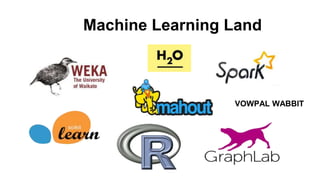
Machine Learning Land 
VOWPAL WABBIT
Some Observations in Big Data Land 
● New use cases push towards faster execution platforms and real 
time predictions engines. 
● Traditional MapReduce on Hadoop is fading away, especially for 
Machine Learning 
● Apache Spark has become the darling of the Big Data world, 
thanks to its high level API and performances. 
● Rise of Machine Learning public APIs to easily integrate models 
into application and other data processing workflows.
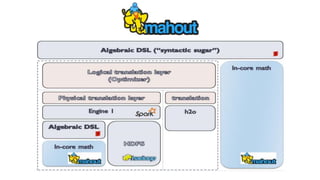
● Used to be the only Hadoop MapReduce Framework 
● Moved from MapReduce towards modern and faster 
backends, namely 
● Now provide a fluent DSL that integrates with Scala and 
Spark
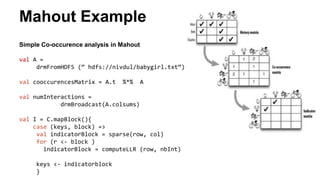
Mahout Example 
Simple Co-occurence analysis in Mahout 
val A = 
drmFromHDFS (“ hdfs://nivdul/babygirl.txt“) 
val cooccurencesMatrix = A.t %*% A 
val numInteractions = 
drmBroadcast(A.colsums) 
val I = C.mapBlock(){ 
case (keys, block) => 
val indicatorBlock = sparse(row, col) 
for (r <- block ) 
indicatorBlock = computeLLR (row, nbInt) 
keys <- indicatorblock 
}
Dataflow system, materialized by immutable and lazy, in-memory distributed 
collections suited for iterative and complex transformations, like in most Machine 
Learning algorithms. 
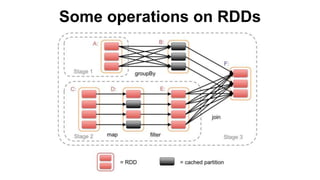
Those in-memory collections are called Resilient Distributed Datasets (RDD) 
They provide : 
● Partitioned data 
● High level operations (map, filter, collect, reduce, zip, join, sample, etc …) 
● No side effects 
● Fault recovery via lineage
Some operations on RDDs
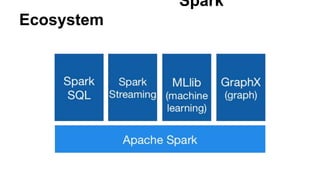
Spark 
Ecosystem
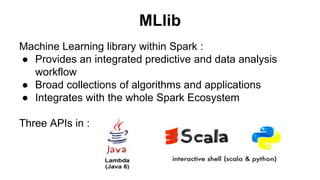
MLlib 
Machine Learning library within Spark : 
● Provides an integrated predictive and data analysis 
workflow 
● Broad collections of algorithms and applications 
● Integrates with the whole Spark Ecosystem 
Three APIs in :
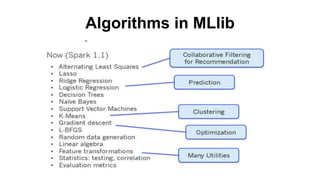
Algorithms in MLlib
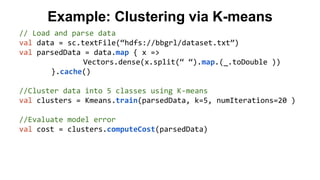
Example: Clustering via K-means 
// Load and parse data 
val data = sc.textFile(“hdfs://bbgrl/dataset.txt”) 
val parsedData = data.map { x => 
Vectors.dense(x.split(“ “).map.(_.toDouble )) 
}.cache() 
//Cluster data into 5 classes using K-means 
val clusters = Kmeans.train(parsedData, k=5, numIterations=20 ) 
//Evaluate model error 
val cost = clusters.computeCost(parsedData)
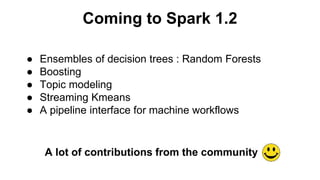
Coming to Spark 1.2 
● Ensembles of decision trees : Random Forests 
● Boosting 
● Topic modeling 
● Streaming Kmeans 
● A pipeline interface for machine workflows 
A lot of contributions from the community
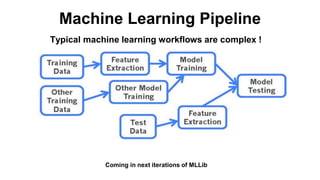
Machine Learning Pipeline 
Typical machine learning workflows are complex ! 
Coming in next iterations of MLLib
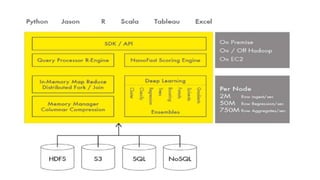
● H20 is a fast (really fast), statistics, Machine Learning 
and maths engine on the JVM. 
● Edited by 0xdata (commercial entity) and focus on 
bringing robust and highly performant machine learning 
algorithms to popular Big Data workloads. 
● Has APIs in R, Java, Scala and Python and integrates 
to third parties tools like Tableau and Excel.
Example in R 
library(h2o) 
localH2O = h2o.init(ip = 'localhost', port = 54321) 
irisPath = system.file("extdata", "iris.csv", package="h2o") 
iris.hex = h2o.importFile(localH2O, path = irisPath, key = "iris.hex") 
iris.data.frame <- as.data.frame(iris.hex) 
> colnames(iris.hex) 
[1] "C1" "C2" "C3" "C4" "C5" 
>
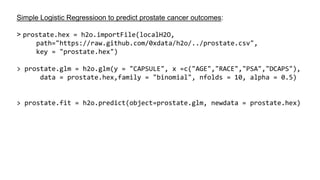
Simple Logistic Regressioon to predict prostate cancer outcomes: 
> prostate.hex = h2o.importFile(localH2O, 
path="https://raw.github.com/0xdata/h2o/../prostate.csv", 
key = "prostate.hex") 
> prostate.glm = h2o.glm(y = "CAPSULE", x =c("AGE","RACE","PSA","DCAPS"), 
data = prostate.hex,family = "binomial", nfolds = 10, alpha = 0.5) 
> prostate.fit = h2o.predict(object=prostate.glm, newdata = prostate.hex)
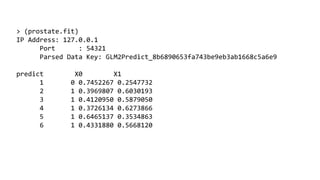
> (prostate.fit) 
IP Address: 127.0.0.1 
Port : 54321 
Parsed Data Key: GLM2Predict_8b6890653fa743be9eb3ab1668c5a6e9 
predict X0 X1 
1 0 0.7452267 0.2547732 
2 1 0.3969807 0.6030193 
3 1 0.4120950 0.5879050 
4 1 0.3726134 0.6273866 
5 1 0.6465137 0.3534863 
6 1 0.4331880 0.5668120
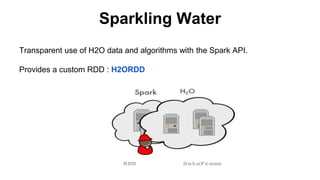
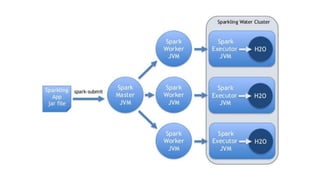
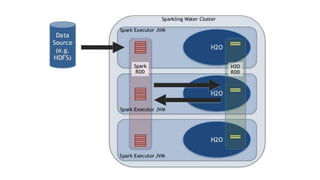
Sparkling Water 
Transparent use of H2O data and algorithms with the Spark API. 
Provides a custom RDD : H2ORDD
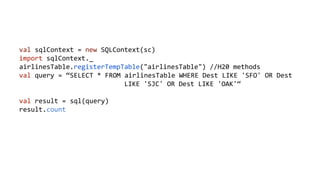
val sqlContext = new SQLContext(sc) 
import sqlContext._ 
airlinesTable.registerTempTable("airlinesTable") //H20 methods 
val query = “SELECT * FROM airlinesTable WHERE Dest LIKE 'SFO' OR Dest 
LIKE 'SJC' OR Dest LIKE 'OAK'“ 
val result = sql(query) 
result.count
Same but with Spark API 
// H2O Context provide useful implicits for conversions 
val h2oContext = new H2OContext(sc) 
import h2oContext._ 
// Create RDD wrapper around DataFrame 
val airlinesTable : RDD[Airlines] = toRDD[Airlines](airlinesData) 
airlinesTable.count 
// And use Spark RDD API directly 
val flightsOnlyToSF = airlinesTable.filter(f => 
f.Dest==Some("SFO") || f.Dest==Some("SJC") || f.Dest==Some("OAK") 
) 
flightsOnlyToSF.count
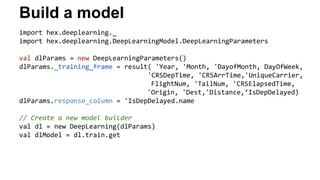
Build a model 
import hex.deeplearning._ 
import hex.deeplearning.DeepLearningModel.DeepLearningParameters 
val dlParams = new DeepLearningParameters() 
dlParams._training_frame = result( 'Year, 'Month, 'DayofMonth, DayOfWeek, 
'CRSDepTime, 'CRSArrTime,'UniqueCarrier, 
FlightNum, 'TailNum, 'CRSElapsedTime, 
'Origin, 'Dest,'Distance,‘IsDepDelayed) 
dlParams.response_column = 'IsDepDelayed.name 
// Create a new model builder 
val dl = new DeepLearning(dlParams) 
val dlModel = dl.train.get
Predict 
// Use model to score data 
val prediction = dlModel.score(result)(‘predict) 
// Collect predicted values via the RDD API 
val predictionValues = toRDD[DoubleHolder](prediction) 
.collect 
.map ( _.result.getOrElse("NaN") )
Slides: http://speakerdeck.com/samklr/

scalable machine learning

  • 1.
  • 2.
    me: Sam Bessalah Software Engineer, Freelance Big Data, Distributed Computing, Machine Learning Paris Data Geek Co-organizer @samklr @DataParis
  • 3.
    Machine Learning Land VOWPAL WABBIT
  • 4.
    Some Observations inBig Data Land ● New use cases push towards faster execution platforms and real time predictions engines. ● Traditional MapReduce on Hadoop is fading away, especially for Machine Learning ● Apache Spark has become the darling of the Big Data world, thanks to its high level API and performances. ● Rise of Machine Learning public APIs to easily integrate models into application and other data processing workflows.
  • 5.
    ● Used tobe the only Hadoop MapReduce Framework ● Moved from MapReduce towards modern and faster backends, namely ● Now provide a fluent DSL that integrates with Scala and Spark
  • 7.
    Mahout Example SimpleCo-occurence analysis in Mahout val A = drmFromHDFS (“ hdfs://nivdul/babygirl.txt“) val cooccurencesMatrix = A.t %*% A val numInteractions = drmBroadcast(A.colsums) val I = C.mapBlock(){ case (keys, block) => val indicatorBlock = sparse(row, col) for (r <- block ) indicatorBlock = computeLLR (row, nbInt) keys <- indicatorblock }
  • 8.
    Dataflow system, materializedby immutable and lazy, in-memory distributed collections suited for iterative and complex transformations, like in most Machine Learning algorithms. Those in-memory collections are called Resilient Distributed Datasets (RDD) They provide : ● Partitioned data ● High level operations (map, filter, collect, reduce, zip, join, sample, etc …) ● No side effects ● Fault recovery via lineage
  • 9.
  • 10.
  • 11.
    MLlib Machine Learninglibrary within Spark : ● Provides an integrated predictive and data analysis workflow ● Broad collections of algorithms and applications ● Integrates with the whole Spark Ecosystem Three APIs in :
  • 12.
  • 13.
    Example: Clustering viaK-means // Load and parse data val data = sc.textFile(“hdfs://bbgrl/dataset.txt”) val parsedData = data.map { x => Vectors.dense(x.split(“ “).map.(_.toDouble )) }.cache() //Cluster data into 5 classes using K-means val clusters = Kmeans.train(parsedData, k=5, numIterations=20 ) //Evaluate model error val cost = clusters.computeCost(parsedData)
  • 15.
    Coming to Spark1.2 ● Ensembles of decision trees : Random Forests ● Boosting ● Topic modeling ● Streaming Kmeans ● A pipeline interface for machine workflows A lot of contributions from the community
  • 16.
    Machine Learning Pipeline Typical machine learning workflows are complex ! Coming in next iterations of MLLib
  • 17.
    ● H20 isa fast (really fast), statistics, Machine Learning and maths engine on the JVM. ● Edited by 0xdata (commercial entity) and focus on bringing robust and highly performant machine learning algorithms to popular Big Data workloads. ● Has APIs in R, Java, Scala and Python and integrates to third parties tools like Tableau and Excel.
  • 19.
    Example in R library(h2o) localH2O = h2o.init(ip = 'localhost', port = 54321) irisPath = system.file("extdata", "iris.csv", package="h2o") iris.hex = h2o.importFile(localH2O, path = irisPath, key = "iris.hex") iris.data.frame <- as.data.frame(iris.hex) > colnames(iris.hex) [1] "C1" "C2" "C3" "C4" "C5" >
  • 20.
    Simple Logistic Regressioonto predict prostate cancer outcomes: > prostate.hex = h2o.importFile(localH2O, path="https://raw.github.com/0xdata/h2o/../prostate.csv", key = "prostate.hex") > prostate.glm = h2o.glm(y = "CAPSULE", x =c("AGE","RACE","PSA","DCAPS"), data = prostate.hex,family = "binomial", nfolds = 10, alpha = 0.5) > prostate.fit = h2o.predict(object=prostate.glm, newdata = prostate.hex)
  • 21.
    > (prostate.fit) IPAddress: 127.0.0.1 Port : 54321 Parsed Data Key: GLM2Predict_8b6890653fa743be9eb3ab1668c5a6e9 predict X0 X1 1 0 0.7452267 0.2547732 2 1 0.3969807 0.6030193 3 1 0.4120950 0.5879050 4 1 0.3726134 0.6273866 5 1 0.6465137 0.3534863 6 1 0.4331880 0.5668120
  • 22.
    Sparkling Water Transparentuse of H2O data and algorithms with the Spark API. Provides a custom RDD : H2ORDD
  • 25.
    val sqlContext =new SQLContext(sc) import sqlContext._ airlinesTable.registerTempTable("airlinesTable") //H20 methods val query = “SELECT * FROM airlinesTable WHERE Dest LIKE 'SFO' OR Dest LIKE 'SJC' OR Dest LIKE 'OAK'“ val result = sql(query) result.count
  • 26.
    Same but withSpark API // H2O Context provide useful implicits for conversions val h2oContext = new H2OContext(sc) import h2oContext._ // Create RDD wrapper around DataFrame val airlinesTable : RDD[Airlines] = toRDD[Airlines](airlinesData) airlinesTable.count // And use Spark RDD API directly val flightsOnlyToSF = airlinesTable.filter(f => f.Dest==Some("SFO") || f.Dest==Some("SJC") || f.Dest==Some("OAK") ) flightsOnlyToSF.count
  • 27.
    Build a model import hex.deeplearning._ import hex.deeplearning.DeepLearningModel.DeepLearningParameters val dlParams = new DeepLearningParameters() dlParams._training_frame = result( 'Year, 'Month, 'DayofMonth, DayOfWeek, 'CRSDepTime, 'CRSArrTime,'UniqueCarrier, FlightNum, 'TailNum, 'CRSElapsedTime, 'Origin, 'Dest,'Distance,‘IsDepDelayed) dlParams.response_column = 'IsDepDelayed.name // Create a new model builder val dl = new DeepLearning(dlParams) val dlModel = dl.train.get
  • 28.
    Predict // Usemodel to score data val prediction = dlModel.score(result)(‘predict) // Collect predicted values via the RDD API val predictionValues = toRDD[DoubleHolder](prediction) .collect .map ( _.result.getOrElse("NaN") )
  • 30.

Editor's Notes

  • #14 c’est où le chat ?