Paul Dix
InfluxData – CTO & co-founder
paul@influxdata.com
@pauldix
InfluxDB IOx - a new columnar
time series database (update)
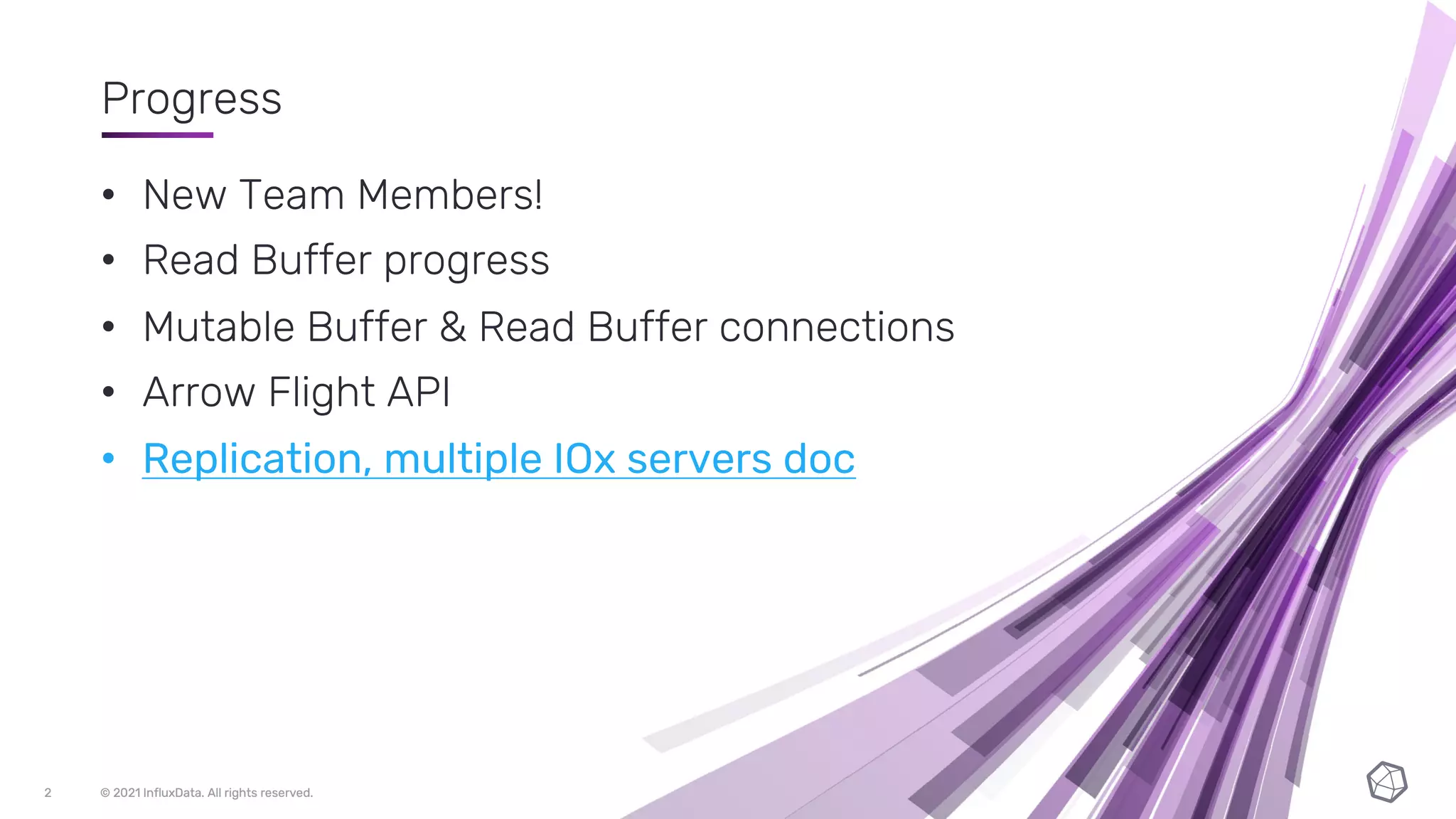
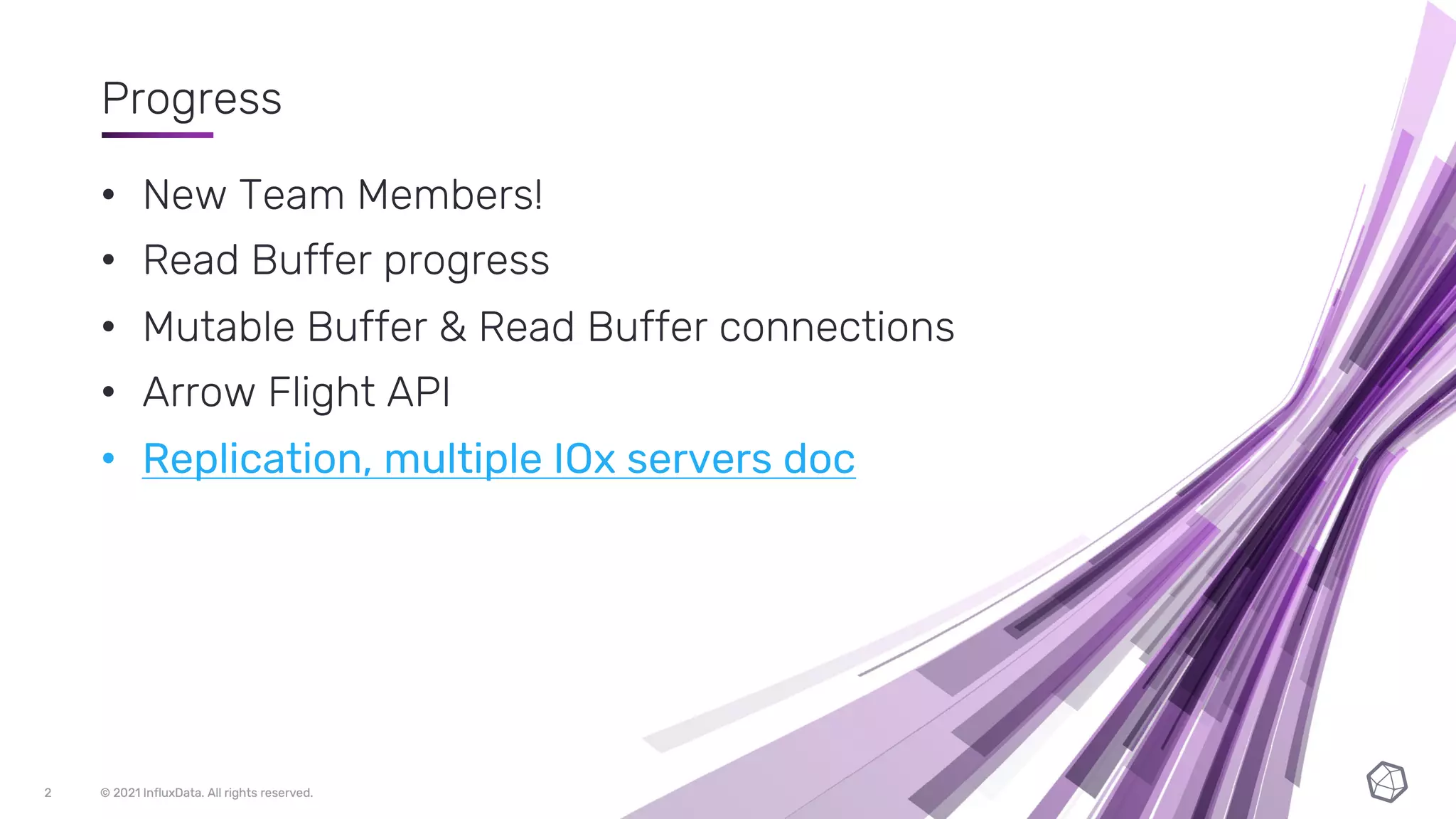
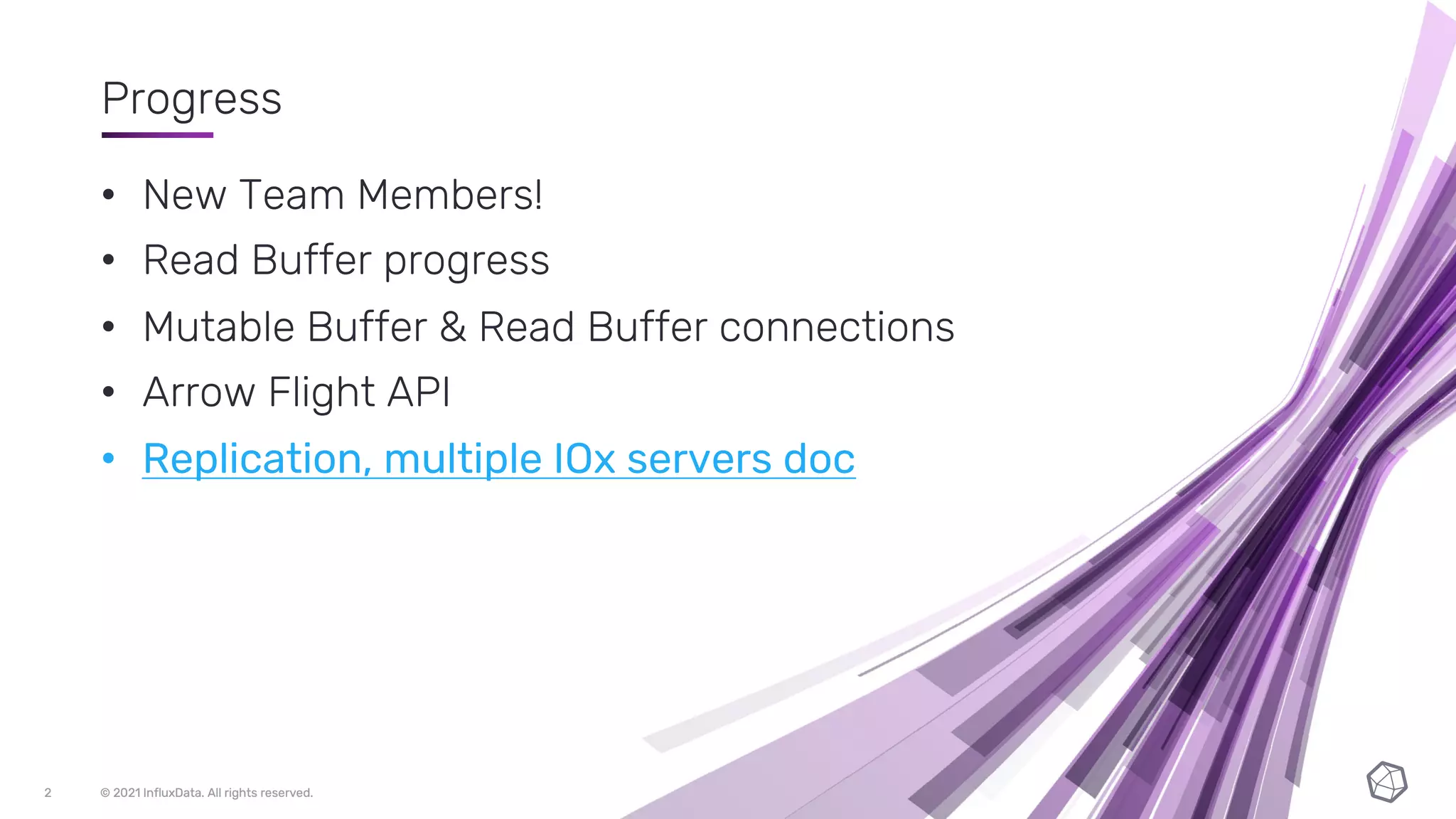
Progress
• New Team Members!
• Read Buffer progress
• Mutable Buffer & Read Buffer connections
• Arrow Flight API
• Replication, multiple IOx servers doc
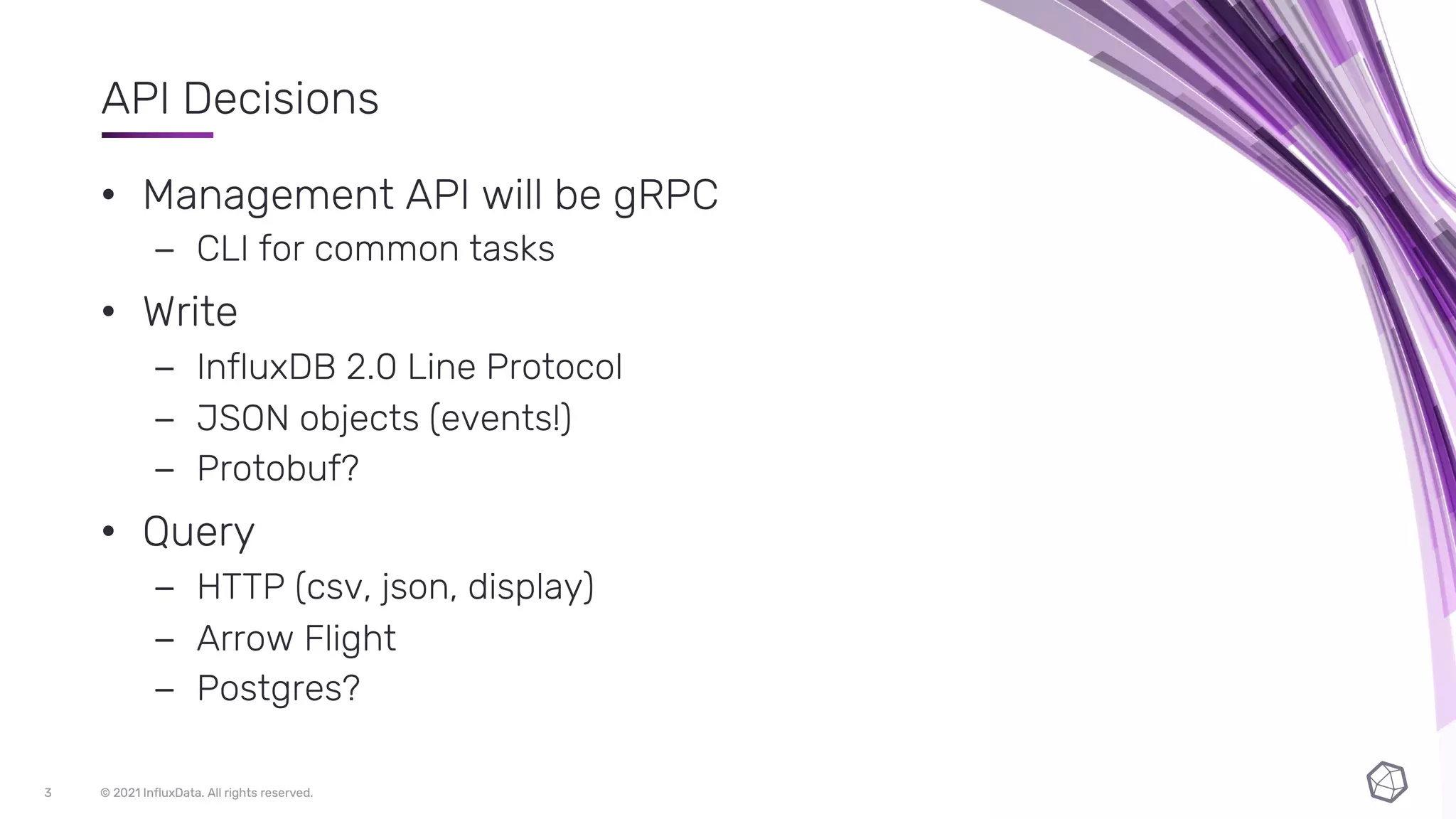
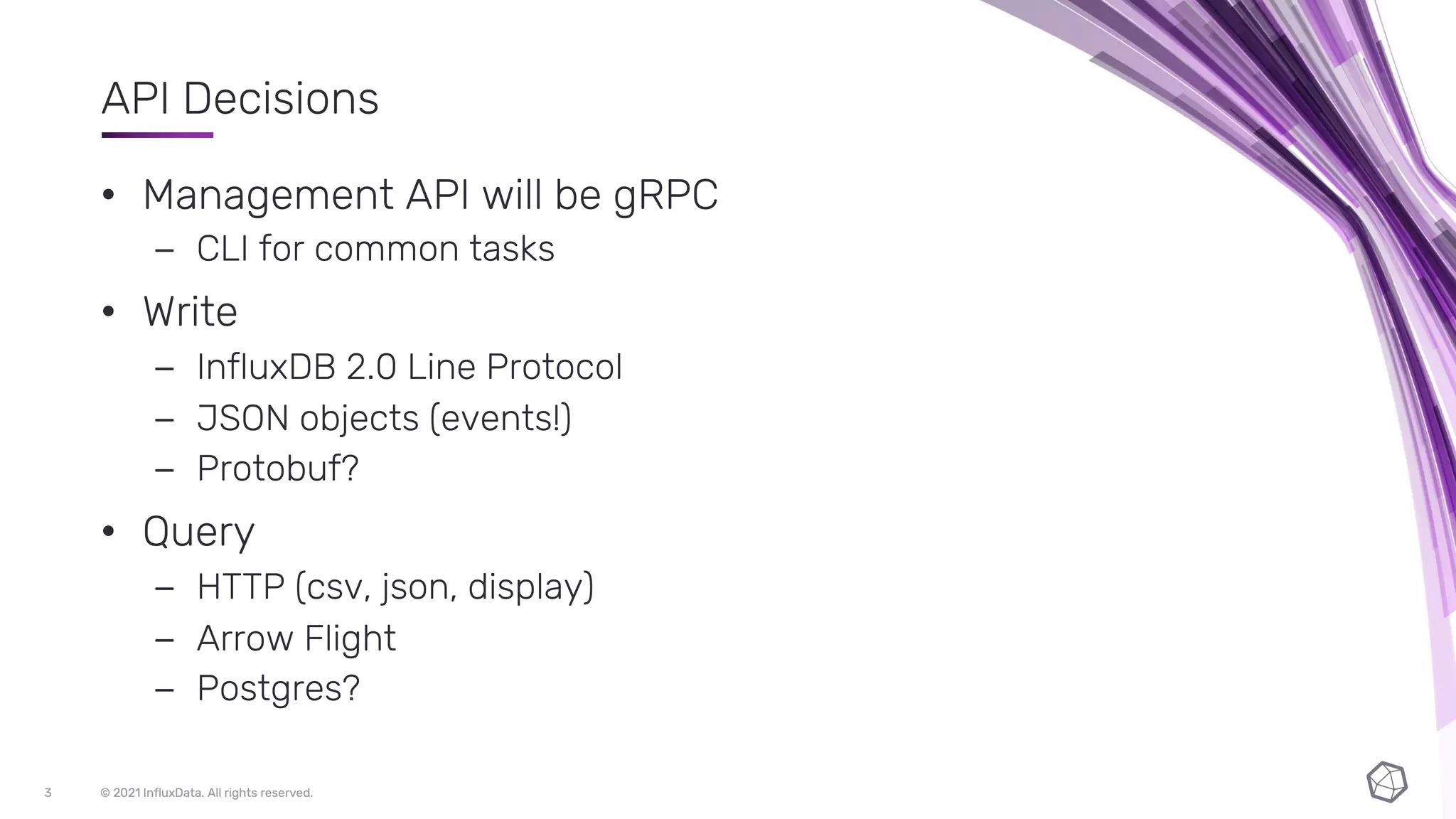
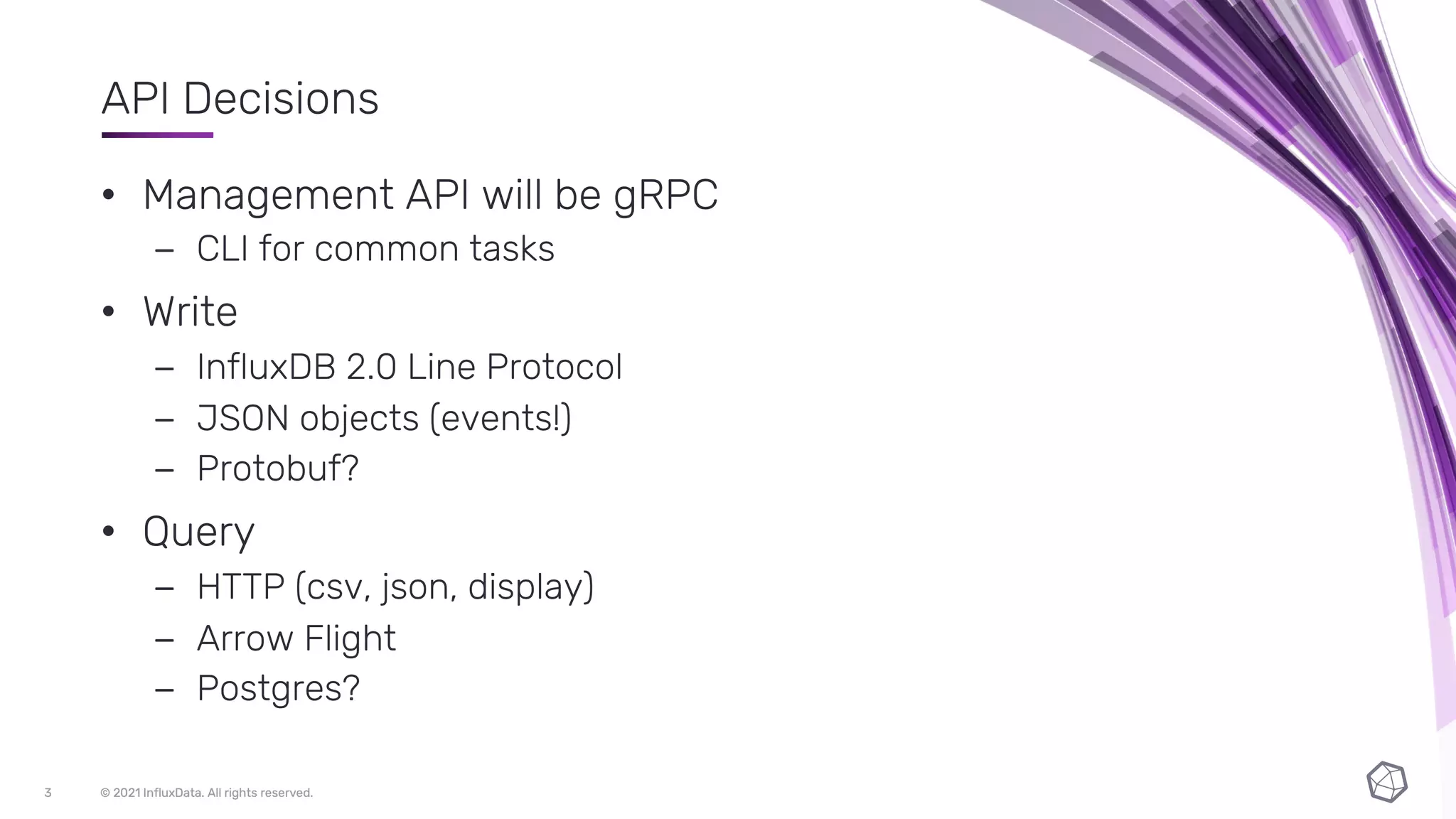
API Decisions
• Management API will be gRPC
– CLI for common tasks
• Write
– InfluxDB 2.0 Line Protocol
– JSON objects (events!)
– Protobuf?
• Query
– HTTP (csv, json, display)
– Arrow Flight
– Postgres?
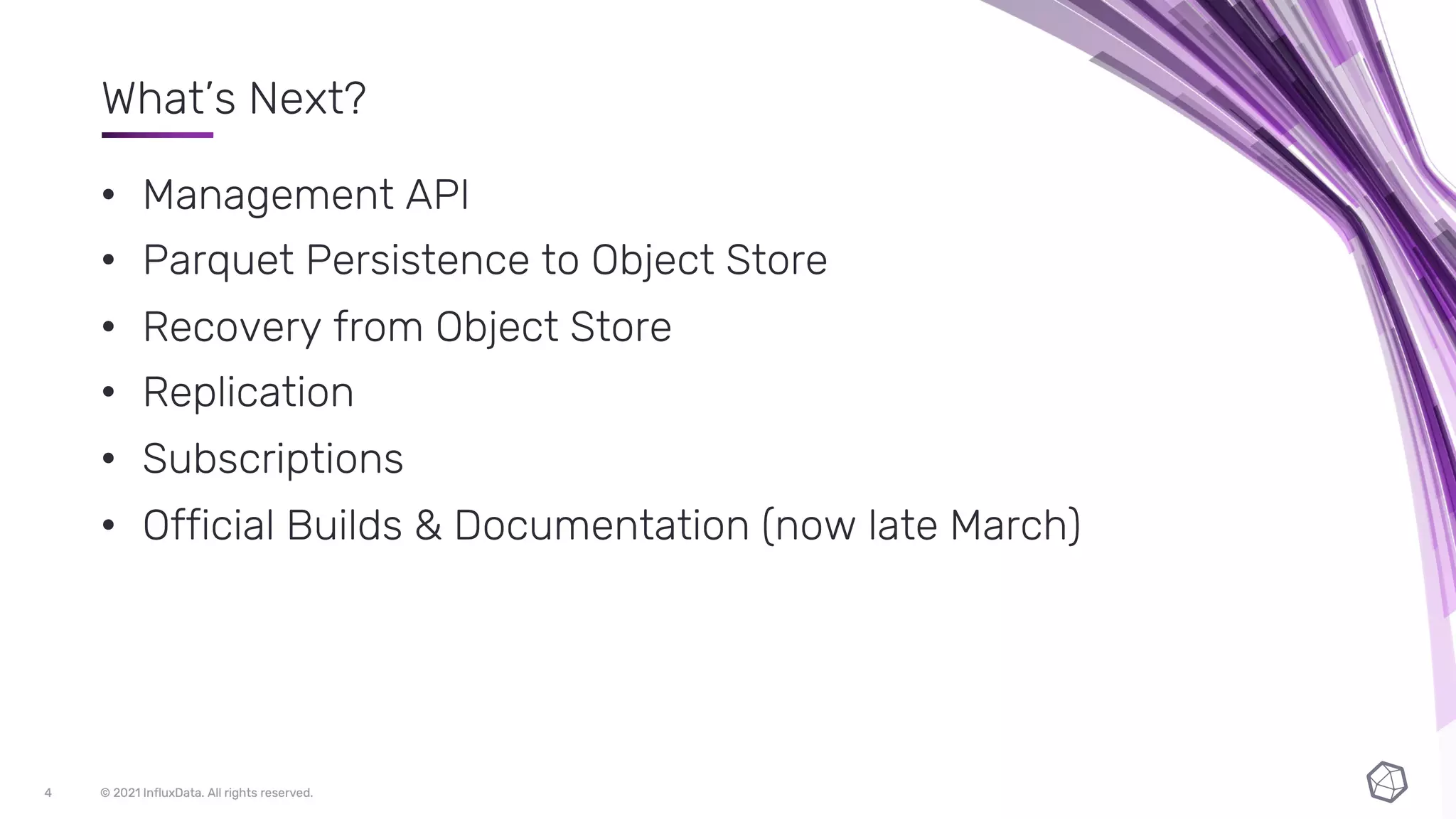
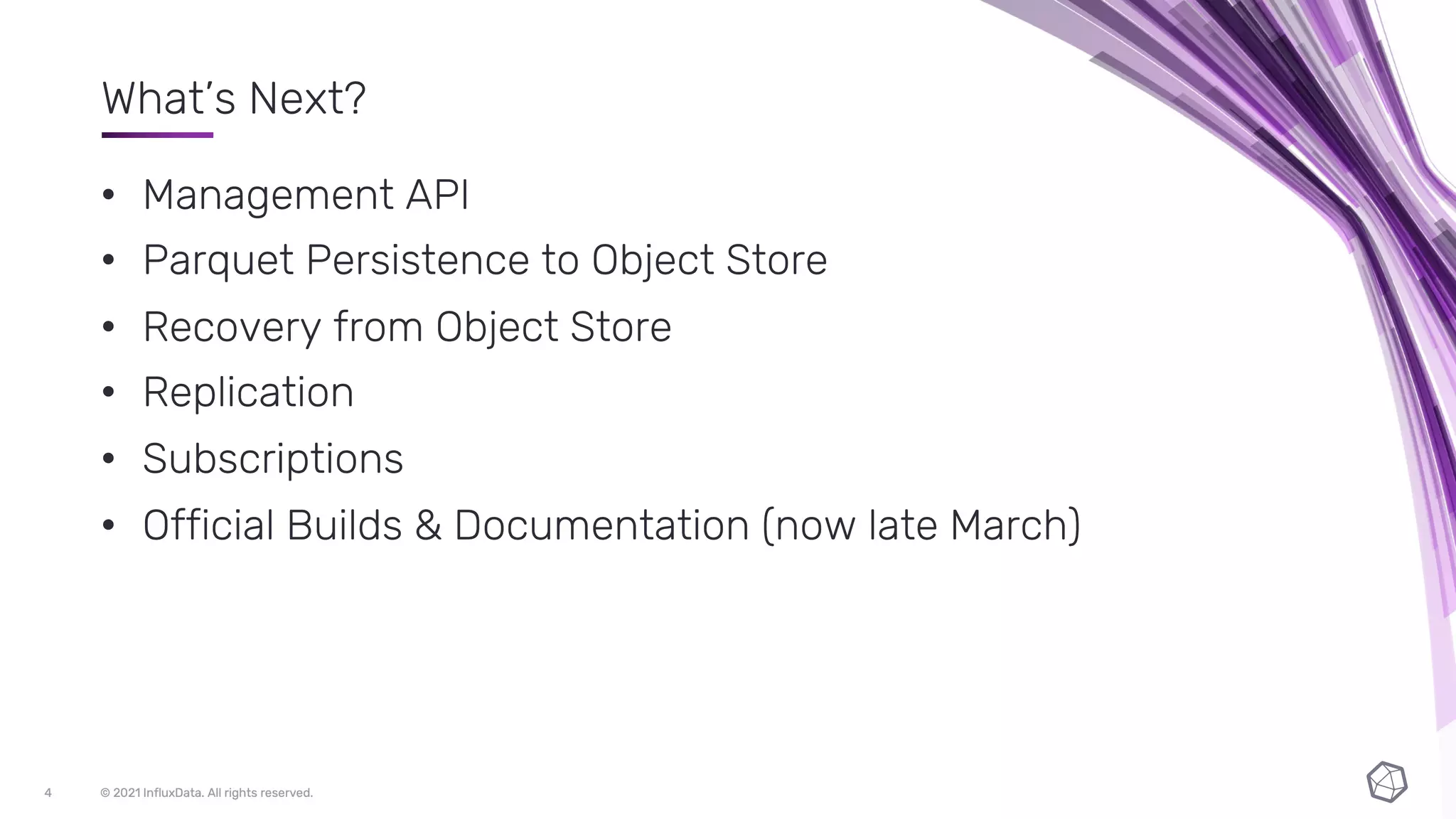
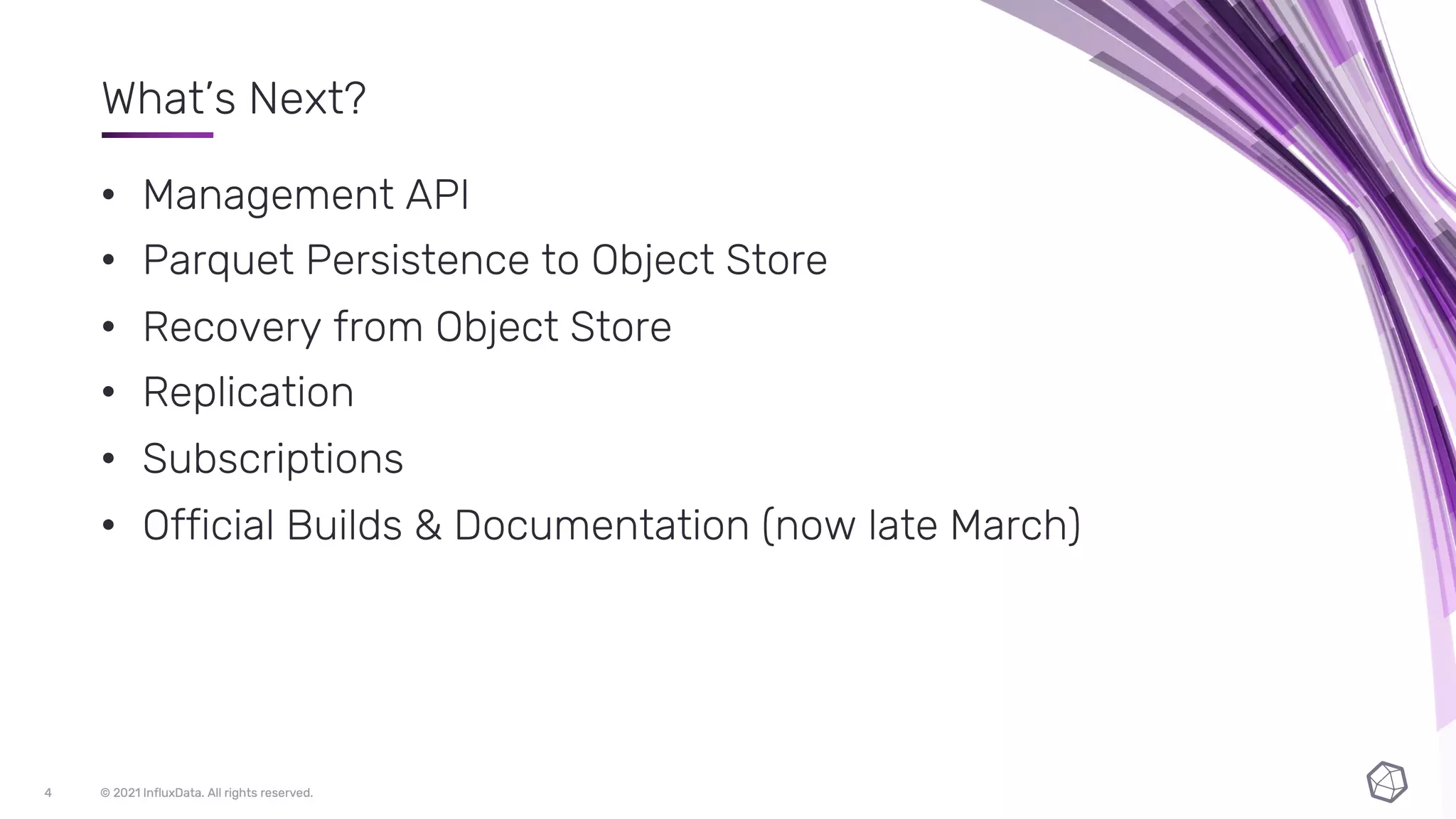
What’s Next?
• Management API
• Parquet Persistence to Object Store
• Recovery from Object Store
• Replication
• Subscriptions
• Official Builds & Documentation (now late March)
Edd Robinson
Engineer @ InfluxData
edd@influxdata.com
@e-dard 🐙
@eddrobinson 🐦
An Intro to the InfluxDB IOx
Read Buffer: a read-optimised
in-memory execution engine
Me
● Software engineer at InfluxData.
● Worked on InfluxDB for ~4y: storage engine, write path, indexing.
Working on IOx (and with Rust!) for just over a year.
What are we working towards?
● Unlimited Data:
○ Object Storage, compression
● Unlimited Cardinality:
○ Data organisation, no large
indexes.
● 🚀 Analytical Queries:
○ in-memory, columnar
data-layout, lots of fanciness
This talk is about...
A sub-system in IOx called the Read Buffer, a new query execution engine.
● Work on data held in-memory and on-heap. No IO at read-time
● Data is immutable.
● Lots of wholesome column-store goodness:
○ 📊
○ 🗜
○ ⇶
○ ❓
○ ❓
Wider Goals
We want to have excellent support for different time-series
use-cases
● Events
● Observability trifecta (logging, tracing, metrics)
● Large analytical workloads
We already have a time-series database?
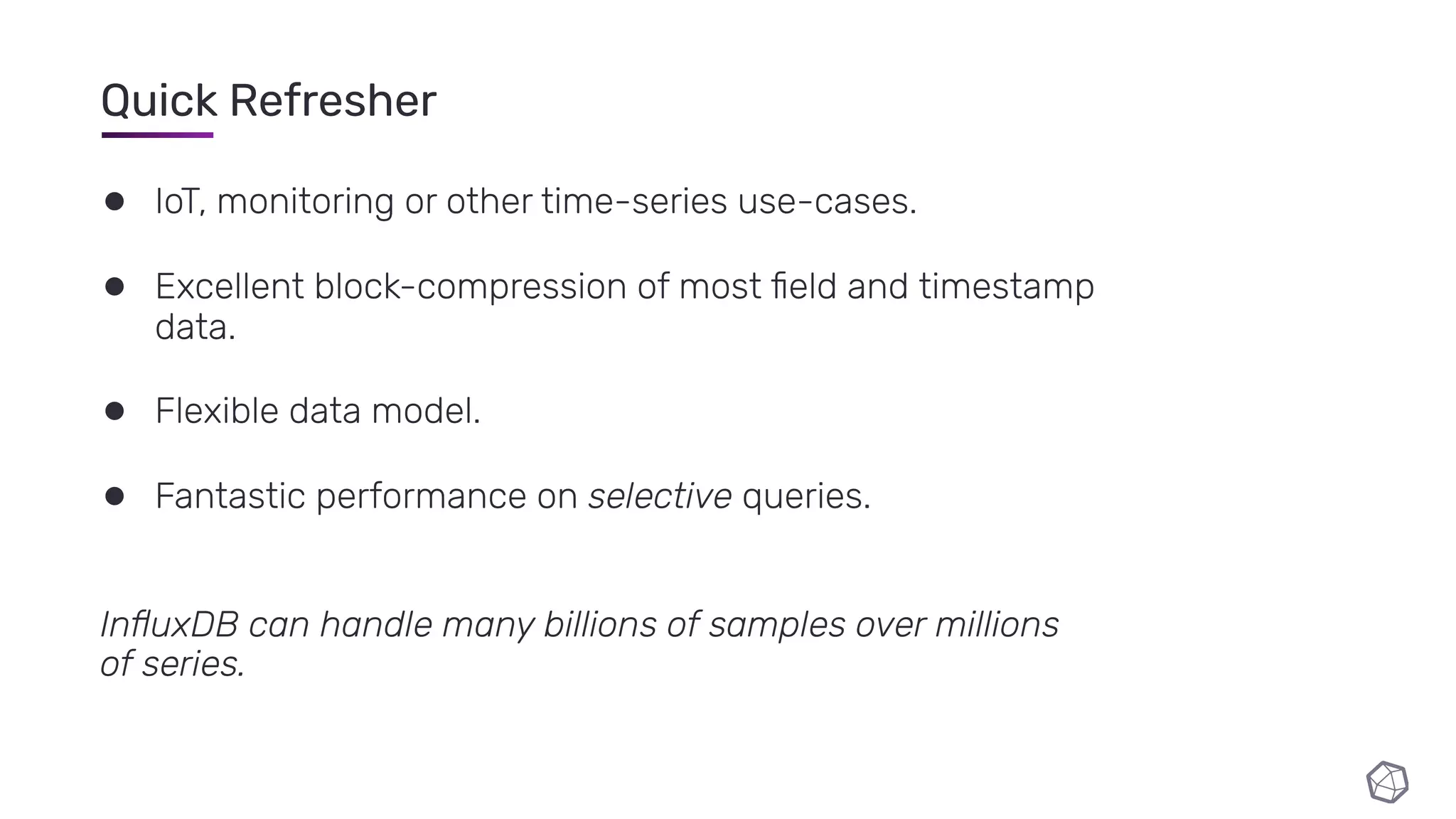
Quick Refresher
●
●
●
●
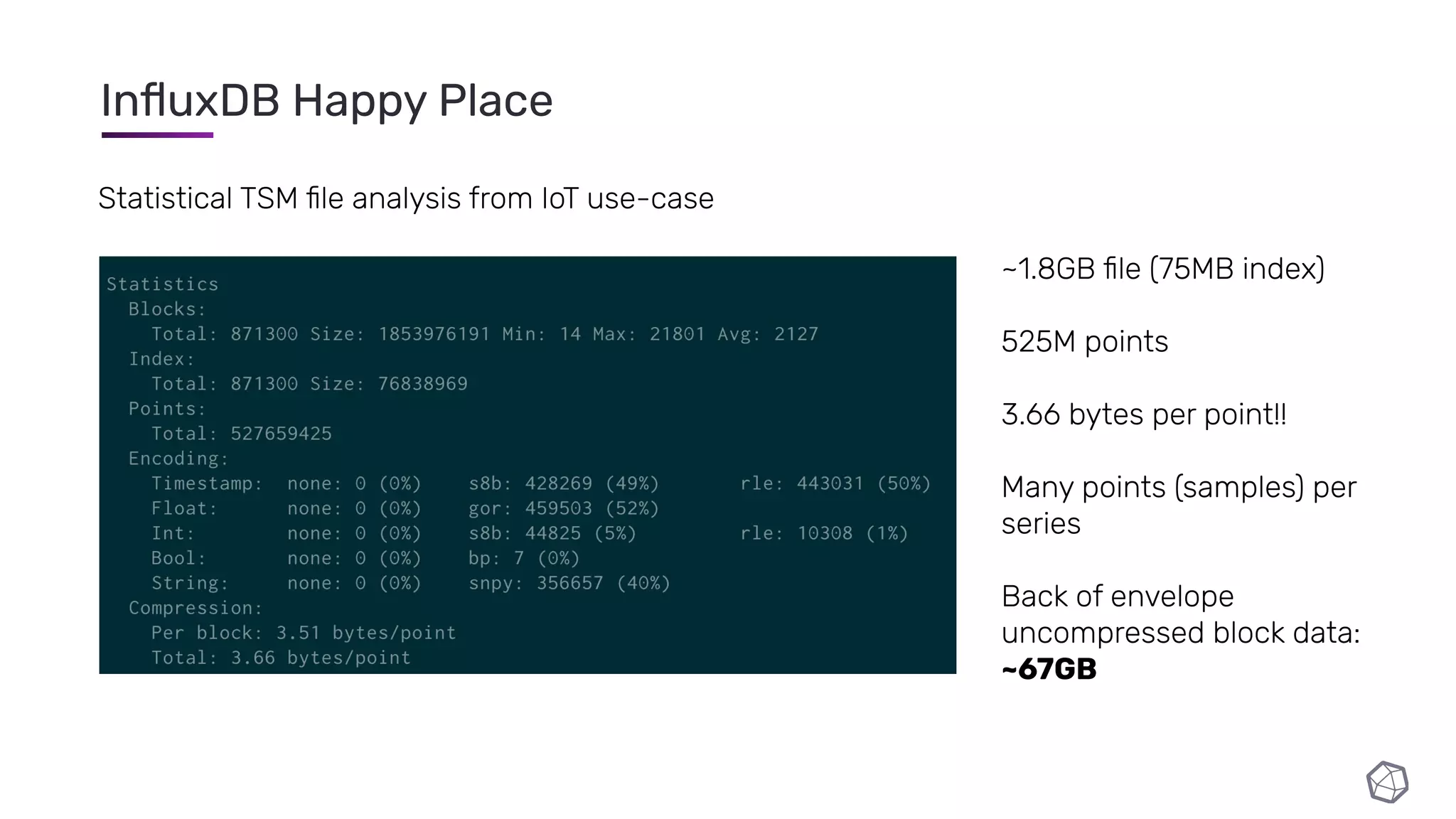
InfluxDB Happy Place
~67GB
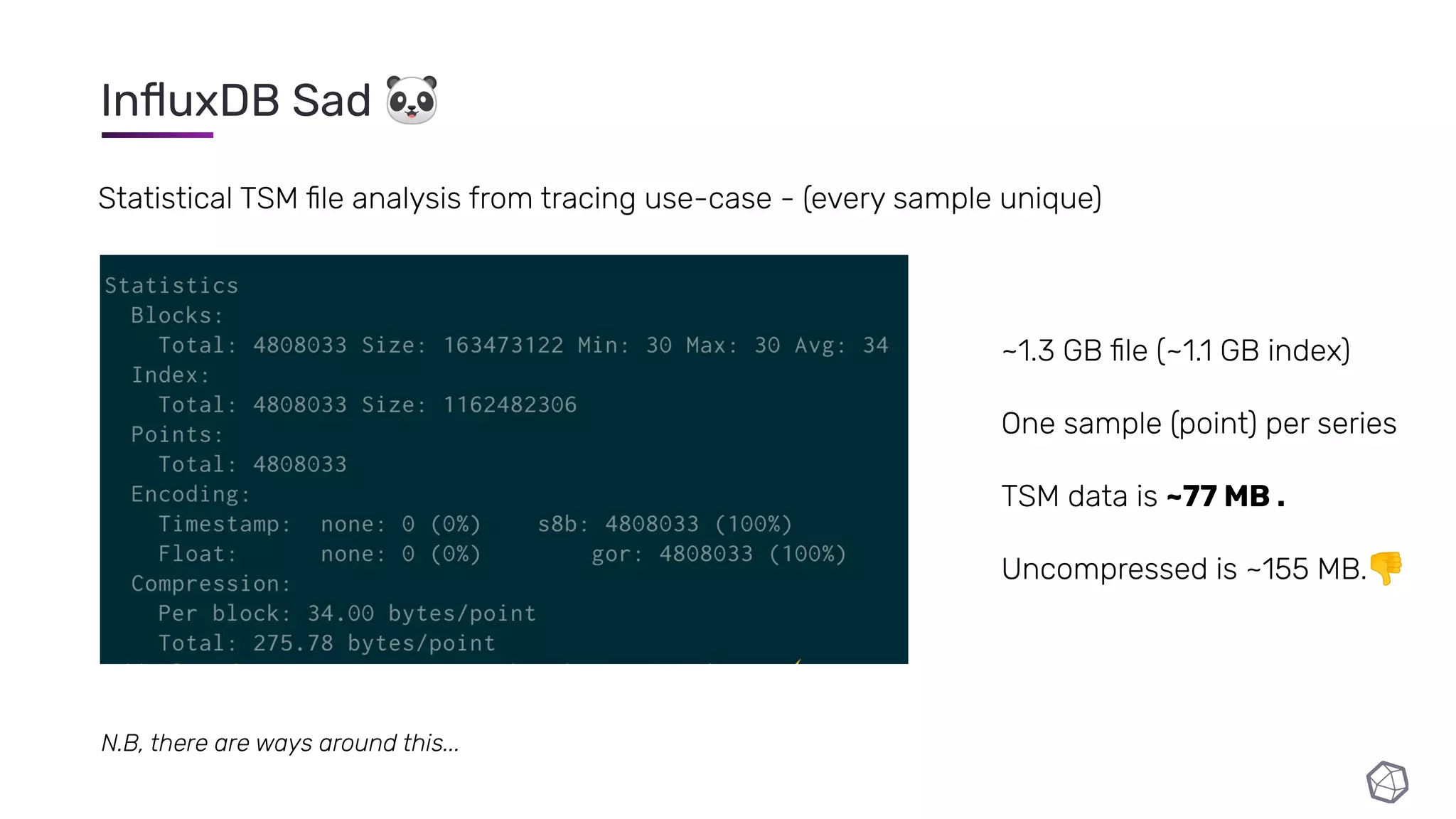
InfluxDB Sad 🐼
~77 MB .
👎
So...
●
● mmap
●
●
●
●
● mmap -
●
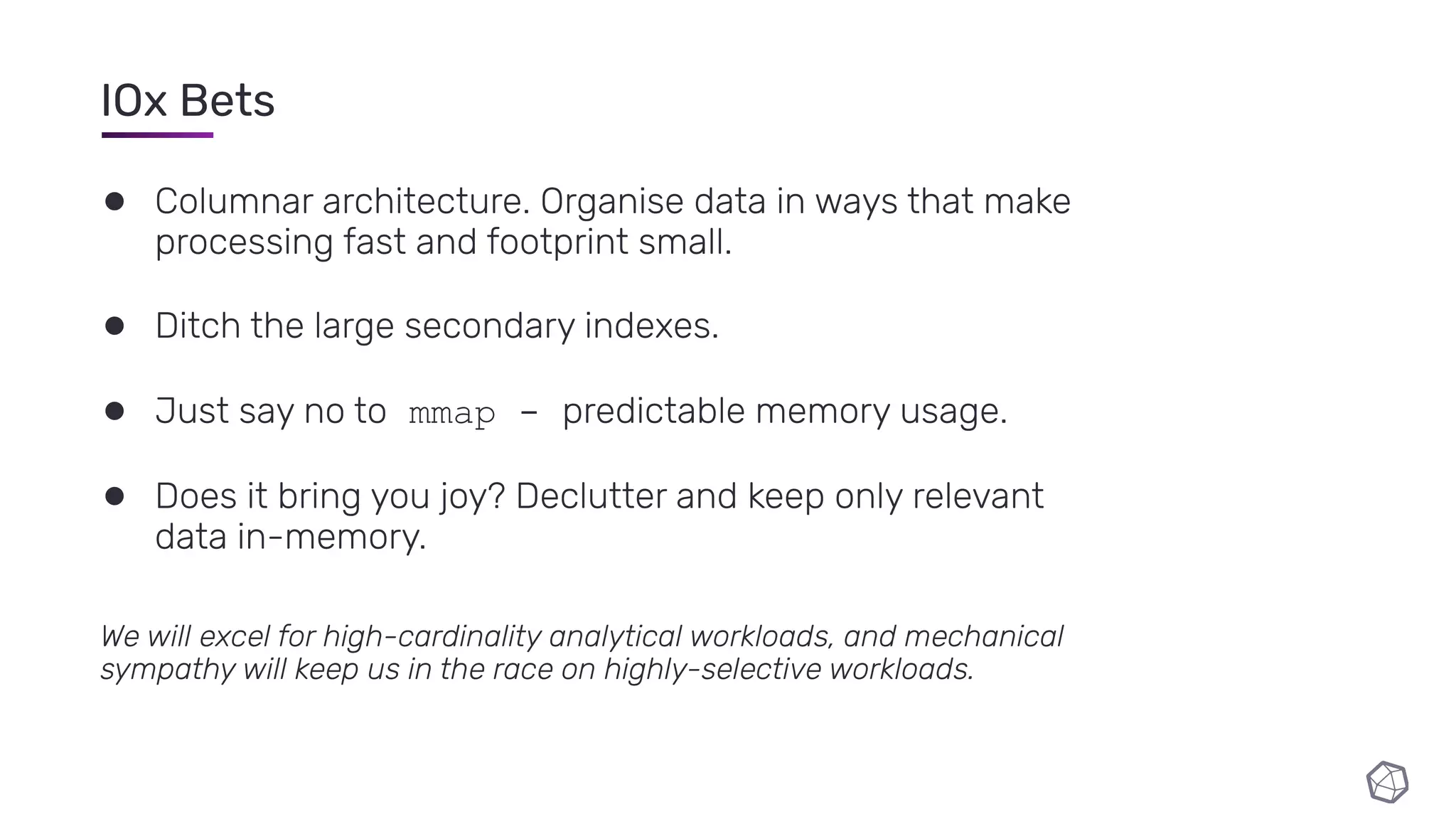
IOx Bets
Why columnar is the way to go
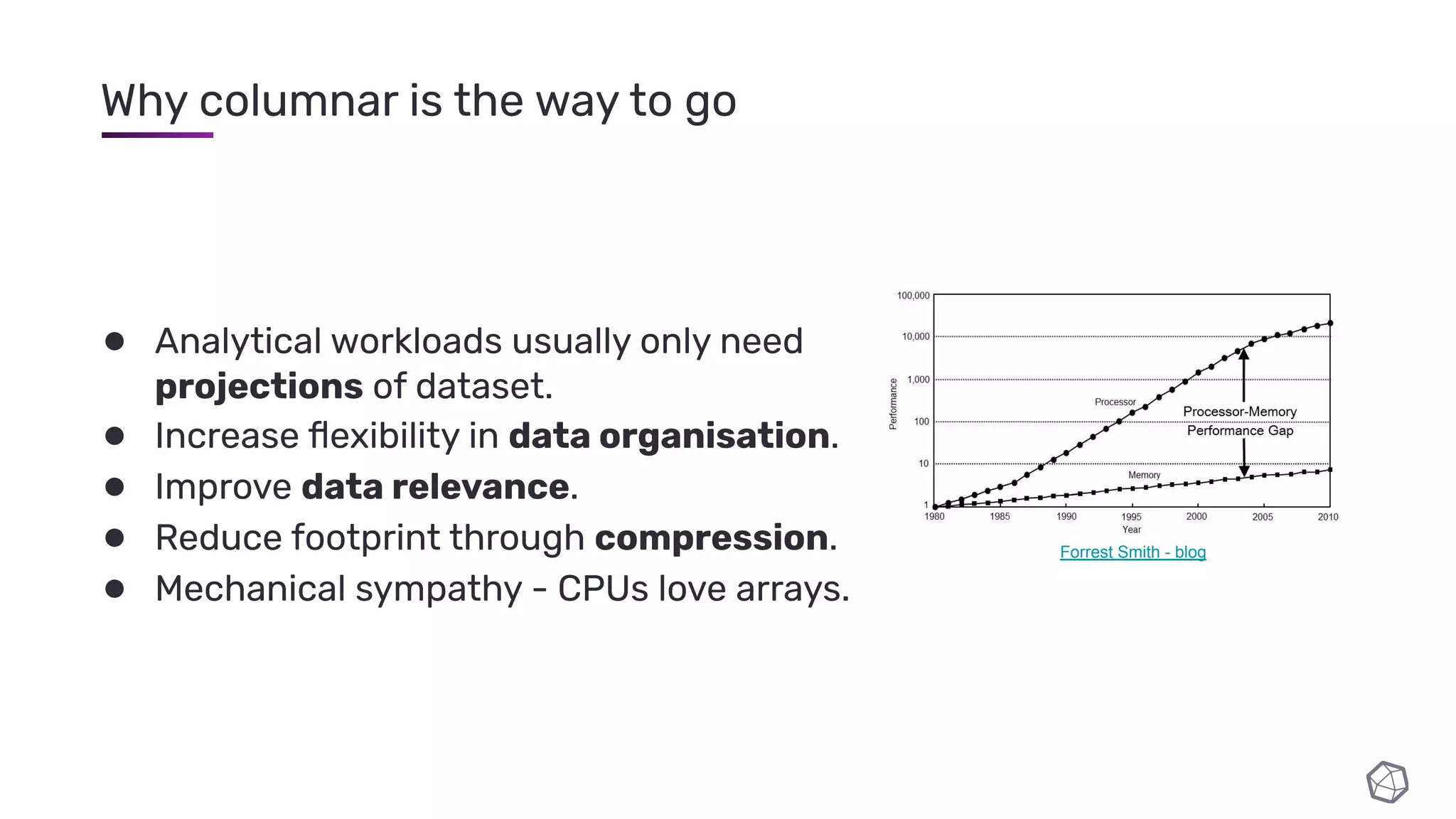
● Analytical workloads usually only need
projections of dataset.
● Increase flexibility in data organisation.
● Improve data relevance.
● Reduce footprint through compression.
● Mechanical sympathy - CPUs love arrays.
Forrest Smith - blog
Why columnar is the way to go
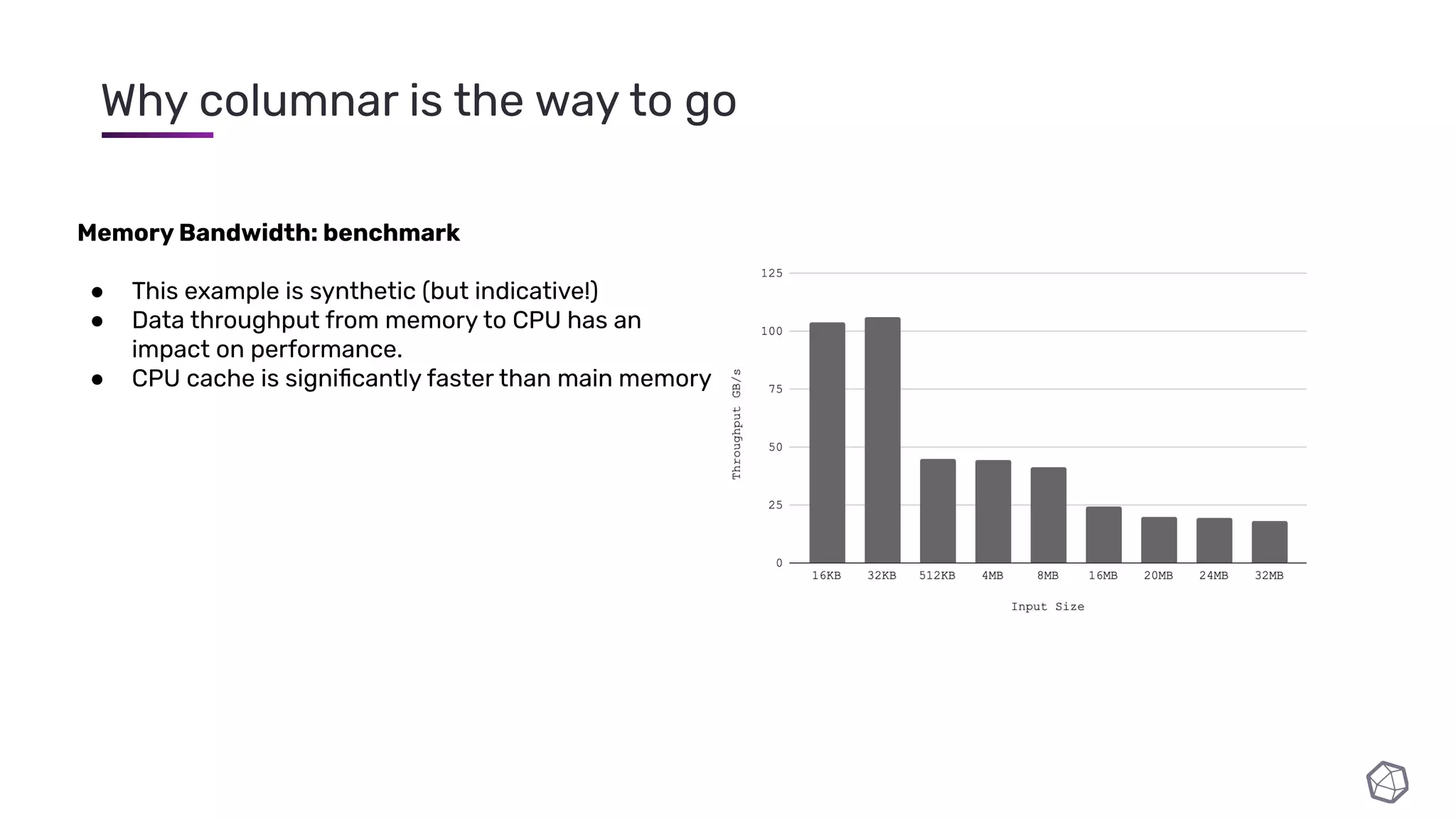
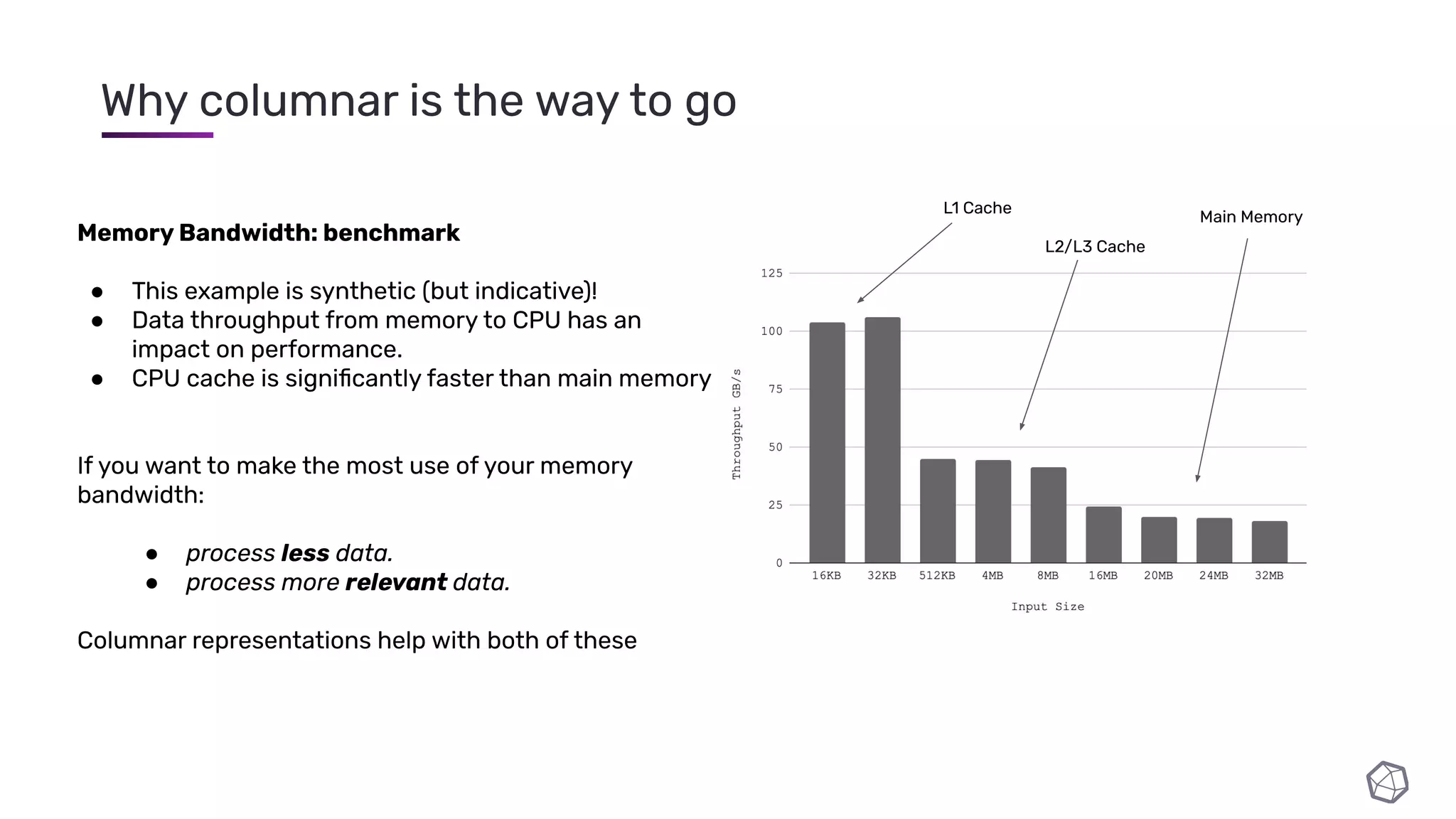
Memory Bandwidth: benchmark
● This example is synthetic (but indicative!)
● Data throughput from memory to CPU has an
impact on performance.
● CPU cache is significantly faster than main memory
Why columnar is the way to go
L1 Cache
L2/L3 Cache
Main Memory
Memory Bandwidth: benchmark
● This example is synthetic (but indicative)!
● Data throughput from memory to CPU has an
impact on performance.
● CPU cache is significantly faster than main memory
If you want to make the most use of your memory
bandwidth:
● process less data.
● process more relevant data.
Columnar representations help with both of these
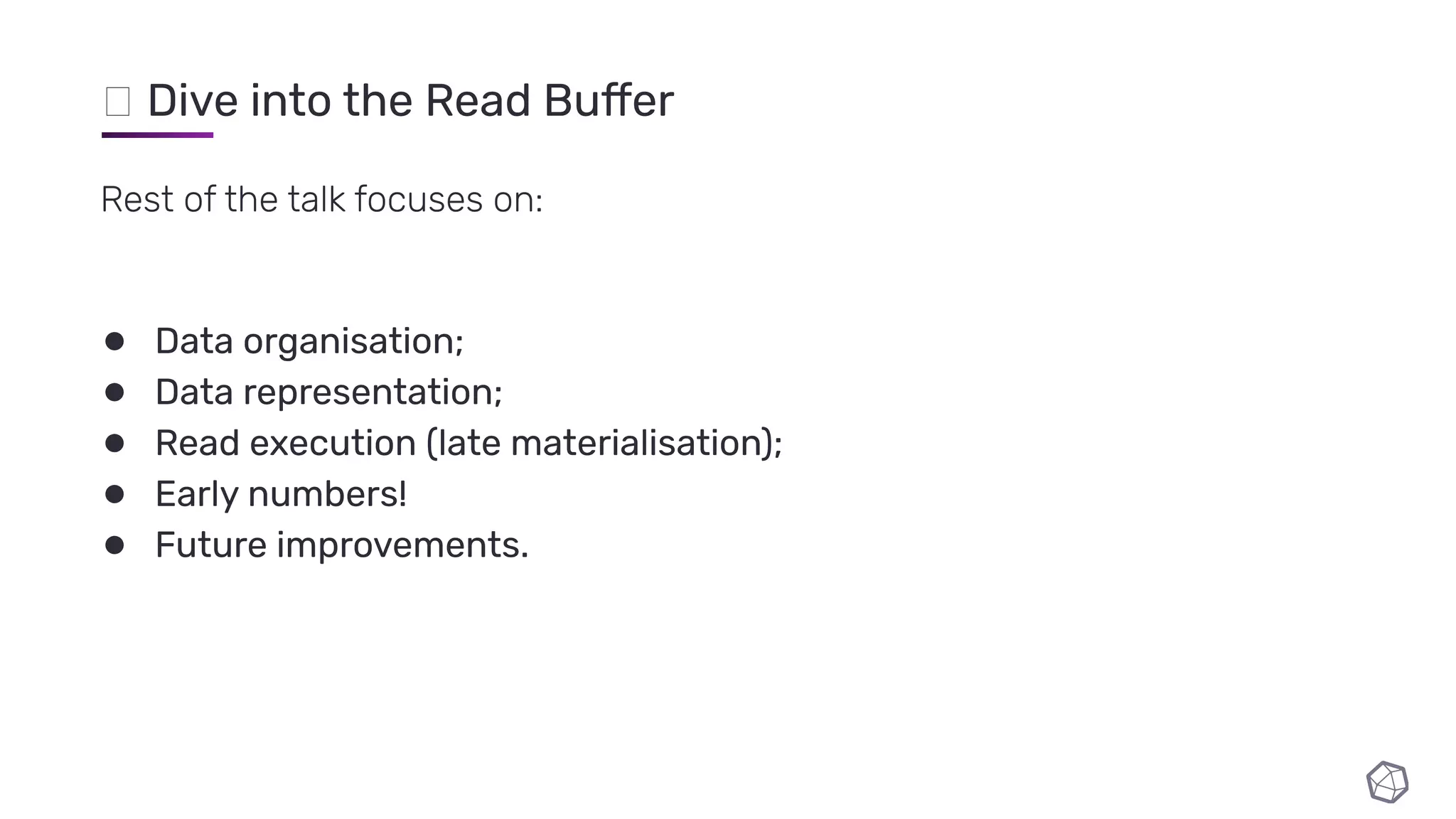
🤿 Dive into the Read Buffer
● Data organisation;
● Data representation;
● Read execution (late materialisation);
● Early numbers!
● Future improvements.
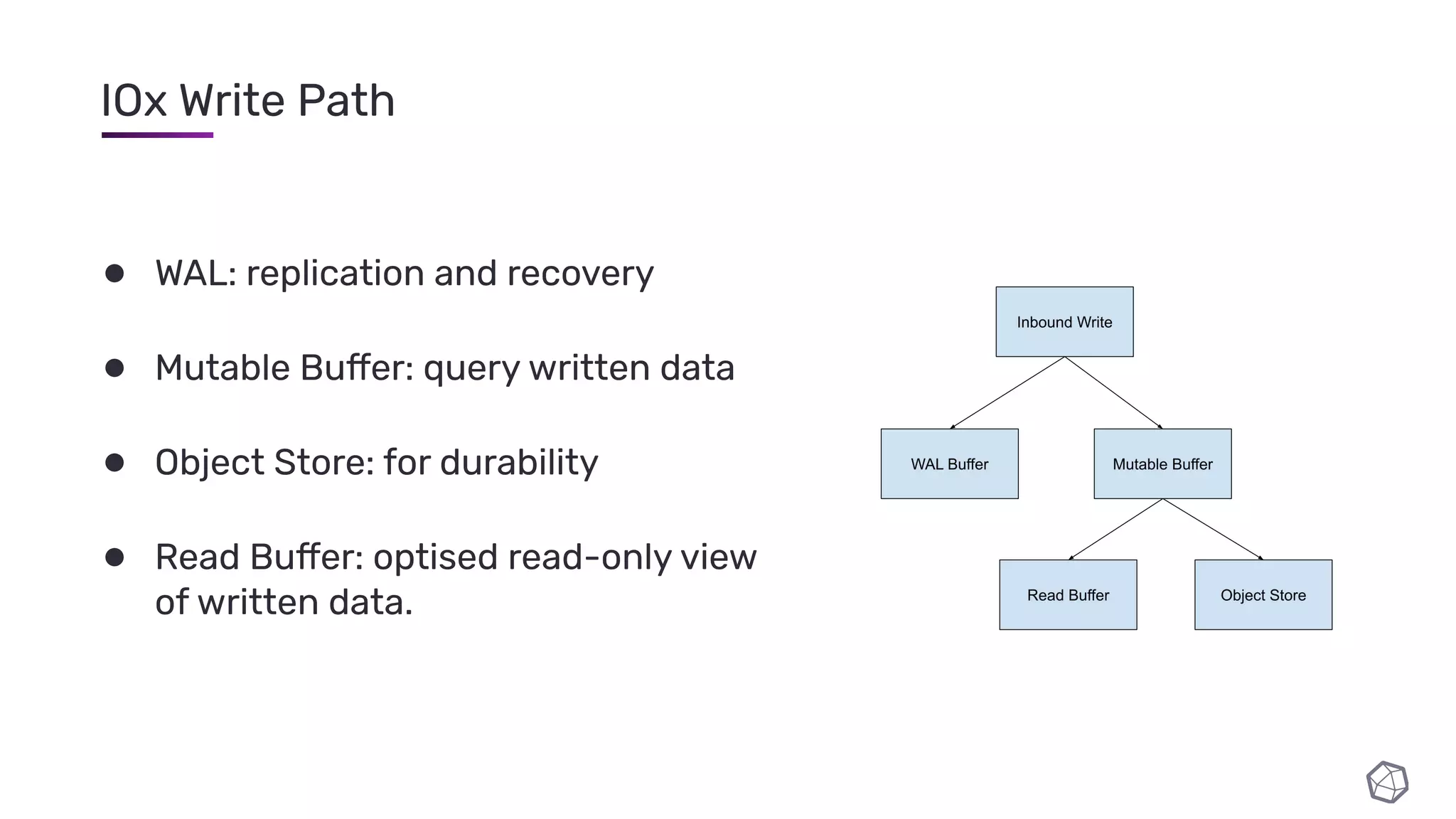
● WAL: replication and recovery
● Mutable Buffer: query written data
● Object Store: for durability
● Read Buffer: optised read-only view
of written data.
IOx Write Path
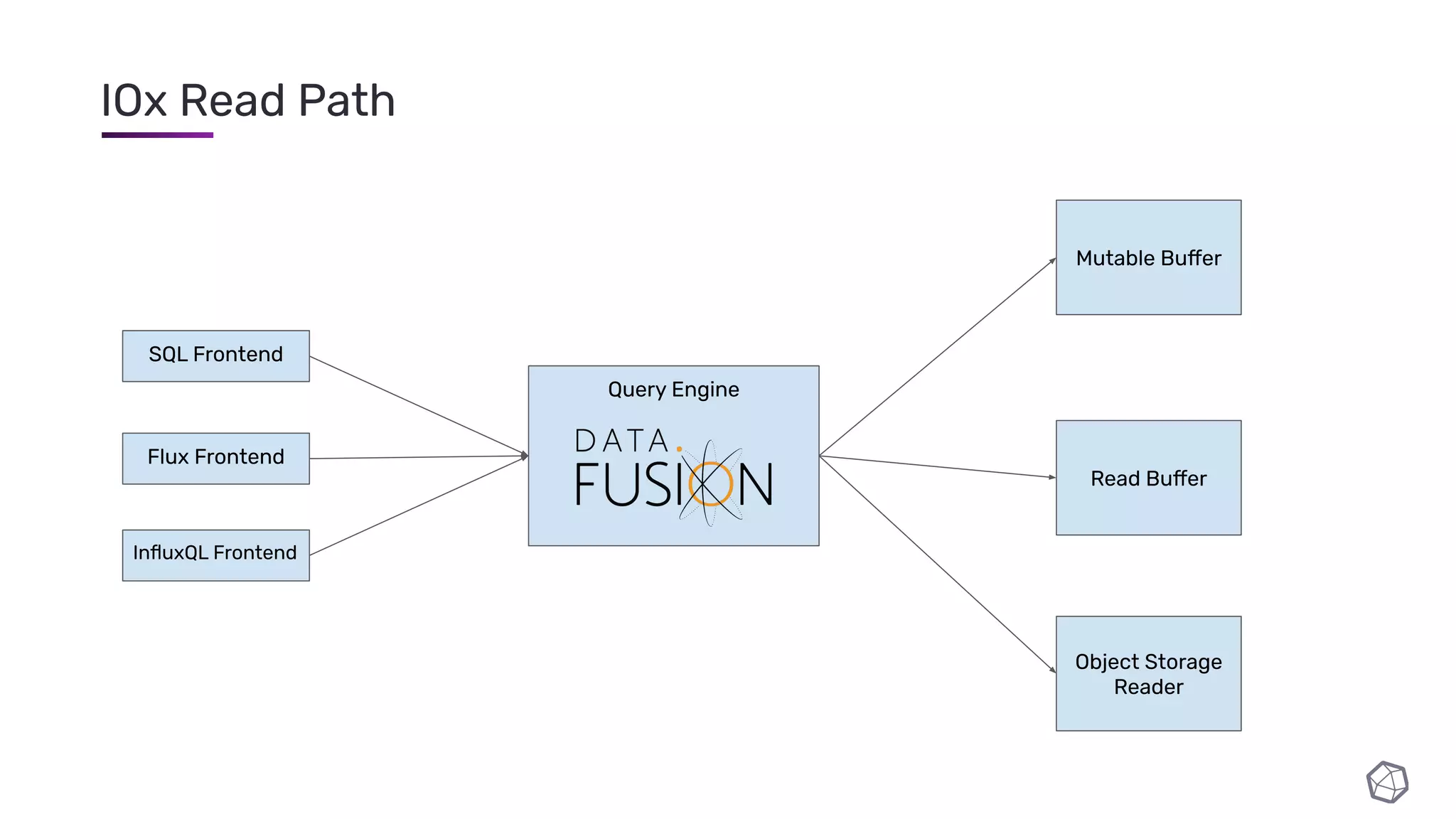
IOx Read Path
Query Engine
SQL Frontend
Flux Frontend
InfluxQL Frontend
Mutable Buffer
Read Buffer
Object Storage
Reader
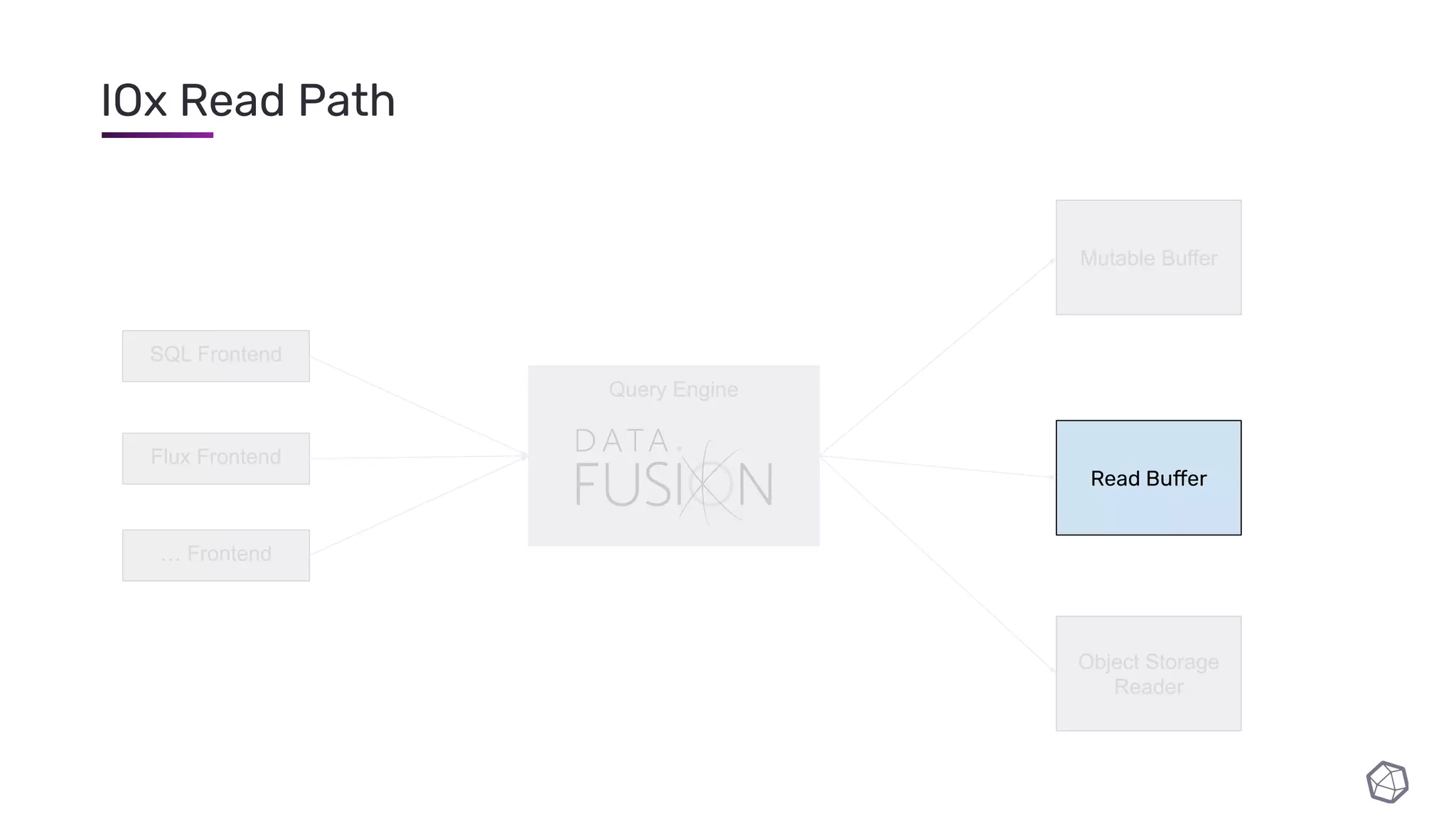
IOx Read Path
Query Engine
SQL Frontend
Flux Frontend
… Frontend
Mutable Buffer
Read Buffer
Object Storage
Reader
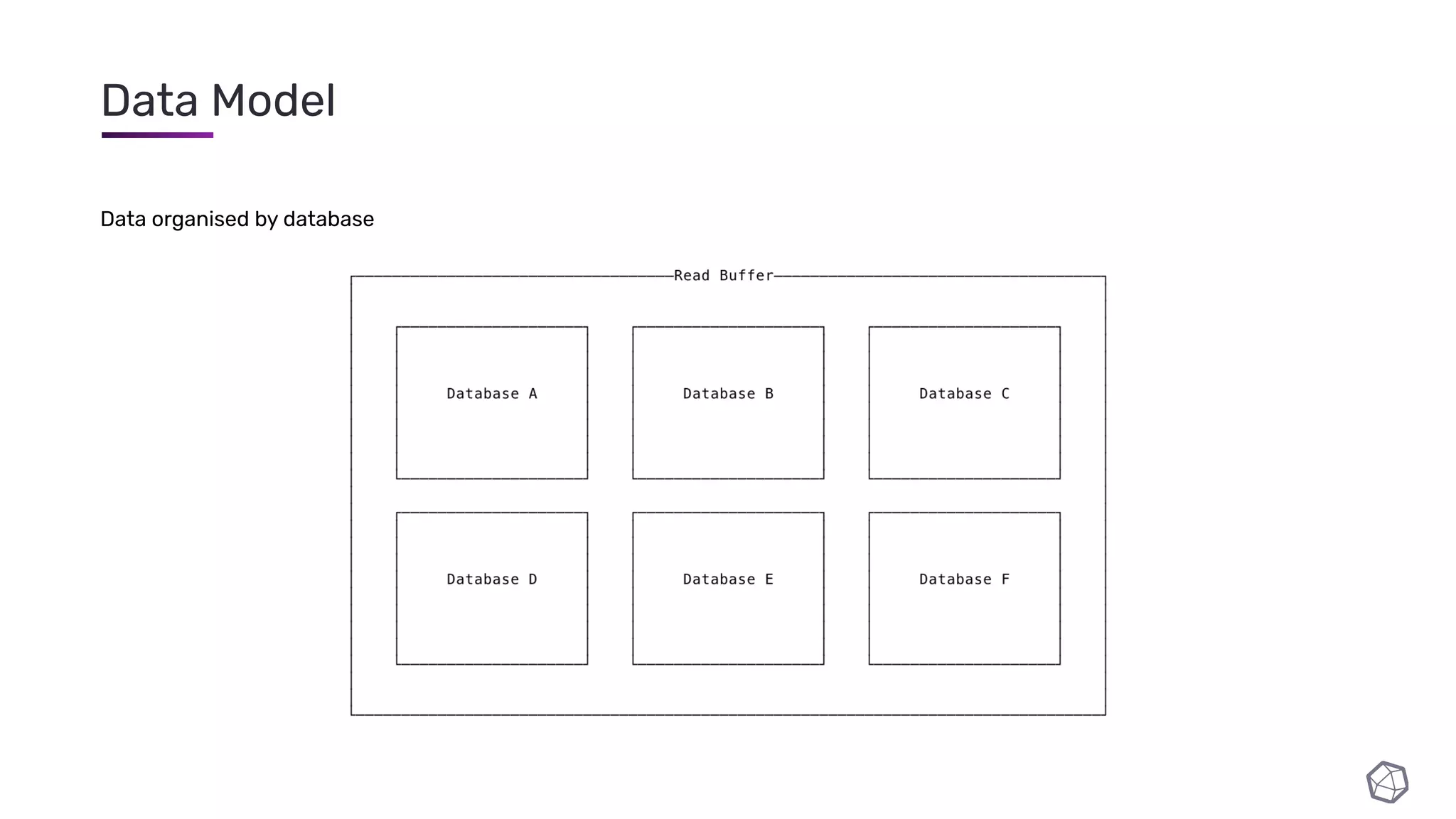
Data Model
Data organised by database
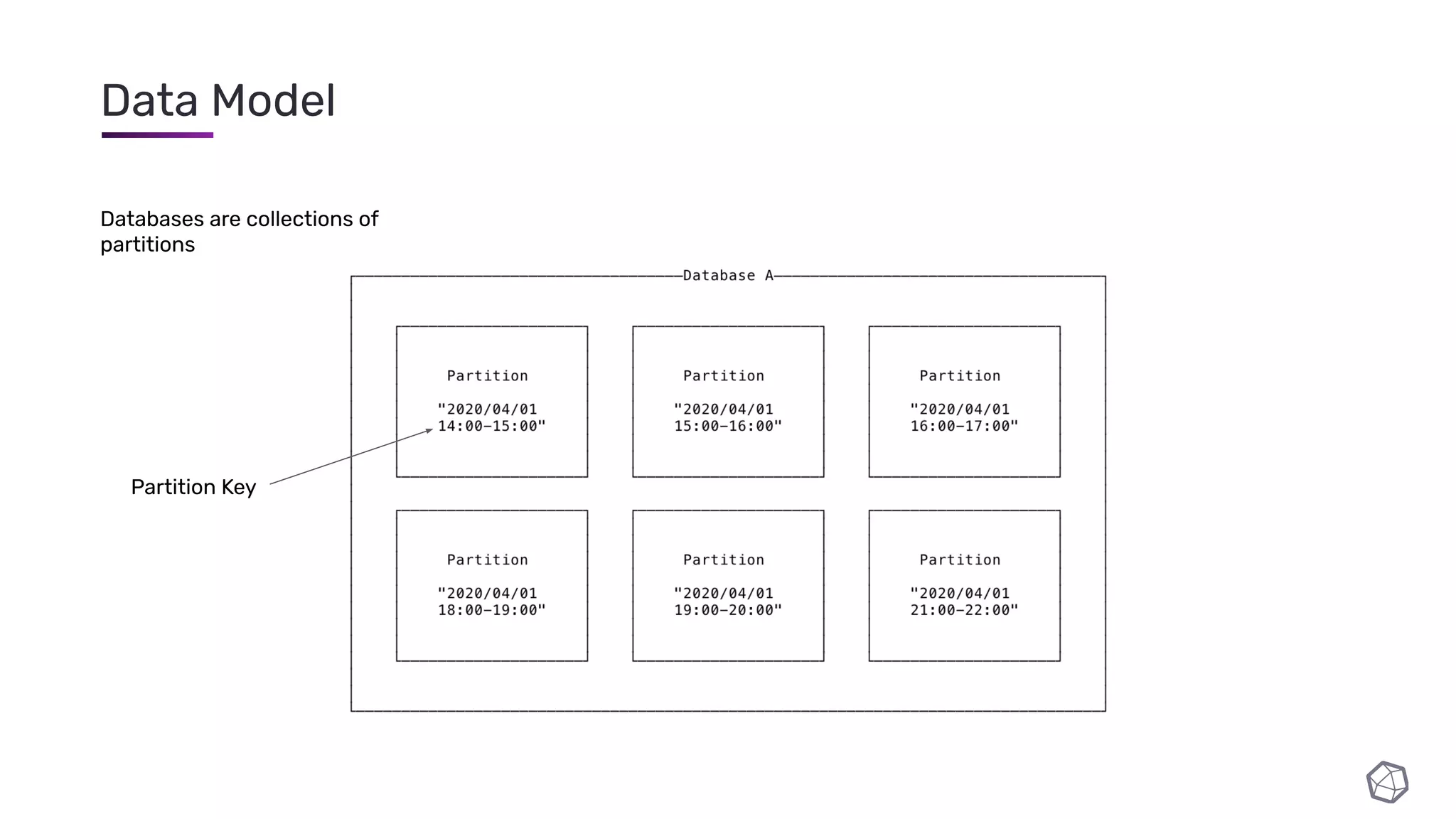
Data Model
Databases are collections of
partitions
Partition Key
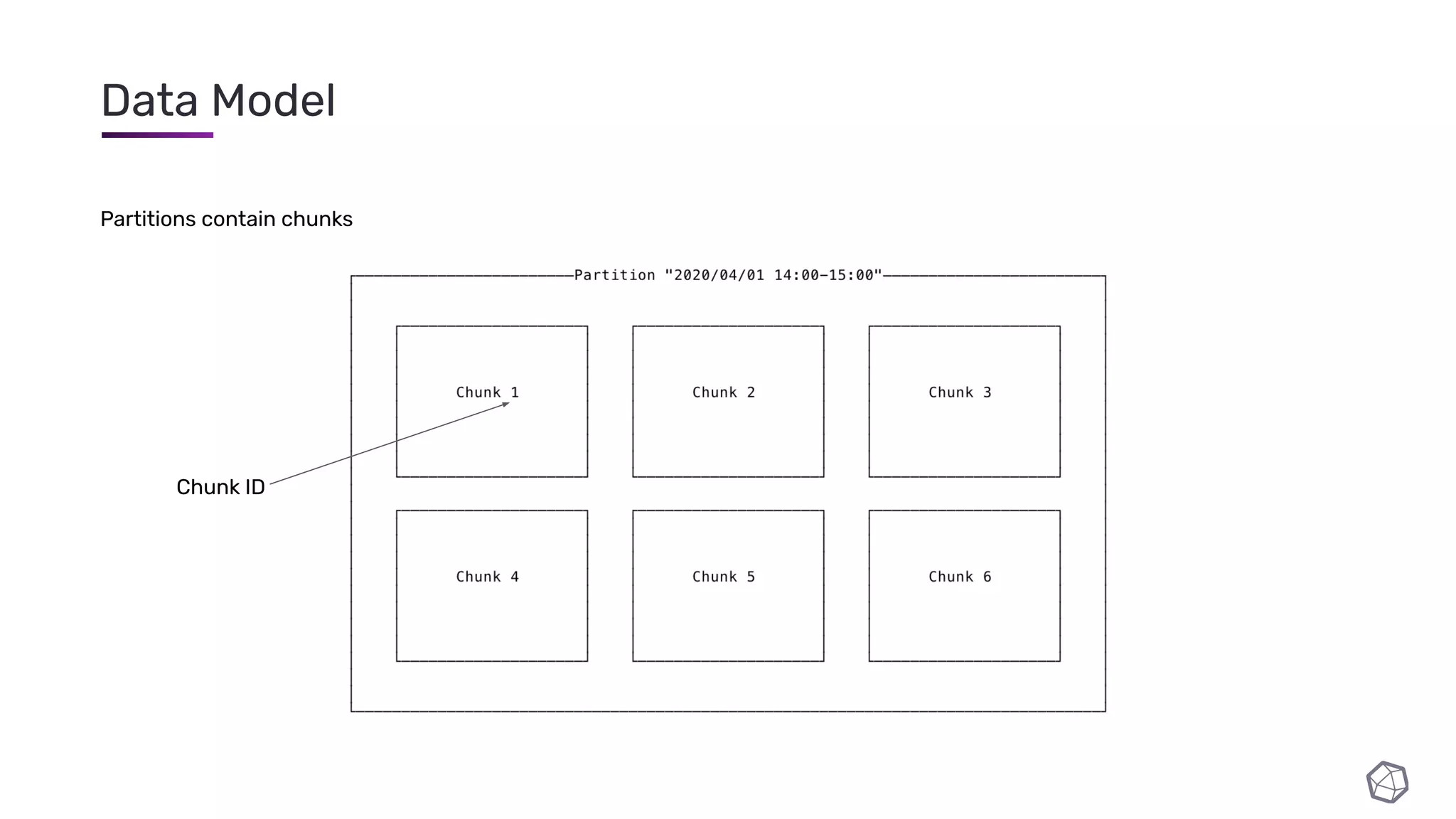
Chunk ID
Data Model
Partitions contain chunks
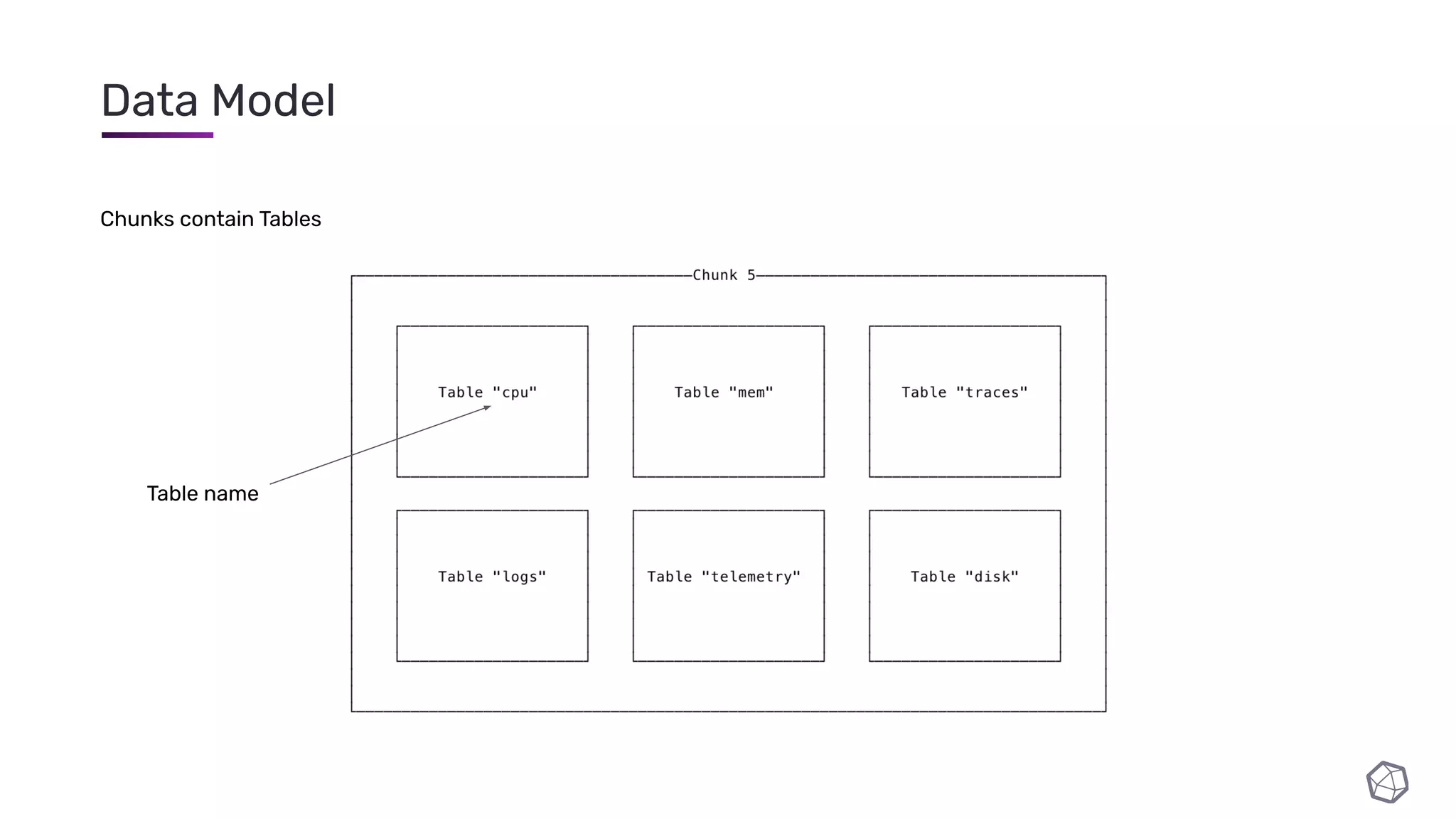
Table name
Data Model
Chunks contain Tables
Data Model
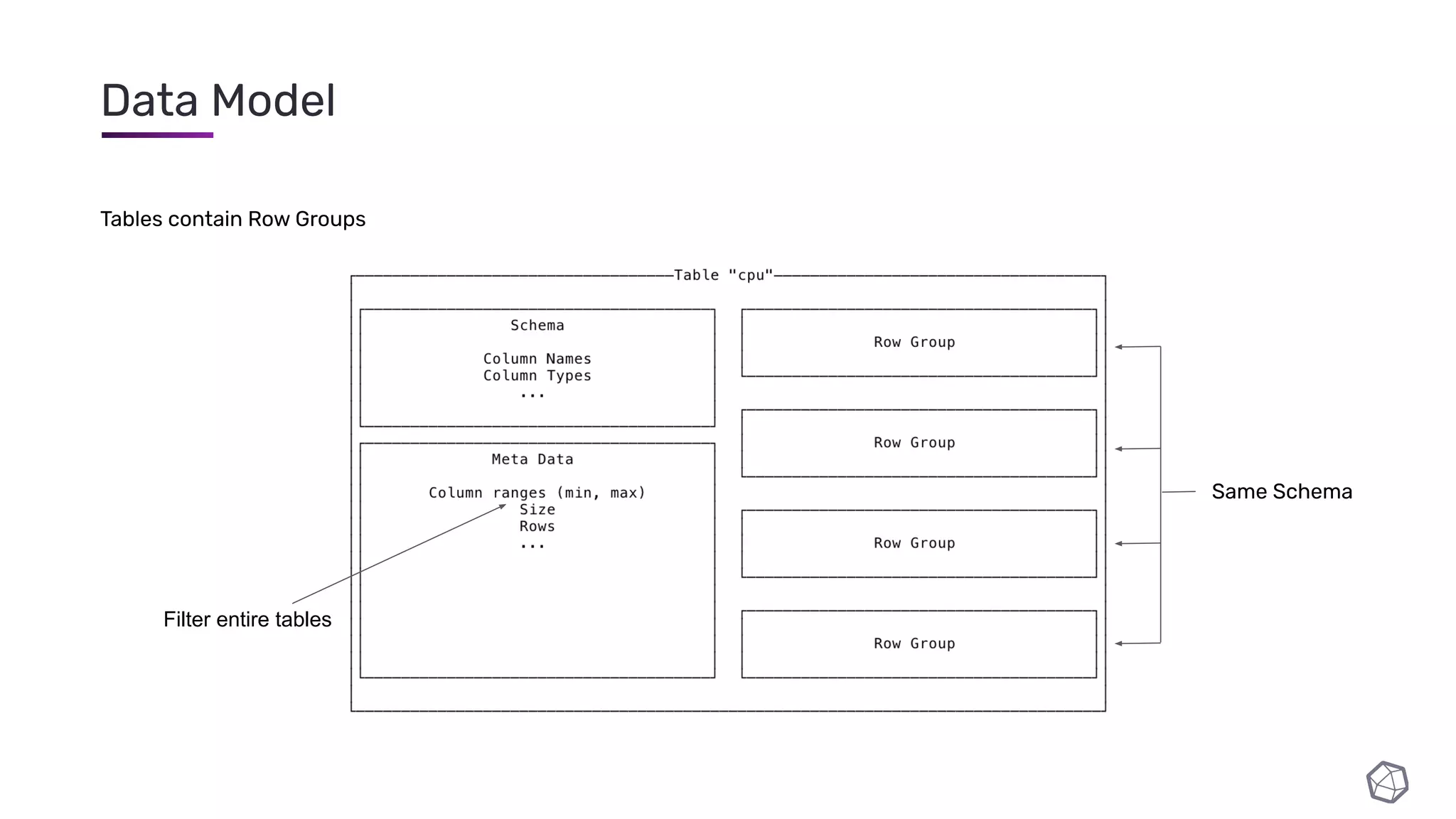
Tables contain Row Groups
Same Schema
Filter entire tables
Data Model
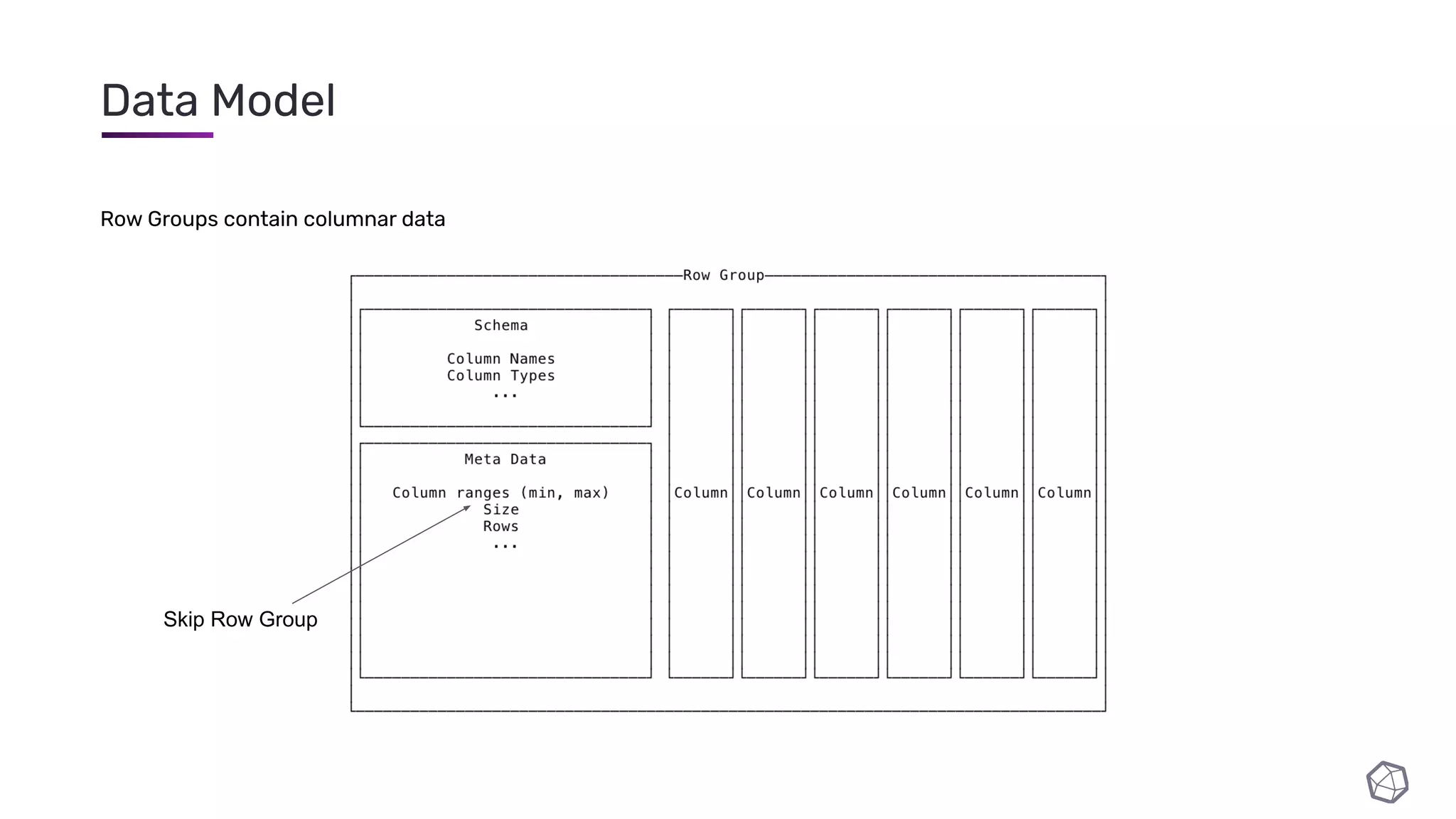
Row Groups contain columnar data
Skip Row Group
Data Model
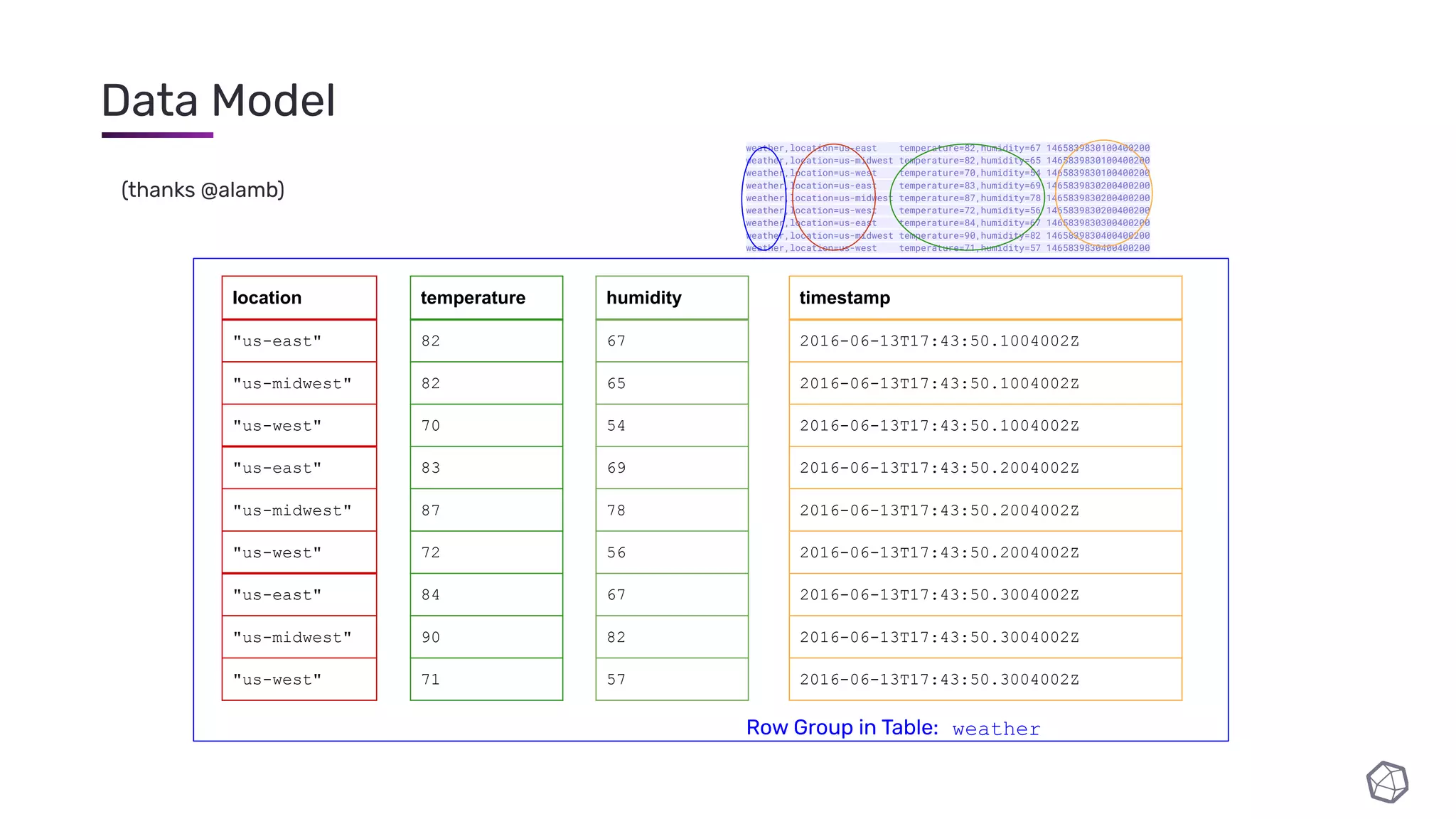
(thanks @alamb)
weather,location=us-east temperature=82,humidity=67 1465839830100400200
weather,location=us-midwest temperature=82,humidity=65 1465839830100400200
weather,location=us-west temperature=70,humidity=54 1465839830100400200
weather,location=us-east temperature=83,humidity=69 1465839830200400200
weather,location=us-midwest temperature=87,humidity=78 1465839830200400200
weather,location=us-west temperature=72,humidity=56 1465839830200400200
weather,location=us-east temperature=84,humidity=67 1465839830300400200
weather,location=us-midwest temperature=90,humidity=82 1465839830400400200
weather,location=us-west temperature=71,humidity=57 1465839830400400200
location
"us-east"
"us-midwest"
"us-west"
"us-east"
"us-midwest"
"us-west"
"us-east"
"us-midwest"
"us-west"
temperature
82
82
70
83
87
72
84
90
71
humidity
67
65
54
69
78
56
67
82
57
timestamp
2016-06-13T17:43:50.1004002Z
2016-06-13T17:43:50.2004002Z
2016-06-13T17:43:50.3004002Z
Row Group in Table: weather
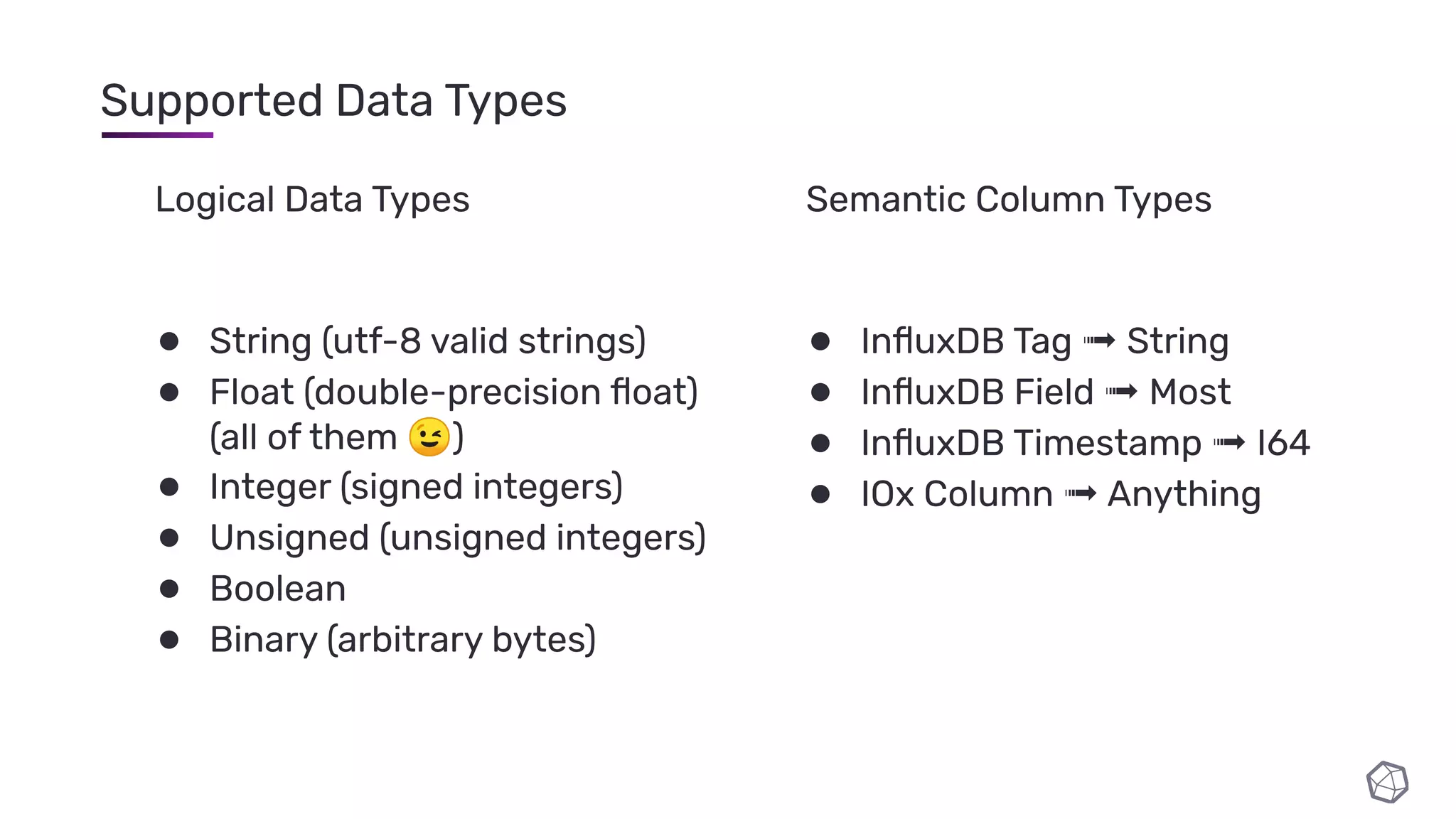
Supported Data Types
Logical Data Types
● String (utf-8 valid strings)
● Float (double-precision float)
(all of them 😉)
● Integer (signed integers)
● Unsigned (unsigned integers)
● Boolean
● Binary (arbitrary bytes)
Semantic Column Types
● InfluxDB Tag ➟ String
● InfluxDB Field ➟ Most
● InfluxDB Timestamp ➟ I64
● IOx Column ➟ Anything
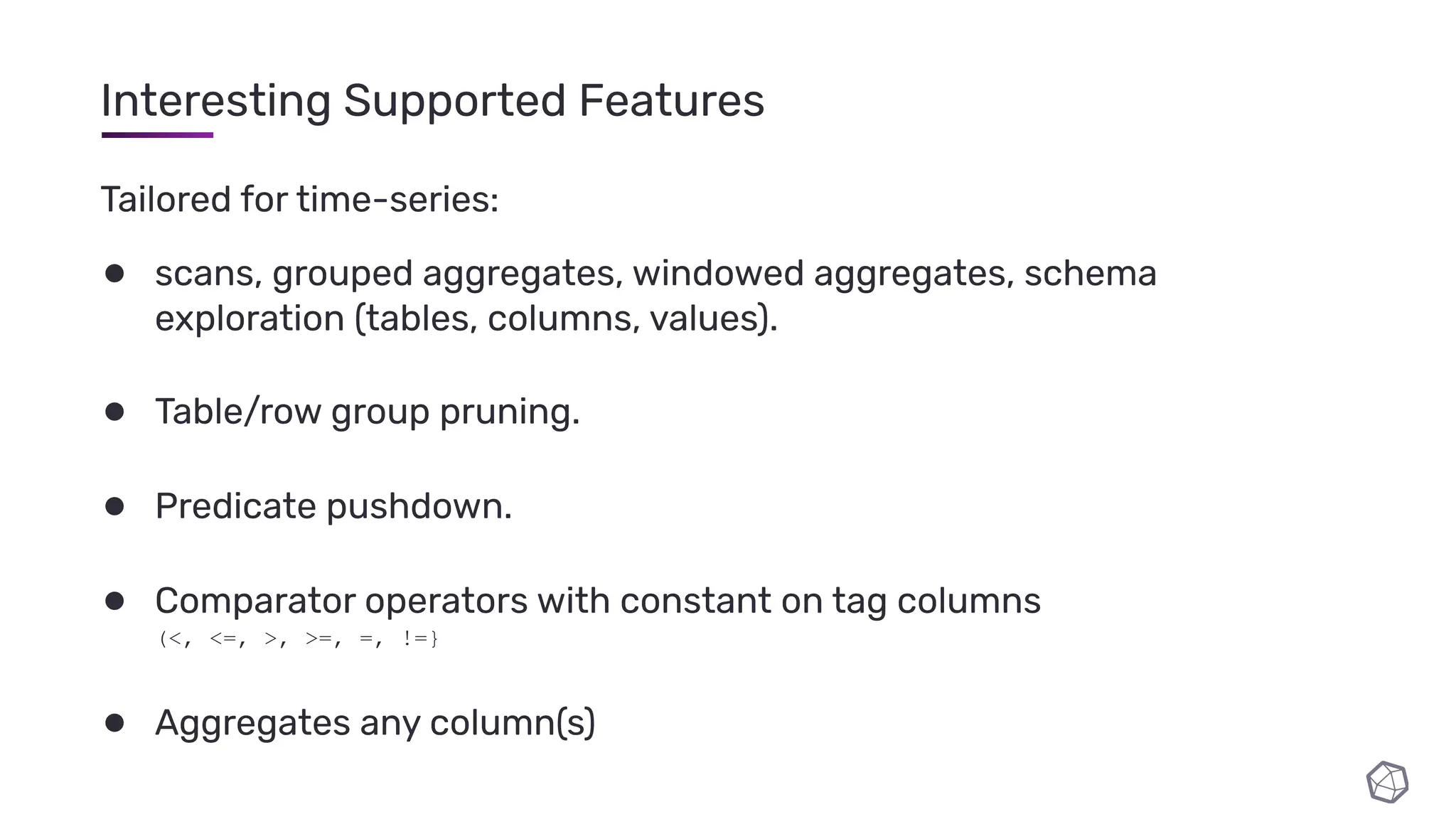
Tailored for time-series:
● scans, grouped aggregates, windowed aggregates, schema
exploration (tables, columns, values).
● Table/row group pruning.
● Predicate pushdown.
● Comparator operators with constant on tag columns
(<, <=, >, >=, =, !=}
● Aggregates any column(s)
Interesting Supported Features
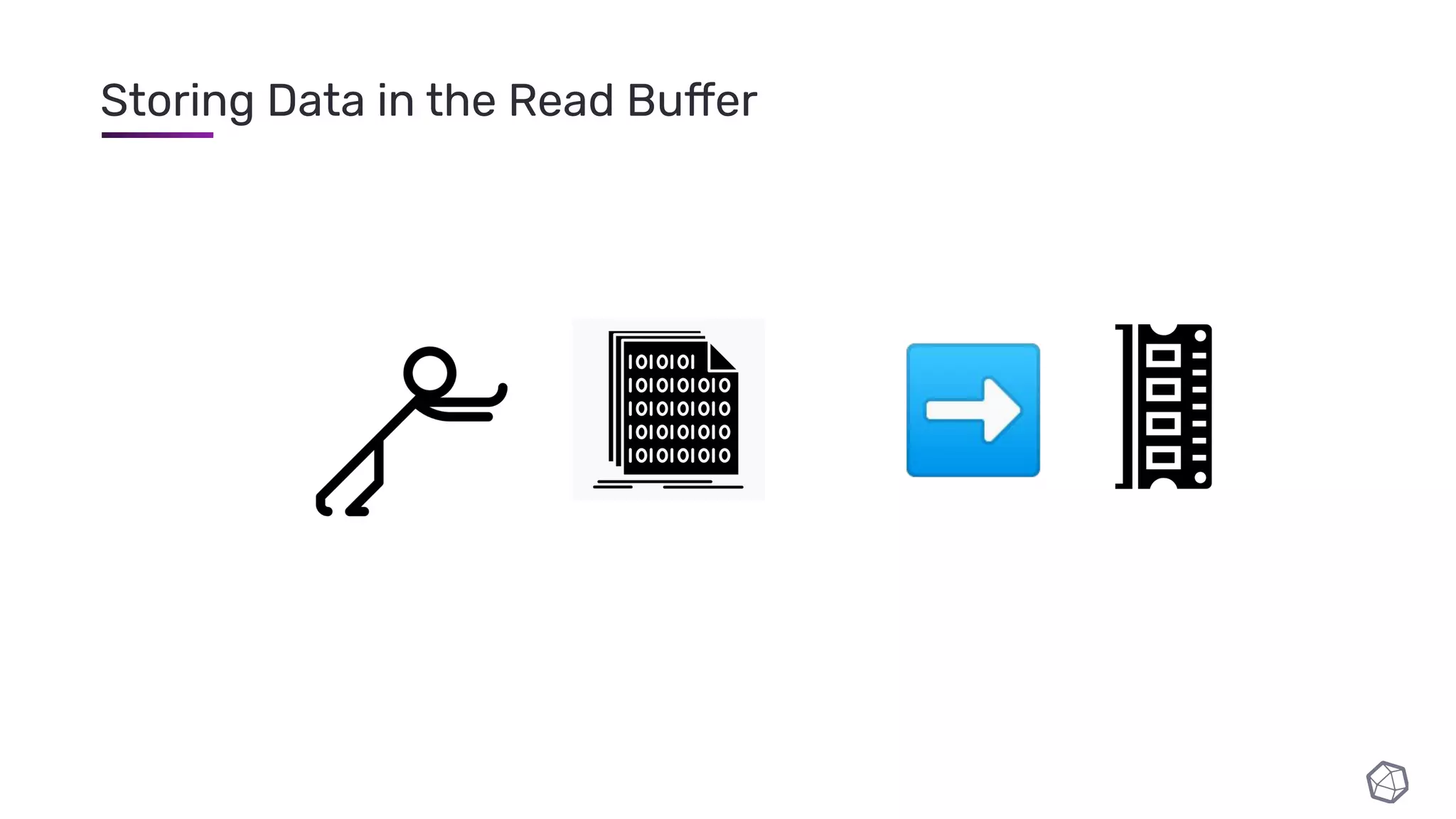
Storing Data in the Read Buffer
➡
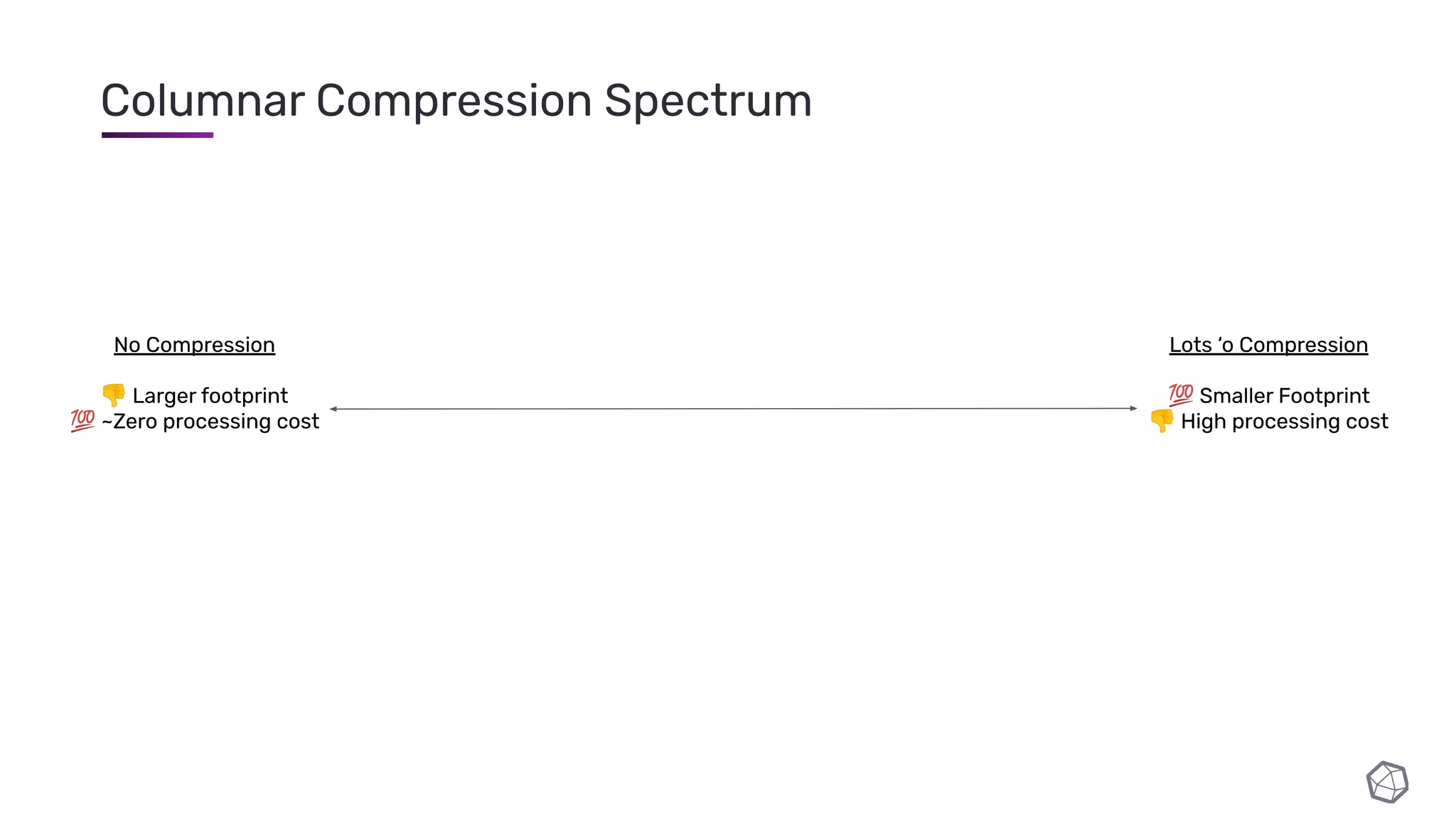
Columnar Compression Spectrum
Lots ‘o Compression
💯 Smaller Footprint
👎 High processing cost
No Compression
👎 Larger footprint
💯 ~Zero processing cost
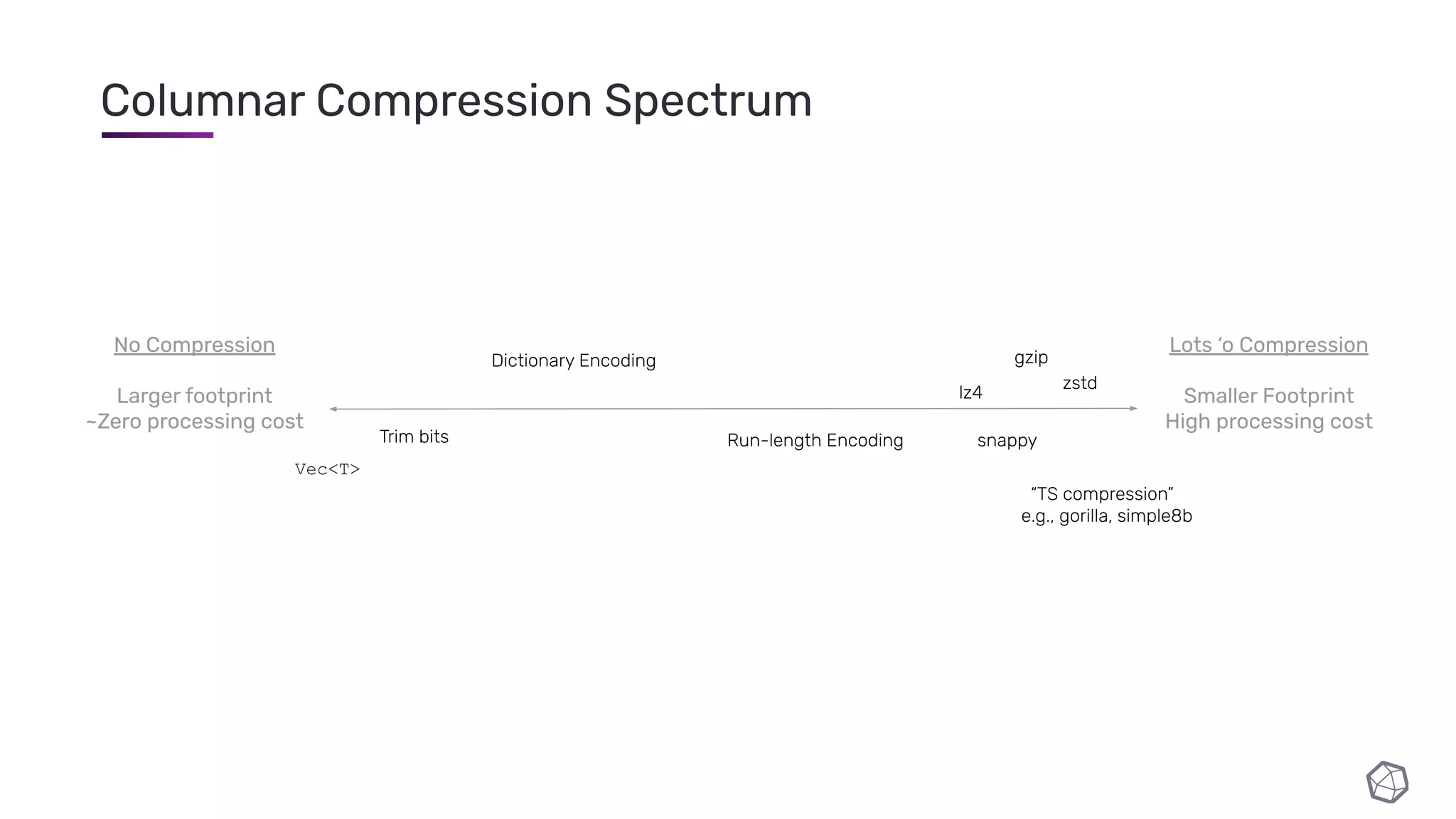
Columnar Compression Spectrum
Lots ‘o Compression
Smaller Footprint
High processing cost
No Compression
Larger footprint
~Zero processing cost
Vec<T>
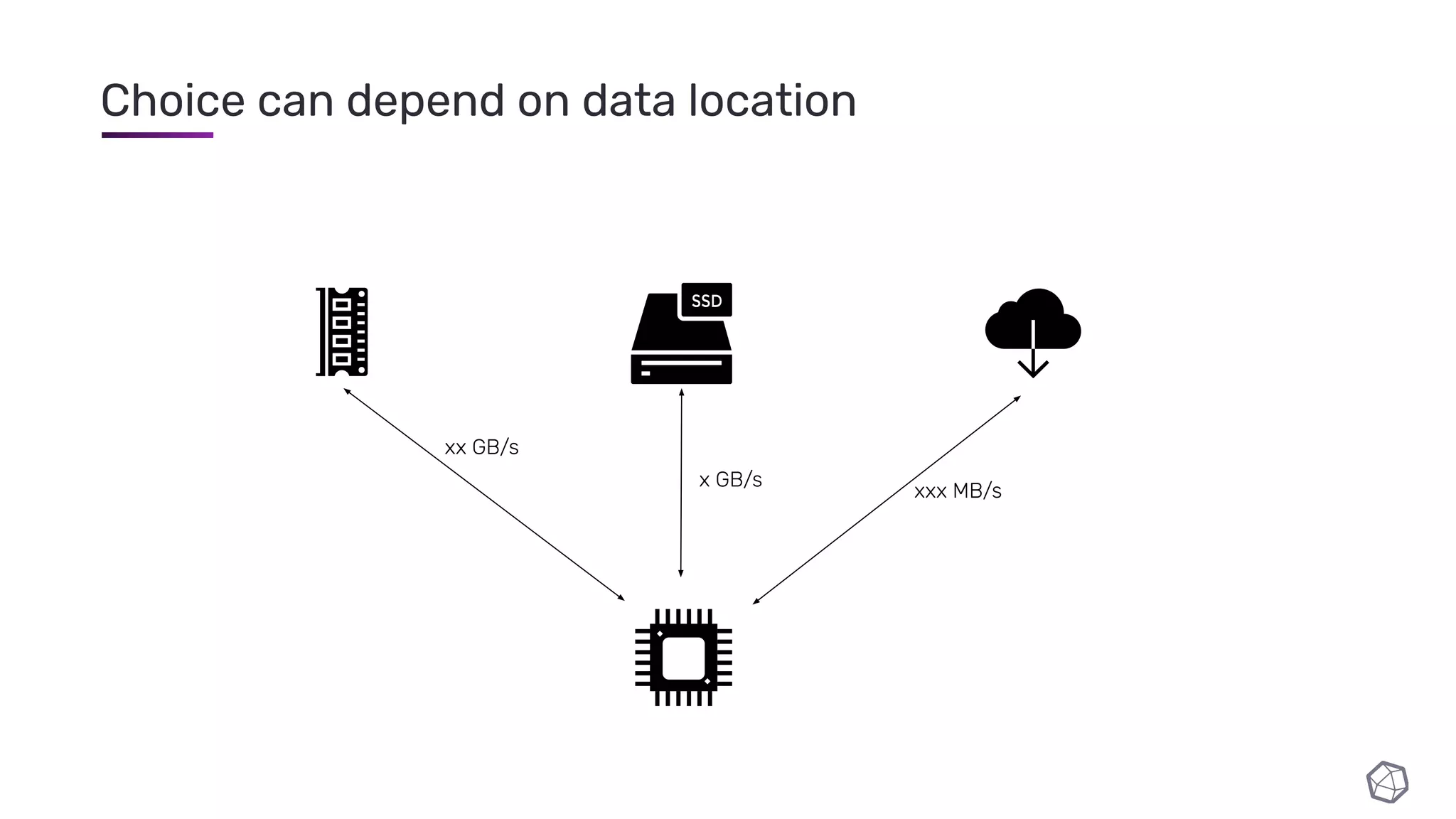
Choice can depend on data location
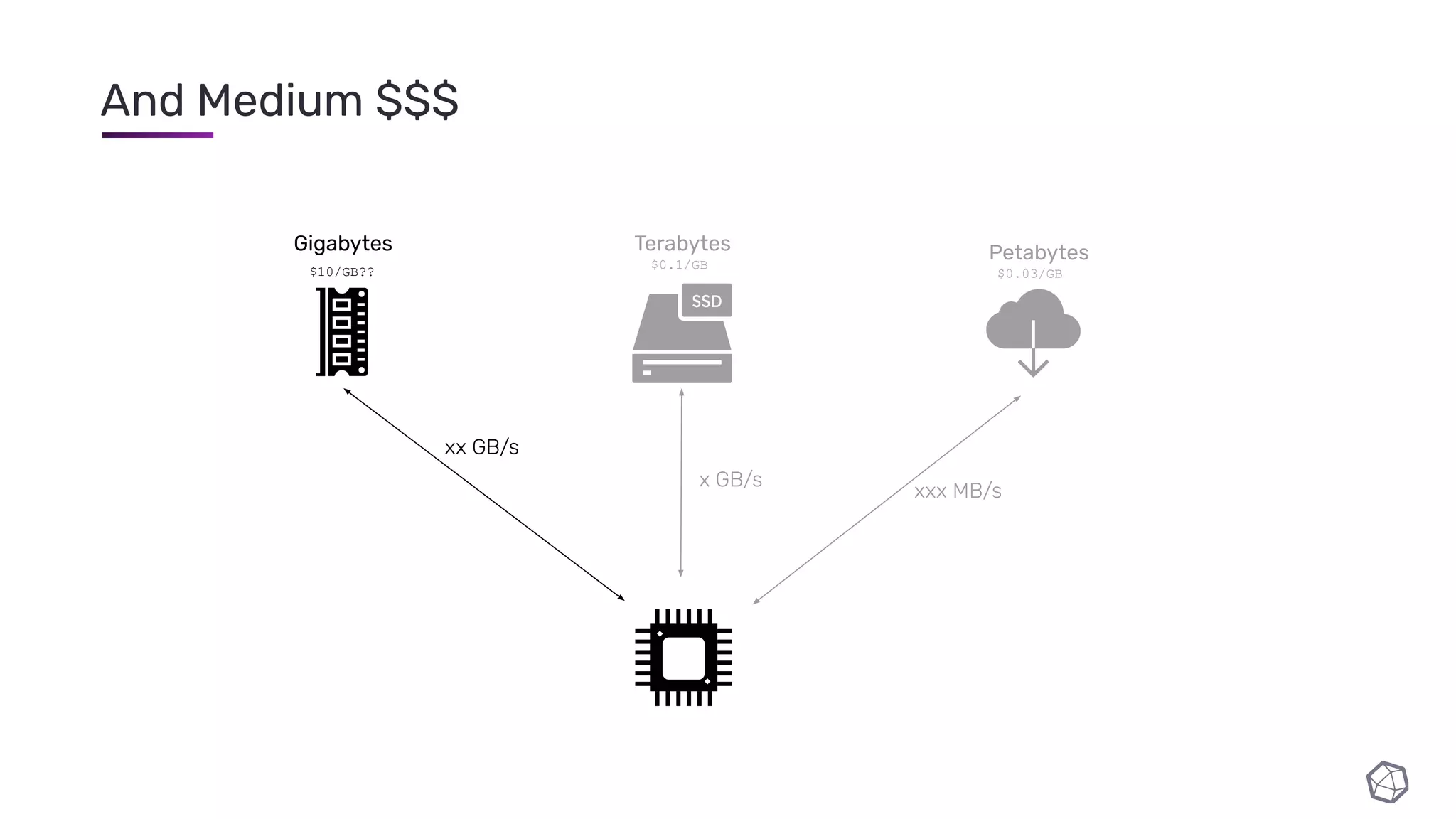
And Medium $$$
Petabytes
$0.03/GB
Gigabytes
$10/GB??
Terabytes
$0.1/GB
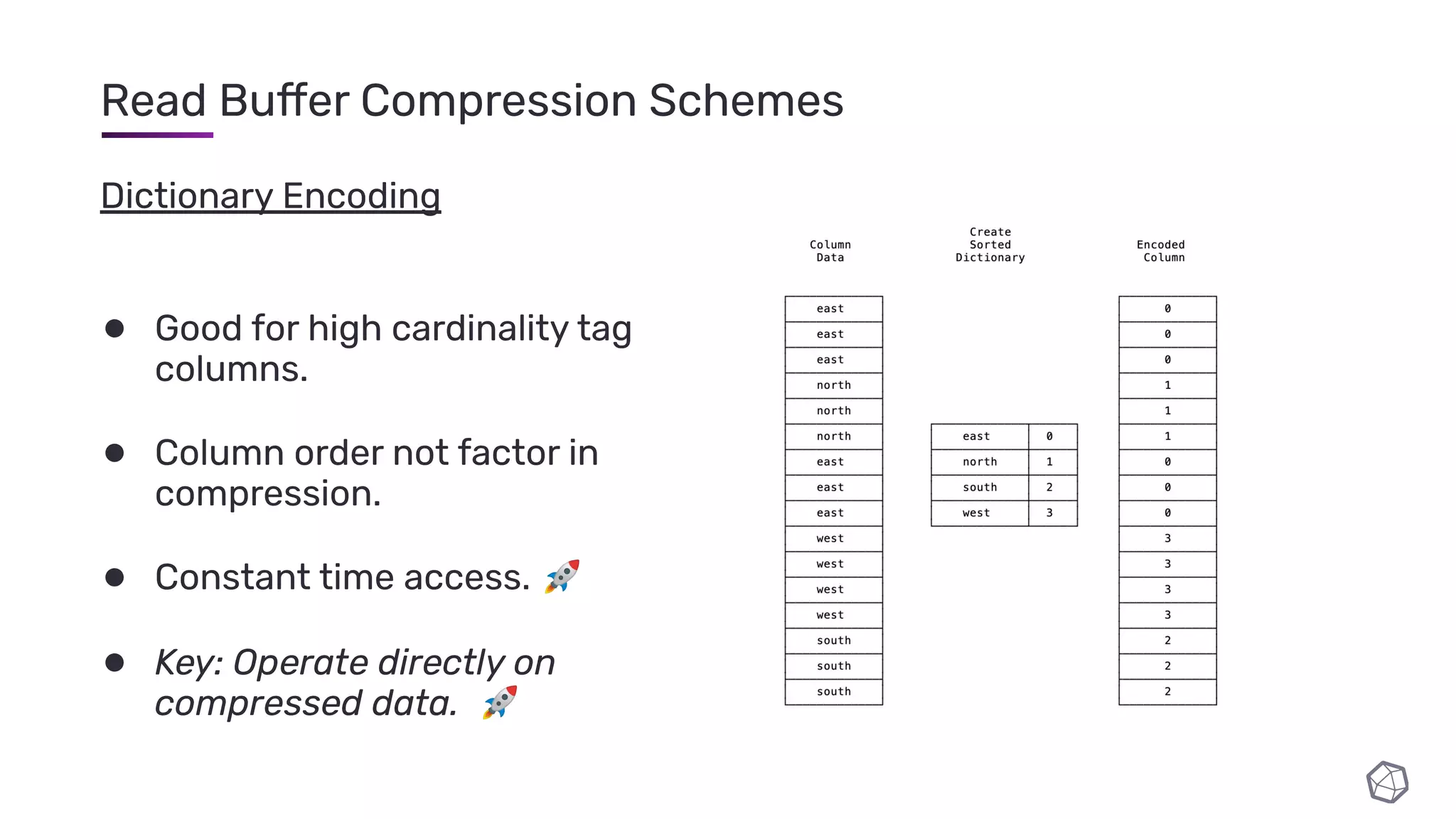
Read Buffer Compression Schemes
Dictionary Encoding
● Good for high cardinality tag
columns.
● Column order not factor in
compression.
● Constant time access. 🚀
● Key: Operate directly on
compressed data. 🚀
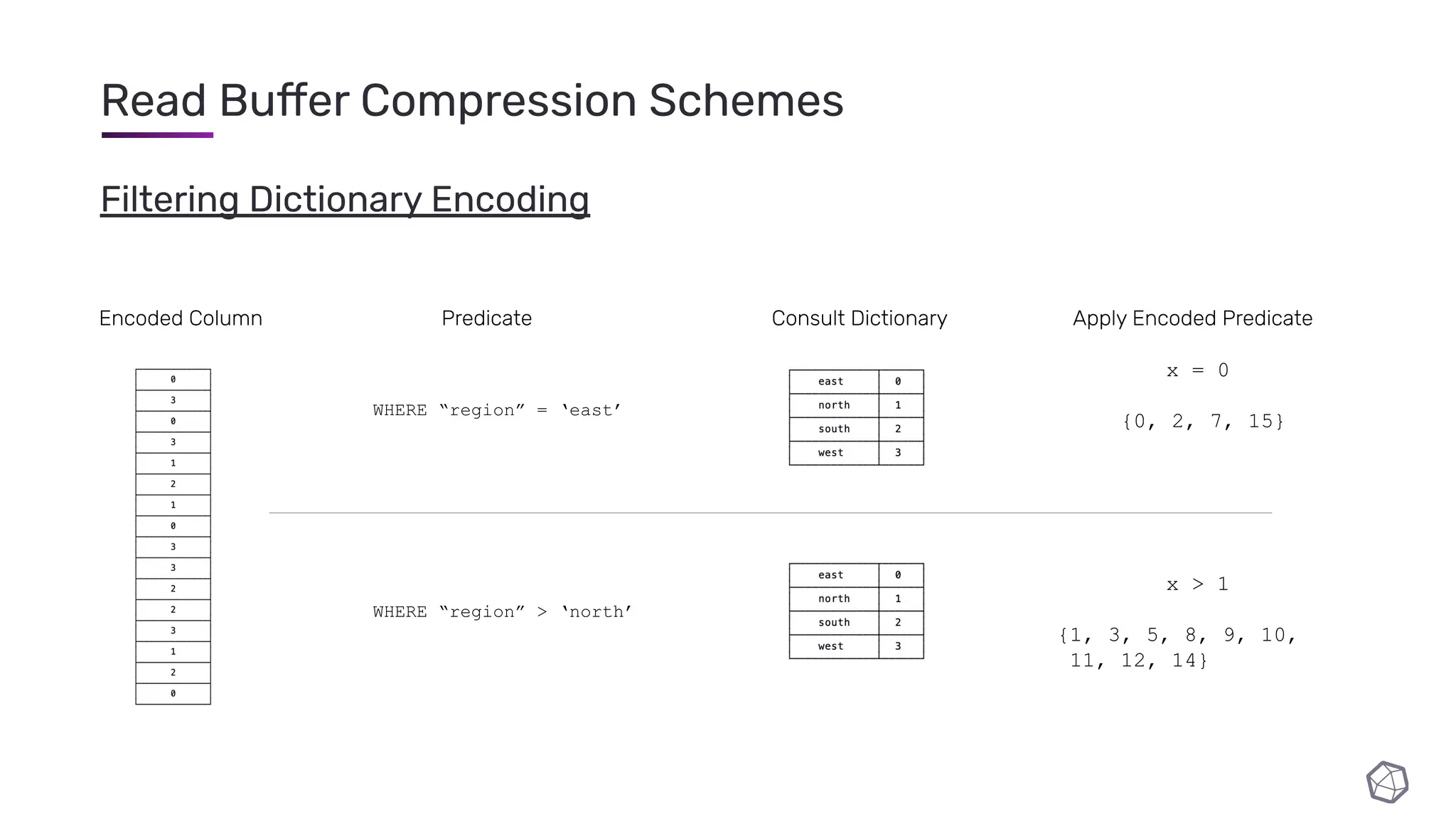
Read Buffer Compression Schemes
Filtering Dictionary Encoding
WHERE “region” = ‘east’
x = 0
{0, 2, 7, 15}
WHERE “region” > ‘north’
x > 1
{1, 3, 5, 8, 9, 10,
11, 12, 14}
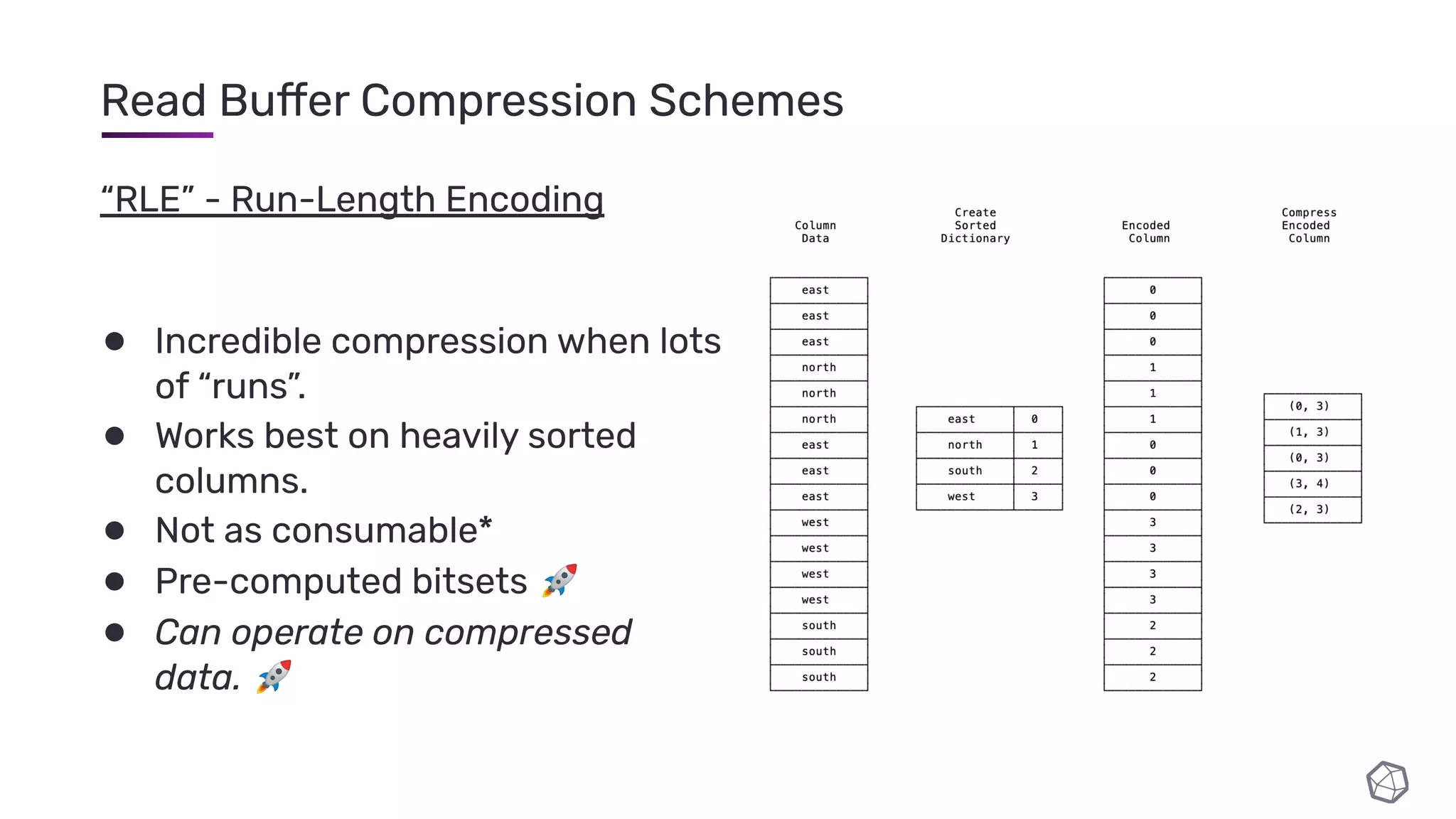
“RLE” - Run-Length Encoding
● Incredible compression when lots
of “runs”.
● Works best on heavily sorted
columns.
● Not as consumable*
● Pre-computed bitsets 🚀
● Can operate on compressed
data. 🚀
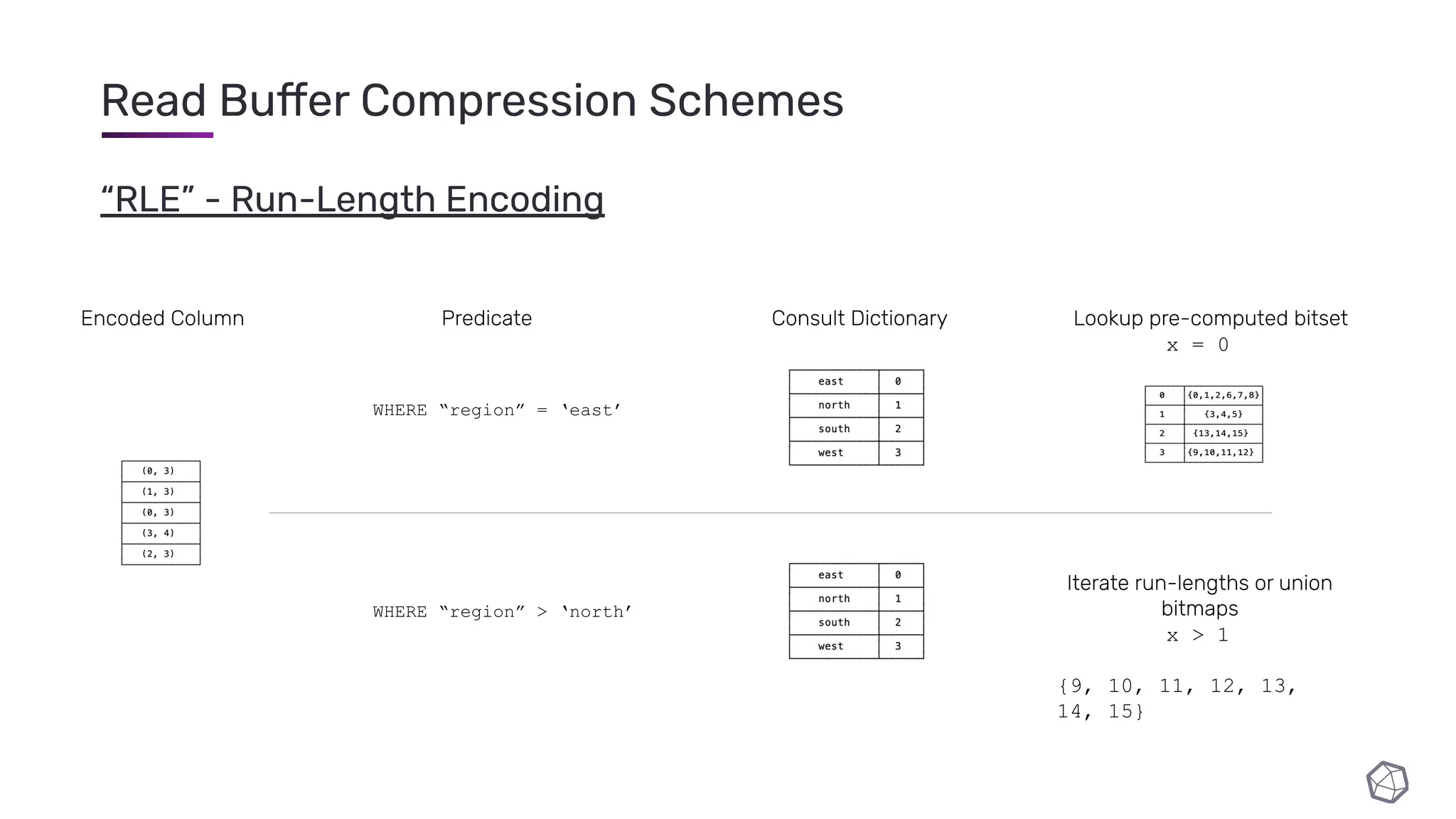
Read Buffer Compression Schemes
“RLE” - Run-Length Encoding
WHERE “region” = ‘east’
x = 0
WHERE “region” > ‘north’
x > 1
{9, 10, 11, 12, 13,
14, 15}
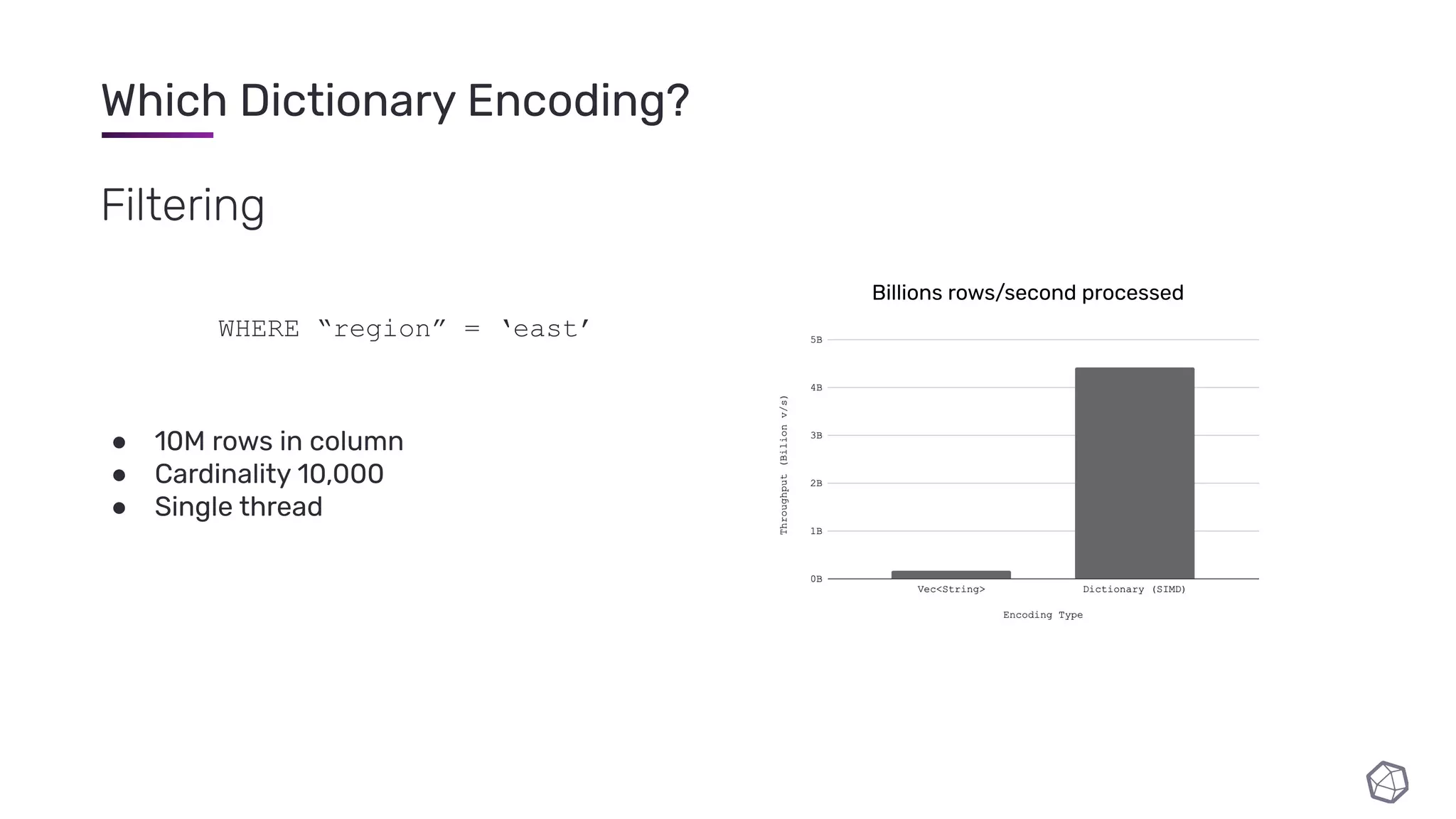
Which Dictionary Encoding?
WHERE “region” = ‘east’
● 10M rows in column
● Cardinality 10,000
● Single thread
Billions rows/second processed
Which Dictionary Encoding?
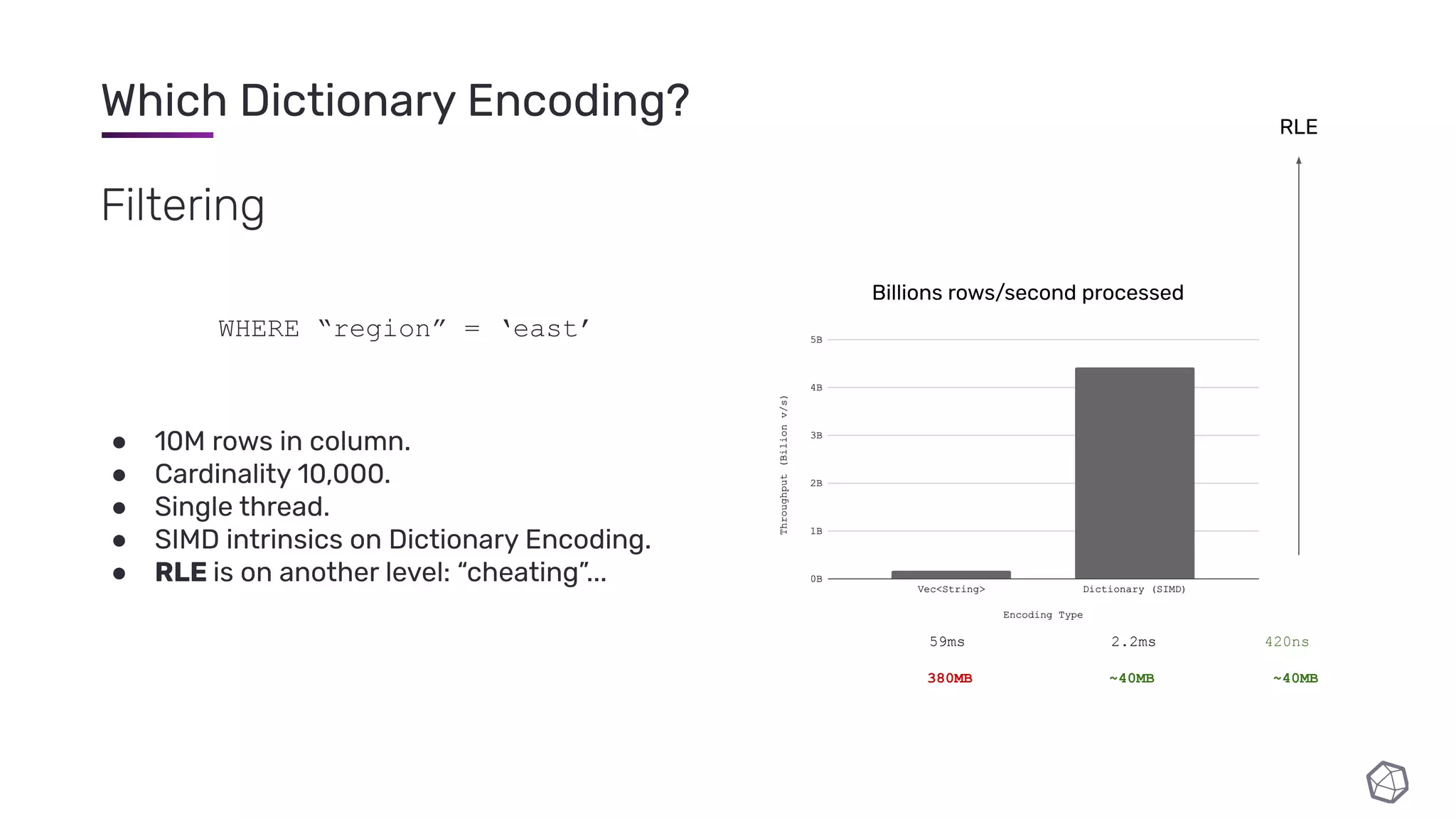
WHERE “region” = ‘east’
● 10M rows in column.
● Cardinality 10,000.
● Single thread.
● SIMD intrinsics on Dictionary Encoding.
● RLE is on another level: “cheating”...
Billions rows/second processed
RLE
59ms 2.2ms 420ns
380MB ~40MB ~40MB
Which Dictionary Encoding?
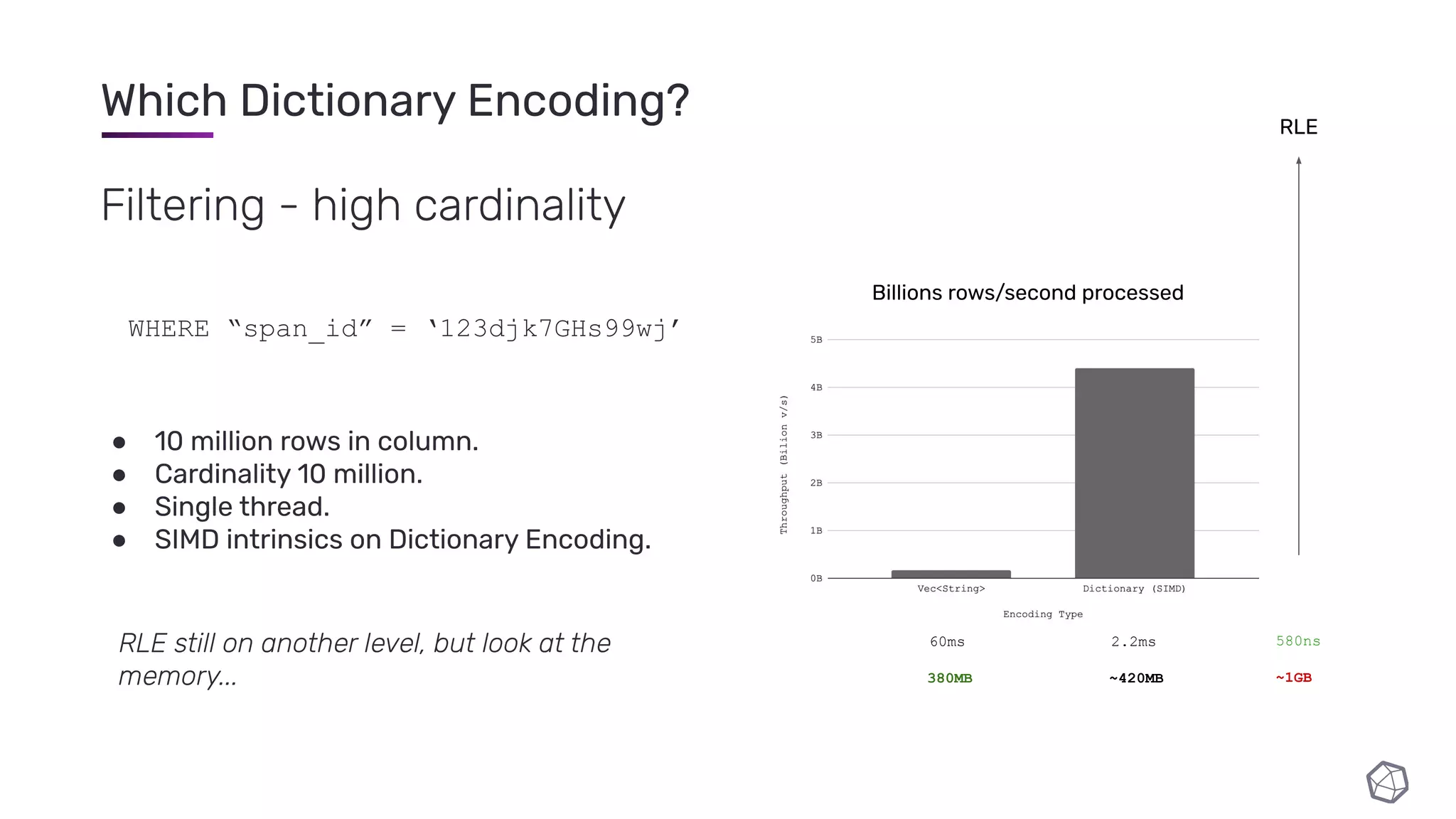
WHERE “span_id” = ‘123djk7GHs99wj’
● 10 million rows in column.
● Cardinality 10 million.
● Single thread.
● SIMD intrinsics on Dictionary Encoding.
Billions rows/second processed
RLE
60ms 2.2ms
380MB ~420MB
580ns
~1GB
Which Dictionary Encoding?
“I need rows [2, 33, 55, 111, 3343]”
10,000,000 row column
Encoding Cardinality 10K
(materialise 1000 rows near end)
Cardinality 10M
(materialise 1 row near end)
Vec<String>
Dictionary μ
RLE μ
Which Dictionary Encoding?
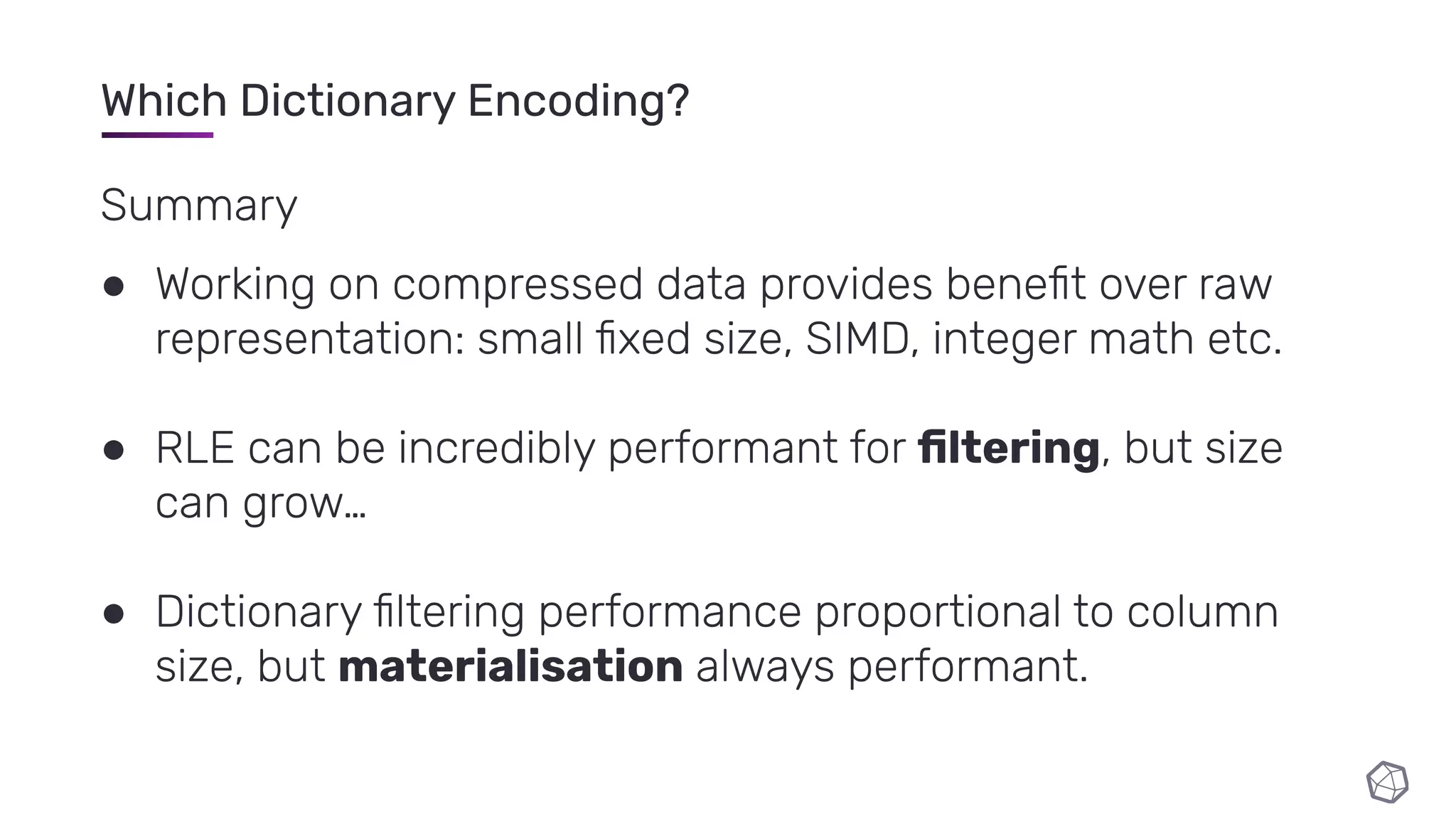
●
● filtering
●
materialisation
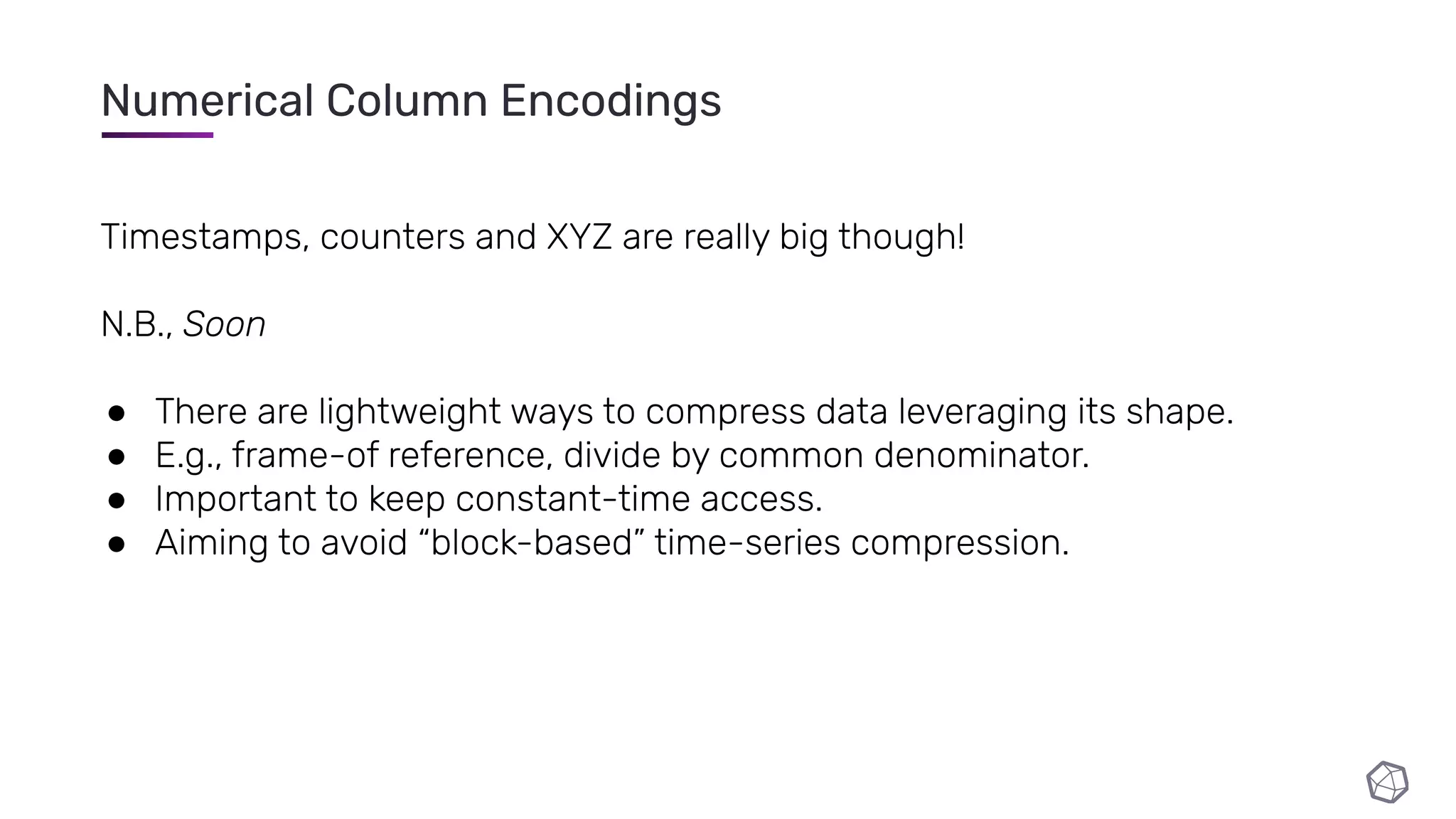
Numerical Column Encodings
Supported Logical types: i64, u64, f64
{u8, i8,.., u64, i64}*
&[i64]: (48 B) [123, 198, 1, 33, 133, 224] ➠ &[u8]: (6 B) [..]
&[i64]: (48 B) [-18, 2, 0, 220, 2, 26] ➠ &[i16]: (12 B) [..]
Numerical Column Encodings
●
●
●
●
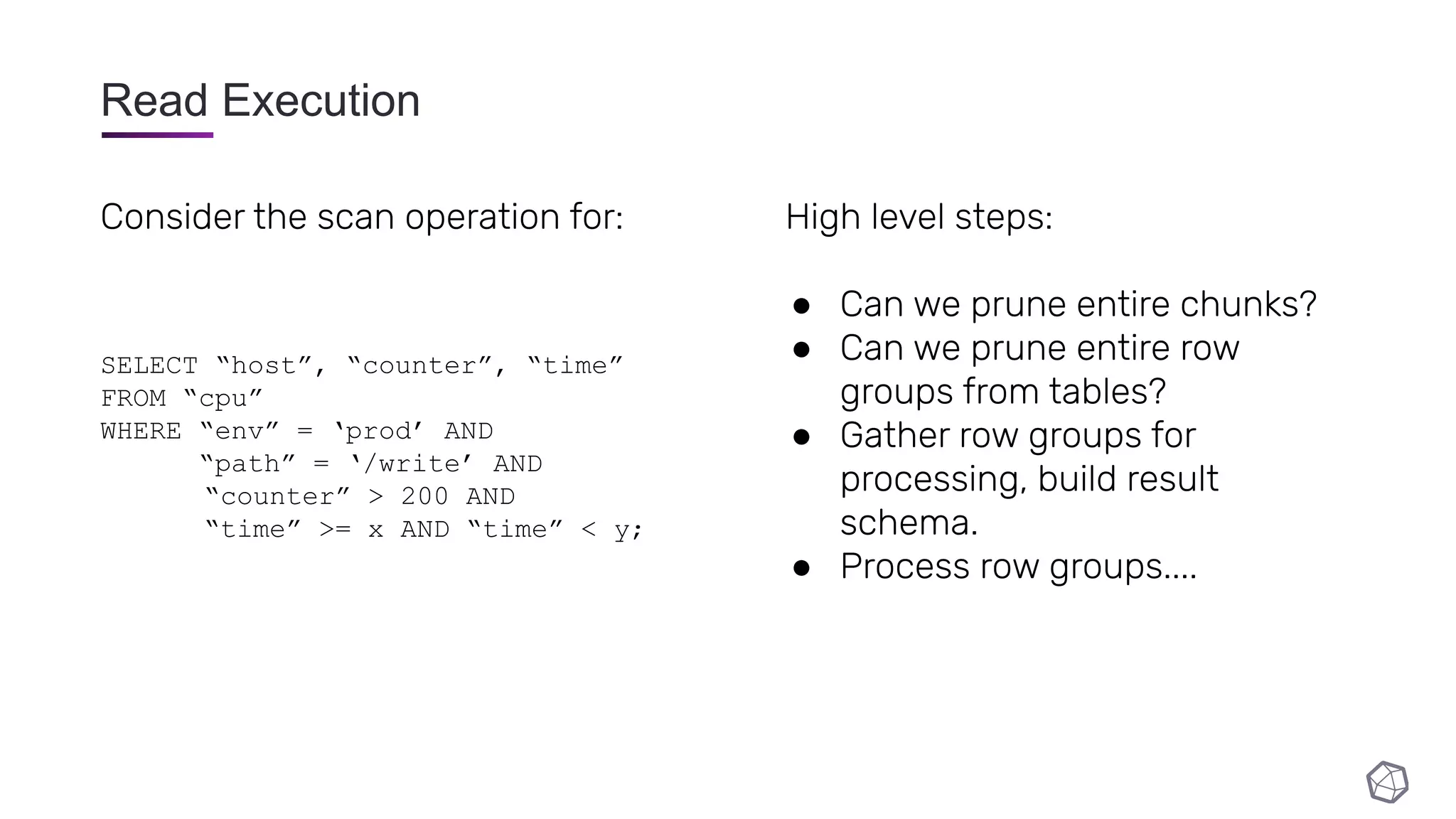
Read Execution
SELECT “host”, “counter”, “time”
FROM “cpu”
WHERE “env” = ‘prod’ AND
“path” = ‘/write’ AND
“counter” > 200 AND
“time” >= x AND “time” < y;
●
●
●
●
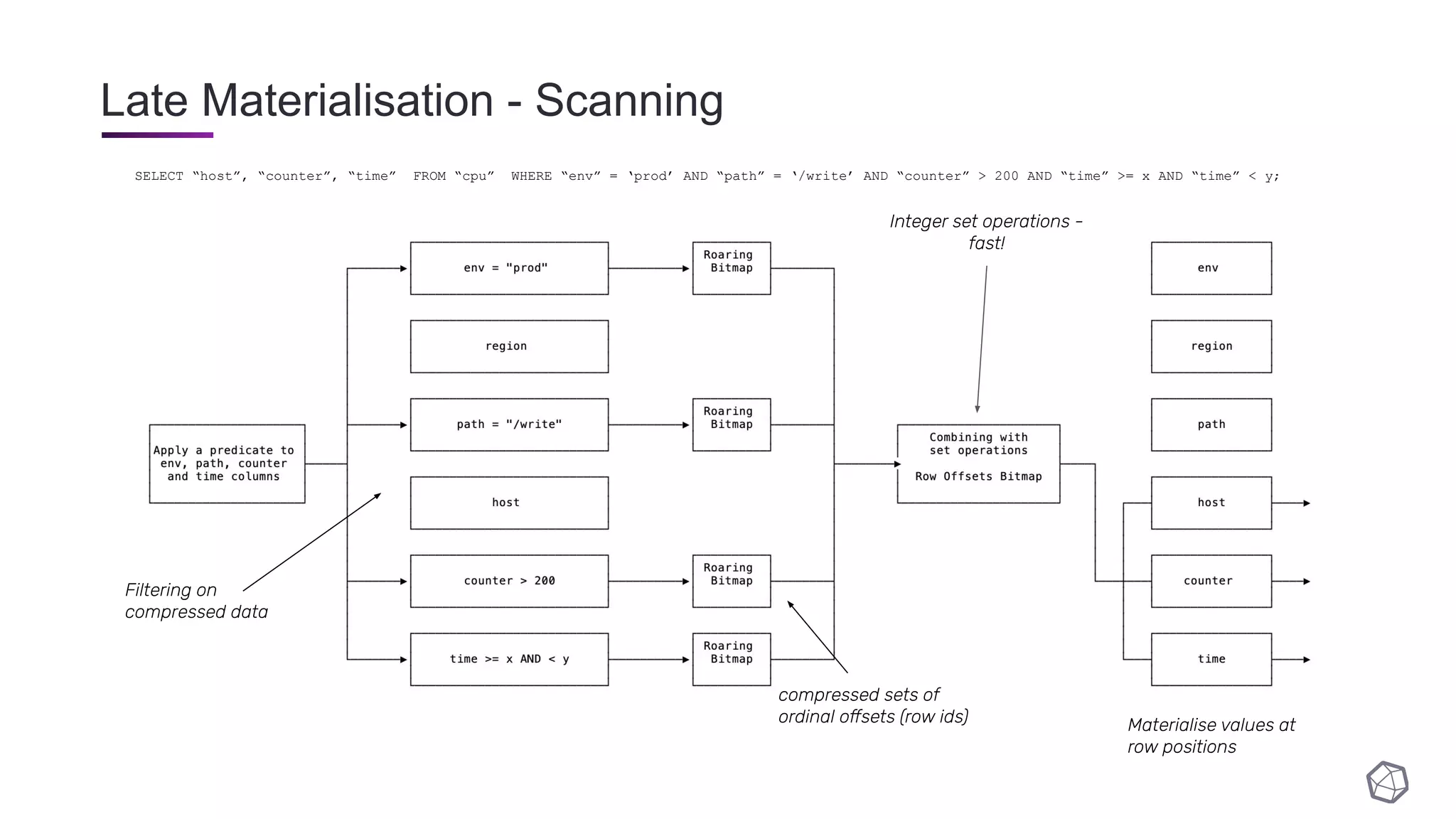
Late Materialisation - Scanning
SELECT “host”, “counter”, “time” FROM “cpu” WHERE “env” = ‘prod’ AND “path” = ‘/write’ AND “counter” > 200 AND “time” >= x AND “time” < y;
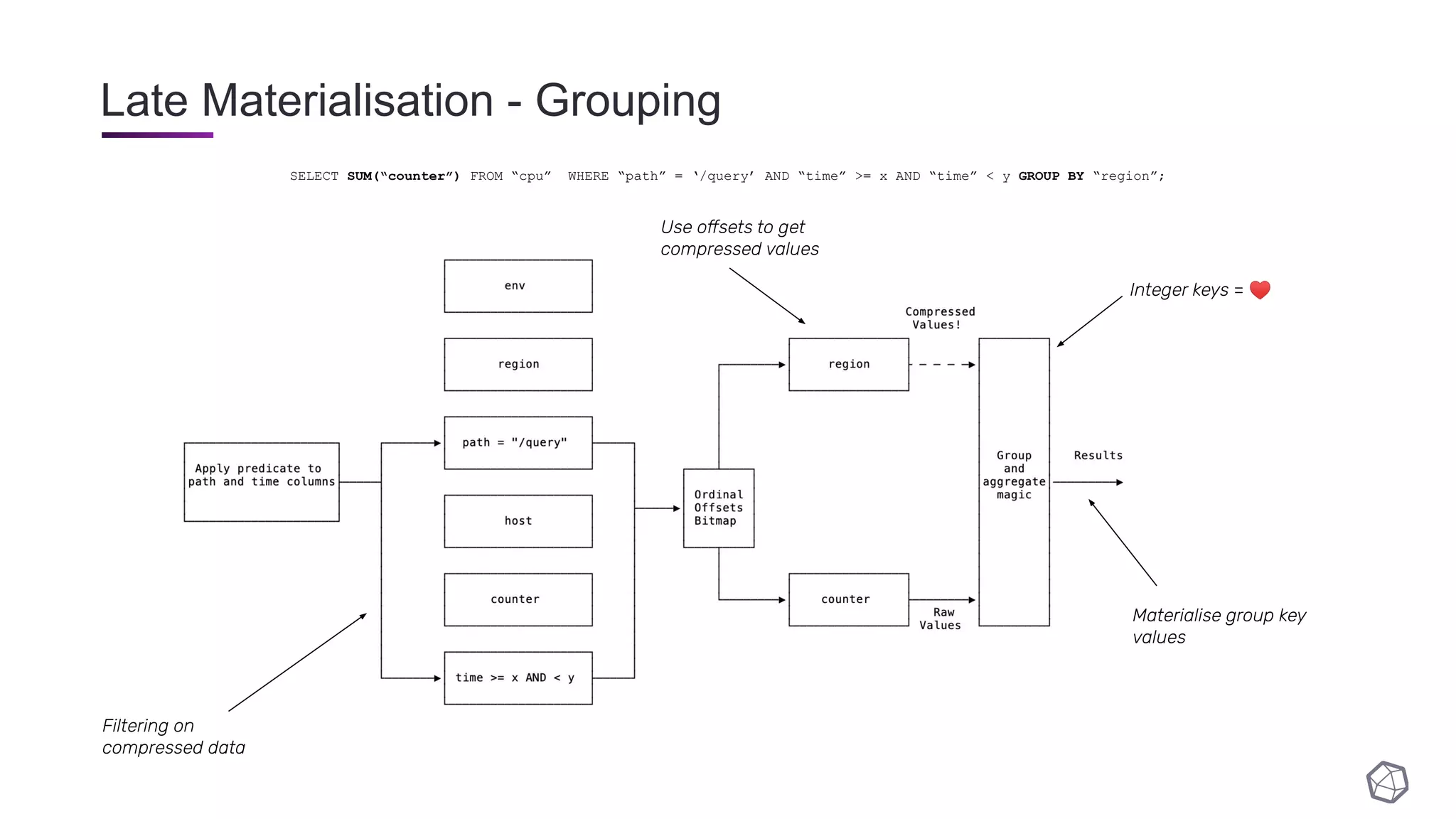
Late Materialisation - Grouping
SELECT SUM(“counter”) FROM “cpu” WHERE “path” = ‘/query’ AND “time” >= x AND “time” < y GROUP BY “region”;
♥
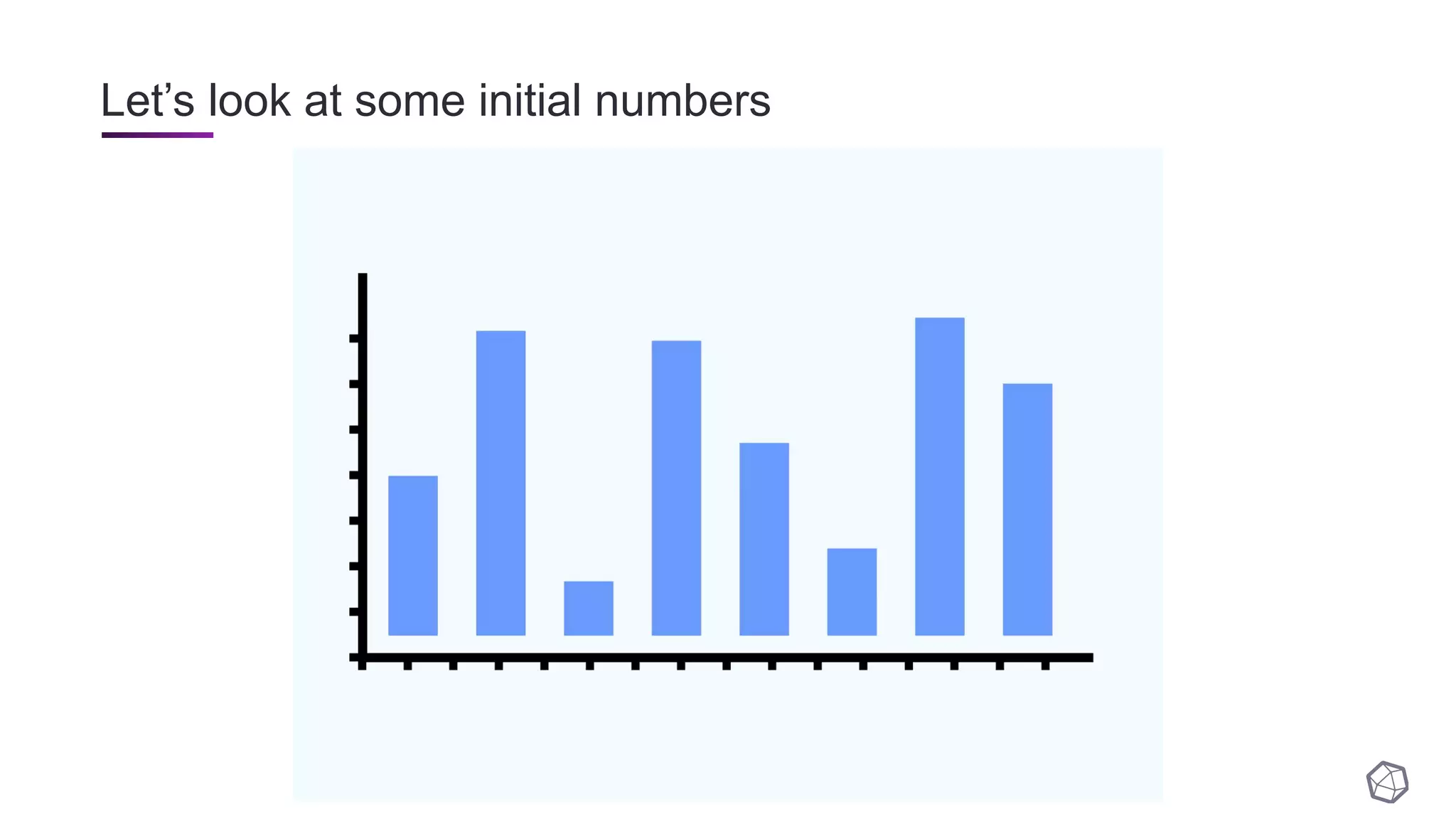
Let’s look at some initial numbers
●
●
span_id
●
●
●
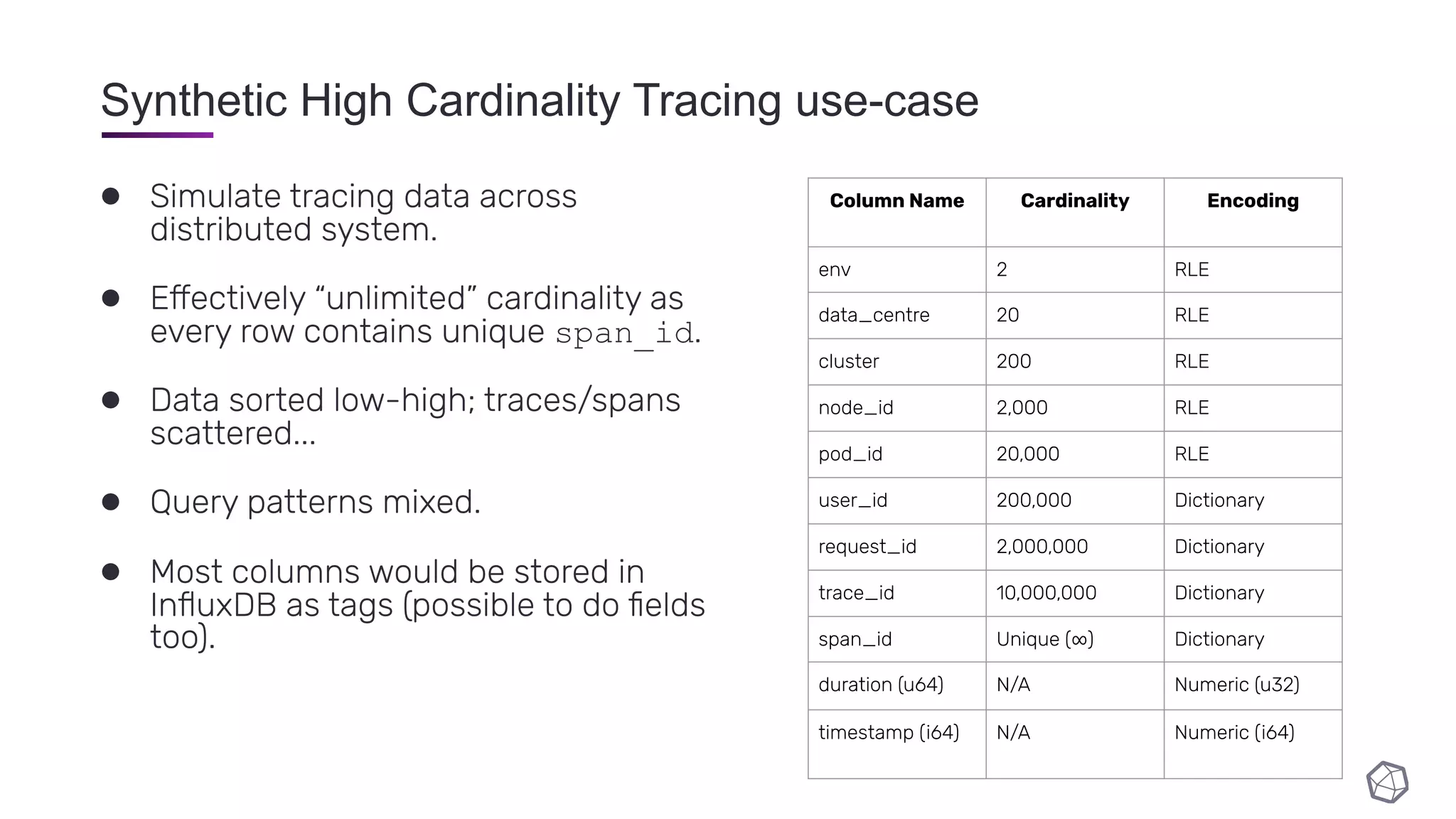
Synthetic High Cardinality Tracing use-case
Column Name Cardinality Encoding
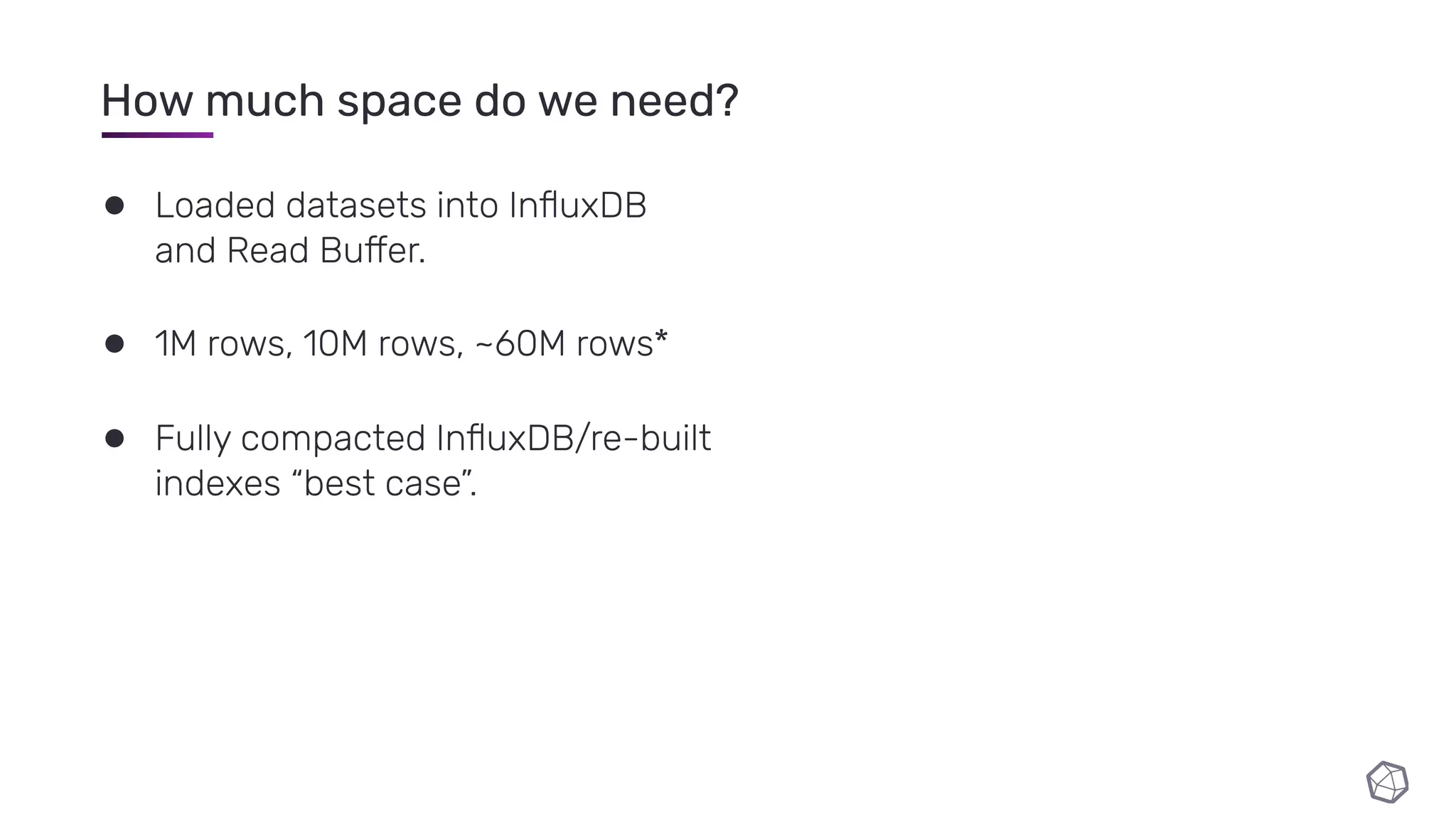
How much space do we need?
●
●
●
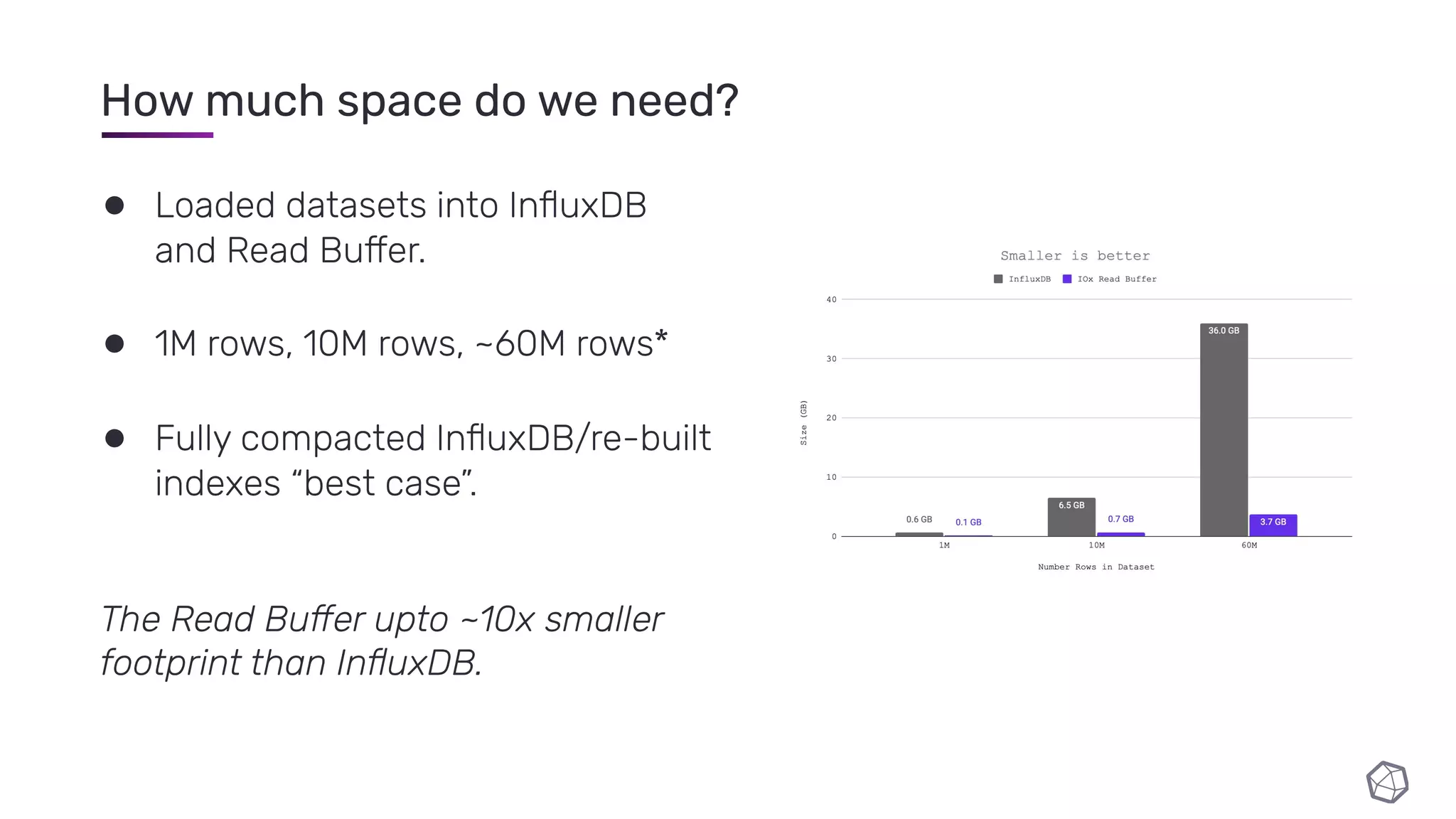
How much space do we need?
●
●
●
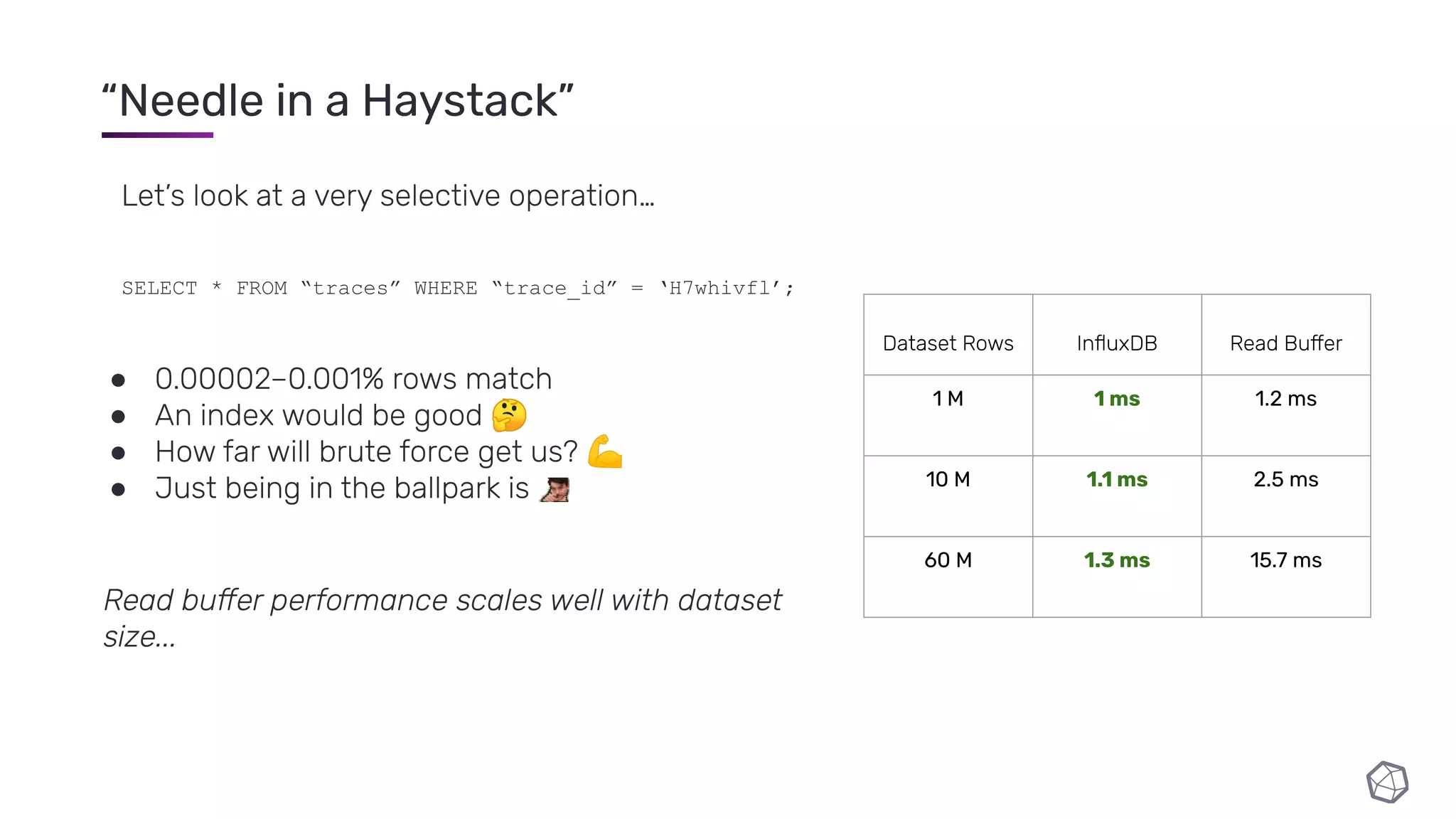
1 M 1 ms 1.2 ms
10 M 1.1 ms 2.5 ms
60 M 1.3 ms 15.7 ms
SELECT * FROM “traces” WHERE “trace_id” = ‘H7whivfl’;
●
● 🤔
● 💪
●
“Needle in a Haystack”
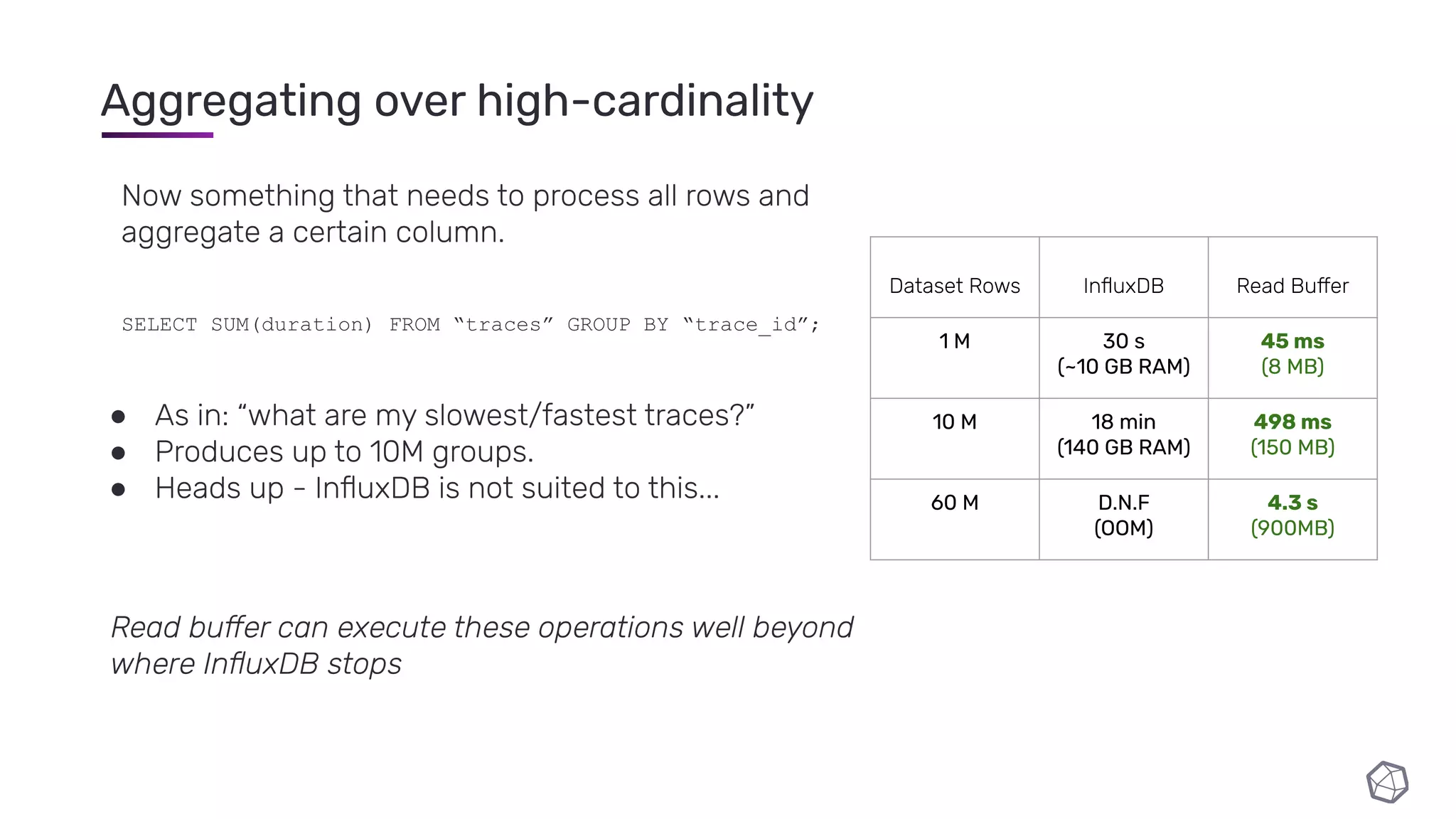
SELECT SUM(duration) FROM “traces” GROUP BY “trace_id”;
●
●
●
Aggregating over high-cardinality
1 M 30 s
(~10 GB RAM)
45 ms
(8 MB)
10 M 18 min
(140 GB RAM)
498 ms
(150 MB)
60 M D.N.F
(OOM)
4.3 s
(900MB)
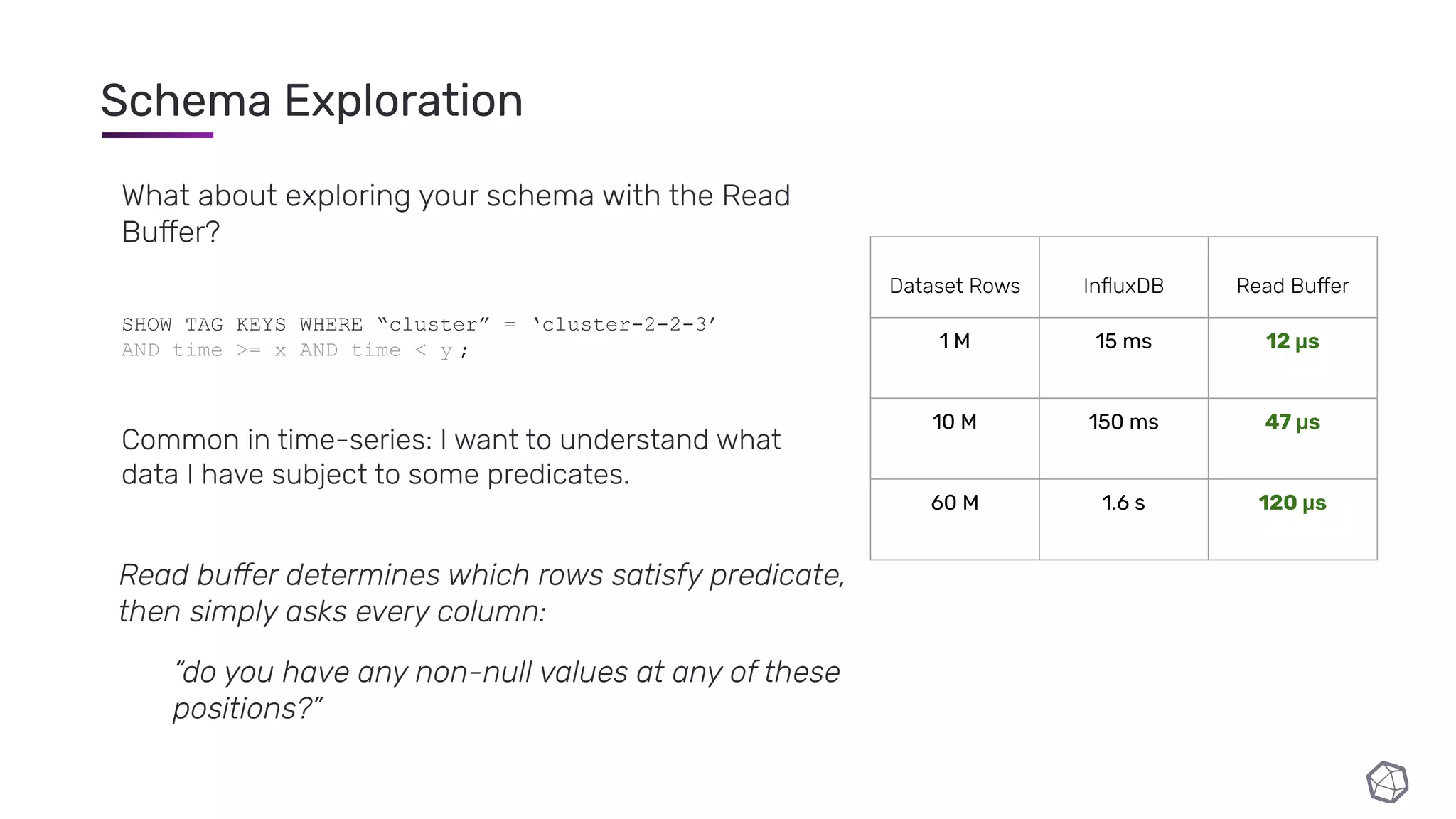
SHOW TAG KEYS WHERE “cluster” = ‘cluster-2-2-3’
AND time >= x AND time < y ;
Schema Exploration
1 M 15 ms 12 μs
10 M 150 ms 47 μs
60 M 1.6 s 120 μs
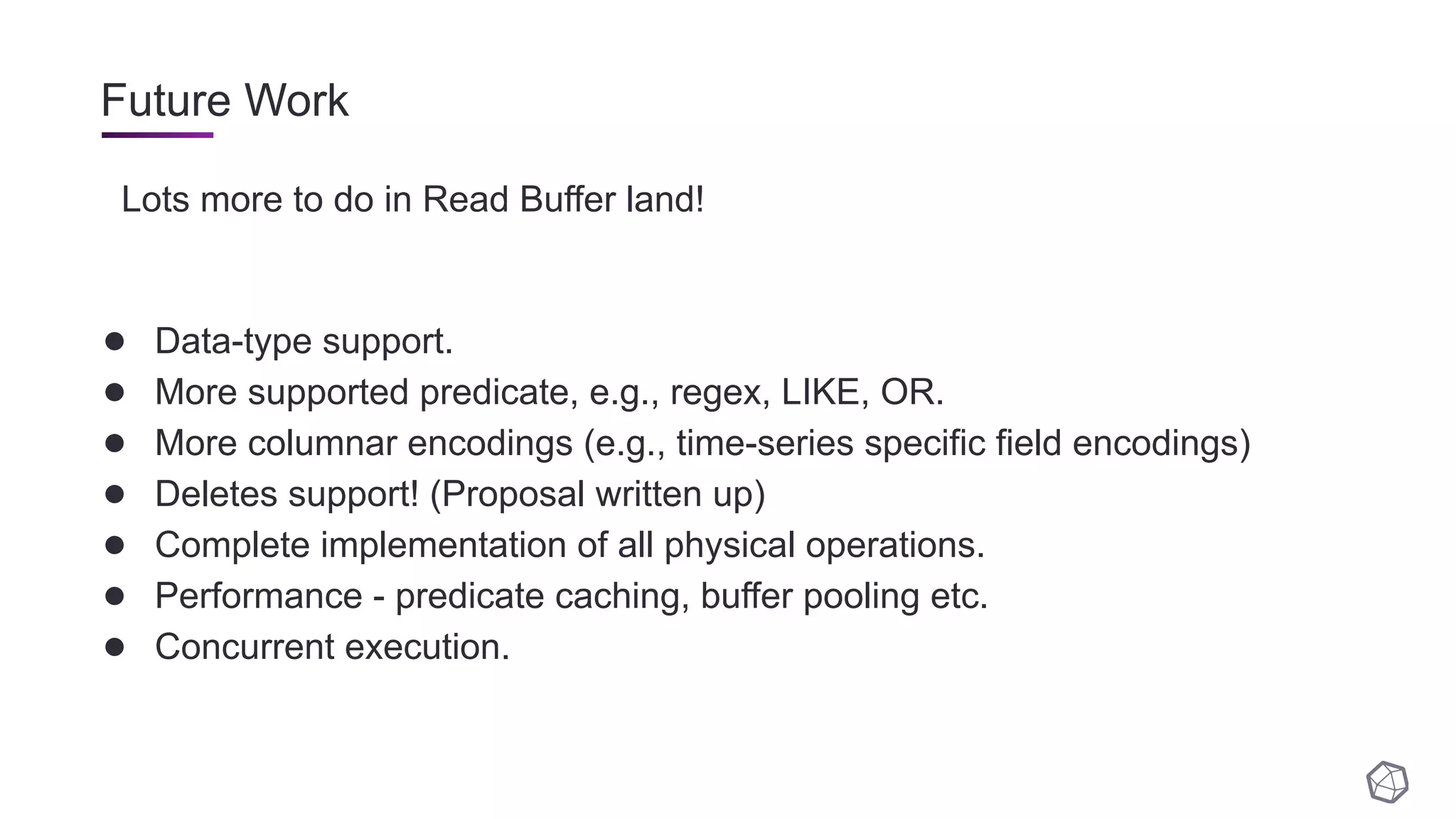
Future Work
Lots more to do in Read Buffer land!
● Data-type support.
● More supported predicate, e.g., regex, LIKE, OR.
● More columnar encodings (e.g., time-series specific field encodings)
● Deletes support! (Proposal written up)
● Complete implementation of all physical operations.
● Performance - predicate caching, buffer pooling etc.
● Concurrent execution.
Thank You
Paul Dix
InfluxData – CTO & co-founder
paul@influxdata.com
@pauldix
InfluxDB IOx - a new columnar
time series database (update)
Progress
• New Team Members!
• Read Buffer progress
• Mutable Buffer & Read Buffer connections
• Arrow Flight API
• Replication, multiple IOx servers doc
API Decisions
• Management API will be gRPC
– CLI for common tasks
• Write
– InfluxDB 2.0 Line Protocol
– JSON objects (events!)
– Protobuf?
• Query
– HTTP (csv, json, display)
– Arrow Flight
– Postgres?
What’s Next?
• Management API
• Parquet Persistence to Object Store
• Recovery from Object Store
• Replication
• Subscriptions
• Official Builds & Documentation (now late March)
Paul Dix
InfluxData – CTO & co-founder
paul@influxdata.com
@pauldix
InfluxDB IOx - a new columnar
time series database (update)
Progress
• New Team Members!
• Read Buffer progress
• Mutable Buffer & Read Buffer connections
• Arrow Flight API
• Replication, multiple IOx servers doc
API Decisions
• Management API will be gRPC
– CLI for common tasks
• Write
– InfluxDB 2.0 Line Protocol
– JSON objects (events!)
– Protobuf?
• Query
– HTTP (csv, json, display)
– Arrow Flight
– Postgres?
What’s Next?
• Management API
• Parquet Persistence to Object Store
• Recovery from Object Store
• Replication
• Subscriptions
• Official Builds & Documentation (now late March)

InfluxDB IOx Tech Talks: Intro to the InfluxDB IOx Read Buffer - A Read-Optimized In-Memory Query Execution Engine

  • 1.
    Paul Dix InfluxData –CTO & co-founder paul@influxdata.com @pauldix InfluxDB IOx - a new columnar time series database (update)
  • 2.
    Progress • New TeamMembers! • Read Buffer progress • Mutable Buffer & Read Buffer connections • Arrow Flight API • Replication, multiple IOx servers doc
  • 3.
    API Decisions • ManagementAPI will be gRPC – CLI for common tasks • Write – InfluxDB 2.0 Line Protocol – JSON objects (events!) – Protobuf? • Query – HTTP (csv, json, display) – Arrow Flight – Postgres?
  • 4.
    What’s Next? • ManagementAPI • Parquet Persistence to Object Store • Recovery from Object Store • Replication • Subscriptions • Official Builds & Documentation (now late March)
  • 5.
    Edd Robinson Engineer @InfluxData edd@influxdata.com @e-dard 🐙 @eddrobinson 🐦 An Intro to the InfluxDB IOx Read Buffer: a read-optimised in-memory execution engine
  • 6.
    Me ● Software engineerat InfluxData. ● Worked on InfluxDB for ~4y: storage engine, write path, indexing. Working on IOx (and with Rust!) for just over a year.
  • 7.
    What are weworking towards? ● Unlimited Data: ○ Object Storage, compression ● Unlimited Cardinality: ○ Data organisation, no large indexes. ● 🚀 Analytical Queries: ○ in-memory, columnar data-layout, lots of fanciness
  • 8.
    This talk isabout... A sub-system in IOx called the Read Buffer, a new query execution engine. ● Work on data held in-memory and on-heap. No IO at read-time ● Data is immutable. ● Lots of wholesome column-store goodness: ○ 📊 ○ 🗜 ○ ⇶ ○ ❓ ○ ❓
  • 9.
    Wider Goals We wantto have excellent support for different time-series use-cases ● Events ● Observability trifecta (logging, tracing, metrics) ● Large analytical workloads
  • 10.
    We already havea time-series database?
  • 11.
  • 12.
  • 13.
  • 14.
  • 15.
  • 16.
    Why columnar isthe way to go ● Analytical workloads usually only need projections of dataset. ● Increase flexibility in data organisation. ● Improve data relevance. ● Reduce footprint through compression. ● Mechanical sympathy - CPUs love arrays. Forrest Smith - blog
  • 17.
    Why columnar isthe way to go Memory Bandwidth: benchmark ● This example is synthetic (but indicative!) ● Data throughput from memory to CPU has an impact on performance. ● CPU cache is significantly faster than main memory
  • 18.
    Why columnar isthe way to go L1 Cache L2/L3 Cache Main Memory Memory Bandwidth: benchmark ● This example is synthetic (but indicative)! ● Data throughput from memory to CPU has an impact on performance. ● CPU cache is significantly faster than main memory If you want to make the most use of your memory bandwidth: ● process less data. ● process more relevant data. Columnar representations help with both of these
  • 19.
    🤿 Dive intothe Read Buffer ● Data organisation; ● Data representation; ● Read execution (late materialisation); ● Early numbers! ● Future improvements.
  • 20.
    ● WAL: replicationand recovery ● Mutable Buffer: query written data ● Object Store: for durability ● Read Buffer: optised read-only view of written data. IOx Write Path
  • 21.
    IOx Read Path QueryEngine SQL Frontend Flux Frontend InfluxQL Frontend Mutable Buffer Read Buffer Object Storage Reader
  • 22.
    IOx Read Path QueryEngine SQL Frontend Flux Frontend … Frontend Mutable Buffer Read Buffer Object Storage Reader
  • 23.
  • 24.
    Data Model Databases arecollections of partitions Partition Key
  • 25.
  • 26.
  • 27.
    Data Model Tables containRow Groups Same Schema Filter entire tables
  • 28.
    Data Model Row Groupscontain columnar data Skip Row Group
  • 29.
    Data Model (thanks @alamb) weather,location=us-easttemperature=82,humidity=67 1465839830100400200 weather,location=us-midwest temperature=82,humidity=65 1465839830100400200 weather,location=us-west temperature=70,humidity=54 1465839830100400200 weather,location=us-east temperature=83,humidity=69 1465839830200400200 weather,location=us-midwest temperature=87,humidity=78 1465839830200400200 weather,location=us-west temperature=72,humidity=56 1465839830200400200 weather,location=us-east temperature=84,humidity=67 1465839830300400200 weather,location=us-midwest temperature=90,humidity=82 1465839830400400200 weather,location=us-west temperature=71,humidity=57 1465839830400400200 location "us-east" "us-midwest" "us-west" "us-east" "us-midwest" "us-west" "us-east" "us-midwest" "us-west" temperature 82 82 70 83 87 72 84 90 71 humidity 67 65 54 69 78 56 67 82 57 timestamp 2016-06-13T17:43:50.1004002Z 2016-06-13T17:43:50.1004002Z 2016-06-13T17:43:50.1004002Z 2016-06-13T17:43:50.2004002Z 2016-06-13T17:43:50.2004002Z 2016-06-13T17:43:50.2004002Z 2016-06-13T17:43:50.3004002Z 2016-06-13T17:43:50.3004002Z 2016-06-13T17:43:50.3004002Z Row Group in Table: weather
  • 30.
    Supported Data Types LogicalData Types ● String (utf-8 valid strings) ● Float (double-precision float) (all of them 😉) ● Integer (signed integers) ● Unsigned (unsigned integers) ● Boolean ● Binary (arbitrary bytes) Semantic Column Types ● InfluxDB Tag ➟ String ● InfluxDB Field ➟ Most ● InfluxDB Timestamp ➟ I64 ● IOx Column ➟ Anything
  • 31.
    Tailored for time-series: ●scans, grouped aggregates, windowed aggregates, schema exploration (tables, columns, values). ● Table/row group pruning. ● Predicate pushdown. ● Comparator operators with constant on tag columns (<, <=, >, >=, =, !=} ● Aggregates any column(s) Interesting Supported Features
  • 32.
    Storing Data inthe Read Buffer ➡
  • 33.
    Columnar Compression Spectrum Lots‘o Compression 💯 Smaller Footprint 👎 High processing cost No Compression 👎 Larger footprint 💯 ~Zero processing cost
  • 34.
    Columnar Compression Spectrum Lots‘o Compression Smaller Footprint High processing cost No Compression Larger footprint ~Zero processing cost Vec<T>
  • 35.
    Choice can dependon data location
  • 36.
  • 37.
    Read Buffer CompressionSchemes Dictionary Encoding ● Good for high cardinality tag columns. ● Column order not factor in compression. ● Constant time access. 🚀 ● Key: Operate directly on compressed data. 🚀
  • 38.
    Read Buffer CompressionSchemes Filtering Dictionary Encoding WHERE “region” = ‘east’ x = 0 {0, 2, 7, 15} WHERE “region” > ‘north’ x > 1 {1, 3, 5, 8, 9, 10, 11, 12, 14}
  • 39.
    “RLE” - Run-LengthEncoding ● Incredible compression when lots of “runs”. ● Works best on heavily sorted columns. ● Not as consumable* ● Pre-computed bitsets 🚀 ● Can operate on compressed data. 🚀 Read Buffer Compression Schemes
  • 40.
    Read Buffer CompressionSchemes “RLE” - Run-Length Encoding WHERE “region” = ‘east’ x = 0 WHERE “region” > ‘north’ x > 1 {9, 10, 11, 12, 13, 14, 15}
  • 41.
    Which Dictionary Encoding? WHERE“region” = ‘east’ ● 10M rows in column ● Cardinality 10,000 ● Single thread Billions rows/second processed
  • 42.
    Which Dictionary Encoding? WHERE“region” = ‘east’ ● 10M rows in column. ● Cardinality 10,000. ● Single thread. ● SIMD intrinsics on Dictionary Encoding. ● RLE is on another level: “cheating”... Billions rows/second processed RLE 59ms 2.2ms 420ns 380MB ~40MB ~40MB
  • 43.
    Which Dictionary Encoding? WHERE“span_id” = ‘123djk7GHs99wj’ ● 10 million rows in column. ● Cardinality 10 million. ● Single thread. ● SIMD intrinsics on Dictionary Encoding. Billions rows/second processed RLE 60ms 2.2ms 380MB ~420MB 580ns ~1GB
  • 44.
    Which Dictionary Encoding? “Ineed rows [2, 33, 55, 111, 3343]” 10,000,000 row column Encoding Cardinality 10K (materialise 1000 rows near end) Cardinality 10M (materialise 1 row near end) Vec<String> Dictionary μ RLE μ
  • 45.
    Which Dictionary Encoding? ● ●filtering ● materialisation
  • 46.
    Numerical Column Encodings SupportedLogical types: i64, u64, f64 {u8, i8,.., u64, i64}* &[i64]: (48 B) [123, 198, 1, 33, 133, 224] ➠ &[u8]: (6 B) [..] &[i64]: (48 B) [-18, 2, 0, 220, 2, 26] ➠ &[i16]: (12 B) [..]
  • 47.
  • 48.
    Read Execution SELECT “host”,“counter”, “time” FROM “cpu” WHERE “env” = ‘prod’ AND “path” = ‘/write’ AND “counter” > 200 AND “time” >= x AND “time” < y; ● ● ● ●
  • 49.
    Late Materialisation -Scanning SELECT “host”, “counter”, “time” FROM “cpu” WHERE “env” = ‘prod’ AND “path” = ‘/write’ AND “counter” > 200 AND “time” >= x AND “time” < y;
  • 50.
    Late Materialisation -Grouping SELECT SUM(“counter”) FROM “cpu” WHERE “path” = ‘/query’ AND “time” >= x AND “time” < y GROUP BY “region”; ♥
  • 51.
    Let’s look atsome initial numbers
  • 52.
    ● ● span_id ● ● ● Synthetic High CardinalityTracing use-case Column Name Cardinality Encoding
  • 53.
    How much spacedo we need? ● ● ●
  • 54.
    How much spacedo we need? ● ● ●
  • 55.
    1 M 1ms 1.2 ms 10 M 1.1 ms 2.5 ms 60 M 1.3 ms 15.7 ms SELECT * FROM “traces” WHERE “trace_id” = ‘H7whivfl’; ● ● 🤔 ● 💪 ● “Needle in a Haystack”
  • 56.
    SELECT SUM(duration) FROM“traces” GROUP BY “trace_id”; ● ● ● Aggregating over high-cardinality 1 M 30 s (~10 GB RAM) 45 ms (8 MB) 10 M 18 min (140 GB RAM) 498 ms (150 MB) 60 M D.N.F (OOM) 4.3 s (900MB)
  • 57.
    SHOW TAG KEYSWHERE “cluster” = ‘cluster-2-2-3’ AND time >= x AND time < y ; Schema Exploration 1 M 15 ms 12 μs 10 M 150 ms 47 μs 60 M 1.6 s 120 μs
  • 58.
    Future Work Lots moreto do in Read Buffer land! ● Data-type support. ● More supported predicate, e.g., regex, LIKE, OR. ● More columnar encodings (e.g., time-series specific field encodings) ● Deletes support! (Proposal written up) ● Complete implementation of all physical operations. ● Performance - predicate caching, buffer pooling etc. ● Concurrent execution.
  • 59.
  • 60.
    Paul Dix InfluxData –CTO & co-founder paul@influxdata.com @pauldix InfluxDB IOx - a new columnar time series database (update)
  • 61.
    Progress • New TeamMembers! • Read Buffer progress • Mutable Buffer & Read Buffer connections • Arrow Flight API • Replication, multiple IOx servers doc
  • 62.
    API Decisions • ManagementAPI will be gRPC – CLI for common tasks • Write – InfluxDB 2.0 Line Protocol – JSON objects (events!) – Protobuf? • Query – HTTP (csv, json, display) – Arrow Flight – Postgres?
  • 63.
    What’s Next? • ManagementAPI • Parquet Persistence to Object Store • Recovery from Object Store • Replication • Subscriptions • Official Builds & Documentation (now late March)
  • 64.
    Paul Dix InfluxData –CTO & co-founder paul@influxdata.com @pauldix InfluxDB IOx - a new columnar time series database (update)
  • 65.
    Progress • New TeamMembers! • Read Buffer progress • Mutable Buffer & Read Buffer connections • Arrow Flight API • Replication, multiple IOx servers doc
  • 66.
    API Decisions • ManagementAPI will be gRPC – CLI for common tasks • Write – InfluxDB 2.0 Line Protocol – JSON objects (events!) – Protobuf? • Query – HTTP (csv, json, display) – Arrow Flight – Postgres?
  • 67.
    What’s Next? • ManagementAPI • Parquet Persistence to Object Store • Recovery from Object Store • Replication • Subscriptions • Official Builds & Documentation (now late March)