1
Big-data Analytics: Need to look
beyond Hadoop?
Dr. Vijay Srinivas Agneeswaran,
Director and Head, Big-data R&D,
Innovation Labs, Impetus.s
• Introduction to Berkeley data analytics stack – Spark
• Machine learning: 3 generations
• Iterative Machine Learning (ML) algorithms – Logistic
regression.
• Code snippets
• Performance comparison with Hadoop.
• Real-time analytics with Twitter’s Storm
• Internet traffic use case – ML over Storm.
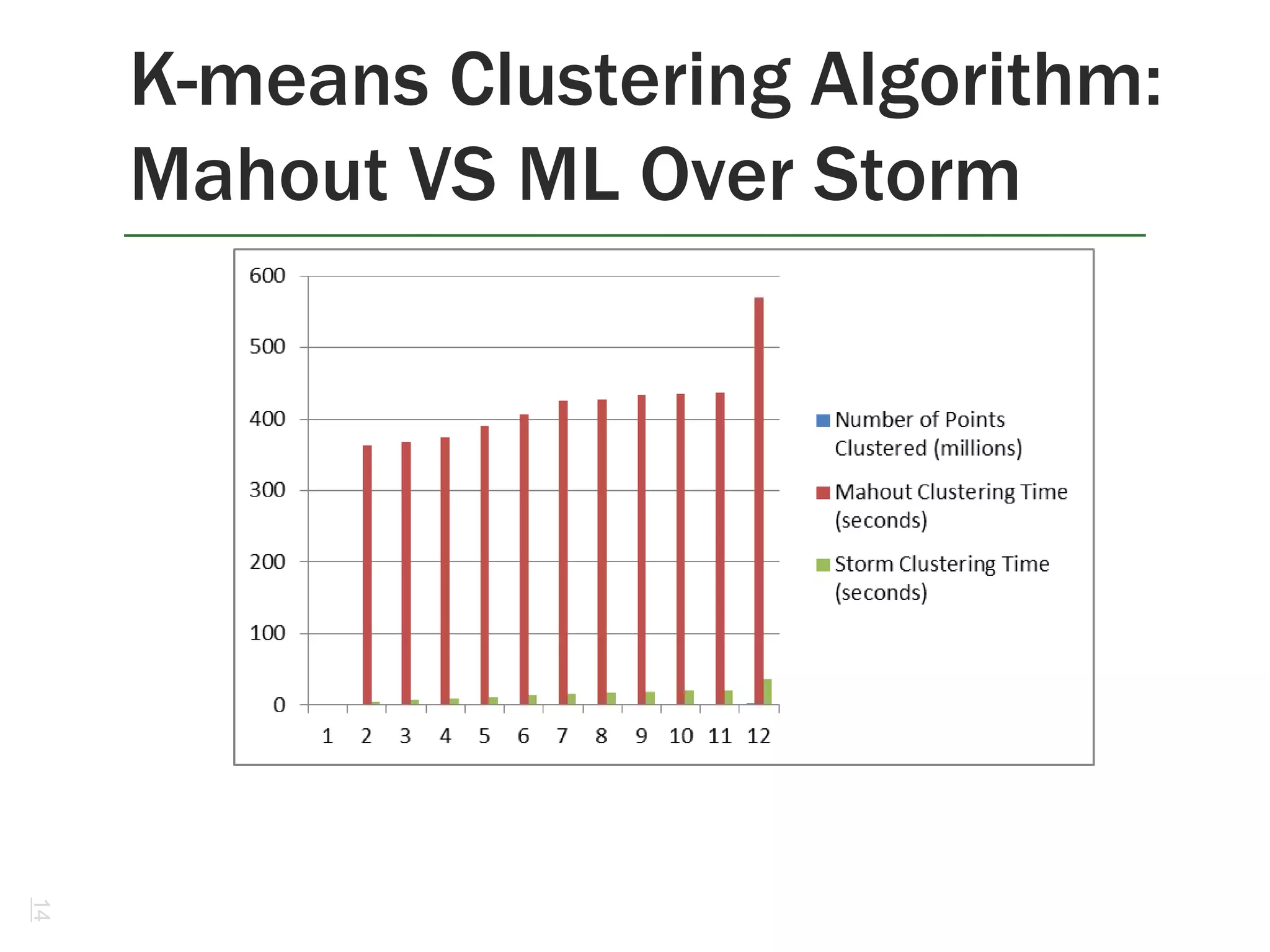
• Performance comparison of Mahout with R/ML over
Storm
Contents
2
3
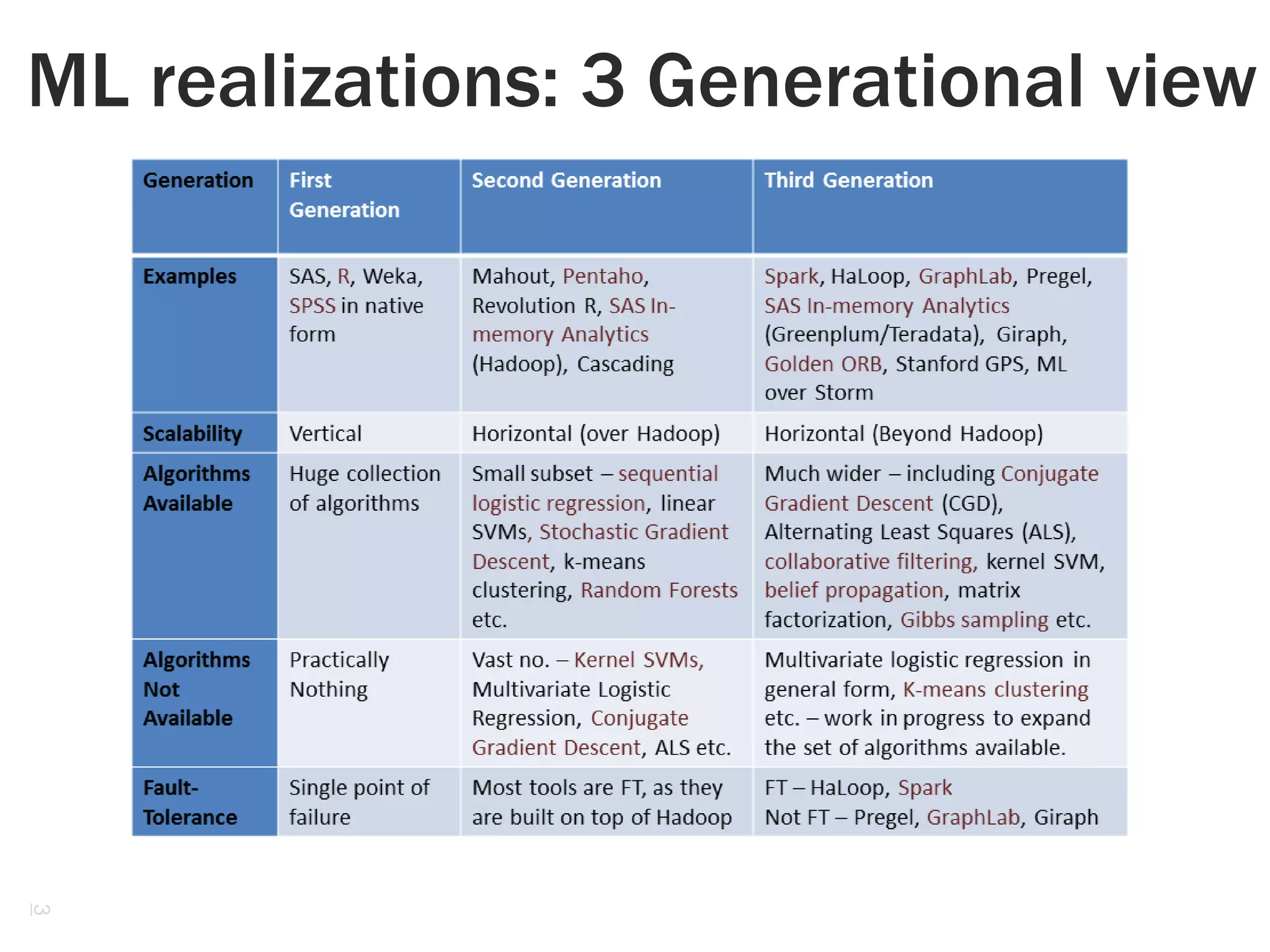
ML realizations: 3 Generational view
Iterative ML Algorithms
 What are iterative algorithms?
 Those that need communication among the computing entities
 Examples – neural networks, PageRank algorithms, network traffic analysis
 Conjugate gradient descent
 Commonly used to solve systems of linear equations
 [CB09] tried implementing CG on dense matrices
 DAXPY – Multiplies vector x by constant a and adds y.
 DDOT – Dot product of 2 vectors
 MatVec – Multiply matrix by vector, produce a vector.
 1 MR per primitive – 6 MRs per CG iteration, hundreds of MRs per CG
computation, leading to 10 of GBs of communication even for small
matrices.
 Other iterative algorithms – fast fourier transform, block tridiagonal
[CB09] C. Bunch, B. Drawert, M. Norman, Mapscale: a cloud environment for scientific computing,
Technical Report, University of California, Computer Science Department, 2009.
5
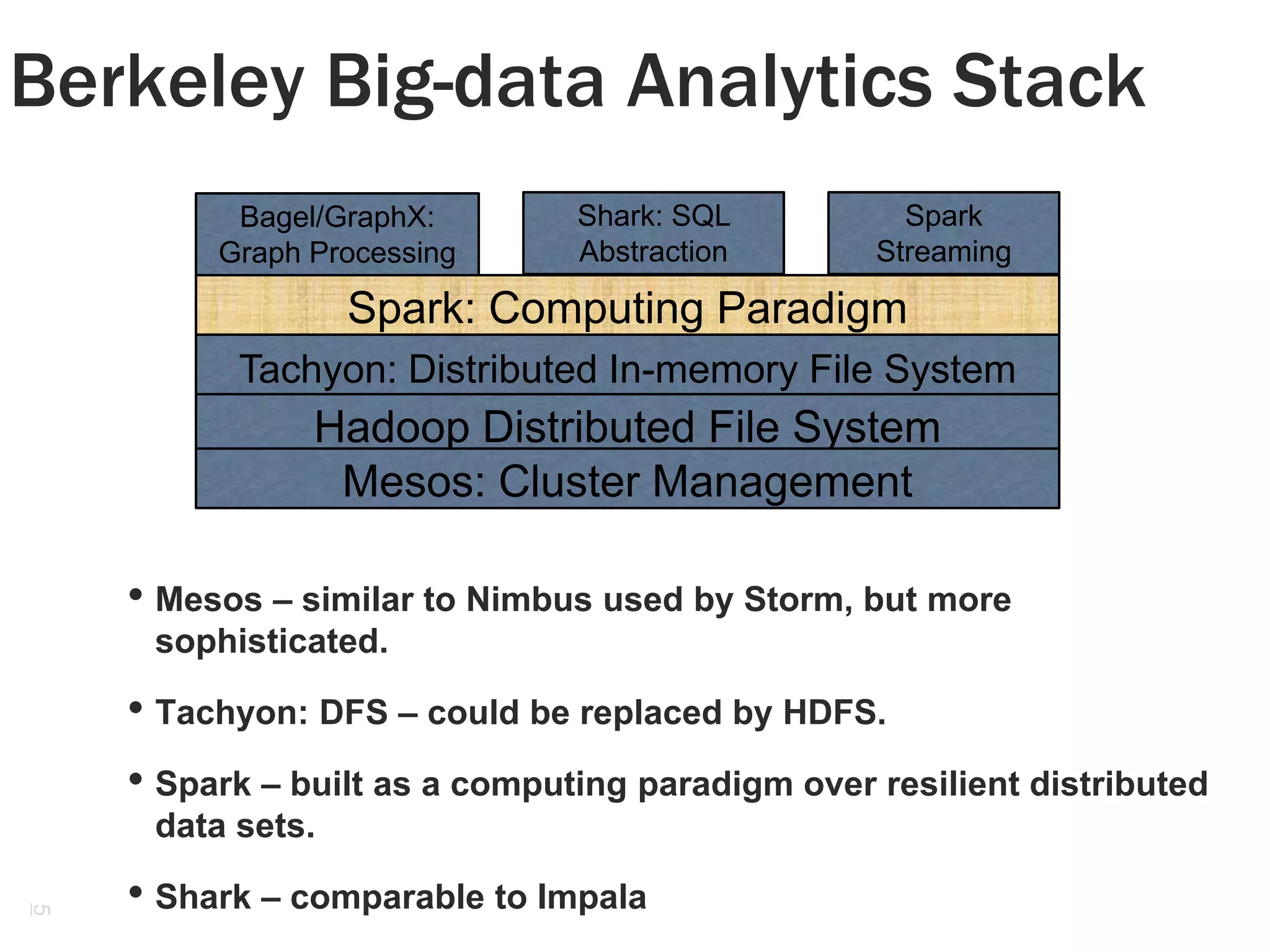
Berkeley Big-data Analytics Stack
Hadoop Distributed File System
Tachyon: Distributed In-memory File System
Spark: Computing Paradigm
Bagel/GraphX:
Graph Processing
• Mesos – similar to Nimbus used by Storm, but more
sophisticated.
• Tachyon: DFS – could be replaced by HDFS.
• Spark – built as a computing paradigm over resilient distributed
data sets.
• Shark – comparable to Impala
Shark: SQL
Abstraction
Spark
Streaming
Mesos: Cluster Management
Spark: Third Generation ML Realization
 Resilient distributed data sets (RDDs)
 Read-only collection of objects partitioned across a cluster
 Can be rebuilt if partition is lost.
 Operations on RDDs
 Transformations – map, flatMap, reduceByKey, sort, join, partitionBy
 Actions – Foreach, reduce, collect, count, lookup
 Programmer can build RDDs from
1. a file in HDFS
2. Parallelizing Scala collection - divide into slices.
3. Transform existing RDD - Specify operations such as Map, Filter
4. Change persistence of RDD Cache or a save action – saves to HDFS.
 Shared variables
 Broadcast variables, accumulators
[MZ10] Matei Zaharia, Mosharaf Chowdhury, Michael J. Franklin, Scott Shenker, and Ion Stoica. 2010. Spark:
cluster computing with working sets. In Proceedings of the 2nd USENIX conference on Hot topics in cloud
computing (HotCloud'10). USENIX Association, Berkeley, CA, USA, 10-10
7
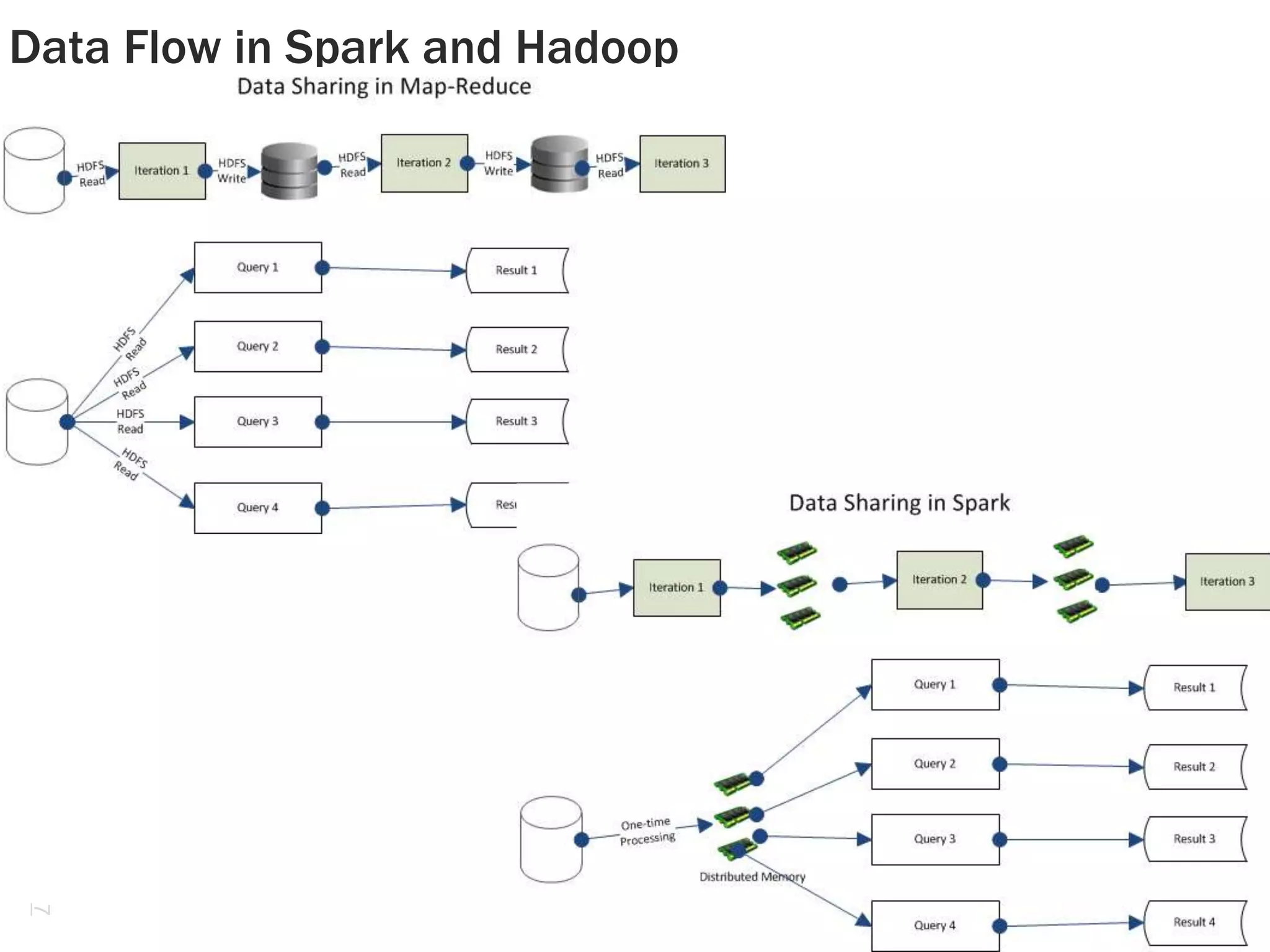
Data Flow in Spark and Hadoop
Some Spark(ling) examples
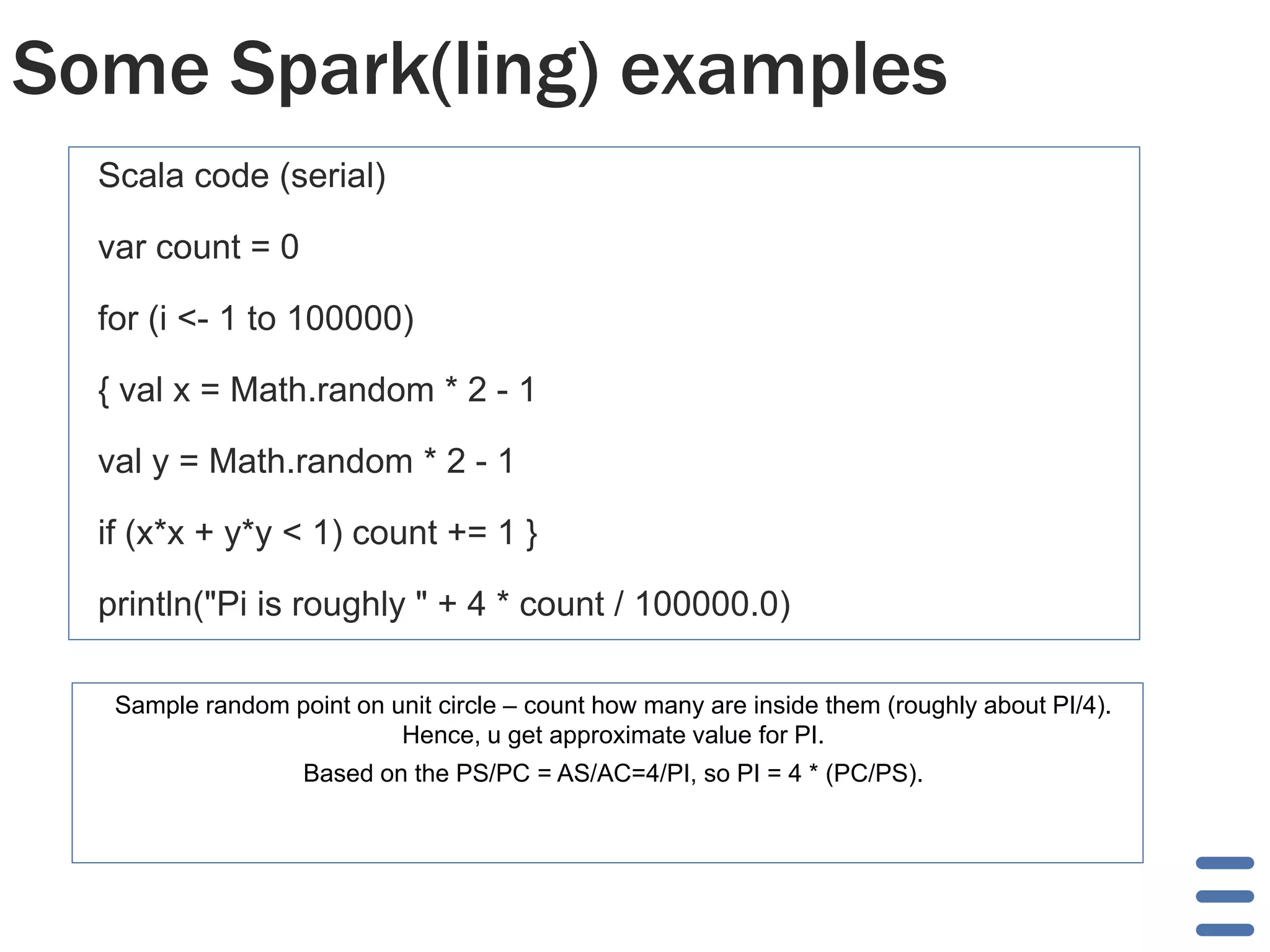
Scala code (serial)
var count = 0
for (i <- 1 to 100000)
{ val x = Math.random * 2 - 1
val y = Math.random * 2 - 1
if (x*x + y*y < 1) count += 1 }
println("Pi is roughly " + 4 * count / 100000.0)
Sample random point on unit circle – count how many are inside them (roughly about PI/4).
Hence, u get approximate value for PI.
Based on the PS/PC = AS/AC=4/PI, so PI = 4 * (PC/PS).
Some Spark(ling) examples
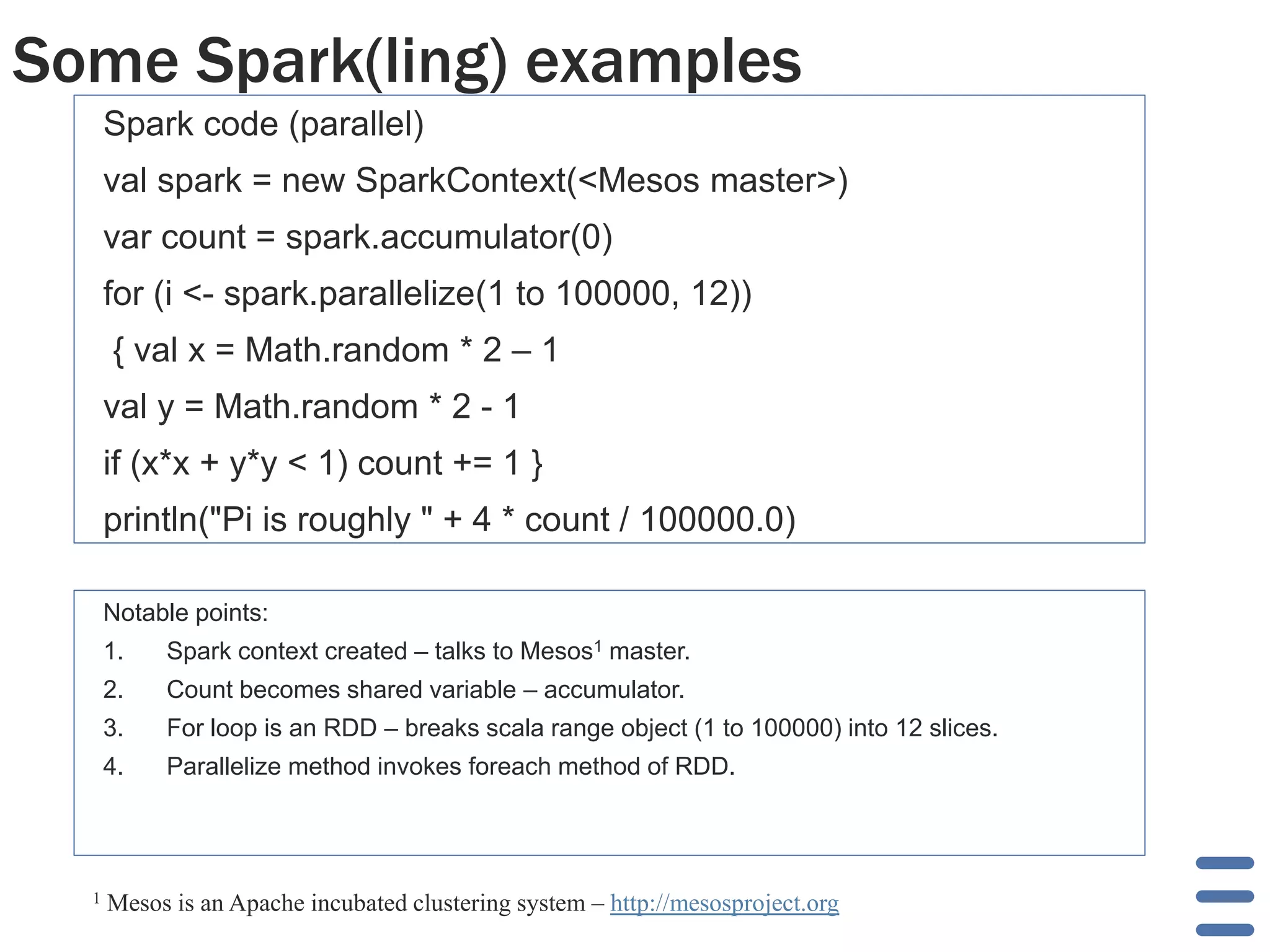
Spark code (parallel)
val spark = new SparkContext(<Mesos master>)
var count = spark.accumulator(0)
for (i <- spark.parallelize(1 to 100000, 12))
{ val x = Math.random * 2 – 1
val y = Math.random * 2 - 1
if (x*x + y*y < 1) count += 1 }
println("Pi is roughly " + 4 * count / 100000.0)
Notable points:
1. Spark context created – talks to Mesos1 master.
2. Count becomes shared variable – accumulator.
3. For loop is an RDD – breaks scala range object (1 to 100000) into 12 slices.
4. Parallelize method invokes foreach method of RDD.
1 Mesos is an Apache incubated clustering system – http://mesosproject.org
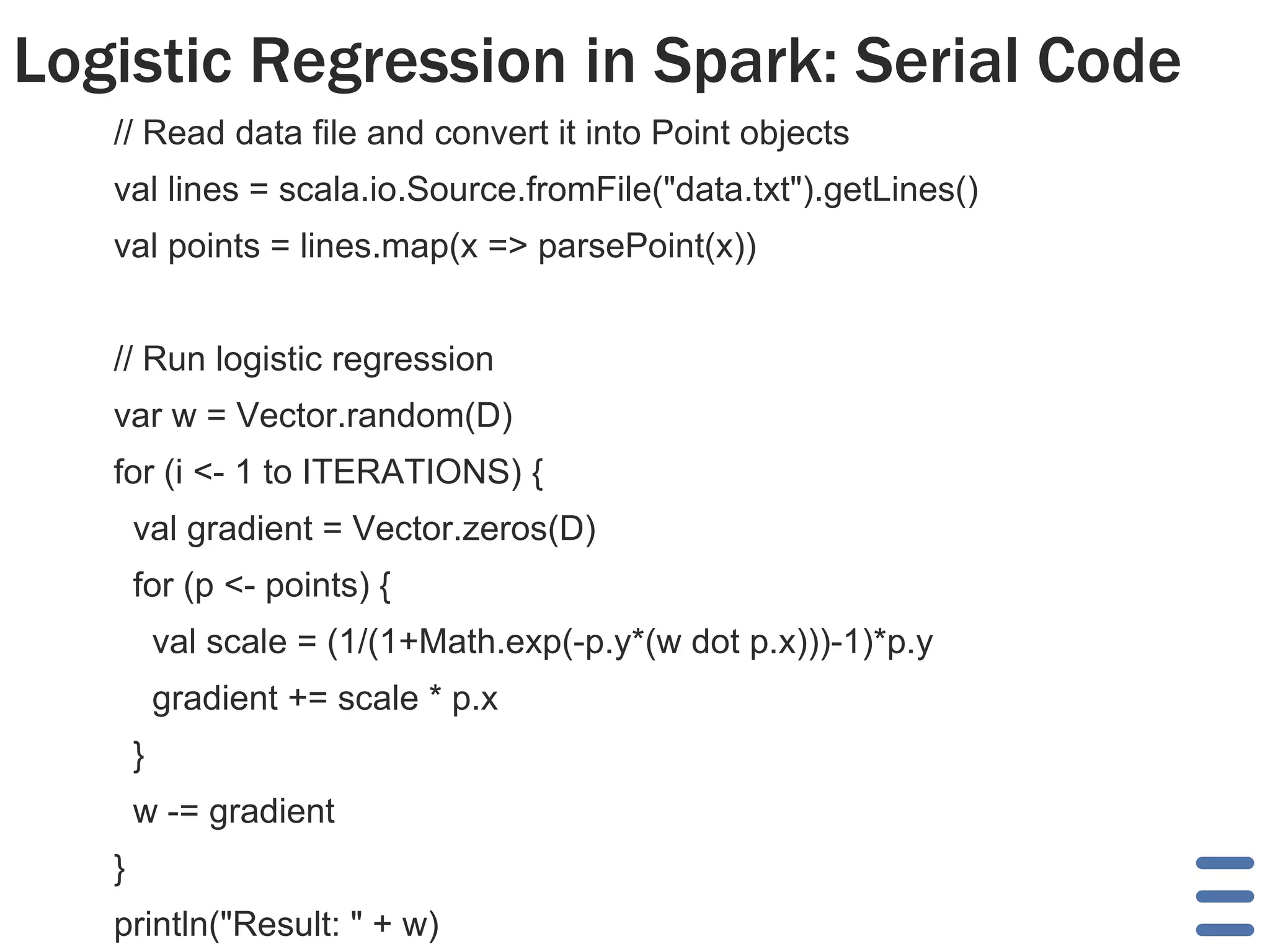
Logistic Regression in Spark: Serial Code
// Read data file and convert it into Point objects
val lines = scala.io.Source.fromFile("data.txt").getLines()
val points = lines.map(x => parsePoint(x))
// Run logistic regression
var w = Vector.random(D)
for (i <- 1 to ITERATIONS) {
val gradient = Vector.zeros(D)
for (p <- points) {
val scale = (1/(1+Math.exp(-p.y*(w dot p.x)))-1)*p.y
gradient += scale * p.x
}
w -= gradient
}
println("Result: " + w)
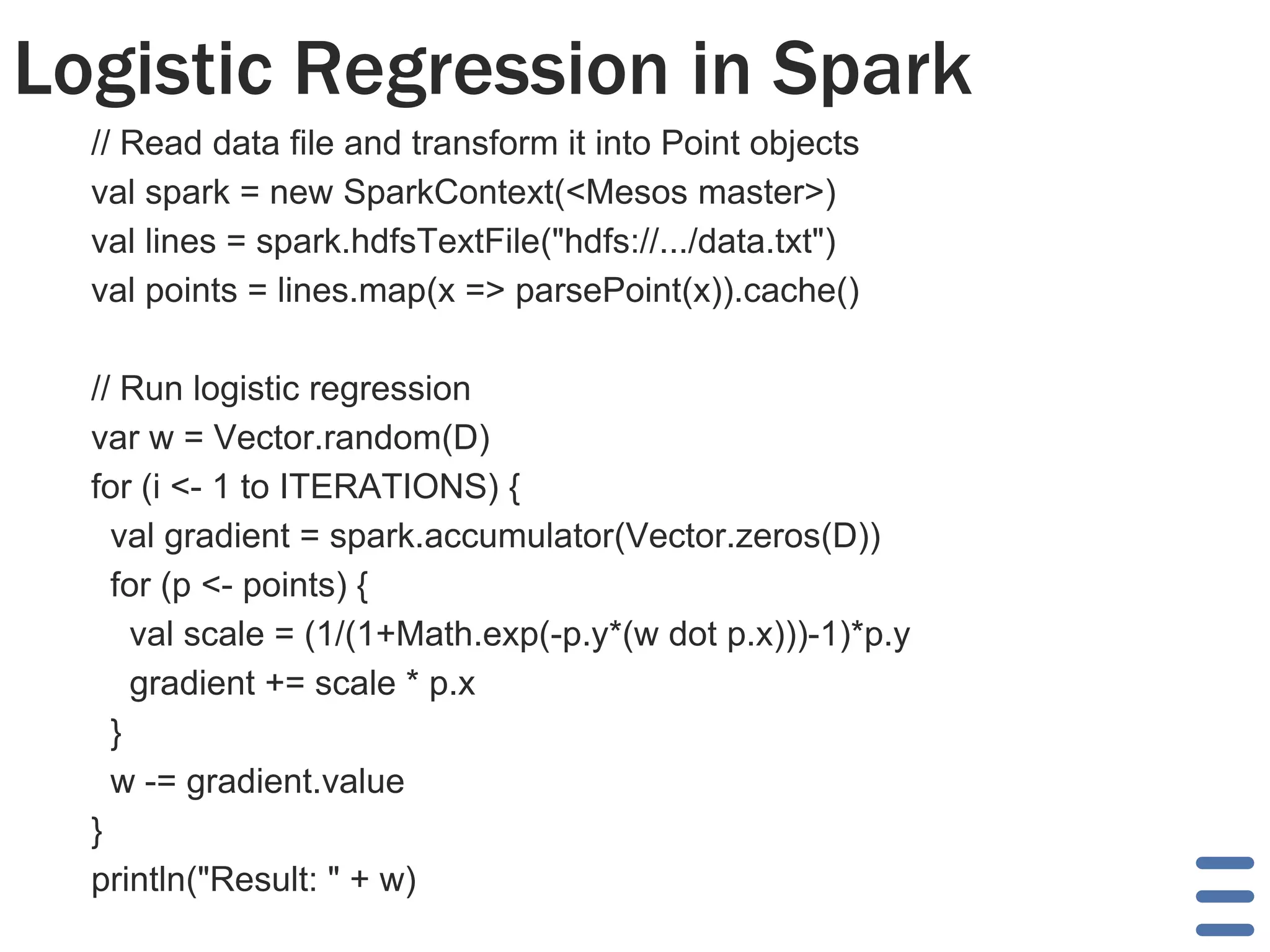
Logistic Regression in Spark
// Read data file and transform it into Point objects
val spark = new SparkContext(<Mesos master>)
val lines = spark.hdfsTextFile("hdfs://.../data.txt")
val points = lines.map(x => parsePoint(x)).cache()
// Run logistic regression
var w = Vector.random(D)
for (i <- 1 to ITERATIONS) {
val gradient = spark.accumulator(Vector.zeros(D))
for (p <- points) {
val scale = (1/(1+Math.exp(-p.y*(w dot p.x)))-1)*p.y
gradient += scale * p.x
}
w -= gradient.value
}
println("Result: " + w)
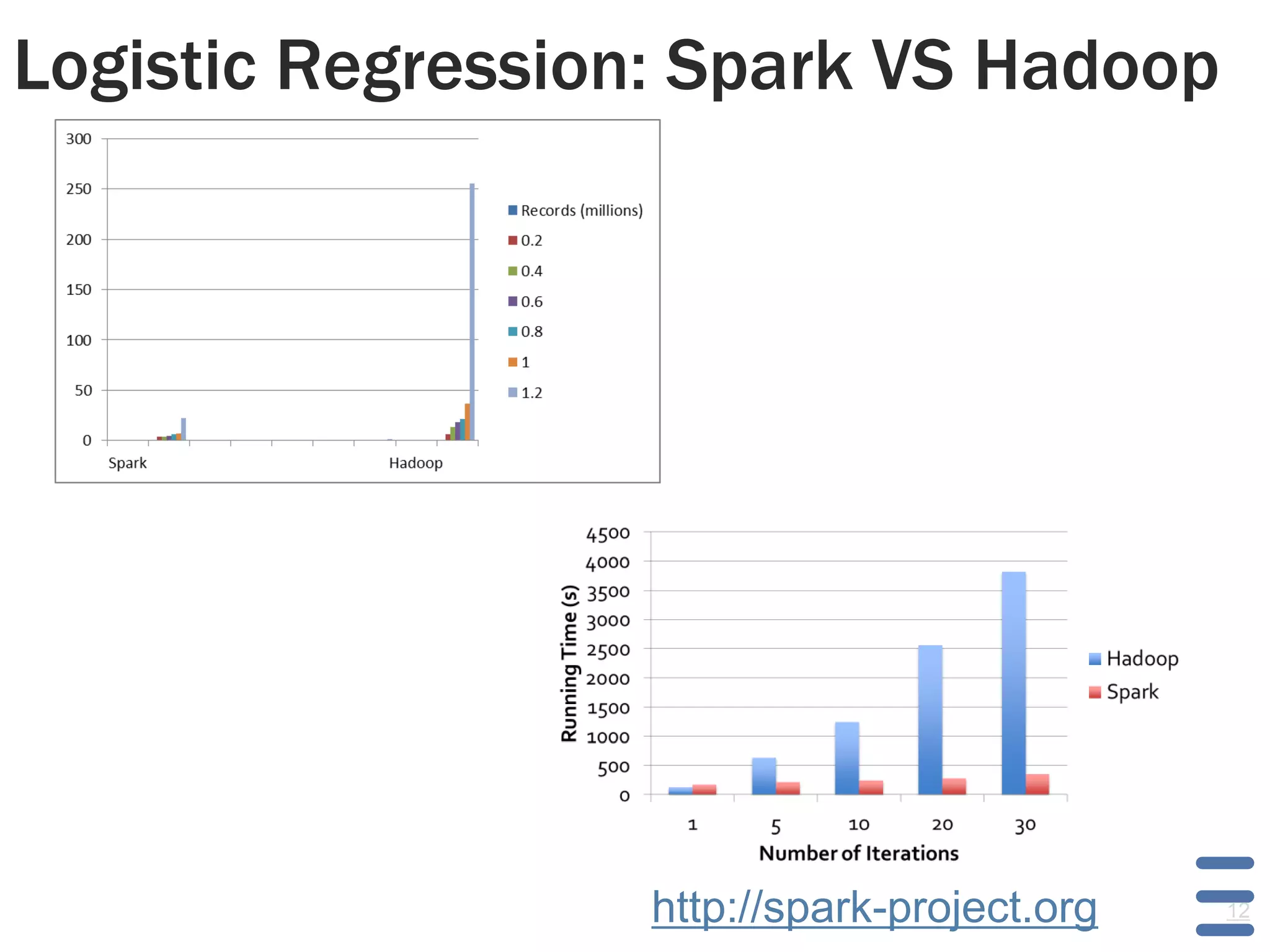
Logistic Regression: Spark VS Hadoop
12http://spark-project.org
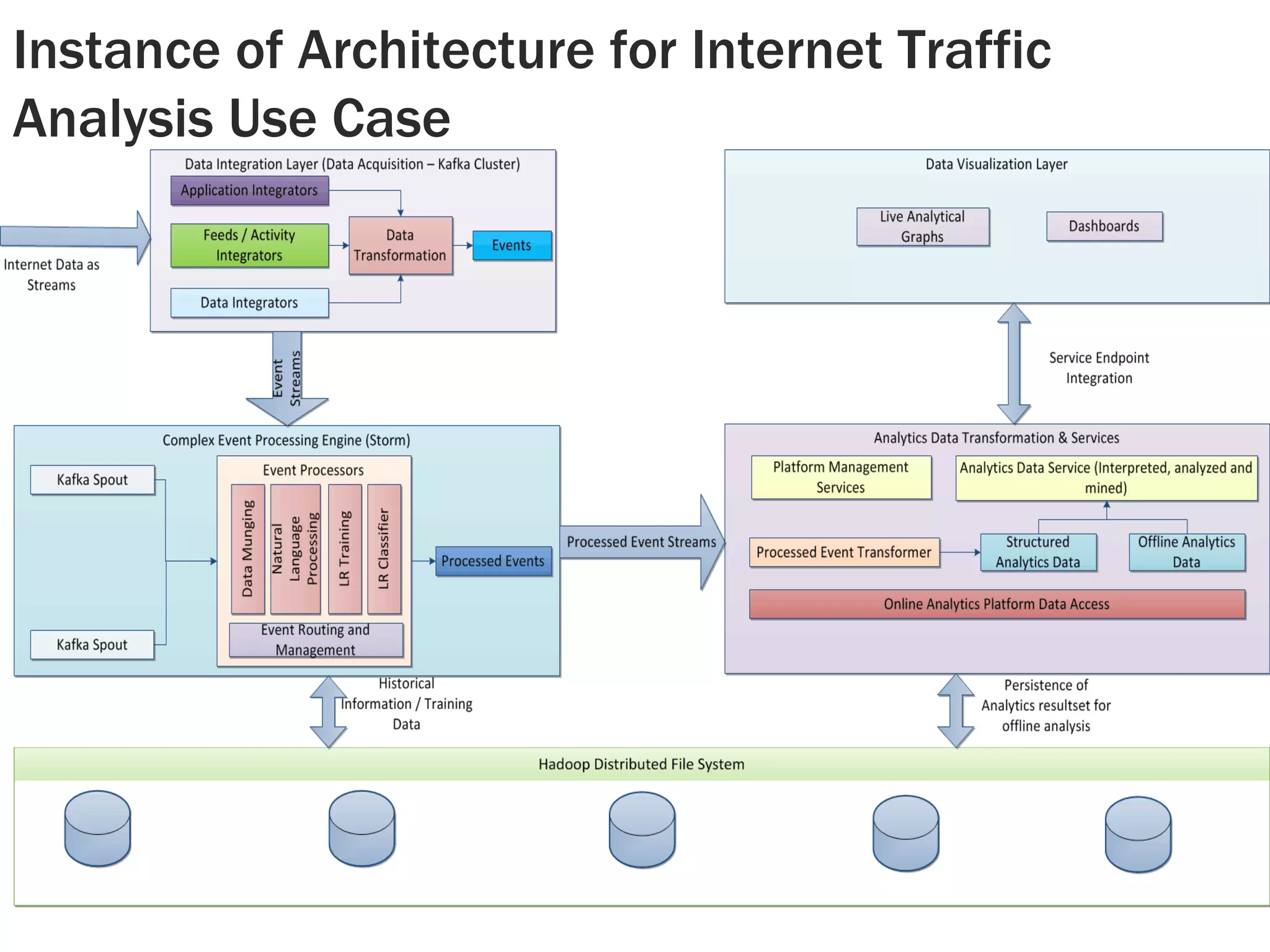
Instance of Architecture for Internet Traffic
Analysis Use Case
K-means Clustering Algorithm:
Mahout VS ML Over Storm
14
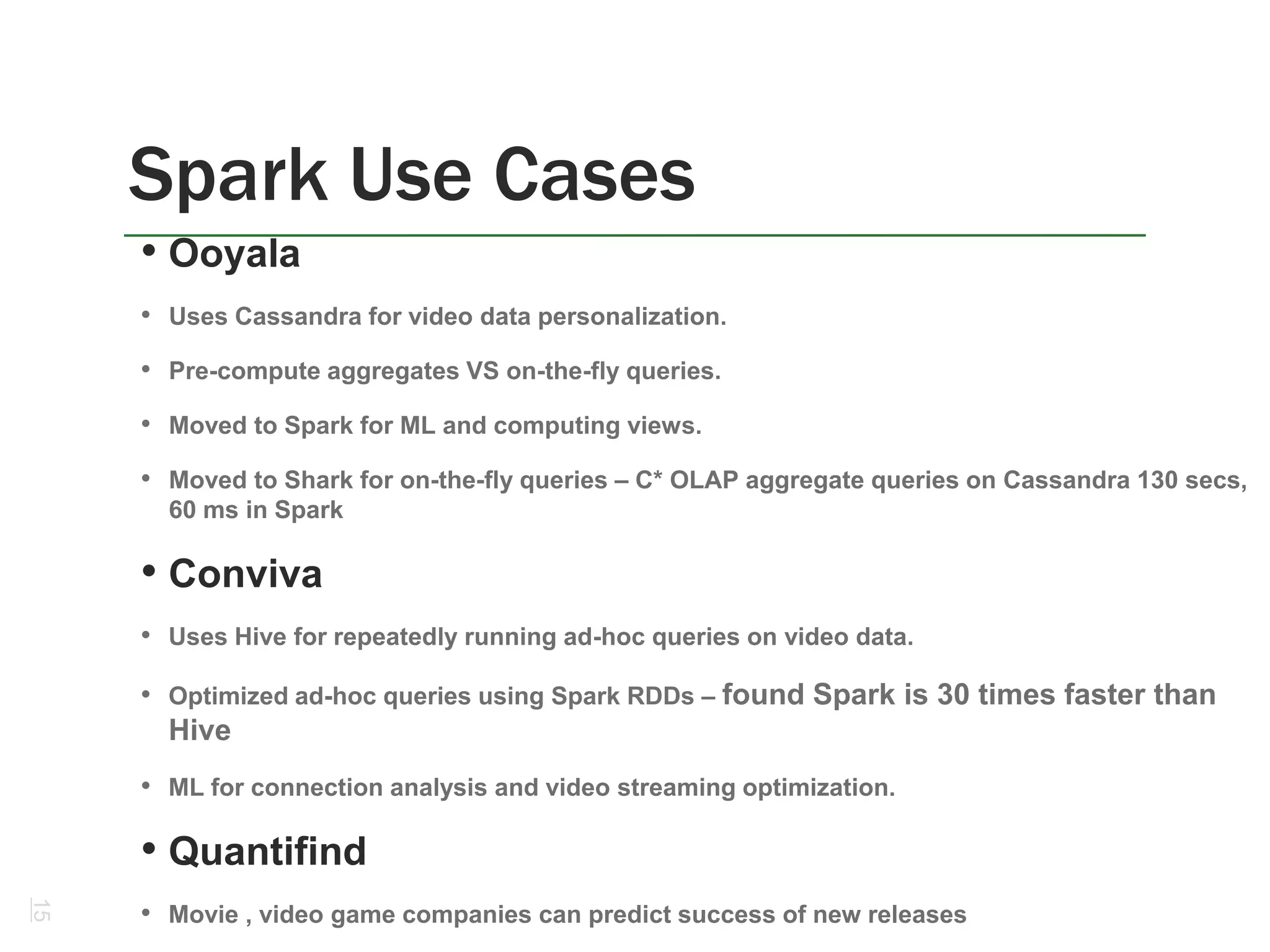
Spark Use Cases
15
• Ooyala
• Uses Cassandra for video data personalization.
• Pre-compute aggregates VS on-the-fly queries.
• Moved to Spark for ML and computing views.
• Moved to Shark for on-the-fly queries – C* OLAP aggregate queries on Cassandra 130 secs,
60 ms in Spark
• Conviva
• Uses Hive for repeatedly running ad-hoc queries on video data.
• Optimized ad-hoc queries using Spark RDDs – found Spark is 30 times faster than
Hive
• ML for connection analysis and video streaming optimization.
• Quantifind
• Movie , video game companies can predict success of new releases
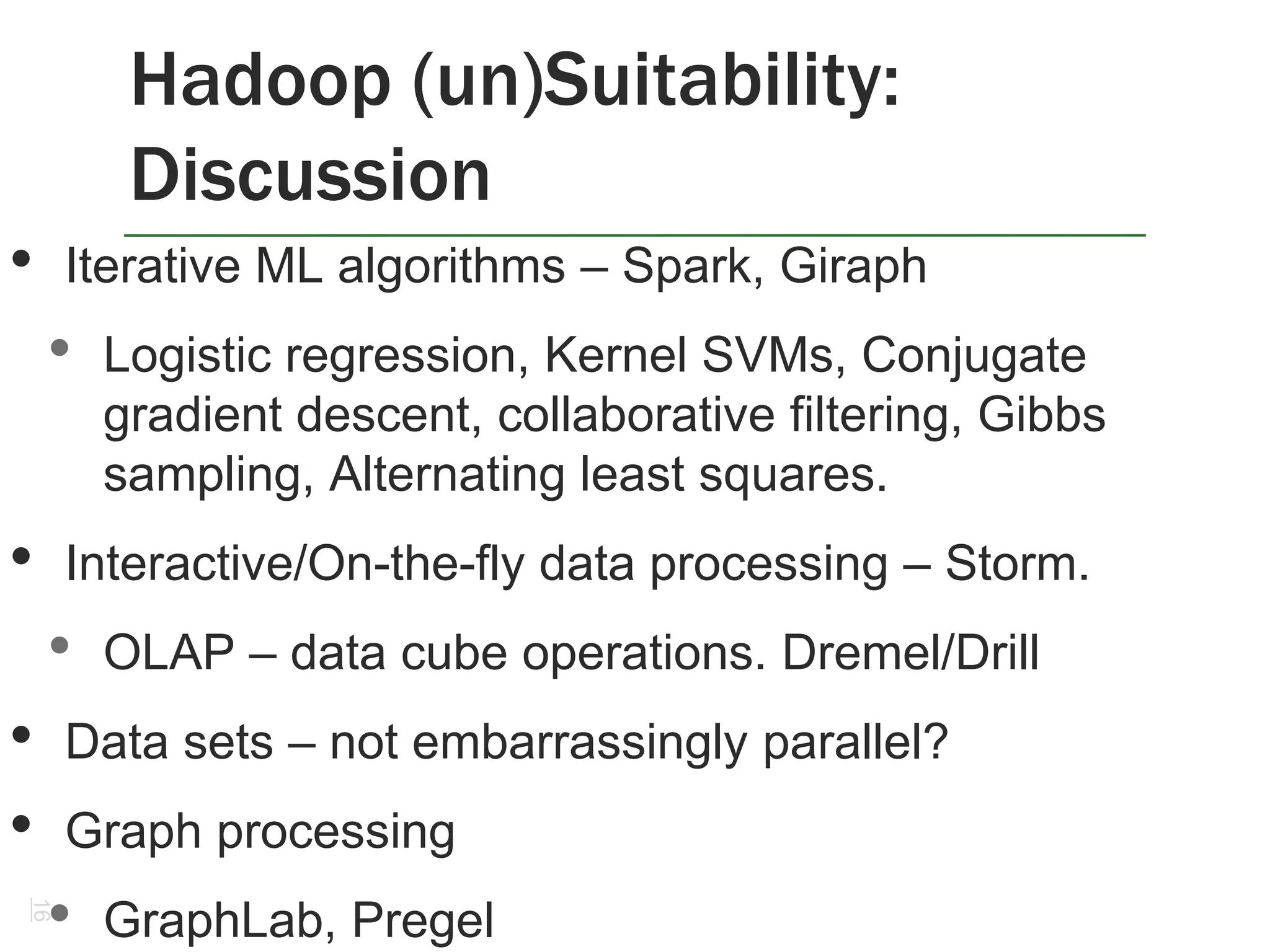
Hadoop (un)Suitability:
Discussion
16
• Iterative ML algorithms – Spark, Giraph
• Logistic regression, Kernel SVMs, Conjugate
gradient descent, collaborative filtering, Gibbs
sampling, Alternating least squares.
• Interactive/On-the-fly data processing – Storm.
• OLAP – data cube operations. Dremel/Drill
• Data sets – not embarrassingly parallel?
• Graph processing
• GraphLab, Pregel
Thank You!
• Mail
vijay.sa@impetus.co.in
• LinkedIn
http://in.linkedin.com/in/vijaysrinivasagneeswaran
• Blogs
blogs.impetus.com
• Twitter
@a_vijaysrinivas.

Big data analytics_beyond_hadoop_public_18_july_2013

  • 1.
    1 Big-data Analytics: Needto look beyond Hadoop? Dr. Vijay Srinivas Agneeswaran, Director and Head, Big-data R&D, Innovation Labs, Impetus.s
  • 2.
    • Introduction toBerkeley data analytics stack – Spark • Machine learning: 3 generations • Iterative Machine Learning (ML) algorithms – Logistic regression. • Code snippets • Performance comparison with Hadoop. • Real-time analytics with Twitter’s Storm • Internet traffic use case – ML over Storm. • Performance comparison of Mahout with R/ML over Storm Contents 2
  • 3.
    3 ML realizations: 3Generational view
  • 4.
    Iterative ML Algorithms What are iterative algorithms?  Those that need communication among the computing entities  Examples – neural networks, PageRank algorithms, network traffic analysis  Conjugate gradient descent  Commonly used to solve systems of linear equations  [CB09] tried implementing CG on dense matrices  DAXPY – Multiplies vector x by constant a and adds y.  DDOT – Dot product of 2 vectors  MatVec – Multiply matrix by vector, produce a vector.  1 MR per primitive – 6 MRs per CG iteration, hundreds of MRs per CG computation, leading to 10 of GBs of communication even for small matrices.  Other iterative algorithms – fast fourier transform, block tridiagonal [CB09] C. Bunch, B. Drawert, M. Norman, Mapscale: a cloud environment for scientific computing, Technical Report, University of California, Computer Science Department, 2009.
  • 5.
    5 Berkeley Big-data AnalyticsStack Hadoop Distributed File System Tachyon: Distributed In-memory File System Spark: Computing Paradigm Bagel/GraphX: Graph Processing • Mesos – similar to Nimbus used by Storm, but more sophisticated. • Tachyon: DFS – could be replaced by HDFS. • Spark – built as a computing paradigm over resilient distributed data sets. • Shark – comparable to Impala Shark: SQL Abstraction Spark Streaming Mesos: Cluster Management
  • 6.
    Spark: Third GenerationML Realization  Resilient distributed data sets (RDDs)  Read-only collection of objects partitioned across a cluster  Can be rebuilt if partition is lost.  Operations on RDDs  Transformations – map, flatMap, reduceByKey, sort, join, partitionBy  Actions – Foreach, reduce, collect, count, lookup  Programmer can build RDDs from 1. a file in HDFS 2. Parallelizing Scala collection - divide into slices. 3. Transform existing RDD - Specify operations such as Map, Filter 4. Change persistence of RDD Cache or a save action – saves to HDFS.  Shared variables  Broadcast variables, accumulators [MZ10] Matei Zaharia, Mosharaf Chowdhury, Michael J. Franklin, Scott Shenker, and Ion Stoica. 2010. Spark: cluster computing with working sets. In Proceedings of the 2nd USENIX conference on Hot topics in cloud computing (HotCloud'10). USENIX Association, Berkeley, CA, USA, 10-10
  • 7.
    7 Data Flow inSpark and Hadoop
  • 8.
    Some Spark(ling) examples Scalacode (serial) var count = 0 for (i <- 1 to 100000) { val x = Math.random * 2 - 1 val y = Math.random * 2 - 1 if (x*x + y*y < 1) count += 1 } println("Pi is roughly " + 4 * count / 100000.0) Sample random point on unit circle – count how many are inside them (roughly about PI/4). Hence, u get approximate value for PI. Based on the PS/PC = AS/AC=4/PI, so PI = 4 * (PC/PS).
  • 9.
    Some Spark(ling) examples Sparkcode (parallel) val spark = new SparkContext(<Mesos master>) var count = spark.accumulator(0) for (i <- spark.parallelize(1 to 100000, 12)) { val x = Math.random * 2 – 1 val y = Math.random * 2 - 1 if (x*x + y*y < 1) count += 1 } println("Pi is roughly " + 4 * count / 100000.0) Notable points: 1. Spark context created – talks to Mesos1 master. 2. Count becomes shared variable – accumulator. 3. For loop is an RDD – breaks scala range object (1 to 100000) into 12 slices. 4. Parallelize method invokes foreach method of RDD. 1 Mesos is an Apache incubated clustering system – http://mesosproject.org
  • 10.
    Logistic Regression inSpark: Serial Code // Read data file and convert it into Point objects val lines = scala.io.Source.fromFile("data.txt").getLines() val points = lines.map(x => parsePoint(x)) // Run logistic regression var w = Vector.random(D) for (i <- 1 to ITERATIONS) { val gradient = Vector.zeros(D) for (p <- points) { val scale = (1/(1+Math.exp(-p.y*(w dot p.x)))-1)*p.y gradient += scale * p.x } w -= gradient } println("Result: " + w)
  • 11.
    Logistic Regression inSpark // Read data file and transform it into Point objects val spark = new SparkContext(<Mesos master>) val lines = spark.hdfsTextFile("hdfs://.../data.txt") val points = lines.map(x => parsePoint(x)).cache() // Run logistic regression var w = Vector.random(D) for (i <- 1 to ITERATIONS) { val gradient = spark.accumulator(Vector.zeros(D)) for (p <- points) { val scale = (1/(1+Math.exp(-p.y*(w dot p.x)))-1)*p.y gradient += scale * p.x } w -= gradient.value } println("Result: " + w)
  • 12.
    Logistic Regression: SparkVS Hadoop 12http://spark-project.org
  • 13.
    Instance of Architecturefor Internet Traffic Analysis Use Case
  • 14.
  • 15.
    Spark Use Cases 15 •Ooyala • Uses Cassandra for video data personalization. • Pre-compute aggregates VS on-the-fly queries. • Moved to Spark for ML and computing views. • Moved to Shark for on-the-fly queries – C* OLAP aggregate queries on Cassandra 130 secs, 60 ms in Spark • Conviva • Uses Hive for repeatedly running ad-hoc queries on video data. • Optimized ad-hoc queries using Spark RDDs – found Spark is 30 times faster than Hive • ML for connection analysis and video streaming optimization. • Quantifind • Movie , video game companies can predict success of new releases
  • 16.
    Hadoop (un)Suitability: Discussion 16 • IterativeML algorithms – Spark, Giraph • Logistic regression, Kernel SVMs, Conjugate gradient descent, collaborative filtering, Gibbs sampling, Alternating least squares. • Interactive/On-the-fly data processing – Storm. • OLAP – data cube operations. Dremel/Drill • Data sets – not embarrassingly parallel? • Graph processing • GraphLab, Pregel
  • 17.
    Thank You! • Mail vijay.sa@impetus.co.in •LinkedIn http://in.linkedin.com/in/vijaysrinivasagneeswaran • Blogs blogs.impetus.com • Twitter @a_vijaysrinivas.