PRESENTED BY
APOLLOJAMES, M.Pharm.,
Asst.Professor, Nandha college of Pharmacy, Erode,Tamilnadu,
India
Scabies
The fear of the Lord is the beginning of knowledge; fools despise wisdom and
instruction. -Proverbs 1:7
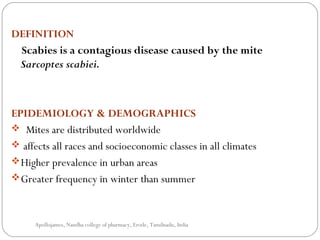
DEFINITION
Scabies is a contagious disease caused by the mite
Sarcoptes scabiei.
EPIDEMIOLOGY & DEMOGRAPHICS
 Mites are distributed worldwide
 affects all races and socioeconomic classes in all climates
Higher prevalence in urban areas
Greater frequency in winter than summer
Apollojames, Nandha college of pharmacy, Erode, Tamilnadu, India
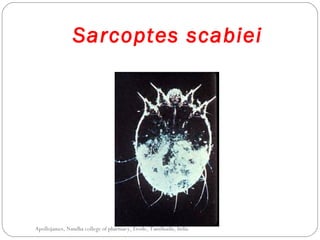
Sarcoptes scabiei
Apollojames, Nandha college of pharmacy, Erode, Tamilnadu, India
Scabies Transmission
Direct, prolonged, skin–to-skin contact
Sexual contact
Exposure is most common in nursing homes, hospitals,
institutions, and daycare settings; can also be spread in
households
Indirect transfer from clothing, towels and bedding
Transmission occurs as long as person is infested and
untreated, including incubation period
Apollojames, Nandha college of pharmacy, Erode,
Tamilnadu, India
Scabies Symptoms
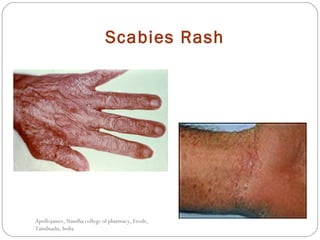
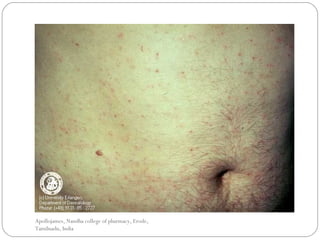
 Pimple-like rash or burrows between fingers, on wrist,
elbows, armpits, belt line, navel, abdomen, and/or back of
the hip
 Erythematous(red) skin
 Intense itching over most of the body, especially at night
 Sores on the body caused by scratching
 Sores can sometimes become infected with bacteria(usually
streptococcus pyogenes or staphylococcus aureas)
Incubation period:
2-6 weeks without previous exposure
1-4 days after re-infestation (usually milder)
Apollojames, Nandha college of pharmacy, Erode,
Tamilnadu, India
Scabies Rash
Apollojames, Nandha college of pharmacy, Erode,
Tamilnadu, India
Apollojames, Nandha college of pharmacy, Erode,
Tamilnadu, India
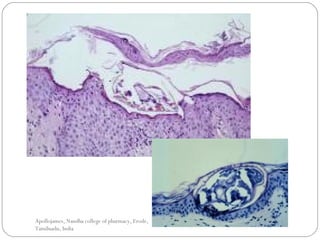
LABORATORY TESTS
 Microscopic demonstration of the organism, feces, or
eggs: a drop of mineral oil may be placed over the
suspected lesion before removal; the scrapings are
transferred directly to a glass slide; a drop of potassium
hydroxide is added and a cover slip is applied.
 Skin biopsy is rarely necessary to make the diagnosis.
Apollojames, Nandha college of pharmacy, Erode,
Tamilnadu, India
Apollojames, Nandha college of pharmacy, Erode,
Tamilnadu, India
Pathophysiology
 The mite, S scabiei spreads disease through direct and
prolonged contact between hosts.
 The mite remains viable for 2-5 days on inanimate objects;
therefore, transmission through for mites, such as infected
bedding or clothing, is possible.
 Once bound to their host, 10-15 mites mate on the surface
of the skin.
Apollojames, Nandha college of pharmacy, Erode,
Tamilnadu, India
After mating, the male mite dies.
The female mite burrows into the epidermis of the
host using her jaws and front legs, where she lays up
to 3 eggs per day for the duration of her 30-60 day
lifetime.
An affected host harbors approximately 11 adult
female mites during a typical infestation. The eggs
hatch in 3-4 days.
The Larvae migrate to skin surface and burrow into
the skin or hair follicles forming short burrows, called
molting pouches. Larvae have 3 pairs of legs and last
only 2 to 3 days before turning into nymphs.
 Nymphs have 4 pairs of legs, and become adults
weeks later.
Apollojames, Nandha college of pharmacy, Erode,
Tamilnadu, India
Mating occurs when male mite penetrates the molting
pouch of the female mite.
Impregnated females extend their molting pouches into
burrows, laying eggs in the process; survive 1-2 months in
tunnels under the skin.
A delayed type IV hypersensitivity reaction to the mites,
their eggs, or scybala (packets of feces) occurs approximately
30 days after infestation.
This reaction is responsible for the intense pruritis, which
is the hallmark of the disease.
Apollojames, Nandha college of pharmacy, Erode,
Tamilnadu, India
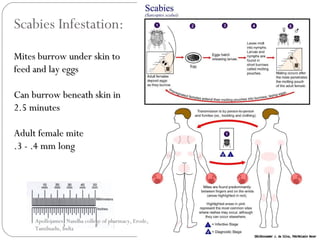
Scabies Infestation:
Mites burrow under skin toMites burrow under skin to
feed and lay eggsfeed and lay eggs
Can burrow beneath skin inCan burrow beneath skin in
2.5 minutes2.5 minutes
Adult female miteAdult female mite
.3 - .4 mm long.3 - .4 mm long
Apollojames, Nandha college of pharmacy, Erode,
Tamilnadu, India
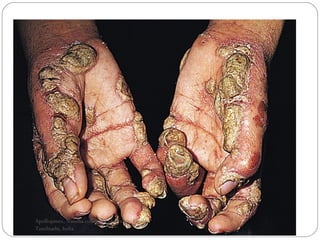
Norwegian Scabies
In 1848, the Norwegians Danielssen and Boeck described a highly
contagious variant of scabies that occurs in immuno- compromised
patients.
This rare form of scabies occurs in elderly or mentally incompetent
patients. Because of an impaired antibody response, these individuals
can be infested with thousands to a couple million mites.
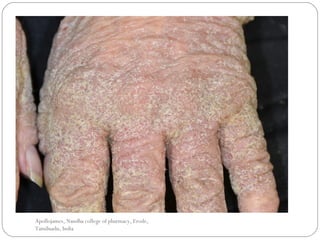
Norwegian scabies is characterized by crusted lesions and scaly plaques
located mainly on the hands, feet, scalp, and other pressure-bearing
areas.
These may sometimes generalize. Hyperkeratosis may occur in these
lesions
Nodular scabies: Orange-red nodules located in the axilla and groin
Apollojames, Nandha college of pharmacy, Erode,
Tamilnadu, India
Apollojames, Nandha college of pharmacy, Erode,
Tamilnadu, India
Apollojames, Nandha college of pharmacy, Erode,
Tamilnadu, India
Scabies Treatment
Application of scabicide over entire body below head
Cream should be reapplied to hands after routine hand
washing, since hands are often infected
Itching may continue for several weeks despite successful
treatment
In ~5% of cases, 2nd
treatment may be necessary after 7-
10 days.
Apollojames, Nandha college of pharmacy, Erode,
Tamilnadu, India
Sulphur
Scabies was historically treated with topical sulfur, a
treatment still in use today
10% sulphur in yellow soft paraffin is safe and effective.
2.5% used for scabies in infants and young children.
Excessive or higher concentration may cause irritation.
Apollojames, Nandha college of pharmacy, Erode,
Tamilnadu, India
Lindane 1% (gamma benzene
hexachloride)
Lindane is an organochloride.
a single application, washed off after 12-24h
6 hour application is equally effective
Adverse effects:
 Neurological effect- seizure
 Toxicity was usually the result of excessive topical application or
accidental ingestion.
 Lindane should not be used to treat premature infants, persons
with a seizure disorder, women who are pregnant or breast-
feeding, persons who have very irritated skin or sores where the
lindane will be applied, infants, children, the elderly, and persons
who weigh less than 110 pounds.
Apollojames, Nandha college of pharmacy, Erode,
Tamilnadu, India
Malathion
 0.5% in aqueous base
 For one application in an adult 100ml lotion is sufficient.
 Apply on cool, dry skin using clean paintbrush or cotton
wool.
 It should be left on the skin for 24h
 If hands are washed with soap and water during the 24h,
it should be reapplied to the hands.
 a second application after an interval of a week.
 Skin irritation may sometimes occur.
Apollojames, Nandha college of pharmacy, Erode,
Tamilnadu, India
Ivermectin
Ivermectin is an oral antiparasitic agent approved for the
treatment of worm infestations.
Evidence suggests that oral ivermectin may be a safe and effective
treatment for scabies;
oral ivermectin has been reported effective in the treatment of
crusted scabies; its use should be considered for patients who have
failed treatment with or who cannot tolerate topical medications
for the treatment of scabies.
The dosage of ivermectin is 200 mcg/kg orally. It should be taken
on an empty stomach with water. A total of two or more doses at
least 7 days apart may be necessary to eliminate a scabies
infestation. The safety of ivermectin in children weighing less than
15 kg and in pregnant women has not been established.Apollojames, Nandha college of pharmacy, Erode,
Tamilnadu, India
Permethrin (Elimite)
5% dermal cream is effective
For a single application in an adult 30-60g of cream is
needed.
Applied to the whole body and left on for 8-12h before
being washed off.
Second application after an interval of a week.
Can cause itching and reddening of the skin.
Apollojames, Nandha college of pharmacy, Erode,
Tamilnadu, India
TREATMENT OVERVIEW
5% permethrin cream: This is the most common treatment for scabies.
It is safe for children as young as 1 month old and women who are
pregnant. 
25% benzyl benzoate lotion.
10% sulfur ointment. 
10% crotamiton cream.
1% lindane lotion.
 Some patients need other treatment, too.
Antihistamine: To control the itch and help you sleep.
Pramoxine lotion: To control the itch.
Antibiotic: To wipe out an infection.
Steroid cream: To ease the redness, swelling, and itch.
Apollojames, Nandha college of pharmacy, Erode,
Tamilnadu, India
Applying Prescription Creams
Follow package insert
Apply thin layer over whole body from neck down,
paying particular attention to folds in skin
Trim fingernails and toenails, apply under nails
Reapply after handwashing
Leave on for at least 8 hours, but not longer than
maximum time recommended for product
Wash off with warm, soapy water and dry skin
Apollojames, Nandha college of pharmacy, Erode,
Tamilnadu, India
Scabies Control
Educate patient about personal hygiene, including hand
washing
Increase awareness and surveillance for scabies
Instruct patient to bath thoroughly, scrubbing the involved
areas with a brush.
Educate other members of the family.
All members of the family should be treated on the same
day.
Apollojames, Nandha college of pharmacy, Erode,
Tamilnadu, India
For your enquiries:
ajamespharma@gmail.com
THANK
UApollojames, Nandha college of pharmacy, Erode,
Tamilnadu, India

5(b)..new scabies

  • 1.
    PRESENTED BY APOLLOJAMES, M.Pharm., Asst.Professor,Nandha college of Pharmacy, Erode,Tamilnadu, India Scabies The fear of the Lord is the beginning of knowledge; fools despise wisdom and instruction. -Proverbs 1:7
  • 2.
    DEFINITION Scabies is acontagious disease caused by the mite Sarcoptes scabiei. EPIDEMIOLOGY & DEMOGRAPHICS  Mites are distributed worldwide  affects all races and socioeconomic classes in all climates Higher prevalence in urban areas Greater frequency in winter than summer Apollojames, Nandha college of pharmacy, Erode, Tamilnadu, India
  • 3.
    Sarcoptes scabiei Apollojames, Nandhacollege of pharmacy, Erode, Tamilnadu, India
  • 4.
    Scabies Transmission Direct, prolonged,skin–to-skin contact Sexual contact Exposure is most common in nursing homes, hospitals, institutions, and daycare settings; can also be spread in households Indirect transfer from clothing, towels and bedding Transmission occurs as long as person is infested and untreated, including incubation period Apollojames, Nandha college of pharmacy, Erode, Tamilnadu, India
  • 5.
    Scabies Symptoms  Pimple-likerash or burrows between fingers, on wrist, elbows, armpits, belt line, navel, abdomen, and/or back of the hip  Erythematous(red) skin  Intense itching over most of the body, especially at night  Sores on the body caused by scratching  Sores can sometimes become infected with bacteria(usually streptococcus pyogenes or staphylococcus aureas) Incubation period: 2-6 weeks without previous exposure 1-4 days after re-infestation (usually milder) Apollojames, Nandha college of pharmacy, Erode, Tamilnadu, India
  • 6.
    Scabies Rash Apollojames, Nandhacollege of pharmacy, Erode, Tamilnadu, India
  • 7.
    Apollojames, Nandha collegeof pharmacy, Erode, Tamilnadu, India
  • 8.
    LABORATORY TESTS  Microscopicdemonstration of the organism, feces, or eggs: a drop of mineral oil may be placed over the suspected lesion before removal; the scrapings are transferred directly to a glass slide; a drop of potassium hydroxide is added and a cover slip is applied.  Skin biopsy is rarely necessary to make the diagnosis. Apollojames, Nandha college of pharmacy, Erode, Tamilnadu, India
  • 9.
    Apollojames, Nandha collegeof pharmacy, Erode, Tamilnadu, India
  • 10.
    Pathophysiology  The mite,S scabiei spreads disease through direct and prolonged contact between hosts.  The mite remains viable for 2-5 days on inanimate objects; therefore, transmission through for mites, such as infected bedding or clothing, is possible.  Once bound to their host, 10-15 mites mate on the surface of the skin. Apollojames, Nandha college of pharmacy, Erode, Tamilnadu, India
  • 11.
    After mating, themale mite dies. The female mite burrows into the epidermis of the host using her jaws and front legs, where she lays up to 3 eggs per day for the duration of her 30-60 day lifetime. An affected host harbors approximately 11 adult female mites during a typical infestation. The eggs hatch in 3-4 days. The Larvae migrate to skin surface and burrow into the skin or hair follicles forming short burrows, called molting pouches. Larvae have 3 pairs of legs and last only 2 to 3 days before turning into nymphs.  Nymphs have 4 pairs of legs, and become adults weeks later. Apollojames, Nandha college of pharmacy, Erode, Tamilnadu, India
  • 12.
    Mating occurs whenmale mite penetrates the molting pouch of the female mite. Impregnated females extend their molting pouches into burrows, laying eggs in the process; survive 1-2 months in tunnels under the skin. A delayed type IV hypersensitivity reaction to the mites, their eggs, or scybala (packets of feces) occurs approximately 30 days after infestation. This reaction is responsible for the intense pruritis, which is the hallmark of the disease. Apollojames, Nandha college of pharmacy, Erode, Tamilnadu, India
  • 13.
    Scabies Infestation: Mites burrowunder skin toMites burrow under skin to feed and lay eggsfeed and lay eggs Can burrow beneath skin inCan burrow beneath skin in 2.5 minutes2.5 minutes Adult female miteAdult female mite .3 - .4 mm long.3 - .4 mm long Apollojames, Nandha college of pharmacy, Erode, Tamilnadu, India
  • 14.
    Norwegian Scabies In 1848,the Norwegians Danielssen and Boeck described a highly contagious variant of scabies that occurs in immuno- compromised patients. This rare form of scabies occurs in elderly or mentally incompetent patients. Because of an impaired antibody response, these individuals can be infested with thousands to a couple million mites. Norwegian scabies is characterized by crusted lesions and scaly plaques located mainly on the hands, feet, scalp, and other pressure-bearing areas. These may sometimes generalize. Hyperkeratosis may occur in these lesions Nodular scabies: Orange-red nodules located in the axilla and groin Apollojames, Nandha college of pharmacy, Erode, Tamilnadu, India
  • 15.
    Apollojames, Nandha collegeof pharmacy, Erode, Tamilnadu, India
  • 16.
    Apollojames, Nandha collegeof pharmacy, Erode, Tamilnadu, India
  • 17.
    Scabies Treatment Application ofscabicide over entire body below head Cream should be reapplied to hands after routine hand washing, since hands are often infected Itching may continue for several weeks despite successful treatment In ~5% of cases, 2nd treatment may be necessary after 7- 10 days. Apollojames, Nandha college of pharmacy, Erode, Tamilnadu, India
  • 18.
    Sulphur Scabies was historicallytreated with topical sulfur, a treatment still in use today 10% sulphur in yellow soft paraffin is safe and effective. 2.5% used for scabies in infants and young children. Excessive or higher concentration may cause irritation. Apollojames, Nandha college of pharmacy, Erode, Tamilnadu, India
  • 19.
    Lindane 1% (gammabenzene hexachloride) Lindane is an organochloride. a single application, washed off after 12-24h 6 hour application is equally effective Adverse effects:  Neurological effect- seizure  Toxicity was usually the result of excessive topical application or accidental ingestion.  Lindane should not be used to treat premature infants, persons with a seizure disorder, women who are pregnant or breast- feeding, persons who have very irritated skin or sores where the lindane will be applied, infants, children, the elderly, and persons who weigh less than 110 pounds. Apollojames, Nandha college of pharmacy, Erode, Tamilnadu, India
  • 20.
    Malathion  0.5% inaqueous base  For one application in an adult 100ml lotion is sufficient.  Apply on cool, dry skin using clean paintbrush or cotton wool.  It should be left on the skin for 24h  If hands are washed with soap and water during the 24h, it should be reapplied to the hands.  a second application after an interval of a week.  Skin irritation may sometimes occur. Apollojames, Nandha college of pharmacy, Erode, Tamilnadu, India
  • 21.
    Ivermectin Ivermectin is anoral antiparasitic agent approved for the treatment of worm infestations. Evidence suggests that oral ivermectin may be a safe and effective treatment for scabies; oral ivermectin has been reported effective in the treatment of crusted scabies; its use should be considered for patients who have failed treatment with or who cannot tolerate topical medications for the treatment of scabies. The dosage of ivermectin is 200 mcg/kg orally. It should be taken on an empty stomach with water. A total of two or more doses at least 7 days apart may be necessary to eliminate a scabies infestation. The safety of ivermectin in children weighing less than 15 kg and in pregnant women has not been established.Apollojames, Nandha college of pharmacy, Erode, Tamilnadu, India
  • 22.
    Permethrin (Elimite) 5% dermalcream is effective For a single application in an adult 30-60g of cream is needed. Applied to the whole body and left on for 8-12h before being washed off. Second application after an interval of a week. Can cause itching and reddening of the skin. Apollojames, Nandha college of pharmacy, Erode, Tamilnadu, India
  • 23.
    TREATMENT OVERVIEW 5% permethrincream: This is the most common treatment for scabies. It is safe for children as young as 1 month old and women who are pregnant.  25% benzyl benzoate lotion. 10% sulfur ointment.  10% crotamiton cream. 1% lindane lotion.  Some patients need other treatment, too. Antihistamine: To control the itch and help you sleep. Pramoxine lotion: To control the itch. Antibiotic: To wipe out an infection. Steroid cream: To ease the redness, swelling, and itch. Apollojames, Nandha college of pharmacy, Erode, Tamilnadu, India
  • 24.
    Applying Prescription Creams Followpackage insert Apply thin layer over whole body from neck down, paying particular attention to folds in skin Trim fingernails and toenails, apply under nails Reapply after handwashing Leave on for at least 8 hours, but not longer than maximum time recommended for product Wash off with warm, soapy water and dry skin Apollojames, Nandha college of pharmacy, Erode, Tamilnadu, India
  • 25.
    Scabies Control Educate patientabout personal hygiene, including hand washing Increase awareness and surveillance for scabies Instruct patient to bath thoroughly, scrubbing the involved areas with a brush. Educate other members of the family. All members of the family should be treated on the same day. Apollojames, Nandha college of pharmacy, Erode, Tamilnadu, India
  • 26.
    For your enquiries: ajamespharma@gmail.com THANK UApollojames,Nandha college of pharmacy, Erode, Tamilnadu, India