Skin diseases
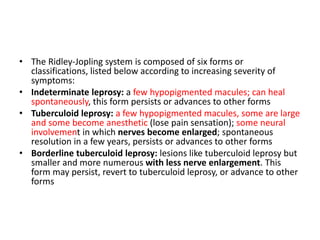
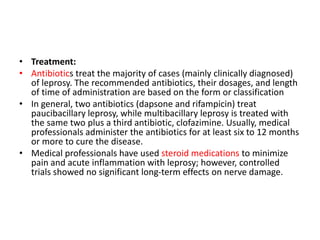
By:
Dr. Laraib Jameel Rph
Find me on slideshare.net
https://www.slideshare.net/
Eczema
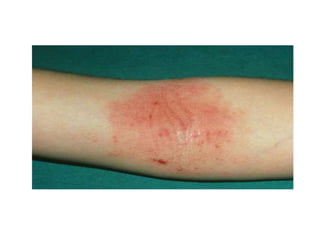
• Definition: Eczema is the name for a group of
conditions that cause the skin to become red,
itchy and inflamed. Blisters may sometimes occur.
• The word “eczema” is derived from a Greek word
meaning “to boil over,” which is a good
description for the red, inflamed, itchy patches
that occur during flare-ups (to burst out). Eczema
can range from mild, moderate, to severe
Eczema
• Eczema is not contagious. You can’t “catch it”
from someone else. While the exact cause
of eczema is unknown, researchers do know
that people who develop eczema do so
because of a combination of genes and
environmental triggers. When an irritant or an
allergen “switches on” the immune system,
skin cells don’t behave as they should causing
an eczema flare-up.
• Causes:
• Healthy skin helps retain moisture and protects you from bacteria, irritants and
allergens. Eczema is related to a gene variation (If both parents have an atopic
disease, the risk is even greater.)
• people with eczema have mutation of genes responsible for creating filaggrin.
Filaggrin is protein that helps our body to maintain healthy protective barrier on
very top layer of skin. Without enough filaggrin to build strong barrier moisture
can escape(free) & bacteria, virus can enter. This is why people with eczema have
dry & infectious skin.
• Hormones: Women can experience increased eczema symptoms at times when
their hormone (progesterone & estrogen) levels are changing, for example during
pregnancy and at certain points in the menstrual cycle.
• Skin has numerous estrogen & progesteron receptors. Cyclic flucuation of
hormones influences skin production of lipids & oils, skin thickness and barrier
function
• Immune system: People with eczema tend to have n over-reactive immune system
that when triggered with by a substance inside or outside the body, it responds by
producing inflammation
• Eczema is atopic disease
• Atopic is a term used to describe an IgE-mediated response within the body
following exposure to external irritants.
• Atopic disease: (atopy is typically associated with hightened immune response to
common allergens, especially inhaled allergens so atopy refers to genetic
tendency to develop allergic disease such as Allergic asthma
• Atopic dermatitis, also known as atopic eczema
• Allergic rhinitis (hay fever)
• Mechanism: When a person who has an atopic disease is exposed to an allergen,
an IgE response occurs that causes immune and blood cells to release substances,
such as histamines(involved in inflammatory responses & act as mediator of
itching), that trigger a variety of physical changes within the body. These changes
can affect blood vessels, stimulate secretion of mucus, affect muscle functioning
and create inflammation within cells of certain parts of the body.
Types of eczema
• Atopic dermatitis: is the most common type of eczema.
• Symptoms often present in childhood and can range from mild to severe.
A child is more likely to develop atopic dermatitis if one of their parents
has had it.
• Children with atopic dermatitis have a higher risk of food sensitivity. They
are also more likely to develop asthma and hay fever.
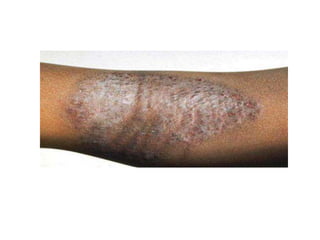
• Atopic dermatitis tends to cause patches of dry skin that can become itchy,
red, and inflamed. These patches often appear in the creases of the
elbows and knees and on the face, neck, and wrists.
• Scratching the patches can worsen the itching and make the skin ooze
clear fluid. Over time, repeated scratching or rubbing can cause the patch
of skin to thicken. This is known as lichen simplex chronicus (LSC).
• LSC is a localized, area of thickened skin (lichenification) resulting from
repeated rubbing, itching, and scratching of the skin. It can occur on
normal skin of individuals with atopic, seborrheic, contact dermatitis, or
psoriasis
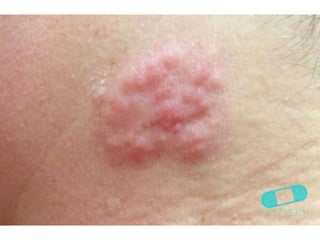
• 2- contact dermatitis:
• Some people experience a skin reaction when they come into contact with
certain substances. This is known as contact dermatitis.
• Symptoms of contact dermatitis can include:
• dry, red, and itchy skin that may feel as though it is burning
• blistering
• hives, a type of rash that consists of small, red bumps
• A person with atopic dermatitis has an increased risk of contact
dermatitis.
• There are two types of contact dermatitis:
A. Irritant contact dermatitis can result from repeated exposure to a
substance that irritates the skin, such as:
• acids and alkalis
• fabric softeners, harsh detergents, weed killers etc
B- Allergic contact dermatitis
• Allergic contact dermatitis occurs when a person's immune system reacts to a
particular substance, known as an allergen.
• A person might not react to an allergen the first time they come into contact with
it. (modify the immune family such as CD4, CD8. T cells- plays proinflammatory
role) However, once they develop an allergy, they will usually have it for life.
• Possible allergens include:
• glues and adhesives
• Latex(BODY FLUID- PLASMA, LYMPH) and rubber
• some medications, such as topical and oral antibiotics
• fabrics and clothing dyes
• some plants, including poison ivy, poison oak, and sumac
• ingredients in some makeup, nail polishes, creams, hair dyes, and other cosmetics
• certain metals, such as nickel and cobalt
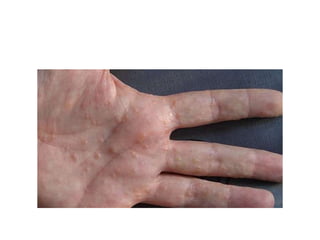
• Dyshidrotic eczema, or pompholyx eczema
• typically appears in adults under 40 years of age. It usually occurs
on the hands and feet and has characteristic symptoms, including
intense itching and the appearance of small blisters.
• In some cases, the blisters can become large and watery. The
blisters may become infected too, which can lead to pain and
swelling. They may also ooze pus.
• Blisters typically clear up within a few weeks. Following this, the
skin often becomes dry and cracked, which may lead to painful skin
fissures.
• Dyshidrotic eczema may be a form of contact dermatitis. People
with dyshidrotic eczema also tend to experience flare-ups (worse)
from time to time.
• Discoid eczema, or nummular eczema,
• is recognizable due to the disc-shaped patches of itchy, red, cracked, and swollen skin that it causes.
• The discs typically appear on the lower legs, torso, and forearms. Sometimes, the center of the disc
clears up, leaving a ring of red skin.
• Discoid eczema can occur in people of any age, including children.
• As with other types of eczema, the causes of discoid eczema are not fully understood. However,
known triggers and risk factors include:
• dry skin
• skin injuries, such as friction or burns
• insect bites
• poor blood flow
• cold climate
• bacterial skin infections
• certain medications
• sensitivity to metals and formaldehyde
• atopic dermatitis
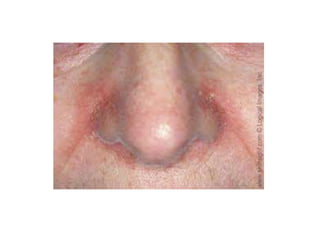
• Seborrheic dermatitis
• is a common condition that causes a red, itchy, and flaky rash. The rash can
appear swollen or raised, and a yellowish or white crust may form on its surface.
• Seborrheic dermatitis develops in areas where the skin is oily, (sebum rich
areas)such as the:
• scalp
• ears
• eyebrows
• eyelids
• face
• upper chest and back
• armpits
• genitals
• Seborrheic dermatitis can affect people of any age. Cradle cap is a type of
seborrheic dermatitis that can occur on the scalp of babies, but this usually
disappears after a few months
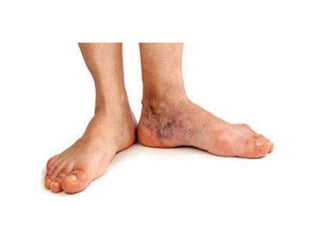
• Varicose eczema is also known as venous, gravitational, or stasis(in-
activity) eczema. It is common in older adults with varicose veins.
(swollen twisted veins)
• Getting older and being less active can weaken the veins in a
person's legs. This can lead to both varicose veins and varicose
eczema.
• Varicose eczema typically affects the lower legs (due to difficulty to
push blood upward against gravity)and symptoms can include:
• hot, itchy spots or blisters
• dry, scaly skin
• weepy, crusty patches
• cracked skin
• The skin on the lower leg may become fragile(easily broken), so it is
important to avoid scratching and picking at the spots and blisters
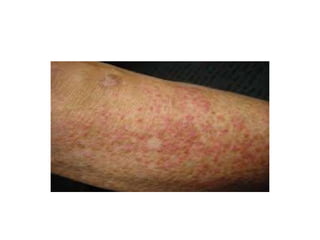
• Asteatotic eczema, also called xerotic eczema and
generally only affects people over 60 years of age. This
may be due to the skin becoming drier as a person
ages(loss of oil glands)
• Asteatotic eczema typically occurs on the lower legs,
but it can also appear on other parts of the body.
Symptoms include:
• cracked, dry skin with a characteristic appearance that
people describe as crazy paving
• pink or red cracks or grooves
• scaling
• itching and soreness
• Diagnosis:
• Eczema can indicate a new allergy, so it is important to
determine what is causing the reaction.
• Eczema can also increase the likelihood of staph infections
• There is no specific test to diagnose most types of eczema.
The doctor will want to know the individual's personal and
family medical history.
• A physical examination of the rash will help the doctor to
diagnose which type of eczema it is.
• The doctor may also perform a patch test, which involves
pricking a person's skin with a needle that contains
potential irritants and allergens. A patch test can determine
whether or not someone has contact dermatitis.
• Symptoms:
• Sometimes the itch gets so bad that people scratch it until
it bleeds, which can make your eczema worse. This is called
the “itch-scratch cycle.”
• Dry, sensitive skin
• Red, inflamed skin
• Very bad itching
• Dark colored patches of skin
• Rough, leathery or scaly patches of skin
• Small, raised bumps, which may leak fluid and crust over
when scratched
• Areas of swelling
• Complications of atopic dermatitis (eczema) may include:
• Asthma and hay fever. Eczema sometimes precedes these conditions. More than
half of young children with atopic dermatitis develop asthma and hay fever(allergic
rhinitis) by age 13.
• Chronic itchy, scaly skin. A skin condition called neurodermatitis (lichen simplex
chronicus) thickening of skin due to rubbing starts with a patch of itchy skin. You
scratch the area, which makes it even itchier. Eventually, you may scratch simply
out of habit. This condition can cause the affected skin to become discolored, thick
and leathery.
• Skin infections. Repeated scratching that breaks the skin can cause open sores and
cracks. These increase the risk of infection from bacteria and viruses, including the
herpes simplex virus.
• Irritant hand dermatitis. This especially affects people whose work requires that
their hands are often wet and exposed to harsh soaps, detergents and
disinfectants.
• Allergic contact dermatitis. This condition is common in people with atopic
dermatitis.
• Sleep problems. The itch-scratch cycle can cause poor sleep quality.
• Treatment:
1. Topical corticosteroid creams and ointments: These are a
type of anti-inflammatory medication and should relieve
the main symptoms of eczema, such as skin inflammation
and itchiness. Apply it as directed, after you moisturize.
Overuse of this drug may cause side effects, including
thinning skin.
2. Systemic corticosteroids: If topical treatments are not
effective, systemic corticosteroids can be prescribed.
3. Antibiotics: These are prescribed if eczema occurs
alongside a bacterial skin infection.
4. Antiviral and antifungal medications: These can treat
fungal and viral infections that occur.
5- Antihistamines: These reduce the risk of
nighttime scratching as they can cause drowsiness.
(sleepiness/ lethargis sleepiness)
6- Topical calcineurin inhibitors: This is a type of
drug that suppresses the activities of the immune
system. It decreases inflammation and helps
prevent flare-ups.
Primecrolimus cream, tacrolimus ointment
7- Barrier repair moisturizers: These reduce water
loss and work to repair the skin. Mostly nos
steroidal emolient cream.
• Therapies:
• Wet dressings. An effective, intensive treatment for severe atopic dermatitis
involves wrapping the affected area with topical corticosteroids and wet bandages.
Sometimes this is done in a hospital for people with widespread lesions because
it's labor intensive and requires nursing expertise. Or, ask your doctor about
learning how to do this technique at home.
• Light therapy. This treatment is used for people who either don't get better with
topical treatments or who rapidly flare again after treatment. The simplest form of
light therapy (phototherapy) involves exposing the skin to controlled amounts of
natural sunlight. Other forms use artificial ultraviolet A (UVA) and narrow band
ultraviolet B (UVB) either alone or with medications.
• Though effective, long-term light therapy has harmful effects, including premature
skin aging and an increased risk of skin cancer. For these reasons, phototherapy is
less commonly used in young children and not given to infants. Talk with your
doctor about the pros and cons of light therapy.
• Phototherapy helps to
• Reduce itch
• Calm inflammation
• Increase vit-D production .(vit-d helps the
immune system reduce level of inflammation
& strengthens skin barriers)
• It contains machine in which patient is placed.
It is mostly for whole body or some times
hands & feet
Preventions:
• using gentle soaps and detergents
• avoiding fragrances or perfumes
• using cooler water for showers and baths
• drying or toweling the skin gently after washing
• Moisturize your skin at least twice a day. (for dry skin)
• Don't scratch. Rather than scratching when you itch, try pressing on
the skin. Cover the itchy area if you can't keep from scratching
it. For children, it might help to trim their nails and have them wear
gloves at night.
• Use a humidifier. Hot, dry indoor air can parch sensitive skin and
worsen itching and flaking. A portable home humidifier or one
attached to your furnace adds moisture to the air inside your home.
Bromhidrosis
• Definition: Bromhidrosis refers to a medical
condition where the body releases bad-smells
plus sweat.
• Synonym: Body order, Osmidrosis, Bromidrosis
• Perspiration(sweat secreted from sweat gland)
itself actually has no odor. It’s only
when sweat encounters(to meet) bacteria on
the skin that a smell can emerge.
Causes:
• You have two types of sweat glands: apocrine and eccrine. Bromhidrosis is
usually related to secretions by apocrine glands. But both types of sweat
glands can lead to abnormal body odor.
• 1-Apocrine gland:
These are in limited areas and produce the pheromones associated with
body scent. (which are hormones meant to have an effect on others. People
and animals release pheromones to attract a mate, for example.) These
glands are located under the arms, breast and groin regions. This sweat is
odorless to start with. The sweat they produce is high in protein which
bacteria can break down easily. Within an hour, the bacteria in the skin break
down then the sweat is broken into fatty acids and ammonia produces
unpleasant and unfavorable odors, the perspiration and produce a foul odor.
Apocrine glands don’t become active until puberty. That’s why BO isn’t
usually an issue among young children.
• 2- Eccrine gland:
• These are located over the whole body. Eccrine
glands produce the salty dilute solution
associated with body sweat when the
temperature rises. Eccrine glands secrete sweat
that lacks odor but if bacteria get breaks down
the sweat, it can start to smell. Various foods like
garlic, curry or even alcohol and medication can
impact the body in various ways.
• Foods which are responsible for bromhidrosis:
• 1- sulfur: Vegetables which contain a huge
amount of sulfide content can be a factor in
causing BO. Sulfide is a naturally occurring
organosulfur. While this form of natural sulfur
is an essential ingredient, excessive amounts
can lead to body odor. Sulfur is found in every
single body cell. Excess sulfur may cause bad
smells to emanate from the body.
2-Meat/fish:
• Another reason for body odor is eating a lot of
red meat. As red meats are tough to digest, the
body works overtime to break it down. This
causes an increase in the amount of sweat
produced. While fish is a good choice
instead, choline found in certain fish meat like
tuna and salmon constitute part of the B-complex
vitamins and such meat can cause the body to
emit an odor.
• 3- fried/greecy foods:
• Another body odor cause is consumption of
different types of fried and greasy food items.
These can cause bacteria to breed in the
mouth and on the skin. Oils in these
maximally processed foods are associated
with lack of effective digestion and lead to
bromhidrosis.
4- heavy processed items:
• foods come with a high glycemic index and have a massive
dose of carbs and sugar. So, they are hard to digest. The
harder the body works, the more sweat there is and the
kidneys may then weaken and fail.
5- coffee/ alcohols:
• BO is also caused by beverages like coffee and alcohol
which take a long time to digest and excrete plenty of
chemicals through sweat in the skin. while water and good
hydration are essential for a sturdy regimen of hydration,
especially during exercise, and when life stress is on the
rise, these beverages like coffee and drinks like alcohol only
serve to aggravate bromhidrosis.
• 6- stress:
• Yes, stress can cause body odor too. Being
anxious and stressed out leads to a huge amount
of a stress hormone called cortisol being
released. It is known as one of the chief reasons
for too much sweating. Sweating can, however,
be less of an issue if the bacteria are living on the
skin in smaller amounts. Remember that the
bacterial components are the real cause of BO
along with lack of proper kidney functionality.
7- medical problems:
• medical problem requires medication, one of the ways it can impact you is
bromhidrosis. There are comprehensive side effects associated with these
medicines. Consequently, one of the results is body odor. Certain medications can
cause sulfur build-up around the teeth and gums. This substance has a smell like
rotten eggs. Make sure the medicines you eat are compatible with each other or
BO and halitosis can be a persistent problem
• diabetic ketoacidosis is a life-threatening condition when your body doesn’t have
enough insulin and your cells cannot get the sugar they need for energy. then they
start to break fat into glycerol & fatty acids in the process of lipolysis which gives
smell. One of the symptoms is a distinct, fruity breath smell.
• Thyroid. Thyroid glands cause our body to sweat. When you have an overactive
thyroid, it causes the body to product an excessive amount of sweat, even if you
aren’t exerting yourself. This can cause excessive body odor.
• Kidney and liver dysfunction. The kidneys and liver help remove toxins from our
system. When they fail to function properly, toxins can build up in the blood and
digestive tract, creating odor.
8- nutritional deficiency:
• When there is a vitamin or mineral deficiency
from food intake, it is essential to make up for it
or bromhidrosis can result. Consider the nutrients
like magnesium, for instance. These aid in the
removal of bromhidrosis. So try to include items
like oatmeal, raw nuts, almond and cashew nuts
or even dark chocolate and get your daily dose
of magnesium= modifies intestinal normal flora
that are beneficial & take part to digest food
• 9- other factors:
• Some of the most common causes of BO include excessive sweat
secretion and lack of bodily hygiene. Other conditions associated
with bromhidrosis include dermatological problems and excessive
weight. Then, another factor that can cause BO is endocrine
disorders like diabetes or inflammation in the skin folds or
intertrigo. Some of the other medical conditions associated with BO
include trichomycosis axillaris or axilla hair shafts being infested
with body odor-emitting bacteria that break down sweat where
skin that is chronically infected on being rubbed together emits an
odor.
• (is a superficial bacterial infection of underarm hair. The disease is
characterised by yellow, black or red granular nodules or
concretions that stick to the hair shaft. )
• Symptoms:
• stinging, musty, sharp sweat smells.
• There’s also a thick moist keratin(protein)
layer that can be seen and observed. When
the skin is constantly rubbed, there are issues
as well such as the formation of calluses (hard
area of skin caused by repeated friction).
Diagnosis:
• Bromhidrosis is easy to diagnose. Your doctor
should be able to identify the condition based
on your scent. You may have no discernible
odor if you’re not sweating or recently
showered. Your doctor may ask to see you
after you’ve been exercising or may have you
exercise on a treadmill, for example, at the
appointment.
• Treatment:
• Botox:
• Botulinum toxin A or Botox blocks nerve impulses
to the muscles and it can be injected into the
underarm to block the impulses to the sweat
glands. The problem with botox treatment is it
wears off once a certain period of time elapses.
So, it may be needed for multiple treatments.
Botox can also be used for sweating hands and
feet.
• Liposucution procedures:
• Another way to cut down on the apocrine sweat is the removal of
sweat glands. Liposuction is a common procedure for removing fat
from the belly or other fatty places in the body. Specifically, special
tubes are carefully inserted into the body and fat is extracted. This
concept can also be applied to sweat glands beneath the arms or in
the underarm area. Small tubes for suction called cannula are
inserted beneath the skin. The tubes are then grazing the skin’s
underside, removing sweat glands as one progresses. This process
leads to less sweat as a result of the impact on the glands. Early
positive outcomes such as less sweating and lack of odor happen.
When the nerves that are stunned during liposuction recover,
however, the problem returns. Therefore, this is also not a
permanent cure. On the other hand, ultrasonic(high energy sound
waves) liposuction can be used to vibrate the energy and target the
sweat glands.
• Surgical methods:
• Yet a highly invasive means of removing the
sweat glands or nerves associated with excessive
perspiration is via surgery. The process is known
as endoscopic thoracic sympathectomy ETS
whereby tiny incisions and specific tools are
employed to damage nerves in the chest linked
with underarm-based sweat glands. The
procedure has a lifespan of 5-10 years, which is
higher than the earlier two methods discussed.
• Electrosurgery:
• Another treatment that is minimally invasive is known
as electrosurgery. Is is used for axillary bromhidrosis It is carried
out with small insulated needles. Over a period of consecutive
treatments, doctors can use the needles for removing the sweat
glands. A surgeon can remove sweat glands through a conventional
operation as well. It begins with an incision in the underarm.
Surgeons can, therefore, see where the glands are clearly located.
This kind of surgery is known as a skin resection. It causes some
scarring on the skin’s surface, though.
• Before invasive procedures are attempted, basic hygiene strategies
need to be carried out. This helps to reduce the bacteria interacting
with the sweat. As bromhidrosis is triggered when bacteria reacts
with the skin, frequent washing can be an effective means of
neutralization of the bacteria.
• Preventions:
• Washing with a soap and some water daily can also ward
off BO. If the smell is localized at the armpits, focus your
cleaning efforts there. An antiseptic soap and antibacterial
cream containing erythromycin and clindamycin can also
help. Strong deodorant can also ward off body odor. It is
also advisable to remove underarm hair or trim it for
hygiene and odor-free armpits.
• Another important step is to regularly wash clothes and
remove sweaty ones. When some clothes can be worn
more than once, if bromhidrosis is a problem, washing after
every wear may be needed. Undershirts and inner-wear
can also keep stench at bay
Hyperhidrosis
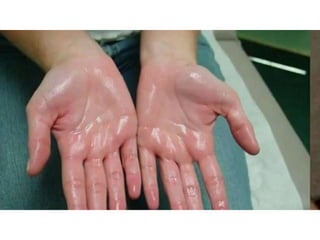
• Definition: is a condition characterized by
excessive sweating. The sweating can affect just
one specific area or the whole body.
• Synonym: polyhidrosis or sudorrhea
• Hyperhidrosis tends to begin during adolescence
• Most commonly, the feet, hands, face, and
armpits are affected because of their relatively
high concentration of sweat glands.
• This disease is related to eccrine gland so
hyperhidrosis is eccrine sweat.
• Types of hyperhidrosis:
• Focal hyperhidrosis: When the excessive sweating is localized. For
example, palmoplantar hyperhidrosis & axiliary hyperhidrosis
(Axillary hyperhidrosis is a form of primary hyperhidrosis that
causes an individual to produce excessive sweat in the
underarm regions. Like most instances of the excessive
sweating from axillary hyperhidrosis is believed to be a genetic
disorder) is excessive sweating of the palms and soles, & sometimes
on face. It is also known as Primary idiopathic
hyperhidrosis: "Idiopathic" means "of unknown cause." In the
majority of cases, the hyperhidrosis is localized.
• Generalized hyperhidrosis: Excessive sweating affects the entire
body. It is also known as Secondary hyperhidrosis because The
person sweats too much because of an underlying health condition,
• Cause:
• Sweating is your body's mechanism to cool itself. Your nervous
system automatically triggers your sweat glands when your body
temperature rises. Sweating also normally occurs, especially on
your palms, when you're nervous.
• The most common form of hyperhidrosis is called primary focal
(essential) hyperhidrosis. With this type, the nerves responsible for
signaling your sweat glands become overactive, even though they
haven't been triggered by physical activity or a rise in
temperature. With stress or nervousness, the problem becomes
even worse. This type usually affects your palms and soles and
sometimes your face.
• There is no medical cause for this type of hyperhidrosis. It may have
a hereditary component, because it sometimes runs in families.
• Secondary hyperhidrosis occurs when excess
sweating is due to a medical condition. It's the
less common type. It's more likely to cause
sweating all over your body. Conditions that may
lead to heavy sweating include:
• Diabetes
• Menopause hot flashes
• Thyroid problems
• Low blood sugar (lypolysis)
• Nervous system disorders
Symptoms:
• Clammy or wet palms of the hands
• Clammy or wet soles of the feet
• Frequent sweating
• Noticeable sweating that soaks through
clothing
• Irritating and painful skin problems, such as
fungal or bacterial infections
• Diagnosis:
• Initially, a doctor may try to rule out any
underlying conditions, such as an overactive
thyroid (hyperthyroidism) or low blood sugar
(hypoglycemia) by ordering blood and urine tests.
• Patients will be asked about the patterns of their
sweating - which parts of the body are affected,
how often sweating episodes occur, and whether
sweating occurs during sleep.
• 2- Thermoregulatory sweat test: a powder which is
sensitive to moisture is applied to the skin. When
excessive sweating occurs at room temperature,
the powder changes color. The patient is then exposed
to high heat and humidity in a sweat cabinet, which
triggers sweating throughout the whole body.
• When exposed to heat, people who do not have
hyperhidrosis tend not to sweat excessively in the
palms of their hands, but patients with hyperhidrosis
do. This test also helps the doctor determine the
severity of the condition.
3- skin conductance:
There are only a couple of places where it is widely recognized
as easy and reliable to measure the skin conductance
response: the palms and the soles of the feet. In these places
there is a high density of the eccrine sweat glands, which are
known to be responsive to emotional and other psychological
stimuli. In either of these areas, the conductance is measured
by placing two electrodes next to the skin and passing a tiny
electric charge between the two points. When the subject
increases in arousal, his/her skin immediately becomes a
slightly better conductor of electricity. This response can then
be measured and communicated.
• The skin conductance response is measured from the
eccrine glands, which cover most of the body and are
especially dense in the palms and soles ofthe feet.
(These are different from the apocrine sweat glands
found primarily in the armpits and genital areas.) The
primary function of eccrine glands is thermoregulation
-- evaporative cooling of the body -- which tends to
increase in aerobic activity, so yes, activity can affect
conductance.However, the eccrine glands located on
the palms and soles have been found to be highly
sensitive to emotional and other significant stimuli,
with a measurable response that precedes the
appearance of sweat.
• 4- Iodine starch test:
• Tincture of iodine is applied to the skin and
allowed to air-dry. After drying, the area is dusted
with cornstarch or potato flour. Sweating is then
encouraged by increased room temperature,
exercise, When sweat reaches the surface of the
skin, the starch and iodine combine, causing
a dramatic color change (yellow → dark blue),
allowing sweat production to be easily visualized.
• It is also known as minor’s test
• Treatments:
• Antidepressants. Some medications used for
depression can also decrease sweating. In
addition, they may help decrease the anxiety that
worsens the hyperhidrosis.
• Nerve-blocking medications. Some oral
medications block the chemicals that permit
certain nerves to communicate with each other.
This can reduce sweating in some people.
Possible side effects include dry mouth, blurred
vision and bladder problems.
• Botulinum toxin injections. Treatment with botulinum
toxin (Botox, Myobloc, others) temporarily blocks the
nerves that cause sweating. Your skin will be iced or
anesthetized first. Each affected area of your body will
need several injections. The effects last six to 12
months, and then the treatment needs to be repeated.
This treatment can be painful, and some people
experience temporary muscle weakness in the treated
area.
• Iontophoresis - the hands and feet are submerged in a
bowl of water. A painless electric current is passed
through the water. Most patients need two to four 20-
30 minute treatments.
• Anticholinergic drugs - these medications inhibit the transmission
of parasympathetic nerve impulses. Patients generally notice an
improvement in symptoms within about 2 weeks.
Surgical methods
• ETS (Endoscopic thoracic sympathectomy) or Sympathectomy:
• - this surgical intervention is only recommended in severe cases
which have not responded to other treatments. The nerves that
carry messages to the sweat glands are cut.
• ETS may be used to treat hyperhidrosis of the face, hands or
armpits. ETS is not recommended for treating hyperhidrosis of the
feet because of the risk of permanent sexual dysfunction.
• Microwave therapy. With this therapy, a
device that delivers microwave energy is used
to destroy sweat glands. Treatments involve
two 20- to 30-minute sessions, three months
apart. Possible side effects are a change in skin
sensation and some discomfort. This therapy
may be expensive and not widely available.
• Lasers. Lasers can target and kill the underarm
sweat glands.
• Home Remedies:
• Use antiperspirant. Nonprescription antiperspirants
contain aluminum-based compounds that temporarily
block the sweat pore. This reduces the amount of
sweat that reaches your skin. This type of product may
help with minor hyperhidrosis.
• Try relaxation techniques. Consider relaxation
techniques such as yoga, meditation and biofeedback.
These can help you learn to control the stress that
triggers sweating.
• Bath daily
• Complications:
• If hyperhidrosis is not treated, it can lead to complications.
• Nail infections: Especially toenail infections.
• Warts: Skin growths caused by the HPV (human papillomavirus).
• Bacterial infections: Especially around hair follicles and between the toes.
• Bromhidrosis
• Heat rash (prickly heat, miliaria): An itchy, red skin rash that often causes
a stinging or prickling sensation. Heat rash develops when sweat ducts
become blocked and perspiration is trapped under the skin.
• Psychological impact: Excessive sweating can affect the patient's self-
confidence, job, and relationships. Some individuals may become anxious,
emotionally stressed, socially withdrawn, and even depressed.
•
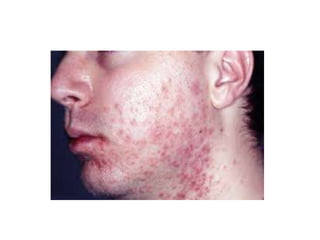
Barber’s itch
• Definition: is inflammation around the hair follicle. This may occur from
rubbing against clothing or shaving, which may damage or block the hair
follicles.
• Synonym: Folliculitis barbae
• This is the medical term for a common condition called barber’s itch; this
condition is an infectious skin disease which arises on the bearded facial
areas of people who are unlucky enough to contact the disease.
• This condition can be both infectious or noninfectious. For example, acne
represents a noninfectious form of folliculitis. However, in most case, it is
infectious, as the staphylococcus aureus (staph) bacteria or fungus infects
the damaged follicles caused by ingrown hair. Skin cells, sebum, and hair
can clump together into a plug. This plug gets infected with bacteria, and
swelling results. A pimple starts to develop when the plug begins to break
down.
• This disorder occurs mainly in people who have curly beard hairs that are
cut too short.
• Types:
• 1- Staphylococcal folliculitis/bacterial folliculitis:
• This common type is marked by itchy, white, pus-filled
bumps that can occur anywhere on your body where
hair follicles are present. When it affects a man’s
beard area, it’s called barber’s itch. It occurs when
hair follicles become infected with Staphylococcus
aureus (staph) bacteria. Although staph bacteria live on
your skin all the time, they generally cause problems
only when they enter your body through a cut or other
wound. This can occur through shaving, scratching or
with an injury to the skin.
• 2- Pseudomonas folliculitis (hot tub folliculitis)
• The pseudomonas bacteria that cause this form
of folliculitis thrive in a wide range of
environments, including hot tubs in which the
chlorine and pH levels aren’t well regulated.
Within eight hours to five days of exposure to the
bacteria, a rash of red, round, itchy bumps will
appear that later may develop into small pus-
filled blisters (pustules). The rash is likely to be
worse in areas where your swimsuit holds
contaminated water against your skin.
• Pseudo-folliculitis: An inflammation of the hair follicles in the beard
area, is not really a true folliculitis. It does look similar, as little
lumps form at the bases of hairs. These lumps do not contain pus.
They are actually due to ingrowing hairs. Sometimes this problem
causes scarring. Pseudo-folliculitis is more common in people with
curly or Afro-Caribbean hair. these can cause a condition that looks
like folliculitis. IT IS ALSO KNOWN AS RAZOR BUMPS
• hairs that have curled around and grown back into the skin. Anyone
can have ingrowing hairs (also called ingrown hairs), but they are
more common in people who have very curly or coarse hair. Curly
hair is more likely to bend back and re-enter the skin, especially
after it's been shaved or cut. Ingrowing hairs may also be caused by
dead skin cells blocking the hair growing as normal.
4- Pityrosporum folliculitis:
• Especially common in teens and adult men, pityrosporum
folliculitis is caused by a yeast and produces chronic, red, itchy
pustules on the back and chest and sometimes on the neck,
shoulders, upper arms and face.
5- Eosinophilic folicullitis: Eosinophils are type of disease fighting cell
of WBCS, indicates for infection Signs and symptoms include intense
itching and recurring patches of bumps and pimples that form near
hair follicles of the face and upper body. Once healed, the affected skin
may be darker than your skin was previously (hyperpigmented).
Eosinophilic pustular folliculitis (EPF) is a skin disorder characterized
by recurring itchy, red or skin-colored bumps and pustules (bumps
containing pus). The condition is named after the fact that skin
biopsies of this disorder find eosinophils (a type of immune cell )
around hair follicles.
• SOME DEEP FOLICULLITIS:
• Sycosis barbae. this is the medical name for a long-term (chronic)
folliculitis in the beard area of the face in men (and some women). It often
affects the upper lip and it can be difficult to treat. The skin is painful and
crusted, with burning and itching on shaving. Numerous pustules develop
in the hair follicles. Some men grow a beard to solve the problem.
• Gram-negative folliculitis. This type sometimes develops if you're
receiving long-term antibiotic therapy for acne. Different bacteria are
involved (not staphylococci). Different bacteria are involved (not
staphylococci). Gram-negative refers to a type of stain that is used in a
laboratory to identify different types of bacteria.
• Boils (furuncles) and carbuncles. These occur when hair follicles become
deeply infected with staph bacteria. A boil usually appears suddenly as a
painful pink or red bump. A carbuncle is a cluster of boils.
Symptoms:
• Folliculitis usually occurs anywhere on the skin, but particularly on
the legs and groin, which rub against clothing consistently. It is also
common in the pubic area, on the vagina or penis and on the labia.
The face and scalp are also susceptible to bacterial infection,
because shaving, Sweating, oils and makeup can irritate the skin
and hair follicle.
• The infection presents itself a small red or white pimples, with a
tiny strand of hair in the middle of the pus. The small bumps may
sore, itch, burn, or ooze pus. When they burst, pus or blood can
come out. These can be recurrent and difficult to treat.
• Severe folliculitis can cause deep, painful boils, scarring or
permanent hair loss
• Hair loss: Fungal spores feed on keratin, a compound integral to the
structure of hair follicles. This can often weaken hair and sometimes even
cause it to fall out. You may notice bald patches appearing on your beard,
but after treatment, any lost hair should grow back
• Ringworm rashes: Barber’s itch is also known as beard ringworm,
characterised by the red circular rashes that can sometimes break out
across the skin of sufferers. These do not always occur with barber’s itch,
but it is quite common for them to appear, usually on the cheeks, or neck
of the patient
• Itching: Itching is almost an automatic reaction that we have when our
skin is irritated or dry. However, scratching away at infected skin may only
serve to aggravate your symptoms further, and can actually aid the
spreading of the infection
• Inflammation: Inflammation occurs in our skin when our immune system
attempts to fight back against invading pathogens and heal any irritation
or wounds
• Discolouration of skin: Fungal spores can
affect the pigmentation of our skin, making it
appear paler in certain areas, such as around
the outside and inside of a ringworm rash.
This discolouration is classified as tinea
versicolor (skin condition of yeast infection
causing discolored patches on trunk &
proximal extremeties), and it is normally
clears once the fungal infection has been
successfully treated
• Causes
• Folliculitis is caused by an infection of the hair follicles by bacteria,
viruses or fungi. The most common cause of folliculitis is
Staphylococcus aureus bacteria.
• Follicles are densest on your scalp, but they occur everywhere on
your body except your palms, soles and mucous membranes, such
as your lips. If follicles become damaged, they become susceptible
to invasion.
• The most common causes of follicle damage include:
• Friction from shaving or tight clothing
• Excessive perspiration
• Inflammatory skin conditions, including dermatitis and acne
• Injuries to your skin, such as abrasions or surgical wounds
• Coverings on your skin, such as plastic dressings or adhesive tape
• Complications:
• Severe folliculitis may include:
• Furunculosis: This condition occurs when a number of boils develop
under your skin. Boils usually start as small red bumps but become
larger and more painful as they fill with pus.
• Scarring: Severe folliculitis may leave thick, raised scars
(hypertrophic or keloid scars) or patches of skin that are darker than
normal.
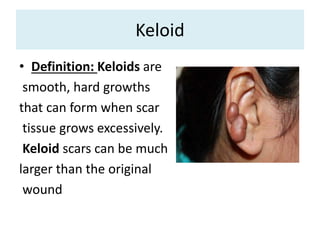
• Keloid is much larger than orignal skin)
• Hypertrophic scars: increase in size= cutaneous condition
characterized by deposit of excessive collagen(protein in connective
tissue) which give rise to raise scars
• Destruction of the hair follicle: This leads to permanent hair loss.
• Diagnosis:
• Your doctor is likely to diagnose folliculitis simply by
looking at your skin.
• When standard treatments fail to clear the infection,
your doctor may send a sample taken from one of your
pustules to a laboratory, where it’s grown on a special
medium (cultured) and then checked for the presence
of bacteria
• Culture medium promotes growth support and survival
• .E-x When doctors suspect eosinophilic folliculitis, they
may remove a small tissue sample (biopsy) from an
active lesion for testing.
• Treatment:
• Medications
• Creams or pills to control infection: For mild infections, your doctor
may recommend the antibiotic cream mupirocin (Bactroban). Oral
antibiotics aren’t routinely used for folliculitis. But for a severe or
recurrent infection, your doctor may prescribe them.
• Creams, shampoos or pills to fight fungal infections: Antifungals
are for infections caused by yeast rather than bacteria, such as
pityrosporum folliculitis. Antibiotics aren’t helpful in treating this
type.
• Creams or pills to reduce inflammation: If you have mild
eosinophilic folliculitis, your doctor may suggest you try a steroid
cream. If your condition is severe, he or she may prescribe oral
corticosteroids. Such drugs can have serious side effects and should
be used for as brief a time as possible.
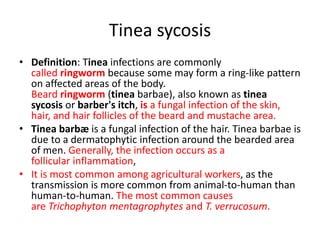
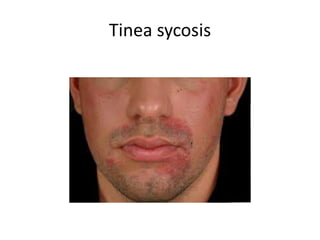
Tinea sycosis
• Definition: Tinea infections are commonly
called ringworm because some may form a ring-like pattern
on affected areas of the body.
Beard ringworm (tinea barbae), also known as tinea
sycosis or barber's itch, is a fungal infection of the skin,
hair, and hair follicles of the beard and mustache area.
• Tinea barbæ is a fungal infection of the hair. Tinea barbae is
due to a dermatophytic infection around the bearded area
of men. Generally, the infection occurs as a
follicular inflammation,
• It is most common among agricultural workers, as the
transmission is more common from animal-to-human than
human-to-human. The most common causes
are Trichophyton mentagrophytes and T. verrucosum.
Tinea sycosis
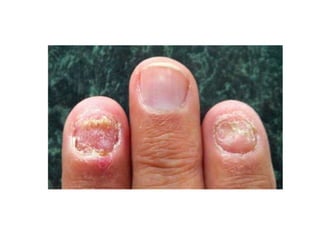
Onychatrophia
• Definition: Onychatrophia: a wasting away of the nail
• When a fully grown nail is atrophied, it loses its shine; loses
healthy look, starts to shrink in size, and may eventually
falls away. This condition is called Onychatrophia and also
known as atrophy. (wasting, shrinking)
• Once a nail atrophies, a condition known as onychatrophia,
the condition is not reversible.
• “Atrophy” is simply the wasting away of a part of the body.
Many times a person’ muscles are described as having been
“atrophied.” This means the muscles have decreased in
size, weakened, and have generally lost the ability to
perform as expected. Unlike muscles, however, the nail
can’t regain its vitality and health.
• Degrees of onychatrophia :
• There are varying degrees of onychatrophia.
• A person may have only one nail that has partially
atrophied but will never worsen because the condition
that caused it was identified and treated early.
• On the other hand, sometimes the primary cause is
ongoing and damage to the nails is so severe a person
may lose all her nails.
• Though the condition affects both men and women, it
is not limited to adults. Children and infants can be
born with, or suffer from, diseases that cause nails to
atrophy.
• APPEARANCE
• Chewed-out, rotting(decomposition due to fungi) and deteriorated. Sometimes the entire nail
plate is gone, which leaves only remnants (small portion)of the nail bed. (separation of the nail
plate from the nail bed. Areas of separation appear white or yellow due to air beneath the nail and
sequestered debris)
• CAUSES
• While one factor can be biting nails consistently, Another name for nail biting is chronic
onychophagia. It is considered the most common stress-relieving habit.
• Onychophagia can cause destruction to the cuticle and nail plate, leading to shortening of nails,
chronic paronychia (infection between edges of skin and nail), and secondary infections.
• other health problems can also contribute to this, such as
• burns,
• nail injury, skin diseases, or fungal infection. Other times it can happen as a result of Thyroid
diseases, Lyell's Syndromes or vascular problems.
• Bacterial nail infection
• Psoriasis (due to fungi)
• Lichen planus
• Epidermolysis bullosa dystrophica
• Psoriasis: Psoriasis is a common skin condition
that speeds up the life cycle of skin cells. It causes
cells to build up rapidly on the surface of the skin.
The extra skin cells form scales and red patches
that are itchy and sometimes painful.
• Nail psoriasis. Psoriasis can affect fingernails and
toenails, causing pitting, abnormal nail growth
and discoloration. Psoriatic nails might loosen
and separate from the nail bed (onycholysis).
Severe cases may cause the nail to crumble.
• Psoriatic nails are characterized by a translucent
discolouration in the nail bed that resembles a drop of oil
beneath the nail plate.
• Early signs that may accompany the "oil drop" include
thickening of the lateral edges (sides) of the nail bed with
or without resultant flattening or concavity of the nail;
separation of the nail from the underlying nail bed,
• often in thin streaks from the tip-edge to the cuticle; sharp
peaked "roof-ridge" raised lines from cuticle to tip;
• or separation of superficial layers of the nail followed by
loss of patches of these superficial layers, leaving thin red
nails beneath; or nail pitting–punctate changes along the
nail plate surface.
• Lichen planus: is inflammatory disease of mouth, nails
& genitals, it has appearance of lace like structure. The
cause of oral lichen planus is not known in most
instances but it is likely to have something to do with
the body’s immune system, some times it is related to
hepatitis –c virus
• Process of onychatrophia in lichen planus:
(1) irregular, longitudinal grooving and ridging of the nail
plate;
(2) "pterygium" formation(abnormal mass of tissue in
corners)
(3) shedding of the nail plate with atrophy of the nail bed;
• Epidermolysis bullosa dystrophica
• Epidermolysis bullosa is a group of genetic conditions that
cause the skin to be very fragile and to blister easily.
Blisters and skin erosions form in response to minor injury
or friction, such as rubbing or scratching.
• Causes: Mutations in the COL7A1 (collagen type VII alpha 1
chain)
• gene cause all three major forms of dystrophic
epidermolysis bullosa. This gene provides instructions for
making a protein that is used to assemble type VII collagen.
Collagens are molecules that give structure and strength
to connective tissues, such as skin, tendons, and ligaments,
throughout the body.
• Nail atrophy or Onychatrophia may be caused by nail disease, skin
disease, or other underlying diseases.
• Nail atrophy will not confuse with anonychia which is a result of
congenital condition, where the toenails and fingernails does not
develop.
• This condition can be caused by contact, damage or impact with
chemicals, but if onychatrophia is found on both finger nails and toe
nails it is generally caused by a more various health condition.
• If this condition is accompanied by rashes or scabs across the body
you need to immediate check medical attention because it is a sign
of deadly skin disorder.
• If your skin appears fine then it could be caused by a long time
untreated psoriasis or thyroid problem.
• It is secondary effect :
• Nails are known to be an indicator on a person’s
overall health. Many times, systemic health issues
cause nail problems such as splitting, yellowing,
and clubbing. Similar to these indicators,
onychatrophia also is evidence of a larger health
problem. Because it’s a secondary effect, not a
primary condition, onychatrophia can be the
result of a wide burns or damage to the matrix,
genetic range of health problems. (Collagen
disorder)
• Symptoms:
• Discoloration
• Nail detachment
• Shrinkage of the nail
• Formation of pus
• Distorted shape of the nail
• Diagnosis:
• Because many people are unfamiliar with
onychatrophia, the condition can be confused by
the casual observer with a fungus. While it’s
tempting to imagine all the ways enhancements
could improve the look of atrophied nails, doctors
caution against applying product over the
damaged area if there is no more nail. If some of
the nail remains and it is clean, free from
infection, so it indicates onychatrophia.
• Doctors can determine if a nail has atrophied
simply by looking at it. They will attempt to treat
the condition that caused the atrophy, but no
treatment is available to improve onychatrophia.
The reason for this is that the problem isn’t in the
nails; onychatrophia can’t be treated in isolation.
At times, a patient may respond to treatment and
recover from the larger health issue. However,
though the cause is removed, once the nails have
atrophied they will not return to normal.
• Treatment:
• Onychatrophia can be an indication of skin disease, a
bacterial or fungal infection, or other health issue. You
can consult a dermatologist if you observe signs of nail
distortion, atrophy, and nail shrinkage, followed by the
nail falling off.
• dermatologist may require diagnosing what is causing
the problem in order to recommend a treatment. This
can include
• Ointments
• Anti-fungal creams
• Antibiotics etc.
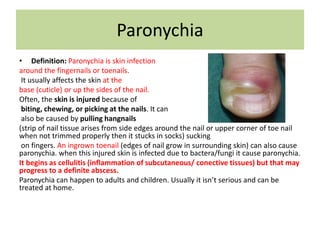
Paronychia
• Definition: Paronychia is skin infection
around the fingernails or toenails.
It usually affects the skin at the
base (cuticle) or up the sides of the nail.
Often, the skin is injured because of
biting, chewing, or picking at the nails. It can
also be caused by pulling hangnails
(strip of nail tissue arises from side edges around the nail or upper corner of toe nail
when not trimmed properly then it stucks in socks) sucking
on fingers. An ingrown toenail (edges of nail grow in surrounding skin) can also cause
paronychia. when this injured skin is infected due to bactera/fungi it cause paronychia.
It begins as cellulitis (inflammation of subcutaneous/ conective tissues) but that may
progress to a definite abscess.
Paronychia can happen to adults and children. Usually it isn’t serious and can be
treated at home.
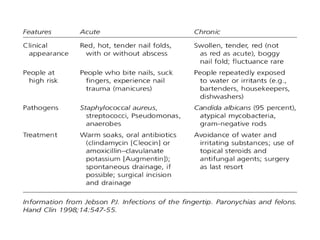
• Types:
• There are 2 types of paronychia
• Acute paronychia — This usually appears as a sudden, very
painful area of swelling, warmth and redness around a
fingernail or toenail, usually after an injury to the area.
• An acute paronychia typically is caused by an infection with
bacteria that invade the skin where it was injured.
• The injury can be caused by overaggressive manicuring
(especially cutting or tearing the cuticle, which is the rim of
paper-thin skin that outlines the outer margins of your
nail). It can also result from biting the edges of the nails or
the skin around the nails, picking at the skin near the nails
or sucking on the fingers.
• Chronic paronychia — This is an infection that usually
develops slowly, causing gradual swelling, tenderness and
redness of the skin around the nails.
• It usually is caused by Candida or other species of yeast
(fungus).
• It often affects several fingers on the same hand. People
who are more likely to get this infection include those with
diabetes or workers whose jobs constantly expose their
hands to water or chemical solvents. Such jobs include
bartending, house cleaning, janitorial work, dentistry,
nursing, food service, dishwashing and hairdressing.
• Thyroid patients : As TH is involved in epidermal
proliferation and differentiation, hair growth, and wound.
• Symptoms:
• swelling, tenderness, and redness around the
nail
• puss-filled abscesses
• hardening of the nail
• deformation or damage to the nail
• the nail separating from the nail bed
• Causes:
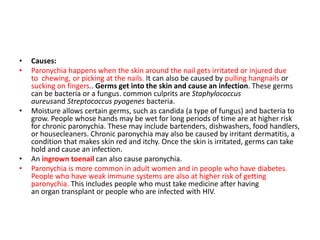
• Paronychia happens when the skin around the nail gets irritated or injured due
to chewing, or picking at the nails. It can also be caused by pulling hangnails or
sucking on fingers.. Germs get into the skin and cause an infection. These germs
can be bacteria or a fungus. common culprits are Staphylococcus
aureusand Streptococcus pyogenes bacteria.
• Moisture allows certain germs, such as candida (a type of fungus) and bacteria to
grow. People whose hands may be wet for long periods of time are at higher risk
for chronic paronychia. These may include bartenders, dishwashers, food handlers,
or housecleaners. Chronic paronychia may also be caused by irritant dermatitis, a
condition that makes skin red and itchy. Once the skin is irritated, germs can take
hold and cause an infection.
• An ingrown toenail can also cause paronychia.
• Paronychia is more common in adult women and in people who have diabetes.
People who have weak immune systems are also at higher risk of getting
paronychia. This includes people who must take medicine after having
an organ transplant or people who are infected with HIV.
• Diagnosis:
• doctor can diagnose paronychia with a simple
physical exam by looking throbbing pain, swelling
and redness in an area of damaged skin around a
nail.
• Special tests aren’t usually necessary. Your
doctor may want to send a sample of fluid
or pus to a laboratory. There they can identify the
bacteria or fungus that is causing the infection.
• Treatment:
• Treatments for paronychia will vary, depending on the severity and whether it is
chronic or acute.
• A person with mild, acute paronychia can try soaking the affected finger or toe in
warm water by adding hydrogen peroxide (half of the solution)three to four
times a day. It is antiseptic & used as to prevent skin infection of minor cuts If
symptoms do not improve, seek further treatment.
• When a bacterial infection causes acute paronychia, a doctor may recommend
an antibiotic, such as
• dicloxacillin or clindamycin.
• When a fungal infection causes chronic paronychia, a doctor will prescribe
antifungal medication. These medications are topical and typically include
• clotrimazole or ketoconazole.
• With proper treatment, an acute paronychia usually heals within 5 to 10 days. A
chronic paronychia may require several weeks of antifungal medication. Even after
proper medical therapy, a paronychia may return if you injure the skin again or
forget to keep the nail area dry.
Paronychia
• If you have an abscess, your doctor may need to drain it. Your
doctor will numb the area, separate the skin from the base or sides
of the nail, and drain the pus.
• Preventions:
• Avoid injuring your nails and fingertips.
• Don’t bite or pick your nails.
• Keep your nails trimmed and smooth.
• Avoid cutting nails too short.
• Don’t scrape or trim your cuticles, as this can injure the skin.
• Use clean nail clippers or scissors.
• Wear gloves when working with water or harsh chemicals.
• Change socks at least every day, and do not wear the same shoes
for two days in a row. This allows them to dry out completely.
Basal cell carcinoma
Basal cells: basal cells — a type of cell within the skin which
are round skin cells that lie deep in the skin's epidermis below
the squamous cells. (basal-base of epidermis which are round
skin cells that lie deep in the skin's epidermis below the
squamous cells.) that produces new skin cells as old ones die
off.
A carcinoma: is a cancerous tumor (an abnormal growth) of
the epithelial tissue, which is the tissue underneath the skin.
• Basal cell carcinoma is a type of skin cancer.
• Basal cell carcinoma occurs most often on areas of the skin
that are exposed to the sun, such as your head and neck.
• Causes:
• 1- Basal cell carcinoma occurs when one of the skin's basal cells
develops a mutation in its DNA.
• Pathomechanism:
• Basal cells are found at the bottom of the epidermis — the
outermost layer of skin. Basal cells produce new skin cells. As new
skin cells are produced, they push older cells toward the skin's
surface, where the old cells die and are swipe out.
• The process of creating new skin cells is controlled by a basal cell's
DNA. A mutation in the DNA causes a basal cell to multiply rapidly
and continue growing when it would normally die. Eventually the
accumulating abnormal cells may form a cancerous tumor — the
lesion that appears on the skin
• 2- Ultraviolet light and other causes
• Much of the damage to DNA in basal cells is thought to result from
ultraviolet (UV) radiation found in sunlight and in commercial
tanning lamps and tanning beds. But sun exposure doesn't explain
skin cancers that develop on skin not ordinarily exposed to sunlight.
• (UV wavelength range= 10nm-400nm)
• Shorter then that of visible light but greater than X-ray
• The sun gives off three wavelengths of ultraviolet light:
• UVA UVB UVC
• UVA: . Ultraviolet A (UVA) is the type of solar radiation most
associated with skin aging (photoaging).
• UVB: Ultraviolet B is associated with sunburn.
• Exposure to both types of radiation is associated with developing
skin cancer
• BCC almost never spreads (metastasizes)
beyond the original tumor site. but it can
move nearby into bone or other tissue under
your skin.
• Risk factors: Factors that increase your risk of basal cell carcinoma include:
• Chronic sun exposure. A lot of time spent in the sun — or in commercial
tanning booths — increases the risk of basal cell carcinoma. The threat is
greater if you live in a sunny or high-altitude location, both of which
expose you to more UV radiation. Severe sunburn, especially during
childhood or adolescence, also increases your risk.
• Radiation therapy. Radiation therapy to treat psoriasis, acne or other skin
conditions may increase the risk of basal cell carcinoma at previous
treatment sites on the skin. (causes DNA damage)
• Fair skin. The risk of basal cell carcinoma is higher among people who
freckle or burn easily or who have very light skin(this is due to protective
effect of skin pigment melanin), red or blond hair, or light-colored eyes.
• Your sex. Men are more likely to develop basal cell carcinoma than
women. (due to higher level of sun exposure)
• your age. Because basal cell carcinoma often takes decades
to develop, the majority of basal cell carcinomas occur
after age 50.
• A personal or family history of skin cancer. If you've had
basal cell carcinoma one or more times, you have a good
chance of developing it again. If you have a family history of
skin cancer, you may have an increased risk of developing
basal cell carcinoma.
• Immune-suppressing drugs. Taking medications that
suppress your immune system, especially after transplant
surgery, significantly increases your risk of skin cancer. Basal
cell carcinoma that develops in people taking immune-
suppressing drugs may be more likely to recur or spread to
other parts of the body. (due to reduced immunity)
• Exposure to arsenic. Arsenic, a toxic metal that's found widely in the
environment, increases the risk of basal cell carcinoma and other cancers.
Everyone has some arsenic exposure because it occurs naturally in the soil,
air and groundwater. But people who may be exposed to higher levels of
arsenic include farmers, refinery workers, and people who drink
contaminated well water or live near smelting plants.
• Inherited syndromes that cause skin cancer. Certain rare genetic diseases
often result in basal cell carcinoma.
• Nevoid basal cell carcinoma syndrome (Gorlin–Goltz syndrome, is an
inherited medical condition involving defects within multiple body systems
such as the skin, nervous system, eyes, endocrine system,
and bones. People with this syndrome are particularly prone to developing
a common and usually non-life-threatening form of non-melanoma skin
cancer.
• Xeroderma pigmentosum causes an extreme sensitivity to sunlight and a
high risk of skin cancer because people with this condition have little or no
ability to repair damage to the skin from ultraviolet light.
• Symptoms:
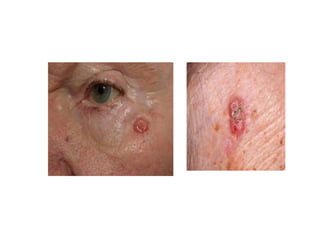
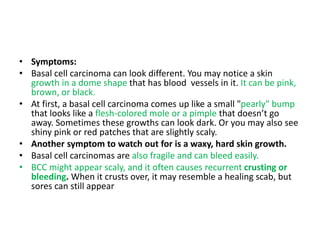
• Basal cell carcinoma can look different. You may notice a skin
growth in a dome shape that has blood vessels in it. It can be pink,
brown, or black.
• At first, a basal cell carcinoma comes up like a small "pearly" bump
that looks like a flesh-colored mole or a pimple that doesn’t go
away. Sometimes these growths can look dark. Or you may also see
shiny pink or red patches that are slightly scaly.
• Another symptom to watch out for is a waxy, hard skin growth.
• Basal cell carcinomas are also fragile and can bleed easily.
• BCC might appear scaly, and it often causes recurrent crusting or
bleeding. When it crusts over, it may resemble a healing scab, but
sores can still appear
• Diagnosis:
• To diagnose any form of skin cancer, a doctor will carry out a
physical examination. They will examine the skin lesion and record
its size, shape, texture, and other physical attributes.
• They may also take a photo of the lesion for specialist review or to
record its current size and appearance for future comparisons. The
doctor will often check the rest of the body for additional skin
symptoms.
• They will also take a medical history focusing on the lesion and any
related conditions, such as sunburn
• If they think that a lesion may be cancerous, the doctor is also likely
to perform a biopsy. There are four different types of skin biopsy,
all of which involve the removal of skin tissue for laboratory
assessment.
• The different types are:
• Shave biopsy: Using a sharp surgical blade, the doctor shaves the top layers of skin
cells, usually as far as the dermis but sometimes deeper. This type of biopsy often
results in bleeding, but it is possible to stop this by cauterizing ( To burn or freeze
through nitric oxide)the wound.
• Punch biopsy: The doctor uses a sharp, hollow surgical tool that resembles a tiny
cookie cutter to remove a circle of skin from below the dermis. A person may need
a single stitch to close the resulting wound.
• Incisional biopsy: The doctor removes part of the growth with a scalpel, cutting
away a full-thickness wedge or slice of skin. This type of biopsy often needs more
than one stitch afterward.
• Excisional biopsy: The doctor removes the whole growth and some surrounding
tissue with a scalpel. The resulting wound usually requires stitches.
• When the entire tumor is removed, the procedure is called an excisional biopsy. If
only a portion of the tumor is removed, the procedure is referred to as
an incisional biopsy
• TREATMENT: Treatment options may include the following:
• Curettage and electro-desiccation: This is a standard procedure for
removing a small lesion. The doctor uses a small, sharp, spoon- or
ring-shaped instrument called a curette to scrape away the
carcinoma before burning the site with an electric needle.
• It may take more than one round of curettage and desiccation to
remove the cancer cells entirely.
• Surgical excision: A surgeon removes the lesion, sometimes in a
procedure known as Mohs surgery, which works better on larger
lesions. During this procedure, the surgeon checks for the presence
of cancer cells after removing each layer.
• Mohs surgery is particularly useful in cases that require the
removal of as little skin as possible, such as on lesions near the
eye. Doctors will also use it on lesions with a high risk of recurrence.
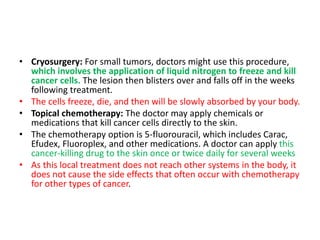
• Cryosurgery: For small tumors, doctors might use this procedure,
which involves the application of liquid nitrogen to freeze and kill
cancer cells. The lesion then blisters over and falls off in the weeks
following treatment.
• The cells freeze, die, and then will be slowly absorbed by your body.
• Topical chemotherapy: The doctor may apply chemicals or
medications that kill cancer cells directly to the skin.
• The chemotherapy option is 5-fluorouracil, which includes Carac,
Efudex, Fluoroplex, and other medications. A doctor can apply this
cancer-killing drug to the skin once or twice daily for several weeks
• As this local treatment does not reach other systems in the body, it
does not cause the side effects that often occur with chemotherapy
for other types of cancer.
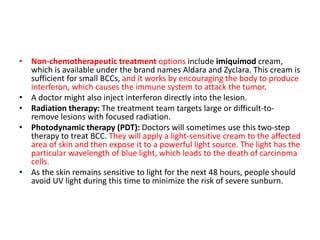
• Non-chemotherapeutic treatment options include imiquimod cream,
which is available under the brand names Aldara and Zyclara. This cream is
sufficient for small BCCs, and it works by encouraging the body to produce
interferon, which causes the immune system to attack the tumor.
• A doctor might also inject interferon directly into the lesion.
• Radiation therapy: The treatment team targets large or difficult-to-
remove lesions with focused radiation.
• Photodynamic therapy (PDT): Doctors will sometimes use this two-step
therapy to treat BCC. They will apply a light-sensitive cream to the affected
area of skin and then expose it to a powerful light source. The light has the
particular wavelength of blue light, which leads to the death of carcinoma
cells.
• As the skin remains sensitive to light for the next 48 hours, people should
avoid UV light during this time to minimize the risk of severe sunburn.
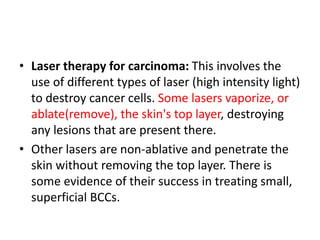
• Laser therapy for carcinoma: This involves the
use of different types of laser (high intensity light)
to destroy cancer cells. Some lasers vaporize, or
ablate(remove), the skin's top layer, destroying
any lesions that are present there.
• Other lasers are non-ablative and penetrate the
skin without removing the top layer. There is
some evidence of their success in treating small,
superficial BCCs.
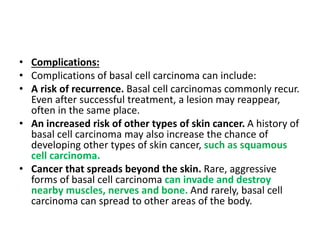
• Complications:
• Complications of basal cell carcinoma can include:
• A risk of recurrence. Basal cell carcinomas commonly recur.
Even after successful treatment, a lesion may reappear,
often in the same place.
• An increased risk of other types of skin cancer. A history of
basal cell carcinoma may also increase the chance of
developing other types of skin cancer, such as squamous
cell carcinoma.
• Cancer that spreads beyond the skin. Rare, aggressive
forms of basal cell carcinoma can invade and destroy
nearby muscles, nerves and bone. And rarely, basal cell
carcinoma can spread to other areas of the body.
• Preventions:
• The best prevention strategy is to adopt sensible practices regarding sun exposure and avoid
tanning beds.
• Minimizing sun exposure: By reducing their exposure to UV light, people can reduce their risk of
sunburn, skin damage, and all types of skin cancer, including carcinoma.
• Use sun-screens
• Wear protective clothing
• Avoid tanning beds
• Self examination: Become familiar with your skin so that you'll notice changes.
• The basic principle of screening for carcinoma and other forms of skin cancer is to look for skin
changes that do not resolve.
• To be effective, self-examination of the skin should involve:
• paying particular attention to areas of skin that get lots of sun exposure
• asking a partner or family member to check difficult-to-see areas and using full-length and hand
mirrors as treatment is likely to be more effective in cases where a person identifies skin changes at
an early stage and receives prompt medical attention.
Cellulities
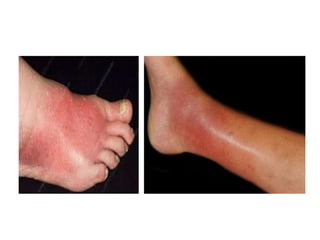
• Definition: Cellulitis, is a bacterial infection of the
dermis—the deep layer of skin—as well as the
subcutaneous tissues, the fat and soft tissue layer
that are under the skin.
• The affected skin appears swollen and red and is
typically painful and warm to the touch.
• Some types of bacteria are naturally present on
the skin and do not normally cause any harm.
However, if the bacteria go deep into the skin,
they can cause an infection.
• Types
• Cellulitis can be classified into different types,
according to where it appears.
• This can be:
• around the eyes, known as periorbital cellulitis
• around the eyes, nose, and cheeks, known as facial
cellulitis
• breast cellulitis
• perianal cellulitis, occurring around the anal orifice
• However, the most common location is the lower legs.
• Causes:
• Bacteria from the Streptococci and staphylococci groups are commonly found on
the surface of the skin and cause no harm, however, if they enter the skin, they
can cause infection.
• For the bacteria to access the deeper skin layers, they need a route in, which is
usually through a break in the skin. A break in the skin can be caused by:
• ulcers
• burns
• bites
• Grazes (light abrassion)
• cuts
• some skin conditions, such as eczema, athlete's foot,( tinea pedis, fungal infection
begins in foot due to feet become sweaty because of tightening of shoes &
produces scaly rash, itching, burning) or psoriasis (cells to build up rapidly)
• Bacteria can also enter through areas of dry, flaky skin or swollen skin.
• Bone infections underneath the skin. (An example is a long-standing, open wound
that is deep enough to expose the bone to bacteria.)
• Symptoms:
• The affected area will become:
• warm
• tender
• inflamed
• swollen
• red
• painful
• Some people may develop blisters, skin dimpling (skin has texture similar
to orange peel, occurs mostly in cancer due to overgrowth of cells ), or
spots. They might also experience a fever, chills, nausea, and shivering.
• Lymph glands may swell and become tender. If the cellulitis has affected
the person's leg, the lymph glands in their groin may also be swollen or
tender.
• Risk factors:
• Common risk factors include:
• a weakened immune system
• skin conditions that cause breaks in the skin, such as eczema and athlete’s
foot, or infectious diseases that cause sores, such as chickenpox
(infectious disease cause by varicella-zoster virus, causes an itchy rash
with small fluid-filled blister)
• intravenous (IV) drug use (Drug addicts who do not have access to a
regular supply of clean needles are more likely suffer from infections deep
inside the skin)
• Diabetes (high b.g level destroys WBCs)
• a previous history of cellulitis
• Circulatory problems, such as not enough blood flow to your arms and
legs, poor drainage of your veins or lymphatic system, or varicose veins --
twisted, enlarged veins near the surface of the skin
• Other skin infections: Conditions, such as chicken
pox and shingles (viral infection causes painful rash &
blister & wraps around torso)may cause skin blisters. If
the blisters break, they can become ideal routes for
bacteria to get into the skin.
• Lymphedema: This condition causes swollen skin that
is more likely to crack. Cracks in the skin may become
perfect entry routes for bacteria. (caused by
compromised lymphatic system, & this condition is of
localized fluid retention & tissue swelling)
• Diagnosis: Diagnosis is usually fairly straightforward and does not
generally require any complicated tests. A doctor will examine the
individual and assess their symptoms.
• The doctor may take a swab, or sample, if there is an open wound.
This can help them identify what type of bacteria is causing
cellulitis.
• However, these samples are easily contaminated due to the
multiple types of bacteria that live on the skin all the time.
• Additional procedures include:
• A blood test if the infection is suspected to have spread to your
blood
• An X-ray if there’s a foreign object in the skin or the bone
underneath is possibly infected
• A culture. Your doctor will use a needle to draw fluid from the
affected area and send it to the lab.
• Treatment:
• Antibiotics are used to treat the infection. Oral antibiotics may be adequate, but in
the severely ill person, intravenous antibiotics will be needed to control and
prevent further spread of the infection. This treatment is given in hospital or,
sometimes, at home by a local doctor or nurse.
• Many different types of antibiotics can be used to treat cellulitis. Which type the
doctor prescribes will depend on what type of bacteria the doctor suspects has
caused the infection.
As the infection improves, you may be able to change from intravenous to oral
antibiotics, which can be taken at home for a further week to 10 days. Most
people respond to antibiotics in two to three days and begin to show
improvement.
In rare cases, the cellulitis may progress to a serious illness by spreading to deeper
tissues. In addition to broad spectrum antibiotics, surgery is sometimes required.
• doctor will usually prescribe a 10- to 21-day
regimen of oral antibiotics to treat your cellulitis.
The length of your treatment with oral antibiotics
will depend on the severity of your condition.
• Cellulitis should go away within 7 to 10 days of
starting antibiotics. Longer treatment could be
necessary if your infection is severe. This can
occur if you suffer from a chronic disease or if
your immune system isn’t working properly.
• Home remedies:
• There is no way to treat cellulitis at home, and this
condition needs to be treated by a doctor. If someone
suspects they have cellulitis, they should call a doctor right
away, and:
• drink plenty of water
• keep the affected area raised, to help reduce swelling and
pain
• take painkillers, as recommended by a doctor
• Some people have suggested using tea tree oil, coconut oil,
and garlic, because they may have antibacterial, antifungal,
and other properties. However, there appears to be no
evidence that they can treat cellulitis
• Complications:
• Sometimes cellulitis can spread throughout the body, entering the lymph nodes
and bloodstream. In rare cases, it can enter into deeper layers of tissue. Potential
complications that can occur are:
• a blood infection (Blood infection and sepsis: If the bacteria reach the
bloodstream, the person has a higher risk of developing sepsis A person
with sepsis may have a fever, accelerated heartbeat, rapid breathing, low blood
pressure (hypotension), dizziness when standing up, reduced urine flow, and
sweaty, pale, cold skin.
• Infection moving to other regions: This is very unusual, but the bacteria that
caused the cellulitis can spread to other parts of the body, including muscle, bone,
or the heart valves. If this happens, the person needs treatment immediately.
• Permanent swelling: People who do not receive treatment for their cellulitis are at
higher risk of having a permanent swelling in the affected area.
• an inflammation of your lymph vessels
• tissue death, or gangrene (body tissue dies due to reduce blood flow & causes
injury/illness/infection)
• Recurrent episodes of cellulitis may damage
the lymphatic drainage system and cause
chronic swelling of the affected limb.
• Rarely, the infection can spread to the deep
layer of tissue called the fascial lining.
Necrotizing fasciitis is an example of a deep-
layer infection. It's an extreme emergency
• Preventions:
• Although some cases of cellulitis are not preventable, there are things that
people can do to reduce their chances of developing it:
• Treat cuts and grazes: If the skin is broken because of a cut, bite, or graze,
it should be kept clean to reduce risk of infection.
• Reduce the likelihood of scratching and infecting the skin: The risk of the
skin being damaged by scratching will be greatly reduced if fingernails are
kept short and clean.
• Take good care of the skin: If the skin is dry, use moisturizers to prevent
skin from cracking. Individuals with greasy skin will not need to do this.
Moisturizers will not help if the skin is already infected.
• Protect the skin: Wear gloves and long sleeves when gardening; do not
wear shorts if there is a likelihood of grazing the skin of the legs.
• Lose weight if you are obese: Obesity may raise the risk of developing
cellulitis.
Leprosy
• Definition: Leprosy is a chronic infectious disease caused
by Mycobacterium leprae, an acid-fast, rod-shaped bacillus. The
disease mainly affects the skin, the peripheral nerves, mucosa of
the upper respiratory tract, and the eyes. Leprosy is curable and
treatment in the early stages can prevent disability.
• Synonym: Hansen’s disease (after the scientist who discovered M.
leprae in 1873.)
• Leprosy was once feared as a highly contagious and devastating
disease, but now we know it doesn’t spread easily and treatment is
very effective. However, if left untreated, the nerve damage can
result in crippling of hands and feet, paralysis, and blindness.
• The disease is termed a chronic granulomatous disease, similar
to tuberculosis, because it produces inflammatory nodules
(lumps)(granulomas) in the skin and peripheral nerves over time.
• Causes: Leprosy is caused mainly by Mycobacterium leprae, a rod-
shaped slow-growing bacillus that is an obligate(to bind)
intracellular (only grows inside of certain human and animal cells)
bacterium.
• M. leprae is termed an "acid fast" bacterium because of its
chemical characteristics. When medical professionals use special
stains for microscopic analysis, it stains red on a blue background
due to mycolic acid content in its cell walls.
• Currently, the organisms cannot be cultured on artificial media. The
bacteria take an extremely long time to reproduce inside of cells
(about 12-14 days as compared to minutes to hours for most
bacteria)
• The bacteria grow very well in the body's macrophages (a type of
immune system cell) and Schwann cells (cells that cover and
protect nerve axons).
• Symptoms:
• It usually takes about 3 to 5 years for symptoms to appear after coming
into contact with the leprosy-causing bacteria. Some people do not
develop symptoms until 20 years later. The time between contact with the
bacteria and the appearance of symptoms is called the incubation period.
Leprosy's long incubation period makes it very difficult for doctors to
determine when and where a person with leprosy got infected.
• Numbness (among the first symptoms)
• Loss of temperature sensation (among the first symptoms)
• Touch sensation reduced (among the first symptoms)
• Pins and needles sensations (among the first symptoms)
• Pain (joints)
• Deep pressure sensations are decreased or lost
• Nerve injury
• Weight loss
• Blisters and/or rashes
• Ulcers, relatively painless
• Skin lesions of hypopigmented macules(spot) (flat, pale areas of
skin that lost color)
• Eye damage (dryness, reduced blinking)
• Hair loss (for example, loss of eyebrows)
• Loss of digits (later symptoms and signs)
• Facial disfigurement (for example, loss of nose) (later symptoms
and signs)
• Erythema nodosum leprosum: tender skin nodules accompanied by
other symptoms like fever, joint pain, neuritis, and edema
• Erythema nodosum is inflammatory condition of fat cells under the
skin resulting in tender red nodules
• The first noticeable sign of leprosy is often the
development of pale or pinkish patches of skin that may be
insensitive to temperature or pain. This is sometimes
accompanied or preceded by nerve problems including
numbness or tenderness in the hands or feet.
• Secondary infections, in turn, can result in tissue loss,
causing fingers and toes to become shortened and
deformed, as cartilage is absorbed into the body.
• Approximately 30% of those affected experience nerve
damage, and the nerve damage sustained is irreversible,
even with treatment of the infection. Damage to nerves
may cause sensation abnormalities, which may lead to
infection, ulceration, and joint deformity
• Classification:
• The 2009 WHO classifications depend on the number
of skin lesions as follows:
• Paucibacillary leprosy: skin lesions with no bacilli (M.
leprae) seen in a skin smear
• Multibacillary leprosy: skin lesions with bacilli (M.
leprae) seen in a skin smear.
• The clinical system of classification for the purpose of
treatment includes the use of number of skin lesions
and nerves involved as the basis for grouping leprosy
patients into multibacillary (MB) and paucibacillary
(PB) leprosy."
• The Ridley-Jopling system is composed of six forms or
classifications, listed below according to increasing severity of
symptoms:
• Indeterminate leprosy: a few hypopigmented macules; can heal
spontaneously, this form persists or advances to other forms
• Tuberculoid leprosy: a few hypopigmented macules, some are large
and some become anesthetic (lose pain sensation); some neural
involvement in which nerves become enlarged; spontaneous
resolution in a few years, persists or advances to other forms
• Borderline tuberculoid leprosy: lesions like tuberculoid leprosy but
smaller and more numerous with less nerve enlargement. This
form may persist, revert to tuberculoid leprosy, or advance to other
forms
• Mid-borderline leprosy: many reddish plaques that are asymmetrically
distributed, moderately anesthetic, with regional adenopathy (swollen
lymph nodes). The form may persist, regress to another form, or progress
• Borderline lepromatous leprosy: many skin lesions with macules (flat
lesions) papules (raised bumps), plaques, and nodules, sometimes with or
without anesthesia; the form may persist, regress or progress to
lepromatous leprosy
• Lepromatous leprosy: Early lesions are pale macules (flat areas) that are
diffuse and symmetric. Later medical professionals can find many M.
leprae organisms in the lesions. Alopecia (hair loss) occurs. Often patients
have no eyebrows or eyelashes. As the disease progresses, nerve
involvement leads to anesthetic areas and limb weakness. Progression
leads to aseptic necrosis (tissue death from lack of blood to area),
lepromas (skin nodules), and disfigurement of many areas, including the
face. The lepromatous form does not regress to the other less severe
forms
• Lepromatous-Lapro-an area of inflammation of skin.
• Spread of disease:
• Researchers suggest that M. leprae spreads person to person by
nasal secretions or droplets from the upper respiratory tract and
nasal mucosa. However, the disease is not highly contagious like
the flu. They speculate that infected droplets reach other peoples'
nasal passages and begin the infection there
• Some investigators suggest the infected droplets can infect others
by entering breaks in the skin.
• Recent genetic studies have demonstrated that several genes
(about seven) are associated with an increased susceptibility to
leprosy. Some researchers now conclude that susceptibility to
leprosy may be partially inheritable.
• The incubation period for leprosy varies from about six months to
20 years
• Diagnosis:
• Physicians diagnose the majority of cases of leprosy by
clinical findings, especially since most current cases are
diagnosed in areas that have limited or no laboratory
equipment available.
• Hypopigmented patches of skin or reddish skin patches
with loss of sensation,
• thickened peripheral nerves, or both clinical findings
together often comprise the clinical diagnosis.
• Skin smears or biopsy material that show acid-fast bacilli
with the Ziehl-Neelsen stain or the Fite stain (biopsy) can
diagnose multibacillary leprosy, or if bacteria are absent,
diagnose paucibacillary leprosy.
• Treatment:
• Antibiotics treat the majority of cases (mainly clinically diagnosed)
of leprosy. The recommended antibiotics, their dosages, and length
of time of administration are based on the form or classification
• In general, two antibiotics (dapsone and rifampicin) treat
paucibacillary leprosy, while multibacillary leprosy is treated with
the same two plus a third antibiotic, clofazimine. Usually, medical
professionals administer the antibiotics for at least six to 12 months
or more to cure the disease.
• Medical professionals have used steroid medications to minimize
pain and acute inflammation with leprosy; however, controlled
trials showed no significant long-term effects on nerve damage.
• Surgery:
• The role for surgery in the treatment of leprosy occurs after a
patient completes medical treatment (antibiotics) with negative
skin smears (no detectable acid-fast bacilli) and is often only
needed in advanced cases.
• Medical professionals individualize surgery for each patient with the
goal to attempt cosmetic improvements and, if possible, to restore
limb function and some neural functions that were lost to the
disease.
• Home remedies: As is the case with many diseases, the lay
literature contains home remedies. For example, purported home
remedies include a paste made from the neem plant, Hydrocotyle,
also known as Cantella asiatica, and even aromatherapy with
frankincense.
• Complications:
• Sensory loss (usually begins in extremities)
• Permanent nerve damage (usually in extremities)
• Muscle weakness
• Progressive disfigurement (for example, eyebrows lost,
disfigurement of the toes, fingers, and nose)
• In addition, the sensory loss causes people to injure
body parts without the individual being aware that
there is an injury. This can lead to additional problems
such as infections and poor wound healing.
Keloid
• Definition: Keloids are
smooth, hard growths
that can form when scar
tissue grows excessively.
Keloid scars can be much
larger than the original
wound
• Pathomechanism: When skin is injured, fibrous
tissue called scar tissue forms over the wound to
repair and protect the injury. In some cases, scar
tissue grows excessively, forming smooth, hard
growths called keloids. Keloids can be much
larger than the original wound. They’re most
commonly found on the chest, shoulders,
earlobes, and cheeks. However, keloids can affect
any part of the body.
• Although keloids aren’t harmful to your health,
they may create cosmetic concerns
• Causes:
• Most types of skin injury can contribute to keloid scarring. These include:
• acne scars
• burns
• Chickenpox scars
• ear piercing
• scratches
• surgical incision sites
• vaccination sites
• Keloids tend to have a genetic component, which means you’re more likely
to have keloids if one or both of your parents has them.
• According to one study, a gene known as the AHNAK gene may play a role
in determining who develops keloids and who doesn’t. The researchers
found that people who have the AHNAK gene may be more likely to
develop keloid scars than those who don’t. (healthline.com)
• AHNAK gene: these are nucleoprotein
• AHNAK has been shown to be essential
for protrusion (to extend from) and
cell migration.
• Reason for development of keloids:
• Doctors do not understand exactly why keloids
form. Alterations in the cellular signals that
control proliferation(process of producing
other cells) and inflammation may be related
to the process of keloid formation, but these
changes have not yet been characterized
sufficiently to explain this defect in wound
healing.
• Symptoms:
• Keloids are raised and look shiny and dome-
shaped,
• ranging in color from pink to red.
• Some keloids become quite large and
unsightly.
• Aside from causing potential cosmetic
problems, these exuberant scars tend to be
itchy, tender, or even painful to the touch.
• Diagnosis:
• A doctor diagnoses a keloid on the basis of its appearance
and a history of tissue injury, such as surgery, acne or body
piercing. In rare cases, the doctor may remove a small piece
of the skin to examine under a microscope. This is called a
biopsy. (as this overgrowth can be tumor)
• Expected Duration
• Keloids may continue to grow slowly for weeks, months or
years. They eventually stop growing but do not disappear
on their own. Once a keloid develops, it is permanent
unless removed or treated successfully. It is common for
keloids that have been removed or treated to return.
• Treatment:
• Corticosteroid injections (intralesional steroids): These are safe but
moderately painful. Injections are usually given once every four to eight
weeks into the keloids) and usually help flatten keloids; however, steroid
injections can also make the flattened keloid redder by stimulating the
formation of more superficial blood vessels. (These can be treated using a
laser. The keloid may look better after treatment than it looked to start
with, but even the best results leave a mark that looks and feels quite
different from the surrounding skin.
• Laser: The pulsed-dye laser can be effective at flattening keloids and
making them look less red. Treatment is safe and not very painful, but
several treatment sessions may be needed. These may be costly, since
such treatments are not generally covered by insurance plans.
• [The pulsed-dye laser for treatment of cutaneous conditions, PDL uses a
concentrated beam of light that targets blood vessels in the skin]
• Pressure: Special earrings are available, which when used
appropriately, can cause keloids on the earlobe to shrink
significantly.
• Cryotherapy: Freezing keloids with liquid nitrogen may
flatten them but often darkens or lightens the site of
treatment.
• Interferon: Interferons are proteins produced by the body's
immune systems that help fight off viruses, bacteria, and
other challenges. In recent studies, injections
of interferon have shown promise in reducing the size of
keloids, though it's not yet certain whether that effect will
be lasting. Current research is under way using a variant of
this method, applying topical imiquimod (Aldara), which
stimulates the body to produce interferon.
• Fluorouracil and bleomycin: Injections of these chemotherapeutic
(anti-cancer) agents, alone or together with steroids, have been
used for treatment of keloids.
• These drugs work by delaying mitosis(division of cell nucleus) in
different phases of the cell cycle and consequently inducing
suppression of fibroblast proliferation.
• Radiation: Some doctors have reported safe and effective use of
radiation to treat keloids using a variety of techniques.
• Silicone gel or sheeting: This involves wearing a sheet of silicone gel
on the affected area continuously for months, which is hard to
sustain. Results are variable. Some doctors claim similar success
with compression dressings made from materials other than
silicone. (this technique helps to stop rising of effected skin after
incision & surgery)

Skin Diseases

  • 1.
    Skin diseases By: Dr. LaraibJameel Rph Find me on slideshare.net https://www.slideshare.net/
  • 2.
    Eczema • Definition: Eczemais the name for a group of conditions that cause the skin to become red, itchy and inflamed. Blisters may sometimes occur. • The word “eczema” is derived from a Greek word meaning “to boil over,” which is a good description for the red, inflamed, itchy patches that occur during flare-ups (to burst out). Eczema can range from mild, moderate, to severe
  • 4.
    Eczema • Eczema isnot contagious. You can’t “catch it” from someone else. While the exact cause of eczema is unknown, researchers do know that people who develop eczema do so because of a combination of genes and environmental triggers. When an irritant or an allergen “switches on” the immune system, skin cells don’t behave as they should causing an eczema flare-up.
  • 5.
    • Causes: • Healthyskin helps retain moisture and protects you from bacteria, irritants and allergens. Eczema is related to a gene variation (If both parents have an atopic disease, the risk is even greater.) • people with eczema have mutation of genes responsible for creating filaggrin. Filaggrin is protein that helps our body to maintain healthy protective barrier on very top layer of skin. Without enough filaggrin to build strong barrier moisture can escape(free) & bacteria, virus can enter. This is why people with eczema have dry & infectious skin. • Hormones: Women can experience increased eczema symptoms at times when their hormone (progesterone & estrogen) levels are changing, for example during pregnancy and at certain points in the menstrual cycle. • Skin has numerous estrogen & progesteron receptors. Cyclic flucuation of hormones influences skin production of lipids & oils, skin thickness and barrier function • Immune system: People with eczema tend to have n over-reactive immune system that when triggered with by a substance inside or outside the body, it responds by producing inflammation
  • 6.
    • Eczema isatopic disease • Atopic is a term used to describe an IgE-mediated response within the body following exposure to external irritants. • Atopic disease: (atopy is typically associated with hightened immune response to common allergens, especially inhaled allergens so atopy refers to genetic tendency to develop allergic disease such as Allergic asthma • Atopic dermatitis, also known as atopic eczema • Allergic rhinitis (hay fever) • Mechanism: When a person who has an atopic disease is exposed to an allergen, an IgE response occurs that causes immune and blood cells to release substances, such as histamines(involved in inflammatory responses & act as mediator of itching), that trigger a variety of physical changes within the body. These changes can affect blood vessels, stimulate secretion of mucus, affect muscle functioning and create inflammation within cells of certain parts of the body.
  • 7.
    Types of eczema •Atopic dermatitis: is the most common type of eczema. • Symptoms often present in childhood and can range from mild to severe. A child is more likely to develop atopic dermatitis if one of their parents has had it. • Children with atopic dermatitis have a higher risk of food sensitivity. They are also more likely to develop asthma and hay fever. • Atopic dermatitis tends to cause patches of dry skin that can become itchy, red, and inflamed. These patches often appear in the creases of the elbows and knees and on the face, neck, and wrists. • Scratching the patches can worsen the itching and make the skin ooze clear fluid. Over time, repeated scratching or rubbing can cause the patch of skin to thicken. This is known as lichen simplex chronicus (LSC). • LSC is a localized, area of thickened skin (lichenification) resulting from repeated rubbing, itching, and scratching of the skin. It can occur on normal skin of individuals with atopic, seborrheic, contact dermatitis, or psoriasis
  • 9.
    • 2- contactdermatitis: • Some people experience a skin reaction when they come into contact with certain substances. This is known as contact dermatitis. • Symptoms of contact dermatitis can include: • dry, red, and itchy skin that may feel as though it is burning • blistering • hives, a type of rash that consists of small, red bumps • A person with atopic dermatitis has an increased risk of contact dermatitis. • There are two types of contact dermatitis: A. Irritant contact dermatitis can result from repeated exposure to a substance that irritates the skin, such as: • acids and alkalis • fabric softeners, harsh detergents, weed killers etc
  • 10.
    B- Allergic contactdermatitis • Allergic contact dermatitis occurs when a person's immune system reacts to a particular substance, known as an allergen. • A person might not react to an allergen the first time they come into contact with it. (modify the immune family such as CD4, CD8. T cells- plays proinflammatory role) However, once they develop an allergy, they will usually have it for life. • Possible allergens include: • glues and adhesives • Latex(BODY FLUID- PLASMA, LYMPH) and rubber • some medications, such as topical and oral antibiotics • fabrics and clothing dyes • some plants, including poison ivy, poison oak, and sumac • ingredients in some makeup, nail polishes, creams, hair dyes, and other cosmetics • certain metals, such as nickel and cobalt
  • 12.
    • Dyshidrotic eczema,or pompholyx eczema • typically appears in adults under 40 years of age. It usually occurs on the hands and feet and has characteristic symptoms, including intense itching and the appearance of small blisters. • In some cases, the blisters can become large and watery. The blisters may become infected too, which can lead to pain and swelling. They may also ooze pus. • Blisters typically clear up within a few weeks. Following this, the skin often becomes dry and cracked, which may lead to painful skin fissures. • Dyshidrotic eczema may be a form of contact dermatitis. People with dyshidrotic eczema also tend to experience flare-ups (worse) from time to time.
  • 14.
    • Discoid eczema,or nummular eczema, • is recognizable due to the disc-shaped patches of itchy, red, cracked, and swollen skin that it causes. • The discs typically appear on the lower legs, torso, and forearms. Sometimes, the center of the disc clears up, leaving a ring of red skin. • Discoid eczema can occur in people of any age, including children. • As with other types of eczema, the causes of discoid eczema are not fully understood. However, known triggers and risk factors include: • dry skin • skin injuries, such as friction or burns • insect bites • poor blood flow • cold climate • bacterial skin infections • certain medications • sensitivity to metals and formaldehyde • atopic dermatitis
  • 15.
    • Seborrheic dermatitis •is a common condition that causes a red, itchy, and flaky rash. The rash can appear swollen or raised, and a yellowish or white crust may form on its surface. • Seborrheic dermatitis develops in areas where the skin is oily, (sebum rich areas)such as the: • scalp • ears • eyebrows • eyelids • face • upper chest and back • armpits • genitals • Seborrheic dermatitis can affect people of any age. Cradle cap is a type of seborrheic dermatitis that can occur on the scalp of babies, but this usually disappears after a few months
  • 17.
    • Varicose eczemais also known as venous, gravitational, or stasis(in- activity) eczema. It is common in older adults with varicose veins. (swollen twisted veins) • Getting older and being less active can weaken the veins in a person's legs. This can lead to both varicose veins and varicose eczema. • Varicose eczema typically affects the lower legs (due to difficulty to push blood upward against gravity)and symptoms can include: • hot, itchy spots or blisters • dry, scaly skin • weepy, crusty patches • cracked skin • The skin on the lower leg may become fragile(easily broken), so it is important to avoid scratching and picking at the spots and blisters
  • 19.
    • Asteatotic eczema,also called xerotic eczema and generally only affects people over 60 years of age. This may be due to the skin becoming drier as a person ages(loss of oil glands) • Asteatotic eczema typically occurs on the lower legs, but it can also appear on other parts of the body. Symptoms include: • cracked, dry skin with a characteristic appearance that people describe as crazy paving • pink or red cracks or grooves • scaling • itching and soreness
  • 21.
    • Diagnosis: • Eczemacan indicate a new allergy, so it is important to determine what is causing the reaction. • Eczema can also increase the likelihood of staph infections • There is no specific test to diagnose most types of eczema. The doctor will want to know the individual's personal and family medical history. • A physical examination of the rash will help the doctor to diagnose which type of eczema it is. • The doctor may also perform a patch test, which involves pricking a person's skin with a needle that contains potential irritants and allergens. A patch test can determine whether or not someone has contact dermatitis.
  • 22.
    • Symptoms: • Sometimesthe itch gets so bad that people scratch it until it bleeds, which can make your eczema worse. This is called the “itch-scratch cycle.” • Dry, sensitive skin • Red, inflamed skin • Very bad itching • Dark colored patches of skin • Rough, leathery or scaly patches of skin • Small, raised bumps, which may leak fluid and crust over when scratched • Areas of swelling
  • 23.
    • Complications ofatopic dermatitis (eczema) may include: • Asthma and hay fever. Eczema sometimes precedes these conditions. More than half of young children with atopic dermatitis develop asthma and hay fever(allergic rhinitis) by age 13. • Chronic itchy, scaly skin. A skin condition called neurodermatitis (lichen simplex chronicus) thickening of skin due to rubbing starts with a patch of itchy skin. You scratch the area, which makes it even itchier. Eventually, you may scratch simply out of habit. This condition can cause the affected skin to become discolored, thick and leathery. • Skin infections. Repeated scratching that breaks the skin can cause open sores and cracks. These increase the risk of infection from bacteria and viruses, including the herpes simplex virus. • Irritant hand dermatitis. This especially affects people whose work requires that their hands are often wet and exposed to harsh soaps, detergents and disinfectants. • Allergic contact dermatitis. This condition is common in people with atopic dermatitis. • Sleep problems. The itch-scratch cycle can cause poor sleep quality.
  • 24.
    • Treatment: 1. Topicalcorticosteroid creams and ointments: These are a type of anti-inflammatory medication and should relieve the main symptoms of eczema, such as skin inflammation and itchiness. Apply it as directed, after you moisturize. Overuse of this drug may cause side effects, including thinning skin. 2. Systemic corticosteroids: If topical treatments are not effective, systemic corticosteroids can be prescribed. 3. Antibiotics: These are prescribed if eczema occurs alongside a bacterial skin infection. 4. Antiviral and antifungal medications: These can treat fungal and viral infections that occur.
  • 25.
    5- Antihistamines: Thesereduce the risk of nighttime scratching as they can cause drowsiness. (sleepiness/ lethargis sleepiness) 6- Topical calcineurin inhibitors: This is a type of drug that suppresses the activities of the immune system. It decreases inflammation and helps prevent flare-ups. Primecrolimus cream, tacrolimus ointment 7- Barrier repair moisturizers: These reduce water loss and work to repair the skin. Mostly nos steroidal emolient cream.
  • 26.
    • Therapies: • Wetdressings. An effective, intensive treatment for severe atopic dermatitis involves wrapping the affected area with topical corticosteroids and wet bandages. Sometimes this is done in a hospital for people with widespread lesions because it's labor intensive and requires nursing expertise. Or, ask your doctor about learning how to do this technique at home. • Light therapy. This treatment is used for people who either don't get better with topical treatments or who rapidly flare again after treatment. The simplest form of light therapy (phototherapy) involves exposing the skin to controlled amounts of natural sunlight. Other forms use artificial ultraviolet A (UVA) and narrow band ultraviolet B (UVB) either alone or with medications. • Though effective, long-term light therapy has harmful effects, including premature skin aging and an increased risk of skin cancer. For these reasons, phototherapy is less commonly used in young children and not given to infants. Talk with your doctor about the pros and cons of light therapy.
  • 27.
    • Phototherapy helpsto • Reduce itch • Calm inflammation • Increase vit-D production .(vit-d helps the immune system reduce level of inflammation & strengthens skin barriers) • It contains machine in which patient is placed. It is mostly for whole body or some times hands & feet
  • 28.
    Preventions: • using gentlesoaps and detergents • avoiding fragrances or perfumes • using cooler water for showers and baths • drying or toweling the skin gently after washing • Moisturize your skin at least twice a day. (for dry skin) • Don't scratch. Rather than scratching when you itch, try pressing on the skin. Cover the itchy area if you can't keep from scratching it. For children, it might help to trim their nails and have them wear gloves at night. • Use a humidifier. Hot, dry indoor air can parch sensitive skin and worsen itching and flaking. A portable home humidifier or one attached to your furnace adds moisture to the air inside your home.
  • 29.
    Bromhidrosis • Definition: Bromhidrosisrefers to a medical condition where the body releases bad-smells plus sweat. • Synonym: Body order, Osmidrosis, Bromidrosis • Perspiration(sweat secreted from sweat gland) itself actually has no odor. It’s only when sweat encounters(to meet) bacteria on the skin that a smell can emerge.
  • 30.
    Causes: • You havetwo types of sweat glands: apocrine and eccrine. Bromhidrosis is usually related to secretions by apocrine glands. But both types of sweat glands can lead to abnormal body odor. • 1-Apocrine gland: These are in limited areas and produce the pheromones associated with body scent. (which are hormones meant to have an effect on others. People and animals release pheromones to attract a mate, for example.) These glands are located under the arms, breast and groin regions. This sweat is odorless to start with. The sweat they produce is high in protein which bacteria can break down easily. Within an hour, the bacteria in the skin break down then the sweat is broken into fatty acids and ammonia produces unpleasant and unfavorable odors, the perspiration and produce a foul odor. Apocrine glands don’t become active until puberty. That’s why BO isn’t usually an issue among young children.
  • 31.
    • 2- Eccrinegland: • These are located over the whole body. Eccrine glands produce the salty dilute solution associated with body sweat when the temperature rises. Eccrine glands secrete sweat that lacks odor but if bacteria get breaks down the sweat, it can start to smell. Various foods like garlic, curry or even alcohol and medication can impact the body in various ways.
  • 32.
    • Foods whichare responsible for bromhidrosis: • 1- sulfur: Vegetables which contain a huge amount of sulfide content can be a factor in causing BO. Sulfide is a naturally occurring organosulfur. While this form of natural sulfur is an essential ingredient, excessive amounts can lead to body odor. Sulfur is found in every single body cell. Excess sulfur may cause bad smells to emanate from the body.
  • 33.
    2-Meat/fish: • Another reasonfor body odor is eating a lot of red meat. As red meats are tough to digest, the body works overtime to break it down. This causes an increase in the amount of sweat produced. While fish is a good choice instead, choline found in certain fish meat like tuna and salmon constitute part of the B-complex vitamins and such meat can cause the body to emit an odor.
  • 34.
    • 3- fried/greecyfoods: • Another body odor cause is consumption of different types of fried and greasy food items. These can cause bacteria to breed in the mouth and on the skin. Oils in these maximally processed foods are associated with lack of effective digestion and lead to bromhidrosis.
  • 35.
    4- heavy processeditems: • foods come with a high glycemic index and have a massive dose of carbs and sugar. So, they are hard to digest. The harder the body works, the more sweat there is and the kidneys may then weaken and fail. 5- coffee/ alcohols: • BO is also caused by beverages like coffee and alcohol which take a long time to digest and excrete plenty of chemicals through sweat in the skin. while water and good hydration are essential for a sturdy regimen of hydration, especially during exercise, and when life stress is on the rise, these beverages like coffee and drinks like alcohol only serve to aggravate bromhidrosis.
  • 36.
    • 6- stress: •Yes, stress can cause body odor too. Being anxious and stressed out leads to a huge amount of a stress hormone called cortisol being released. It is known as one of the chief reasons for too much sweating. Sweating can, however, be less of an issue if the bacteria are living on the skin in smaller amounts. Remember that the bacterial components are the real cause of BO along with lack of proper kidney functionality.
  • 37.
    7- medical problems: •medical problem requires medication, one of the ways it can impact you is bromhidrosis. There are comprehensive side effects associated with these medicines. Consequently, one of the results is body odor. Certain medications can cause sulfur build-up around the teeth and gums. This substance has a smell like rotten eggs. Make sure the medicines you eat are compatible with each other or BO and halitosis can be a persistent problem • diabetic ketoacidosis is a life-threatening condition when your body doesn’t have enough insulin and your cells cannot get the sugar they need for energy. then they start to break fat into glycerol & fatty acids in the process of lipolysis which gives smell. One of the symptoms is a distinct, fruity breath smell. • Thyroid. Thyroid glands cause our body to sweat. When you have an overactive thyroid, it causes the body to product an excessive amount of sweat, even if you aren’t exerting yourself. This can cause excessive body odor. • Kidney and liver dysfunction. The kidneys and liver help remove toxins from our system. When they fail to function properly, toxins can build up in the blood and digestive tract, creating odor.
  • 38.
    8- nutritional deficiency: •When there is a vitamin or mineral deficiency from food intake, it is essential to make up for it or bromhidrosis can result. Consider the nutrients like magnesium, for instance. These aid in the removal of bromhidrosis. So try to include items like oatmeal, raw nuts, almond and cashew nuts or even dark chocolate and get your daily dose of magnesium= modifies intestinal normal flora that are beneficial & take part to digest food
  • 39.
    • 9- otherfactors: • Some of the most common causes of BO include excessive sweat secretion and lack of bodily hygiene. Other conditions associated with bromhidrosis include dermatological problems and excessive weight. Then, another factor that can cause BO is endocrine disorders like diabetes or inflammation in the skin folds or intertrigo. Some of the other medical conditions associated with BO include trichomycosis axillaris or axilla hair shafts being infested with body odor-emitting bacteria that break down sweat where skin that is chronically infected on being rubbed together emits an odor. • (is a superficial bacterial infection of underarm hair. The disease is characterised by yellow, black or red granular nodules or concretions that stick to the hair shaft. )
  • 40.
    • Symptoms: • stinging,musty, sharp sweat smells. • There’s also a thick moist keratin(protein) layer that can be seen and observed. When the skin is constantly rubbed, there are issues as well such as the formation of calluses (hard area of skin caused by repeated friction).
  • 41.
    Diagnosis: • Bromhidrosis iseasy to diagnose. Your doctor should be able to identify the condition based on your scent. You may have no discernible odor if you’re not sweating or recently showered. Your doctor may ask to see you after you’ve been exercising or may have you exercise on a treadmill, for example, at the appointment.
  • 42.
    • Treatment: • Botox: •Botulinum toxin A or Botox blocks nerve impulses to the muscles and it can be injected into the underarm to block the impulses to the sweat glands. The problem with botox treatment is it wears off once a certain period of time elapses. So, it may be needed for multiple treatments. Botox can also be used for sweating hands and feet.
  • 43.
    • Liposucution procedures: •Another way to cut down on the apocrine sweat is the removal of sweat glands. Liposuction is a common procedure for removing fat from the belly or other fatty places in the body. Specifically, special tubes are carefully inserted into the body and fat is extracted. This concept can also be applied to sweat glands beneath the arms or in the underarm area. Small tubes for suction called cannula are inserted beneath the skin. The tubes are then grazing the skin’s underside, removing sweat glands as one progresses. This process leads to less sweat as a result of the impact on the glands. Early positive outcomes such as less sweating and lack of odor happen. When the nerves that are stunned during liposuction recover, however, the problem returns. Therefore, this is also not a permanent cure. On the other hand, ultrasonic(high energy sound waves) liposuction can be used to vibrate the energy and target the sweat glands.
  • 44.
    • Surgical methods: •Yet a highly invasive means of removing the sweat glands or nerves associated with excessive perspiration is via surgery. The process is known as endoscopic thoracic sympathectomy ETS whereby tiny incisions and specific tools are employed to damage nerves in the chest linked with underarm-based sweat glands. The procedure has a lifespan of 5-10 years, which is higher than the earlier two methods discussed.
  • 45.
    • Electrosurgery: • Anothertreatment that is minimally invasive is known as electrosurgery. Is is used for axillary bromhidrosis It is carried out with small insulated needles. Over a period of consecutive treatments, doctors can use the needles for removing the sweat glands. A surgeon can remove sweat glands through a conventional operation as well. It begins with an incision in the underarm. Surgeons can, therefore, see where the glands are clearly located. This kind of surgery is known as a skin resection. It causes some scarring on the skin’s surface, though. • Before invasive procedures are attempted, basic hygiene strategies need to be carried out. This helps to reduce the bacteria interacting with the sweat. As bromhidrosis is triggered when bacteria reacts with the skin, frequent washing can be an effective means of neutralization of the bacteria.
  • 46.
    • Preventions: • Washingwith a soap and some water daily can also ward off BO. If the smell is localized at the armpits, focus your cleaning efforts there. An antiseptic soap and antibacterial cream containing erythromycin and clindamycin can also help. Strong deodorant can also ward off body odor. It is also advisable to remove underarm hair or trim it for hygiene and odor-free armpits. • Another important step is to regularly wash clothes and remove sweaty ones. When some clothes can be worn more than once, if bromhidrosis is a problem, washing after every wear may be needed. Undershirts and inner-wear can also keep stench at bay
  • 47.
    Hyperhidrosis • Definition: isa condition characterized by excessive sweating. The sweating can affect just one specific area or the whole body. • Synonym: polyhidrosis or sudorrhea • Hyperhidrosis tends to begin during adolescence • Most commonly, the feet, hands, face, and armpits are affected because of their relatively high concentration of sweat glands. • This disease is related to eccrine gland so hyperhidrosis is eccrine sweat.
  • 49.
    • Types ofhyperhidrosis: • Focal hyperhidrosis: When the excessive sweating is localized. For example, palmoplantar hyperhidrosis & axiliary hyperhidrosis (Axillary hyperhidrosis is a form of primary hyperhidrosis that causes an individual to produce excessive sweat in the underarm regions. Like most instances of the excessive sweating from axillary hyperhidrosis is believed to be a genetic disorder) is excessive sweating of the palms and soles, & sometimes on face. It is also known as Primary idiopathic hyperhidrosis: "Idiopathic" means "of unknown cause." In the majority of cases, the hyperhidrosis is localized. • Generalized hyperhidrosis: Excessive sweating affects the entire body. It is also known as Secondary hyperhidrosis because The person sweats too much because of an underlying health condition,
  • 50.
    • Cause: • Sweatingis your body's mechanism to cool itself. Your nervous system automatically triggers your sweat glands when your body temperature rises. Sweating also normally occurs, especially on your palms, when you're nervous. • The most common form of hyperhidrosis is called primary focal (essential) hyperhidrosis. With this type, the nerves responsible for signaling your sweat glands become overactive, even though they haven't been triggered by physical activity or a rise in temperature. With stress or nervousness, the problem becomes even worse. This type usually affects your palms and soles and sometimes your face. • There is no medical cause for this type of hyperhidrosis. It may have a hereditary component, because it sometimes runs in families.
  • 51.
    • Secondary hyperhidrosisoccurs when excess sweating is due to a medical condition. It's the less common type. It's more likely to cause sweating all over your body. Conditions that may lead to heavy sweating include: • Diabetes • Menopause hot flashes • Thyroid problems • Low blood sugar (lypolysis) • Nervous system disorders
  • 52.
    Symptoms: • Clammy orwet palms of the hands • Clammy or wet soles of the feet • Frequent sweating • Noticeable sweating that soaks through clothing • Irritating and painful skin problems, such as fungal or bacterial infections
  • 53.
    • Diagnosis: • Initially,a doctor may try to rule out any underlying conditions, such as an overactive thyroid (hyperthyroidism) or low blood sugar (hypoglycemia) by ordering blood and urine tests. • Patients will be asked about the patterns of their sweating - which parts of the body are affected, how often sweating episodes occur, and whether sweating occurs during sleep.
  • 54.
    • 2- Thermoregulatorysweat test: a powder which is sensitive to moisture is applied to the skin. When excessive sweating occurs at room temperature, the powder changes color. The patient is then exposed to high heat and humidity in a sweat cabinet, which triggers sweating throughout the whole body. • When exposed to heat, people who do not have hyperhidrosis tend not to sweat excessively in the palms of their hands, but patients with hyperhidrosis do. This test also helps the doctor determine the severity of the condition.
  • 55.
    3- skin conductance: Thereare only a couple of places where it is widely recognized as easy and reliable to measure the skin conductance response: the palms and the soles of the feet. In these places there is a high density of the eccrine sweat glands, which are known to be responsive to emotional and other psychological stimuli. In either of these areas, the conductance is measured by placing two electrodes next to the skin and passing a tiny electric charge between the two points. When the subject increases in arousal, his/her skin immediately becomes a slightly better conductor of electricity. This response can then be measured and communicated.
  • 56.
    • The skinconductance response is measured from the eccrine glands, which cover most of the body and are especially dense in the palms and soles ofthe feet. (These are different from the apocrine sweat glands found primarily in the armpits and genital areas.) The primary function of eccrine glands is thermoregulation -- evaporative cooling of the body -- which tends to increase in aerobic activity, so yes, activity can affect conductance.However, the eccrine glands located on the palms and soles have been found to be highly sensitive to emotional and other significant stimuli, with a measurable response that precedes the appearance of sweat.
  • 57.
    • 4- Iodinestarch test: • Tincture of iodine is applied to the skin and allowed to air-dry. After drying, the area is dusted with cornstarch or potato flour. Sweating is then encouraged by increased room temperature, exercise, When sweat reaches the surface of the skin, the starch and iodine combine, causing a dramatic color change (yellow → dark blue), allowing sweat production to be easily visualized. • It is also known as minor’s test
  • 58.
    • Treatments: • Antidepressants.Some medications used for depression can also decrease sweating. In addition, they may help decrease the anxiety that worsens the hyperhidrosis. • Nerve-blocking medications. Some oral medications block the chemicals that permit certain nerves to communicate with each other. This can reduce sweating in some people. Possible side effects include dry mouth, blurred vision and bladder problems.
  • 59.
    • Botulinum toxininjections. Treatment with botulinum toxin (Botox, Myobloc, others) temporarily blocks the nerves that cause sweating. Your skin will be iced or anesthetized first. Each affected area of your body will need several injections. The effects last six to 12 months, and then the treatment needs to be repeated. This treatment can be painful, and some people experience temporary muscle weakness in the treated area. • Iontophoresis - the hands and feet are submerged in a bowl of water. A painless electric current is passed through the water. Most patients need two to four 20- 30 minute treatments.
  • 60.
    • Anticholinergic drugs- these medications inhibit the transmission of parasympathetic nerve impulses. Patients generally notice an improvement in symptoms within about 2 weeks. Surgical methods • ETS (Endoscopic thoracic sympathectomy) or Sympathectomy: • - this surgical intervention is only recommended in severe cases which have not responded to other treatments. The nerves that carry messages to the sweat glands are cut. • ETS may be used to treat hyperhidrosis of the face, hands or armpits. ETS is not recommended for treating hyperhidrosis of the feet because of the risk of permanent sexual dysfunction.
  • 61.
    • Microwave therapy.With this therapy, a device that delivers microwave energy is used to destroy sweat glands. Treatments involve two 20- to 30-minute sessions, three months apart. Possible side effects are a change in skin sensation and some discomfort. This therapy may be expensive and not widely available. • Lasers. Lasers can target and kill the underarm sweat glands.
  • 62.
    • Home Remedies: •Use antiperspirant. Nonprescription antiperspirants contain aluminum-based compounds that temporarily block the sweat pore. This reduces the amount of sweat that reaches your skin. This type of product may help with minor hyperhidrosis. • Try relaxation techniques. Consider relaxation techniques such as yoga, meditation and biofeedback. These can help you learn to control the stress that triggers sweating. • Bath daily
  • 63.
    • Complications: • Ifhyperhidrosis is not treated, it can lead to complications. • Nail infections: Especially toenail infections. • Warts: Skin growths caused by the HPV (human papillomavirus). • Bacterial infections: Especially around hair follicles and between the toes. • Bromhidrosis • Heat rash (prickly heat, miliaria): An itchy, red skin rash that often causes a stinging or prickling sensation. Heat rash develops when sweat ducts become blocked and perspiration is trapped under the skin. • Psychological impact: Excessive sweating can affect the patient's self- confidence, job, and relationships. Some individuals may become anxious, emotionally stressed, socially withdrawn, and even depressed. •
  • 64.
    Barber’s itch • Definition:is inflammation around the hair follicle. This may occur from rubbing against clothing or shaving, which may damage or block the hair follicles. • Synonym: Folliculitis barbae • This is the medical term for a common condition called barber’s itch; this condition is an infectious skin disease which arises on the bearded facial areas of people who are unlucky enough to contact the disease. • This condition can be both infectious or noninfectious. For example, acne represents a noninfectious form of folliculitis. However, in most case, it is infectious, as the staphylococcus aureus (staph) bacteria or fungus infects the damaged follicles caused by ingrown hair. Skin cells, sebum, and hair can clump together into a plug. This plug gets infected with bacteria, and swelling results. A pimple starts to develop when the plug begins to break down. • This disorder occurs mainly in people who have curly beard hairs that are cut too short.
  • 66.
    • Types: • 1-Staphylococcal folliculitis/bacterial folliculitis: • This common type is marked by itchy, white, pus-filled bumps that can occur anywhere on your body where hair follicles are present. When it affects a man’s beard area, it’s called barber’s itch. It occurs when hair follicles become infected with Staphylococcus aureus (staph) bacteria. Although staph bacteria live on your skin all the time, they generally cause problems only when they enter your body through a cut or other wound. This can occur through shaving, scratching or with an injury to the skin.
  • 67.
    • 2- Pseudomonasfolliculitis (hot tub folliculitis) • The pseudomonas bacteria that cause this form of folliculitis thrive in a wide range of environments, including hot tubs in which the chlorine and pH levels aren’t well regulated. Within eight hours to five days of exposure to the bacteria, a rash of red, round, itchy bumps will appear that later may develop into small pus- filled blisters (pustules). The rash is likely to be worse in areas where your swimsuit holds contaminated water against your skin.
  • 68.
    • Pseudo-folliculitis: Aninflammation of the hair follicles in the beard area, is not really a true folliculitis. It does look similar, as little lumps form at the bases of hairs. These lumps do not contain pus. They are actually due to ingrowing hairs. Sometimes this problem causes scarring. Pseudo-folliculitis is more common in people with curly or Afro-Caribbean hair. these can cause a condition that looks like folliculitis. IT IS ALSO KNOWN AS RAZOR BUMPS • hairs that have curled around and grown back into the skin. Anyone can have ingrowing hairs (also called ingrown hairs), but they are more common in people who have very curly or coarse hair. Curly hair is more likely to bend back and re-enter the skin, especially after it's been shaved or cut. Ingrowing hairs may also be caused by dead skin cells blocking the hair growing as normal.
  • 69.
    4- Pityrosporum folliculitis: •Especially common in teens and adult men, pityrosporum folliculitis is caused by a yeast and produces chronic, red, itchy pustules on the back and chest and sometimes on the neck, shoulders, upper arms and face. 5- Eosinophilic folicullitis: Eosinophils are type of disease fighting cell of WBCS, indicates for infection Signs and symptoms include intense itching and recurring patches of bumps and pimples that form near hair follicles of the face and upper body. Once healed, the affected skin may be darker than your skin was previously (hyperpigmented). Eosinophilic pustular folliculitis (EPF) is a skin disorder characterized by recurring itchy, red or skin-colored bumps and pustules (bumps containing pus). The condition is named after the fact that skin biopsies of this disorder find eosinophils (a type of immune cell ) around hair follicles.
  • 70.
    • SOME DEEPFOLICULLITIS: • Sycosis barbae. this is the medical name for a long-term (chronic) folliculitis in the beard area of the face in men (and some women). It often affects the upper lip and it can be difficult to treat. The skin is painful and crusted, with burning and itching on shaving. Numerous pustules develop in the hair follicles. Some men grow a beard to solve the problem. • Gram-negative folliculitis. This type sometimes develops if you're receiving long-term antibiotic therapy for acne. Different bacteria are involved (not staphylococci). Different bacteria are involved (not staphylococci). Gram-negative refers to a type of stain that is used in a laboratory to identify different types of bacteria. • Boils (furuncles) and carbuncles. These occur when hair follicles become deeply infected with staph bacteria. A boil usually appears suddenly as a painful pink or red bump. A carbuncle is a cluster of boils.
  • 71.
    Symptoms: • Folliculitis usuallyoccurs anywhere on the skin, but particularly on the legs and groin, which rub against clothing consistently. It is also common in the pubic area, on the vagina or penis and on the labia. The face and scalp are also susceptible to bacterial infection, because shaving, Sweating, oils and makeup can irritate the skin and hair follicle. • The infection presents itself a small red or white pimples, with a tiny strand of hair in the middle of the pus. The small bumps may sore, itch, burn, or ooze pus. When they burst, pus or blood can come out. These can be recurrent and difficult to treat. • Severe folliculitis can cause deep, painful boils, scarring or permanent hair loss
  • 72.
    • Hair loss:Fungal spores feed on keratin, a compound integral to the structure of hair follicles. This can often weaken hair and sometimes even cause it to fall out. You may notice bald patches appearing on your beard, but after treatment, any lost hair should grow back • Ringworm rashes: Barber’s itch is also known as beard ringworm, characterised by the red circular rashes that can sometimes break out across the skin of sufferers. These do not always occur with barber’s itch, but it is quite common for them to appear, usually on the cheeks, or neck of the patient • Itching: Itching is almost an automatic reaction that we have when our skin is irritated or dry. However, scratching away at infected skin may only serve to aggravate your symptoms further, and can actually aid the spreading of the infection • Inflammation: Inflammation occurs in our skin when our immune system attempts to fight back against invading pathogens and heal any irritation or wounds
  • 73.
    • Discolouration ofskin: Fungal spores can affect the pigmentation of our skin, making it appear paler in certain areas, such as around the outside and inside of a ringworm rash. This discolouration is classified as tinea versicolor (skin condition of yeast infection causing discolored patches on trunk & proximal extremeties), and it is normally clears once the fungal infection has been successfully treated
  • 74.
    • Causes • Folliculitisis caused by an infection of the hair follicles by bacteria, viruses or fungi. The most common cause of folliculitis is Staphylococcus aureus bacteria. • Follicles are densest on your scalp, but they occur everywhere on your body except your palms, soles and mucous membranes, such as your lips. If follicles become damaged, they become susceptible to invasion. • The most common causes of follicle damage include: • Friction from shaving or tight clothing • Excessive perspiration • Inflammatory skin conditions, including dermatitis and acne • Injuries to your skin, such as abrasions or surgical wounds • Coverings on your skin, such as plastic dressings or adhesive tape
  • 75.
    • Complications: • Severefolliculitis may include: • Furunculosis: This condition occurs when a number of boils develop under your skin. Boils usually start as small red bumps but become larger and more painful as they fill with pus. • Scarring: Severe folliculitis may leave thick, raised scars (hypertrophic or keloid scars) or patches of skin that are darker than normal. • Keloid is much larger than orignal skin) • Hypertrophic scars: increase in size= cutaneous condition characterized by deposit of excessive collagen(protein in connective tissue) which give rise to raise scars • Destruction of the hair follicle: This leads to permanent hair loss.
  • 76.
    • Diagnosis: • Yourdoctor is likely to diagnose folliculitis simply by looking at your skin. • When standard treatments fail to clear the infection, your doctor may send a sample taken from one of your pustules to a laboratory, where it’s grown on a special medium (cultured) and then checked for the presence of bacteria • Culture medium promotes growth support and survival • .E-x When doctors suspect eosinophilic folliculitis, they may remove a small tissue sample (biopsy) from an active lesion for testing.
  • 77.
    • Treatment: • Medications •Creams or pills to control infection: For mild infections, your doctor may recommend the antibiotic cream mupirocin (Bactroban). Oral antibiotics aren’t routinely used for folliculitis. But for a severe or recurrent infection, your doctor may prescribe them. • Creams, shampoos or pills to fight fungal infections: Antifungals are for infections caused by yeast rather than bacteria, such as pityrosporum folliculitis. Antibiotics aren’t helpful in treating this type. • Creams or pills to reduce inflammation: If you have mild eosinophilic folliculitis, your doctor may suggest you try a steroid cream. If your condition is severe, he or she may prescribe oral corticosteroids. Such drugs can have serious side effects and should be used for as brief a time as possible.
  • 78.
    Tinea sycosis • Definition:Tinea infections are commonly called ringworm because some may form a ring-like pattern on affected areas of the body. Beard ringworm (tinea barbae), also known as tinea sycosis or barber's itch, is a fungal infection of the skin, hair, and hair follicles of the beard and mustache area. • Tinea barbæ is a fungal infection of the hair. Tinea barbae is due to a dermatophytic infection around the bearded area of men. Generally, the infection occurs as a follicular inflammation, • It is most common among agricultural workers, as the transmission is more common from animal-to-human than human-to-human. The most common causes are Trichophyton mentagrophytes and T. verrucosum.
  • 79.
  • 80.
    Onychatrophia • Definition: Onychatrophia:a wasting away of the nail • When a fully grown nail is atrophied, it loses its shine; loses healthy look, starts to shrink in size, and may eventually falls away. This condition is called Onychatrophia and also known as atrophy. (wasting, shrinking) • Once a nail atrophies, a condition known as onychatrophia, the condition is not reversible. • “Atrophy” is simply the wasting away of a part of the body. Many times a person’ muscles are described as having been “atrophied.” This means the muscles have decreased in size, weakened, and have generally lost the ability to perform as expected. Unlike muscles, however, the nail can’t regain its vitality and health.
  • 82.
    • Degrees ofonychatrophia : • There are varying degrees of onychatrophia. • A person may have only one nail that has partially atrophied but will never worsen because the condition that caused it was identified and treated early. • On the other hand, sometimes the primary cause is ongoing and damage to the nails is so severe a person may lose all her nails. • Though the condition affects both men and women, it is not limited to adults. Children and infants can be born with, or suffer from, diseases that cause nails to atrophy.
  • 83.
    • APPEARANCE • Chewed-out,rotting(decomposition due to fungi) and deteriorated. Sometimes the entire nail plate is gone, which leaves only remnants (small portion)of the nail bed. (separation of the nail plate from the nail bed. Areas of separation appear white or yellow due to air beneath the nail and sequestered debris) • CAUSES • While one factor can be biting nails consistently, Another name for nail biting is chronic onychophagia. It is considered the most common stress-relieving habit. • Onychophagia can cause destruction to the cuticle and nail plate, leading to shortening of nails, chronic paronychia (infection between edges of skin and nail), and secondary infections. • other health problems can also contribute to this, such as • burns, • nail injury, skin diseases, or fungal infection. Other times it can happen as a result of Thyroid diseases, Lyell's Syndromes or vascular problems. • Bacterial nail infection • Psoriasis (due to fungi) • Lichen planus • Epidermolysis bullosa dystrophica
  • 84.
    • Psoriasis: Psoriasisis a common skin condition that speeds up the life cycle of skin cells. It causes cells to build up rapidly on the surface of the skin. The extra skin cells form scales and red patches that are itchy and sometimes painful. • Nail psoriasis. Psoriasis can affect fingernails and toenails, causing pitting, abnormal nail growth and discoloration. Psoriatic nails might loosen and separate from the nail bed (onycholysis). Severe cases may cause the nail to crumble.
  • 85.
    • Psoriatic nailsare characterized by a translucent discolouration in the nail bed that resembles a drop of oil beneath the nail plate. • Early signs that may accompany the "oil drop" include thickening of the lateral edges (sides) of the nail bed with or without resultant flattening or concavity of the nail; separation of the nail from the underlying nail bed, • often in thin streaks from the tip-edge to the cuticle; sharp peaked "roof-ridge" raised lines from cuticle to tip; • or separation of superficial layers of the nail followed by loss of patches of these superficial layers, leaving thin red nails beneath; or nail pitting–punctate changes along the nail plate surface.
  • 86.
    • Lichen planus:is inflammatory disease of mouth, nails & genitals, it has appearance of lace like structure. The cause of oral lichen planus is not known in most instances but it is likely to have something to do with the body’s immune system, some times it is related to hepatitis –c virus • Process of onychatrophia in lichen planus: (1) irregular, longitudinal grooving and ridging of the nail plate; (2) "pterygium" formation(abnormal mass of tissue in corners) (3) shedding of the nail plate with atrophy of the nail bed;
  • 87.
    • Epidermolysis bullosadystrophica • Epidermolysis bullosa is a group of genetic conditions that cause the skin to be very fragile and to blister easily. Blisters and skin erosions form in response to minor injury or friction, such as rubbing or scratching. • Causes: Mutations in the COL7A1 (collagen type VII alpha 1 chain) • gene cause all three major forms of dystrophic epidermolysis bullosa. This gene provides instructions for making a protein that is used to assemble type VII collagen. Collagens are molecules that give structure and strength to connective tissues, such as skin, tendons, and ligaments, throughout the body.
  • 88.
    • Nail atrophyor Onychatrophia may be caused by nail disease, skin disease, or other underlying diseases. • Nail atrophy will not confuse with anonychia which is a result of congenital condition, where the toenails and fingernails does not develop. • This condition can be caused by contact, damage or impact with chemicals, but if onychatrophia is found on both finger nails and toe nails it is generally caused by a more various health condition. • If this condition is accompanied by rashes or scabs across the body you need to immediate check medical attention because it is a sign of deadly skin disorder. • If your skin appears fine then it could be caused by a long time untreated psoriasis or thyroid problem.
  • 89.
    • It issecondary effect : • Nails are known to be an indicator on a person’s overall health. Many times, systemic health issues cause nail problems such as splitting, yellowing, and clubbing. Similar to these indicators, onychatrophia also is evidence of a larger health problem. Because it’s a secondary effect, not a primary condition, onychatrophia can be the result of a wide burns or damage to the matrix, genetic range of health problems. (Collagen disorder)
  • 90.
    • Symptoms: • Discoloration •Nail detachment • Shrinkage of the nail • Formation of pus • Distorted shape of the nail
  • 91.
    • Diagnosis: • Becausemany people are unfamiliar with onychatrophia, the condition can be confused by the casual observer with a fungus. While it’s tempting to imagine all the ways enhancements could improve the look of atrophied nails, doctors caution against applying product over the damaged area if there is no more nail. If some of the nail remains and it is clean, free from infection, so it indicates onychatrophia.
  • 92.
    • Doctors candetermine if a nail has atrophied simply by looking at it. They will attempt to treat the condition that caused the atrophy, but no treatment is available to improve onychatrophia. The reason for this is that the problem isn’t in the nails; onychatrophia can’t be treated in isolation. At times, a patient may respond to treatment and recover from the larger health issue. However, though the cause is removed, once the nails have atrophied they will not return to normal.
  • 93.
    • Treatment: • Onychatrophiacan be an indication of skin disease, a bacterial or fungal infection, or other health issue. You can consult a dermatologist if you observe signs of nail distortion, atrophy, and nail shrinkage, followed by the nail falling off. • dermatologist may require diagnosing what is causing the problem in order to recommend a treatment. This can include • Ointments • Anti-fungal creams • Antibiotics etc.
  • 94.
    Paronychia • Definition: Paronychiais skin infection around the fingernails or toenails. It usually affects the skin at the base (cuticle) or up the sides of the nail. Often, the skin is injured because of biting, chewing, or picking at the nails. It can also be caused by pulling hangnails (strip of nail tissue arises from side edges around the nail or upper corner of toe nail when not trimmed properly then it stucks in socks) sucking on fingers. An ingrown toenail (edges of nail grow in surrounding skin) can also cause paronychia. when this injured skin is infected due to bactera/fungi it cause paronychia. It begins as cellulitis (inflammation of subcutaneous/ conective tissues) but that may progress to a definite abscess. Paronychia can happen to adults and children. Usually it isn’t serious and can be treated at home.
  • 95.
    • Types: • Thereare 2 types of paronychia • Acute paronychia — This usually appears as a sudden, very painful area of swelling, warmth and redness around a fingernail or toenail, usually after an injury to the area. • An acute paronychia typically is caused by an infection with bacteria that invade the skin where it was injured. • The injury can be caused by overaggressive manicuring (especially cutting or tearing the cuticle, which is the rim of paper-thin skin that outlines the outer margins of your nail). It can also result from biting the edges of the nails or the skin around the nails, picking at the skin near the nails or sucking on the fingers.
  • 96.
    • Chronic paronychia— This is an infection that usually develops slowly, causing gradual swelling, tenderness and redness of the skin around the nails. • It usually is caused by Candida or other species of yeast (fungus). • It often affects several fingers on the same hand. People who are more likely to get this infection include those with diabetes or workers whose jobs constantly expose their hands to water or chemical solvents. Such jobs include bartending, house cleaning, janitorial work, dentistry, nursing, food service, dishwashing and hairdressing. • Thyroid patients : As TH is involved in epidermal proliferation and differentiation, hair growth, and wound.
  • 98.
    • Symptoms: • swelling,tenderness, and redness around the nail • puss-filled abscesses • hardening of the nail • deformation or damage to the nail • the nail separating from the nail bed
  • 99.
    • Causes: • Paronychiahappens when the skin around the nail gets irritated or injured due to chewing, or picking at the nails. It can also be caused by pulling hangnails or sucking on fingers.. Germs get into the skin and cause an infection. These germs can be bacteria or a fungus. common culprits are Staphylococcus aureusand Streptococcus pyogenes bacteria. • Moisture allows certain germs, such as candida (a type of fungus) and bacteria to grow. People whose hands may be wet for long periods of time are at higher risk for chronic paronychia. These may include bartenders, dishwashers, food handlers, or housecleaners. Chronic paronychia may also be caused by irritant dermatitis, a condition that makes skin red and itchy. Once the skin is irritated, germs can take hold and cause an infection. • An ingrown toenail can also cause paronychia. • Paronychia is more common in adult women and in people who have diabetes. People who have weak immune systems are also at higher risk of getting paronychia. This includes people who must take medicine after having an organ transplant or people who are infected with HIV.
  • 100.
    • Diagnosis: • doctorcan diagnose paronychia with a simple physical exam by looking throbbing pain, swelling and redness in an area of damaged skin around a nail. • Special tests aren’t usually necessary. Your doctor may want to send a sample of fluid or pus to a laboratory. There they can identify the bacteria or fungus that is causing the infection.
  • 101.
    • Treatment: • Treatmentsfor paronychia will vary, depending on the severity and whether it is chronic or acute. • A person with mild, acute paronychia can try soaking the affected finger or toe in warm water by adding hydrogen peroxide (half of the solution)three to four times a day. It is antiseptic & used as to prevent skin infection of minor cuts If symptoms do not improve, seek further treatment. • When a bacterial infection causes acute paronychia, a doctor may recommend an antibiotic, such as • dicloxacillin or clindamycin. • When a fungal infection causes chronic paronychia, a doctor will prescribe antifungal medication. These medications are topical and typically include • clotrimazole or ketoconazole. • With proper treatment, an acute paronychia usually heals within 5 to 10 days. A chronic paronychia may require several weeks of antifungal medication. Even after proper medical therapy, a paronychia may return if you injure the skin again or forget to keep the nail area dry.
  • 102.
    Paronychia • If youhave an abscess, your doctor may need to drain it. Your doctor will numb the area, separate the skin from the base or sides of the nail, and drain the pus. • Preventions: • Avoid injuring your nails and fingertips. • Don’t bite or pick your nails. • Keep your nails trimmed and smooth. • Avoid cutting nails too short. • Don’t scrape or trim your cuticles, as this can injure the skin. • Use clean nail clippers or scissors. • Wear gloves when working with water or harsh chemicals. • Change socks at least every day, and do not wear the same shoes for two days in a row. This allows them to dry out completely.
  • 104.
    Basal cell carcinoma Basalcells: basal cells — a type of cell within the skin which are round skin cells that lie deep in the skin's epidermis below the squamous cells. (basal-base of epidermis which are round skin cells that lie deep in the skin's epidermis below the squamous cells.) that produces new skin cells as old ones die off. A carcinoma: is a cancerous tumor (an abnormal growth) of the epithelial tissue, which is the tissue underneath the skin. • Basal cell carcinoma is a type of skin cancer. • Basal cell carcinoma occurs most often on areas of the skin that are exposed to the sun, such as your head and neck.
  • 106.
    • Causes: • 1-Basal cell carcinoma occurs when one of the skin's basal cells develops a mutation in its DNA. • Pathomechanism: • Basal cells are found at the bottom of the epidermis — the outermost layer of skin. Basal cells produce new skin cells. As new skin cells are produced, they push older cells toward the skin's surface, where the old cells die and are swipe out. • The process of creating new skin cells is controlled by a basal cell's DNA. A mutation in the DNA causes a basal cell to multiply rapidly and continue growing when it would normally die. Eventually the accumulating abnormal cells may form a cancerous tumor — the lesion that appears on the skin
  • 107.
    • 2- Ultravioletlight and other causes • Much of the damage to DNA in basal cells is thought to result from ultraviolet (UV) radiation found in sunlight and in commercial tanning lamps and tanning beds. But sun exposure doesn't explain skin cancers that develop on skin not ordinarily exposed to sunlight. • (UV wavelength range= 10nm-400nm) • Shorter then that of visible light but greater than X-ray • The sun gives off three wavelengths of ultraviolet light: • UVA UVB UVC • UVA: . Ultraviolet A (UVA) is the type of solar radiation most associated with skin aging (photoaging). • UVB: Ultraviolet B is associated with sunburn. • Exposure to both types of radiation is associated with developing skin cancer
  • 108.
    • BCC almostnever spreads (metastasizes) beyond the original tumor site. but it can move nearby into bone or other tissue under your skin.
  • 109.
    • Risk factors:Factors that increase your risk of basal cell carcinoma include: • Chronic sun exposure. A lot of time spent in the sun — or in commercial tanning booths — increases the risk of basal cell carcinoma. The threat is greater if you live in a sunny or high-altitude location, both of which expose you to more UV radiation. Severe sunburn, especially during childhood or adolescence, also increases your risk. • Radiation therapy. Radiation therapy to treat psoriasis, acne or other skin conditions may increase the risk of basal cell carcinoma at previous treatment sites on the skin. (causes DNA damage) • Fair skin. The risk of basal cell carcinoma is higher among people who freckle or burn easily or who have very light skin(this is due to protective effect of skin pigment melanin), red or blond hair, or light-colored eyes. • Your sex. Men are more likely to develop basal cell carcinoma than women. (due to higher level of sun exposure)
  • 110.
    • your age.Because basal cell carcinoma often takes decades to develop, the majority of basal cell carcinomas occur after age 50. • A personal or family history of skin cancer. If you've had basal cell carcinoma one or more times, you have a good chance of developing it again. If you have a family history of skin cancer, you may have an increased risk of developing basal cell carcinoma. • Immune-suppressing drugs. Taking medications that suppress your immune system, especially after transplant surgery, significantly increases your risk of skin cancer. Basal cell carcinoma that develops in people taking immune- suppressing drugs may be more likely to recur or spread to other parts of the body. (due to reduced immunity)
  • 111.
    • Exposure toarsenic. Arsenic, a toxic metal that's found widely in the environment, increases the risk of basal cell carcinoma and other cancers. Everyone has some arsenic exposure because it occurs naturally in the soil, air and groundwater. But people who may be exposed to higher levels of arsenic include farmers, refinery workers, and people who drink contaminated well water or live near smelting plants. • Inherited syndromes that cause skin cancer. Certain rare genetic diseases often result in basal cell carcinoma. • Nevoid basal cell carcinoma syndrome (Gorlin–Goltz syndrome, is an inherited medical condition involving defects within multiple body systems such as the skin, nervous system, eyes, endocrine system, and bones. People with this syndrome are particularly prone to developing a common and usually non-life-threatening form of non-melanoma skin cancer. • Xeroderma pigmentosum causes an extreme sensitivity to sunlight and a high risk of skin cancer because people with this condition have little or no ability to repair damage to the skin from ultraviolet light.
  • 112.
    • Symptoms: • Basalcell carcinoma can look different. You may notice a skin growth in a dome shape that has blood vessels in it. It can be pink, brown, or black. • At first, a basal cell carcinoma comes up like a small "pearly" bump that looks like a flesh-colored mole or a pimple that doesn’t go away. Sometimes these growths can look dark. Or you may also see shiny pink or red patches that are slightly scaly. • Another symptom to watch out for is a waxy, hard skin growth. • Basal cell carcinomas are also fragile and can bleed easily. • BCC might appear scaly, and it often causes recurrent crusting or bleeding. When it crusts over, it may resemble a healing scab, but sores can still appear
  • 113.
    • Diagnosis: • Todiagnose any form of skin cancer, a doctor will carry out a physical examination. They will examine the skin lesion and record its size, shape, texture, and other physical attributes. • They may also take a photo of the lesion for specialist review or to record its current size and appearance for future comparisons. The doctor will often check the rest of the body for additional skin symptoms. • They will also take a medical history focusing on the lesion and any related conditions, such as sunburn • If they think that a lesion may be cancerous, the doctor is also likely to perform a biopsy. There are four different types of skin biopsy, all of which involve the removal of skin tissue for laboratory assessment.
  • 114.
    • The differenttypes are: • Shave biopsy: Using a sharp surgical blade, the doctor shaves the top layers of skin cells, usually as far as the dermis but sometimes deeper. This type of biopsy often results in bleeding, but it is possible to stop this by cauterizing ( To burn or freeze through nitric oxide)the wound. • Punch biopsy: The doctor uses a sharp, hollow surgical tool that resembles a tiny cookie cutter to remove a circle of skin from below the dermis. A person may need a single stitch to close the resulting wound. • Incisional biopsy: The doctor removes part of the growth with a scalpel, cutting away a full-thickness wedge or slice of skin. This type of biopsy often needs more than one stitch afterward. • Excisional biopsy: The doctor removes the whole growth and some surrounding tissue with a scalpel. The resulting wound usually requires stitches. • When the entire tumor is removed, the procedure is called an excisional biopsy. If only a portion of the tumor is removed, the procedure is referred to as an incisional biopsy
  • 115.
    • TREATMENT: Treatmentoptions may include the following: • Curettage and electro-desiccation: This is a standard procedure for removing a small lesion. The doctor uses a small, sharp, spoon- or ring-shaped instrument called a curette to scrape away the carcinoma before burning the site with an electric needle. • It may take more than one round of curettage and desiccation to remove the cancer cells entirely. • Surgical excision: A surgeon removes the lesion, sometimes in a procedure known as Mohs surgery, which works better on larger lesions. During this procedure, the surgeon checks for the presence of cancer cells after removing each layer. • Mohs surgery is particularly useful in cases that require the removal of as little skin as possible, such as on lesions near the eye. Doctors will also use it on lesions with a high risk of recurrence.
  • 116.
    • Cryosurgery: Forsmall tumors, doctors might use this procedure, which involves the application of liquid nitrogen to freeze and kill cancer cells. The lesion then blisters over and falls off in the weeks following treatment. • The cells freeze, die, and then will be slowly absorbed by your body. • Topical chemotherapy: The doctor may apply chemicals or medications that kill cancer cells directly to the skin. • The chemotherapy option is 5-fluorouracil, which includes Carac, Efudex, Fluoroplex, and other medications. A doctor can apply this cancer-killing drug to the skin once or twice daily for several weeks • As this local treatment does not reach other systems in the body, it does not cause the side effects that often occur with chemotherapy for other types of cancer.
  • 117.
    • Non-chemotherapeutic treatmentoptions include imiquimod cream, which is available under the brand names Aldara and Zyclara. This cream is sufficient for small BCCs, and it works by encouraging the body to produce interferon, which causes the immune system to attack the tumor. • A doctor might also inject interferon directly into the lesion. • Radiation therapy: The treatment team targets large or difficult-to- remove lesions with focused radiation. • Photodynamic therapy (PDT): Doctors will sometimes use this two-step therapy to treat BCC. They will apply a light-sensitive cream to the affected area of skin and then expose it to a powerful light source. The light has the particular wavelength of blue light, which leads to the death of carcinoma cells. • As the skin remains sensitive to light for the next 48 hours, people should avoid UV light during this time to minimize the risk of severe sunburn.
  • 118.
    • Laser therapyfor carcinoma: This involves the use of different types of laser (high intensity light) to destroy cancer cells. Some lasers vaporize, or ablate(remove), the skin's top layer, destroying any lesions that are present there. • Other lasers are non-ablative and penetrate the skin without removing the top layer. There is some evidence of their success in treating small, superficial BCCs.
  • 119.
    • Complications: • Complicationsof basal cell carcinoma can include: • A risk of recurrence. Basal cell carcinomas commonly recur. Even after successful treatment, a lesion may reappear, often in the same place. • An increased risk of other types of skin cancer. A history of basal cell carcinoma may also increase the chance of developing other types of skin cancer, such as squamous cell carcinoma. • Cancer that spreads beyond the skin. Rare, aggressive forms of basal cell carcinoma can invade and destroy nearby muscles, nerves and bone. And rarely, basal cell carcinoma can spread to other areas of the body.
  • 120.
    • Preventions: • Thebest prevention strategy is to adopt sensible practices regarding sun exposure and avoid tanning beds. • Minimizing sun exposure: By reducing their exposure to UV light, people can reduce their risk of sunburn, skin damage, and all types of skin cancer, including carcinoma. • Use sun-screens • Wear protective clothing • Avoid tanning beds • Self examination: Become familiar with your skin so that you'll notice changes. • The basic principle of screening for carcinoma and other forms of skin cancer is to look for skin changes that do not resolve. • To be effective, self-examination of the skin should involve: • paying particular attention to areas of skin that get lots of sun exposure • asking a partner or family member to check difficult-to-see areas and using full-length and hand mirrors as treatment is likely to be more effective in cases where a person identifies skin changes at an early stage and receives prompt medical attention.
  • 121.
    Cellulities • Definition: Cellulitis,is a bacterial infection of the dermis—the deep layer of skin—as well as the subcutaneous tissues, the fat and soft tissue layer that are under the skin. • The affected skin appears swollen and red and is typically painful and warm to the touch. • Some types of bacteria are naturally present on the skin and do not normally cause any harm. However, if the bacteria go deep into the skin, they can cause an infection.
  • 123.
    • Types • Cellulitiscan be classified into different types, according to where it appears. • This can be: • around the eyes, known as periorbital cellulitis • around the eyes, nose, and cheeks, known as facial cellulitis • breast cellulitis • perianal cellulitis, occurring around the anal orifice • However, the most common location is the lower legs.
  • 124.
    • Causes: • Bacteriafrom the Streptococci and staphylococci groups are commonly found on the surface of the skin and cause no harm, however, if they enter the skin, they can cause infection. • For the bacteria to access the deeper skin layers, they need a route in, which is usually through a break in the skin. A break in the skin can be caused by: • ulcers • burns • bites • Grazes (light abrassion) • cuts • some skin conditions, such as eczema, athlete's foot,( tinea pedis, fungal infection begins in foot due to feet become sweaty because of tightening of shoes & produces scaly rash, itching, burning) or psoriasis (cells to build up rapidly) • Bacteria can also enter through areas of dry, flaky skin or swollen skin. • Bone infections underneath the skin. (An example is a long-standing, open wound that is deep enough to expose the bone to bacteria.)
  • 125.
    • Symptoms: • Theaffected area will become: • warm • tender • inflamed • swollen • red • painful • Some people may develop blisters, skin dimpling (skin has texture similar to orange peel, occurs mostly in cancer due to overgrowth of cells ), or spots. They might also experience a fever, chills, nausea, and shivering. • Lymph glands may swell and become tender. If the cellulitis has affected the person's leg, the lymph glands in their groin may also be swollen or tender.
  • 126.
    • Risk factors: •Common risk factors include: • a weakened immune system • skin conditions that cause breaks in the skin, such as eczema and athlete’s foot, or infectious diseases that cause sores, such as chickenpox (infectious disease cause by varicella-zoster virus, causes an itchy rash with small fluid-filled blister) • intravenous (IV) drug use (Drug addicts who do not have access to a regular supply of clean needles are more likely suffer from infections deep inside the skin) • Diabetes (high b.g level destroys WBCs) • a previous history of cellulitis • Circulatory problems, such as not enough blood flow to your arms and legs, poor drainage of your veins or lymphatic system, or varicose veins -- twisted, enlarged veins near the surface of the skin
  • 127.
    • Other skininfections: Conditions, such as chicken pox and shingles (viral infection causes painful rash & blister & wraps around torso)may cause skin blisters. If the blisters break, they can become ideal routes for bacteria to get into the skin. • Lymphedema: This condition causes swollen skin that is more likely to crack. Cracks in the skin may become perfect entry routes for bacteria. (caused by compromised lymphatic system, & this condition is of localized fluid retention & tissue swelling)
  • 128.
    • Diagnosis: Diagnosisis usually fairly straightforward and does not generally require any complicated tests. A doctor will examine the individual and assess their symptoms. • The doctor may take a swab, or sample, if there is an open wound. This can help them identify what type of bacteria is causing cellulitis. • However, these samples are easily contaminated due to the multiple types of bacteria that live on the skin all the time. • Additional procedures include: • A blood test if the infection is suspected to have spread to your blood • An X-ray if there’s a foreign object in the skin or the bone underneath is possibly infected • A culture. Your doctor will use a needle to draw fluid from the affected area and send it to the lab.
  • 129.
    • Treatment: • Antibioticsare used to treat the infection. Oral antibiotics may be adequate, but in the severely ill person, intravenous antibiotics will be needed to control and prevent further spread of the infection. This treatment is given in hospital or, sometimes, at home by a local doctor or nurse. • Many different types of antibiotics can be used to treat cellulitis. Which type the doctor prescribes will depend on what type of bacteria the doctor suspects has caused the infection. As the infection improves, you may be able to change from intravenous to oral antibiotics, which can be taken at home for a further week to 10 days. Most people respond to antibiotics in two to three days and begin to show improvement. In rare cases, the cellulitis may progress to a serious illness by spreading to deeper tissues. In addition to broad spectrum antibiotics, surgery is sometimes required.
  • 130.
    • doctor willusually prescribe a 10- to 21-day regimen of oral antibiotics to treat your cellulitis. The length of your treatment with oral antibiotics will depend on the severity of your condition. • Cellulitis should go away within 7 to 10 days of starting antibiotics. Longer treatment could be necessary if your infection is severe. This can occur if you suffer from a chronic disease or if your immune system isn’t working properly.
  • 131.
    • Home remedies: •There is no way to treat cellulitis at home, and this condition needs to be treated by a doctor. If someone suspects they have cellulitis, they should call a doctor right away, and: • drink plenty of water • keep the affected area raised, to help reduce swelling and pain • take painkillers, as recommended by a doctor • Some people have suggested using tea tree oil, coconut oil, and garlic, because they may have antibacterial, antifungal, and other properties. However, there appears to be no evidence that they can treat cellulitis
  • 132.
    • Complications: • Sometimescellulitis can spread throughout the body, entering the lymph nodes and bloodstream. In rare cases, it can enter into deeper layers of tissue. Potential complications that can occur are: • a blood infection (Blood infection and sepsis: If the bacteria reach the bloodstream, the person has a higher risk of developing sepsis A person with sepsis may have a fever, accelerated heartbeat, rapid breathing, low blood pressure (hypotension), dizziness when standing up, reduced urine flow, and sweaty, pale, cold skin. • Infection moving to other regions: This is very unusual, but the bacteria that caused the cellulitis can spread to other parts of the body, including muscle, bone, or the heart valves. If this happens, the person needs treatment immediately. • Permanent swelling: People who do not receive treatment for their cellulitis are at higher risk of having a permanent swelling in the affected area. • an inflammation of your lymph vessels • tissue death, or gangrene (body tissue dies due to reduce blood flow & causes injury/illness/infection)
  • 133.
    • Recurrent episodesof cellulitis may damage the lymphatic drainage system and cause chronic swelling of the affected limb. • Rarely, the infection can spread to the deep layer of tissue called the fascial lining. Necrotizing fasciitis is an example of a deep- layer infection. It's an extreme emergency
  • 134.
    • Preventions: • Althoughsome cases of cellulitis are not preventable, there are things that people can do to reduce their chances of developing it: • Treat cuts and grazes: If the skin is broken because of a cut, bite, or graze, it should be kept clean to reduce risk of infection. • Reduce the likelihood of scratching and infecting the skin: The risk of the skin being damaged by scratching will be greatly reduced if fingernails are kept short and clean. • Take good care of the skin: If the skin is dry, use moisturizers to prevent skin from cracking. Individuals with greasy skin will not need to do this. Moisturizers will not help if the skin is already infected. • Protect the skin: Wear gloves and long sleeves when gardening; do not wear shorts if there is a likelihood of grazing the skin of the legs. • Lose weight if you are obese: Obesity may raise the risk of developing cellulitis.
  • 135.
    Leprosy • Definition: Leprosyis a chronic infectious disease caused by Mycobacterium leprae, an acid-fast, rod-shaped bacillus. The disease mainly affects the skin, the peripheral nerves, mucosa of the upper respiratory tract, and the eyes. Leprosy is curable and treatment in the early stages can prevent disability. • Synonym: Hansen’s disease (after the scientist who discovered M. leprae in 1873.) • Leprosy was once feared as a highly contagious and devastating disease, but now we know it doesn’t spread easily and treatment is very effective. However, if left untreated, the nerve damage can result in crippling of hands and feet, paralysis, and blindness. • The disease is termed a chronic granulomatous disease, similar to tuberculosis, because it produces inflammatory nodules (lumps)(granulomas) in the skin and peripheral nerves over time.
  • 136.
    • Causes: Leprosyis caused mainly by Mycobacterium leprae, a rod- shaped slow-growing bacillus that is an obligate(to bind) intracellular (only grows inside of certain human and animal cells) bacterium. • M. leprae is termed an "acid fast" bacterium because of its chemical characteristics. When medical professionals use special stains for microscopic analysis, it stains red on a blue background due to mycolic acid content in its cell walls. • Currently, the organisms cannot be cultured on artificial media. The bacteria take an extremely long time to reproduce inside of cells (about 12-14 days as compared to minutes to hours for most bacteria) • The bacteria grow very well in the body's macrophages (a type of immune system cell) and Schwann cells (cells that cover and protect nerve axons).
  • 137.
    • Symptoms: • Itusually takes about 3 to 5 years for symptoms to appear after coming into contact with the leprosy-causing bacteria. Some people do not develop symptoms until 20 years later. The time between contact with the bacteria and the appearance of symptoms is called the incubation period. Leprosy's long incubation period makes it very difficult for doctors to determine when and where a person with leprosy got infected. • Numbness (among the first symptoms) • Loss of temperature sensation (among the first symptoms) • Touch sensation reduced (among the first symptoms) • Pins and needles sensations (among the first symptoms) • Pain (joints) • Deep pressure sensations are decreased or lost • Nerve injury
  • 138.
    • Weight loss •Blisters and/or rashes • Ulcers, relatively painless • Skin lesions of hypopigmented macules(spot) (flat, pale areas of skin that lost color) • Eye damage (dryness, reduced blinking) • Hair loss (for example, loss of eyebrows) • Loss of digits (later symptoms and signs) • Facial disfigurement (for example, loss of nose) (later symptoms and signs) • Erythema nodosum leprosum: tender skin nodules accompanied by other symptoms like fever, joint pain, neuritis, and edema • Erythema nodosum is inflammatory condition of fat cells under the skin resulting in tender red nodules
  • 139.
    • The firstnoticeable sign of leprosy is often the development of pale or pinkish patches of skin that may be insensitive to temperature or pain. This is sometimes accompanied or preceded by nerve problems including numbness or tenderness in the hands or feet. • Secondary infections, in turn, can result in tissue loss, causing fingers and toes to become shortened and deformed, as cartilage is absorbed into the body. • Approximately 30% of those affected experience nerve damage, and the nerve damage sustained is irreversible, even with treatment of the infection. Damage to nerves may cause sensation abnormalities, which may lead to infection, ulceration, and joint deformity
  • 140.
    • Classification: • The2009 WHO classifications depend on the number of skin lesions as follows: • Paucibacillary leprosy: skin lesions with no bacilli (M. leprae) seen in a skin smear • Multibacillary leprosy: skin lesions with bacilli (M. leprae) seen in a skin smear. • The clinical system of classification for the purpose of treatment includes the use of number of skin lesions and nerves involved as the basis for grouping leprosy patients into multibacillary (MB) and paucibacillary (PB) leprosy."
  • 141.
    • The Ridley-Joplingsystem is composed of six forms or classifications, listed below according to increasing severity of symptoms: • Indeterminate leprosy: a few hypopigmented macules; can heal spontaneously, this form persists or advances to other forms • Tuberculoid leprosy: a few hypopigmented macules, some are large and some become anesthetic (lose pain sensation); some neural involvement in which nerves become enlarged; spontaneous resolution in a few years, persists or advances to other forms • Borderline tuberculoid leprosy: lesions like tuberculoid leprosy but smaller and more numerous with less nerve enlargement. This form may persist, revert to tuberculoid leprosy, or advance to other forms
  • 142.
    • Mid-borderline leprosy:many reddish plaques that are asymmetrically distributed, moderately anesthetic, with regional adenopathy (swollen lymph nodes). The form may persist, regress to another form, or progress • Borderline lepromatous leprosy: many skin lesions with macules (flat lesions) papules (raised bumps), plaques, and nodules, sometimes with or without anesthesia; the form may persist, regress or progress to lepromatous leprosy • Lepromatous leprosy: Early lesions are pale macules (flat areas) that are diffuse and symmetric. Later medical professionals can find many M. leprae organisms in the lesions. Alopecia (hair loss) occurs. Often patients have no eyebrows or eyelashes. As the disease progresses, nerve involvement leads to anesthetic areas and limb weakness. Progression leads to aseptic necrosis (tissue death from lack of blood to area), lepromas (skin nodules), and disfigurement of many areas, including the face. The lepromatous form does not regress to the other less severe forms • Lepromatous-Lapro-an area of inflammation of skin.
  • 143.
    • Spread ofdisease: • Researchers suggest that M. leprae spreads person to person by nasal secretions or droplets from the upper respiratory tract and nasal mucosa. However, the disease is not highly contagious like the flu. They speculate that infected droplets reach other peoples' nasal passages and begin the infection there • Some investigators suggest the infected droplets can infect others by entering breaks in the skin. • Recent genetic studies have demonstrated that several genes (about seven) are associated with an increased susceptibility to leprosy. Some researchers now conclude that susceptibility to leprosy may be partially inheritable. • The incubation period for leprosy varies from about six months to 20 years
  • 144.
    • Diagnosis: • Physiciansdiagnose the majority of cases of leprosy by clinical findings, especially since most current cases are diagnosed in areas that have limited or no laboratory equipment available. • Hypopigmented patches of skin or reddish skin patches with loss of sensation, • thickened peripheral nerves, or both clinical findings together often comprise the clinical diagnosis. • Skin smears or biopsy material that show acid-fast bacilli with the Ziehl-Neelsen stain or the Fite stain (biopsy) can diagnose multibacillary leprosy, or if bacteria are absent, diagnose paucibacillary leprosy.
  • 145.
    • Treatment: • Antibioticstreat the majority of cases (mainly clinically diagnosed) of leprosy. The recommended antibiotics, their dosages, and length of time of administration are based on the form or classification • In general, two antibiotics (dapsone and rifampicin) treat paucibacillary leprosy, while multibacillary leprosy is treated with the same two plus a third antibiotic, clofazimine. Usually, medical professionals administer the antibiotics for at least six to 12 months or more to cure the disease. • Medical professionals have used steroid medications to minimize pain and acute inflammation with leprosy; however, controlled trials showed no significant long-term effects on nerve damage.
  • 146.
    • Surgery: • Therole for surgery in the treatment of leprosy occurs after a patient completes medical treatment (antibiotics) with negative skin smears (no detectable acid-fast bacilli) and is often only needed in advanced cases. • Medical professionals individualize surgery for each patient with the goal to attempt cosmetic improvements and, if possible, to restore limb function and some neural functions that were lost to the disease. • Home remedies: As is the case with many diseases, the lay literature contains home remedies. For example, purported home remedies include a paste made from the neem plant, Hydrocotyle, also known as Cantella asiatica, and even aromatherapy with frankincense.
  • 147.
    • Complications: • Sensoryloss (usually begins in extremities) • Permanent nerve damage (usually in extremities) • Muscle weakness • Progressive disfigurement (for example, eyebrows lost, disfigurement of the toes, fingers, and nose) • In addition, the sensory loss causes people to injure body parts without the individual being aware that there is an injury. This can lead to additional problems such as infections and poor wound healing.
  • 148.
    Keloid • Definition: Keloidsare smooth, hard growths that can form when scar tissue grows excessively. Keloid scars can be much larger than the original wound
  • 149.
    • Pathomechanism: Whenskin is injured, fibrous tissue called scar tissue forms over the wound to repair and protect the injury. In some cases, scar tissue grows excessively, forming smooth, hard growths called keloids. Keloids can be much larger than the original wound. They’re most commonly found on the chest, shoulders, earlobes, and cheeks. However, keloids can affect any part of the body. • Although keloids aren’t harmful to your health, they may create cosmetic concerns
  • 150.
    • Causes: • Mosttypes of skin injury can contribute to keloid scarring. These include: • acne scars • burns • Chickenpox scars • ear piercing • scratches • surgical incision sites • vaccination sites • Keloids tend to have a genetic component, which means you’re more likely to have keloids if one or both of your parents has them. • According to one study, a gene known as the AHNAK gene may play a role in determining who develops keloids and who doesn’t. The researchers found that people who have the AHNAK gene may be more likely to develop keloid scars than those who don’t. (healthline.com)
  • 151.
    • AHNAK gene:these are nucleoprotein • AHNAK has been shown to be essential for protrusion (to extend from) and cell migration.
  • 152.
    • Reason fordevelopment of keloids: • Doctors do not understand exactly why keloids form. Alterations in the cellular signals that control proliferation(process of producing other cells) and inflammation may be related to the process of keloid formation, but these changes have not yet been characterized sufficiently to explain this defect in wound healing.
  • 153.
    • Symptoms: • Keloidsare raised and look shiny and dome- shaped, • ranging in color from pink to red. • Some keloids become quite large and unsightly. • Aside from causing potential cosmetic problems, these exuberant scars tend to be itchy, tender, or even painful to the touch.
  • 154.
    • Diagnosis: • Adoctor diagnoses a keloid on the basis of its appearance and a history of tissue injury, such as surgery, acne or body piercing. In rare cases, the doctor may remove a small piece of the skin to examine under a microscope. This is called a biopsy. (as this overgrowth can be tumor) • Expected Duration • Keloids may continue to grow slowly for weeks, months or years. They eventually stop growing but do not disappear on their own. Once a keloid develops, it is permanent unless removed or treated successfully. It is common for keloids that have been removed or treated to return.
  • 155.
    • Treatment: • Corticosteroidinjections (intralesional steroids): These are safe but moderately painful. Injections are usually given once every four to eight weeks into the keloids) and usually help flatten keloids; however, steroid injections can also make the flattened keloid redder by stimulating the formation of more superficial blood vessels. (These can be treated using a laser. The keloid may look better after treatment than it looked to start with, but even the best results leave a mark that looks and feels quite different from the surrounding skin. • Laser: The pulsed-dye laser can be effective at flattening keloids and making them look less red. Treatment is safe and not very painful, but several treatment sessions may be needed. These may be costly, since such treatments are not generally covered by insurance plans. • [The pulsed-dye laser for treatment of cutaneous conditions, PDL uses a concentrated beam of light that targets blood vessels in the skin]
  • 156.
    • Pressure: Specialearrings are available, which when used appropriately, can cause keloids on the earlobe to shrink significantly. • Cryotherapy: Freezing keloids with liquid nitrogen may flatten them but often darkens or lightens the site of treatment. • Interferon: Interferons are proteins produced by the body's immune systems that help fight off viruses, bacteria, and other challenges. In recent studies, injections of interferon have shown promise in reducing the size of keloids, though it's not yet certain whether that effect will be lasting. Current research is under way using a variant of this method, applying topical imiquimod (Aldara), which stimulates the body to produce interferon.

  • 157.
    • Fluorouracil andbleomycin: Injections of these chemotherapeutic (anti-cancer) agents, alone or together with steroids, have been used for treatment of keloids. • These drugs work by delaying mitosis(division of cell nucleus) in different phases of the cell cycle and consequently inducing suppression of fibroblast proliferation. • Radiation: Some doctors have reported safe and effective use of radiation to treat keloids using a variety of techniques. • Silicone gel or sheeting: This involves wearing a sheet of silicone gel on the affected area continuously for months, which is hard to sustain. Results are variable. Some doctors claim similar success with compression dressings made from materials other than silicone. (this technique helps to stop rising of effected skin after incision & surgery)