Scabies
Dr Azmiree
Scabies
•Causative organism: Sarcoptes scabiei var.
hominis (Itch mite).
Highly contagious disease
spreads in households and environments
where there is intimate personal contact
Transmitted through infected clothes, linens
and sexual contacts.
PATHOGENESIS
Parasite infestation occurs by close ontact or
clothes or fomites of infected person
Mites form burrow and lays eggs
Sensitization occurs
Clinical lesions occurs
CLASSIFICATION
•Classical
•Nodular scabies
•Crusted (Norwegian) scabies
•Bullous scabies
PREDISPOSING FACTORS
•Lack of hygiene
•Low socioeconomic conditions
•Close physical contacts
•Immunocompromisation
•Vagabond
•Old age
•Hospital stay
•Down syndrome, Organ transplant, Leukemia,
AIDS patients
CLINICAL FEATURES
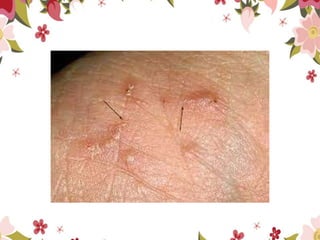
• Pathognomonic lesion:
• Burrow which is slightly elevated, greyish and
tortuous lines. Vesicle or pustule containing the
mite may be found found at the end of the burrow
(Definition: a linear or curvilinear papule, caused by a
burrowing scabies mite)
•Papules, excoriations, bulla, crust and
lichenification occurs.
•Pruritus is prominent symptom which is
severe and usually more intense in the night.
•Even after successful treatment, itch can
continue and occasionally nodular lesions
persist.
SITES
•Finger webs
•Wrists
•Axilla
•Nipple and Areola
•Umbilicus
•Lower abdomen
•Genitalia
•Buttock
•Scrotum and penis
•Face and scalp in infant
•Around and underneath nails
•Involvement of the genitals in males and of
the nipples in females are pathognomic.
COMPLICATIONS
•Local:
•Secondary bacterial infections –
impetigo, folliculitis, furunculosis.
•Eczematization
•Systemic:
•Acute glomerulonephritis –
when the lesions are secondarily infected by β-
haemolytic streptococcal strains of 49, 55, 57, 60 and
M type 2, then there is deposition of Ag-Ab in the
glomerular basement membrane causing
inflammation resulting in Acute glomerulonephritis.
INVESTIAGATIONS
•The diagnosis is made by identifying the scabietic
burrow and visualizing the mite (by extracting with
a needle under microscope or using a
dermatoscope).
•Burrow is detected with gentian violet and then the
organism is isolated with needle or scalpel and
visualized under microscope.
TREATMENT
•General measures
1. Counselling and reassurance
2. Maintenance of personal hygiene
3. Treatment of family members and close
contacts at a time.
4. Washing of clothes and beddings.
• Specific measures
1. Topical therapy
 5% permethrin cream – 2 applications 1
week apart., Apply all over the body
(except head and face in adults) and keep it
for 8 to 12 hours. Then wash off .
 All family members and physical contacts
need to apply in the same way at same
time.
 25% Benzyl benzoate
 Crotamiton 10% cream
 10% precipitated sulphur
 Malathion
 Lindane
 Monosulfirum
2. Systemic therapy
•Ivermectin: single dose in case of
severe infestation and in
immunosuppressed patients.
3. Symptomatic therapy
•Antihistamines
•Antibiotics if there is secondary
infection: flucloxacillin
•For eczematization: Topical steroid
Thank you

scabies.pptx