STEREOTACTIC
BODY
RADIOTHERAPY
Dr.Brijesh Maheshwari(jr-1)
Moderator- Dr. Piyush Sir, Dr.Ayush sir,
Dr.Rashika Ma’am
Topics that will be covered…..
HISTORY AND INTRODUCTION
WHAT IS SBRT AND HOW IT IS DIFFERENT FROM
OTHER MODALITIES
HOW IT WORKS(Radio-Biology)
HOW IT IS EXECUTED (Simulation and planning)
INDICATION
SITE WISE DISCUSSION
Historic Background
• The first one to combine stereotactic
methodology with radiation therapy was Swedish
neuro-surgeon LARS LEKSELL. He performed
first treatment in 1951.
• LEKSEL continued his work and built the first
isotope radiation machine in 1968,the gamma
knife.
SBRT is….
the term applied in the United States by the ASTRO
for the management and delivery of
1.image-guided
2.high-dose radiation therapy
3. with tumor-ablative intent
4. within a course of treatment
5.does not exceed 5 fractions.
6. Real time motion management
7.Computed assisted robotic delivery
Stereotactic refers to using a precise three
dimensional mapping technique to guide
procedure
SRS SRT SBRT
conformal
irradiation of
defined target
volume in a
single session
in cranium.
delivery of highly
conformal radiation
to defined target
volume in cranial
sites in multiple
fraction using non
invasive positioning
technique.
Is atreatment
modality that involves
the delivery of very
high individual doses
of radiation to tumors
in various extra cranial
sites with high
precision in multiple
fraction
 The biological mechanisms of these new modalities
have been unclear.
 DNA damages by direct effect of radiation alone
cannot account for the high efficacy of SBRT and
SRS
 Evidence now indicates that SBRT with doses higher
than about 10 Gy per fraction induces severe vascular
damages.
• The role of 4 Rs and the LQ model is limited in SBRT
and SRS.
• Lee et al. observed that delivery of an ablative dose of radiation
of 15–25 Gy in an animal model resulted in a considerable
increase in Tcell priming in draining lymphoid tissue, which in
turn led to reduction or eradication of the primary tumor or
distant metastasis in a CD8+ Tcell dependent fashion.
• GarciaBarros et al. demonstrated that exposure of mouse MCA129
fibrosarcoma and B16 melanoma cells to single doses of 15–20 Gy
was followed by a rapid wave of endothelial apoptosis at 1–6 h after
irradiation, which was followed by death of the tumor cells at 2–3
days after irradiation.
Rationale of SBRT
Conceptual theories of cancer growth and numerous
lines of evidence behind use of SBRT for metastatic
lesions are
 The Empiric Or Phenomenological,
 The Patterns-of-failure Concept,
 The Theory Of Oligo metastases,
 A Lethal Burden Variation Of The Norton-simon
Hypothesis, Or
 Immunological Enhancement.
A Lethal Burden Variation Of The Norton-
simon Hypothesis
• Tenets of this hypothesis has two goals
1)to reduce thetumor burden in such a way that
the remaining cancer cells within in the body
enters into a state of higher growth fraction thus
become more susceptible to cytotoxic
treatment.
2)to prevent or delay as long as possible the lethal
tumor burden that is fatal to patient
Methods Of Cell Kill in SBRT
• DNA damage
• Anti Angiogenesis
• Endothelial cellApoptosis
SBRT guidelines
1.Qualified personnel(qualified medical physicist,
licensed radiation therapist, board certified radiation
oncologist)
2. Ongoing machine quality assurance program;
3. Documentation in accordance with the ACR Practice
Guideline for Communication: Radiation Oncology;
4. Quality control of treatment accessories;
5. Quality control of planning and treatment images;
6. Quality control of treatment planning system;
7. Simulation and treatment systems based on actual measurement of
organ motion and setup uncertainty.
SBRT(physics and technology)
1. Immobilization
2.CT simulation
3. Planning
4. Repositioning
5. Re-localization
6. Treatment delivery techniques by
Specialized SBRT models: Novalis, Cyberknife
SIMULATION
1. Positioning and immobilization
2. Respiratory tracking (gating) and simulation
a) Dampening
b)Gating
c)tracking or “chasing.”
• Ablative intent
• Dose inhomogeneity inside the PTV is
acceptable
• Maximum point dose up to 160% of Prescription
Dose within PTV is common.
• Minimize the volume of normal tissue irradiation
outside of the PTV(from entrance and exit of
beams, scatter radiation
3.TreatmentPlanning
The trace of the target motion allow the
creation of a internal target
volume (ITV) for treatment
planning
4D CT based planning
4.Treatment Verification
• Precision should be validated with each treatment
session by QC process both during and subsequent
fractions
• KBCT images should be taken on daily basis.
Patient Selection
• In several reports, the eligibility criteria in
oligometastatic tumors were
1)limited number of metastases (one to five)
2)limited tumor diameter (<4 cm)
3)a locally controlled primary tumor
4)no other metastatic sites
5) controlled primary
6)favorable histology
7) young age
8) good performance status (PS) of the patient
INDICATIONS
• The most common indications for SBRT are
the treatment of
a)non-metastatic primary cancer
b)oligo-metastases (that is, metastases that
are limited in number and/or organ sites).
Clinical Experience with Stereotactic Body
Radiation Therapy in Selected Sites
1)Lung
2)Liver
3)Spine
4)Prostate
5)Pancreas
SBRT LUNG
INDICATIONS
1 . Stage INSCLC
2 . Pulmonarymetastases
STEPS
1.Simulation
2.floroscopy to see the tumor motion in all
directions.
3.if tumor movement is more than
8mm then dampening with
abdominal compression.
4. Acquisition of slow CT in free breathing
time.
Abdominal Compression
• Abdominal belt with inflatable bladder
• Inflation: 15-40 mmHg
DOSE PRESCRIPTIONS
• Prescription should be such that BED >
100Gy
1. 12Gy in 4 fractions
2. 20 Gy in 3 fractions
3. 10Gy in 2 fractions
• The local recurrence rates were 8.4% in patients who
received a biological effective dose (BED) of 100 Gy
or more at the isocenter, and 42.9% in patients
receiving less than 100 Gy in BED.
• The local control rate was 95% median follow-up of
17.5 months and severe toxicity occurring at a median
of 10.5 months in 17% of those patients with peripheral
lesions versus 46% with central lesion.
1.Onishi H, Shirato H, Nagata Y,Hiraoka M, Fujino M, Gomi K et al (2007 )J
Thorac Oncol 2(7 Suppl 3):S94
•2.Timmerman R, McGarry R, Yiannoutsos C, et al..J Clin Oncol 2006;24(30):4833–4839
PULMONARY METS
• There are several reports on SBRT for metastatic lung cancer
.
• Up to two lesions were simultaneously treated in most of
these reports, except for that by Okunieff (up to five lesions).
The local control rate was more than 60% andthe overall survival
rate was more than 30% at 2 years.
• These outcomes were thought to becomparable to surgical
metastatectomy.
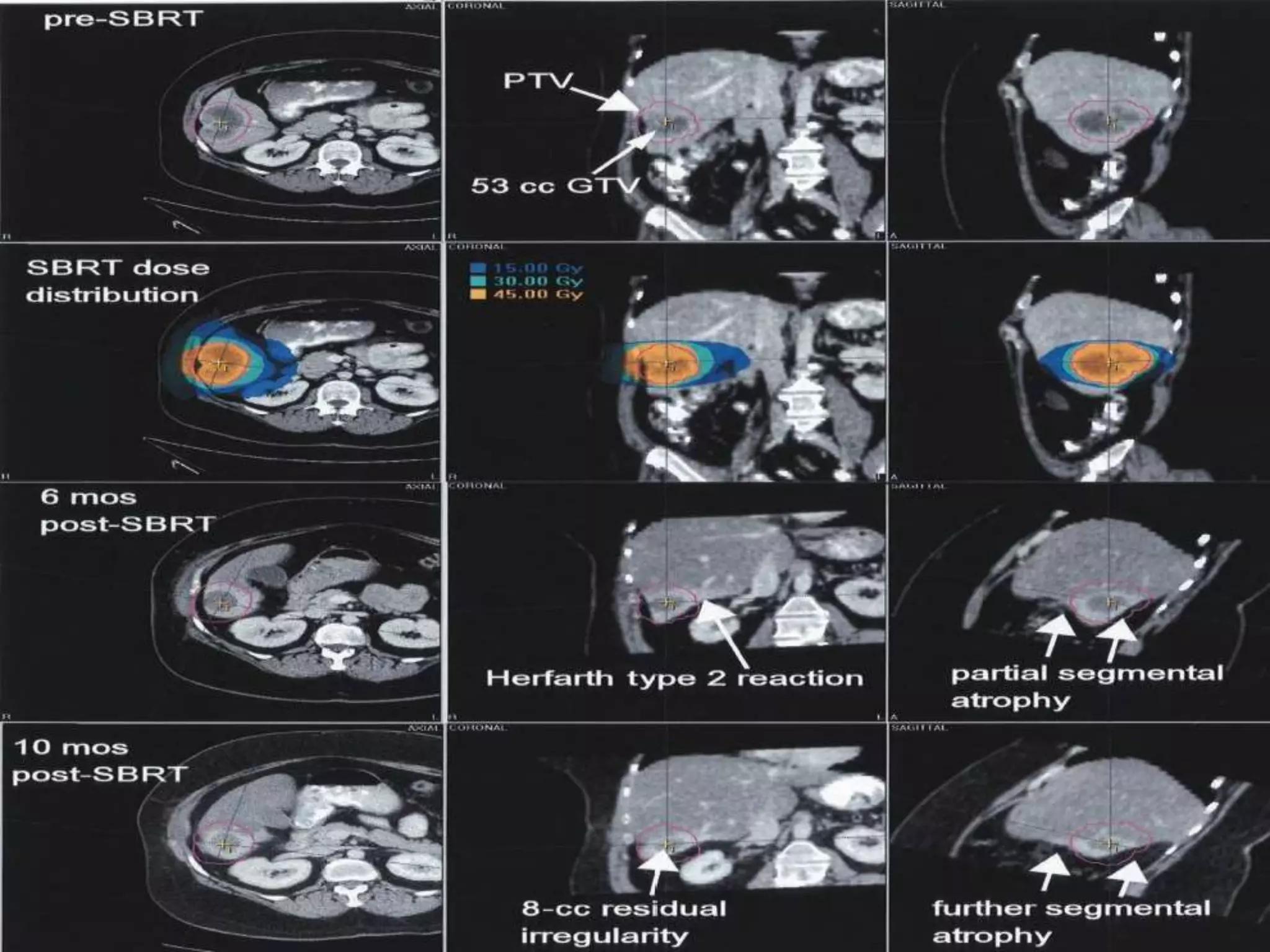
•SBRT: LIVER
Challenges in Targeting Liver Tumors
• Limited visualization of the target
• Changes in GI organ luminal filling
Critical structures (stomach) may change in shape
and position between planning and treatment
• Interfraction target displacement with respect to
bony anatomy
First Liver SBRT Experience
• 50 patients treated to 75 lesions with SBRT
for primary and metastatic liver tumors
• 15 to 45 Gy, 1-5 fractions
• Mean follow-up of 12 months
• 30% of tumors demonstrated growth arrest, 40%
were reduced in size, and 32% disappeared by
imaging studies
• 4 local failures (5.3%)
• Mean survival time was 13.4 months
• Blomgren, et. al., J
Radiosurgery, 1998
SBRT:SPINE
SBRT is an emerging technology used
for the treatment of spinal tumors.
• For patients who are not candidates for
conventional radiotherapy
• To improve the quality of life for patients who
may be spared a prolonged treatment
course.
• Acute Radiation toxicity is reduced.
INDICATIONS
• Pain control in vertebral metastases
• Malignant Epidural Spinal Cord compression
• Benign Spinal Cord Tumors
VERTEBRAL METS
 Pain control was higher than 90% with single doses over 16
Gy at 1 year(1).
 Strong trend toward increased pain control with higher
radiation dose .
 Higher Radiosurgery dose requirements (>20 Gy) for local
control with higher incidences of vertebral compression
fracture in up to 40% of the patients(2)
1. Gerszten PC et al (2005) Single-fraction Radiosurgery for the treatment of spinalbreast metastases. Cancer
104(10):2244–2254
2.Yamada Y et al (2008) High-dose, single-fraction image-guided intensity-modulated radiotherapy for metastatic spinal
lesions.
• Int J Radiat Oncol Biol Phys 71(2):484–490
• Most critical challenge is to minimize the risk
of spinal cord injury.
• Possible exacerbating factors
 Previous Neurotoxic chemotherapy
 Post surgery (Sub clinical vascular injury)
 Prior spinal trauma
DOSE CONSTRAINTS
• The Partial volume spinal cord tolerance dose
is 10 Gy to the 10% spinal cord volume.
• It is defined from 6mm superior to the
target volume to 6 mm inferior to the target
volume
• 10 Gy to the volume of 0.35 cc of the
spinal cord
SBRT PROSTATE
Indications
Primary treatment for organ confined low risk
prostrate cancer
Dose escalation for intermediate and high risk
prostrate cancer
Steps
1.Gold Fiducial placement under trans rectal
USG guidance ( 2 at base and 1 at apex. Each
fiducial 1.1mm thickness and 3mm length)
2.Simulation with full bladder
3.Planning CT scan with IR marker guidance
Dose Prescription
Dose of 35- 38Gy in 5 daily fractions as primary
treatment for low risk Prostrate cancer.(1)
Dose of 50Gy in 5 fractions as dose escalation (2)
1.Katz A, Santoro M, Ashley R, et al.. BMC Urol 2010;10:1.
2.Boike TP, Lotan Y, Chinsoo Cho L, et al. J Clin Oncol
2011;29:2020– 2026.
Dose volume constraints
1.Rectum were such that the V50% <50%,
V80% <20%, V90% <10%,and V100% <5%.
2.The bladder DVH goals were V50% <40% and
V100% <10%.
3.The femoral head DVH goal was V40% <5%.
SBRT:PANCREAS
Indications
 Boderline Resectable Pancreatic Ca
 Unresectable Pancreatic Ca
Challenges
 The head of the pancreas, where majority of tumors
reside, is in close proximity to the C-loop of the
duodenum
 Delivery of conventionally fractionated radiation
(1.8–2 Gy/day) to more than 50 Gy results in
damage to the small bowel such as ulcerations,
stenosis, bleeding, and perforation.
 The pancreas move with respiration, as well as
with peristalsis that is not easily predictable.
UCLA Technique
1.Logistically, 2–3 gold fiducials are placed directly
into the tumor under CT guidance for targeting
purposes.
2.A custom immobilization device is created for
each patient
3. Four-dimensional CT (4D-CT) images are used
for treatment planning. FDG-PET images are also
used for treatment planning
4.An internal target volume (ITV) is
contoured based on the 4D-CT.
5. The ITV is expanded by 0 –3 mm (except for
expansion into the duodenum or stomach) to
form the PTV
 Dose of 36 Gy in three fractions is prescribed to the
isodose surface which covers the 95% of the PTV.
 No more than 50% of the contoured duodenum risk
object receives more than 21 Gy. For pancreatic head
lesions
 The dose to the contralateral duodenal wall closest to the
GTV is limited to a total dose of 18 Gy
Complications
• SBRT for lung tumors can potentially result in clinically
significant lung toxic effects, such as collapse of
airways, atelectasis, fibrosis and symptomatic
pneumonitis.
• SBRT for spinal tumors can result in minor acute or sub
acute nonneurologic complications such as esophagitis,
mucositis, dysphagia, diarrhea, lethargy, wound break
down, nausea, vomiting, noncardiac chest pain, mild
skin hyperpigmentation, trismus, transient laryngitis,
and idiopathic vasculitis.
• SBRT for pancreatic cancer is associated with
considerable toxic effects, which are related to the
proximity of the pancreas to various serial-
functioning structures such as the stomach and
small bowel.
• For patients with HCC, the reported rates of toxic
effects are relatively low.
SBRT

SBRT

  • 1.
  • 3.
    Topics that willbe covered….. HISTORY AND INTRODUCTION WHAT IS SBRT AND HOW IT IS DIFFERENT FROM OTHER MODALITIES HOW IT WORKS(Radio-Biology) HOW IT IS EXECUTED (Simulation and planning) INDICATION SITE WISE DISCUSSION
  • 4.
    Historic Background • Thefirst one to combine stereotactic methodology with radiation therapy was Swedish neuro-surgeon LARS LEKSELL. He performed first treatment in 1951. • LEKSEL continued his work and built the first isotope radiation machine in 1968,the gamma knife.
  • 5.
    SBRT is…. the termapplied in the United States by the ASTRO for the management and delivery of 1.image-guided 2.high-dose radiation therapy 3. with tumor-ablative intent 4. within a course of treatment 5.does not exceed 5 fractions. 6. Real time motion management 7.Computed assisted robotic delivery
  • 6.
    Stereotactic refers tousing a precise three dimensional mapping technique to guide procedure SRS SRT SBRT conformal irradiation of defined target volume in a single session in cranium. delivery of highly conformal radiation to defined target volume in cranial sites in multiple fraction using non invasive positioning technique. Is atreatment modality that involves the delivery of very high individual doses of radiation to tumors in various extra cranial sites with high precision in multiple fraction
  • 10.
     The biologicalmechanisms of these new modalities have been unclear.  DNA damages by direct effect of radiation alone cannot account for the high efficacy of SBRT and SRS  Evidence now indicates that SBRT with doses higher than about 10 Gy per fraction induces severe vascular damages. • The role of 4 Rs and the LQ model is limited in SBRT and SRS.
  • 11.
    • Lee etal. observed that delivery of an ablative dose of radiation of 15–25 Gy in an animal model resulted in a considerable increase in Tcell priming in draining lymphoid tissue, which in turn led to reduction or eradication of the primary tumor or distant metastasis in a CD8+ Tcell dependent fashion. • GarciaBarros et al. demonstrated that exposure of mouse MCA129 fibrosarcoma and B16 melanoma cells to single doses of 15–20 Gy was followed by a rapid wave of endothelial apoptosis at 1–6 h after irradiation, which was followed by death of the tumor cells at 2–3 days after irradiation.
  • 12.
    Rationale of SBRT Conceptualtheories of cancer growth and numerous lines of evidence behind use of SBRT for metastatic lesions are  The Empiric Or Phenomenological,  The Patterns-of-failure Concept,  The Theory Of Oligo metastases,  A Lethal Burden Variation Of The Norton-simon Hypothesis, Or  Immunological Enhancement.
  • 13.
    A Lethal BurdenVariation Of The Norton- simon Hypothesis • Tenets of this hypothesis has two goals 1)to reduce thetumor burden in such a way that the remaining cancer cells within in the body enters into a state of higher growth fraction thus become more susceptible to cytotoxic treatment. 2)to prevent or delay as long as possible the lethal tumor burden that is fatal to patient
  • 14.
    Methods Of CellKill in SBRT • DNA damage • Anti Angiogenesis • Endothelial cellApoptosis
  • 16.
    SBRT guidelines 1.Qualified personnel(qualifiedmedical physicist, licensed radiation therapist, board certified radiation oncologist) 2. Ongoing machine quality assurance program; 3. Documentation in accordance with the ACR Practice Guideline for Communication: Radiation Oncology; 4. Quality control of treatment accessories; 5. Quality control of planning and treatment images; 6. Quality control of treatment planning system; 7. Simulation and treatment systems based on actual measurement of organ motion and setup uncertainty.
  • 17.
    SBRT(physics and technology) 1.Immobilization 2.CT simulation 3. Planning 4. Repositioning 5. Re-localization 6. Treatment delivery techniques by Specialized SBRT models: Novalis, Cyberknife
  • 18.
  • 19.
    2. Respiratory tracking(gating) and simulation a) Dampening b)Gating c)tracking or “chasing.”
  • 20.
    • Ablative intent •Dose inhomogeneity inside the PTV is acceptable • Maximum point dose up to 160% of Prescription Dose within PTV is common. • Minimize the volume of normal tissue irradiation outside of the PTV(from entrance and exit of beams, scatter radiation 3.TreatmentPlanning
  • 21.
    The trace ofthe target motion allow the creation of a internal target volume (ITV) for treatment planning
  • 22.
    4D CT basedplanning
  • 23.
    4.Treatment Verification • Precisionshould be validated with each treatment session by QC process both during and subsequent fractions • KBCT images should be taken on daily basis.
  • 24.
    Patient Selection • Inseveral reports, the eligibility criteria in oligometastatic tumors were 1)limited number of metastases (one to five) 2)limited tumor diameter (<4 cm) 3)a locally controlled primary tumor 4)no other metastatic sites 5) controlled primary 6)favorable histology 7) young age 8) good performance status (PS) of the patient
  • 25.
    INDICATIONS • The mostcommon indications for SBRT are the treatment of a)non-metastatic primary cancer b)oligo-metastases (that is, metastases that are limited in number and/or organ sites).
  • 26.
    Clinical Experience withStereotactic Body Radiation Therapy in Selected Sites 1)Lung 2)Liver 3)Spine 4)Prostate 5)Pancreas
  • 27.
  • 28.
    INDICATIONS 1 . StageINSCLC 2 . Pulmonarymetastases
  • 29.
    STEPS 1.Simulation 2.floroscopy to seethe tumor motion in all directions. 3.if tumor movement is more than 8mm then dampening with abdominal compression. 4. Acquisition of slow CT in free breathing time.
  • 30.
    Abdominal Compression • Abdominalbelt with inflatable bladder • Inflation: 15-40 mmHg
  • 31.
    DOSE PRESCRIPTIONS • Prescriptionshould be such that BED > 100Gy 1. 12Gy in 4 fractions 2. 20 Gy in 3 fractions 3. 10Gy in 2 fractions
  • 32.
    • The localrecurrence rates were 8.4% in patients who received a biological effective dose (BED) of 100 Gy or more at the isocenter, and 42.9% in patients receiving less than 100 Gy in BED. • The local control rate was 95% median follow-up of 17.5 months and severe toxicity occurring at a median of 10.5 months in 17% of those patients with peripheral lesions versus 46% with central lesion. 1.Onishi H, Shirato H, Nagata Y,Hiraoka M, Fujino M, Gomi K et al (2007 )J Thorac Oncol 2(7 Suppl 3):S94 •2.Timmerman R, McGarry R, Yiannoutsos C, et al..J Clin Oncol 2006;24(30):4833–4839
  • 34.
    PULMONARY METS • Thereare several reports on SBRT for metastatic lung cancer . • Up to two lesions were simultaneously treated in most of these reports, except for that by Okunieff (up to five lesions). The local control rate was more than 60% andthe overall survival rate was more than 30% at 2 years. • These outcomes were thought to becomparable to surgical metastatectomy.
  • 35.
  • 36.
    Challenges in TargetingLiver Tumors • Limited visualization of the target • Changes in GI organ luminal filling Critical structures (stomach) may change in shape and position between planning and treatment • Interfraction target displacement with respect to bony anatomy
  • 37.
    First Liver SBRTExperience • 50 patients treated to 75 lesions with SBRT for primary and metastatic liver tumors • 15 to 45 Gy, 1-5 fractions • Mean follow-up of 12 months • 30% of tumors demonstrated growth arrest, 40% were reduced in size, and 32% disappeared by imaging studies • 4 local failures (5.3%) • Mean survival time was 13.4 months • Blomgren, et. al., J Radiosurgery, 1998
  • 40.
  • 41.
    SBRT is anemerging technology used for the treatment of spinal tumors. • For patients who are not candidates for conventional radiotherapy • To improve the quality of life for patients who may be spared a prolonged treatment course. • Acute Radiation toxicity is reduced.
  • 42.
    INDICATIONS • Pain controlin vertebral metastases • Malignant Epidural Spinal Cord compression • Benign Spinal Cord Tumors
  • 43.
    VERTEBRAL METS  Paincontrol was higher than 90% with single doses over 16 Gy at 1 year(1).  Strong trend toward increased pain control with higher radiation dose .  Higher Radiosurgery dose requirements (>20 Gy) for local control with higher incidences of vertebral compression fracture in up to 40% of the patients(2) 1. Gerszten PC et al (2005) Single-fraction Radiosurgery for the treatment of spinalbreast metastases. Cancer 104(10):2244–2254 2.Yamada Y et al (2008) High-dose, single-fraction image-guided intensity-modulated radiotherapy for metastatic spinal lesions. • Int J Radiat Oncol Biol Phys 71(2):484–490
  • 44.
    • Most criticalchallenge is to minimize the risk of spinal cord injury. • Possible exacerbating factors  Previous Neurotoxic chemotherapy  Post surgery (Sub clinical vascular injury)  Prior spinal trauma
  • 45.
    DOSE CONSTRAINTS • ThePartial volume spinal cord tolerance dose is 10 Gy to the 10% spinal cord volume. • It is defined from 6mm superior to the target volume to 6 mm inferior to the target volume • 10 Gy to the volume of 0.35 cc of the spinal cord
  • 46.
  • 47.
    Indications Primary treatment fororgan confined low risk prostrate cancer Dose escalation for intermediate and high risk prostrate cancer
  • 48.
    Steps 1.Gold Fiducial placementunder trans rectal USG guidance ( 2 at base and 1 at apex. Each fiducial 1.1mm thickness and 3mm length) 2.Simulation with full bladder 3.Planning CT scan with IR marker guidance
  • 49.
    Dose Prescription Dose of35- 38Gy in 5 daily fractions as primary treatment for low risk Prostrate cancer.(1) Dose of 50Gy in 5 fractions as dose escalation (2) 1.Katz A, Santoro M, Ashley R, et al.. BMC Urol 2010;10:1. 2.Boike TP, Lotan Y, Chinsoo Cho L, et al. J Clin Oncol 2011;29:2020– 2026.
  • 50.
    Dose volume constraints 1.Rectumwere such that the V50% <50%, V80% <20%, V90% <10%,and V100% <5%. 2.The bladder DVH goals were V50% <40% and V100% <10%. 3.The femoral head DVH goal was V40% <5%.
  • 52.
  • 53.
    Indications  Boderline ResectablePancreatic Ca  Unresectable Pancreatic Ca
  • 54.
    Challenges  The headof the pancreas, where majority of tumors reside, is in close proximity to the C-loop of the duodenum  Delivery of conventionally fractionated radiation (1.8–2 Gy/day) to more than 50 Gy results in damage to the small bowel such as ulcerations, stenosis, bleeding, and perforation.  The pancreas move with respiration, as well as with peristalsis that is not easily predictable.
  • 55.
    UCLA Technique 1.Logistically, 2–3gold fiducials are placed directly into the tumor under CT guidance for targeting purposes. 2.A custom immobilization device is created for each patient 3. Four-dimensional CT (4D-CT) images are used for treatment planning. FDG-PET images are also used for treatment planning
  • 56.
    4.An internal targetvolume (ITV) is contoured based on the 4D-CT. 5. The ITV is expanded by 0 –3 mm (except for expansion into the duodenum or stomach) to form the PTV
  • 57.
     Dose of36 Gy in three fractions is prescribed to the isodose surface which covers the 95% of the PTV.  No more than 50% of the contoured duodenum risk object receives more than 21 Gy. For pancreatic head lesions  The dose to the contralateral duodenal wall closest to the GTV is limited to a total dose of 18 Gy
  • 59.
    Complications • SBRT forlung tumors can potentially result in clinically significant lung toxic effects, such as collapse of airways, atelectasis, fibrosis and symptomatic pneumonitis. • SBRT for spinal tumors can result in minor acute or sub acute nonneurologic complications such as esophagitis, mucositis, dysphagia, diarrhea, lethargy, wound break down, nausea, vomiting, noncardiac chest pain, mild skin hyperpigmentation, trismus, transient laryngitis, and idiopathic vasculitis.
  • 60.
    • SBRT forpancreatic cancer is associated with considerable toxic effects, which are related to the proximity of the pancreas to various serial- functioning structures such as the stomach and small bowel. • For patients with HCC, the reported rates of toxic effects are relatively low.