SBRT Prostate –
Simulation to Execution
Dr. Rushi Panchal,
HOD - Radiation Oncology,
M S Patel Cancer Centre & Shree Krishna Hospital,
Karamsad, Anand-Gujarat.
Localized Prostate Cancer:
Competing Treatment Modalities
Surveillance (No Dose option)
Radiotherapy: - Brachytherapy: LDR / HDR
- High dose EBRT (IMRT)
- Hypofractionation (incuding SBRT)
Surgery: - Radical Retropubic
- Laparoscopic / Robotic
Cryosurgery
HIFU
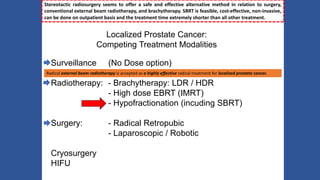
Stereotactic radiosurgery seems to offer a safe and effective alternative method in relation to surgery,
conventional external beam radiotherapy, and brachytherapy. SBRT is feasible, cost-effective, non-invasive,
can be done on outpatient basis and the treatment time extremely shorter than all other treatment.
Radical external beam radiotherapy is accepted as a highly effective radical treatment for localized prostate cancer.
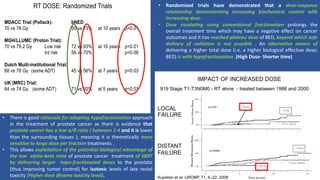
RT DOSE: Randomized Trials
MDACC Trial (Pollack): bNED
70 vs 78 Gy 50 vs 73% at 10 years p<0.01
MGH/LLUMC (Proton Trial):
70 vs 79.2 Gy Low risk 72 vs 93% at 10 years p<0.01
Int risk 58 vs 70% p=0.06
Dutch Multi-institutional Trial:
68 vs 78 Gy (some ADT) 45 vs 56% at 7 years p=0.03
UK (MRC) Trial:
64 vs 74 Gy (some ADT) 71 vs 60% at 5 years p<0.01
IMPACT OF INCREASED DOSE
919 Stage T1-T3N0M0 - RT alone - treated between 1986 and 2000
LOCAL
FAILURE
DISTANT
FAILURE
Kupelian et al. IJROBP. 71, 6–22, 2008
• Randomized trials have demonstrated that a dose-response
relationship demonstrating increasing biochemical control with
increasing dose.
• Dose escalating using conventional fractionation prolongs the
overall treatment time which may have a negative effect on cancer
outcomes and it has reached plateau dose of BED, beyond which safe
delivery of radiation is not possible . An alternative means of
delivering a higher total dose (i.e. a higher biological effective dose;
BED) is with hypofractionation. (High Dose- Shorter time)
• There is good rationale for adopting hypofractionation approach
in the treatment of prostate cancer as there is evidence that
prostate cancer has a low α/β ratio ( between 1-4 and it is lower
than the surrounding tissues ), meaning it is theoretically more
sensitive to large dose per fraction treatments .
• This allows exploitation of the potential biological advantage of
the low alpha-beta ratio of prostate cancer treatment of SBRT
by delivering larger hypo-fractionated doses to the prostate
(thus improving tumor control) for isotoxic levels of late rectal
toxicity (Higher dose @same toxicity level).
St. Thomas Hospital (London): Lloyd-Davies, Urology. 36: 107, 1990
55 Gy in 12 fractions
36 Gy in 6 fractions: 6 Gy per fraction
Canadian randomized trial: Lukka, JCO. 23: 6132-6138, 2005
66 Gy in 33 fractions versus 52.5 Gy/20 fractions (2.6 Gy per fraction)
• Hypofractionated arm worse? 5yr bRFS: 53% vs. 56%; p < 0.05
• No difference in toxicity
Australian randomized trial:
64 Gy/32 fractions versus 55 Gy/20 fractions (2.75 Gy per fraction)
• Hypo arm better bRFS.
• Median FU 90 mos needed to show difference.
• GI toxicity slightly worse with hypo.
Yeoh, IJROBP, 66: 1072-83, 2006
Yeoh, IJROBP 81, 1271-8, 2011
OLD (LOW-DOSE) EXPERIENCES: 2D, no IMRT, no IGRT
Single arm Fraction Total Dose BED Med FU (mos)
Size(Gy) Number ( =2) Last report
Cleveland Clinic 2.5 28 70.0 158 103
McGill 3.0 22 66.0 165 90
2.94 22 64.7 160 59
U Wisconsin 3.63 16 58.1 163 50
4.30 12 51.6 163 55
(Many more )
Randomized Hypofrac Arm BED Conv Arm
MDACC 72.0 at 2.4 Gy 158 vs 75.6 at 1.8 Gy
FCCC 70.2 at 2.7 Gy 165 vs 76.0 at 2.0 Gy
PMH / PROFIT 60.0 at 3.0 Gy 150 vs 78.0 at 2.0 Gy
RTOG 0415 70.0 at 2.5 Gy 158 vs 73.8 at 1.8 Gy
CHHiP(UK) 60.0 at 3.0 Gy 150 vs 74.0 at 2.0 Gy
Italian Study 62.0 at 3.1 Gy 158 vs 80.0 at 2.0 Gy
Dutch Study 64.6 at 3.4 Gy 174 vs 78.0 at 2.0 Gy
MODERN HYPOFRACTIONATION EXPERIENCES: IMRT / IGRT
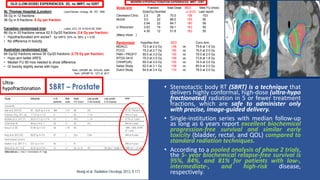
• Stereotactic body RT (SBRT) is a technique that
delivers highly conformal, high-dose (ultra-hypo
fractionated) radiation in 5 or fewer treatment
fractions, which are safe to administer only
with precise, image-guided delivery.
• Single-institution series with median follow-up
as long as 6 years report excellent biochemical
progression-free survival and similar early
toxicity (bladder, rectal, and QOL) compared to
standard radiation techniques.
• According to a pooled analysis of phase 2 trials,
the 5- year biochemical relapse-free survival is
95%, 84%, and 81% for patients with low-,
intermediate-, and high-risk disease,
respectively.
Ultra-
hypofractionation
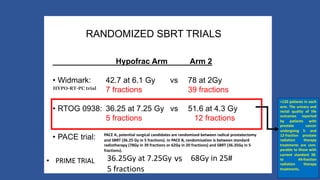
RANDOMIZED SBRT TRIALS
Hypofrac Arm Arm 2
• Widmark: 42.7 at 6.1 Gy vs 78 at 2Gy
7 fractions 39 fractions
• RTOG 0938: 36.25 at 7.25 Gy vs 51.6 at 4.3 Gy
5 fractions 12 fractions
• PACE trial:
• PRIME TRIAL 68Gy in 25#vs36.25Gy at 7.25Gy
5 fractions
PACE A, potential surgical candidates are randomised between radical prostatectomy
and SBRT (36.25 Gy in 5 fractions). In PACE B, randomisation is between standard
radiotherapy (78Gy in 39 fractions or 62Gy in 20 fractions) and SBRT (36.35Gy in 5
fractions).
HYPO-RT-PC trial
>120 patients in each
arm. The urinary and
rectal quality of life
outcomes reported
by patients with
prostate cancer
undergoing 5- and
12-fraction prostate
radiation therapy
treatments are com-
parable to those with
current standard 38-
to 44-fraction
radiation therapy
treatments.
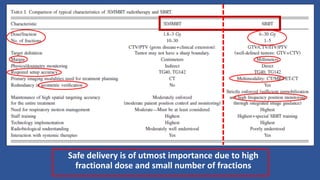
Safe delivery is of utmost importance due to high
fractional dose and small number of fractions
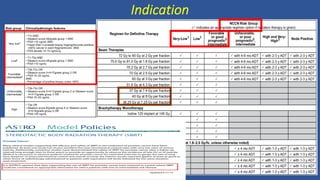
Indication
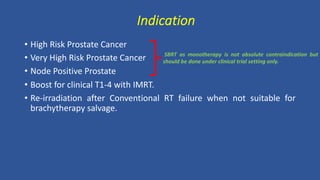
Indication
• High Risk Prostate Cancer
• Very High Risk Prostate Cancer
• Node Positive Prostate
• Boost for clinical T1-4 with IMRT.
• Re-irradiation after Conventional RT failure when not suitable for
brachytherapy salvage.
SBRT as monotherapy is not absolute contraindication but
should be done under clinical trial setting only.
Case Selection
• No Evidence of distant metastases.
• No Previous radical surgery (prostatectomy)/cryosurgery/HIFU for prostate
cancer.
• No Previous pelvic irradiation other than for prostate cancer/prostate
Brachytherapy.
• No history of proctitis, diverticulitis, or inflammatory bowel conditions.
• Prostate volume should be <100 cc, But large prostate and/or median lobe
enlargement per say is not absolute contraindication for SBRT.
• For Moderate-severe urinary symptoms (e.g. high IPSS score, typically defined
as > 20), conventional fractionation RT is preferred over SBRT. Patients with
known obstructive symptoms with stricture is not suitable for SBRT.
• Large TURP defects which preclude seed placement is not candidate for SBRT.
• Contraindicated in excessive artefact not allowing proper localization of
prostate (e.g. Hip replacement) or Fiducial marker implantation is not possible
(e.g. allergy to gold).
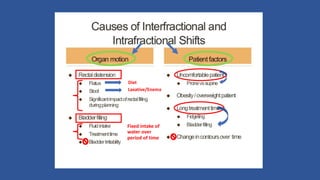
Diet
Laxative/Enema
Fixed intake of
water over
period of time
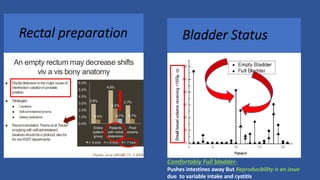
Rectal preparation Bladder Status
Comfortably Full bladder-
Pushes intestines away But Reproducibility is an issue
due to variable intake and cystitis
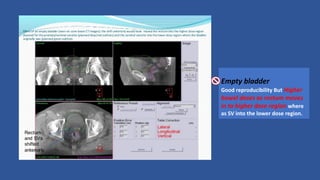
Empty bladder
Good reproducibility But Higher
bowel doses as rectum moves
in to higher dose region where
as SV into the lower dose region.
Why fiducials?
Lack of correlation between
prostate position and the
localization of pelvic bony
anatomy Because the
prostate gland is not
attached directly to any bony
structures and its position is
significantly affected by the
degree of rectal filling with
fecal/gas content, it is
subject to large inter- and
intra-fractional variations.
So, Fiducial markers placed
within the prostate are
required to improve target
localization.
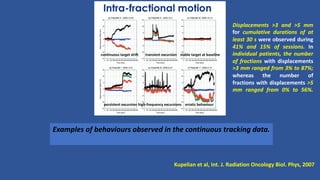
Examples of behaviours observed in the continuous tracking data.
Kupelian et al, Int. J. Radiation Oncology Biol. Phys, 2007
Displacements >3 and >5 mm
for cumulative durations of at
least 30 s were observed during
41% and 15% of sessions. In
individual patients, the number
of fractions with displacements
>3 mm ranged from 3% to 87%;
whereas the number of
fractions with displacements >5
mm ranged from 0% to 56%.
continuous target drift transient excursion stable target at baseline
persistent excursion high-frequency excursions erratic behaviour
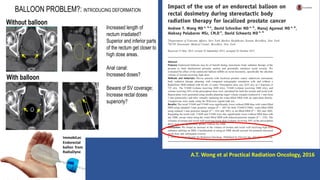
BALLOON PROBLEM?: INTRODUCING DEFORMATION
Increased length of
rectum irradiated?
Superior and inferior parts
of the rectum get closer to
high dose areas.
Anal canal:
Increased doses?
Beware of SV coverage;
Increase rectal doses
superiorly?
Without balloon
With balloon
A.T. Wong et al Practical Radiation Oncology, 2016
ImmobiLoc
Endorectal
ballon from
RadiaDyne
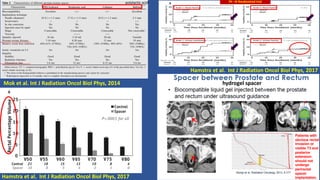
Hamstra et al. Int J Radiation Oncol Biol Phys, 2017
hydrogel spacer
polylactic acid
Mok et al. Int J Radiation Oncol Biol Phys, 2014
Patients with
obvious rectal
invasion or
visible T3 and
posterior
extension
should not
undergo
perirectal
spacer
implantation.
Ph –III Randomized trial
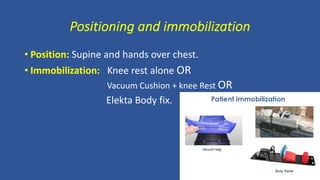
Positioning and immobilization
• Position: Supine and hands over chest.
• Immobilization: Knee rest alone OR
Vacuum Cushion + knee Rest OR
Elekta Body fix.
• Rectal protocol: Patients should adhere to a
- low gas, low motility diet(+/- antiflatulent) commencing 1-2 days prior to simulation and treatment.
- One tablespoon of milk of magnesia will be taken the night before the simulation and the night
before each treatment.
- One proctoclysis ( sodium phosphate ) enema will be administered 2–3 hrs. before the simulation
and each treatment.
• Bladder Protocol:
- Consistent full urinary bladder filling procedure should be used for an individual patient for
simulation and for each treatment except where treatment time exceeds 30 minutes when patients
may be treated with an empty bladder e.g. Cyberknife based SBRT. Bladder filling may be
achieved by asking patients to void urine completely and to drink 500 ml of water 45 minutes prior
to simulation/treatment to achieve least displacement of internal organ not urinate between this
time and simulation/treatment.
- If patient is already catheterized at baseline then Foley catheter should be in place and 50 cc of
water instilled in the bladder at the time of simulation and each treatment
• TRUS-guided placement: of at least 3 gold seed fiducial markers (2 at base, 1 at apex) at least 5
days prior to simulation. Same way Transrectally or transperineally under ultrasound guidance, the
placement of three electromagnetic transponders, the Calypso® beacons (Varian Medical Systems, Palo Alto,
CA ) is to be done 4-5 days prior simulation.
• If MR scan is planned with use of Calypso system, MR should be obtained prior to the implantation of
transponders.
Preparation For Simulation
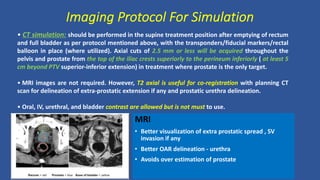
Imaging Protocol For Simulation
• CT simulation: should be performed in the supine treatment position after emptying of rectum
and full bladder as per protocol mentioned above, with the transponders/fiducial markers/rectal
balloon in place (where utilized). Axial cuts of 2.5 mm or less will be acquired throughout the
pelvis and prostate from the top of the iliac crests superiorly to the perineum inferiorly ( at least 5
cm beyond PTV superior-inferior extension) in treatment where prostate is the only target.
• MRI images are not required. However, T2 axial is useful for co-registration with planning CT
scan for delineation of extra-prostatic extension if any and prostatic urethra delineation.
• Oral, IV, urethral, and bladder contrast are allowed but is not must to use.
MRI
• Better visualization of extra prostatic spread , SV
invasion if any
• Better OAR delineation - urethra
• Avoids over estimation of prostate
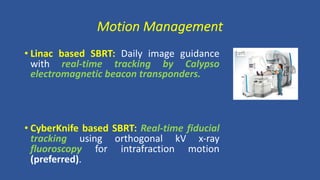
Motion Management
• Linac based SBRT: Daily image guidance
with real-time tracking by Calypso
electromagnetic beacon transponders.
• CyberKnife based SBRT: Real-time fiducial
tracking using orthogonal kV x-ray
fluoroscopy for intrafraction motion
(preferred).
Target Volume delineation
• GTV = whole of prostate gland including any ECE.
• CTV = GTV for low risk
= GTV + Proximal 1 cm of SV for intermediate risk
= GTV + Proximal 2cm of SV +/- pelvic lymphatics for high risk
= GTV + Entire SV +/- Pelvic lymphatics if SV is involved in very high risk
= Prostate + SV + Gross Pelvic node + pelvic lymphatic if pelvic N+
• PTV = CTV + 5mm margin except posterior 3 mm. For CTV pelvic nodal region
5 mm margin is sufficient to create PTV pelvic node.
OAR Contouring
• Bladder, rectum, bilateral femora (to the level of ischial tuberosity), penile bulb, skin
and urethra.
• For patients where the maximum point dose to a point that is 0.03 cc exceeds 107% of
prescribed dose, visualization of the urethra is required either by MRI based delineation or
traced along the catheter if patient has been catharized baseline.
• The normal tissues will be contoured and considered as solid organs rather than contouring the
bladder and rectal walls.
• The bladder should be contoured from its base to the dome including the wall.
• The rectum should be contoured from the anus (at the level of bottom of the ischial tuberosities)
for a length of 15 cm or to the rectosigmoid flexure. This generally is below the bottom of the
sacroiliac joints.
• Bowel will be represented by a single solid structure encompassing the peritoneal cavity and any
loops of bowel in the pelvis. The upper extent will be kept constant at 2 cm superior to the
uppermost extent of the PTV.
• Penile bulb will be contoured on the CT image below the pelvic diaphragm.
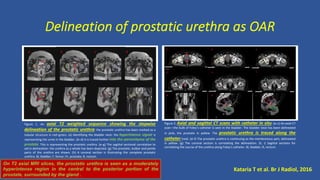
Delineation of prostatic urethra as OAR
Figure 1. An axial T2 weighted sequence showing the stepwise
delineation of the prostatic urethra: the prostatic urethra has been marked as a
tubular structure in red–green. (a) Identifying the bladder neck: the hyperintense signal is
representing the urine in the bladder. (b–d) It is traced further into the parenchyma of the
prostate. This is representing the prostatic urethra. (e–g) The sagittal sectional correlation to
aid in delineation: the urethra as a whole has been depicted. (g) The prostatic, bulbar and penile
parts of the urethra are shown. (h) A coronal section is illustrating the complete prostatic
urethra. Bl, bladder; F, femur; Pr, prostate; R, rectum.
Figure 2. Axial and sagittal CT scans with catheter in situ: (a–c) An axial CT
scan—the bulb of Foley’s catheter is seen in the bladder. The bladder neck has been delineated
in pink, the prostate in yellow. The prostatic urethra is traced along the
catheter (red). (d–f) The prostatic urethra is continuing as the membranous part, delineated
in yellow. (g) The coronal section is correlating the delineation. (h, i) Sagittal sections for
correlating the course of the urethra along Foley’s catheter. Bl, bladder; R, rectum.
Kataria T et al. Br J Radiol, 2016
On T2 axial MRI slices, the prostatic urethra is seen as a moderately
hyperintense region in the central to the posterior portion of the
prostate, surrounded by the gland .
• 35Gy-40Gy/5#@ 7-8Gy/#. 36.25Gy/5# is most preferred fractionation. The limit of dose
per fraction escalation appears to have been reached, 50Gy delivered in 5 fractions,
toxicity (particularly rectal) was excessive.
• 38Gy/4# @ 9.5Gy/# can be used as a monotherapy.
• 19Gy/1# can be used as a monotherapy.
• 19Gy/2# to 21Gy/2# can be given as a boost after 45-50Gy of conventional fractionated
EBRT.
• 25Gy/5# to pelvic lymphatics with SIB to Prostate (+/- SV) 35-40Gy/5# can be given in
High Risk to very high risk monotherapy case. Sometimes SV dose can be kept 25Gy/5# to
respect normal tissue tolerance.
• Node positive case can be treated as above mentioned high risk to very high risk
monotherapy case along with gross node can be boosted to 35- 36.25Gy/5#.
Dose Prescription
UT Southwestern Protocol (R. Timmerman)
ASTRO 2013 Update. Abstract 2405
Median follow-up is 25.5 months
Dose groups: 9.0 Gy x 5 = 45 Gy
9.5 Gy x 5 = 47.5 Gy
10.0 Gy x 5 = 50 Gy
10% developped High Grade Rectal Toxicity (Grade 4)
Predictors of Gr4 rectal toxicity;
• Diabetes (trend p=0.07).
• > 35% of rectal wall at 39 Gy (p=0.03)
• Volume of rectal wall receiving 50 Gy (p=0.01)
Gr4 toxicity: All had > 3.5 cm3 of rectal wall > 50 Gy (p < .0001).
All patients with no rectal toxicity had < 3.5 cm3 rectal wall at 50 Gy.
• Post RT Salvage: 30Gy/5# @ 6Gy/# If focal recurrence found on
biopsy/MRI/PSMA PET-CT, consider partial volume treatment to dominant intra-
prostatic lesion.
• Any of above mentioned fractionation schedule :
patient should be treated either on
alternate day or twice a week but not daily
to prevent GI & GU Toxicity.
Dose Prescription
Planning
• Use of IMRT (DMLC or SMLC) or related techniques (Tomotherapy/VMAT/Cyberknife)
that uses inverse treatment planning techniques to determine weighting for a large
number of fields sequentially irradiating sub-regions of a target.
• Coplanar or non-coplanar beam arrangements will be custom designed for each case to
deliver highly conformal dose distributions.
• For fixed gantry angle IMRT delivery, a least 5 gantry positions should be used.
• The recommended photon energies for this are 6-10 MV with or without flattening
filter. The use of beams with higher energy is discouraged.
• Planning should be done as a single phase simultaneous integrated boost (SIB) technique
in case multiple target plan having differential dose in case of high risk / very high risk /
node positive disease.
Delivery Platform
Linac based vs Robotic delivery:
• Most experience with robotic delivery
• Coplanar vs non-coplanar delivery
• Platforms seem comparable
Y.-W. Lin et al. Physica Medica, In press (2014)
Delivery Platform
Y.-W. Lin et al. Physica Medica, In press (2014)
CK
Linac
CK
Linac
CK
Linac
CK
Linac
CTV PTV
Rectum Bladder
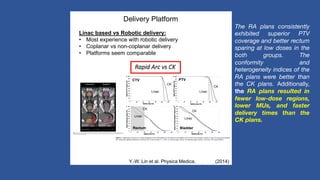
Rapid Arc vs CK
The RA plans consistently
exhibited superior PTV
coverage and better rectum
sparing at low doses in the
both groups. The
conformity and
heterogeneity indices of the
RA plans were better than
the CK plans. Additionally,
the RA plans resulted in
fewer low-dose regions,
lower MUs, and faster
delivery times than the
CK plans.
Fsd
Plan evaluation
• It is Different based on total dose and dose per fraction.
• It is Similar for Photon(LINAC Based) and proton except CK Based
treatment.
• RTOG 0938 is most commonly used protocol for plan evaluation for 5
fraction SBRT Prostate ( incase of prostate treatment only ) due to its
clinical outcome has been published and is randomized control study.
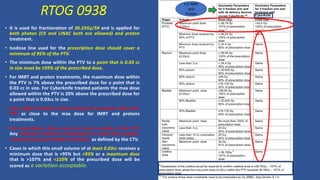
RTOG 0938
• It is used for fractionation of 36.25Gy/5# and is applied for
both photon (CK and LINAC both are allowed) and proton
treatment.
• Isodose line used for the prescription dose should cover a
minimum of 95% of the PTV.
• The minimum dose within the PTV to a point that is 0.03 cc
in size must be ≥95% of the prescribed dose.
• For IMRT and proton treatments, the maximum dose within
the PTV is 7% above the prescribed dose for a point that is
0.03 cc in size. For Cyberknife treated patients the max dose
allowed within the PTV is 20% above the prescribed dose for
a point that is 0.03cc in size.
• Every effort should be made to keep the max dose within the
PTV as close to the max dose for IMRT and protons
treatments.
• The prescription doses must not occur outside of the PTV.
Any hotspots should be manipulated to avoid the prostate-
rectal and prostate-bladder interfaces as defined by the CTV.
• Cases in which this small volume of at least 0.03cc receives a
minimum dose that is <95% but >93% or a maximum dose
that is >107% and <110% of the prescribed dose will be
scored as a variation acceptable.
For IMRT
and
Proton
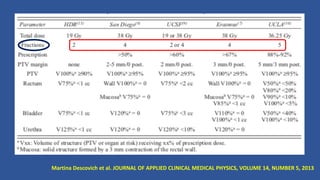
Martina Descovich et al. JOURNAL OF APPLIED CLINICAL MEDICAL PHYSICS, VOLUME 14, NUMBER 5, 2013
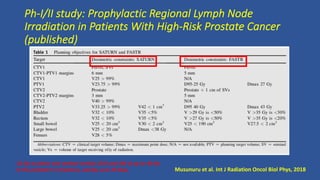
Ph-I/II study: Prophylactic Regional Lymph Node
Irradiation in Patients With High-Risk Prostate Cancer
(published)
Musunuru et al. Int J Radiation Oncol Biol Phys, 2018
25 Gy to pelvis and seminal vesicles (SV) and SIB of up to 40 Gy
to the prostate in 5 fractions, weekly, over 29 days.
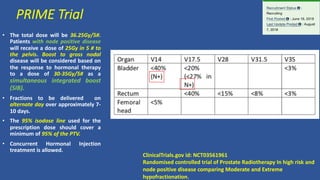
PRIME Trial
• The total dose will be 36.25Gy/5#.
Patients with node positive disease
will receive a dose of 25Gy in 5 # to
the pelvis. Boost to gross nodal
disease will be considered based on
the response to hormonal therapy
to a dose of 30-35Gy/5# as a
simultaneous integrated boost
(SIB).
• Fractions to be delivered on
alternate day over approximately 7-
10 days.
• The 95% isodose line used for the
prescription dose should cover a
minimum of 95% of the PTV.
• Concurrent Hormonal Injection
treatment is allowed.
ClinicalTrials.gov id: NCT03561961
Randomised controlled trial of Prostate Radiotherapy In high risk and
node positive disease comparing Moderate and Extreme
hypofractionation.
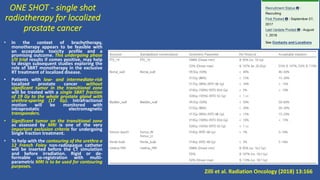
ONE SHOT - single shot
radiotherapy for localized
prostate cancer
• In the context of brachytherapy,
monotherapy appears to be feasible with
an acceptable toxicity profile and a
promising outcome. This undergoing phase
I/II trial results if comes positive, may help
to design subsequent studies exploring the
role of SBRT monotherapy in the exclusive
RT treatment of localized disease.
• Patients with low- and intermediate-risk
localized prostate cancer without
significant tumor in the transitional zone
will be treated with a single SBRT fraction
of 19 Gy to the whole prostate gland with
urethra-sparing (17 Gy). Intrafractional
motion will be monitored with
intraprostatic electromagnetic
transponders.
• Significant tumor on the transitional zone
as assessed by MRI is one of the very
important exclusion criteria for undergoing
Single fraction treatment.
• To help with the contouring of the urethra a
12 French Foley non-radiopaque catheter
will be inserted before the CT simulation
and before irradiation. Rigid or de-
formable co-registration with multi-
parametric MRI is to be used for contouring
purposes.
Zilli et al. Radiation Oncology (2018) 13:166
Set Up
• After patient is set up on the treatment table as per simulation instruction (A
rectal balloon can be used to immobilize the prostate if used during simulation)
and aligned with the laser & skin marks, either the system of implanted
electromagnetic beacon transponders that do not use ionizing radiation or the
2D or 3D IGRT systems that use x-rays will be used to align the patient based on
the canter of mass of the transponders/ intra prostatic fiducial markers with the
treatment machine geometry based on reference image of the treatment plan.
The co-registered alignment result will be evaluated by the attending physician
and attending physicist and be approved for treatment by attending physician on
site.
• If a tracking system is used for localization of the prostate, it will be used during
the treatment to track the target motion. A correction action will be performed
both manually and automatically if the target migrated more than 2 mm for
more than 20 seconds in any of three orthogonal coordinates.
• If a tracking system is not used to ensure the target coverage during treatment In
view of intrafraction motion and, periodic target localization will be employed every
7 minutes from initial beam-on. However, with the use of FFF beam, the treatment
time reduced from 7- 8 min to about 3-4 min, eliminating the need for mid-
treatment scan. For that mid-treatment scan was taken to reconfirm it and if
necessary, re-adjust the position of the prostate within the PTV.
• In case intra-prostatic fiducial not used then The initial localizations and alignment
is based on auto co-registered by using a bone and soft tissue matching to the
planning images. After automatic matching, fine manual adjustments were done
using direct visualisation of the prostate. As correction was feasible in only three
directions, any pitch, yaw or roll of more than 2 degrees mandated a re-set-up. For
treatment delivery, when there was a conflict between the shift needed to cover the
prostate and that needed to cover the nodes, the prostate was given precedence
over the (prophylactic) nodes to ensure proper coverage of the primary target. In
the case on an unresolvable conflict, a re-setup was mandated.
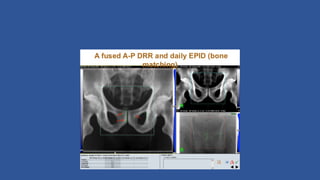
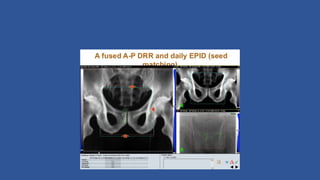
• The physicist will be on-site for image guidance and treatment.
Set Up
• Daily IGRT is must for prostate SBRT.
• An accepted IGRT technique together with radio-opaque fiducial markers
or electromagnetic transponders implanted in the prostate must be used
to position treatment beams.
• X-ray IGRT techniques with or without real-time tracking:
The x-ray IGRT system that can be used are 2D and 3D IGRT systems. These
systems can use either kV or MV x-rays. A computerized method for image
registration (either manual (drag and drop images) or automatic) is
required for determination of the patient shift.
• Examples of 2D systems are the ExacTrac, on board imaging (OBI),
electronic portal imaging device (EPID), CyberKnife real-time system,
etc.
• Examples of the 3D systems are the use of helical tomo CT imaging, cone-
beam CT and CT-in-the-room.
Image Guidance
• Non X-Ray IGRT Technique:
The non X- Ray IGRT includes the Calypso 4D localization system or ultrasound based
IGRT.
• The Calypso 4D Localization System (Calypso System, Calypso Medical, Seattle,
WA) is based on electromagnetic detection of implanted Beacon
transponders that allows the three-dimensional position of the implanted
transponders And target isocenter to be Tracked at a frequency of 10 Hz,
providing continuous, real-time localization and monitoring of the prostate.
During each fraction, initial positioning was performed using lasers and skin
marks; the target isocenter was subsequently aligned to the machine
isocenter using the Calypso System.
• Transabdominal Ultrasound systems are relatively inexpensive and offer soft
tissue visualization capability. Images of the prostate and adjacent organs are
acquired in the treatment position by placing a transducer on the patient’s
abdomen. Contours from the planning system are displayed in the ultrasound
context and correctly aligned to the position of the prostate with respect to
the isocenter. Placement of the transabdominal imaging transducer requires a
degree of technical skill and training to acquire suitable images and to
avoid displacing the prostate with extra abdominal pressure.
Image Guidance
Delivery
• Current SBRT systems rely on image guidance for patient setup before every
fraction.
• The details of the IGRT is depend on the treatment machine. Typically simulation
CT images or DRR are transferred to the treatment console to perform
registration with kV and/or MV images acquired with the in- room imaging
systems.
• Resulting IGRT offsets in the co-registration signify setup shifts required to bring
the patient into the planned position. Align the patient after image guidance,
typically by moving the treatment couch.
• After any patient shift, repeat the imaging study to ensure proper patient
alignment is made or not. Prior to the first and all treatment fractions, the in-
room images must be reviewed by a physician before beam on the treatment.
• For dose delivery techniques that take more than 7 minutes (from initial beam on
to last beam completion time), measures to detect and compensate for
intrafraction motion are required.
Pre-Medication
• Patients should be started on prophylactic alpha-blocker (Tab
Tamsulosin 0.4 mg Once a day) at the time of simulation. Therapy is
continued through at least first follow-up at 1 month after treatment.
• Tablet Dexamethasone 4 mg is given before each fraction of SBRT.
Post Radiation Care
• Tab Pentoxifylline (800 mg/day) and Cap vitamin E (1000 mg/day)
can be given for as long as 6 months to prevent late radiation toxicity.
Follow Up
• Initial follow up is 3-4 weeks after SBRT to assess acute toxicity.
• Thereafter they underwent regular follow-up every 3 months for the
first year and 6 monthly thereafter. They underwent clinical
examination and PSA testing, together with toxicity assessment.
Imaging was only carried out if clinically indicated. Biochemical
failure was defined according to the revised ASTRO definition
(Phoenix). Late genitourinary/gastrointestinal Toxicity documentation
using RTOG criteria.
CONCLUSIONS
Prostate SBRT is a faster, cheaper and better way of
treating prostate cancers. It is the obvious evolution of
EBRT for localized prostate cancer.
SBRT is considered an acceptable option for low and
intermediate risk patients.
Late rectal toxicity is minimal with hypofractionated RT
(including SBRT).
Urinary toxicity is pronounced early after RT and is self
limited.
THANK YOU

SBRT prostate

  • 1.
    SBRT Prostate – Simulationto Execution Dr. Rushi Panchal, HOD - Radiation Oncology, M S Patel Cancer Centre & Shree Krishna Hospital, Karamsad, Anand-Gujarat.
  • 2.
    Localized Prostate Cancer: CompetingTreatment Modalities Surveillance (No Dose option) Radiotherapy: - Brachytherapy: LDR / HDR - High dose EBRT (IMRT) - Hypofractionation (incuding SBRT) Surgery: - Radical Retropubic - Laparoscopic / Robotic Cryosurgery HIFU Stereotactic radiosurgery seems to offer a safe and effective alternative method in relation to surgery, conventional external beam radiotherapy, and brachytherapy. SBRT is feasible, cost-effective, non-invasive, can be done on outpatient basis and the treatment time extremely shorter than all other treatment. Radical external beam radiotherapy is accepted as a highly effective radical treatment for localized prostate cancer.
  • 3.
    RT DOSE: RandomizedTrials MDACC Trial (Pollack): bNED 70 vs 78 Gy 50 vs 73% at 10 years p<0.01 MGH/LLUMC (Proton Trial): 70 vs 79.2 Gy Low risk 72 vs 93% at 10 years p<0.01 Int risk 58 vs 70% p=0.06 Dutch Multi-institutional Trial: 68 vs 78 Gy (some ADT) 45 vs 56% at 7 years p=0.03 UK (MRC) Trial: 64 vs 74 Gy (some ADT) 71 vs 60% at 5 years p<0.01 IMPACT OF INCREASED DOSE 919 Stage T1-T3N0M0 - RT alone - treated between 1986 and 2000 LOCAL FAILURE DISTANT FAILURE Kupelian et al. IJROBP. 71, 6–22, 2008 • Randomized trials have demonstrated that a dose-response relationship demonstrating increasing biochemical control with increasing dose. • Dose escalating using conventional fractionation prolongs the overall treatment time which may have a negative effect on cancer outcomes and it has reached plateau dose of BED, beyond which safe delivery of radiation is not possible . An alternative means of delivering a higher total dose (i.e. a higher biological effective dose; BED) is with hypofractionation. (High Dose- Shorter time) • There is good rationale for adopting hypofractionation approach in the treatment of prostate cancer as there is evidence that prostate cancer has a low α/β ratio ( between 1-4 and it is lower than the surrounding tissues ), meaning it is theoretically more sensitive to large dose per fraction treatments . • This allows exploitation of the potential biological advantage of the low alpha-beta ratio of prostate cancer treatment of SBRT by delivering larger hypo-fractionated doses to the prostate (thus improving tumor control) for isotoxic levels of late rectal toxicity (Higher dose @same toxicity level).
  • 4.
    St. Thomas Hospital(London): Lloyd-Davies, Urology. 36: 107, 1990 55 Gy in 12 fractions 36 Gy in 6 fractions: 6 Gy per fraction Canadian randomized trial: Lukka, JCO. 23: 6132-6138, 2005 66 Gy in 33 fractions versus 52.5 Gy/20 fractions (2.6 Gy per fraction) • Hypofractionated arm worse? 5yr bRFS: 53% vs. 56%; p < 0.05 • No difference in toxicity Australian randomized trial: 64 Gy/32 fractions versus 55 Gy/20 fractions (2.75 Gy per fraction) • Hypo arm better bRFS. • Median FU 90 mos needed to show difference. • GI toxicity slightly worse with hypo. Yeoh, IJROBP, 66: 1072-83, 2006 Yeoh, IJROBP 81, 1271-8, 2011 OLD (LOW-DOSE) EXPERIENCES: 2D, no IMRT, no IGRT Single arm Fraction Total Dose BED Med FU (mos) Size(Gy) Number ( =2) Last report Cleveland Clinic 2.5 28 70.0 158 103 McGill 3.0 22 66.0 165 90 2.94 22 64.7 160 59 U Wisconsin 3.63 16 58.1 163 50 4.30 12 51.6 163 55 (Many more ) Randomized Hypofrac Arm BED Conv Arm MDACC 72.0 at 2.4 Gy 158 vs 75.6 at 1.8 Gy FCCC 70.2 at 2.7 Gy 165 vs 76.0 at 2.0 Gy PMH / PROFIT 60.0 at 3.0 Gy 150 vs 78.0 at 2.0 Gy RTOG 0415 70.0 at 2.5 Gy 158 vs 73.8 at 1.8 Gy CHHiP(UK) 60.0 at 3.0 Gy 150 vs 74.0 at 2.0 Gy Italian Study 62.0 at 3.1 Gy 158 vs 80.0 at 2.0 Gy Dutch Study 64.6 at 3.4 Gy 174 vs 78.0 at 2.0 Gy MODERN HYPOFRACTIONATION EXPERIENCES: IMRT / IGRT • Stereotactic body RT (SBRT) is a technique that delivers highly conformal, high-dose (ultra-hypo fractionated) radiation in 5 or fewer treatment fractions, which are safe to administer only with precise, image-guided delivery. • Single-institution series with median follow-up as long as 6 years report excellent biochemical progression-free survival and similar early toxicity (bladder, rectal, and QOL) compared to standard radiation techniques. • According to a pooled analysis of phase 2 trials, the 5- year biochemical relapse-free survival is 95%, 84%, and 81% for patients with low-, intermediate-, and high-risk disease, respectively. Ultra- hypofractionation
  • 5.
    RANDOMIZED SBRT TRIALS HypofracArm Arm 2 • Widmark: 42.7 at 6.1 Gy vs 78 at 2Gy 7 fractions 39 fractions • RTOG 0938: 36.25 at 7.25 Gy vs 51.6 at 4.3 Gy 5 fractions 12 fractions • PACE trial: • PRIME TRIAL 68Gy in 25#vs36.25Gy at 7.25Gy 5 fractions PACE A, potential surgical candidates are randomised between radical prostatectomy and SBRT (36.25 Gy in 5 fractions). In PACE B, randomisation is between standard radiotherapy (78Gy in 39 fractions or 62Gy in 20 fractions) and SBRT (36.35Gy in 5 fractions). HYPO-RT-PC trial >120 patients in each arm. The urinary and rectal quality of life outcomes reported by patients with prostate cancer undergoing 5- and 12-fraction prostate radiation therapy treatments are com- parable to those with current standard 38- to 44-fraction radiation therapy treatments.
  • 6.
    Safe delivery isof utmost importance due to high fractional dose and small number of fractions
  • 7.
  • 8.
    Indication • High RiskProstate Cancer • Very High Risk Prostate Cancer • Node Positive Prostate • Boost for clinical T1-4 with IMRT. • Re-irradiation after Conventional RT failure when not suitable for brachytherapy salvage. SBRT as monotherapy is not absolute contraindication but should be done under clinical trial setting only.
  • 9.
    Case Selection • NoEvidence of distant metastases. • No Previous radical surgery (prostatectomy)/cryosurgery/HIFU for prostate cancer. • No Previous pelvic irradiation other than for prostate cancer/prostate Brachytherapy. • No history of proctitis, diverticulitis, or inflammatory bowel conditions. • Prostate volume should be <100 cc, But large prostate and/or median lobe enlargement per say is not absolute contraindication for SBRT. • For Moderate-severe urinary symptoms (e.g. high IPSS score, typically defined as > 20), conventional fractionation RT is preferred over SBRT. Patients with known obstructive symptoms with stricture is not suitable for SBRT. • Large TURP defects which preclude seed placement is not candidate for SBRT. • Contraindicated in excessive artefact not allowing proper localization of prostate (e.g. Hip replacement) or Fiducial marker implantation is not possible (e.g. allergy to gold).
  • 10.
  • 11.
    Rectal preparation BladderStatus Comfortably Full bladder- Pushes intestines away But Reproducibility is an issue due to variable intake and cystitis
  • 12.
    Empty bladder Good reproducibilityBut Higher bowel doses as rectum moves in to higher dose region where as SV into the lower dose region.
  • 13.
    Why fiducials? Lack ofcorrelation between prostate position and the localization of pelvic bony anatomy Because the prostate gland is not attached directly to any bony structures and its position is significantly affected by the degree of rectal filling with fecal/gas content, it is subject to large inter- and intra-fractional variations. So, Fiducial markers placed within the prostate are required to improve target localization.
  • 16.
    Examples of behavioursobserved in the continuous tracking data. Kupelian et al, Int. J. Radiation Oncology Biol. Phys, 2007 Displacements >3 and >5 mm for cumulative durations of at least 30 s were observed during 41% and 15% of sessions. In individual patients, the number of fractions with displacements >3 mm ranged from 3% to 87%; whereas the number of fractions with displacements >5 mm ranged from 0% to 56%. continuous target drift transient excursion stable target at baseline persistent excursion high-frequency excursions erratic behaviour
  • 17.
    BALLOON PROBLEM?: INTRODUCINGDEFORMATION Increased length of rectum irradiated? Superior and inferior parts of the rectum get closer to high dose areas. Anal canal: Increased doses? Beware of SV coverage; Increase rectal doses superiorly? Without balloon With balloon A.T. Wong et al Practical Radiation Oncology, 2016 ImmobiLoc Endorectal ballon from RadiaDyne
  • 18.
    Hamstra et al.Int J Radiation Oncol Biol Phys, 2017 Hamstra et al. Int J Radiation Oncol Biol Phys, 2017 hydrogel spacer polylactic acid Mok et al. Int J Radiation Oncol Biol Phys, 2014 Patients with obvious rectal invasion or visible T3 and posterior extension should not undergo perirectal spacer implantation. Ph –III Randomized trial
  • 19.
    Positioning and immobilization •Position: Supine and hands over chest. • Immobilization: Knee rest alone OR Vacuum Cushion + knee Rest OR Elekta Body fix.
  • 20.
    • Rectal protocol:Patients should adhere to a - low gas, low motility diet(+/- antiflatulent) commencing 1-2 days prior to simulation and treatment. - One tablespoon of milk of magnesia will be taken the night before the simulation and the night before each treatment. - One proctoclysis ( sodium phosphate ) enema will be administered 2–3 hrs. before the simulation and each treatment. • Bladder Protocol: - Consistent full urinary bladder filling procedure should be used for an individual patient for simulation and for each treatment except where treatment time exceeds 30 minutes when patients may be treated with an empty bladder e.g. Cyberknife based SBRT. Bladder filling may be achieved by asking patients to void urine completely and to drink 500 ml of water 45 minutes prior to simulation/treatment to achieve least displacement of internal organ not urinate between this time and simulation/treatment. - If patient is already catheterized at baseline then Foley catheter should be in place and 50 cc of water instilled in the bladder at the time of simulation and each treatment • TRUS-guided placement: of at least 3 gold seed fiducial markers (2 at base, 1 at apex) at least 5 days prior to simulation. Same way Transrectally or transperineally under ultrasound guidance, the placement of three electromagnetic transponders, the Calypso® beacons (Varian Medical Systems, Palo Alto, CA ) is to be done 4-5 days prior simulation. • If MR scan is planned with use of Calypso system, MR should be obtained prior to the implantation of transponders. Preparation For Simulation
  • 21.
    Imaging Protocol ForSimulation • CT simulation: should be performed in the supine treatment position after emptying of rectum and full bladder as per protocol mentioned above, with the transponders/fiducial markers/rectal balloon in place (where utilized). Axial cuts of 2.5 mm or less will be acquired throughout the pelvis and prostate from the top of the iliac crests superiorly to the perineum inferiorly ( at least 5 cm beyond PTV superior-inferior extension) in treatment where prostate is the only target. • MRI images are not required. However, T2 axial is useful for co-registration with planning CT scan for delineation of extra-prostatic extension if any and prostatic urethra delineation. • Oral, IV, urethral, and bladder contrast are allowed but is not must to use. MRI • Better visualization of extra prostatic spread , SV invasion if any • Better OAR delineation - urethra • Avoids over estimation of prostate
  • 22.
    Motion Management • Linacbased SBRT: Daily image guidance with real-time tracking by Calypso electromagnetic beacon transponders. • CyberKnife based SBRT: Real-time fiducial tracking using orthogonal kV x-ray fluoroscopy for intrafraction motion (preferred).
  • 23.
    Target Volume delineation •GTV = whole of prostate gland including any ECE. • CTV = GTV for low risk = GTV + Proximal 1 cm of SV for intermediate risk = GTV + Proximal 2cm of SV +/- pelvic lymphatics for high risk = GTV + Entire SV +/- Pelvic lymphatics if SV is involved in very high risk = Prostate + SV + Gross Pelvic node + pelvic lymphatic if pelvic N+ • PTV = CTV + 5mm margin except posterior 3 mm. For CTV pelvic nodal region 5 mm margin is sufficient to create PTV pelvic node.
  • 24.
    OAR Contouring • Bladder,rectum, bilateral femora (to the level of ischial tuberosity), penile bulb, skin and urethra. • For patients where the maximum point dose to a point that is 0.03 cc exceeds 107% of prescribed dose, visualization of the urethra is required either by MRI based delineation or traced along the catheter if patient has been catharized baseline. • The normal tissues will be contoured and considered as solid organs rather than contouring the bladder and rectal walls. • The bladder should be contoured from its base to the dome including the wall. • The rectum should be contoured from the anus (at the level of bottom of the ischial tuberosities) for a length of 15 cm or to the rectosigmoid flexure. This generally is below the bottom of the sacroiliac joints. • Bowel will be represented by a single solid structure encompassing the peritoneal cavity and any loops of bowel in the pelvis. The upper extent will be kept constant at 2 cm superior to the uppermost extent of the PTV. • Penile bulb will be contoured on the CT image below the pelvic diaphragm.
  • 25.
    Delineation of prostaticurethra as OAR Figure 1. An axial T2 weighted sequence showing the stepwise delineation of the prostatic urethra: the prostatic urethra has been marked as a tubular structure in red–green. (a) Identifying the bladder neck: the hyperintense signal is representing the urine in the bladder. (b–d) It is traced further into the parenchyma of the prostate. This is representing the prostatic urethra. (e–g) The sagittal sectional correlation to aid in delineation: the urethra as a whole has been depicted. (g) The prostatic, bulbar and penile parts of the urethra are shown. (h) A coronal section is illustrating the complete prostatic urethra. Bl, bladder; F, femur; Pr, prostate; R, rectum. Figure 2. Axial and sagittal CT scans with catheter in situ: (a–c) An axial CT scan—the bulb of Foley’s catheter is seen in the bladder. The bladder neck has been delineated in pink, the prostate in yellow. The prostatic urethra is traced along the catheter (red). (d–f) The prostatic urethra is continuing as the membranous part, delineated in yellow. (g) The coronal section is correlating the delineation. (h, i) Sagittal sections for correlating the course of the urethra along Foley’s catheter. Bl, bladder; R, rectum. Kataria T et al. Br J Radiol, 2016 On T2 axial MRI slices, the prostatic urethra is seen as a moderately hyperintense region in the central to the posterior portion of the prostate, surrounded by the gland .
  • 26.
    • 35Gy-40Gy/5#@ 7-8Gy/#.36.25Gy/5# is most preferred fractionation. The limit of dose per fraction escalation appears to have been reached, 50Gy delivered in 5 fractions, toxicity (particularly rectal) was excessive. • 38Gy/4# @ 9.5Gy/# can be used as a monotherapy. • 19Gy/1# can be used as a monotherapy. • 19Gy/2# to 21Gy/2# can be given as a boost after 45-50Gy of conventional fractionated EBRT. • 25Gy/5# to pelvic lymphatics with SIB to Prostate (+/- SV) 35-40Gy/5# can be given in High Risk to very high risk monotherapy case. Sometimes SV dose can be kept 25Gy/5# to respect normal tissue tolerance. • Node positive case can be treated as above mentioned high risk to very high risk monotherapy case along with gross node can be boosted to 35- 36.25Gy/5#. Dose Prescription UT Southwestern Protocol (R. Timmerman) ASTRO 2013 Update. Abstract 2405 Median follow-up is 25.5 months Dose groups: 9.0 Gy x 5 = 45 Gy 9.5 Gy x 5 = 47.5 Gy 10.0 Gy x 5 = 50 Gy 10% developped High Grade Rectal Toxicity (Grade 4) Predictors of Gr4 rectal toxicity; • Diabetes (trend p=0.07). • > 35% of rectal wall at 39 Gy (p=0.03) • Volume of rectal wall receiving 50 Gy (p=0.01) Gr4 toxicity: All had > 3.5 cm3 of rectal wall > 50 Gy (p < .0001). All patients with no rectal toxicity had < 3.5 cm3 rectal wall at 50 Gy.
  • 27.
    • Post RTSalvage: 30Gy/5# @ 6Gy/# If focal recurrence found on biopsy/MRI/PSMA PET-CT, consider partial volume treatment to dominant intra- prostatic lesion. • Any of above mentioned fractionation schedule : patient should be treated either on alternate day or twice a week but not daily to prevent GI & GU Toxicity. Dose Prescription
  • 28.
    Planning • Use ofIMRT (DMLC or SMLC) or related techniques (Tomotherapy/VMAT/Cyberknife) that uses inverse treatment planning techniques to determine weighting for a large number of fields sequentially irradiating sub-regions of a target. • Coplanar or non-coplanar beam arrangements will be custom designed for each case to deliver highly conformal dose distributions. • For fixed gantry angle IMRT delivery, a least 5 gantry positions should be used. • The recommended photon energies for this are 6-10 MV with or without flattening filter. The use of beams with higher energy is discouraged. • Planning should be done as a single phase simultaneous integrated boost (SIB) technique in case multiple target plan having differential dose in case of high risk / very high risk / node positive disease.
  • 29.
    Delivery Platform Linac basedvs Robotic delivery: • Most experience with robotic delivery • Coplanar vs non-coplanar delivery • Platforms seem comparable Y.-W. Lin et al. Physica Medica, In press (2014) Delivery Platform Y.-W. Lin et al. Physica Medica, In press (2014) CK Linac CK Linac CK Linac CK Linac CTV PTV Rectum Bladder Rapid Arc vs CK The RA plans consistently exhibited superior PTV coverage and better rectum sparing at low doses in the both groups. The conformity and heterogeneity indices of the RA plans were better than the CK plans. Additionally, the RA plans resulted in fewer low-dose regions, lower MUs, and faster delivery times than the CK plans. Fsd
  • 30.
    Plan evaluation • Itis Different based on total dose and dose per fraction. • It is Similar for Photon(LINAC Based) and proton except CK Based treatment. • RTOG 0938 is most commonly used protocol for plan evaluation for 5 fraction SBRT Prostate ( incase of prostate treatment only ) due to its clinical outcome has been published and is randomized control study.
  • 31.
    RTOG 0938 • Itis used for fractionation of 36.25Gy/5# and is applied for both photon (CK and LINAC both are allowed) and proton treatment. • Isodose line used for the prescription dose should cover a minimum of 95% of the PTV. • The minimum dose within the PTV to a point that is 0.03 cc in size must be ≥95% of the prescribed dose. • For IMRT and proton treatments, the maximum dose within the PTV is 7% above the prescribed dose for a point that is 0.03 cc in size. For Cyberknife treated patients the max dose allowed within the PTV is 20% above the prescribed dose for a point that is 0.03cc in size. • Every effort should be made to keep the max dose within the PTV as close to the max dose for IMRT and protons treatments. • The prescription doses must not occur outside of the PTV. Any hotspots should be manipulated to avoid the prostate- rectal and prostate-bladder interfaces as defined by the CTV. • Cases in which this small volume of at least 0.03cc receives a minimum dose that is <95% but >93% or a maximum dose that is >107% and <110% of the prescribed dose will be scored as a variation acceptable. For IMRT and Proton
  • 32.
    Martina Descovich etal. JOURNAL OF APPLIED CLINICAL MEDICAL PHYSICS, VOLUME 14, NUMBER 5, 2013
  • 33.
    Ph-I/II study: ProphylacticRegional Lymph Node Irradiation in Patients With High-Risk Prostate Cancer (published) Musunuru et al. Int J Radiation Oncol Biol Phys, 2018 25 Gy to pelvis and seminal vesicles (SV) and SIB of up to 40 Gy to the prostate in 5 fractions, weekly, over 29 days.
  • 34.
    PRIME Trial • Thetotal dose will be 36.25Gy/5#. Patients with node positive disease will receive a dose of 25Gy in 5 # to the pelvis. Boost to gross nodal disease will be considered based on the response to hormonal therapy to a dose of 30-35Gy/5# as a simultaneous integrated boost (SIB). • Fractions to be delivered on alternate day over approximately 7- 10 days. • The 95% isodose line used for the prescription dose should cover a minimum of 95% of the PTV. • Concurrent Hormonal Injection treatment is allowed. ClinicalTrials.gov id: NCT03561961 Randomised controlled trial of Prostate Radiotherapy In high risk and node positive disease comparing Moderate and Extreme hypofractionation.
  • 35.
    ONE SHOT -single shot radiotherapy for localized prostate cancer • In the context of brachytherapy, monotherapy appears to be feasible with an acceptable toxicity profile and a promising outcome. This undergoing phase I/II trial results if comes positive, may help to design subsequent studies exploring the role of SBRT monotherapy in the exclusive RT treatment of localized disease. • Patients with low- and intermediate-risk localized prostate cancer without significant tumor in the transitional zone will be treated with a single SBRT fraction of 19 Gy to the whole prostate gland with urethra-sparing (17 Gy). Intrafractional motion will be monitored with intraprostatic electromagnetic transponders. • Significant tumor on the transitional zone as assessed by MRI is one of the very important exclusion criteria for undergoing Single fraction treatment. • To help with the contouring of the urethra a 12 French Foley non-radiopaque catheter will be inserted before the CT simulation and before irradiation. Rigid or de- formable co-registration with multi- parametric MRI is to be used for contouring purposes. Zilli et al. Radiation Oncology (2018) 13:166
  • 36.
    Set Up • Afterpatient is set up on the treatment table as per simulation instruction (A rectal balloon can be used to immobilize the prostate if used during simulation) and aligned with the laser & skin marks, either the system of implanted electromagnetic beacon transponders that do not use ionizing radiation or the 2D or 3D IGRT systems that use x-rays will be used to align the patient based on the canter of mass of the transponders/ intra prostatic fiducial markers with the treatment machine geometry based on reference image of the treatment plan. The co-registered alignment result will be evaluated by the attending physician and attending physicist and be approved for treatment by attending physician on site. • If a tracking system is used for localization of the prostate, it will be used during the treatment to track the target motion. A correction action will be performed both manually and automatically if the target migrated more than 2 mm for more than 20 seconds in any of three orthogonal coordinates.
  • 37.
    • If atracking system is not used to ensure the target coverage during treatment In view of intrafraction motion and, periodic target localization will be employed every 7 minutes from initial beam-on. However, with the use of FFF beam, the treatment time reduced from 7- 8 min to about 3-4 min, eliminating the need for mid- treatment scan. For that mid-treatment scan was taken to reconfirm it and if necessary, re-adjust the position of the prostate within the PTV. • In case intra-prostatic fiducial not used then The initial localizations and alignment is based on auto co-registered by using a bone and soft tissue matching to the planning images. After automatic matching, fine manual adjustments were done using direct visualisation of the prostate. As correction was feasible in only three directions, any pitch, yaw or roll of more than 2 degrees mandated a re-set-up. For treatment delivery, when there was a conflict between the shift needed to cover the prostate and that needed to cover the nodes, the prostate was given precedence over the (prophylactic) nodes to ensure proper coverage of the primary target. In the case on an unresolvable conflict, a re-setup was mandated. • The physicist will be on-site for image guidance and treatment. Set Up
  • 38.
    • Daily IGRTis must for prostate SBRT. • An accepted IGRT technique together with radio-opaque fiducial markers or electromagnetic transponders implanted in the prostate must be used to position treatment beams. • X-ray IGRT techniques with or without real-time tracking: The x-ray IGRT system that can be used are 2D and 3D IGRT systems. These systems can use either kV or MV x-rays. A computerized method for image registration (either manual (drag and drop images) or automatic) is required for determination of the patient shift. • Examples of 2D systems are the ExacTrac, on board imaging (OBI), electronic portal imaging device (EPID), CyberKnife real-time system, etc. • Examples of the 3D systems are the use of helical tomo CT imaging, cone- beam CT and CT-in-the-room. Image Guidance
  • 39.
    • Non X-RayIGRT Technique: The non X- Ray IGRT includes the Calypso 4D localization system or ultrasound based IGRT. • The Calypso 4D Localization System (Calypso System, Calypso Medical, Seattle, WA) is based on electromagnetic detection of implanted Beacon transponders that allows the three-dimensional position of the implanted transponders And target isocenter to be Tracked at a frequency of 10 Hz, providing continuous, real-time localization and monitoring of the prostate. During each fraction, initial positioning was performed using lasers and skin marks; the target isocenter was subsequently aligned to the machine isocenter using the Calypso System. • Transabdominal Ultrasound systems are relatively inexpensive and offer soft tissue visualization capability. Images of the prostate and adjacent organs are acquired in the treatment position by placing a transducer on the patient’s abdomen. Contours from the planning system are displayed in the ultrasound context and correctly aligned to the position of the prostate with respect to the isocenter. Placement of the transabdominal imaging transducer requires a degree of technical skill and training to acquire suitable images and to avoid displacing the prostate with extra abdominal pressure. Image Guidance
  • 40.
    Delivery • Current SBRTsystems rely on image guidance for patient setup before every fraction. • The details of the IGRT is depend on the treatment machine. Typically simulation CT images or DRR are transferred to the treatment console to perform registration with kV and/or MV images acquired with the in- room imaging systems. • Resulting IGRT offsets in the co-registration signify setup shifts required to bring the patient into the planned position. Align the patient after image guidance, typically by moving the treatment couch. • After any patient shift, repeat the imaging study to ensure proper patient alignment is made or not. Prior to the first and all treatment fractions, the in- room images must be reviewed by a physician before beam on the treatment. • For dose delivery techniques that take more than 7 minutes (from initial beam on to last beam completion time), measures to detect and compensate for intrafraction motion are required.
  • 41.
    Pre-Medication • Patients shouldbe started on prophylactic alpha-blocker (Tab Tamsulosin 0.4 mg Once a day) at the time of simulation. Therapy is continued through at least first follow-up at 1 month after treatment. • Tablet Dexamethasone 4 mg is given before each fraction of SBRT.
  • 42.
    Post Radiation Care •Tab Pentoxifylline (800 mg/day) and Cap vitamin E (1000 mg/day) can be given for as long as 6 months to prevent late radiation toxicity.
  • 43.
    Follow Up • Initialfollow up is 3-4 weeks after SBRT to assess acute toxicity. • Thereafter they underwent regular follow-up every 3 months for the first year and 6 monthly thereafter. They underwent clinical examination and PSA testing, together with toxicity assessment. Imaging was only carried out if clinically indicated. Biochemical failure was defined according to the revised ASTRO definition (Phoenix). Late genitourinary/gastrointestinal Toxicity documentation using RTOG criteria.
  • 44.
    CONCLUSIONS Prostate SBRT isa faster, cheaper and better way of treating prostate cancers. It is the obvious evolution of EBRT for localized prostate cancer. SBRT is considered an acceptable option for low and intermediate risk patients. Late rectal toxicity is minimal with hypofractionated RT (including SBRT). Urinary toxicity is pronounced early after RT and is self limited.
  • 45.