ARPES and SPE-LEEM Study on
Supported, Suspended, and
Twisted Bilayer MoS2
SPEAKER: PO-CHUN(FIGO) YEH
ADVISOR: PROF. R. M. OSGOOD
“SPE-LEEM” = Spectroscopic Photo-Emission and Low
Energy Electron Microscopy
1
APS March meeting 2015 Y2: Focus Session: Beyond Graphene - New 2D Materials
MANY THANKS!
Jurek Sadowski
DaTong Zhang
Arend van der Zande
Abdullah Al-Mahboob
Prof. James Hone
Prof. Irving Herman
Daniel A. ChenetProf. R. M. Osgood
WenCan Jin
Jerry Dadap
Nader Zaki Peter Sutter
2
Ghidewon Arefe
Andrea Locatelli Tevfik Onur Metnes Alessandro Sala
and many!
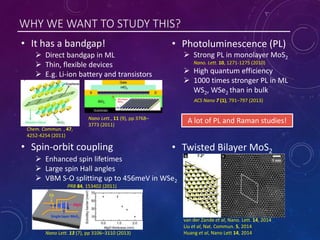
WHY WE WANT TO STUDY THIS?
• Spin-orbit coupling
• It has a bandgap! • Photoluminescence (PL)
• Twisted Bilayer MoS2
 Strong PL in monolayer MoS2
Nano. Lett. 10, 1271-1275 (2010)
 High quantum efficiency
 1000 times stronger PL in ML
WS2, WSe2 than in bulk
ACS Nano 7 (1), 791–797 (2013)
 Direct bandgap in ML
 Thin, flexible devices
 E.g. Li-ion battery and transistors
Nano Lett., 11 (9), pp 3768–
3773 (2011)
Chem. Commun. , 47,
4252-4254 (2011)
 Enhanced spin lifetimes
 Large spin Hall angles
 VBM S-O splitting up to 456meV in WSe2
PRB 84, 153402 (2011)
Nano Lett. 13 (7), pp 3106–3110 (2013)
van der Zande et al, Nano. Lett. 14, 2014
Liu et al, Nat. Commun. 5, 2014
Huang et al, Nano Lett 14, 2014
A lot of PL and Raman studies!
OUR AIM:
With SPE-LEEM, we can:
o Measure the MoS2 band structure directly
o Study the band gap transition and the role of interlayer
coupling in ML, BL, and twist bilayer MoS2
o Study the substrate effect via suspension
o Study hole effective mass directly
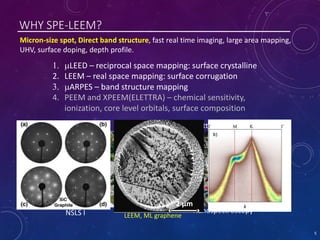
WHY SPE-LEEM?
Micron-size spot, Direct band structure, fast real time imaging, large area mapping,
UHV, surface doping, depth profile.
NSLS I Nanospectroscopy
1. mLEED – reciprocal space mapping: surface crystalline
2. LEEM – real space mapping: surface corrugation
3. mARPES – band structure mapping
4. PEEM and XPEEM(ELETTRA) – chemical sensitivity,
ionization, core level orbitals, surface composition
BNL, NY, USA Elettra, Trieste, Italy
5
2 µm
LEEM, ML graphene
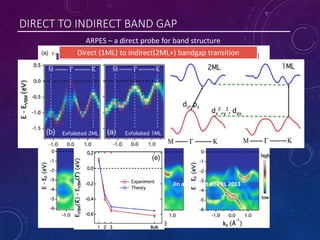
DIRECT TO INDIRECT BAND GAP
Photoelectron k-space
mapping
Direct (1ML) to indirect(2ML+) bandgap transition
ARPES – a direct probe for band structure
Jin and Yeh et al, PRL 2013
dz, pz
dx
2
+y
2, dxy
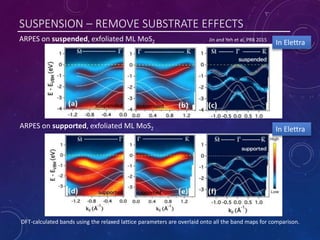
SUSPENSION – REMOVE SUBSTRATE EFFECTS
DFT-calculated bands using the relaxed lattice parameters are overlaid onto all the band maps for comparison.
ARPES on suspended, exfoliated ML MoS2
ARPES on supported, exfoliated ML MoS2 In Elettra
In ElettraJin and Yeh et al, PRB 2015
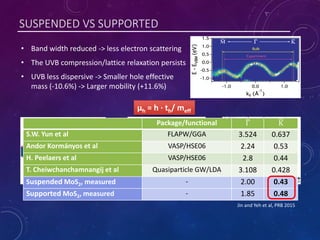
• Band width reduced -> less electron scattering
• The UVB compression/lattice relaxation persists
• UVB less dispersive -> Smaller hole effective
mass (-10.6%) -> Larger mobility (+11.6%)
SUSPENDED VS SUPPORTED
µh = h · th/ meff
Jin and Yeh et al, PRB 2015
Package/functional Γ Κ
S.W. Yun et al FLAPW/GGA 3.524 0.637
Andor Kormányos et al VASP/HSE06 2.24 0.53
H. Peelaers et al VASP/HSE06 2.8 0.44
T. Cheiwchanchamnangij et al Quasiparticle GW/LDA 3.108 0.428
Suspended MoS2, measured - 2.00 0.43
Supported MoS2, measured - 1.85 0.48
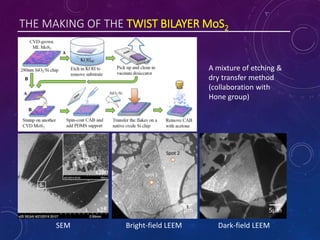
THE MAKING OF THE TWIST BILAYER MoS2
A mixture of etching &
dry transfer method
(collaboration with
Hone group)
SEM Bright-field LEEM Dark-field LEEM
(0°)
(60°)
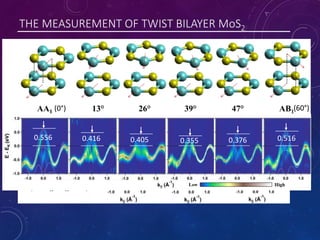
THE MEASUREMENT OF TWIST BILAYER MoS2
0.556 0.416 0.405 0.355 0.376 0.516
(0°) (60°)
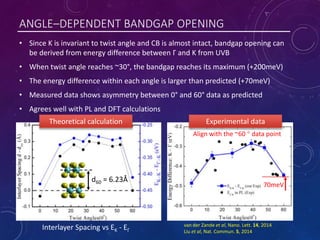
ANGLE–DEPENDENT BANDGAP OPENING
• Since K is invariant to twist angle and CB is almost intact, bandgap opening can
be derived from energy difference between Γ and K from UVB
• When twist angle reaches ~30°, the bandgap reaches its maximum (+200meV)
• The energy difference within each angle is larger than predicted (+70meV)
• Measured data shows asymmetry between 0° and 60° data as predicted
• Agrees well with PL and DFT calculations
Interlayer Spacing vs EK - EГ
d60 = 6.23Å
van der Zande et al, Nano. Lett. 14, 2014
Liu et al, Nat. Commun. 5, 2014
Align with the ~60 ° data point
Theoretical calculation Experimental data
70meV
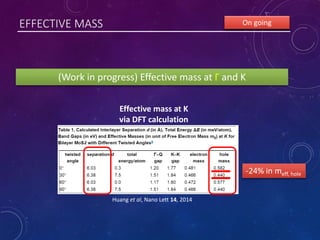
EFFECTIVE MASS On going
Effective mass at K
via DFT calculation
Huang et al, Nano Lett 14, 2014
(Work in progress) Effective mass at Γ and K
-24% in meff, hole
CONCLUSION
 Bandgap transition originates from the shifting of Γ at the
top-most valence band by quantum confinement
 Hole effective mass / mobility affected by the substrate
 Twist angle -> Interlayer coupling changes the band gap
 SPE-LEEM system with LEEM, µLEED, and µARPES is ideal
for studying 2D materials
13
SPIN-ORBIT SPLITTING
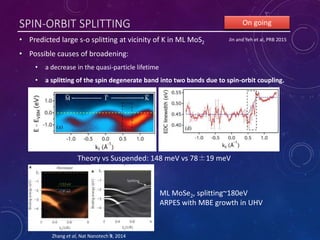
• Predicted large s-o splitting at vicinity of K in ML MoS2
• Possible causes of broadening:
• a decrease in the quasi-particle lifetime
• a splitting of the spin degenerate band into two bands due to spin-orbit coupling.
Theory vs Suspended: 148 meV vs 78±19 meV
On going
Jin and Yeh et al, PRB 2015
ML MoSe2, splitting~180eV
ARPES with MBE growth in UHV
Zhang et al, Nat Nanotech 9, 2014
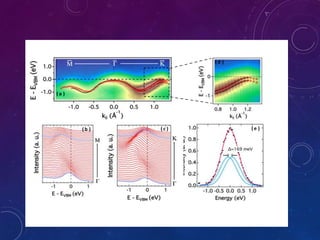
( a )
( b ) ( c )
( d )
( e )
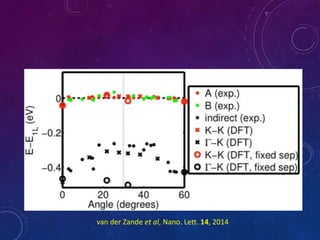
van der Zande et al, Nano. Lett. 14, 2014
SPE-LEEM - PERSPECTIVES
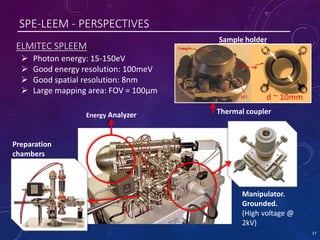
ELMITEC SPLEEM
Energy Analyzer
Manipulator.
Grounded.
(High voltage @
2kV)
Preparation
chambers
 Photon energy: 15-150eV
 Good energy resolution: 100meV
 Good spatial resolution: 8nm
 Large mapping area: FOV = 100µm
Thermal coupler
Sample holder
d ~ 10mm
17
NOTES
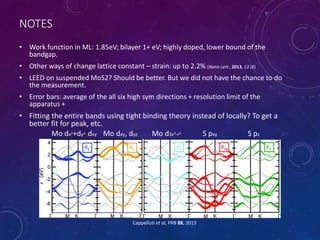
• Work function in ML: 1.85eV; bilayer 1+ eV; highly doped, lower bound of the
bandgap.
• Other ways of change lattice constant – strain: up to 2.2% (Nano Lett., 2013, 13 (8)
• LEED on suspended MoS2? Should be better. But we did not have the chance to do
the measurement.
• Error bars: average of the all six high sym directions + resolution limit of the
apparatus +
• Fitting the entire bands using tight binding theory instead of locally? To get a
better fit for peak, etc.
Mo dx2+dy2, dxy Mo dxy, dyz Mo d3z2-r2 S pxy S pz
Cappelluti et al, PRB 88, 2013
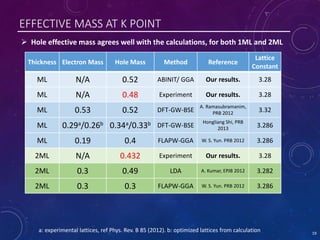
EFFECTIVE MASS AT K POINT
a: experimental lattices, ref Phys. Rev. B 85 (2012). b: optimized lattices from calculation
 Hole effective mass agrees well with the calculations, for both 1ML and 2ML
19
Thickness Electron Mass Hole Mass Method Reference
Lattice
Constant
ML N/A 0.52 ABINIT/ GGA Our results. 3.28
ML N/A 0.48 Experiment Our results. 3.28
ML 0.53 0.52 DFT-GW-BSE
A. Ramasubramanim,
PRB 2012 3.32
ML 0.29a/0.26b 0.34a/0.33b DFT-GW-BSE
Hongliang Shi, PRB
2013 3.286
ML 0.19 0.4 FLAPW-GGA W. S. Yun. PRB 2012 3.286
2ML N/A 0.432 Experiment Our results. 3.28
2ML 0.3 0.49 LDA A. Kumar, EPJB 2012 3.282
2ML 0.3 0.3 FLAPW-GGA W. S. Yun. PRB 2012 3.286
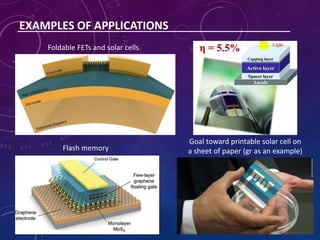
Foldable FETs and solar cells.
Goal toward printable solar cell on
a sheet of paper (gr as an example)Flash memory
EXAMPLES OF APPLICATIONS
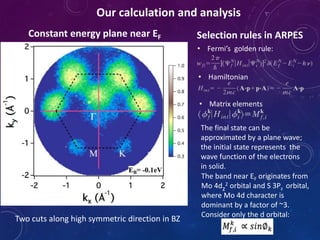
Constant energy plane near EF
The band near EF originates from
Mo 4dz
2 orbital and S 3Pz orbital,
where Mo 4d character is
dominant by a factor of ~3.
Consider only the d orbital:
Two cuts along high symmetric direction in BZ
Selection rules in ARPES
• Fermi’s golden rule:
• Hamiltonian
• Matrix elements
The final state can be
approximated by a plane wave;
the initial state represents the
wave function of the electrons
in solid.
Our calculation and analysis
July 27, 2015
Slide 22
Many-body Physics from ARPES
 Response of crystal to “hole”
ARPES measures Spectral Function A(k,w)
 Band renormalization Re[S(k,w)]
 Scattering Rate Im[S(k,w)]
 Re[S(k,w)] and Im[S(k,w)] related by
Kramers-Kronig transformation
diffraction
contrast
sample
contrast
aperture
objective
[0,0]
[h,j]
SURFACE STRUCTURE
Au+O/Rh(110)
quantum size
contrast
d
FILM THICKNESS
Co/W(110)
geometric
phase contrast
MORPHOLOGY
Mo(110)
WHAT CAN BE MEASURED WITH LEEM?
23
“We must be clear that when it comes to atoms, language can be used only as in poetry.” -
Niels Bohr
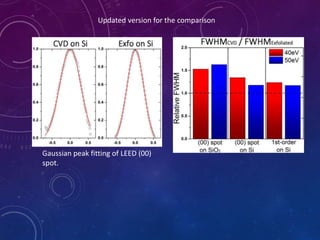
Updated version for the comparison
Gaussian peak fitting of LEED (00)
spot.
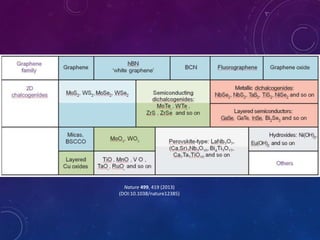
Nature 499, 419 (2013)
(DOI:10.1038/nature12385)
LATTICE RELAXATION
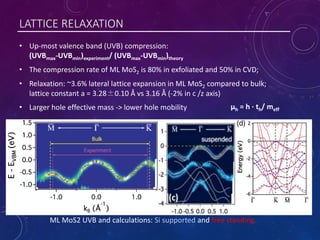
• Up-most valence band (UVB) compression:
(UVBmax-UVBmin)experiment/ (UVBmax-UVBmin)theory
• The compression rate of ML MoS2 is 80% in exfoliated and 50% in CVD;
• Relaxation: ~3.6% lateral lattice expansion in ML MoS2 compared to bulk;
lattice constant a = 3.28±0.10 Å vs 3.16 Å (-2% in c /z axis)
• Larger hole effective mass -> lower hole mobility µh = h · th/ meff
ML MoS2 UVB and calculations: Si supported and free standing

APS march meeting 2015

  • 1.
    ARPES and SPE-LEEMStudy on Supported, Suspended, and Twisted Bilayer MoS2 SPEAKER: PO-CHUN(FIGO) YEH ADVISOR: PROF. R. M. OSGOOD “SPE-LEEM” = Spectroscopic Photo-Emission and Low Energy Electron Microscopy 1 APS March meeting 2015 Y2: Focus Session: Beyond Graphene - New 2D Materials
  • 2.
    MANY THANKS! Jurek Sadowski DaTongZhang Arend van der Zande Abdullah Al-Mahboob Prof. James Hone Prof. Irving Herman Daniel A. ChenetProf. R. M. Osgood WenCan Jin Jerry Dadap Nader Zaki Peter Sutter 2 Ghidewon Arefe Andrea Locatelli Tevfik Onur Metnes Alessandro Sala and many!
  • 3.
    WHY WE WANTTO STUDY THIS? • Spin-orbit coupling • It has a bandgap! • Photoluminescence (PL) • Twisted Bilayer MoS2  Strong PL in monolayer MoS2 Nano. Lett. 10, 1271-1275 (2010)  High quantum efficiency  1000 times stronger PL in ML WS2, WSe2 than in bulk ACS Nano 7 (1), 791–797 (2013)  Direct bandgap in ML  Thin, flexible devices  E.g. Li-ion battery and transistors Nano Lett., 11 (9), pp 3768– 3773 (2011) Chem. Commun. , 47, 4252-4254 (2011)  Enhanced spin lifetimes  Large spin Hall angles  VBM S-O splitting up to 456meV in WSe2 PRB 84, 153402 (2011) Nano Lett. 13 (7), pp 3106–3110 (2013) van der Zande et al, Nano. Lett. 14, 2014 Liu et al, Nat. Commun. 5, 2014 Huang et al, Nano Lett 14, 2014 A lot of PL and Raman studies!
  • 4.
    OUR AIM: With SPE-LEEM,we can: o Measure the MoS2 band structure directly o Study the band gap transition and the role of interlayer coupling in ML, BL, and twist bilayer MoS2 o Study the substrate effect via suspension o Study hole effective mass directly
  • 5.
    WHY SPE-LEEM? Micron-size spot,Direct band structure, fast real time imaging, large area mapping, UHV, surface doping, depth profile. NSLS I Nanospectroscopy 1. mLEED – reciprocal space mapping: surface crystalline 2. LEEM – real space mapping: surface corrugation 3. mARPES – band structure mapping 4. PEEM and XPEEM(ELETTRA) – chemical sensitivity, ionization, core level orbitals, surface composition BNL, NY, USA Elettra, Trieste, Italy 5 2 µm LEEM, ML graphene
  • 6.
    DIRECT TO INDIRECTBAND GAP Photoelectron k-space mapping Direct (1ML) to indirect(2ML+) bandgap transition ARPES – a direct probe for band structure Jin and Yeh et al, PRL 2013 dz, pz dx 2 +y 2, dxy
  • 7.
    SUSPENSION – REMOVESUBSTRATE EFFECTS DFT-calculated bands using the relaxed lattice parameters are overlaid onto all the band maps for comparison. ARPES on suspended, exfoliated ML MoS2 ARPES on supported, exfoliated ML MoS2 In Elettra In ElettraJin and Yeh et al, PRB 2015
  • 8.
    • Band widthreduced -> less electron scattering • The UVB compression/lattice relaxation persists • UVB less dispersive -> Smaller hole effective mass (-10.6%) -> Larger mobility (+11.6%) SUSPENDED VS SUPPORTED µh = h · th/ meff Jin and Yeh et al, PRB 2015 Package/functional Γ Κ S.W. Yun et al FLAPW/GGA 3.524 0.637 Andor Kormányos et al VASP/HSE06 2.24 0.53 H. Peelaers et al VASP/HSE06 2.8 0.44 T. Cheiwchanchamnangij et al Quasiparticle GW/LDA 3.108 0.428 Suspended MoS2, measured - 2.00 0.43 Supported MoS2, measured - 1.85 0.48
  • 9.
    THE MAKING OFTHE TWIST BILAYER MoS2 A mixture of etching & dry transfer method (collaboration with Hone group) SEM Bright-field LEEM Dark-field LEEM
  • 10.
    (0°) (60°) THE MEASUREMENT OFTWIST BILAYER MoS2 0.556 0.416 0.405 0.355 0.376 0.516 (0°) (60°)
  • 11.
    ANGLE–DEPENDENT BANDGAP OPENING •Since K is invariant to twist angle and CB is almost intact, bandgap opening can be derived from energy difference between Γ and K from UVB • When twist angle reaches ~30°, the bandgap reaches its maximum (+200meV) • The energy difference within each angle is larger than predicted (+70meV) • Measured data shows asymmetry between 0° and 60° data as predicted • Agrees well with PL and DFT calculations Interlayer Spacing vs EK - EГ d60 = 6.23Å van der Zande et al, Nano. Lett. 14, 2014 Liu et al, Nat. Commun. 5, 2014 Align with the ~60 ° data point Theoretical calculation Experimental data 70meV
  • 12.
    EFFECTIVE MASS Ongoing Effective mass at K via DFT calculation Huang et al, Nano Lett 14, 2014 (Work in progress) Effective mass at Γ and K -24% in meff, hole
  • 13.
    CONCLUSION  Bandgap transitionoriginates from the shifting of Γ at the top-most valence band by quantum confinement  Hole effective mass / mobility affected by the substrate  Twist angle -> Interlayer coupling changes the band gap  SPE-LEEM system with LEEM, µLEED, and µARPES is ideal for studying 2D materials 13
  • 14.
    SPIN-ORBIT SPLITTING • Predictedlarge s-o splitting at vicinity of K in ML MoS2 • Possible causes of broadening: • a decrease in the quasi-particle lifetime • a splitting of the spin degenerate band into two bands due to spin-orbit coupling. Theory vs Suspended: 148 meV vs 78±19 meV On going Jin and Yeh et al, PRB 2015 ML MoSe2, splitting~180eV ARPES with MBE growth in UHV Zhang et al, Nat Nanotech 9, 2014
  • 15.
    ( a ) (b ) ( c ) ( d ) ( e )
  • 16.
    van der Zandeet al, Nano. Lett. 14, 2014
  • 17.
    SPE-LEEM - PERSPECTIVES ELMITECSPLEEM Energy Analyzer Manipulator. Grounded. (High voltage @ 2kV) Preparation chambers  Photon energy: 15-150eV  Good energy resolution: 100meV  Good spatial resolution: 8nm  Large mapping area: FOV = 100µm Thermal coupler Sample holder d ~ 10mm 17
  • 18.
    NOTES • Work functionin ML: 1.85eV; bilayer 1+ eV; highly doped, lower bound of the bandgap. • Other ways of change lattice constant – strain: up to 2.2% (Nano Lett., 2013, 13 (8) • LEED on suspended MoS2? Should be better. But we did not have the chance to do the measurement. • Error bars: average of the all six high sym directions + resolution limit of the apparatus + • Fitting the entire bands using tight binding theory instead of locally? To get a better fit for peak, etc. Mo dx2+dy2, dxy Mo dxy, dyz Mo d3z2-r2 S pxy S pz Cappelluti et al, PRB 88, 2013
  • 19.
    EFFECTIVE MASS ATK POINT a: experimental lattices, ref Phys. Rev. B 85 (2012). b: optimized lattices from calculation  Hole effective mass agrees well with the calculations, for both 1ML and 2ML 19 Thickness Electron Mass Hole Mass Method Reference Lattice Constant ML N/A 0.52 ABINIT/ GGA Our results. 3.28 ML N/A 0.48 Experiment Our results. 3.28 ML 0.53 0.52 DFT-GW-BSE A. Ramasubramanim, PRB 2012 3.32 ML 0.29a/0.26b 0.34a/0.33b DFT-GW-BSE Hongliang Shi, PRB 2013 3.286 ML 0.19 0.4 FLAPW-GGA W. S. Yun. PRB 2012 3.286 2ML N/A 0.432 Experiment Our results. 3.28 2ML 0.3 0.49 LDA A. Kumar, EPJB 2012 3.282 2ML 0.3 0.3 FLAPW-GGA W. S. Yun. PRB 2012 3.286
  • 20.
    Foldable FETs andsolar cells. Goal toward printable solar cell on a sheet of paper (gr as an example)Flash memory EXAMPLES OF APPLICATIONS
  • 21.
    Constant energy planenear EF The band near EF originates from Mo 4dz 2 orbital and S 3Pz orbital, where Mo 4d character is dominant by a factor of ~3. Consider only the d orbital: Two cuts along high symmetric direction in BZ Selection rules in ARPES • Fermi’s golden rule: • Hamiltonian • Matrix elements The final state can be approximated by a plane wave; the initial state represents the wave function of the electrons in solid. Our calculation and analysis
  • 22.
    July 27, 2015 Slide22 Many-body Physics from ARPES  Response of crystal to “hole” ARPES measures Spectral Function A(k,w)  Band renormalization Re[S(k,w)]  Scattering Rate Im[S(k,w)]  Re[S(k,w)] and Im[S(k,w)] related by Kramers-Kronig transformation
  • 23.
    diffraction contrast sample contrast aperture objective [0,0] [h,j] SURFACE STRUCTURE Au+O/Rh(110) quantum size contrast d FILMTHICKNESS Co/W(110) geometric phase contrast MORPHOLOGY Mo(110) WHAT CAN BE MEASURED WITH LEEM? 23
  • 24.
    “We must beclear that when it comes to atoms, language can be used only as in poetry.” - Niels Bohr
  • 25.
    Updated version forthe comparison Gaussian peak fitting of LEED (00) spot.
  • 26.
    Nature 499, 419(2013) (DOI:10.1038/nature12385)
  • 27.
    LATTICE RELAXATION • Up-mostvalence band (UVB) compression: (UVBmax-UVBmin)experiment/ (UVBmax-UVBmin)theory • The compression rate of ML MoS2 is 80% in exfoliated and 50% in CVD; • Relaxation: ~3.6% lateral lattice expansion in ML MoS2 compared to bulk; lattice constant a = 3.28±0.10 Å vs 3.16 Å (-2% in c /z axis) • Larger hole effective mass -> lower hole mobility µh = h · th/ meff ML MoS2 UVB and calculations: Si supported and free standing